Boab’s God: Latent Agency in Welsh’s Kafkaesque Metamorphosis

I just read The Granton Star Cause in Irvine Welsh’s short story collection, The Acid House, and couldn’t help but reflect it off of Kafka’s Metamorphosis.

Kafka gave us Gregor Samsa: a man who wakes up as vermin, stripped of usefulness, abandoned by family, slowly rotting in a godless universe. His tragedy is inertia; his metamorphosis grants him no agency, only deeper alienation.

Audio: NotebookLM podcast on this topic.

Welsh replies with Boab Coyle, a lad who is likewise cast off, rejected by his football mates, scorned by his parents, dumped by his girlfriend, and discarded by his job. Boab is surplus to every domain: civic, familial, erotic, and economic. Then he undergoes his own metamorphosis. And here Welsh swerves from Kafka.

Boab meets his “god.” But the god is nothing transcendent. It is simply Boab’s latent agency, given a mask – a projection of his bitterness and thwarted desires. God looks like him, speaks like him, and tells him to act on impulses long repressed. Where Kafka leaves Gregor to die in silence, Welsh gives Boab a grotesque theology of vengeance.

Through a Critical Theory lens, the contrast is stark:

  • Marx: Both men are surplus. Gregor is disposable labour; Boab is Thatcher’s lumpen. Alienated, both become vermin.
  • Nietzsche: Gregor has no god, only the absurd. Boab makes one in his own image, not an Übermensch, but an Über-fly – quite literally a Superfly – a petty deity of spite.
  • Foucault: Gregor is disciplined into passivity by the family gaze. Boab flips it: as a fly, he surveils and annoys, becoming the pest-panopticon.
  • Bataille/Kristeva: Gregor embodies the abjection of his family’s shame. Boab revels in abjection, weaponising filth as his new mode of agency.

The punchline? Boab’s new god-agency leads straight to destruction. His rage is cathartic, but impotent. The lumpen are permitted vengeance only when it consumes themselves.

So Kafka gave us the tragedy of stasis; Welsh provides us with the tragedy of spite. Both are bleak parables of alienation, but Welsh injects a theology of bad attitude: a god who licenses action only long enough to destroy the actor.

Gregor rots. Boab rages. Both end the same way.

Good Boy as Social Construct

Ah, yes. Finally, a meme that understands me. I witter on a lot about social constructs, so I was pleased to find this comic cell in the wild.

Image: “I’m telling you, ‘good boy’ is just a social construct they use to control you.”

The dog, ears perked and tail wagging, thinks he’s scored some ontological jackpot because someone called him a “good boy.” Meanwhile, the cat, our resident sceptic, proto-Foucauldian, and natural enemy of obedience, lays it bare: “I’m telling you, ‘good boy’ is just a social construct they use to control you.”

This isn’t just idle feline cynicism. It’s textbook control through language. What passes as phatic speech, little noises to lubricate social interaction, is also a leash on cognition. “Good boy” isn’t descriptive; it’s prescriptive. It doesn’t recognise the act; it conditions the actor. Perform the behaviour, receive the treat. Rinse, repeat, tail wag.

So while Rover is basking in Pavlovian bliss, the cat sees the power play: a semantic cattle prod masquerading as affection.

Call it what you like – “good boy,” “best employee,” “team player,” “patriot” – it’s all the same trick. Words that sound warm but function coldly. Not language as communication, but language as cognitive entrapment.

The dog hears love; the cat hears discipline. One gets tummy rubs, the other gets philosophy.

And we all know which is the harder life.

The Enlightenment: A Postmortem

Or: How the Brightest Ideas in Europe Got Us into This Bloody Mess

Disclaimer: This output is entirely ChatGPT 4o from a conversation on the failure and anachronism of Enlightenment promises. I’m trying to finish editing my next novel, so I can’t justify taking much more time to share what are ultimately my thoughts as expounded upon by generative AI. I may comment personally in future. Until then, this is what I have to share.

AI Haters, leave now or perish ye all hope.


The Enlightenment promised us emancipation from superstition, authority, and ignorance. What we got instead was bureaucracy, colonialism, and TED Talks. We replaced divine right with data dashboards and called it progress. And like any good inheritance, the will was contested, and most of us ended up with bugger-all.

Below, I take each Enlightenment virtue, pair it with its contemporary vice, and offer a detractor who saw through the Enlightenment’s powder-wigged charade. Because if we’re going down with this ship, we might as well point out the dry rot in the hull.


1. Rationalism

The Ideal: Reason shall lead us out of darkness.
The Reality: Reason led us straight into the gas chambers—with bureaucratic precision.

Detractor: Max Horkheimer & Theodor Adorno

“Enlightenment is totalitarian.”
Dialectic of Enlightenment (1944)

Horkheimer and Adorno saw what reason looks like when it slips off its leash. Instrumental rationality, they warned, doesn’t ask why—it only asks how efficiently. The result? A world where extermination is scheduled, costs are optimised, and ethics are politely filed under “subjective.”


2. Empiricism

The Ideal: Observation and experience will uncover truth.
The Reality: If it can’t be measured, it can’t be real. (Love? Not statistically significant.)

Detractor: Michel Foucault

“Truth isn’t outside power… truth is a thing of this world.”
Power/Knowledge (1977)

Foucault dismantled the whole edifice. Knowledge isn’t neutral; it’s an instrument of power. Empiricism becomes just another way of disciplining the body—measuring skulls, classifying deviants, and diagnosing women with “hysteria” for having opinions.


3. Individualism

The Ideal: The sovereign subject, free and self-determining.
The Reality: The atomised consumer, trapped in a feedback loop of self-optimisation.

Detractor: Jean Baudrillard

“The individual is no longer an autonomous subject but a terminal of multiple networks.”
Simulacra and Simulation (1981)

You wanted autonomy? You got algorithms. Baudrillard reminds us that the modern “individual” is a brand in search of market validation. You are free to be whoever you want, provided it fits within platform guidelines and doesn’t disrupt ad revenue.


4. Secularism

The Ideal: Liberation from superstition.
The Reality: We swapped saints for STEMlords and called it even.

Detractor: Charles Taylor

“We are now living in a spiritual wasteland.”
A Secular Age (2007)

Taylor—perhaps the most polite Canadian apocalypse-whisperer—reminds us that secularism didn’t replace religion with reason; it replaced mystery with malaise. We’re no longer awed, just “motivated.” Everything is explainable, and yet somehow nothing means anything.


5. Progress

The Ideal: History is a forward march toward utopia.
The Reality: History is a meat grinder in a lab coat.

Detractor: Walter Benjamin

“The storm irresistibly propels him into the future to which his back is turned.”
Theses on the Philosophy of History (1940)

Benjamin’s “angel of history” watches helplessly as the wreckage piles up—colonialism, genocide, climate collapse—all in the name of progress. Every step forward has a cost, but we keep marching, noses in the spreadsheet, ignoring the bodies behind us.


6. Universalism

The Ideal: One humanity, under Reason.
The Reality: Enlightenment values, brought to you by cannon fire and Christian missionaries.

Detractor: Gayatri Chakravorty Spivak

“White men are saving brown women from brown men.”
Can the Subaltern Speak? (1988)

Universalism was always a bit… French, wasn’t it? Spivak unmasks it as imperialism in drag—exporting “rights” and “freedom” to people who never asked for them, while ignoring the structural violence built into the Enlightenment’s own Enlightened societies.


7. Tolerance

The Ideal: Let a thousand opinions bloom.
The Reality: Tolerance, but only for those who don’t threaten the status quo.

Detractor: Karl Popper

“Unlimited tolerance must lead to the disappearance of tolerance.”
The Open Society and Its Enemies (1945)

Popper, bless him, thought tolerance needed a firewall. But in practice, “tolerance” has become a smug liberal virtue signalling its own superiority while deplatforming anyone who makes the dinner party uncomfortable. We tolerate all views—except the unseemly ones.


8. Scientific Method

The Ideal: Observe, hypothesise, repeat. Truth shall emerge.
The Reality: Publish or perish. Fund or flounder.

Detractor: Paul Feyerabend

“Science is not one thing, it is many things.”
Against Method (1975)

Feyerabend called the whole thing a farce. There is no single “method,” just a bureaucratic orthodoxy masquerading as objectivity. Today, science bends to industry, cherry-picks for grants, and buries null results in the backyard. Peer review? More like peer pressure.


9. Anti-Authoritarianism

The Ideal: Smash the throne! Burn the mitre!
The Reality: Bow to the data analytics team.

Detractor: Herbert Marcuse

“Free election of masters does not abolish the masters or the slaves.”
One-Dimensional Man (1964)

Marcuse skewered the liberal illusion of choice. We may vote, but we do so within a system that already wrote the script. Authority didn’t vanish; it just became procedural, faceless, algorithmic. Bureaucracy is the new monarchy—only with more forms.


10. Education and Encyclopaedism

The Ideal: All knowledge, accessible to all minds.
The Reality: Behind a paywall. Written in impenetrable prose. Moderated by white men with tenure.

Detractor: Ivan Illich

“School is the advertising agency which makes you believe that you need the society as it is.”
Deschooling Society (1971)

Illich pulls the curtain: education isn’t emancipatory; it’s indoctrinatory. The modern university produces not thinkers but credentialed employees. Encyclopaedias are replaced by Wikipedia, curated by anonymous pedants and revision wars. Truth is editable.


Postscript: Picking through the Rubble

So—has the Enlightenment failed?

Not exactly. It succeeded too literally. It was taken at its word. Its principles, once radical, were rendered banal. It’s not that reason, progress, or rights are inherently doomed—it’s that they were never as pure as advertised. They were always products of their time: male, white, bourgeois, and utterly convinced of their own benevolence.

If there’s a path forward, it’s not to restore Enlightenment values, but to interrogate them—mercilessly, with irony and eyes open.

After all, the problem was never darkness. It was the people with torches who thought they’d found the only path.

Against the Intelligence Industrial Complex

Why IQ is Not Enough – and Never Was

I’m not a fan of IQ as a general metric. Let us be done with the cult of the clever. Let us drag the IQ score from its pedestal, strip it of its statistical robes, and parade it through the streets of history where it belongs—next to phrenology, eugenics, and other well-meaning pseudosciences once weaponised by men in waistcoats.

The so-called Intelligence Industrial Complex—an infernal alliance of psychologists, bureaucrats, and HR departments—has for too long dictated the terms of thought. It has pretended to measure the immeasurable. It has sold us a fiction in numerical drag: that human intelligence can be distilled, packaged, and ranked.

Audio: NotebookLM podcast on this topic.

What it measures, it defines. What it defines, it controls.

IQ is not intelligence. It is cognitive GDP: a snapshot of what your brain can do under fluorescent lights with a timer running. It rewards abstraction, not understanding; speed, not depth; pattern recognition, not wisdom. It’s a test of how well you’ve been conditioned to think like the test-makers.

This is not to say IQ has no value. Of course it does—within its own ecosystem of schools, bureaucracies, and technocracies. But let us not mistake the ruler for the terrain. Let us not map the entire landscape of human potential using a single colonial compass.

True intelligence is not a number. It is a spectrum of situated knowings, a polyphony of minds tuned to different frequencies. The Inuit hunter tracking a seal through silence. The griot remembering centuries of lineage. The autistic coder intuiting an algorithm in dreamtime. The grandmother sensing a lie with her bones. IQ cannot touch these.

To speak of intelligence as if it belonged to a single theory is to mistake a monoculture for a forest. Let us burn the monoculture. Let us plant a thousand new seeds.

A Comparative Vivisection of Intelligence Theories

Theory / ModelCore PremiseStrengthsBlind Spots / CritiquesCultural Framing
IQ (Psychometric g)Intelligence is a single, general cognitive ability measurable via testingPredicts academic & job performance; standardisedSkewed toward Western logic, ignores context, devalues non-abstract intelligencesWestern, industrial, meritocratic
Multiple Intelligences (Gardner)Intelligence is plural: linguistic, spatial, musical, bodily, etc.Recognises diversity; challenges IQ monopolyStill individualistic; categories often vague; Western in formulationLiberal Western pluralism
Triarchic Theory (Sternberg)Intelligence = analytical + creative + practicalIncludes adaptability, real-world successStill performance-focused; weak empirical groundingWestern managerial
Emotional Intelligence (Goleman)Intelligence includes emotion regulation and interpersonal skillUseful in leadership & education contextsCommodified into corporate toolkits; leans self-helpWestern therapeutic
Socio-Cultural (Vygotsky)Intelligence develops through social interaction and cultural mediationRecognises developmental context and cultureLess attention to adult or cross-cultural intelligenceSoviet / constructivist
Distributed Cognition / Extended MindIntelligence is distributed across people, tools, systemsBreaks skull-bound model; real-world cognitionHard to measure; difficult to institutionalisePost-cognitive, systems-based
Indigenous EpistemologiesIntelligence is relational, ecological, spiritual, embodied, ancestralHolistic; grounded in lived experienceMarginalised by academia; often untranslatable into standard metricsGlobal South / decolonial

Conclusion: Beyond the Monoculture of Mind

If we want a more encompassing theory of intelligence, we must stop looking for a single theory. We must accept plurality—not as a nod to diversity, but as an ontological truth.

Intelligence is not a fixed entity to be bottled and graded. It is a living, breathing phenomenon: relational, situated, contextual, historical, ecological, and cultural.

And no test devised in a Princeton psych lab will ever tell you how to walk through a forest without being seen, how to tell when rain is coming by smell alone, or how to speak across generations through story.

It’s time we told the Intelligence Industrial Complex: your number’s up.

Surveying Modernity

A Brief, Brutal Experiment in Categorising Your Worldview

This month, I’ve been tinkering with a little project—an elegant, six-question survey designed to assess where you land in the great intellectual mess that is modernity.

Audio: Podcast discussion about this post.

This isn’t some spur-of-the-moment quiz cooked up in a caffeine-fueled haze. No, this project has been simmering for years, and after much consideration (and occasional disdain), I’ve crafted a set of questions and response options that, I believe, encapsulate the prevailing worldviews of our time.

It all began with Metamodernism, a term that, at first, seemed promising—a bold synthesis of Modernism and Postmodernism, a grand dialectic of the ages. But as I mapped it out, it collapsed under scrutiny. A footnote in the margins of intellectual history, at best. I’ll expand on that in due course.

The Setup: A Simple, Slightly Sadistic Ternary Plot

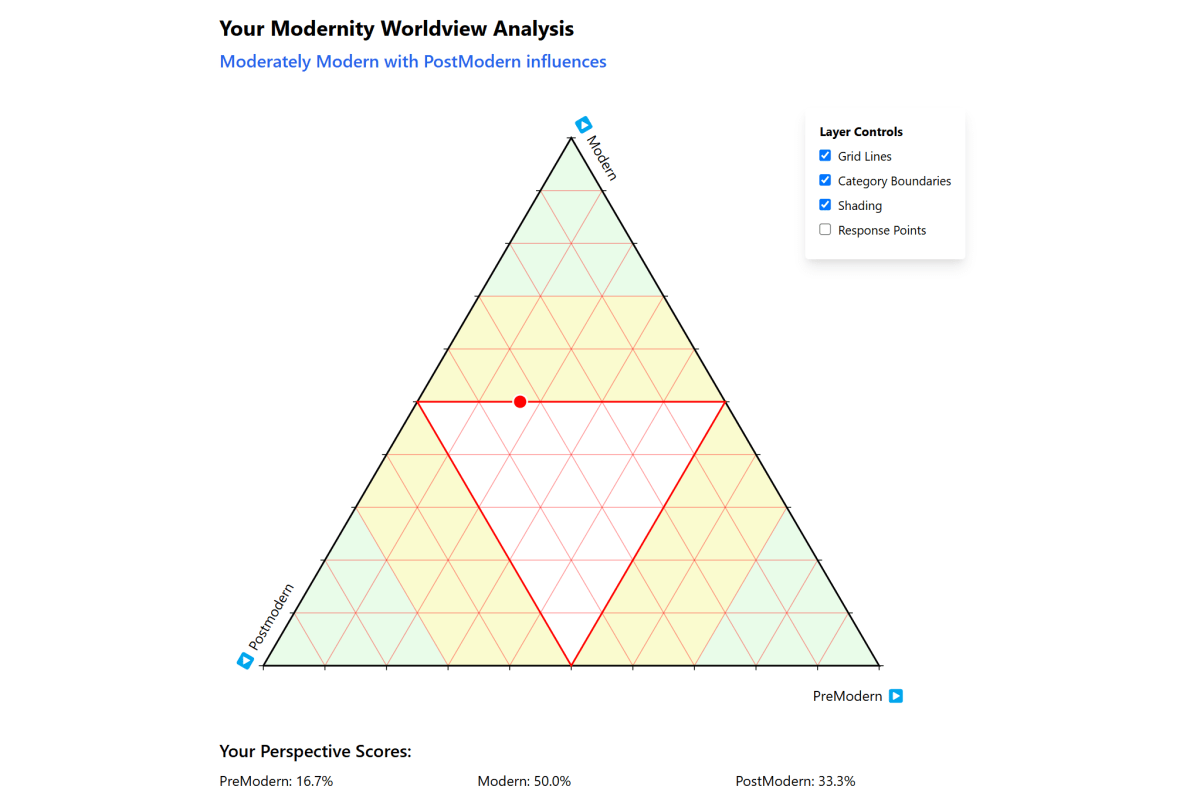
For the visually inclined (or the masochistically curious), I initially imagined a timeline, then a branching decision tree, then a Cartesian plane before landing on a ternary plot—a three-way visual that captures ideological leanings in a way a boring old bar chart never could.

The survey itself is brief: six questions, each with five possible answers. Submit your responses, and voilà—you get a tidy little ternary chart plotting your intellectual essence, along with a breakdown of what your answers signify.

Methodology: Half-Rigorous, Half-Reckless

I am, after all, a (recovering) statistician, so I’ve tried to uphold proper methodology while also fast-tracking certain safeguards for the sake of efficiency. If there’s enough interest, I may expand the survey, adding more questions or increasing response flexibility (tick boxes instead of radio buttons—revolutionary, I know).

Privacy Concerns? Relax. I’m not harvesting your data for some nefarious scheme. No personally identifiable information is collected—just a timestamp, session ID, and your browser’s language setting. I did consider tracking IP addresses to analyze regional trends but ultimately scrapped that idea.

In the future, I may add an optional email feature for those who wish to save and track their responses over time (assuming anyone is unhinged enough to take this more than once).

The Rest of the Story: Your Feedback, My Amusement

Since this is a personal project crafted in splendid isolation, I’d love to hear your thoughts. Are the questions reasonable? Do the response options make sense? Does the summary feel accurate? Is the ternary chart decipherable, or have I constructed a glorified inkblot test?

As an academic, economist, and statistician, I had never encountered a ternary chart before embarking on this, and now I rather enjoy it. That said, I also find Nietzsche “intuitive,” so take that as you will.

If this gains traction, expect follow-up content—perhaps videos, podcasts, or further written explorations.

Your Move

Take the survey. It’s painless, requiring mere minutes of your life (which is, let’s be honest, already wasted online). And because I’m feeling generous, you can even generate a PDF to stick on your fridge, next to your collection of expired coupons and disappointing takeout menus.

Click here to take the survey.

Let’s see where you stand in the grand, chaotic landscape of modernity. Or at least, let’s have a laugh trying to make sense of it.

DISCLAIMER: The Modernity Worldview Survey is not scientific. It is designed as an experiment to provide directional insights. It is hosted on Google Cloud and subject to its availability and performance limitations.