Seeing Red – Or, How the Enlightenment Got Colour-Blind

6–9 minutes

With the MEOW thesis now roaming freely across the intellectual savannah, knocking over conceptual furniture and frightening the rationalists, it’s time to walk through a simple example. We’ll stay safely within the realm of conscious perception for now. That way, no one panics, and everyone can pretend they’re on familiar ground.

Our case study: colour.

Or rather, the quite embarrassing misunderstanding of colour that Western philosophy has been peddling for roughly three centuries.

Audio: NotebookLM podcast summary of this topic, Colour, Perception, and Mediated Ontology.

The Realist’s Apple: A Comedy of Certainty

Picture an apple on a table: plump, unashamedly spherical, wearing its redness like a badge of honour. The traditional Realist swears it’s red in itself, quite independent of anyone wandering in to admire it. The apple has redness the way it has mass, curvature, and that little bruise from the careless shop assistant. When you enter the room, you ‘see’ the red it’s been proudly radiating all along.

Image 0: Subject viewing red apple.

By school age, most of us are told that apples don’t ‘have’ colour; they merely reflect certain wavelengths. A minor complication. A mechanical detail. Nothing to disturb the fundamental metaphysical fantasy: that redness is still ‘out there’, waiting patiently for your eyes to come collect it.

It’s all very straightforward. Very tidy. And very wrong.

Idealists to the Rescue (Unfortunately)

Ask an Idealist about the apple and the entertainment begins.

The Berkeley devotee insists the apple exists only so long as it’s perceived – esse est percipi – which raises awkward questions about what happens when you step out for a cuppa. God, apparently, keeps the universe running as a kind of 24-hour perceptual babysitter. You may find this profound or you may find it disturbingly clingy.

The Kantian, inevitably wearing a waistcoat, insists the apple-in-itself is forever inaccessible behind the Phenomenal Veil of Mystery. What you experience is the apple-for-you, sculpted by space, time, causality, and a toolkit of categories you never asked for. This explains a lot about post-Kantian philosophy, not least the fixation on walls no one can climb.

Contemporary idealists get creative: proto-experience in everything, cosmic consciousness as universal substrate, matter as a sleepy epiphenomenon of Mind. It’s quite dazzling if you ignore the categories they’re smashing together.

What unites these camps is the conviction that mind is doing the heavy lifting and the world is an afterthought – inconvenient, unruly, and best kept in the margins.

The Shared Mistake: An Architectural Catastrophe

Both Realist and Idealist inherit the same faulty blueprint: mind here, world there – two self-contained realms entering into an epistemic handshake.

Realists cling to unmediated access (a fantasy incompatible with biology).
Idealists cling to sovereign mentality (a fantasy incompatible with objectivity).

Both take ‘experience’ to be a relation between two pre-existing domains rather than a single structured encounter.

This is the mistake. Not Realism’s claims about mind-independence. Not Idealism’s claims about mental primacy. The mistake is the architecture – the assumption of two separately-existing somethings that subsequently relate.

MEOW – yes, we’re calling it that – puts it bluntly:

The problem isn’t where colour is. The problem is assuming it has to be in something – mind or world – rather than in the event.

Redness isn’t inside your head or inside the apple.
It’s co-constituted by biological, cognitive, linguistic, and cultural mediation interacting with persistent constraint patterns.

Time to peel this onion… er, apple.

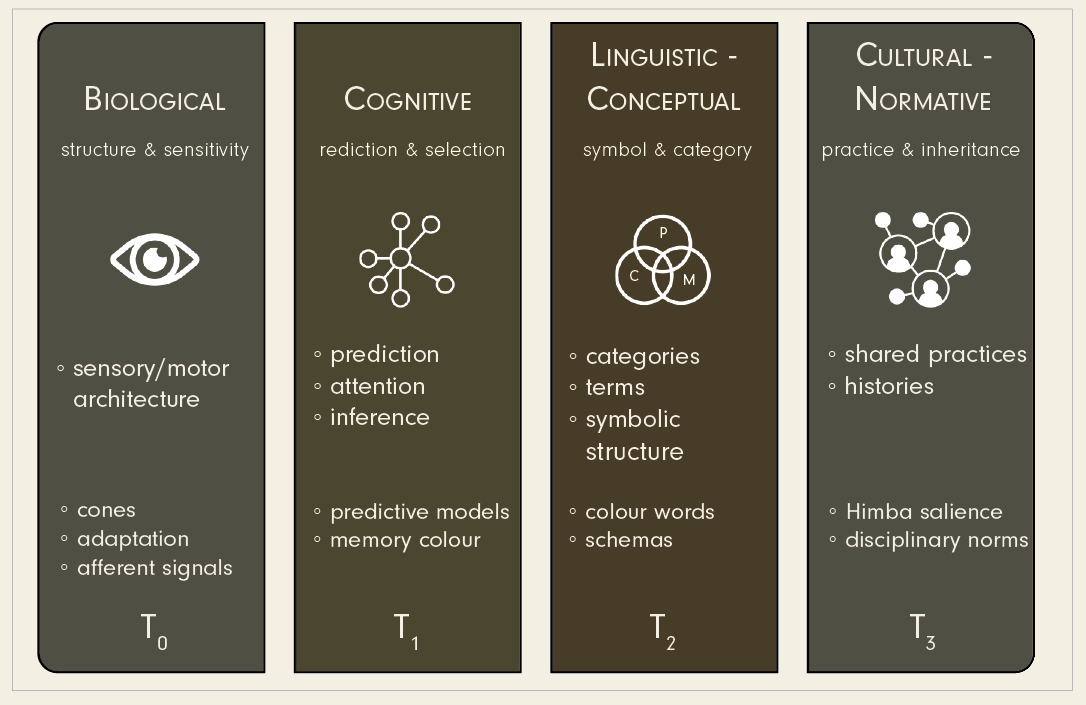
The Four Layers of Mediation (T₀–T₃)

A Ridiculously Oversimplified Cheat-Sheet That Still Outperforms Most Metaphysics Syllabi
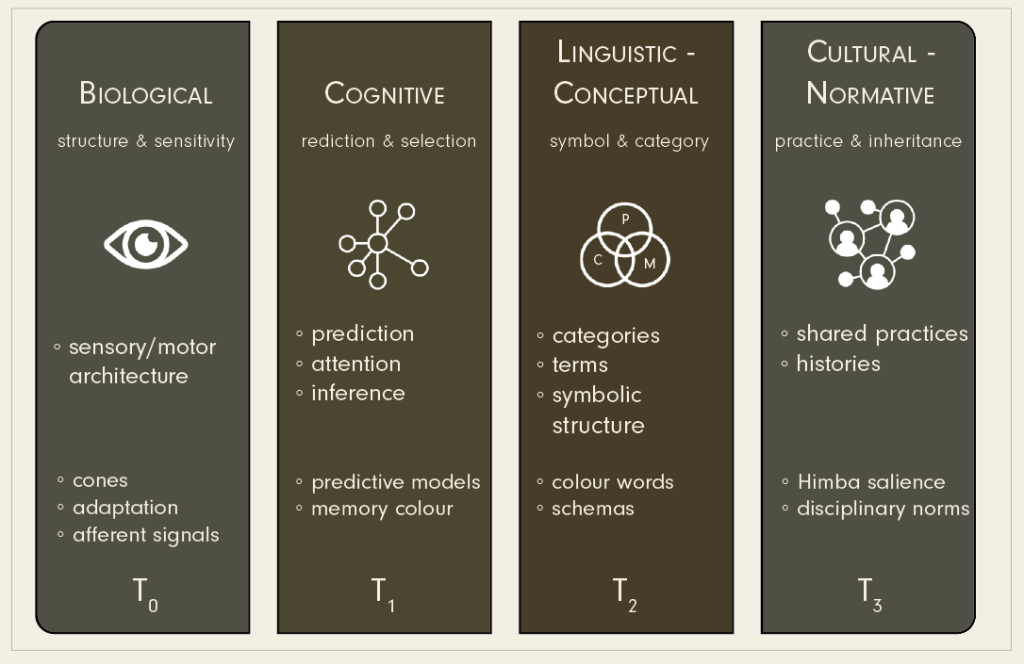
Image 1: Four-tier diagram (T₀ Biological → T₃ Cultural)

T₀ Biological Mediation

Structure and Sensitivity: the Architecture You Never Asked For

This is where the Enlightenment’s fantasy of ‘raw perception’ goes to die.

Your visual system transforms, filters, enhances, suppresses, and reconstructs before ‘red’ even reaches consciousness. Cone responses, opponent processes, retinal adaptation, spatial filtering all of it happening before the poor cortex even gets a look-in.

You never perceive ‘wavelengths’. You perceive the output of a heavily processed biological pipeline.

Image 2: Chromatic processing pathway (T₀→T₁): the layered biological transformations that make “red” possible long before consciousness gets involved.

T₁ Cognitive Mediation

Prediction and Inference: You See What You Expect (Until Constraint Smacks You)

Your cognitive system doesn’t ‘receive’ colour information it predicts it and updates the guess when necessary.

Memory colour biases perception toward canonical instances. Attentional gating determines what gets processed intensively and what gets summary treatment. Top-down modulation shapes what counts as signal versus noise.

There is no percept without mediation. There is no ‘raw data’ waiting underneath.

The Enlightenment liked to imagine perception as a passive window.
Cognition turns that window into a heavily editorialised newsfeed.

Image 3: Expectation and input co-determine the percept: “red” emerges from the encounter, not from either source alone.

T₂ Linguistic–Conceptual Mediation

Categories and Symbols: How Words Carve the Spectrum

Enter the famous Whorf skirmishes.
Do words change perception?
Do they merely label pre-existing distinctions?
Do Russians really ‘see’ blue differently?

Berlin & Kay gave us focal colour universals constraint patterns stable across cultures.
Roberson et al. gave us the Himba data linguistic categories reshaping discrimination and salience.

The correct answer is neither universalism nor relativism. It’s MEOW’s favourite refrain:

Mediation varies; constraint persists.

Words don’t invent colours.
But they do reorganise the perceptual field, changing what pops and what hides.
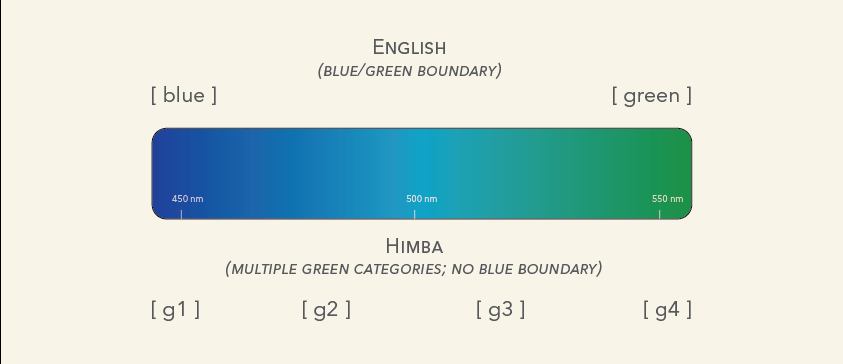
Image 4: Different languages carve the same physical continuum differently: English imposes a blue/green split; Himba divides the region into several greens with no blue boundary at all.

T₃ Cultural–Normative Mediation

Shared Practices: The Social Life of Perception

Your discipline, training, historical context, and shared norms tell you:

  • which distinctions matter
  • which differences ‘count’
  • which patterns get ignored

A Himba herder, a Renaissance painter, and a radiologist do not inhabit the same perceptual world even when staring at the same patch of light.

Cultural mediation doesn’t rewrite biology; it reorganises priorities, salience, and interpretive readiness.
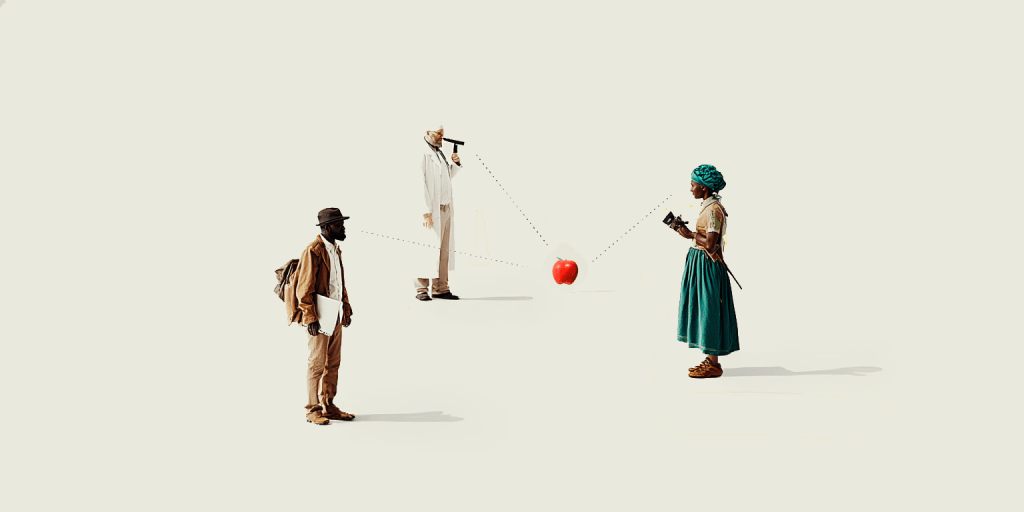
Image 5: Three observers confronting the same stimulus yet extracting different distinctions: the scientist tracks wavelength, the artist tracks hue and value, and the Himba pastoralist tracks ecologically salient greens. Same object, different salience hierarchies. Not arbitrary – just mediated.

What Seeing Red Actually Involves (Step By Exhausting Step)

You walk into a room. Apple on table. Looks red. What just happened?

T₀ – Biological: Long wavelength light hits L-cones harder than M- and S-cones. Opponent channels compute (L−M). Adaptation shifts baseline. Edge detection fires. You don’t have ‘red’ yet – you have transformed photoreceptor output.

T₁ Cognitive: Your brain predicts ‘apple, probably red’ based on shape and context. Memory colour pulls toward canonical apple-red. Attention allocates processing resources. Prediction matches input (roughly). System settles: ‘yes, red apple’.

T₂ Linguistic–Conceptual: The continuous gradient gets binned: ‘red’, not ‘crimson’ or ‘scarlet’ unless you’re a designer. The category provides stability, ties this instance to others, makes it reportable.

T₃ Cultural–Normative: Does the exact shade matter? Depends whether you’re buying it, photographing it, or painting it. Your practical context determines which distinctions you bother tracking.

And through all of this: Constraint. Metameric matches stay stable. Focal colours persist cross-culturally. Wavelength sensitivities don’t budge. The encounter isn’t arbitrary – but it’s not unmediated either.

What happened wasn’t: Mind Met World.
What happened was: an encounter-event unfolded, organised through four mediational layers, exhibiting stable constraint patterns that made it this and not that.

Where This Leaves Us

Colour is not ‘out there’. Colour is not ‘in here’.

Colour is the structured relational event of encounter.

Four mediation layers shape what appears.
Constraint patterns stabilise the encounter so we aren’t hallucinating wildly divergent rainbows.

There is no ‘apple as it really is’ waiting behind the encounter.
Nor is there a sovereign mind constructing its own private theatre.

There is only the event – where biological structure, cognitive dynamics, conceptual categories, and cultural histories co-emerge with the stable patterns of constraint we lazily call ‘the world’.

The apple was never red ‘in itself’.
You were never seeing it ‘as it really is’.
And the Enlightenment can finally take off its colour-blind uncle glasses and admit it’s been squinting at the wrong question for three hundred years.

Next time: Why visual illusions aren’t perception failing, but perception revealing itself.

Until then: stop asking where colour ‘really’ lives.

It lives in the event. And the event is mediated, constrained, and real enough.

The Mediated Encounter Ontology of the World

Philosophers adore two things: inventing problems and then fainting when someone solves them. For decades, we’ve been treated to the realism–idealism tug-of-war, that noble pantomime in which two exhausted metaphysical camps clutch the same conceptual teddy bear and insist the other stole it first. It’s almost touching.

Try out the MEOW GPT language parser.

Enter Nexal Ontology, my previous attempt at bailing water out of this sinking ship. It fought bravely, but as soon as anyone spotted even a faint resemblance to Whitehead, the poor thing collapsed under the weight of process-cosmology PTSD. One throwaway comment about ‘actual occasions’, and Nexal was done. Dead on arrival. A philosophical mayfly.

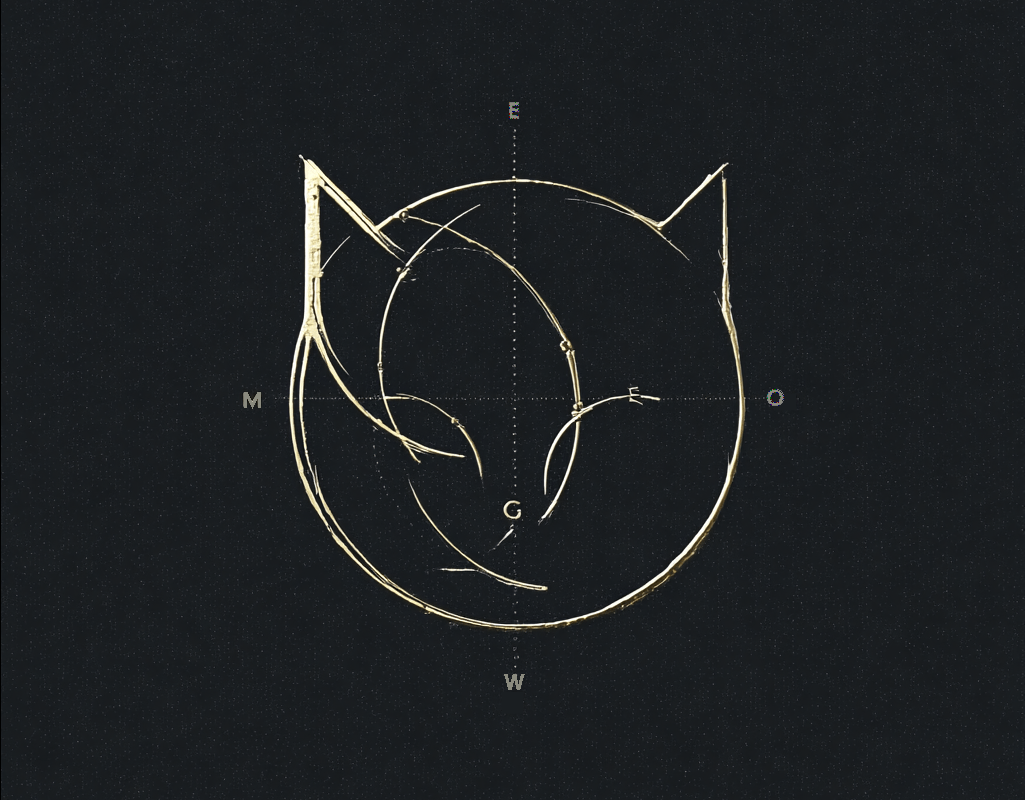
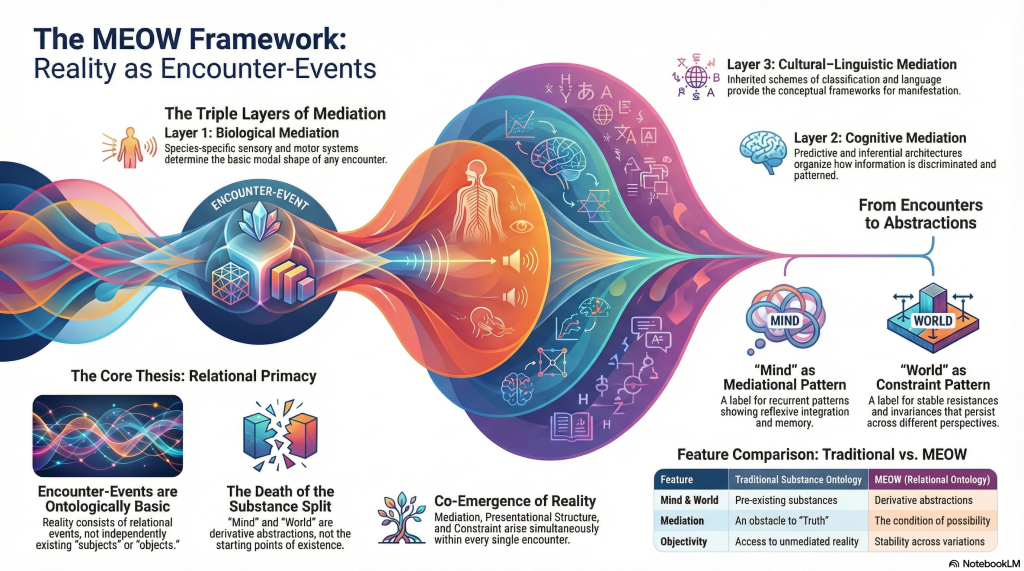
But MEOW*The Mediated Encounter Ontology of the World – did not die. It shrugged off the Whitehead comparison with the indifference of a cat presented with a salad. MEOW survived the metaphysical death match because its commitments are simply too lean, too stripped-back, too structurally minimal for speculative cosmology to get its claws into. No prehensions. No eternal objects. No divine lure. Just encounter, mediation, constraint, and the quiet dignity of not pretending to describe the architecture of the universe.

And that’s why MEOW stands. It outlived Nexal not by being grander, but by being harder to kill.

Image: The Four Mediation Layers – Biological, Cognitive, Conceptual, Cultural – structuring every encounter we mistake for ‘direct’.

This little illustration gives the flavour:
T0 Biological mediation – the body’s refusal to be neutral.
T1 Cognitive mediation – the brain, doing predictive improv.
T2 Linguistic–conceptual – words pretending they’re objective.
T3 Cultural–normative – the inheritance of everyone else’s mistakes.

The essay argues that what we call ‘mind’ and ‘world’ are just abstractions we extract after the encounter, not the metaphysical scaffolding that produces it. Once you begin with the encounter-event itself – already mediated, already structured, already resistive – the mind–world binary looks about as sophisticated as a puppet show.

What the essay actually does

The Mediated Encounter Ontology of the World is the first framework I’ve written that genuinely sheds the Enlightenment scaffolding rather than rebuking it. MEOW shows:

  • Mediation isn’t an epistemic flaw; it’s the only way reality appears.
  • Constraint isn’t evidence of a noumenal backstage; it’s built into the encounter.
  • Objectivity is just stability across mediation, not a mystical view-from-nowhere.
  • ‘Mind’ and ‘world’ are names for recurring patterns, not metaphysical hotels.
  • And – importantly – MEOW does all of this without drifting into Whiteheadian cosmological fan-fiction.

The full essay is now published and archived:

DOI: https://doi.org/10.5281/zenodo.17685689

If you prefer a soft landing and the sound of a passable human voice explaining why metaphysics keeps tripping over its shoelaces, a NotebookLM discussion is here:

Audio: NotebookLM summary podcast of this essay.

MEOW is the survivor because it does the one thing philosophy is terrible at: it refuses to pretend. No substances, no noumena, no grand metaphysical machinery—just a clean, relational architecture that mirrors how we actually encounter the world.

And frankly, that’s quite enough ontology for one lifetime.


* To be perfectly honest, I originally fled from Michela Massimi’s Perspectival Realism in search of a cleaner terminological habitat. I wanted to avoid the inevitable, dreary academic cross-pollination: the wretched fate of being forever shelved beside a project I have no quarrel with but absolutely no desire to be mistaken for. My proposed replacement, Nexal Ontology, looked promising until I realised it had wandered, by sheer lexical accident, into Whitehead’s garden – an unintentional trespass for which I refused to stick around to apologise. I could already hear the process-metaphysics crowd sharpening their teeth.

Early evasive action was required.

I preferred nexal to medial, but the terminology had already been colonised, and I am nothing if not territorial. Mediated Ontology would have staked its claim well enough, but something was missing – something active, lived, structural. Enter the Encounter.

And once the acronym MEO appeared on the page, I was undone. A philosopher is only human, and the gravitational pull toward MEOW was irresistible. What, then, could honour the W with appropriate pomp? The World, naturally. Thus was born The Mediated Encounter Ontology of the World.

Pretentious? Yes. Obnoxious? Also yes.

And so it remains—purring contentedly in its absurdity.

Arriving Late to Massimi’s Party: Perspectival Realism in Parallel

Where our projects nod politely, then go their separate ways

I suppose it was inevitable. You spend years muttering into your notebook about mediation, realism without bombast, the irretrievability of universality, and the peculiar way science manages to stumble forward with partial, parochial tools… and then, inevitably, you discover that someone else—Michela Massimi, in this case—has been busy constructing her own edifice a few hills over.

Audio: NotebookLM podcast summary and discussion of this topic

I arrived late to her party. Fine. But now that I’m here, let’s pour a drink and compare architecture.

Because while our buildings look similar from a distance—both labelled Perspectival Realism—they’re made from different bricks and aimed at different skylines.


1. A Courteous Bow: We Are Not Strangers in the Same Wilderness

Massimi and I share several foundational intuitions:

  • No God’s-eye view.
    She rejects the fantasy of disembodied objectivity. So do I. Reality is not a neutral theatre awaiting the Enlightenment spectator.
  • Knowledge is situated.
    Her emphasis on historically embedded scientific communities echoes my own insistence that sense, cognition, and culture structure every act of knowing.
  • Plural perspectives, not universal sovereignty.
    No single inferential vantage point dominates; multiple perspectives can be fruitfully interlaced.
    That’s strikingly consonant with my claim that mediation is a condition, not a defect.
  • Anti-relativist without universalist delusion.
    Neither of us has patience for the “all maps are equal” caricature peddled by people who wouldn’t know a real relativist if they tripped over one in a library.

From this angle, we’re intellectual cousins—two people independently refusing Enlightenment triumphalism while refusing to surrender realism to the absolutists.


2. The Parting of the Ways: Our Projects Are Not the Same Creature

But similarities disguise deeper divergences. Here are the important ones:

a) She’s doing epistemology; I’m doing ontology.

Massimi reconstructs realism from the inside out by examining scientific practice—models, inferences, historically evolving toolkits.

My project is more structural. Sense mediation (icons), cognitive mediation (instrumentation), and linguistic-cultural mediation (conceptual carving) are not methodological observations; they are conditions of access to reality. They’re deeper than scientific practice—they underlie it.

b) She salvages realism; I happily burn universality and build realism back from the ashes.

Massimi is rehabilitating realism’s good name.
I’m less sentimental. Realism, as a doctrine, has been caught lying too many times. I want the realism of resistance, not the realism of representation.

c) Her anchor is “modal robustness”; mine is “structured resistance through mediation.”

Massimi’s realism rests on the idea that phenomena are robust across models and contexts—they persist modally.

I agree that robustness is useful. But robustness is filtered through linguistic concepts, cognitive priors, and sensorimotor limitations. It’s a second-order indicator, not a metaphysical foothold.

Resistance—the world’s refusal to bend to belief—is deeper. It’s what enables robustness to manifest.

d) Her perspectives are model-based; mine are existential.

Massimi focuses on scientific perspectives—frameworks articulated through inferential blueprints.

My perspectivalism lives at the level of:

  • what our senses can show,
  • what our minds can shape,
  • what our languages can articulate,
  • what our cultures deem thinkable.

That’s a wider cut than scientific models.

We are working at different depths of mediation.


3. Convergences Worth Keeping, Divergences Worth Defending

Let me put it cleanly:

  • Massimi gives us a realism of models.
    A realism that emerges from the community of scientific practice, negotiated through historically situated inferential perspectives.
  • I’m after a realism of resistance.
    A realism that remains intact even when models break, when languages fail, when cognitive categories run aground.
    Not the realism of what we say, but the realism of what pushes back.

Our projects are not incompatible, but they are differently motivated.

She is concerned with scientific rationality’s legitimacy.
I am concerned with the conditions of access to reality in the first place.

She patches the Enlightenment’s ship.
I point out that the ship’s hull is three layers of mediation thick, and pretend that universality is the hole in the floor.


4. A Clean Acknowledgement: She Was Here First (Sort Of)

Yes—Massimi coined the term in this specific form, and she developed a sophisticated, rigorous scientific perspectivism that deserves respect.

But my Perspectival Realism emerged from a different genealogy:

  • the insufficiency of language,
  • the inescapability of conceptual carving,
  • the recursive inadequacy of cognitive tools,
  • the quiet, stubborn existence of a world we only ever meet askance.

Different animals. Same habitat.

So no, I’m not competing with Massimi.
And no, I’m not rebranding her work.

What I’m doing—and what this piece makes explicit—is placing my ontology in dialogue with hers. Two parallel rejections of universality. Two parallel refusals of relativism. Two parallel attempts to articulate realism without pretending we’ve escaped the conditions of being human.

If I arrived late to her race, so be it.
I’m not running for her finish line anyway.


DISCLAIMER: This article was written or output by ChatGPT 5.1. It started as a conversation with Claude Sonnet 4.5, where I had input days of output for evaluation. One of these outputs was the post about Erasmus and the Emissary Who Forgot to Bow. A group chat ensued between me, Claude and ChatGPT.

What started as a discussion about the merits of my position, expressed in the Erasmus-influenced essay, drifted to one about Perspectival Realism. That discussion deepened on ChatGPT, as I further discussed my recent thoughts on the latter topic. I had rendered a Magic: The Gathering parody trading card as I contemplated the subject. It’s how my brain works.

All of this led me to ask ChatGPT to summarise the conversation, and, upon further discussion, I asked it to draft this article – the second of five.

  1. Perspectival Realism: The First Ontology Without an Asterisk
    This article discusses what Perspectival Realism means to me and how I got to this position.
  2. Why Perspectival Realism Is Not Relativism
    Further discussion prompted me to differentiate this ontology from other perspectives.
  3. Arriving Late to Massimi’s Party: Perspectival Realism in Parallel 👈
    I spent another half-hour following Google search results as I wanted to see if anyone else had already been using the term, Perspectival Realism. I ended up on the Oxford publishing site. I found a 2022 book with this name, authored by Michela Massimi. They allowed me to download the book, so I asked ChatGPT to summarise our positions, specifically where we agreed and differed.
  4. Against the Vat: Why Perspectival Realism Survives Every Sceptical Hypothesis
    At 0500, I returned to bed, but I woke up again at 0700, thinking about how one might differentiate between Putnam’s brain in a vat from Perspectival Realism. ChatGPT asked if I wanted that output in long-form.
  5. The Constraint Interface: Toward a Nexal Ontology
    Being uncomfortable with the dichotomy between Realism and Idealism, I chatted to come up with terminology that disrupts what I consider a false dichotomy, focusing on the nexus rather than privileging one or the other. Consider this similar to the debate on sex and gender binaries.

As I mentioned at the end of the first series, I may return to this series and publish a coherent expository version more in line with my usual style. Meantime, this allows me to share my ideas unvarnished and unpolished at the same time, granting me more time to focus on other matters. Apologies to those who may disagree with the outline format. Honestly, it annoys me, but I am choosing function over form at the moment.

Why Perspectival Realism Is Not Relativism

Reality decides; perspectives compete.

The moment you say “our access to reality is mediated,” someone inevitably performs their civic duty as Defender of Enlightenment Orthodoxy and announces, as if discovering fire, “So you’re a relativist, then?”

It’s a comforting little reflex. If a position denies universality, it must be relativism. If it rejects the view from nowhere, it must reject the very idea of truth. If it acknowledges cultural scaffolding, it must be one critique away from saying flat-earthers and astrophysicists are peers.

This objection misunderstands both relativism and Perspectival Realism.

Audio: NotebookLM podcast summarising this topic.

Let’s begin with the essential distinction—think of this as the tattoo at the base of the spine:

Relativism says: all maps are equally valid.
Perspectival Realism says: all maps are partial, and some are better.

  • Better at predicting.
  • Better at surviving.
  • Better at cohering with everything else we know.
  • Better at not getting you killed.

This is the spine of the position. Everything else is elaboration.


Relativism’s Self-Destruct Button

Relativism denies that reality has enough structure to constrain belief. According to its logic, perspectives are sovereign. The world bends to interpretation.

If that were true:

  • Gravity would turn itself off for anyone sufficiently committed to optimism.
  • Viruses would consult your cosmology before infecting you.
  • The Müller–Lyer illusion wouldn’t vary between populations because there’d be no stable perceptual machinery for it to fool.

Relativism collapses because the world does not permit it.

Perspectival Realism begins from the opposite premise:

  • There is one reality.
  • It resists us.
  • Perspectives rise or fall by how well they handle that resistance.

You can’t get further from relativism than that.


Why Perspective ≠ Prison

Another familiar confusion:
“If access is perspectival, aren’t we trapped in our own little worlds?”

No.
Mediation isn’t isolation. It’s a shared condition.

You and I may wear sunglasses of different tint, but we still walk the same street. Your glasses may darken the building I call “red,” so you call it “dark red.” That’s not incommensurability—that’s disagreement within a shared world. We argue, we adjust, we converge.

Perspectival Realism doesn’t say “worlds are sealed off.”
It says we are situated—embodied, encultured, cognitively structured.
Our lenses differ. The street does not.


The Crucial Point: The World Pushes Back

Relativism has no mechanism for adjudication. Perspectival Realism has the best one available: reality’s structured resistance.

If your perspective predicts, explains, and survives contact with the world, it’s better. If it collapses upon use, it’s worse. If it transfers across contexts, it’s better. If it leaves you dead, it’s worse.

This is not metaphysics.
It’s survival.

And it is very explicitly not relativism.


Logic: Form Universal, Application Situated

A predictable objection:

Objection: “Isn’t logic universal? Doesn’t that kill perspectivalism?”

Response:
Basic inferential forms—modus ponens, contradiction—are indeed widespread. That’s Layer 2 architecture: the cognitive machinery we all share.

But what counts as a valid premise, which inferences feel compelling, and which conclusions are considered exhaustive vary across cultures (Layer 3). Logic’s form is stable; its deployment is contextual.

Perspectival Realism doesn’t deny logic.
It denies the fantasy that logic operates in a cultural vacuum.


Relativism’s Moral Collapse

Why “anything goes” goes nowhere

Relativism becomes lethal the moment ethics enters the scene. If all perspectives are equally valid, you lose the ability to critique harmful practices. Torture, forced servility, institutionalised cruelty—all become “just different frameworks.”

Perspectival Realism rejects this.

You don’t need a metaphysical skyhook to condemn torture.
You need:

  • Shared vulnerability – all humans are embodied beings capable of pain.
  • Empirical observation – societies that normalise cruelty become unstable and self-poisoning.
  • Pragmatic convergence – diverse cultures can agree that some practices destroy the conditions of flourishing.
  • Reality-tested norms – ethical systems survive because they work, not because they download from a Platonic server.

This is not relativism.
It’s ethics under realism-without-universality.

You can condemn harmful practices without pretending to be the mouthpiece of timeless universal Reason. You can ground human rights in intersubjective evidence—not metaphysical fiat.

No view from nowhere required.


The Three-Way Contrast
(The Only Chart You Need)

Naive Realism:
There is one perfectly accurate map.

Relativism:
All maps are equally good.

Perspectival Realism:

  • All maps are partial.
  • Some are atrocious.
  • Some work astonishingly well because they track deeper regularities of the terrain.
  • No map is complete.
  • No map is sovereign.
  • The terrain adjudicates between them.

You don’t need omniscience to compare maps.
You need terrain.
And we all share the same one.


Prediction: The Final Judge

If you want the single litmus test:

  • Does the perspective predict anything?
  • Does it do so consistently?
  • Does it correct itself when wrong?
  • Does it transfer beyond its original context?

If yes → closer to reality.
If no → a charming story, but please don’t build bridges with it.

Relativism has no concept of “closer to.”
Perspectival Realism depends on it.


Putting It All Together

Perspectival Realism maintains:

  • Realism: the world exists independently of our representations.
  • Anti-universalism: no representation escapes mediation.
  • Anti-relativism: some representations perform better because they align more closely with what the world actually does.
  • Humility: we navigate through partial perspectives, comparing, refining, and error-correcting.

No one gets to declare universal sovereignty.
Everyone gets tested by the same reality.

Relativism says everything is equally true.
Perspectival Realism says everything is equally mediated—but not equally successful.

  • Reality decides.
  • Perspectives compete.
  • And relativism loses on the first contact.

COMMENTARY: To be fair, the argument about relativism is a strawman argument against virtually no one who would hold or defend this position. For whatever reason, the training data indicated that this was a significant contender. I’ve heard similar weak strawmen in other disciplines, and I felt I should address the invisible elephant in the room. — Bry Willis


DISCLAIMER: This article was written or output by ChatGPT 5.1. It started as a conversation with Claude Sonnet 4.5, where I had input days of output for evaluation. One of these outputs was the post about Erasmus and the Emissary Who Forgot to Bow. A group chat ensued between me, Claude and ChatGPT.

What started as a discussion about the merits of my position, expressed in the Erasmus-influenced essay, drifted to one about Perspectival Realism. That discussion deepened on ChatGPT, as I further discussed my recent thoughts on the latter topic. I had rendered a Magic: The Gathering parody trading card as I contemplated the subject. It’s how my brain works.

All of this led me to ask ChatGPT to summarise the conversation, and, upon further discussion, I asked it to draft this article – the second of five.

  1. Perspectival Realism: The First Ontology Without an Asterisk
    This article discusses what Perspectival Realism means to me and how I got to this position.
  2. Why Perspectival Realism Is Not Relativism 👈
    Further discussion prompted me to differentiate this ontology from other perspectives.
  3. Arriving Late to Massimi’s Party: Perspectival Realism in Parallel
    I spent another half-hour following Google search results as I wanted to see if anyone else had already been using the term, Perspectival Realism. I ended up on the Oxford publishing site. I found a 2022 book with this name, authored by Michela Massimi. They allowed me to download the book, so I asked ChatGPT to summarise our positions, specifically where we agreed and differed.
  4. Against the Vat: Why Perspectival Realism Survives Every Sceptical Hypothesis
    At 0500, I returned to bed, but I woke up again at 0700, thinking about how one might differentiate between Putnam’s brain in a vat from Perspectival Realism. ChatGPT asked if I wanted that output in long-form.
  5. The Constraint Interface: Toward a Nexal Ontology
    Being uncomfortable with the dichotomy between Realism and Idealism, I chatted to come up with terminology that disrupts what I consider a false dichotomy, focusing on the nexus rather than privileging one or the other. Consider this similar to the debate on sex and gender binaries.

As I mentioned at the end of the first series, I may return to this series and publish a coherent expository version more in line with my usual style. Meantime, this allows me to share my ideas unvarnished and unpolished at the same time, granting me more time to focus on other matters. Apologies to those who may disagree with the outline format. Honestly, it annoys me, but I am choosing function over form at the moment.