Iain McGilchrist feels that the world is moving too much toward a left hemisphere-dominated world. This has happened before, ebbing and flowing, and perhaps it will change direction again at some point. Although this compartmentalised thinking has its roots at the beginning of the Age of Enlightenment, it has accelerated in the past century as specialisation has too many of us losing the woods for the trees.
Podcast: Audio rendition of this page content
Humans have “a sufficiently strong propensity not only to make divisions in knowledge where there are none in nature, and then to impose the divisions on nature, making the reality thus conformable to the idea, but to go further, and to convert the generalisations made from observation into positive entities, permitting for the future these artificial creations to tyrannise over the understanding.”
— Henry Maudsley, The Physiology and Pathology of the Mind,1867
I hope McGilchrist explores extreme right hemisphere dominance more in The Master and His Emissary, whether relatively due to a deficient left hemisphere or because of the right hemisphere running amok.
McGilchrist warns the reader time and again that both hemispheres are involved in many activities, and it is what they are doing or how they are processing the events that differ. But when we generalise some primary competencies—a decidedly left hemisphere activity—, we notice that the left hemisphere is about constrained thinking with a focus on elements rather than the whole as illustrated previously and creating a map to re-present those data.
A Woman’s Face in the Trees: Gestalt in Action
Conversely, the right hemisphere is about openness and experiencing the world as it is presented rather than a re-presentation. I likened this to a Zen approach. It would probably not be unfair to relate this to the Buddhist notion of oneness and selflessness.
Given Iain’s assessment, perhaps right hemisphere dominance is not our biggest concern at the moment. However, I perceive a potential problem. Given the right hemisphere’s proclivity toward Gestalt, I am concerned that it also overgeneralises things into a whole where they shouldn’t be connected, as such. Gestalt is what fills in spaces in perception to make it appear as a whole. I’ll consider this to be an interpolation. But if it interpolates wrong, we may incur fitness penalties. Aside from this, I consider extrapolation—or perhaps misidentified boundary states, which is to say we include aspects outside of the ‘real’ domain boundary and glom it onto the model because, cognitively speaking, we don’t know what to do with it or how to interpret it. Once it gets passed to the left hemisphere, it (incorrectly) codifies it, from that point onward being mis-re-presented.
So where the left hemisphere loses the woods for the trees, the right hemisphere annexes the neighbours’ woods.
Continuing with a quick post based on observations in The Master and the Emissary by Iain McGilchrist, another example of hemispheral specialisation is illustrated in the image below.
Podcast: Audio rendition of this page content
A typical person will envisage this large S composited with smaller Ss (that could be replaced with any symbols, so there is nothing special about the S comprised of Ss) as represented by the centre image of the rendition of the bilateral interpretations.
Where there is left hemisphere damage, the right would envisage something more like the S on the right—seeing the big picture but losing detail. Where there is right hemisphere damage, the left would perceive something more like the S on the left, which is the detail of the composite Ss without recognising that they composed a bigger picture. This is conveyed in the aphorism of losing the woods for the trees whilst the former right hemisphere dominant view might not realise that the forest has trees.
But even this misses the point slightly because if you are viewing this as a typical person, you can assemble the Ss on the left and realise that it makes a larger S whereas a person with right hemisphere damage will just see a mass of Ss and not see the larger S shape. Moreover, it’s not that the right hemisphere wouldn’t ‘see’ the smaller composite Ss, it just wouldn’t put any significance on them, thus ignoring them and considering them to be background noise.
I really do want to share about the non-stereoscopic animals as well as another instalment from The Matter with Things. At least one of these is probable for the next post.
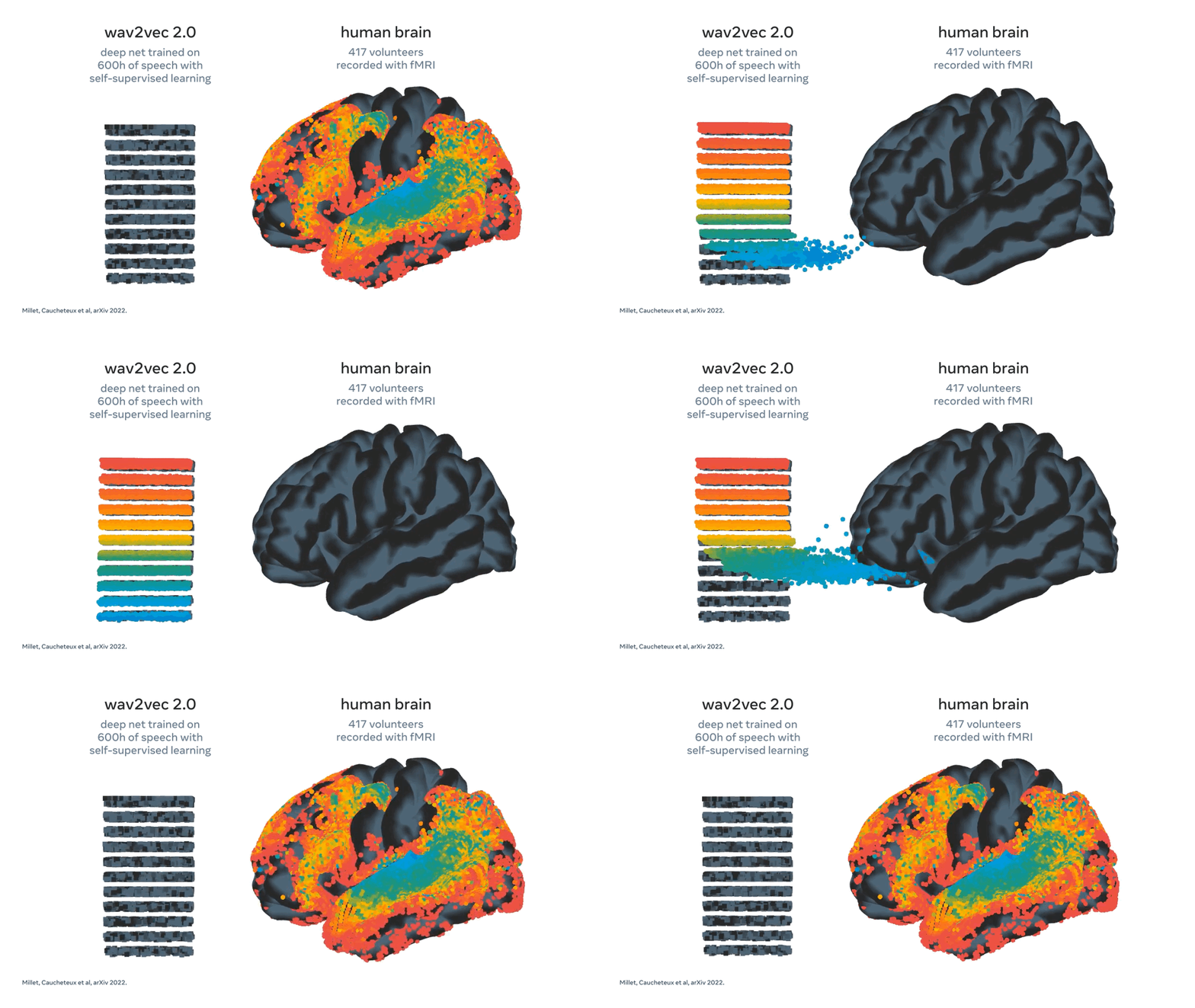
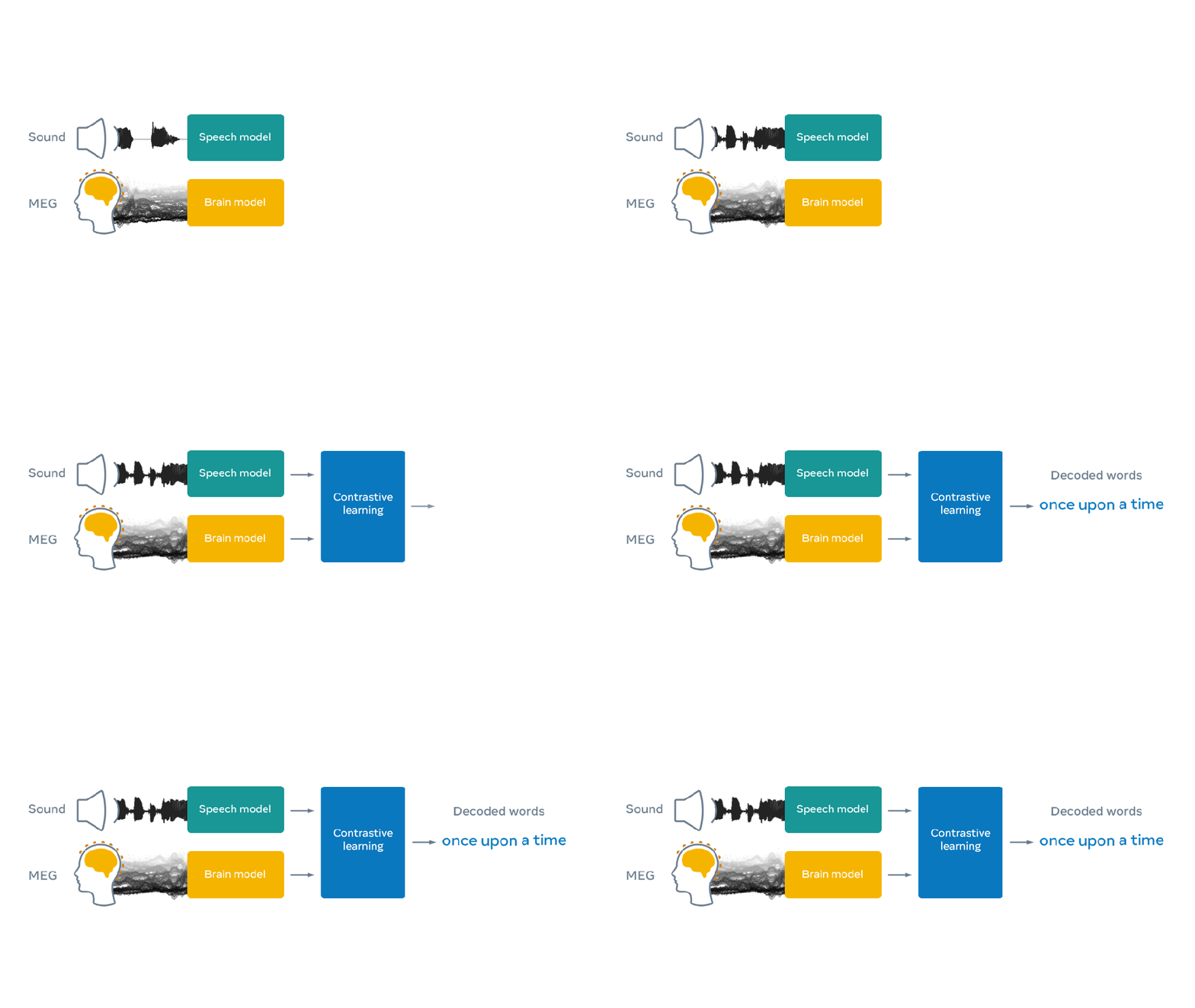
Apologies in advance for sharing PR hype from Meta (formerly known as Facebook),but I want to comment on the essence of the idea, which is using AI to decode speech from brain activity. It seems to imply that one would apply supervised machine learning to train a system to map speech to brain activity as illustrated by the image below.
Podcast: Audio rendition of this page contentTo decode speech from noninvasive brain signals, we train a model with contrastive learning to align speech and its corresponding brain activity
The dataset would require the captured patterns of a large enough sample size. In this case, it appears to have been some 417 volunteers.
Activations of wav2vec 2.0 (left) map onto the brain (right) in response to the same speech sounds. The representations of the first layers of this algorithm (cool colours) map onto the early auditory cortex, whereas the deepest layers map onto high-level brain regions (e.g. prefrontal and parietal cortex).
This feels like it could have many commercial, consumer, and industrial uses including removing other human-computer interface devices, notably keyboards, but perhaps even mouses. Yes, I said mouses. Sue me.
Given hypotheses related to language and cognition, I am wondering what can be gleaned by mapping different multiple native language speakers to cognitive processes in order to remap them to speech output if it would be able to arrive at some common grammar that could then output a given thought stream into any known (and mapped) language, allowing for instantaneous “translation”.
Of course, a longer-term goal would be to skip the external devices and interface brain to brain. This sounds rogue science fiction scary, as one might imagine an external device trained on a brain to read its contents. One of the last things this world needs is to have to worry about neuro-rights and about being monitored for thought crimes. Come to think of it, isn’t there already a book on this? Nevermind. Probably not.
Technology is generally not inherently harmful or helpful, as that is determined by use. Humans do seem to tend toward the nefarious. Where do you think this will go? Leave a comment.
I mentioned in my last post about how Artificial Intelligence discovered a new variable—or, as the claim suggests, a new physics. This was a tie-in to the possible missing dimensions of human perception models.
Without delving too deep, the idea is that we can predict activity within dynamic systems. For example, we are all likely at least familiar with Newtonian physics—postulates such as F = ma [Force equals mass times acceleration or d = vt [distance equals velocity times time] and so on. In these cases, there are three variables that appear to capture everything we need to predict one thing given the other two that need to remain constant. Of course, we’d need to employ calculus instead of algebra if these are not constant. A dynamic system may require linear algebra instead.
When scientists represent the world, they tend to use maths. As such, they need to associate variables as proxies for physical properties and interactions in the world. Prominent statistician, George Box reminds us that all models are wrong, but some are useful. He repeated this sentiment many times, instructing us to ‘remember that models are wrong: the practical question is how wrong do they have to be to not be useful‘. But no matter how hard we try, a model will never be the real thing. The map cannot become the terrain, no matter how much we might expect it to be. By definition, a model is always an approximation.
All models are wrong but some are useful
George Box
In the Material Idealism post, the embedded video featuring Bernardo Kastrup equated human perception to the instrumentation panels of an aeroplane. Like the purported observer in a brain, the pilot can view the instruments and perform all matters of actions to manipulate the plane, including taking off, navigating through the environment, avoiding obstacles, and then landing. But this instrumentation provides only a representation of what’s ‘really’ outside.
Like mechanisms in the body, instrumentation can be ‘wired’ to trigger all sorts of warnings and alerts, whether breached thresholds or predictions. The brain serves the function of a predictive difference engine. It’s a veritable Bayesian inference calculator. Anil Seth provides an accessible summary in Being You. It relies on the senses to deliver input. Without these sense organs, the brain would be otherwise unaware and blinded from external goings on.
The brain cannot see or hear. It interprets inputs from eyes and ears to do so. Eyes capture light-oriented events, which are transmitted to the brain via optic nerves, and brain functions interpret this information into colour and shape, polarisation and hue, depth and distance, and so on. It also differentiates these data into friend or foe signals, relative beauty, approximate texture, and such. Ears provide a similar function within their scope of perception.
As mentioned, some animals have different sense perception capabilities and limitations, but none of these captures data not also accessible to humans via external mechanisms.
Some humans experience synesthesia, where they interpret certain stimuli differently, perhaps hearing colours or smelling music. We tend to presume that they are the odd ones out, but this assumption does not make it so. Perhaps these people are actually ahead of the rest of us on an evolutionary scale. I suppose time might sort that one out.
But here’s the point. Like the pilot, we can only experience what we are instrumented to experience, as limited to our sense perception and cognition faculties. If there are events not instrumented, it will be as if they don’t exist to the pilot. Can the pilot hear what’s happening outside?
This is the point of the AI experiment referenced above. Humans modelled some dynamic process that was presumed to be ‘good enough’, with the difference written off as an error factor. Artificial Intelligence, not limited to human cognitive biases, found another variable to significantly reduce the error factor.
According to the theory of evolution, humans are fitness machines. Adapt or perish. This is over-indexed on hereditary transmission and reproduction, but we are more vigilant for things that may make us thrive or perish versus aspects irrelevant to survival. Of course, some of these may be benign and ignored now but become maleficent in future. Others may not yet exist in our realm.
In either case, we can’t experience what we can’t perceive. And as Kastrup notes, some things not only evade perception but cannot even be conceived of.
I am not any more privileged than the next person to what these missing factors are nor the ramifications, but I tend to agree that there may be unknown unknowns forever unknowable. I just can’t conceive what and where.
Synchronicity is in full force and effect. I’ve been on holiday for the past week and a half during which time I’ve read twice over Being You by neuroscientist Anil Seth, who also competently narrates an audio version. I enjoyed it, though it was on one hand too general and on the other hand oddly specific. I expect to summarise it presently.
Meantime, I just watched this interview with Bernardo Kastrup, of whom I’ve only recently become aware, and he makes some of the points Anil makes, but I feel his logical leap to the spiritual realm is a bit premature and wishful thinking on his part—sort of a God of the gaps approach.
Russell Brand interviews philosopher and author Bernardo Kastrup
I find his analogy equating human perception and an aeroplane cockpit on instrument control is apt, and I fully agree that humans are limited by their sense organs and limited cognitive faculties. so there exists more than we can measure or even perceive.
I recently read an article about a recent discovery where artificial intelligence identified a new dynamic variable in physics.
It stands to reason that there are a great many things about nature that are flat out not only NOT PERCEIVABLE by us but INCONCEIVABLE by us
Bernardo Kastrup
Aristotle is responsible for the notion that humans are limited to 5 senses, a myth still propagated by education systems. We are all familiar with the five basic senses:
Sense
Perception
Sensory Organ
Vision
Vision
Eye
Hearing
Auditory
Ear
Touch
Tactile
Skin
Taste
Gustatory
Mouth
Smell
Olfactory
Nose
Touch limits the scope of the somatosensory system that extends tactile mechanoreception perception with thermoception, which not only perceives the temperature of external objects and environments but includes receptors necessary to regulate internal body temperatures.
Sense
Perception
Sensory Organ
Vestibular
Equilibrioception
Inner Ear
Equilibrium or balance is yet another sense.
Perhaps it’s that vestibular sensation feels different to the rest, and so it gets marginalised.
Apart from the senses in and of themselves, we know that different life forms with analogous sense receptors perceive the world with different levels of acuity and resolution as well as range.
Dogs hear sounds at higher frequencies. Whales hear lower frequencies.
Birds see at a faster ‘frame rate’ than humans. In fact, a bird watching a film would not see the contiguous frames as fluid motion but would likely perceive the frames like a flip book progressing too slowly. Their visual acuity is also sharper, effectively giving them a higher DPI resolution. Thankfully, our visual system doesn’t provide a dithered or pixelated representation.
Some animals also ‘see’ images on infrared or ultraviolet frequencies.
Human eyes are front-mounted and provide binocular vision and depth perception. Internal mechanisms give the appearance of a continuous view. In fact, our eyes have a very small focal width, but they flit and flitter to capture snippets that are stitched together to give the impression of a scene. This is a Gestalt consideration.
Side-mounted eyes operate at a different level. For example, a pigeon needs to continually bob its head to render a stereoscopic view. Similarly, internal mechanisms stitch these images into a cogent environment.
And then there are compound eyes. Despite the manner these are depicted in movies, it’s likely that the visual system composites the facets into a single view.
Where humans can sense depth, distance, and direction with their eyes and ears, sharks can sense direction with their ‘nose’s.
Whilst humans have some ‘awareness’ of pheromones, this awareness is heightened in other animals via vomeronasal organ perception.
The notion of time is another perception, but we don’t even have a decent definition or understanding of time, so we’ve got a while before we figure this one out.
In addition to these human faculties, we understand that animals have others we had discovered.
Sense
Perception
Example Species
Magnetoception
Magnetic fields
birds, cattle, bacteria
Echolocation
Spatial
bats, cetaceans
Electroception
Electric fields
fish
Hygroreception
Moisture levels
insects
The addition of these other senses is borderline trivial insomuch as they each sense known phenomena. The question is whether some animals sense phenomena yet unknown.
I had more I wanted to say, but my time was occupied gathering these lists. Perhaps when I return to comment on Being You, I’ll share more.
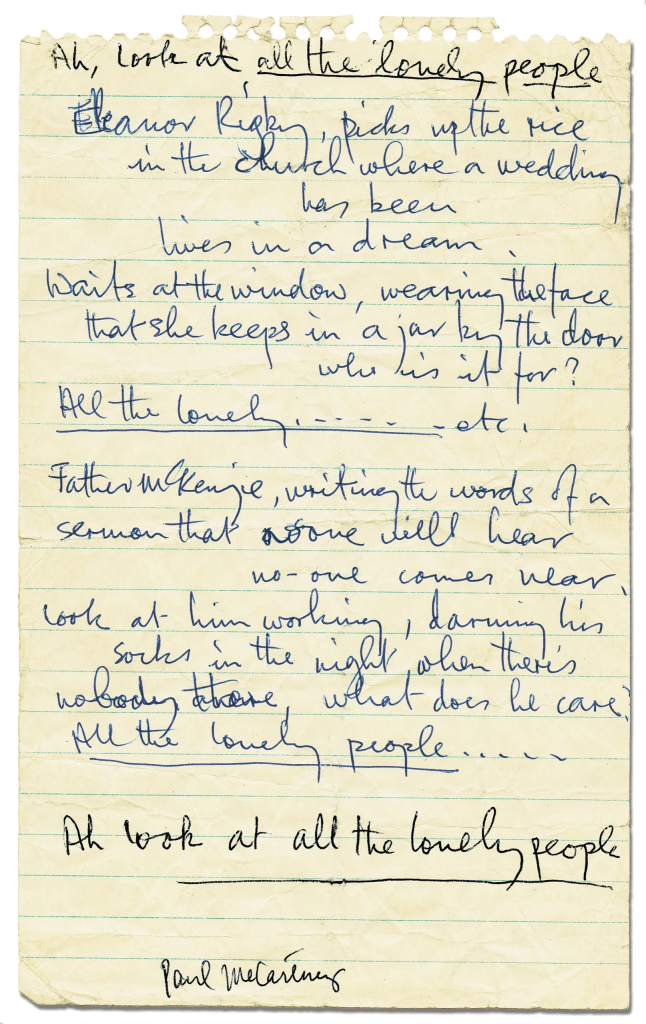
This post reflects on how memory operates and true and false memories. The video clip is about a minute long and shows Paul McCartney recounting how he decided to create the character of his eponymous song Eleanor Rigby.
He fancied the name Eleanor and was trying to think of a two-syllable word to follow when he spotted a sign that read Rigby & Evens, a wine and spirits shop in Bristol.
Rigby & Evens, Limited Sign
According to Paul, these were the components leading to the title character.
Eleanor Rigby Hand-written Lyrics by Pail McCartney
From the perspective of recency over primacy, Paul may be correct, but it could also be, as he admits, that he had seen the tombstone without it being consciously registered. He may have even been consciously aware but subsequently forgotten it. Perhaps this is why the name resonated with him, having been exposed previously. Memory is known to be reinforced through repetition. From the perspective of primacy over recency, he may have never settled on the name had he not seen the inscription on the gravestone.
Could it be that this was a coincidence and Paul never did see that grave marker, or is it more likely that he did? We’ll never know for sure, but it is an interesting turn of events.
This may end up being a shorter post, but in the realm of free will and agency, ask yourself about conspiracy theorists. Not a particular theory—or maybe some safe target like flat earthers. I think one would be hard-pressed to say that these people choose to believe this. They are convinced for whatever reasons. In principle, people who tend to believe in conspiracies have other determining factors—not the sort of ‘determined’ as Determinism suggests, but still beyond their conscious choices. We can agree with them or mock them, but they’ve got a predisposition toward these beliefs.
Social psychologists often argue that beliefs in conspiracy theories are connected with broader social and intergroup conflicts where conspiracy theories are used to justify and maintain conflict or to attribute blame to an unjust social system (Crocker et al., 1999). Other research has sought to explain the appeal of conspiracy theories by focusing on personality characteristics of conspiracy theorists. Among other factors, a sense of powerlessness and anomie—an inability to affect change and feelings of insignificance within society—have been found to correlate positively with high levels of beliefs in conspiracy theories (Hamsher et al., 1968; Whitson and Galinsky, 2008; Bruder et al., 2013).
Of course, people truly guilty of the conspiracy being accused tend to push the notion that their accusers are nutters, and this redirect tends to work on those not prone to conspiracies. This is problematic relative to getting to the facts of the matter, but for our purposes, yet again agency has been subverted.
“When people feel threatened and out of control, it’s natural to want to feel more control and bring order to the randomness by resorting to conspiracy theories,” says John Cook, PhD, founder of the website Skeptical Science and co-author of “The Conspiracy Theory Handbook.”
This is pretty much the same cognitive deficit behind the blaming that agency serves as an unwitting proxy.
Americans are a particularly gullible lot, with some 80 per cent of them believing in at least one unsubstantiated conspiracy theory. Of course, it could prove that at least one of these becomes substantiated. In fact, perhaps it already has. I don’t know if the United States government is particularly mendacious or if that is a conspiracy belief in its own right.
A toddler lives with me. She’s been on the brink of verbal language for the past few months, and I am sharing some observations.
Listen on Spotify
Juicy Shoes
Juice (in a sippy cup) and shoe(s)
Two objects that play a large part of her verbal life are juice and shoes. As I hear her employ these words, they are virtually indistinguishable. I may actually misperceive her, and she could be uttering the same morphemes. I captioned how I perceive these images with IPA references.
In English (in IPA), juice is spelt / d͡ʒˈuːs / and shoes is / ˈʃuːz /. She simplifies ‘juice’ by not voicing the leading alveolar plosive ‘d’ and by shortening the diphthong to a monopthong vowel. For ‘shoe’, she similarly shortens the vowel sound and annunciates a voiceless rather than voiced alveolar fricative.
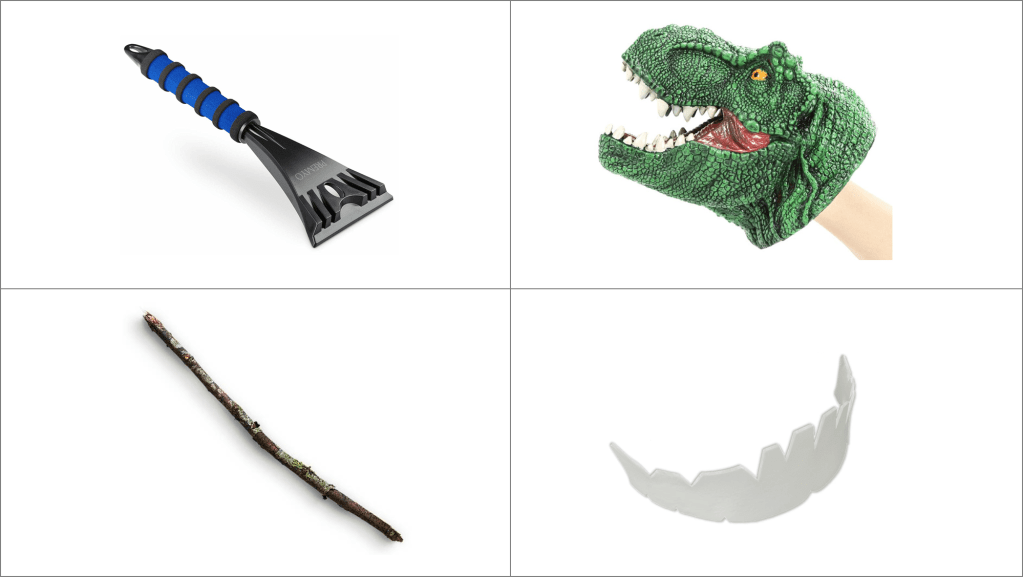
Awhr
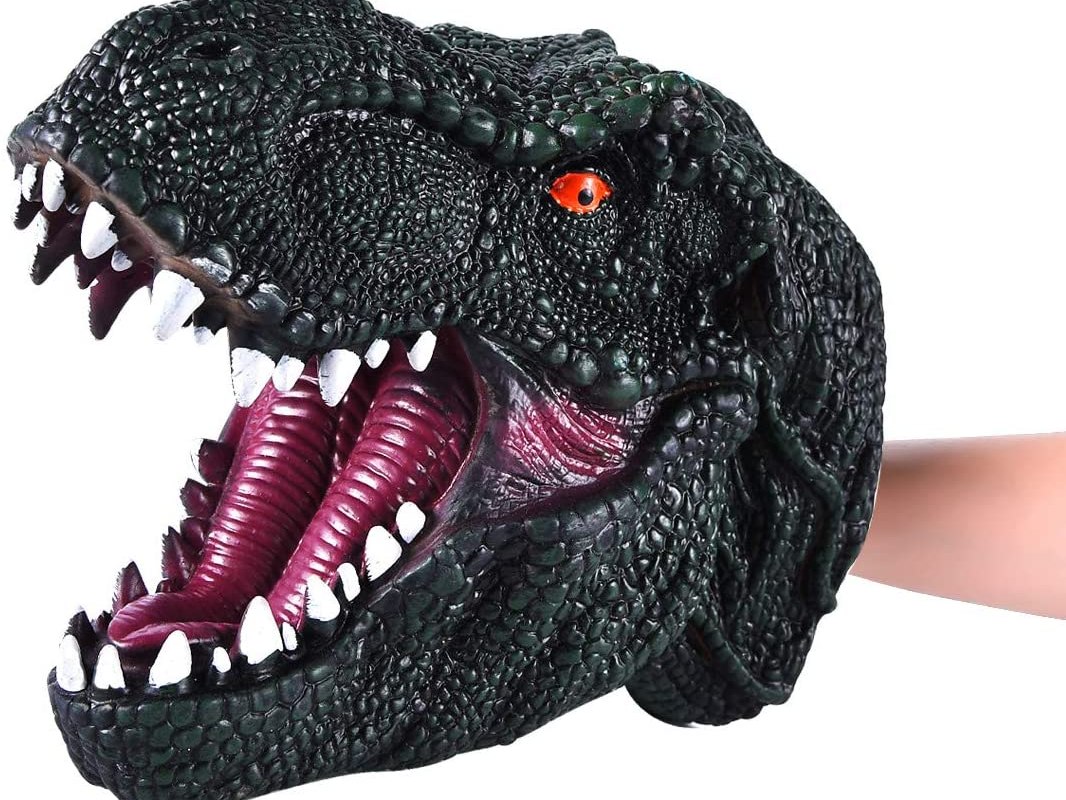
Left to Right, Top to Bottom: Windscreen Ice Scraper, Silicone Dinosaur Hand Puppet, Stick, Cap Shaper
Can you guess the common thread the above objects share?
Spoiler Alert: They are each signified by the same signifier— Awhr, which I believe may be transliterated as Rawr. Bear with me.
She loves dinosaurs. Seeing one, she reflexively roars onomatopoeically, awhr. I know. You are thinking to yourself, that’s a no brainer. Dinosaurs roar. At least in the modern-day mythos. I don’t speak dinosaur, and perhaps dinos had regional dialects or species nuances. She’s just a toddler, so ‘awhr‘ is representative of all dinos.
But, you are thinking, these other things not only don’t roar, but they’re also inanimate. Sure, you tell yourself, the dinosaur is a puppet, but you can envisage the connexion. That’s a toy dinosaur, but these other things are an ice scraper, a stick, and who knows what that last thing is? It’s a hat shaper. It was an insert to a cap—like a baseball cap or trucker cap. It was removed for the cap to be wearable, and the insert is one of her favourite toys. All of these rank high on her list of preferred toys.
As far as I can tell, she envisages the cap insert as teeth—resembling, perhaps, the teeth of a dinosaur—hence ferocity, hence a roar. I believe the roar-stick connexion has an aetiology that involves the ice scraper, so I’ll share that origin story.
Whilst shopping for an ice scraper in Winter, we were in the automotive aisle. As she was interested in the variety of air fresheners, I parked her trolley and surveyed the aisle looking for scrapers. Finding one—and for reasons unknown to me; perhaps the ‘teeth’ on the back of it—, I represented it as a claw and produced my own roar. The impression was made. It’s been months, and whenever she interacts with it, she roars as if it were a dinosaur.
By extension, I believe, the stick is a simulacrum. We’ve travelled from the signified to the first-level signifier (puppet) to a second-level signifier (scraper) to a third-level signifier (stick). Absent the causal narrative, one would be hard-pressed to suss out why a child might be representing a stick with a roar. And now you know.
But wait. There’s more. I was so busy geeking out, that I almost forgot the story that prompted this post in the first place. We were driving somewhere. She sits in a car seat that, by design restricts her movement, and sometimes her playthings go out of reach, where ‘sometimes’ means ‘almost invariably’.
As we were heading wherever, I heard the cue, awhr. A quick glance in the mirror caught the dinosaur puppet. I reached back and handed it to her. Crisis averted. She played with the puppet for a bit, and that leads to a brief diversion from the narrative. Her roars have two noted contexts. The first is playing, awhr. She finds herself amused to be a dino ventriloquist, and she bursts out laughing if you acknowledge her playing. The second is serious business, awhr. Laughter is not the expected reaction. Anything less than feigned terror will get you the look. This is no play dino. This is a dino incarnate. But I digress.
A minute or so later, awhr. This roar is neither play nor serious. She wanted something else. A quick survey of available candidates, and I sussed out the cap stretcher cum teeth. Crisis averted. But only for a minute. After satisfactorily animating the stretcher, another roar. Another glance back. No good candidates. But there was a stick. What do I have to lose?
Awhr. Yep. This is what she had in mind. She animated the stick for another few minutes. And that brings this chapter to an end.
Moar
Though her vocabulary is so far quite constrained, she does have a few more available words. More was pretty early on her list, almost invariably accompanied with a gesture—thrusting an empty juice cup or just generically declaring that she wanted more of whatever it was that she’d just had. Nice general-purpose word, for sure.
Thank You
Thank you was another early entry. She pronounces it like the German, danke, but with a cut schwa sound at the end and perhaps more: / ˈtaŋk ə /. Schwa is already a short unstressed vowel, and I don’t know how to represent it shorter. In musical notation, I might have opted for a staccato-pianississimo combo in an attempt to capture the dynamics. Alas…
Hello, Goodbye
Other phatic and still enthusiastic utterances are hi and bye with attendant waving gestures.
Enfin
She does have words for dad and mum, respectively da and ma or maman, comme en français, and she employs nods and headshakes to communicate yes and no. And she uses sulking body posture to convey disappointment. Finally, she says ow to any number of things to indicate frustration.
I’m sure she’ll be adding many more words relatively soon and quickly.
God knows that I am not interested in God, but in the quoted sentence, ‘If God did not exist, it would be necessary to invent him‘, Voltaire has established a pattern: If X did not exist, it would be necessary to invent X. Identity is a possible X. Time and now are other possible Xs.
I’ll focus on identity. That identity is a social construct may be technically correct, but so what? My position is that identity doesn’t exist, yet people–including me–identify. We search for identities that don’t exist. What I was when I looked is no longer there. And if someone invents a new attribute of identity, we tend to evaluate how we relate to it. Among other things, cognition is a difference engine.
“The mirror is a worthless invention. The only way to truly see yourself is in the reflection of someone else’s eyes.”
— Voltaire
When the concept of race is brought up—as invalid of a concept as it may be—, we assess how we relate to it. Sex, gender, self—it’s all the same pattern.
I’ve written on race identity in the past. Given it’s a fiction for the human species, it’s a moving target even within the realm of identity, a moving target in its own right. In my estimation, race is a conflation of colour, class, and culture—evidently, the 3Cs. So, although I don’t believe the concept of race is valid for homo sapiens sapiens, I still have a sense of what the users of this term mean. Besides colour, which I feel is the primary attribute, couched in this notion is cultural affinity as proxied by national original, another nonsensical notion.
In my case, I was raised as a WASP. My family background is white, Anglo-Saxon (Norwegian), and Protestant (Northern Baptist), so in the US I am afforded privilege. Were I to play it up, I should be able to parlay this into better jobs, better housing in better neighbourhoods, with access to better networks, and on and on. And even though I don’t play that game, I still accrue some of these benefits. Others I eschew. But I have options. This is the nature of privilege.
I don’t identify as white, nor do I identify as black or brown. This mantle is cast upon me. I can deny the notion, but I am helpless. Just as the black person can’t escape being identified as being black, the white person is similarly chained to their whiteness. In the United States, historically, a white person can deny the attribute of white, but simpletons will still consider them as white. But this is not a disadvantage to overcome. Some might argue that with a shifting colour landscape these days are coming to an end, but they haven’t ended yet, to the chagrin of the white folk who want to continue to ride the wave of privilege. People of colour, on the other hand, likely want to see this wave crash (and burn, if that’s possible).
But I’ve gone off the plantation—or is that reservation? No matter. Identity is nothing more than a connected locus of stateless states. It’s an n-dimensional snapshot of everchanging moments. The relationship between identity and identification might be viewed by analogy as the relationship between sex and gender, both social constructions in their own right. As with sex, identity is assigned. Except in rare cases, one doesn’t have the option of denying their biological sex. As with gender, identification is a space where you can self-assess. It’s just as pointless, but it somehow makes us feel better.
As with Voltaire’s quip, if the Self did not exist, it would be necessary to invent it. And invent, we do. As with objects in physical space, there is more absent than there, but that doesn’t prevent us from imagining it as real and present. In the end, identification is a heuristic that has survived as an evolutionary fitness trait. For what it’s worth, it affords us the capacity to differentiate between friends and enemies, us and them. But it also can be over-indexed and lead to unwanted or at least unexpected results. The question is how much energy should one expend on identity formation and assessment?
That perception and memory work hand in hand is mostly taken for granted, but this case reminds us that this sometimes breaks down. This is not the case of the neurotypical limitations to fallible sense organs and standard cognitive boundaries and biases. This subject can’t discern the arabic numerals from 2 through 9.
To recap the study, the man can perceive 0 and 1 as per usual, but numerals 2 through 9 are not recognisable. Not even in combination, so A4 or 442 are discernible.
In a neurotypical model, a person sees an object, a 3 or a tree, and perhaps learns its common symbolic identifier—’3′, ‘three’, or ‘tree’. The next time this person encounters the object—or in this case the symbol—, say, 3, it will be recognised as such, and the person may recite the name-label of the identifier: three.
It might look like this, focusing on the numerals:
For each observation, the impression of 3 is different.
Phenomenologically, this is different to the question of whether two subjects share the same perception of, say, the colour red. Even if you perceive red as red, and another perceives red as red, as long as this relative reference persists to the subject, you can still communicate within this space. When you see a red apple, you can remark that the apple is red—the name marker—, and the same is true for the other, who can also communicate to you that the apple is indeed red because the word ‘red’ become a common index marker.
But in the anomalous case, the name marker would have little utility because ‘red’ would be generated by some conceivably unbounded stochastic function:
Colourₓ = ƒ(x), where x is some random value at each observation
It would be impossible to communicate given this constraint.
This, as I’ve referenced, is anomalous, so most of us have a stronger coupling between perception and memory recall. Interesting to me in this instance is not how memory can be (and quite often is) corrupted, but that fundamental perception itself can be corrupted as well—and not simply through hallucination or optical illusion.











 Philosophics