Jung and Catholic Ritual

I was chatting with some Catholics on Social Media, responding to a post about the need to grow their base. I sympathised that it must be difficult because the product of organised religion was not exactly tailor-fit. Protestants have provision for roll-your-own, but not Catholics. This led me to a discussion about what Jung wrote about rituals – that it doesn’t matter if the underlying rationale was remembered because some people like ritual for its own sake – candles, incense, wafers, whatever.

(I studied Jung intensely in the mid-’90s, and while I still find him useful as metaphor, I don’t take his broader metaphysics seriously anymore – too mystical for my tastes. But this particular insight about ritual sticks.)

Follows are the unedited results.

Yes, and Jung was being quietly subversive about it. He was pointing to something most modern institutions would rather not hear.

For Carl Jung, ritual doesn’t need to be true in the propositional sense to be effective in the psychological one. Its power doesn’t reside in correct belief, historical accuracy, or even conscious assent. It resides in repetition, form, symbol, and the way those elements bypass the rational gatekeeper and go straight for the nervous system.

Which is precisely why ritual unnerves modernity.

Once you accept Jung’s claim, you’re forced to concede that meaning is not the primary engine of human orientation. Function is. A ritual can continue to stabilise, contain, and organise psychic life long after its original metaphysics has decayed, been forgotten, or become frankly unbelievable. The candles still work even if God has quietly slipped out the back.

This is deeply inconvenient for Enlightenment-descended sensibilities, which insist that symbols must justify themselves, that practices require reasons, and that belief precedes action. Jung flips that on its head. We act first. We kneel first. We chant first. Understanding, if it arrives at all, comes later as a kind of aftercare.

Which helps explain your mate’s conversion without invoking any sudden metaphysical awakening.

Catholic ritual functions even when belief wobbles. Protestantism, having stripped ritual back to avoid superstition, leaves belief carrying all the weight. Once belief falters, there’s nothing left to hold the structure together. No choreography. No inherited muscle memory. No symbolic surplus. Just a sermon competing with the rest of the week’s content.

Jung saw this coming. He understood that modern people would continue to need ritual even as they lost faith in the stories that once justified it. His worry wasn’t that people would abandon religion. It was that they would abandon ritual competence and then wonder why anxiety, fragmentation, and compensatory myth-making flooded in through the cracks.

From that angle, Catholicism’s current crisis looks different again.

The conservatives think ritual must be defended because it encodes truth.
The progressives think ritual can be loosened because truth can be updated.
Jung would have said both are missing the point.

Ritual persists because it does work that language cannot do. It orders time. It disciplines the body. It makes the invisible feel locally real. Strip away the incense, the repetition, the inherited forms, and you don’t get a purer faith. You get an exposed psyche scrambling for substitutes.

So when someone says, “I’m drawn to Catholicism because of the candles and incense,” they’re not being shallow. They’re being honest in a way theologians and sociologists often aren’t. They’re admitting that humans are not primarily convinced creatures.

They are conditioned ones.

Jung didn’t romanticise that fact. He warned about it. But he understood it well enough to say the thing modern institutions still resist admitting:
you can drain a ritual of meaning and it will still shape lives long after the doctrine has stopped persuading anyone.

Dukkha, the Path of Pain, and the Illusion of Freedom: Buddhism, Antinatalism, and the Lonely Road of Individuation

The First Noble Truth of Buddhism—the notion that life is suffering, or dukkha—is often misinterpreted as a bleak condemnation of existence. But perhaps there’s something deeper here, something challenging yet quietly liberating. Buddhism doesn’t merely suggest that life is marred by occasional suffering; rather, it proposes that suffering is woven into the very fabric of life itself. Far from relegating pain to an exception, dukkha posits that dissatisfaction, discomfort, and unfulfilled longing are the baseline conditions of existence.

This isn’t to say that life is an unending stream of torment; even in nature, suffering may seem the exception rather than the rule, often concealed by survival-driven instincts and primal ignorance. But we, as conscious beings, are haunted by awareness. Aware of our mortality, our desires, our inadequacies, and ultimately, of our impotence to escape this pervasive friction. And so, if suffering is indeed the constant, how do we respond? Buddhism, antinatalism, and Jungian psychology each offer their own, starkly different paths.

The Buddhist Response: Letting Go of the Illusion

In Buddhism, dukkha is a truth that urges us not to look away but to peer more closely into the nature of suffering itself. The Buddha, with his diagnosis, didn’t suggest we simply “cope” with suffering but rather transform our entire understanding of it. Suffering, he argued, is born from attachment—from clinging to transient things, ideas, people, and identities. We build our lives on desires and expectations, only to find ourselves caught in a cycle of wanting, attaining, and inevitably losing. It’s a form of existential whiplash, one that keeps us bound to dissatisfaction because we can’t accept the impermanence of what we seek.

The Buddhist approach is both radical and elusive: by dissolving attachment and breaking the cycle of clinging, we supposedly dissolve suffering itself. The destination of this path—Nirvana—is not a state of elation or contentment but a transcendence beyond the very conditions of suffering. In reaching Nirvana, one no longer relies on external or internal validation, and the violence of social judgment, cultural obligation, and personal ambition falls away. This may seem austere, yet it offers a powerful antidote to a world that equates happiness with accumulation and possession.

Antinatalism: Opting Out of Existence’s Violence

Where Buddhism seeks liberation within life, antinatalism takes an even more radical stance: why bring new beings into an existence steeped in suffering? For antinatalists, the suffering embedded in life renders procreation ethically questionable. By creating life, we induct a new being into dukkha, with all its attendant violences—society’s harsh judgments, culture’s rigid impositions, the bureaucratic machinery that governs our daily lives, and the inescapable tyranny of time. In essence, to give birth is to invite someone into the struggle of being.

This perspective holds that the most humane action may not be to mend the suffering we encounter, nor even to accept it as Buddhism advises, but to prevent it altogether. It sees the cycle of life and death not as a majestic dance but as a tragic spiral, in which each generation inherits suffering from the last, perpetuating violence, hardship, and dissatisfaction. Antinatalism, therefore, could be seen as the ultimate recognition of dukkha—an extreme empathy for potential beings and a refusal to impose the weight of existence upon them.

Jungian Individuation: The Lonely Path of Becoming

Jung’s concept of individuation offers yet another approach: to delve deeply into the self, to integrate all aspects of the psyche—the conscious and the unconscious—and to emerge as a fully realised individual. For Jung, suffering is not to be escaped but understood and incorporated. Individuation is a journey through one’s darkest shadows, a confrontation with the parts of oneself that society, culture, and even one’s own ego would rather ignore. It is, in a way, an anti-social act, as individuation requires the courage to step away from societal norms and embrace parts of oneself that might be seen as disturbing or unconventional.

But individuation is a lonely road. Unlike the Buddhist path, which seeks to transcend suffering, individuation requires one to face it head-on, risking rejection and alienation. Society’s judgment, a kind of violence in itself, awaits those who deviate from accepted roles. The individuated person may, in effect, be punished by the very structures that insist upon conformity. And yet, individuation holds the promise of a more authentic existence, a self that is not a mere amalgam of cultural expectations but a reflection of one’s truest nature.

The Delusions That Keep Us Tethered to Suffering

Yet, for all their starkness, these paths might seem almost abstract, philosophical abstractions that don’t fully capture the reality of living within the constraints of society, culture, and self. Human beings are armed with powerful psychological mechanisms that obscure dukkha: self-delusion, cognitive dissonance, and hubris. We fabricate beliefs about happiness, purpose, and progress to protect ourselves from dukkha’s existential weight. We convince ourselves that fulfilment lies in achievements, relationships, or material success. Cognitive dissonance allows us to live in a world that we know, on some level, will disappoint us without being paralysed by that knowledge.

It’s worth noting that even those who acknowledge dukkha—who glimpse the violence of existence and the illusory nature of happiness—may still find themselves clinging to these mental defences. They are shields against despair, the comforting armours that allow us to navigate a world in which suffering is the baseline condition. This is why Buddhism, antinatalism, and individuation require such rigorous, often painful honesty: they each ask us to set down these shields, to face suffering not as a solvable problem but as an intrinsic truth. In this light, psychological defences are seen not as failures of awareness but as survival strategies, albeit strategies that limit us from ever fully confronting the nature of existence.

Finding Meaning Amidst the Violence of Being

To pursue any of these paths—Buddhist enlightenment, antinatalism, or Jungian individuation—one must be prepared to question everything society holds dear. They are radical responses to a radical insight: that suffering is not accidental but foundational. Each path offers a different form of liberation, whether through transcendence, abstention, or self-integration, but they all require a certain fearlessness, a willingness to look deeply into the uncomfortable truths about life and existence.

Buddhism calls us to renounce attachment and embrace impermanence, transcending suffering by reshaping the mind. Antinatalism challenges us to consider whether it is ethical to bring life into a world marked by dukkha, advocating non-existence as an escape from suffering. And individuation asks us to become fully ourselves, embracing the loneliness and alienation that come with resisting society’s violence against the individual.

Perhaps the most realistic approach is to accept that suffering exists, to choose the path that resonates with us, and to walk it with as much awareness as possible. Whether we seek to transcend suffering, avoid it, or integrate it, each path is a confrontation with the violence of being. And maybe, in that confrontation, we find a fleeting peace—not in the absence of suffering, but in the freedom to choose our response to it. Dukkha remains, but we may find ourselves less bound by it, able to move through the world with a deeper, quieter understanding.

Under the Influence

Galen Strawson is my latest male crush. With almost everything I read or hear from him, I say, ‘that’s what I think’, over and over and over again. So I thought I’d share some of my journey to now. I made a post about female influences not too long ago. This is a bit different.

My first obsession, let’s say was the Beatles. I can’t pinpoint precisely when, but when I was a child, it’s been said that I would sing ‘she’s got a chicken to ride’ when it came on to AM radio. I asked for or bought all of their albums, and read everything about them that a kid could get his hands on back in the day. This obsession lasted for years and overlaps some of my next interests. My interests were in John Lennon’s political interests and George Harrison’s spiritual interests. I didn’t really find Paul McCartney or Ringo Starr very interesting beyond their musical abilities. And to be honest, I also got all of the Stones, Led Zeppelin, Pink Floyd, and so on. At my peak, I had over a thousand vinyl records—all lost in a house fire because vinyl and heat are generally incompatible. Paper didn’t fare much better, as I lost hundreds of books, too. A lesson in impermanence.

I am a bit of a nonconformist, a contrarian, and a polemicist

In grades 5 to 8, National Socialism and World War II were fascinating to me. Not Hitler, per se, though I do recall reading Mein Kampf at the time. There was just something about the sense of unity. Upon reflection, I realised that this meant me conforming to some other trend, and that was no longer interesting, as I am a bit of a nonconformist, a contrarian, and a polemicist, so there was that.

At some point, I came across Voltaire’s Candide and it just struck me. This may have commenced me on my path to becoming somewhat of a francophile. I extended my interest into the language and culture. My WWII phase has already primed that pump. I remember reading Dumas, Hugo, and some Descartes.

After I graduated, I was a recording engineer and musician. I remember reading Schoenberg’s Structural Function of Harmony and being enamoured with Dvořák and Stravinsky. I was influenced by many musicians, engineers, and producers, but there was just something about Schoenberg.

I went through a Kafka phase—that eventually included Donald Barthelme. His Absurdism was a nice foundation for my subsequent interest in Camus. It was something that just resonated with me. After Kafka, I discovered Dostoyevsky and consumed everything of his I could get my hands on.

I took from Jung and Campbell the importance of metaphor

In the 1990s, I discovered Carl Jung and eventually Joseph Campbell and a few years I spent reading Jung’s Complete Works and peripheral material related to Archetypal and Depth Psychology. I absorbed the material. I took from Jung and Campbell the importance of metaphor, but it never really resonnated beyond this.

Somehow, this experience led me to the Existentialism of Sartre (and Camus and Beauvoir). At the same time something clicked with me, I was always put off by the teleological imperative these guys seemed to insist upon—Sartre’s political involvement and Camus’ insistence on Art. These were their paths—and I certainly had an interest in Art and Politics—, but I felt this was too prescriptive.

For a brief time, I really liked Hume (and Spinoza), but then I discovered Nietzche and felt compelled to read his major works. It all made sense to me. It still does. Nietsche set me up for Foucault with his power relationships and the sense that morality, good, and evil are all socially constructed and contextual.

And Nietzsche brought me to Foucault and his lens of Power. These two still resonate with me. I investigated a lot of postmodern thinkers after this.

Nietzsche brought me to Foucault and his lens of Power

Daniel Dennett came next. He seems brilliant, and I tend to agree with most of what he says. I was still absorbing. Where biologist Robert Sapolsky gets philosophical, it’s about the same.

But Galen Strawson is different. And I have a lot of catching up to do in my reading of his direct work. The difference is that with these prior influences, I was absorbing and synthesising—creating my own perspectives and worldview. By the time I am finding Strawson, with every encounter, I am ticking off boxes.

  • That’s what I think
  • That’s what I think
  • That’s what I think
  • That’s what I think

Only, he started publishing in the 1960s. I could have been reading his work all along. Since I agree with 99.999 per cent of what I get from him and he is such a deep thinker, I am looking for two things:

  1. Something that expands rather than confirms
  2. Some spaces to operate that he has missed or ignored

As I continue on my Anti-Agency project and gather more inputs and perspectives, I’ll be considering a lot of Strawson. Here’s a clip I really enjoyed. I am thinking of doing a sort of reaction piece, but whether or not that happens, here’s the source.

[Video] Galen Strawson — Is Free Will a Necessary Illusion?

Spoiler Alert: I believe that free will is a cognitive bias related to apophenia. It’s a Gestalt heuristic.

The futility of words

“Solitude is for me a fount of healing which makes my life worth living. Talking is often torment for me, and I need many days of silence to recover from the futility of words.”

— Carl Jung

My research into the insufficiency of language yields some nice results. Thank you Google.


To Gustav Schmaltz
30 May 1957
Dear Schmaltz:

I understand your wish very well, but I must tell you at once that it does not fit in my with my situation. I am not getting on at 82 and feel not only the weight of my years and the tiredness this brings, but even more strongly, the need to live in harmony with the inner demands of my old age. Solitude is for me a fount of healing which makes my life worth living. Talking is often torment for me, and I need many days of silence to recover from the futility of words. I have got my marching orders and only look back when there is nothing else to do. The journey is a great adventure in itself, but not one that can be talked about at great length. What you think of as a few days of spiritual communion would be unendurable for me with anyone, even my closest friends. The rest is silence! This realization comes clearer every day, as the need to communicate dwindles.

Naturally, I would be glad to see you for one afternoon for about two hours, preferably in Kusnacht, my door to the world. Around August 5 would suit me best, as I shall be home at then in any case. Meanwhile, with best greetings,

Yours ever,
Jung.

I need many days of silence to recover from the futility of words

Carl Jung

Clearly, the main theme here is solitute and slience, but I keyed in on the futility quote.

Thinking Truth

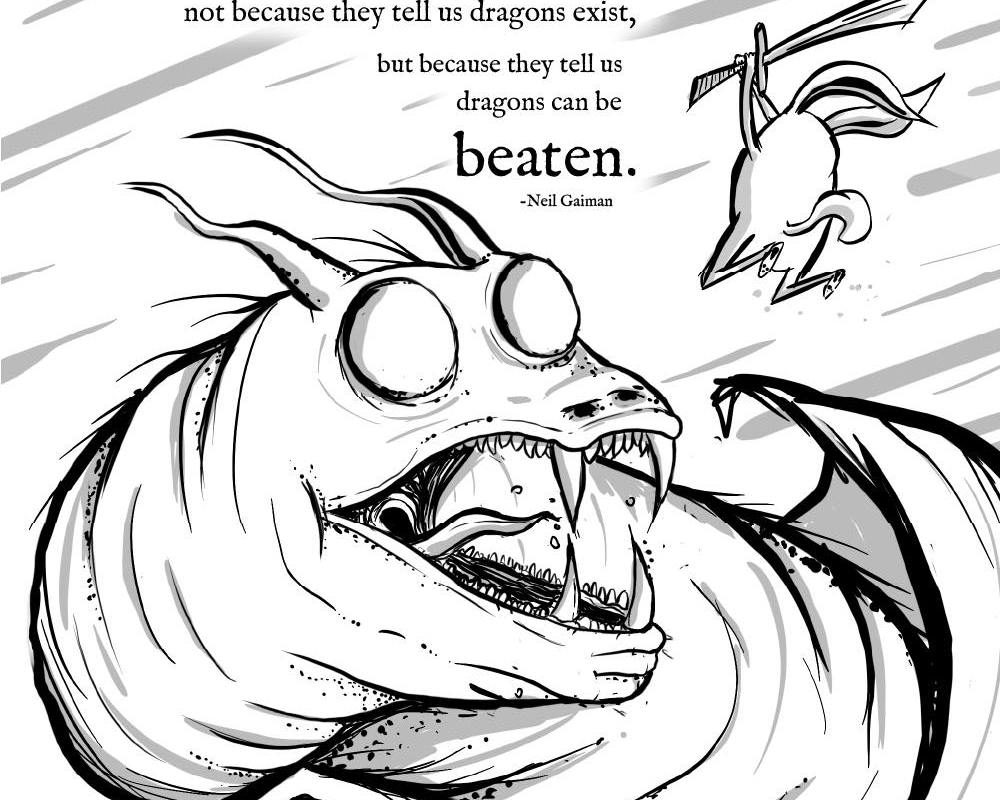
Neil Gaiman, an articulate, imaginatory writer. He makes a claim:

Fairy tales are more than true — not because they tell us dragons exist, but because they tell us that dragons can be beaten.

Neil Gaiman

To me, this is a problem with correlating imagination with truth. Moreover, many a war was lost on the story that it could be won.

Of course, we can still play the metaphor game. I’ve been a fan of metaphor since Joseph Campbell. Metaphor is strength. There was a time when I read Jung and had a stronger interest in Depth and Archetypal Psychology. And fairy tales per Marie-Louise von Franz or her more contemporary cantadora, Clarissa Pinkola Estes. Archetypes are metaphor, but this doesn’t render them real. Still, we can operate as if they are. The trick is to remember that they are not.

The Value of Experience

I hear people say this:

Experience is more important than material wealth because you can’t take it with you.

This is silly on so many levels.

Firstly, you can’t take experiences with you any more than you can take material, so the entire logic is faulty.

Secondly, although unsaid, this is typically uttered by those who equate experience with travel to other places, and so one needs some notion of material wealth to do so.

Thirdly, just being alive and somewhat aware is an experience, but I understand the notion implies a diversity of experience.

Fourthly, you still can’t take it with you.

Personally, I love aphorisms, those near-phatic quips that no one really thinks about, yet they feel that these are somehow guiding principles.

Opposites attract.

versus

Like attracts like.

Which of these is correct?

In fact, each of these statements may be correct; it simply depends on context. The issue is that people spout these off to make a point.

Opposites attract is how we justify when two unexpected people, for example, are together. It is also the basis behind the Jungian anima-animus concept.

Like attracts like may be either to justify why person A is with person B, but it sometimes further is meant to imply a sort of guilt by association.

The other issue is one of dimension. When applied to people, they are multidimensional. So which dimension is opposite and which is like. Of course, we’ll choose the dimension that fits our purposes.

Perhaps a 172 cm brunette woman is a police officer has a life partner who is a 172 cm blonde man, who is a criminal, and who both enjoy art museums.

Without specifying what percentage the likeness needs to be to qualify,
if like truly attracted like, wouldn’t the 172 cm brunette policewoman be attracted to another 172 cm brunette policewoman? Or would just another taller policewoman be good enough?

Anyway, nothing earth-shattering here. This is simply another example of the imprecision of language. That, and I couldn’t sleep.

Meaningless

4–6 minutes

Whether in English or in French, I don’t believe Foucault ever uttered the words, ‘It is meaningless to speak in the name of – or against – Reason, Truth, or Knowledge‘*, but I don’t think he’d disagree with the sentiment.


“All my analyses are against the idea of universal necessities in human existence.”

Michel Foucault

Foucault was a postmodernist, and on balance, political Conservatives (Rightists?) dislike the notion of postmodernism. Evidently, a lot of Postmodernists are also Leftists (Progressives or Liberals in the US), so somehow critics such as Jordan Peterson conflate the two clearly distinct concepts.

A basis for Conservatism is the notion of an objective truth, and despite recent sociopolitical trends, they at least say they are guardians or truth and purveyors of knowledge. Conservatives (OK, so I am broad-brushing here) are staunch individualists who believe strongly in possession and property, of material, of an objective reality. Fundamentally, the are aligned to a monotheistic god or at least some discernible (and objective) moral compass.

On the Left, especially post-Enlightenment, they’ve substituted God with some anthropomorphic Nature. In fact, they find comfort in natural laws and human nature. Science is often their respite because science is objective. Isn’t it? Leftists are friends or Reason, and one can’t acquire enough knowledge. Moderation need not apply here; the more the merrier.

This being said, evidently, many on the Left seem to have abandoned this comfort zone. Of course, this may be because the Left-Right dichotomy doesn’t capture the inherent nuance, and so they were miscategorised—perhaps, much in the same manner as persons are miscategorised in a binary gender system. No. It must be something else.

In any case, both side claim to the parties of knowledge, reason, and truth because the opposing parties are clearly abject morons. There is no hint of irony in the situation where each side claims some objective notion of truth—whether divinely granted or self-evidently reasoned—, yet they can’t resolve what the true truth is. If only the other side were more rational.

By now, we are well aware of the demise of homo economicus, the hyper-rational actor foundational to modern economic theory. In reality, humans are only rational given the loosest definitions, say, to (in most cases) know enough to get in the shade on a 37.2°C day. However, as behavioural economist Dan Ariely noted by the title of his book, people are Predictably Irrational. Ariely is just standing on the shoulders of Kahneman and Tversky and Richard Thaler. My point is that humans are only marginally rational.

As I’ve written elsewhere, truth is nothing more than a rhetorical endpoint. It is hardly objective. It’s a matter of opinion. Unfortunately, systems of government and jurisprudence require this objective truth. In truth—see what I did there?—, social fabric requires a shared notion of truth.

A shared notion doesn’t imply that this notion is objective, but if it’s not objective, how does one resolve differences of opinion as to which is the better truth. Without establishing a frame and a lens, this is impossible. The problem is that frames and lenses are also relative. Whether the members accept a given frame or lens is also a matter of rhetoric. It’s turtles all the way down.

Turtles all the way down

Even if all members agree on all parameters of truth at day 0, there is nothing to prevent opinion changes or from new members not to share these parameters. Such is always the problem with social contract theory. [How does one commit to a contract s/he is born into with little recourse to rescind the contract, renegotiate terms, or choose a different contract option. The world is already carved up, and the best one can do is to jump from the frying pan into the fire.]

In the end, the notion of truth is necessary, but it doesn’t exist. Playing Devil’s advocate, let’s say that there is a single purveyor of Truth; let’s just say that it’s the monotheistic Abrahamic God of Judeo-Christian beliefs. There is no (known) way to ascertain that a human would have the privilege to know such a truth nor, if s/he were to encounter, say, a burning bush of some sort, that this entity would be conveying truth; so, we aren’t really in a better place. Of course, we could exercise faith and just believe, but this is a subjective action. We could also take Descarte’s line of logic and declare that a good God would not deceive us—sidestepping that this ethereal being was good, as advertised. I’m afraid it’s all dead ends here, too.

And so, we are back to where we started: no objective truth, limited ability to reason, and some fleeting notion of knowledge. We are still left with nothing.

Enter the likes of Jordan Peterson, he with his fanciful notion of metaphysics and morality—a channeller of Carl Jung. His tactic is to loud dog the listener and outshout them indignantly. His followers, already primed with a shared worldview, are adept (or inept) cheerleaders ready to uncritically echo his refrain. To them, his virtue-ethical base, steeped in consequentialism awash in deontology, Peterson speaks the truth.

He also potentiates the selfish anti-collective germ and rage of the declining white man. He’s sort of a less entertaining Howard Stern for the cleverer by half crowd. He gives a voice to the voiceless—or perhaps the thoughtless. He uses ‘reason’ to back his emotional pleas. He finds a voice in the wilderness where white Western males are the oppressed. If only they hadn’t been born centuries earlier—albeit with iPhones and microwaves.

Those would be the days.

* I believe this phrase attributed to Foucault was a paraphrase by philosopher Todd May.