
This is a follow-on to some recent posts.* It would be a mistake to pretend that the grammatical habits discussed here float free of intellectual history. They do not. They align uncannily well with the way two broad philosophical traditions came to frame the self, experience, and knowledge.
On the Anglo-American analytic side, the modern picture of the self emerges early with John Locke. In An Essay Concerning Human Understanding (1690), Locke does not yet offer a full ‘bundle theory’, but he lays the groundwork decisively. Consciousness, for Locke, is what unifies experience over time through memory. The self is not a substance but a continuity of awareness, accessible through introspection and reportable as a series of mental contents.¹
Locke’s treatment of personal identity already presupposes a grammar of states. In An Essay Concerning Human Understanding, he insists that personal identity “consists” in consciousness alone, extending backward through memory to past thoughts and actions (II.xxvii.9).

The self is not something that unfolds; it is something that can be retrospectively tracked. Experiences appear as items one is conscious of, and identity becomes a matter of continuity between those items. It is no accident that Locke later calls ‘person’ a forensic term, fit for attribution, responsibility, and judgement (II.xxvii.28). The grammar is already administrative.

The grammatical resonance is hard to miss. Experiences are treated as inspectable states: I am aware of X; I have the idea of Y. Consciousness becomes something one can, in principle, take inventory of.
David Hume completes the move with characteristic bluntness. In A Treatise of Human Nature (1739–40), he famously reports that when he looks inward, he never catches himself without a perception. The self, he concludes, is nothing over and above a bundle of impressions and ideas, linked by habit and association.²
Where Locke still spoke of consciousness as what makes the self, Hume takes the next step and goes looking for that self directly. What he finds instead are only perceptions: heat, cold, pleasure, pain. The self does not endure; it is inferred. Identity becomes a habit of grammar and memory, not a feature of experience itself.

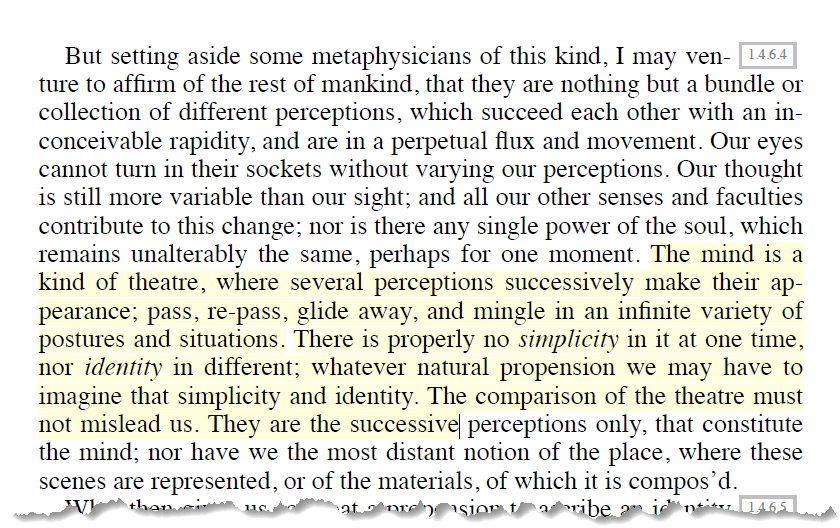

This is not merely a metaphysical claim. It is a grammatical one. Experience appears as a sequence of discrete items, each presentable as something one is or has at a given moment. Duration is reduced to succession; undergoing becomes adjacency. The copula does the quiet work.
From here, it is a short step to the analytic comfort with:
- truth-conditional analysis,
- propositional attitudes,
- mental states as objects of third-person description,
- and, eventually, the scientific naturalisation of consciousness.
None of this is accidental. The grammar and the metaphysics grow together.
The Continental Recoil
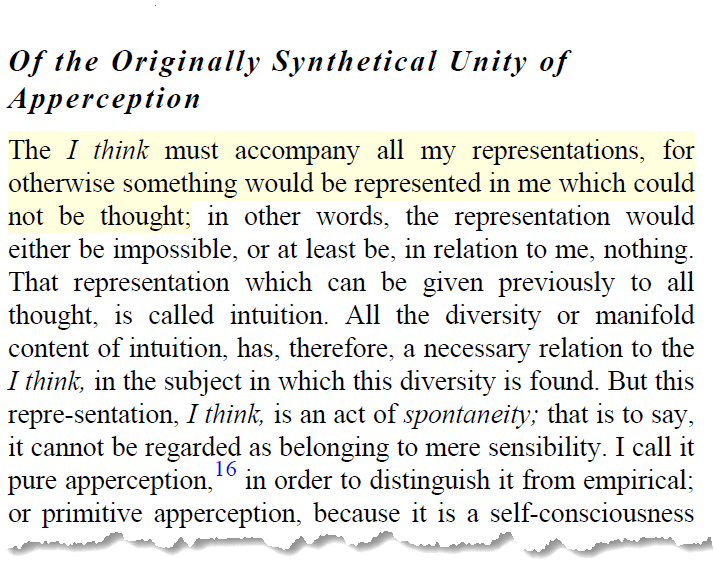
Across the Channel, a different unease takes hold. Immanuel Kant already resists the reduction of the subject to a bundle. In the Critique of Pure Reason (1781/1787), the ‘I think’ is not an object among objects but a necessary condition for experience at all.³ The subject cannot be encountered the way sensations can. It is not something one has or is; it is that through which anything appears.
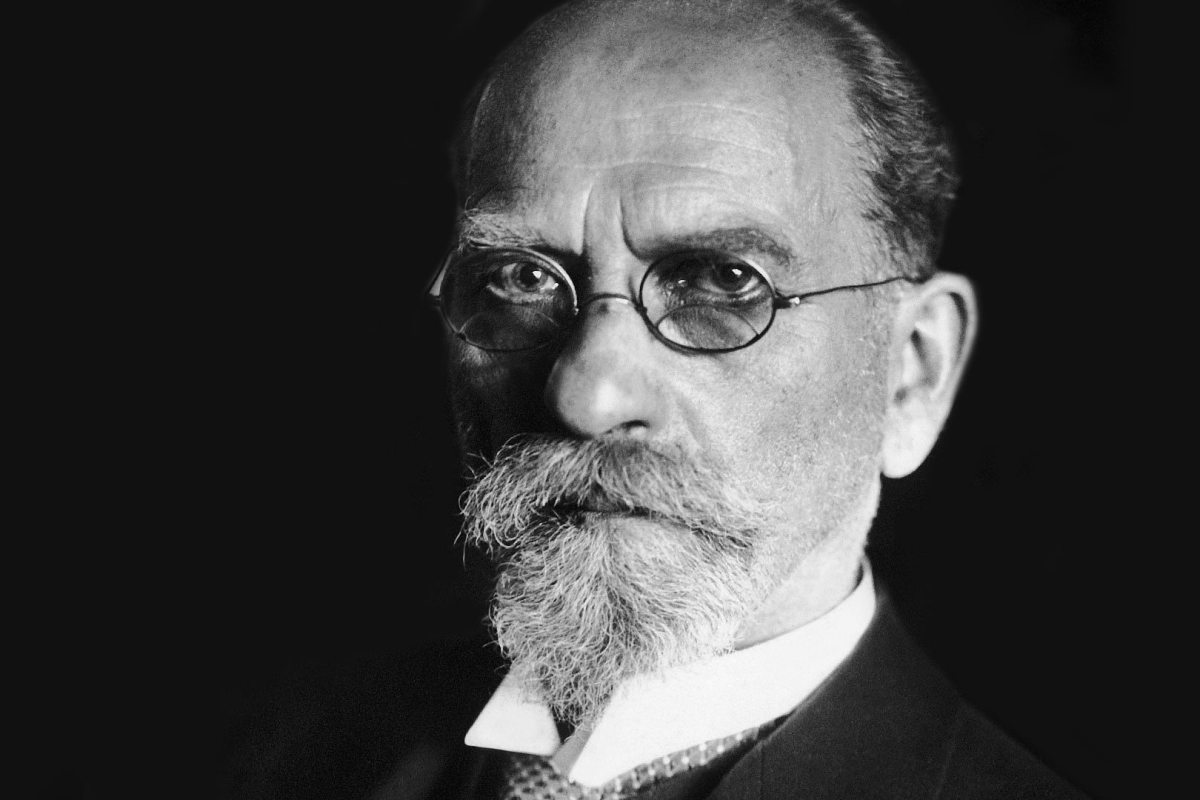
This resistance deepens with Edmund Husserl, whose phenomenology insists that experience must be described as it is lived, not as it is later reconstructed into states. Consciousness is intentional, temporal, and irreducibly first-personal.⁴ Duration is no longer a sequence of snapshots but a flowing structure of retention and protention.

Heidegger radicalises this further. In Being and Time (1927), Dasein is not a container for experiences but a mode of being-in-the-world. Experience is not something that happens inside a subject; it is the subject’s way of being disclosed to a world.⁵
By the time we reach Sartre and Merleau-Ponty, any attempt to treat sensation as a property or possession of a self begins to look like a category mistake. Feeling is not a thing one owns. It is a relation, an encounter, a situation.
Notably, these traditions operate in languages where ‘having’ and reflexive constructions dominate descriptions of sensation. This does not determine the philosophy, but it makes certain moves feel natural and others strained.
Two Ontologies, One Quiet Filter
What matters here is not who is right. It is that entire ontological styles become normalised long before argument begins. Grammar does not force conclusions, but it sets default expectations. Some descriptions feel ‘clean’, others ‘muddy’. Some questions feel legitimate, others oddly misframed. This is where institutional gatekeeping enters.
Peer review, citation norms, and journal scope are often described as quality controls. Sometimes they are. But they also function as recognition systems. Work that leans too heavily on phenomenological description may appear ‘imprecise’ to an analytic referee. Work that treats mental states as discrete objects may appear ‘naïve’or “reductive” to a continental one. Hybrid work becomes difficult to place, difficult to referee, and therefore risky. The issue is rarely explicit disagreement. It is a failure of grammatical hospitality.
Where Sensing Falls Through the Cracks
Against this background, it is perhaps unsurprising that sensing never becomes dominant. To speak of feeling is to refuse both ontological closure and inventory. It resists being cleanly formalised or neatly opposed. It fits awkwardly into truth-conditional frameworks and offers little leverage for grand theory. And yet, it is arguably closer to how experience actually unfolds. Which may explain why it remains linguistically available but philosophically marginal: acceptable in life, tolerated in literature, quietly sidelined in theory.
Notes (for those who care)
- Locke, J. (1690). An Essay Concerning Human Understanding, Book II, esp. chs. 1, 27.
- Hume, D. (1739–40). A Treatise of Human Nature, Book I, Part IV, §6.
- Kant, I. (1781/1787). Critique of Pure Reason, Transcendental Deduction.
- Husserl, E. (1913). Ideas Pertaining to a Pure Phenomenology.
- Heidegger, M. (1927). Being and Time.
NB: This may be a bit disorganised, but I’ve hit my limit.


 Philosophics