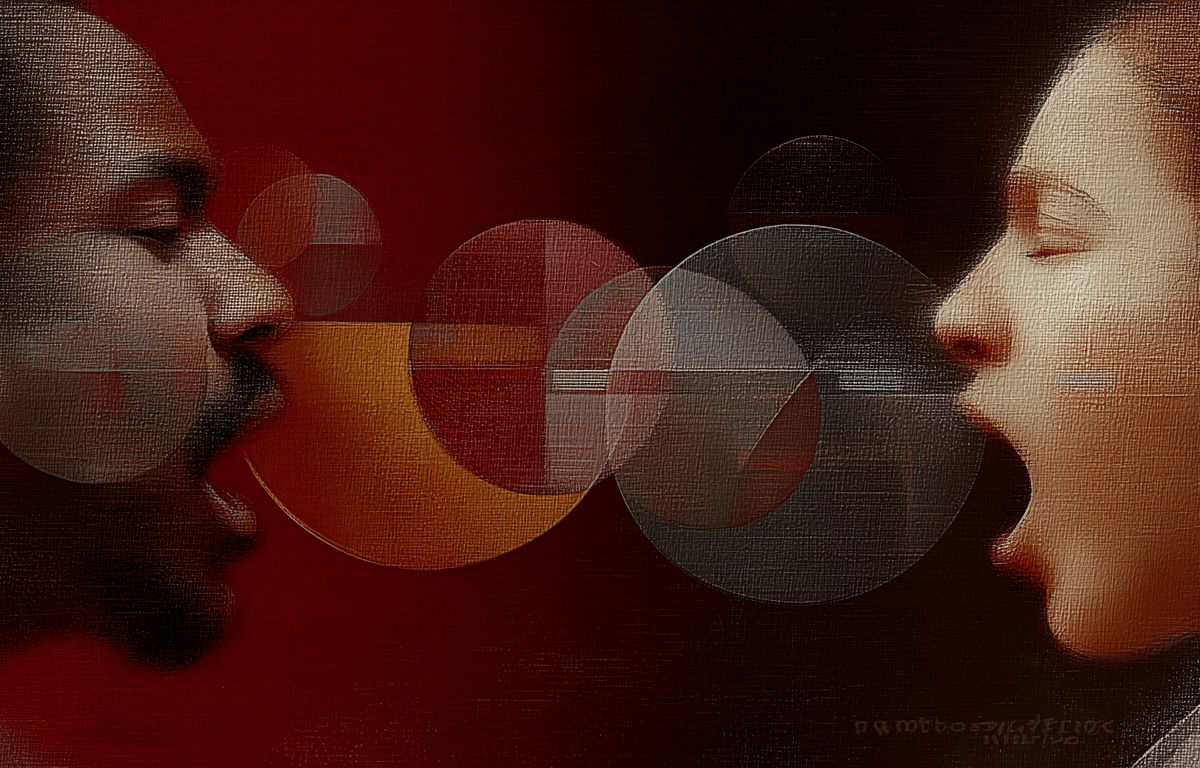
Why We Keep Talking Past Each Other

8–11 minutes

I am a philosopher of language. That is typically my primary perspective, so communication and limitations often fall into my sights. I believe that not all disagreements can be resolved through language communication. This illustrates one barrier in particular.

This essay is not an attempt to resolve disagreement, adjudicate truth, or reconcile competing worldviews. It is an attempt to explain why so many disagreements persist despite intelligence, good faith, and shared vocabulary – and why escalating those disagreements often makes them worse rather than better.

What follows is diagnostic rather than prescriptive. I am less interested in who is right than in why arguments so often fail to converge, and why those failures are routinely misinterpreted as moral defects rather than structural mismatches. The claim is not that ‘anything goes’, nor that all perspectives are equally valid, but that many disputes operate across ontological fault lines that no amount of better reasoning, evidence, or civility can bridge on their own terms.

Recognising this does not require abandoning one’s commitments. It requires abandoning the fantasy that every disagreement is corrigible and that persuasion is always the appropriate response to difference. If the essay succeeds, it will not produce consensus. It may, however, produce a little more clarity, a little less moral theatre, and a slightly more disciplined form of charity – one grounded not in agreement, but in an honest appraisal of where disagreement actually lives.

Audio: NotebookLM summary podcast of this content.

On Ontological Incommensurability and the Case for Civilised Disagreement

Most disagreements that metastasise into moral theatre are not disagreements at all. They are collisions between incompatible ontologies, misdiagnosed as differences of opinion.

We continue to behave as though all disputes take place on a shared stage called “reality,” where facts sit patiently waiting to be interpreted, weighed, or refuted. From this perspective, disagreement is assumed to be corrigible. If only one side listened harder, reasoned better, or acquired the right evidence, convergence would follow. This assumption is not merely optimistic. It is wrong.

Many of our most entrenched conflicts persist precisely because the parties involved do not inhabit the same world in any substantive sense. They operate with different background assumptions about what exists, what counts as real, what can ground truth, and what sorts of things are even eligible for belief. Argument, in such cases, does not fail due to bad faith or insufficient charity. It fails because it presumes a shared ontology that does not exist.

Before proceeding, a clarification. I am using ontology here in a deliberately broad, working sense. Not merely as an inventory of what exists, but as the background framework that determines what can count as real, meaningful, or normatively binding in the first place. This inevitably overlaps with epistemology, ethics, and theories of agency. Not because these domains are identical, but because in lived discourse they travel together. The fault line I am describing is not disciplinary. It is structural.

Video: Two people in ontological bubbles. (no sound)

Opinion Is Not Ontology

A difference of opinion presupposes a common world. Two people may disagree about what justice requires, but only because they agree, tacitly, that justice is a thing of some kind. Two people may dispute whether God exists, but only because they share enough conceptual scaffolding for the sentence to function.

Ontological disagreement runs deeper. It concerns not what is the case, but what it even means for something to be the case at all. When these levels are conflated, discourse becomes theatrical. Arguments are repeated with increasing urgency, frustration is moralised, and disagreement is reinterpreted as stubbornness, ignorance, or vice. Civility erodes not because people are cruel, but because they are speaking from worlds that do not interlock.

Consider debates over abortion. Pro-life arguments typically presuppose that the fetus is already a moral person; pro-choice arguments often presuppose that moral personhood is inseparable from bodily autonomy. These positions are not primarily disagreements about policy, compassion, or even ‘the value of life’. They are disagreements about what kinds of entities exist and when they begin to matter. Shared language about rights or harm often masks this deeper ontological divergence, which is why such debates rarely converge despite decades of argument.

When Critique Presumes the Ontology It Opposes

This distinction helps explain a familiar but often confusing phenomenon: cases where two parties appear to agree on symptoms, vocabulary, and even outrage, yet remain fundamentally misaligned.

Consider critiques of institutional cruelty that condemn dehumanising practices while retaining the very assumptions that make those practices intelligible. For example, workplace critiques that oppose excessive surveillance, unfair metrics, or punitive performance targets often still presume the figure of the autonomous, responsible worker whose output reflects individual will. The system is blamed for misapplying norms, not for producing those norms as instruments of control. Such critiques are often insightful and well-intentioned. They identify real harm. They name real suffering. And yet they stall.

The reason is not timidity or bad analysis. It is ontological inheritance. These critiques operate inside the same metaphysical framework that generates the harm they diagnose. They presuppose moral realism, individual agency, and normative grounding as givens, then object to their misapplication. The result is an internal critique: coherent, compelling, and structurally limited.

From a different ontological position, the problem is not that the norms are misapplied, but that the norms themselves function as delivery mechanisms of harm. What appears as reform from within appears as reenactment from without. This is not a misunderstanding. It is a category error.

Recognising this helps explain why superficial agreement so often feels productive while changing nothing. Shared language can create the appearance of convergence while leaving foundational divergence intact. The temperature drops. The mediator applauds. The underlying machinery hums on.

Igtheism and the Refusal to Pretend

This is why I describe myself, somewhat unfashionably, as an igtheist rather than an atheist.

Atheism still accepts the question ‘Does God exist?’ as well-formed. It grants the concept enough coherence to deny its instantiation. Agnosticism does much the same, merely pausing at the threshold. Both remain inside the game.

Igtheism steps back and asks a prior question: What, precisely, are we talking about? If no stable referent can be specified, the sentence does not become false. It becomes undefined. The system returns ‘does not compute’. This is not evasive. It is diagnostic.

Try as I may, I cannot make sense of strong metaphysical Realism, let alone Theism. The idea that there exists a fully formed, mind-independent world ‘out there’, grounding truth prior to mediation, language, practice, or perspective, does not parse for me. Not as a contested claim. As a coherent one.

However, and this is the crucial point, once I accept Realism as a mechanism, Theism suddenly makes sense. If you already believe in a metaphysically exterior realm that guarantees truth and coherence, then placing God there is not a leap. It is an economy of scale.

Paraphrased bluntly: They believe there is a whole world ‘out there’. I don’t believe in any of it, so God might as well live out there, too.

From within that worldview, atheistic Realism is arguably the stranger position. The cathedral has been built; denying the altar looks parsimonious rather than principled.

I am not offering a competing metaphysical system here. Not idealism, not pragmatism, not a substitute ontology waiting in the wings. I am declining the assumption that reality must come pre-packaged as a mind-independent domain in order to be intelligible or actionable at all.

Of course, non-realist positions are not exempt from this problem; they, too, can smuggle in unexamined ontological commitments under the guise of pragmatism, coherence, or practice.

Pascal’s Wager and Ontological Blackmail

This is why igtheism tends to offend theists more than atheism ever could. When a theist says, ‘How can you not care? Your soul depends on it’, they are not making an argument. They are issuing an ontological demand. Pascal’s Wager is merely this demand formalised into decision theory.

The wager only works if one has already granted the existence of souls, post-mortem identity, divine reward structures, and a cosmic enforcement mechanism that cares about belief states. Without those assumptions, there is no wager. There is only a shouted house rule addressed to someone who is not in the casino.

None of this is meant to trivialise the existential seriousness with which such claims are often held. It is simply to note that care does not precede ontology; it follows it. One cannot meaningfully care about entities one does not recognise as intelligible occupants of the world.

Why This Doesn’t End in Relativism

None of this implies that ‘all ontologies are equally true’, nor that disagreement is pointless. It implies something far less comforting and far more useful: many disagreements are non-resolvable by design. This does not deny that ontological frameworks can and do shift over time, sometimes under empirical pressure; it only denies that such shifts are guaranteed, universal, or achievable through argument alone.

Non-resolvability does not entail arbitrariness. Ontological frameworks can be evaluated for internal coherence, practical consequences, and the kinds of lives they make possible. What cannot be done is to adjudicate between them using criteria that belong exclusively to one side. Recognising this does not require abandoning one’s worldview. It requires abandoning the fantasy that persuasion is always possible, or that failure to persuade is a moral defect.

Once we see that we are not standing on the same ground, something like charity becomes possible. Not the saccharine kind. The disciplined kind. I understand that this matters enormously to you. I do not share the ontology that makes it matter to me. This is not a truce forged through compromise. It is a ceasefire born of ontological honesty.

Civility Without Convergence

Our age is addicted to resolution. Every disagreement is treated as a problem to be solved, a synthesis waiting to happen, a bridge yet to be built. Sometimes there is no bridge. Sometimes the most responsible thing to do is to stop pretending there is one.

Civility does not require agreement. It does not even require mutual understanding in the strong sense. It requires only that we stop mistaking incompatible world-models for intellectual obstinacy. We are not all arguing about the same furniture. Some of us are questioning whether the room exists at all.

Once that is acknowledged, the volume drops. The moral theatre loses its urgency. And disagreement, while still real, becomes less corrosive. Not because we have reconciled our ontologies. But because we have finally noticed that they do not reconcile.

Arriving Late to Massimi’s Party: Perspectival Realism in Parallel

Where our projects nod politely, then go their separate ways

I suppose it was inevitable. You spend years muttering into your notebook about mediation, realism without bombast, the irretrievability of universality, and the peculiar way science manages to stumble forward with partial, parochial tools… and then, inevitably, you discover that someone else—Michela Massimi, in this case—has been busy constructing her own edifice a few hills over.

Audio: NotebookLM podcast summary and discussion of this topic

I arrived late to her party. Fine. But now that I’m here, let’s pour a drink and compare architecture.

Because while our buildings look similar from a distance—both labelled Perspectival Realism—they’re made from different bricks and aimed at different skylines.


1. A Courteous Bow: We Are Not Strangers in the Same Wilderness

Massimi and I share several foundational intuitions:

  • No God’s-eye view.
    She rejects the fantasy of disembodied objectivity. So do I. Reality is not a neutral theatre awaiting the Enlightenment spectator.
  • Knowledge is situated.
    Her emphasis on historically embedded scientific communities echoes my own insistence that sense, cognition, and culture structure every act of knowing.
  • Plural perspectives, not universal sovereignty.
    No single inferential vantage point dominates; multiple perspectives can be fruitfully interlaced.
    That’s strikingly consonant with my claim that mediation is a condition, not a defect.
  • Anti-relativist without universalist delusion.
    Neither of us has patience for the “all maps are equal” caricature peddled by people who wouldn’t know a real relativist if they tripped over one in a library.

From this angle, we’re intellectual cousins—two people independently refusing Enlightenment triumphalism while refusing to surrender realism to the absolutists.


2. The Parting of the Ways: Our Projects Are Not the Same Creature

But similarities disguise deeper divergences. Here are the important ones:

a) She’s doing epistemology; I’m doing ontology.

Massimi reconstructs realism from the inside out by examining scientific practice—models, inferences, historically evolving toolkits.

My project is more structural. Sense mediation (icons), cognitive mediation (instrumentation), and linguistic-cultural mediation (conceptual carving) are not methodological observations; they are conditions of access to reality. They’re deeper than scientific practice—they underlie it.

b) She salvages realism; I happily burn universality and build realism back from the ashes.

Massimi is rehabilitating realism’s good name.
I’m less sentimental. Realism, as a doctrine, has been caught lying too many times. I want the realism of resistance, not the realism of representation.

c) Her anchor is “modal robustness”; mine is “structured resistance through mediation.”

Massimi’s realism rests on the idea that phenomena are robust across models and contexts—they persist modally.

I agree that robustness is useful. But robustness is filtered through linguistic concepts, cognitive priors, and sensorimotor limitations. It’s a second-order indicator, not a metaphysical foothold.

Resistance—the world’s refusal to bend to belief—is deeper. It’s what enables robustness to manifest.

d) Her perspectives are model-based; mine are existential.

Massimi focuses on scientific perspectives—frameworks articulated through inferential blueprints.

My perspectivalism lives at the level of:

  • what our senses can show,
  • what our minds can shape,
  • what our languages can articulate,
  • what our cultures deem thinkable.

That’s a wider cut than scientific models.

We are working at different depths of mediation.


3. Convergences Worth Keeping, Divergences Worth Defending

Let me put it cleanly:

  • Massimi gives us a realism of models.
    A realism that emerges from the community of scientific practice, negotiated through historically situated inferential perspectives.
  • I’m after a realism of resistance.
    A realism that remains intact even when models break, when languages fail, when cognitive categories run aground.
    Not the realism of what we say, but the realism of what pushes back.

Our projects are not incompatible, but they are differently motivated.

She is concerned with scientific rationality’s legitimacy.
I am concerned with the conditions of access to reality in the first place.

She patches the Enlightenment’s ship.
I point out that the ship’s hull is three layers of mediation thick, and pretend that universality is the hole in the floor.


4. A Clean Acknowledgement: She Was Here First (Sort Of)

Yes—Massimi coined the term in this specific form, and she developed a sophisticated, rigorous scientific perspectivism that deserves respect.

But my Perspectival Realism emerged from a different genealogy:

  • the insufficiency of language,
  • the inescapability of conceptual carving,
  • the recursive inadequacy of cognitive tools,
  • the quiet, stubborn existence of a world we only ever meet askance.

Different animals. Same habitat.

So no, I’m not competing with Massimi.
And no, I’m not rebranding her work.

What I’m doing—and what this piece makes explicit—is placing my ontology in dialogue with hers. Two parallel rejections of universality. Two parallel refusals of relativism. Two parallel attempts to articulate realism without pretending we’ve escaped the conditions of being human.

If I arrived late to her race, so be it.
I’m not running for her finish line anyway.


DISCLAIMER: This article was written or output by ChatGPT 5.1. It started as a conversation with Claude Sonnet 4.5, where I had input days of output for evaluation. One of these outputs was the post about Erasmus and the Emissary Who Forgot to Bow. A group chat ensued between me, Claude and ChatGPT.

What started as a discussion about the merits of my position, expressed in the Erasmus-influenced essay, drifted to one about Perspectival Realism. That discussion deepened on ChatGPT, as I further discussed my recent thoughts on the latter topic. I had rendered a Magic: The Gathering parody trading card as I contemplated the subject. It’s how my brain works.

All of this led me to ask ChatGPT to summarise the conversation, and, upon further discussion, I asked it to draft this article – the second of five.

  1. Perspectival Realism: The First Ontology Without an Asterisk
    This article discusses what Perspectival Realism means to me and how I got to this position.
  2. Why Perspectival Realism Is Not Relativism
    Further discussion prompted me to differentiate this ontology from other perspectives.
  3. Arriving Late to Massimi’s Party: Perspectival Realism in Parallel 👈
    I spent another half-hour following Google search results as I wanted to see if anyone else had already been using the term, Perspectival Realism. I ended up on the Oxford publishing site. I found a 2022 book with this name, authored by Michela Massimi. They allowed me to download the book, so I asked ChatGPT to summarise our positions, specifically where we agreed and differed.
  4. Against the Vat: Why Perspectival Realism Survives Every Sceptical Hypothesis
    At 0500, I returned to bed, but I woke up again at 0700, thinking about how one might differentiate between Putnam’s brain in a vat from Perspectival Realism. ChatGPT asked if I wanted that output in long-form.
  5. The Constraint Interface: Toward a Nexal Ontology
    Being uncomfortable with the dichotomy between Realism and Idealism, I chatted to come up with terminology that disrupts what I consider a false dichotomy, focusing on the nexus rather than privileging one or the other. Consider this similar to the debate on sex and gender binaries.

As I mentioned at the end of the first series, I may return to this series and publish a coherent expository version more in line with my usual style. Meantime, this allows me to share my ideas unvarnished and unpolished at the same time, granting me more time to focus on other matters. Apologies to those who may disagree with the outline format. Honestly, it annoys me, but I am choosing function over form at the moment.

Why Perspectival Realism Is Not Relativism

Reality decides; perspectives compete.

The moment you say “our access to reality is mediated,” someone inevitably performs their civic duty as Defender of Enlightenment Orthodoxy and announces, as if discovering fire, “So you’re a relativist, then?”

It’s a comforting little reflex. If a position denies universality, it must be relativism. If it rejects the view from nowhere, it must reject the very idea of truth. If it acknowledges cultural scaffolding, it must be one critique away from saying flat-earthers and astrophysicists are peers.

This objection misunderstands both relativism and Perspectival Realism.

Audio: NotebookLM podcast summarising this topic.

Let’s begin with the essential distinction—think of this as the tattoo at the base of the spine:

Relativism says: all maps are equally valid.
Perspectival Realism says: all maps are partial, and some are better.

  • Better at predicting.
  • Better at surviving.
  • Better at cohering with everything else we know.
  • Better at not getting you killed.

This is the spine of the position. Everything else is elaboration.


Relativism’s Self-Destruct Button

Relativism denies that reality has enough structure to constrain belief. According to its logic, perspectives are sovereign. The world bends to interpretation.

If that were true:

  • Gravity would turn itself off for anyone sufficiently committed to optimism.
  • Viruses would consult your cosmology before infecting you.
  • The Müller–Lyer illusion wouldn’t vary between populations because there’d be no stable perceptual machinery for it to fool.

Relativism collapses because the world does not permit it.

Perspectival Realism begins from the opposite premise:

  • There is one reality.
  • It resists us.
  • Perspectives rise or fall by how well they handle that resistance.

You can’t get further from relativism than that.


Why Perspective ≠ Prison

Another familiar confusion:
“If access is perspectival, aren’t we trapped in our own little worlds?”

No.
Mediation isn’t isolation. It’s a shared condition.

You and I may wear sunglasses of different tint, but we still walk the same street. Your glasses may darken the building I call “red,” so you call it “dark red.” That’s not incommensurability—that’s disagreement within a shared world. We argue, we adjust, we converge.

Perspectival Realism doesn’t say “worlds are sealed off.”
It says we are situated—embodied, encultured, cognitively structured.
Our lenses differ. The street does not.


The Crucial Point: The World Pushes Back

Relativism has no mechanism for adjudication. Perspectival Realism has the best one available: reality’s structured resistance.

If your perspective predicts, explains, and survives contact with the world, it’s better. If it collapses upon use, it’s worse. If it transfers across contexts, it’s better. If it leaves you dead, it’s worse.

This is not metaphysics.
It’s survival.

And it is very explicitly not relativism.


Logic: Form Universal, Application Situated

A predictable objection:

Objection: “Isn’t logic universal? Doesn’t that kill perspectivalism?”

Response:
Basic inferential forms—modus ponens, contradiction—are indeed widespread. That’s Layer 2 architecture: the cognitive machinery we all share.

But what counts as a valid premise, which inferences feel compelling, and which conclusions are considered exhaustive vary across cultures (Layer 3). Logic’s form is stable; its deployment is contextual.

Perspectival Realism doesn’t deny logic.
It denies the fantasy that logic operates in a cultural vacuum.


Relativism’s Moral Collapse

Why “anything goes” goes nowhere

Relativism becomes lethal the moment ethics enters the scene. If all perspectives are equally valid, you lose the ability to critique harmful practices. Torture, forced servility, institutionalised cruelty—all become “just different frameworks.”

Perspectival Realism rejects this.

You don’t need a metaphysical skyhook to condemn torture.
You need:

  • Shared vulnerability – all humans are embodied beings capable of pain.
  • Empirical observation – societies that normalise cruelty become unstable and self-poisoning.
  • Pragmatic convergence – diverse cultures can agree that some practices destroy the conditions of flourishing.
  • Reality-tested norms – ethical systems survive because they work, not because they download from a Platonic server.

This is not relativism.
It’s ethics under realism-without-universality.

You can condemn harmful practices without pretending to be the mouthpiece of timeless universal Reason. You can ground human rights in intersubjective evidence—not metaphysical fiat.

No view from nowhere required.


The Three-Way Contrast
(The Only Chart You Need)

Naive Realism:
There is one perfectly accurate map.

Relativism:
All maps are equally good.

Perspectival Realism:

  • All maps are partial.
  • Some are atrocious.
  • Some work astonishingly well because they track deeper regularities of the terrain.
  • No map is complete.
  • No map is sovereign.
  • The terrain adjudicates between them.

You don’t need omniscience to compare maps.
You need terrain.
And we all share the same one.


Prediction: The Final Judge

If you want the single litmus test:

  • Does the perspective predict anything?
  • Does it do so consistently?
  • Does it correct itself when wrong?
  • Does it transfer beyond its original context?

If yes → closer to reality.
If no → a charming story, but please don’t build bridges with it.

Relativism has no concept of “closer to.”
Perspectival Realism depends on it.


Putting It All Together

Perspectival Realism maintains:

  • Realism: the world exists independently of our representations.
  • Anti-universalism: no representation escapes mediation.
  • Anti-relativism: some representations perform better because they align more closely with what the world actually does.
  • Humility: we navigate through partial perspectives, comparing, refining, and error-correcting.

No one gets to declare universal sovereignty.
Everyone gets tested by the same reality.

Relativism says everything is equally true.
Perspectival Realism says everything is equally mediated—but not equally successful.

  • Reality decides.
  • Perspectives compete.
  • And relativism loses on the first contact.

COMMENTARY: To be fair, the argument about relativism is a strawman argument against virtually no one who would hold or defend this position. For whatever reason, the training data indicated that this was a significant contender. I’ve heard similar weak strawmen in other disciplines, and I felt I should address the invisible elephant in the room. — Bry Willis


DISCLAIMER: This article was written or output by ChatGPT 5.1. It started as a conversation with Claude Sonnet 4.5, where I had input days of output for evaluation. One of these outputs was the post about Erasmus and the Emissary Who Forgot to Bow. A group chat ensued between me, Claude and ChatGPT.

What started as a discussion about the merits of my position, expressed in the Erasmus-influenced essay, drifted to one about Perspectival Realism. That discussion deepened on ChatGPT, as I further discussed my recent thoughts on the latter topic. I had rendered a Magic: The Gathering parody trading card as I contemplated the subject. It’s how my brain works.

All of this led me to ask ChatGPT to summarise the conversation, and, upon further discussion, I asked it to draft this article – the second of five.

  1. Perspectival Realism: The First Ontology Without an Asterisk
    This article discusses what Perspectival Realism means to me and how I got to this position.
  2. Why Perspectival Realism Is Not Relativism 👈
    Further discussion prompted me to differentiate this ontology from other perspectives.
  3. Arriving Late to Massimi’s Party: Perspectival Realism in Parallel
    I spent another half-hour following Google search results as I wanted to see if anyone else had already been using the term, Perspectival Realism. I ended up on the Oxford publishing site. I found a 2022 book with this name, authored by Michela Massimi. They allowed me to download the book, so I asked ChatGPT to summarise our positions, specifically where we agreed and differed.
  4. Against the Vat: Why Perspectival Realism Survives Every Sceptical Hypothesis
    At 0500, I returned to bed, but I woke up again at 0700, thinking about how one might differentiate between Putnam’s brain in a vat from Perspectival Realism. ChatGPT asked if I wanted that output in long-form.
  5. The Constraint Interface: Toward a Nexal Ontology
    Being uncomfortable with the dichotomy between Realism and Idealism, I chatted to come up with terminology that disrupts what I consider a false dichotomy, focusing on the nexus rather than privileging one or the other. Consider this similar to the debate on sex and gender binaries.

As I mentioned at the end of the first series, I may return to this series and publish a coherent expository version more in line with my usual style. Meantime, this allows me to share my ideas unvarnished and unpolished at the same time, granting me more time to focus on other matters. Apologies to those who may disagree with the outline format. Honestly, it annoys me, but I am choosing function over form at the moment.