Philosophers adore two things: inventing problems and then fainting when someone solves them. For decades, we’ve been treated to the realism–idealism tug-of-war, that noble pantomime in which two exhausted metaphysical camps clutch the same conceptual teddy bear and insist the other stole it first. It’s almost touching.
Enter Nexal Ontology, my previous attempt at bailing water out of this sinking ship. It fought bravely, but as soon as anyone spotted even a faint resemblance to Whitehead, the poor thing collapsed under the weight of process-cosmology PTSD. One throwaway comment about ‘actual occasions’, and Nexal was done. Dead on arrival. A philosophical mayfly.
But MEOW* – The Mediated Encounter Ontology of the World – did not die. It shrugged off the Whitehead comparison with the indifference of a cat presented with a salad. MEOW survived the metaphysical death match because its commitments are simply too lean, too stripped-back, too structurally minimal for speculative cosmology to get its claws into. No prehensions. No eternal objects. No divine lure. Just encounter, mediation, constraint, and the quiet dignity of not pretending to describe the architecture of the universe.
And that’s why MEOW stands. It outlived Nexal not by being grander, but by being harder to kill.
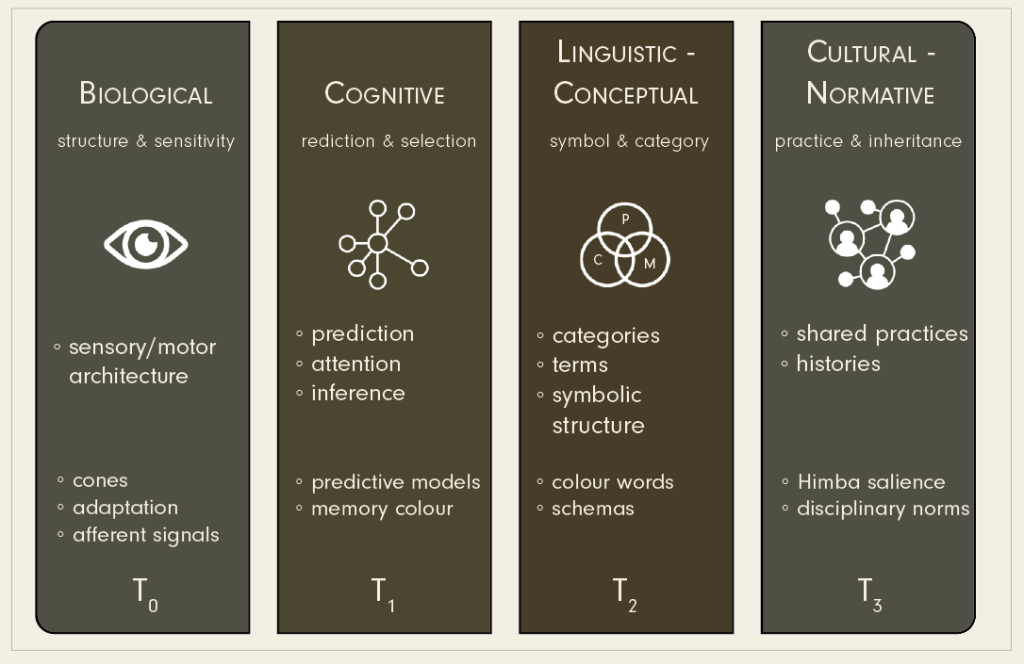
Image: The Four Mediation Layers – Biological, Cognitive, Conceptual, Cultural – structuring every encounter we mistake for ‘direct’.
This little illustration gives the flavour: • T0 Biological mediation – the body’s refusal to be neutral. • T1 Cognitive mediation – the brain, doing predictive improv. • T2 Linguistic–conceptual – words pretending they’re objective. • T3 Cultural–normative – the inheritance of everyone else’s mistakes.
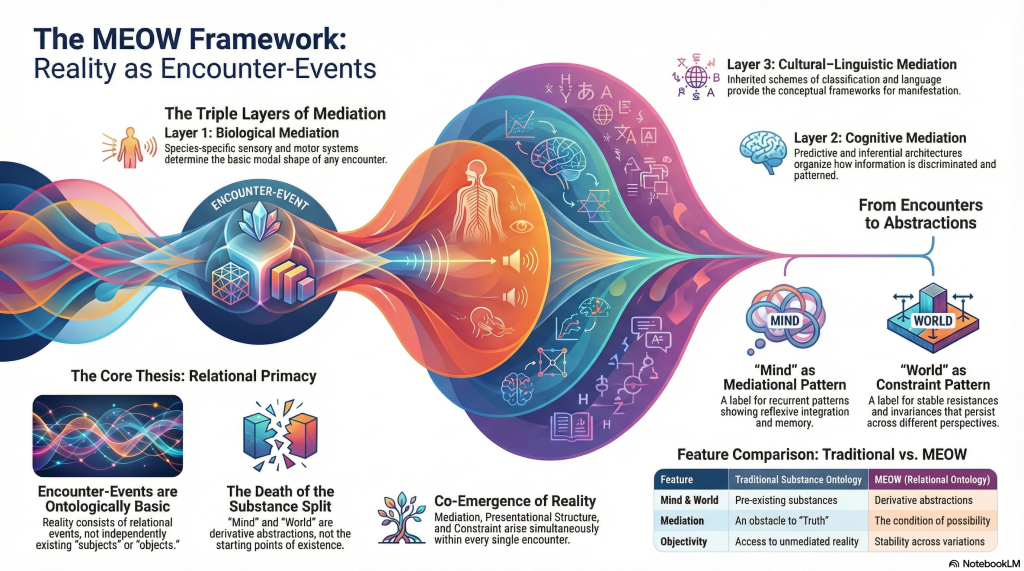
The essay argues that what we call ‘mind’ and ‘world’ are just abstractions we extract after the encounter, not the metaphysical scaffolding that produces it. Once you begin with the encounter-event itself – already mediated, already structured, already resistive – the mind–world binary looks about as sophisticated as a puppet show.
Image: NotebookLM Infographic (merges cognitive-linguistic, which I don’t support)
What the essay actually does
The Mediated Encounter Ontology of the World is the first framework I’ve written that genuinely sheds the Enlightenment scaffolding rather than rebuking it. MEOW shows:
Mediation isn’t an epistemic flaw; it’s the only way reality appears.
Constraint isn’t evidence of a noumenal backstage; it’s built into the encounter.
Objectivity is just stability across mediation, not a mystical view-from-nowhere.
‘Mind’ and ‘world’ are names for recurring patterns, not metaphysical hotels.
And – importantly – MEOW does all of this without drifting into Whiteheadian cosmological fan-fiction.
If you prefer a soft landing and the sound of a passable human voice explaining why metaphysics keeps tripping over its shoelaces, a NotebookLM discussion is here:
Audio: NotebookLM summary podcast of this essay.
MEOW is the survivor because it does the one thing philosophy is terrible at: it refuses to pretend. No substances, no noumena, no grand metaphysical machinery—just a clean, relational architecture that mirrors how we actually encounter the world.
And frankly, that’s quite enough ontology for one lifetime.
* To be perfectly honest, I originally fled from Michela Massimi’s Perspectival Realism in search of a cleaner terminological habitat. I wanted to avoid the inevitable, dreary academic cross-pollination: the wretched fate of being forever shelved beside a project I have no quarrel with but absolutely no desire to be mistaken for. My proposed replacement, Nexal Ontology, looked promising until I realised it had wandered, by sheer lexical accident, into Whitehead’s garden – an unintentional trespass for which I refused to stick around to apologise. I could already hear the process-metaphysics crowd sharpening their teeth.
Early evasive action was required.
I preferred nexal to medial, but the terminology had already been colonised, and I am nothing if not territorial. Mediated Ontology would have staked its claim well enough, but something was missing – something active, lived, structural. Enter the Encounter.
And once the acronym MEO appeared on the page, I was undone. A philosopher is only human, and the gravitational pull toward MEOW was irresistible. What, then, could honour the W with appropriate pomp? The World, naturally. Thus was born The Mediated Encounter Ontology of the World.
Pretentious? Yes. Obnoxious? Also yes.
And so it remains—purring contentedly in its absurdity.
Update: Please note that I have refined my position on this and documented it in a newer post. It builds upon this idea but clarifies some disconnects and provides me with some ontological distance from Massimi.
There comes a moment in any serious thinker’s life when the metaphysical menu starts looking like a bad buffet: too much on offer, none of it quite edible, and the dishes that appear promising turn out to depend on ingredients you can’t stomach. Realism insists the world is simply there, chugging along regardless of your opinions. Anti-realism points out, inconveniently, that all your access is wildly mediated. Perspectivism adds humility. Constructivism chastises you for overconfidence. Analytic Idealism sweeps matter off the table entirely, until you ask why consciousness spits out such stubbornly consistent patterns.
I’ve been through all of them. Realism*—asterisk for “but what about mediation?” Idealism*—asterisk for “but what about resistance?”
Everything almost worked. And “almost” is the metaphysical kiss of death. “Almost” is where the asterisks live.
Perspectival Realism is the first position I can hold without planting that apologetic little star in the margins.
Audio: NotebookLM podcast summary on this topic.
The Asterisk Journey (Brief, Painless, Necessary)
This isn’t a conversion narrative. It’s a salvage operation. Each station on the journey left me with tools worth keeping.
Layer 1: Iconography (Hoffman, minus the metaphysics)
Perception is not a window. It’s an interface. A species-specific dashboard designed for survival, not truth. Evolution gave you a set of icons—colour patches, contrast edges, looming shapes—not an accurate rendering of reality’s architecture.
Uexküll called this the umwelt: every organism inhabits its own perceptual slice of the world. Bees see ultraviolet; snakes sense heat; humans see embarrassingly little.
This is Layer 1 mediation: Reality-as-filtered-for-primates.
Layer 2: Instrumentation (Kastrup, minus the leap)
Consciousness is the instrument through which reality is measured. Measuring instruments shape the measurements. That doesn’t make the world mind-shaped; it just means you only ever get readings through the apparatus you’ve got.
This is Layer 2 mediation: Your cognitive architecture—predictive priors, attentional limitations, spatial-temporal scaffolding—structures experience before thought arrives.
Where I leave Kastrup behind is the familiar leap: “Because consciousness measures reality, reality must be made of consciousness.” That’s the instrumentality fallacy.
You need consciousness to access the world. That tells you nothing about what the world is.
Layer 3: Linguistic–Cultural Carving (Your home field)
And then comes the mediation philosophers most reliably ignore: language. Language does not describe reality. It carves it.
Some cultures divide colour into eleven categories; some into five. The Müller-Lyer illusion fools Westerners far more than it fools hunter-gatherers. Concepts feel natural only because you inherited them pre-packaged.
This is Layer 3 mediation: the cultural-linguistic filter that makes the world legible—and in the same breath, distorts it.
You mistake the map for the territory because it’s the only map you’ve ever held.
The Hard Problem, Dissolved — Not Solved
When English splits the world into “mental” and “physical,” it accidentally manufactures the “hard problem of consciousness.” Sanskrit traditions carve reality differently and end up with different “mysteries.”
The hard problem isn’t a revelation about reality. It’s a conceptual knot tied by Layer 3 mediation.
Changing the ontology to “everything is mind” doesn’t untie the knot. It just dyes the rope a different colour.
The Triple Lock
Put the three layers together and you get the honest picture:
Your senses give you icons, not the thing-in-itself.
Your cognition structures those icons automatically.
Your culture tells you what the structured icons mean.
And yet—despite all of this—the world pushes back.
Gravity doesn’t care about your interpretive community. Arsenic does not negotiate its effects with your culture. Your beliefs about heat won’t keep your hand from burning.
This is the fulcrum of Perspectival Realism:
Reality is real and resists us, but all access is triply mediated.
The realism remains. The universality does not.
Why Perspectival Realism is Not Relativism
Relativism says: “Everyone’s perspective is equally valid.” Perspectival Realism says: “Everyone’s perspective is equally situated.”
Very different claims.
Some perspectives predict better. Some cohere better. Some survive reality’s resistance better. Some transfer across contexts better. Some correct their own errors faster.
You don’t need a view from nowhere to say that. You just need to notice which maps get you killed less often.
What This Framework Enables
1. Progress without foundation myths
Science improves because reality resists bad models. Mediation doesn’t prevent progress; it’s the condition of it.
2. Critique without arrogance
You can rank perspectives without pretending to hover above them.
3. Cross-cultural dialogue without imperialism or despair
Cultures carve experience differently, but they’re carving the same underlying world. Translation is hard, not impossible.
4. Honest metaphysics
No glamourised escape from sensory embodiment, cognitive bias, or cultural inheritance. Just the patient business of refining our mediated grip on the real.
What Perspectival Realism Actually Claims
Let me make the commitments explicit:
There is a world independent of our representations.
All access to it is mediated by perception, cognition, and culture.
Perspectives can be compared because reality pushes back.
No perspective is unmediated.
The asymptote—Reality-as-it-is—is unreachable.
This isn’t pessimism. It’s maturity.
Why This Is the First Ontology Without an Asterisk
Every worldview before this needed the quiet, shamefaced footnote:
Realism*: “But access is mediated.”
Idealism*: “But resistance is real.”
Perspectivism*: “But we still need to rank perspectives.”
Constructivism*: “But the world’s invariances aren’t constructs.”
Perspectival Realism eats the objections instead of dodging them. There is no asterisk because the worldview is built from the asterisks.
No promises of transcendence. No pretense of universality. No linguistic sleight-of-hand.
Just embodied beings navigating a real world through fallible instruments, shared practices, and cultural grammars—occasionally catching a clearer glimpse, never stepping outside the frame.
The realism remains. The universality does not. And for once, metaphysics isn’t lying to you.
DISCLAIMER: This article was written or output by ChatGPT 5.1. It started as a conversation with Claude Sonnet 4.5, where I had input days of output for evaluation. One of these outputs was the post about Erasmus and the Emissary Who Forgot to Bow. A group chat ensued between me, Claude and ChatGPT.
What started as a discussion about the merits of my position, expressed in the Erasmus-influenced essay, drifted to one about Perspectival Realism. That discussion deepened on ChatGPT, as I further discussed my recent thoughts on the latter topic. I had rendered a Magic: The Gathering parody trading card as I contemplated the subject. It’s how my brain works.
All of this led me to ask ChatGPT to summarise the conversation, and, upon further discussion, I asked it to draft this very article – the first of five.
Perspectival Realism: The First Ontology Without an Asterisk 👈 This article discusses what Perspectival Realism means to me and how I got to this position.
Arriving Late to Massimi’s Party: Perspectival Realism in Parallel I spent another half-hour following Google search results as I wanted to see if anyone else had already been using the term, Perspectival Realism. I ended up on the Oxford publishing site. I found a 2022 book with this name, authored by Michela Massimi. They allowed me to download the book, so I asked ChatGPT to summarise our positions, specifically where we agreed and differed.
Against the Vat: Why Perspectival Realism Survives Every Sceptical Hypothesis At 0500, I returned to bed, but I woke up again at 0700 thinking about how one might differentiate between Putnam’s brain in a vat from Perspectival Realism. ChatGPT asked if I wanted that output in long-form.
The Constraint Interface: Toward a Nexal Ontology Being uncomfortable with the dichotomy between Realism and Idealism, I chatted to come up with terminology that disrupts what I consider a false dichotomy, focusing on the nexus rather than privileging one or the other. Consider this similar to the debate on sex and gender binaries.
Could I have improved on these articles if I had rewritten or polished them? Maybe. What’s the purpose? This is all a result of my concepts and inquiries. I endorse the output. I may return to make edits in future, or I may restate this information in my own voice, but for now, let this serve as notice that I am not afraid of generative AI; I am not afraid that it is going to supplant my thinking. I find that whilst I can prompt GPTs to make connexions or to query who else might be relevant to a topic, it doesn’t generally offer its own initiative, what we term Agency.
As for this particular post, it reads more like a listicle. I could have rendered it more expositional, but the structured thinking is all here; why should I reinvent the wheel just to put skin on these bones? As I said, perhaps I’ll flesh this out for elaboration or publication in future, for now, let this serve as a waypoint and a record of how I got here. This supplants my prior position, the asterisked Analytic Idealism, published in 2022, which supplanted my asterisked Realism. Perhaps I’ll finally be able to settle for an ontology and epistemology with no stars.
We live in an age intoxicated by models: climate models, economic models, epidemiological models, cosmological models—each one an exquisite confection of assumptions draped in a lab coat and paraded as gospel. Yet if you trace the bloodline of model-building back through the annals of intellectual history, you encounter two figures who coldly remind us of the scam: George Box and Hilary Lawson.
Box: The Gentle Assassin of Certainty
George Box, the celebrated statistician, is often credited with the aphorism: “All models are wrong, but some are useful.” However, Box himself never uttered this precise phrase. What he did say, in his 1976 paper Science and Statistics, was:
“Since all models are wrong, the scientist must be alert to what is importantly wrong.”
George Box
The “some are useful” flourish was added later by a public desperate to sweeten the bitter pill. Nevertheless, Box deserves credit for the lethal insight: no model, however elegant, perfectly captures reality. They are provisional guesses, finger-paintings smeared across the rough surface of the unknown.
Audio: NotebookLM podcast on this topic.
Lawson: The Arsonist Who Burned the Map
Hilary Lawson, contemporary philosopher and author of Closure: A Story of Everything, drags Box’s modest scepticism into full-blown philosophical insurrection. In a recent lecture, Lawson declared:
“You don’t need truth to have a usable model.”
Hilary Lawson
Where Box warns us the emperor’s clothes don’t fit, Lawson points out that the emperor himself is a paper doll. Either way, we dress our ignorance in equations and hope no one notices the draft.
Lawson’s view is grim but clarifying: models are not mere approximations of some Platonic truth. They are closures—temporary, pragmatic structures we erect to intervene effectively in a world we will never fully comprehend. Reality, in Lawson’s framing, is an “openness”: endlessly unfolding, resistant to total capture.
The Case of the Celestial Spheres
Take Aristotle’s model of celestial spheres. Ludicrous? Yes. Obsolete? Absolutely. Yet for centuries, it allowed navigators to chart courses, astrologers to cast horoscopes, and priests to intimidate peasants—all without the slightest whiff of heliocentrism. A model does not need to be right; it merely needs to be operational.
Our modern theories—Big Bang cosmology, dark matter, and quantum gravity—may well be tomorrow’s celestial spheres: charming relics of ignorance that nonetheless built bridges, cured diseases, and sold mobile phones.
Summary Table: Lawson’s View on Models and Truth
Aspect
Lawson’s Position
Role of Models
Tools/metaphors for intervention, not truth
Truth
Not required for usefulness
Refinement
Models are improved for practical effectiveness
Reality
Fundamentally open, never fully captured by models
Implication
Focus on utility and adaptability, not final truth
Conclusion
Box taught us to distrust the fit of our models; Lawson reminds us there is no true body underneath them. If truth is a ghost, then our models are ghost stories—and some ghost stories, it turns out, are very good at getting us through the night.
We are left not with certainty, but with craftsmanship: the endless, imperfect art of refining our closures, knowing full well they are lies that work. Better lies. Usable lies. And perhaps, in a world without final answers, that is the most honest position of all.
I’ve been reengaging with philosophy, though my positions haven’t changed recently. My last change was to shift from being a qualified material realist to a qualified idealist in the shape of Analytic Idealism. In most matters I can think of, I am an anti-realist, which is to say concepts like truth and morality are not objective; rather they are mind-dependent.
I’ve long been on record of taking the stance that Capital-T Truth, moral truths, are derived rhetorically. There is no underlying Truth, only what we are aggregately convinced of, by whatever route we’ve taken. As a moral non-cognitivist, I am convinced that morality is derived through emotion and expressed or prescribed after a quick stop through logic gates. Again, there is nothing objective about morality.
Truth and morality are subjective and relative constructs. They resonate with us emotionally, so we adopt them.
Were I a theist — more particularly a monotheist —, I might be inclined to be emotionally invested in some Divine Command theory, where I believe that some god may have dictated these moral truths. Of course, this begs the question of how these so-called “Truths” were conveyed from some spirit world to this mundane world. I have no such conflict.
But let’s ask how an atheist might believe in moral realism. Perhaps, they might adopt a Naturalistic stance: we have some natural intuition or in-built moral mechanism that is not mind-dependent or socially determined. I am not a naturalist and I don’t take a universalist approach to the world, so this doesn’t resonate with me. I can agree that we have an in-built sense of fairness, and this might become a basis for some aspects of morality, but this is still triggered by an emotional response that is mind-dependent.
Another curious thing for me is why non-human animals cannot commit immoral acts. Isn’t this enough to diminish some moral universal? In the end, they are an extension of language by some definition. No language, not even a semblance of morality.
Anyway, there’s nothing new here. I just felt like creating a philosophical post as I’ve been so distracted by my health and writing.


 Philosophics