Several countries set aside holidays to celebrate thanks-giving. This is a fine tradition, if not hypocritical, given the behaviours manifest on the other days, which isn’t to say that the day itself isn’t without consistency challenges.
Audio: NotebookLM summary podcast on this topic.
In the United States, today is the day of thanks – Thanksgiving™ – the last Thursday of the month of November. This problem isn’t the day or the name; it’s the accompanying tradition that has to go.
Video: “Pilgrim” riding a 4-legged turkey – Damned Midjourney. (No sound).
This day is supposed to represent a day of unity, where the Pilgrims™ shared thanks with the indigenous peoples, without whom they would have likely perished. Without Romanticising, this might have been a better outcome.
As history is penned by the survivors, the Pilgrims and their ilk repaid their thanks with genocide and systematic oppression. The country – renamed as America, and then the United States of… (a misnomer if there ever was one) – summarily renamed these inhabitants as Native Americans. Somehow, Proto Americans feels more apt.
To make a long story longer, we need to jettison this performative connexion to these indigenous peoples and focus on just being thankful for the sake of being thankful – at least by metaphor. This isn’t out of respect for the indigenous cultures, but at least reflects less revisionist history.
They almost got rid of Columbus Day, if not for the uprising of white Christian nationalists. They should extricate the religious aspects of Christmas, an even more hypocritical holiday.
Or maybe I just don’t like holidays.
More accurately, I don’t trust a civilisation that sets aside one day to perform gratitude, then spends the remaining 364 as a Black Friday pre-game warmup. We gorge on narratives the way we gorge on turkey: carving up the past, seasoning it with national mythology, and swallowing without chewing. The Pilgrims™ didn’t break bread so much as break treaties; they didn’t share so much as seize. But here we are, centuries later, performing thanks like a national yoga pose. Stretch, breathe, pretend everything is fine.
What if, instead of reanimating a historical fan-fiction about harmony and pie, we admitted the truth? That the country owes its existence to conquest, and its conscience to annual amnesia? Strip Thanksgiving of its sanctimony and keep the gratitude if you must, but at least stop embossing colonialism with little cartoon turkeys in buckled hats.
Be thankful for the food, for the people you’ve not yet alienated, for the brief respite from wage-slavery. But realise the holiday itself is a museum of revision. A diorama of innocence that never existed. A Norman Rockwell oil painting slapped over a crime scene.
So enjoy your meal. Be warm, be fed, be kind – even if only for a day. Just don’t confuse the performance of gratitude with the reality it obscures.
Given all of the clamouring about taxations and abolishing the Internal Revenue Service, affectionately known as the IRS. In Britain, one may be more aware of His Majesty’s Revenue and Customs (HMRC). In France, it’s Direction générale des Finances publiques (DGFiP).
Audio: NotebookLM podcast on this topic.
Given how up in arms the reincarnation of the NAZI party, disfectionately known as Republicans (or Republican’ts depending on your mood or persuasion), have been towards the IRS and taxation in general – they love to cosplay tossing crates of tea into harbours – I asked ChatGPT to clarify the originals of income taxes in the United States.
For the benefit of more casual readers, income taxes were unconstitutional – illegal – until 1913. These were snuck in under the guise of only applying to the wealthy, the 1% of the time. But once the floodgates were opened, the focus shifted to the 95%, increasingly exempting the wealthy. Even so, they still complain and evade.
Enough wittering. Here’s what ChatGPT had to say on the matter.
The Republican Party — yes, that bastion of “limited government” and “individual liberty” — was the main political force that promoted and passed the constitutional income tax that became the 16th Amendment.
To sprinkle a little more salt into the irony wound: it was under President William Howard Taft, a Republican, that the push for a constitutional amendment authorising federal income taxes really gained momentum. Congress proposed the 16th Amendment in 1909 (during Taft’s administration), and it was ratified by the states in 1913 — just in time for the modern federal leviathan to roll up its sleeves and plunge its greasy hands into everyone’s pockets.
Now, to be fair (or at least historically accurate), Taft and the Republicans framed it as a political counterattack against the Democrats’ attempts to impose income taxes via ordinary legislation — taxes which had been previously struck down by the Supreme Court in Pollock v. Farmers’ Loan & Trust Co. (1895). The amendment was sold as a “clarification” of federal powers. Think of it as constitutional tax laundering: put the amendment through, and voilà, what was once forbidden now becomes nobly sanctioned.
So yes — the same Republican Party that today wails about taxation like it’s the herald of the apocalypse, once upon a time delivered the federal income tax into America’s cradle. Swaddled it. Rocked it to sleep. Burped it.
It’s July. The season of independence in the United States. Independence from the overt tyranny of Britain, but not from the tacit tyranny of their government—the government purported to be ‘of the people, by the people, and for the people‘ per Abraham Lincoln’s 1863 Gettysburg Address. As their Constitution reads, ‘We the People‘. Governments may be of the people and by the people, but governments are an emergent phenomenon as happens when oxygen and hydrogen combine just so and create water. Two gases combine to create a new substance—water. Some forget that, like water, government are a distinct element to the people that constitute it. Some think it resembles them. It doesn’t. It’s Hobbes’ Leviathan—or a Jabberwok.
In preparation for the traditional Summer season, I took to reading Derrida’s 1976 essay, Declarations of Independence. It was interesting, but I was hoping to get more from it. I decided to deconstruct the opening paragraph—the preamble—of the Declaration of Independence:
We hold these truths to be self-evident, that all men are created equal, that they are endowed by their Creator with certain unalienable Rights, that among these are Life, Liberty and the pursuit of Happiness.
Deconstructing Binary Oppositions
Self-Evident vs. Non-Self-Evident
The Declaration boldly asserts that ‘these truths’ are ‘self-evident’,’ a claim that is nothing more than a rhetorical trick. By presenting these ideas as self-evident, the authors seek to place them beyond questioning, discouraging dissent and critical examination. In reality, these ‘truths’ are far from universal; they are the product of a specific cultural and historical context, shaped by the interests and perspectives of the privileged few who drafted the document.
Interrogating Assumptions and Hierarchies The Declaration of Independence asserts that certain truths are ‘self-evident’, implying that these truths are so obvious that they require no further justification. However, the concept of self-evidence itself is far from universally accepted. It is deeply embedded in the philosophical tradition of Enlightenment rationalism, which holds that reason and logic can reveal fundamental truths about the world.
Philosophical Foundations of Self-Evidence
Enlightenment Rationalism: The idea of self-evidence relies heavily on Enlightenment rationalism, which posits that certain truths can be known directly through reason and are therefore beyond dispute. Philosophers such as René Descartes and Immanuel Kant emphasised the power of human reason to uncover self-evident truths. Descartes, for instance, argued for the self-evident nature of ‘Cogito, ergo sum‘ (‘I think, therefore I am’) as a fundamental truth (Descartes, Meditations on First Philosophy).
Critique of Rationalism: Critics of Enlightenment rationalism, including existentialists like Friedrich Nietzsche and phenomenologists like Martin Heidegger, argue that what is considered self-evident is often culturally and historically contingent. Nietzsche, for example, contended that what we take as ‘truth’ is a product of our perspective and historical context, not an absolute given (Nietzsche, Beyond Good and Evil).
Cultural and Philosophical Contingency
Cultural Relativity: Different cultures and philosophical traditions may not find the same truths to be self-evident. For instance, the concept of individual rights as self-evident truths is a product of Western liberal thought and may not hold the same self-evident status in other cultural frameworks. In many Eastern philosophies, the focus is more on community and harmony rather than individual rights.
Subjectivity of Self-Evidence: The term ‘self-evident’ implies an inherent, unquestionable truth, yet what one group or culture finds self-evident, another may not. This variability reveals the instability and subjectivity of the claim. For example, in traditional Confucian societies, the emphasis is placed on hierarchy and duty rather than equality and individual rights, demonstrating a different set of ‘self-evident’ truths.
Constructed Nature of Truth
Language and Context: Jacques Derrida’s concept of différance illustrates how meaning is not fixed but constantly deferred through language. What we consider to be “truth” is constructed through linguistic and social contexts. Derrida argues that texts do not have a single, stable meaning but rather a multiplicity of interpretations that change depending on the reader’s perspective and context (Derrida, Of Grammatology).
Social Construction: Michel Foucault’s analysis of power and knowledge further deconstructs the notion of objective truth. Foucault argues that what is accepted as truth is produced by power relations within society. Truths are constructed through discourses that serve the interests of particular social groups, rather than being objective or self-evident (Foucault, Discipline and Punish).
Created Equal vs. Not Created Equal
The Declaration’s claim that ‘all men are created equal’ is a blatant falsehood, a manipulative promise designed to appease the masses whilst maintaining the status quo. The glaring contradictions of slavery and gender inequality expose the hollowness of this assertion. Equality, as presented here, is nothing more than an ideological construct, a tool for those in power to maintain their dominance while paying lip service to the ideals of justice and fairness.
Creator vs. No Creator
The Declaration refers to a ‘Creator’ who endows individuals with rights, grounding its claims in a divine or natural law. This invokes a theistic worldview where moral and legal principles are derived from a higher power. However, Derrida challenges this by showing that the concept of a creator is a cultural and philosophical construct, not a universal truth.
The presence of the creator in the text serves to legitimise the rights it declares. However, this legitimacy is contingent on accepting the cultural narrative of a creator. Secular and non-theistic perspectives are marginalised by this assertion, revealing the ideological biases inherent in the Declaration. The authority of the declaration is thus shown to be dependent on particular beliefs, rather than an objective reality.
Unalienable vs. Alienable
The notion of ‘unalienable Rights’ is another empty promise, a rhetorical flourish designed to inspire loyalty and obedience. In practice, these supposedly inherent and inviolable rights are regularly violated and denied, particularly to those on the margins of society. The Declaration’s lofty language of ‘Life, Liberty and the pursuit of Happiness’ rings hollow in the face of systemic oppression and injustice. These rights are not unalienable; they are contingent upon the whims of those in power.
Conclusion
Through this deconstruction, we expose the Declaration of Independence for what it truly is: a masterful work of propaganda, filled with false promises and manipulative rhetoric. The document’s purported truths and self-evident principles are revealed as arbitrary constructs, designed to serve the interests of the powerful while placating the masses with empty platitudes.
As some celebrate this 4th of July, let us not be fooled by the high-minded language and lofty ideals of our founding documents. Instead, let us recognise them for what they are: tools of control and manipulation, employed by those who seek to maintain their grip on power. Only by constantly questioning and deconstructing these texts can we hope to expose the truth behind the facade and work towards a more genuine understanding of freedom and equality.
References
Jacques Derrida, “Declarations of Independence,” in Negotiations: Interventions and Interviews 1971-2001, ed. Elizabeth Rottenberg (Stanford: Stanford University Press, 2002).
Jacques Derrida, Of Grammatology (Baltimore: Johns Hopkins University Press, 1976).
Friedrich Nietzsche, Beyond Good and Evil (Cambridge: Cambridge University Press, 2002).
Michel Foucault, Discipline and Punish: The Birth of the Prison (New York: Vintage Books, 1995).
Immanuel Kant, Critique of Pure Reason (Cambridge: Cambridge University Press, 1998).
René Descartes, Meditations on First Philosophy (Cambridge: Cambridge University Press, 1996).
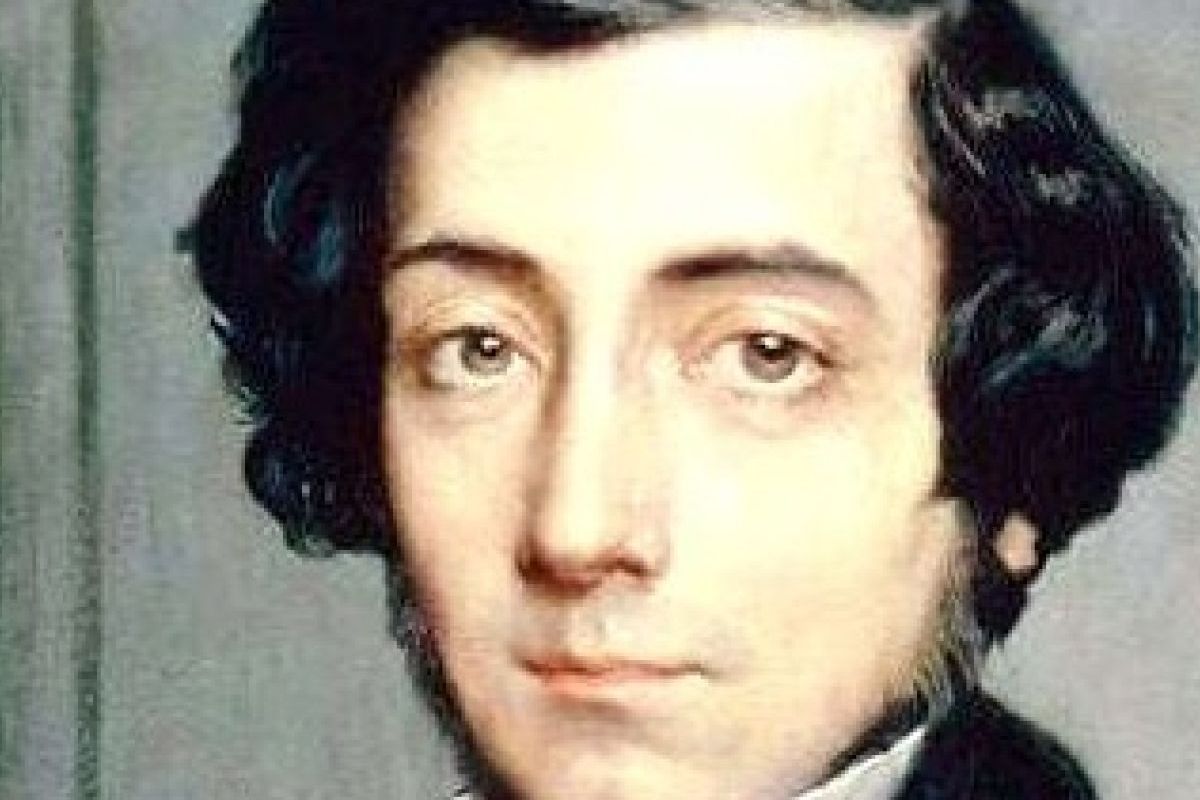
In the furtherance of my critique of Democracy, I’ve gone back to re-read de Tocqueville’s Democracy in America, an original critique, though with much promise at the time.
In the introductory chapter, de Tocqueville notes the tradeoffs democracy makes. Essentially, he recognises the mediocrity, but he senses it’s somehow worth it. I break up his paragraphs and italicise for emphasis.
I admit that, in a democratic State thus constituted, society will not be stationary; but the impulses of the social body may be regulated and directed forwards;
Here de Tocqueville presumes the metanarrative of progress and all it entails.
if there be less splendor than in the halls of an aristocracy, the contrast of misery will be less frequent also;
The middle class served this purpose, but this benefit is being eroded as the acquisitive classes have learnt how to game the system and pillage the public coffers.
the pleasures of enjoyment may be less excessive, but those of comfort will be more general;
Here he considers the masses, but he fails to distinguish them from the aristocracy, now manifest as the 1%.
the sciences may be less perfectly cultivated, but ignorance will be less common;
Literacy may be elevated under this system, perhaps owing as much to the needs of Capitalism than of Democracy. In the US, the pair are inextricable.
Here, de Tocqueville is spot on. I won’t defend science or progress, but if this is a goal, the post-truth era is testament to the need for cultivation. Science is like investing: there is a compounding effect. Failing to progress effects downstream advancements, not linearly, but geometrically.
the impetuosity of the feelings will be repressed, and the habits of the nation softened;
there will be more vices and fewer crimes.
Interesting point, but I won’t linger; vices are morality plays, and crimes are tautological—though I suppose he is hinting that the demos will consider fewer situations to qualify as crimes, and so they’ll be relinquished to the realm of vices.
In the absence of enthusiasm and of an ardent faith, great sacrifices may be obtained from the members of a commonwealth by an appeal to their understandings and their experience;
each individual will feel the same necessity for uniting with his fellow-citizens to protect his own weakness; and as he knows that if they are to assist he must coöperate, he will readily perceive that his personal interest is identified with the interest of the community.
The nation, taken as a whole, will be less brilliant, less glorious, and perhaps less strong
Alexis de Tocqueville
The nation, taken as a whole, will be less brilliant, less glorious, and perhaps less strong;
Indeed.
but the majority of the citizens will enjoy a greater degree of prosperity, and the people will remain quiet, not because it despairs of amelioration, but because it is conscious of the advantages of its condition.
Tocqueville gets partial credit for this insight.
If all the consequences of this state of things were not good or useful, society would at least have appropriated all such as were useful and good;
Tocqueville misses the mark a bit here, tripping himself up on a somewhat Utilitarian—if not Pollyanna—worldview.
and having once and for ever renounced the social advantages of aristocracy, mankind would enter into possession of all the benefits which democracy can afford.
But here it may be asked what we have adopted in the place of those institutions, those ideas, and those customs of our forefathers which we have abandoned.
The spell of royalty is broken, but it has not been succeeded by the majesty of the laws;
the people has learned to despise all authority, but fear now extorts a larger tribute of obedience than that which was formerly paid by reverence and by love.
Here de Tocqueville appears to suggest a citizenry that fears rather than reveres its government in classic Machiavellian splendour.
I perceive that we have destroyed those independent beings which were able to cope with tyranny single-handed;
the weakness of the whole community has therefore succeeded that influence of a small body of citizens, which, if it was sometimes oppressive, was often conservative.
the Government that has inherited the privileges of which families, corporations, and individuals have been deprived
Alexis de Tocqueville
but it is the Government that has inherited the privileges of which families, corporations, and individuals have been deprived;
Ever the Madisonian, de Tocqueville shows concern of the consolidation of power.
the weakness of the whole community has therefore succeeded that influence of a small body of citizens, which, if it was sometimes oppressive, was often conservative.
The division of property has lessened the distance which separated the rich from the poor;
Although there was more egality…
but it would seem that the nearer they draw to each other, the greater is their mutual hatred, and the more vehement the envy and the dread with which they resist each other’s claims to power;
…and Tocqueville was prescient here—, the enmity of the haves of the moneyed classes crashes full-force into the have nots as the fabric of separation becomes more and more threadbare, as with Samhain this weekend.
the notion of Right is alike insensible to both classes, and Force affords to both the only argument for the present, and the only guarantee for the future.
The poor man retains the prejudices of his forefathers without their faith, and their ignorance without their virtues;
he has adopted the doctrine of self-interest as the rule of his actions, without understanding the science which controls it, and his egotism is no less blind than his devotedness was formerly.
If society is tranquil, it is not because it relies upon its strength and its well-being, but because it knows its weakness and its infirmities;
a single effort may cost it its life;
everybody feels the evil, but no one has courage or energy enough to seek the cure;
Alexis de Tocqueville
everybody feels the evil, but no one has courage or energy enough to seek the cure;
the desires, the regret, the sorrows, and the joys of the time produce nothing that is visible or permanent, like the passions of old men which terminate in impotence.
It’s sometimes difficult living in such a narcissistic place. I’ve lived in and out of the US, but I seemed to have settled here for now. I’ve lived on each coast, the Southwest, and the Midwest. I’ve visited all but four states—notably, Wyoming, Montana, and North & South Dakota, so you might recognise the trend.
Currently, I reside in Delaware, but my office is in Manhatten. As a consultant, I am most often wherever my client is. Combined, I’ve lived in LA for well over a decade, my earliest youth was spent in and around Boston. In my 20s in the 1980s, I spent my formative years in Los Angeles, the centre of the music industry at the time, where I was a recording engineer and musician. I had left my roots in Boston with various pitstops along the way to settle in LA, but I returned to Boston in the late ’80s to attend university and grad school. In Boston, I was married and then divorced, an event that gave me leave to return to Los Angeles, where I got married again and relocated to Chicago, where I spent over a decade as well. Divorced again, I relocated near Philadelphia for work and settled into rural northern, Delaware.
To the uninitiated, the US have two cosmopolitan cities, NYC and LA. By population, the third largest city, Chicago, is an oversized farm town. It qualifies as a city on the basis of population, and it’s not a bad place to be, but it lacks the cultural diversity and buzz of a NY or LA. There is none of that in Philadelphia and even less in Delaware.
Donut
The United States are like Australia. It’s ostensibly like a doughnut—empty in the middle, except to say the top and bottom don’t offer much either. So this is not to say that there aren’t valuable things, lessons, and people in these other areas, but by and large, even with the Internet and social media, they are still a decade and more behind.
When I lived in Japan—and I realise that I am coming off as some sort of culture snob—, I was taken aback at how far they seemed behind my frame of reference, having come from an affluent, white, East Coast, family. On one hand, their technology was off the charts and, owing to the exchange rate, it was cheap. Besides the exchange rate, the mark-up was enormous. Americans have no sense of value, and so as much as they exploit other countries, the last laugh is on them.
Americans are not some monolithic entity. There are many dimensions and divisions. To say Americans [fill in the blank] would be disingenuous. To listen to the politicians—especially the ones on the Right, and not just the fringe—you might be left thinking that American are all narcissistic assholes. In fact, this is the same cohort that leaves you feeling that the US have never left the Dark Ages with their religious superstitions.
Much of the country is actually in the 21st Century, but when you try to assess some average sentiment, this vocal minority makes it seem we live in perhaps the fifteenth century.
Roman General Lucius (John Cusack) — Dragon Blade Film
Even behind these anachronisms, there is still a sense of American exceptionalism—or perhaps there was a time that they were exceptional in some bout of nostalgia. You can cherry-pick some dimensions and claim to rank high on the scale but any exceptionalism only happens by adopting a frame. Many who come to the conclusion that the US are or were exceptional tend to fetishise Ancient Greece and Rome as well. In my opinion, it’s indoctrination, but there has to be more than this. There needs to be a certain gullibility gene that creates the propensity to believe these narratives. Without going off the rails, it might be fair to say that this genetic predisposition might have been the reason humans have evolved this far. I’d like to think it’s merely vestigial, but I’ll presume that this is only wishful thinking.
Americans, like most people, have a sense of identity, whether personal or to groups. And like the personae we project as individuals, we have myriad group personae as well. Perhaps there is already a term for this. If not, I’m not going to coin a term now.
Like individual identity, people defend their notion of group identity, and they tend to over-estimate. More than half of people consider themselves to be average or better than average in looks or intelligence and so on. Clearly, this defies statistics, but it is not merely an attempt to assuage some cognitive dissonance; you can come to a defensible position by picking some attributes that might excel (on some subjective aesthetic scale) and then overvaluing these attributes relative to the entire domain. Perhaps a person is taller than average and has been told s/he has beautiful eyes. It would be easy to discount other factors and place oneself in a higher rank due to these two factors. It works like this for national identity.
In the US, they will focus on some economic indicator, argue that it is important and captures broader coverage than it does, and then reference it as proof of exceptionalism. Meantime, the population is being indoctrinated into accepting this narrative, and much effort is spent trying to convince the larger world that this attribute is important.
In this MAGA Age of Make America Great Again, it’s helpful to remember that it never was and never will be great. And that’s OK. It’s also helpful to remember that the ‘good ole days’ are rarely as we remember them in the rearview mirror.
To some extent or another, humans appear to need order—some more than others. Societies are a manifestation of order, and we’ve got subcultures for those who don’t fit in with the mainstream. Humans are also a story-telling lot, which helps to provide a sense of order. Metanarratives are a sort of origin story with a scintilla of aspiration toward some imagined semblance of progress.
Some people appear to be more predisposed to need to ride this metanarrative as a lifeboat. These people are typically Conservative, authority-bound traditionalists, but even the so-called Progressives need this thread of identity. The problem seems to come down to a sort of tolerance versus intolerance split, a split along the same divide as created by monotheism in the presence of polytheism.
Meet the new boss, same as the old boss.
Won’t Get Fooled Again — The Who
In a polytheistic world, when two cultures collided, their religious pantheons were simply merged. In a blink, a society might go from 70 gods to 130. On this basis, there was a certain tolerance. Monotheism, on the other hand, is intolerant—a winner takes all death match. The tolerant polytheists might say, sure, you’ve got a god? Great. He can sit over there by the elephant dude. Being intolerant like a petulant schoolboy, the monotheists would throw a tantrum at the thought that there might be other gods on the block. Monotheists won’t even allow demigods, though there is the odd saint or two.
This is a battle between absolutism and relativism. The relativist is always in a weaker arguing position because intolerant absolutists are convinced that their way is the only way, yet the tolerant relativists are always at risk of being marginalised. This is what Karl Popper was addressing with the Paradox of Tolerance.
In a functioning society, a majority of the metanarratives are adopted by the majority of its constituent. On balance, these metanarratives are somewhat inviolable and more so by the inclined authoritarians.
A problem is created when a person or group disagrees with the held views. The ones espousing these views—especially the Traditionals—become indignant. What do you mean there are more than two genders? You are either male or female. Can’t you tell by the penis?
I happened to read a tweet by the GOP declaring their stupidity:
America the Stupid
The Vice President, a living anachronism and proxy for the American Midwest Rust Belt superimposed on the Bible Belt, he tells his sheep that “The moment America becomes a socialist country is the moment that America ceases to be America…” Americans as a whole are pretty dim, and it seems to get dimmer the higher one ascends their government. Pence seems very firm in affirming a notion of American identity, but not accepting that identities change. He may become upset if he finds out that George Washington is dead—in fact, there are very few remnants of the original United States aside from some dirt, trees, and a few edifices—and the country is still the county. Some people have a difficult time grasping identity. It makes me wonder if he fails to recognise himself in the mirror after he gets his hair cut.
The idea behind deconstruction is to deconstruct the workings of strong nation-states with powerful immigration policies, to deconstruct the rhetoric of nationalism, the politics of place, the metaphysics of native land and native tongue… The idea is to disarm the bombs… of identity that nation-states build to defend themselves against the stranger, against Jews and Arabs and immigrants…
Jacques Derrida
Interesting to me is how people complain about this and that politically. Most of this is somewhat reflexive and as phatic as a ‘how are you?’, but some is more intentional and actioned. Occasionally, the energy is kinetic instead of potential, but the result is always the same: One power structure is replaced by another.
What you aspire to as revolutionaries is a new master. You will get one
Jacques Lacan
As Lacan noted, as people, we believe ourselves to be democratic, but most of us appear to be finding and then worshipping some authority figures who will promise us what we desire. We desire to have someone else in charge, who can make everything OK, someone who is in a sense an ideal parent. I don’t believe this to be categorical, but I do believe that there is a large contingent of people who require this.
As an aside, I’ve spent a lot of time (let’s call it a social experiment) in the company of social reprobates. What never ceases to amaze me is how these social outcasts seem to have a strong sense of right and wrong and how things should be. Conveniently, they exempt themselves from this scope, so if they steel to buy drugs, it’s OK, but if someone else gets caught, they should get what’s coming to them.
About a year ago I was chatting with a mate, and I shared an observation that the biggest substance abusers in high school—”the Man’s not going hold me down” cohort—are the biggest conservatives. A girl a few houses down from me became a stripper, but her political views are very Conservative, an avid Trump supporter.
One woman I know is a herion-addicted prostitute. In her eyes, she’s fine (sort of—without getting into psychoanalytics); other women are junkie whores. A heavy dose of assuaged cognitive dissonance is the prescription for this, but it confounds me.
Getting back to the original topic, people who need this order are resistant to deconstruction and other hallmark notions of poststructuralism. They need closure. This translates into a need for metanarratives. When confronted with the prospect of no Truth, they immediately need to find a substitute—speculatively, anyway, as denial and escalating commitment will kick into overdrive.
The same problem mentioned above comes into play here. A few years ago, there was an Occupy Wall Street group, and like atheists, there are myriad reasons why people participated. One of the commonest complaints by the power structure and the public at large is if you don’t like the status quo, what status should replace it. None of the above was never an acceptable response.
It doesn’t matter that in this universe we occupy there is more disorder than order, and entropy rules, pareidolia is the palliative. And religion remains an opiate of the masses.







 Philosophics