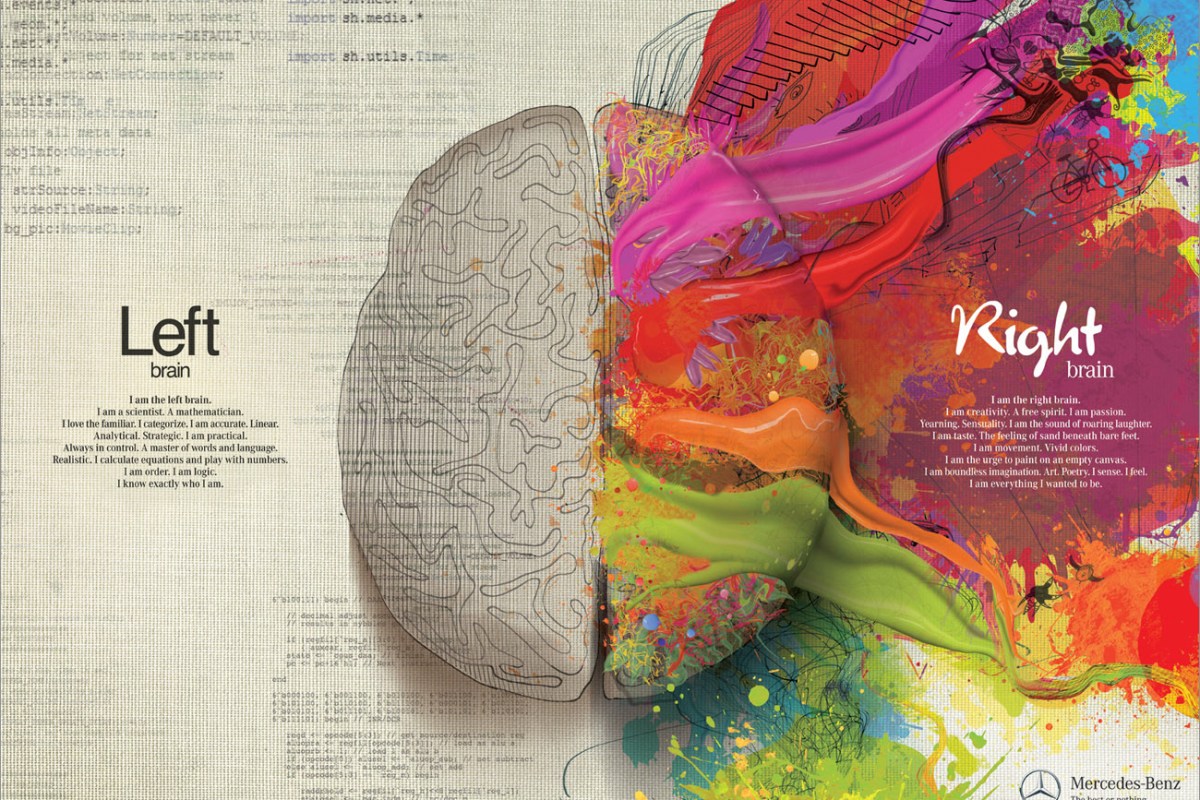
I’ve just finished reading Iain McGilchrist’s The Master and His Emissary, having paused The Matter with Things to put it to bed. The book is divided into two sections. The first lays down the neuroscientific base whilst the second contains expository forrays. Technically, one might argue that there are three sections as the last unnumbered chapter seems to stand alone from the second part. It’s only one chapter containing some 36 pages, so I’m not going to lose any sleep over it. But this will not be a book review, as highly recommended as it is.
I’ve been a vocal proponent of hiring neurodiverse people into certain roles. Having read the book and absorbed the rationale, it’s easy to see how it aligns with and supports some of my own experiences. In particular, I’ve noticed that many companies hire autism spectrum on the Aspergers end of the scale. These people tend to be hired into IT and programming roles—functions already having reputations for being staffed with socially awkward and low EQ individuals, characteristics of people on the spectrum. It makes sense because left-hemisphere-dominant managers evaluate this hyper-left-hemisphere-dominant cohort as assets. Without getting too deep into the territory of stereotypes, in general, this group are laser-focused and doggedly pursue tasks at hand without tiring. I’ve met plenty of ADHD-diagnosed people in these roles, too—not as many, but also employed in technology-oriented positions.
The underrepresented class are right-hemisphere-dominant people. To be fair, I’ve encountered many Creative people in Agencies, but their right-hemisphere life is separate from their left and not appreciated in the workplace. They mainly exercise their right-hemisphere life outside of office hours on personal passion projects. I’d also be willing to bet that these people are not truly right-hemisphere-dominant. Rather, they have the ability to balance and allow the left hemisphere to take over during business hours.
In some cases, these people happen to have right-hemisphere insights into a project or have some creative inspiration off hours to benefit the work of the next day. But the right hemisphere is not time-boxed. It doesn’t function on demand. In fact, it shuts down on demand, and the left introduces bootleg knock-offs. Of course, this doesn’t matter, as it is probably better than their left-hemisphere managers and clients and good enough in their eyes. I’m not convinced they’d actually recognise the right-hemisphere solution as better because the left hemisphere prefers its own tribe anyway.
If you are reading this and you are saying, “They’re running a business. They can’t wait for weeks or months for a resource to have the epiphany of a creative solution,” you’ve made my point, and you’ve presented strong evidence that you are operating from your left hemisphere as well. There’s no shame in this. The first step is to admit there’s a problem.
My point is not to antagonise left-hemisphere-dominant people or the fact that they’re at home with other like-minded people. It’s only natural. They usually find right-hemisphere types to be too eccentric for their taste anyway.
But these right- or balanced-hemisphere thinkers, not given the space for their right-hemisphere to yield benefit, are likely in a Creative function, whether in art, illustration, copywriting, or some such. They are like unicorns outside of this context.
As for me, I am at times balanced and at times left. At other times, I’m purely right, though this is admittedly short-lived and unsustainable. But in a balanced state—in a right-shifted mode—, this is where my Gestalt comes into play. One of my roles is to evaluate processes. The left hemisphere analyses in components and pieces. Taking an analytical approach, I can document that the knee bone is connected to the shin bone and the shin bone is connected to the ankle bone and so on, but this requires context, something the left hemisphere is weak at. The left hemisphere will tell us that this is the bone connexion process, as it were. But it’s more than this. It’s meaningless without musculature and connective tissue and a nervous system and a circulatory system. And we’d likely want the person to whom the bones belong to be alive. And how do these bones contribute to function and perambulation? This is a larger system thinking approach.
System thinking is a recommendation for looking at processes, but this is right-hemisphere activity. Most people asked to perform this are left-hemisphere-dominant, so they give it short-shrift.
At the end of this rant, my point is that I hear all about equity, diversity, and inclusion, but this cohort is not only underrepresented but almost nonexistent. To be fair, many of these people wouldn’t feel comfortable behind your walls anyway, aren’t likely to prefer the constraint of your walls, and they’d probably feel like outsiders. But this is the challenge with true inclusion.
Classes are a left-hemisphere operation at the start—male, female, black, white, L, B, G, T, and so on. These are left-hemisphere constructs. But since you are already stuck in this place anyway, let’s consider expanding the neurodiverse class to include right-hemisphere people.

 Philosophics