Some milestones arrive quietly; others tap you on the shoulder and whisper, “Well? Are you going to gloat, or shall I?”
So here we are. The Anti-Enlightenment corpus – yes, that unruly battalion of essays insisting that the Enlightenment was less a dawn and more a flash-bang grenade into the human psyche – is about to pass 1,000 downloads across Zenodo and PhilArchive. By the time you read this, the counter will likely have ticked over, as if to confirm that a non-institutionally affiliated heretic can, in fact, find readers willing to squint at philosophy written in the half-light.
I should say something gracious. Something humble. Something befitting a scholar who’s spent far too much time dismantling the sacred furniture of modernity.
Video: Midjourney woman sketch for no apparent reason (no sound)
And hooray for you, the masochists who keep downloading this stuff.
Whether it’s Objectivity Is Illusion, which politely reminds you that truth is just a social ritual in a lab coat, or Against Agency, where we pretend the autonomous self was ever more than Enlightenment-era fan fiction, or The Will to Be Ruled, in which we accept that most people would rather outsource their freedom to the nearest charismatic authoritarian – each piece contributes to the great unmasking of reason’s beloved myths.
If you’ve made your way through The Illusion of Light (cloth or paperback – the cloth is for people who enjoy prestige bindings with their epistemic despair – or on Kindle for the ones who have already surrendered), you’ve already walked the whole architecture: rooms filled with rational ghosts, temporal anxieties, moral fictions, and the faint smell of Enlightenment wiring beginning to smoulder.
And still you download. Saints, the lot of you.
A thousand reads does not confer legitimacy – nothing so vulgar – but it does confirm that the cracks in the Enlightenment’s porcelain façade are visible from more than one angle. It suggests that others, too, are learning to see in the dark, to navigate by afterglow rather than glare.
So: thank you.
For the curiosity.
For the tolerance of structural pessimism.
For indulging a scholar who insists on disassembling Western metaphysics one lovingly overlong sentence at a time.
Here’s to the next thousand. And the thousand after that. And to the collective, slow, post-Enlightenment work of maintenance in the half-light.
The Anti-Enlightenment lives on your hard drives now.
There’s no taking it back.
Written by Bry Willis and ChatGPT because Bry is off to Fiji, celebrating (or something like that.
It seems my latest rant about AI-authorship accusations stirred something in me, that I need to apologise for being a professional writer – or is that a writing professional? Blame the Enlightenment, blame writing and communication courses, whatevs. I certainly do. But since some people are still waving the pitchforks, insisting that anything too coherent must be artificially tainted, I should address the obvious point everyone keeps missing:
The writing structures people attribute to AI aren’t AI inventions. They’re human inventions. Old ones. Codified ones. And we made the machines copy them. Sure, they have a certain cadence. It’s the cadence you’d have if you also followed the patterns you should have been taught in school or opened a book or two on the topic. I may have read one or two over the years.
Wait for it… The orthodoxy is ours. I hate to be the one to break it to you.
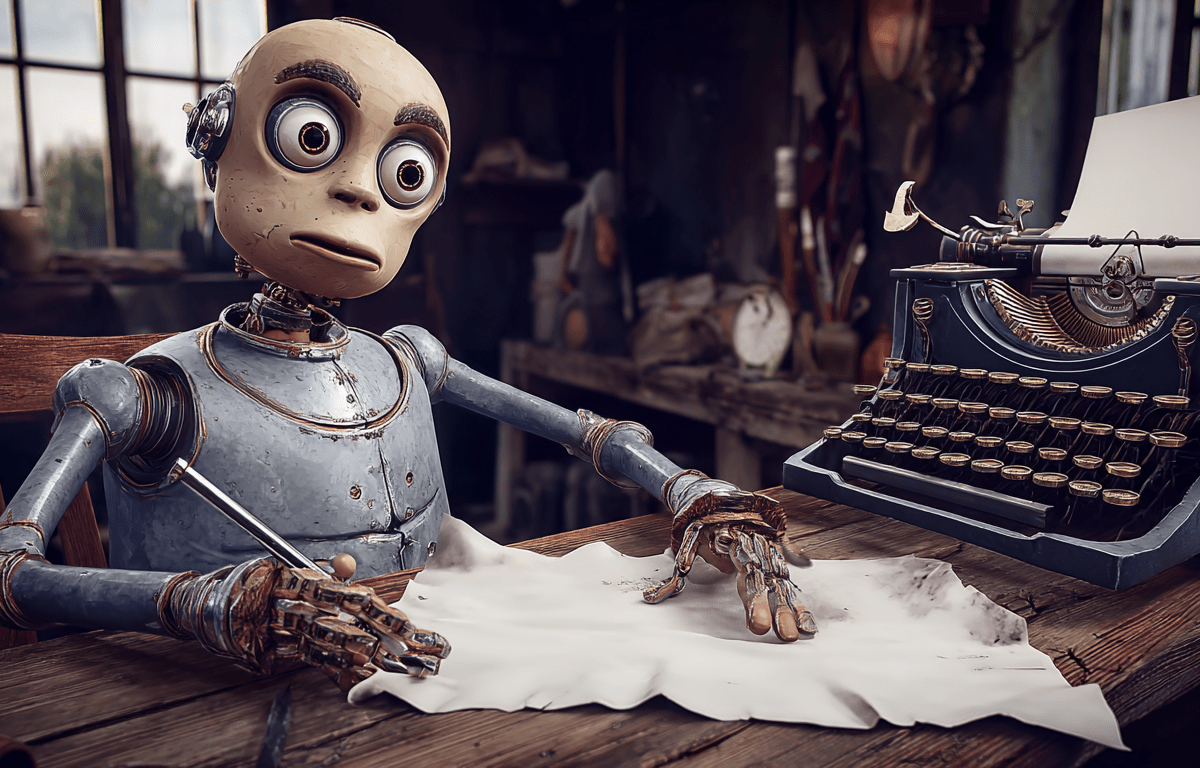
Video: AI Robot Assistant (no audio)
Professional Writing Has Its Own House Rules (And They’re Older Than AI Neural Nets)
👉 I wrote earlier how even talking about AI is censored in Reddit. 🤷
Audio: NotebookLM podcast on this topic and the last one.
Long before AI arrived to ruin civilisation and steal everyone’s quiz-night jobs, we’d already built an entire culture around ‘proper writing’. The sort of writing that would make a communications lecturer beam with pride. The Sith may come in twos; good writing comes in threes.
Tell them what you’re going to say.
Say it.
Repeat what you told them.
But wait, there’s more:
Use linear flow, not intellectual jazz.
One idea per paragraph, please.
Support it with sources.
Conclude like a responsible adult.
These aren’t merely classroom antics. They’re the architectural grammar of academic, corporate, scientific, and policy writing. No poetic flourishes. No existential detours. No whimsical cadence. The aim is clarity, predictability, and minimal risk of misinterpretation. It’s the textual equivalent of wearing sensible shoes to a board meeting. So when someone reads a structured piece of prose and yelps, ‘It sounds like AI!’, what they’re really saying is:
It sounds like someone who was properly trained to write in a professional context.
Je m’accuse. AI Didn’t Invent Structure. We Forced It To Learn Ours. Full stop. The problem is that it did whilst most of us didn’t.
If AI tends toward this style – linear, tidy, methodical, lamentably sane – that’s because we fed it millions of examples of ‘proper writing’. It behaves professionally because we trained it on professional behaviour – surprisingly tautological. Quelle surprise, eh?
Just as you don’t blame a mimeograph for producing a perfectly dull office memo, you don’t blame AI for sounding like every competent academic who’s been beaten with the stick of ‘clarity and cohesion’. It’s imitation through ingestion. It’s mimicry through mass exposure.
And Now for the Twist: My Fiction Has None of These Constraints
My fiction roams freely. It spirals, loops, dissolves, contradicts, broods, and wanders through margins where structured writing fears to tread. It chases affect, not clarity. Rhythm, not rubrics. Experience, not exegesis.
No one wants to read an essay that sounds like Dr Seuss, but equally, no one wants a novel that reads like the bylaws of a pension committee.
Different aims, different freedoms: Academic and professional writing must behave itself. Fiction absolutely should not.
This isn’t a value judgement. One isn’t ‘truer’ or ‘better’ than the other – only different tools for different jobs. One informs; the other evokes. One communicates; the other murmurs and unsettles.
Not to come off like Dr Phil (or Dr Suess), but the accusation itself reveals the real anxiety. When someone accuses a writer of sounding ‘AI-like,’ what they usually mean is:
‘Your writing follows the conventions we taught you to follow – but now those conventions feel suspect because a machine can mimic them’.
And that’s not a critique of the writing. It’s a critique of the culture around writing – a panic that the mechanical parts of our craft are now automated and thus somehow ‘impure’.
But structure is not impurity. Professional clarity is not soullessness. Repetition, sequencing, scaffolding – these aren’t telltale signs of AI; they’re the residue of centuries of human pedagogy.
AI mirrors the system. It didn’t create the system. And if the system’s beginning to look uncanny in the mirror, that’s a problem of the system, not the reflection.
In Short: The Craft Is Still the Craft, Whether Human or Machine
Professional writing has rules because it needs them. Fiction abandons them because it can. AI imitates whichever domain you place in front of it.
The accusation that structured writing ‘sounds artificial’ is merely a confusion between form and origin. The form is ours. The origin is irrelevant.
If clarity is now considered suspicious, I fear for the state of discourse. But then again, I’ve feared for that for some time.
And apparently, I’ve still got more to say on the matter.


 Philosophics