I haven’t yet shared my thoughts that equate bureaucracy with violence, but this is somewhat tangential or perhaps orthogonal.
Humanity does not gradually progress from combat to combat until it arrives at universal reciprocity, where the rule of law finally replaces warfare; humanity installs each of its violences in a system of rules and thus proceeds from domination to domination. The nature of these rules allows violence to be inflicted on violence and the resurgence of new forces that are sufficiently strong to dominate those in power. Rules are empty in themselves, violent and unfinalised; they are impersonal and can be bent to any purpose. The successes of history belong to those who are capable of seizing these rules, to replace those who had used them, to disguise themselves so as to pervert them, invert their meaning, and redirect them against those who had initially imposed them; controlling this complex mechanism, they will make it function so as to overcome the rulers through their own rules.
Michel Foucault, Nietzsche, Genealogy, History 1977
Taking holiday, so taking shortcuts in posting. Here, Foucault discusses Nietzsche.
Jordan Peterson is decidedly not my cup of tea. I can tolerate Pinker and Haidt. I agree with much of what they have to say, but in this video, the dissonance finally dawns on me. Interestingly, I can tolerate Peterson within the scope of this discussion.
I don’t agree with much of what these three are saying, but it is refreshing to hear Peterson outside of a philosophical domain, a place where he has no place. And although I don’t agree with him here, it is on the basis of his argumentation rather than his abject ineptitude.
I disagree with this trio. This video reveals these three people as Institutionalists. Peterson may be a political Conservative versus Pinker’s and Haidt’s enlightened Liberalism, but this is a common core value they defend with escalating commitment. Typically, we find these to be polar opposites, but here they have a common enemy that is not necessarily anti-institutionalists or anarchists but people who don’t understand venerable institutions and thereby risk tipping the apple cart or toppling the Jenga tower because they just don’t understand. Not like them. Besides constitutionalism, the common thread is Paternalism. They may disagree on the specifics, but one thing is true: We know more than you, and this knowledge is embedded in the sacred institutions. If only the others understood.
In this video, we hear these three commiserate about the diversity and inclusion forces in University today, and where this movement is off base.
I just wrapped up chapter eleven of The Righteous Mind by Jonathan Haidt. I’ve got only 35 pages to go to get through chapter twelve. I’ve been tempted to stop reading. Chapter eleven—and I am tempted to inject a bankruptcy pun here—has been more frustrating than the rest thus far. And yet I am glad to have persisted.
My intellectual focus these past months has been on agency. Et voilà, paydirt. Chapter eleven’s title reveals the context: Religion is a Team Sport. Let’s walk through this garden together.
A goal of Haidt is to educate the reader on his third principle of moral psychology: Morality binds and blinds. He establishes parallels between sports and religion. And here’s the thing—I don’t disagree. But here’s the other thing—I feel that are equally vapid—, with no apologies to sports fans or the religious. Let’s keep moving.
“A college football game is a superb analogy for religion.”
Jonathan Haidt, The Righteous Mind, Chapter 12: Religion is a Team Sport
He talks about the organising and unifying functions of both. But here’s the thing. It unifies the like-minded. Haidt claims to be irreligious and not be into sports, and yet he cites these as somehow desirable. I find him to be an apologist for religion.
I am not a psychologist, but if I were, I’d be tempted to claim that Haidt’s conclusions follow from his personal beliefs. He believes in morals, society, order, intuition, and institutions. He is a textbook Modern and an extrovert to boot. I think he also falls into teleological fallacy traps. Was that a play on words?
Although he views religion through rose-coloured glasses, he comes to the conclusion that religions have done a great deal of harm over the millennia, but the good outweighs the bad, especially if you consider it through a social-moral lens. But if religion creates in-groups versus out-groups, which they do, and religious in-groups outlive even non-religious ingroups, then this is a winning option. But what if you don’t like that option?
Personally, I am a collectivist, but this is not willy-nilly any collective.
Haidt contrasts the New Atheist vantage that religious belief is an evolutionary byproduct versus a position that what started as a byproduct evolved into group selection and then, perhaps, an epigenetic phenomenon.
Here’s my contention:
Borrowing from New Atheism, Haidt adopts the notion of a “hypersensitive agency detection device [that] is finely tuned to maximize survival, not accuracy”.
The first step in the New Atheist story—one that I won’t challenge—is the hypersensitive agency detection device. The idea makes a lot of sense: we see faces in the clouds, but never clouds in faces, because we have special cognitive modules for face detection. The face detector is on a hair trigger, and it makes almost all of its mistakes in one direction—false positives (seeing a face when no real face is present, e.g., ), rather than false negatives (failing to see a face that is really present). Similarly, most animals confront the challenge of distinguishing events that are caused by the presence of another animal (an agent that can move under its own power) from those that are caused by the wind, or a pinecone falling, or anything else that lacks agency.
The solution to this challenge is an agency detection module, and like the face detector, it’s on a hair trigger. It makes almost all of its mistakes in one direction—false positives (detecting an agent when none is present), rather than false negatives (failing to detect the presence of a real agent). If you want to see the hypersensitive agency detector in action, just slide your fist around under a blanket, within sight of a puppy or a kitten. If you want to know why it’s on a hair trigger, just think about which kind of error would be more costly the next time you are walking alone at night in the deep forest or a dark alley. The hypersensitive agency detection device is finely tuned to maximize survival, not accuracy.
Op Cit, p. 292
I fully agree with the assertion that the brain values fitness over truth, and I’ve commented in several posts that pareidolia and apophenia create false-positive interpretations of reality.
But now suppose that early humans, equipped with a hypersensitive agency detector, a new ability to engage in shared intentionality, and a love of stories, begin to talk about their many misperceptions. Suppose they begin attributing agency to the weather. (Thunder and lightning sure make it seem as though somebody up in the sky is angry at us.) Suppose a group of humans begins jointly creating a pantheon of invisible agents who cause the weather, and other assorted cases of good or bad fortune. Voilà—the birth of supernatural agents, not as an adaptation for anything but as a by-product of a cognitive module that is otherwise highly adaptive.
Op Cit, p. 293
For me, this supports my contention that agency is a wholly constructed fiction. The same agency we ascribe to unknown natural events, we ascribe to ourselves. And perhaps this ability served an egoistic function, which was then generalised to the larger world we inhabit.
I have an issue with his teleological bias. He feels that because we have evolved a certain way to date; this will serve as a platform for the next level as it were. I’ll counter with a statement I often repeat: It is possible to have adapted in a way that we have been forced into an evolutionary dead end. Historically, it’s been said that 99 per cent of species that ever occupied this earth are no longer extant. That’s a lot of evolutionary dead ends. I am aware that few species could have survived an asteroid strike or extended Ice Ages, but these large-scale extinction events are not the only terminal points for no longer extant species.
So finally, Haidt essentially says that it doesn’t matter that these religious and cultural narratives are wholly fictitious, if they promote group survival, we should adopt them. This seems to elevate the society over the individual, which is fine, but perhaps the larger world would be better off still without the cancer? Just because it can survive—like some virulent strain—doesn’t mean we should keep it.
Finally, given these fictions, what’s a logical reasonable person to do? I don’t buy into ‘this country is superior to that country’ or ‘this religion is better than that religion’ or even ‘this sports team is better than that’ or ‘this company is better than that’.
Haidt does idolise Jeremy Bentham, but this is more Pollyannaism. It sounds good on paper, but as an economist, I’ll reveal that it doesn’t work in the real world. No one can effectively dimensionalise and define ‘good’, and it’s a moving target at that.
No thank you, Jonathan. I don’t want to buy what you are selling.
News Flash: From the time I started this content, I’ve since read the final chapter. Where I categorically reject a lot of what Haidt proposes in this chapter, I tend to find chapter twelve to fit more amicably with my worldview. Perhaps I’ll share my thoughts on that next.
If you’ve reached this far, apologies for the disjointed presentment. I completed this over the course of a day through workaday interruptions and distractions. I wish I had an editor who could assert some continuity, but I am on to the next thing, so…
Bonus: I happened upon this journal article, and it somehow ended up here. I haven’t even read it yet, so I’ve got no commentary. Perhaps someday.
Rai, T. S., and A. P. Fiske. 2011. “Moral Psychology Is Relationship Regulation: Moral Motives for Unity, Hierarchy, Equality, and Proportionality.” Psychological Review 118:57–75
Not really, but I’ve had visitors from these countries visit here in the past 7 days. Whilst I either try to be culturally inclusive or admit where I am obviously off, I live in the United States at the time and it just colours my perspective in the same manner it would be coloured if I was spending a lot of time steeped in some other cultural setting.
I am aware that people visit blogs for different reasons. Some are searching for confirming views or to broaden a perspective; others are scratching their heads and asking if people actually think like this or that. In all cases, you are welcome. You are also welcome to share your agreements or disagreements.
What I find most interesting are my subscribers (or whatever WordPress names them). from what I can tell, at least three-quarters of subscribers to Philosophics would appear to have views counter to my own. Of course, they are welcome, but it seems that a have a lot of, let’s say, ‘spiritual’ subscribers, where I hold antithetical if not diametrically opposed views. I’ll presume this is to keep a pulse on a different perspective, which I admire.
Nothing more to say at the moment. Just taking a quick break to give a special shoutout to anyone who has visited from one of these countries. If ‘Unknown Region‘ is some interdimensional visitor, you are still welcome. Thanks for stopping by.
In other news, Boris Johnson resigns. Another Conservative politician hits the bin. I’m neither Conservative nor Liberal, so I think I am in a place where I can comment as a disinterested observer. Of course, I am not fully disinterested; I am rather apathetic to it all. None of my horses is in the prevailing parties.
As I’ve been reading (too much) Jonathan Haidt, of all things, a Liberal apologist for Conservatives aimed at a Liberal audience. I have to wonder why Conservative politicians are so corrupt.
Hear me out. Before you accuse me of a hack job, allow me to explain. Are Liberal politicians corrupt? Of course, they are. Probably as corrupt. By and large, they have the same handlers and funding sources. But then why call out Conservatives as being corrupt?
According to Haidt and his Moral Foundations Theory (MFT), Conservatives collectively have more moral dimensions than Liberals and they have elevated ‘disgust’ triggers. This is what makes them more obsessed with ‘purity’.
According to MFT, Liberals have two moral dimensions: Care and Fairness, regarding the left side of the value pairs. Conservatives share these, but they also include Loyalty, Authority, and Sanctity.
“The Righteous Mind: Why Good People Are Divided by Politics and Religion,” Haidt 2012
I am distracted for a moment by the epiphany that this explains a lot about why American police units operate the way they do—dysfunctionally from the Liberal and minority perspective. Whilst they care and want ‘fairness’, how they care is typically different (though there are clear overlaps), and ‘fairness’ means something different to them. Next, dogpile on loyalty, authority, and sanctity.
Loyalty is to their group of other blue lives as well as their nationalistic and paternal fealty. Authority is them. They are the authority, and this is an inviolable relationship. Don’t question it. And then there’s sanctity. We need to clean up the neighbourhoods and cleanse them of criminals. The dirty people need to be taken off the streets as we perform our moral duties.
And I’m back. Whilst this intermission was a diversion, it is at the same time on point because they share this worldview with Conservative politicians—tough on crime, law and order. But what I am calling out is that if this is their worldview, they should be measured by a higher standard.
Distracted again, this also explains a lot about the outrage over Julian Assange, Chelsea Manning, and Edward Snowden. Each of these people exposed unfathomable corruption, and Conservatives want their heads on platters. This reflects their viewing of the world through a deontological lens and as measured by a different sense of fairness.
I am not judging here. I am merely pointing out that their loyalty to country (or whatever) trumps the fairness mechanism. In a way, they see it as unfair that someone would have the audacity to betray their (notably corrupt) government. They even buy into the argument that they could have used the reporting mechanisms in place rather than air the dirty laundry in the public forum. These people find no discomfort in maintaining state secrets, even when the secrecy is for nefarious intent.
Back again. My point is that if these are primary drivers for Conservatives—fundamental attribution bias notwithstanding—, why do they subvert their own morals? For Liberals, there is no such subversion because they don’t believe these are relevant moral dimensions. This bleeds into the abortion debate—the sanctity of life: Life is sacred (and too much hypocrisy on the Right to unpack here), so you need to abide by moral code. Let’s not run astray again.
Wrapping this up, even if Conservatives are no more or less corrupt than Liberals, they are claiming to have a higher standard and yet they fail to abide by it. For a Conservative to call out a Liberal for the same violation is rather silly because the Liberal never agreed to the Terms & Conditions at the start.
Done
As I was mistyping the title, I realised that ‘resigns’ is ‘reigns’ with an inserted ‘s’. Nothing more.
Je m’accuse. I am as guilty as the next bloke when it comes to constructing false dichotomies. I like reading Steven Pinker, Jonathan Haidt, and Joshua Greene, though I disagree with some fundamental aspects. Having put Time Reborn to bed, I’ve reengaged with The Righteous Mind and it’s dawned on me what goes against my grain. In retrospect, it should have been obvious all along, and perhaps it was. When I read works by these cats, I catch myself saying, ‘Yeah, but…’. A lot.
To be fair, I’ve not read much of Greene, so I’ll focus on the other two, Haidt in particular. From what I can tell, Greene is cut from the same cloth. I’ll elaborate. When I cite Haidt, just know that I mean the other two and their ilk.
Haidt divides the world into Liberals and Conservatives. This is the false dichotomy. I’m aware that I recently expounded on the political spectrum, but this is more than that. Whether this would be better depicted as further Left on the political spectrum or another dimension is open to debate.
I believe the biggest dissonance I feel against this common perspective is that these guys are all Liberals. In particular, they are Ivory Tower Liberals™—paternalistic know-it-alls. Upon reflection, Cass Sunstein falls into this category: paternalistic intellectuals. I don’t mean this pejoratively, but each of these is a privileged prescriptivist. But that’s not my beef.
The other common thread is that these people are all institutionalists. This brings everything into focus. These people are defenders of Enlightenment Age morality, so they’ve all adopted the same metanarrative.
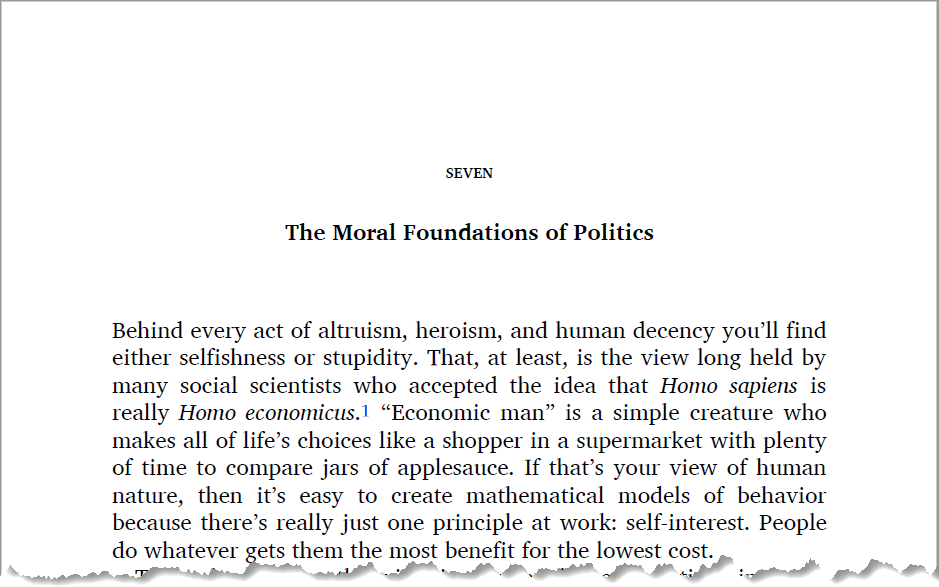
The Righteous Mind – Chapter 7
Haidt’s observations are accurate enough, but only within the frame of institutionalism—a frame I reject. This leaves my perspective out of view and unrepresented. In chapter seven, he establishes his action pairs that serve to divine moral truths about a person’s foundational political beliefs. He argues, like Pinker, that the mind is not a Blank Slate. He adopts neuroscientist Gary Marcus’ definition of innate:
“Nature bestows upon the newborn a considerably complex brain, but one that is best seen as prewired—flexible and subject to change—rather than hardwired, fixed, and immutable.”
— Gary Marcus, The Birth of the Mind (2004)
He further morphs Marcus’ ideas into this:
Nature provides a first draft, which experience then revises.… “Built-in” does not mean unmalleable; it means “organized in advance of experience.”
— Jonathan Haidt, The Righteous Mind (2012)
Given this background, Haidt invented these action pairs:
Care – Harm
Fairness – Cheating
Loyalty – Betrayal
Authority – Subversion
Sanctity – Degradation
I suppose I could reserve an entire post to disintegrate these. Suffice it to say that, categorically, I have issues with the meta of some of them—particularly, the last four. I am more accepting of the care – harm dichotomy, so my commentary would be more nuanced, especially in light of the scenario he cited, which shed light on his own thought processes.
I’m getting off track. The point I want to make is that these shared perspectives on society and identity, respectively macro- and microcosmic, make sense in an institutional framework, but is less necessary otherwise. And although Haidt attempts to defend his positions as not being invasive [my words, not his], this is simply because he accepts the underlying metanarratives blindly.
I’ll probably return to expound on this later, but for now, I am on to other things. Meantime, here is a review from a European, who rightly points out that this is a book written by an American for an American audience, even if he feels it is more universally applicable.
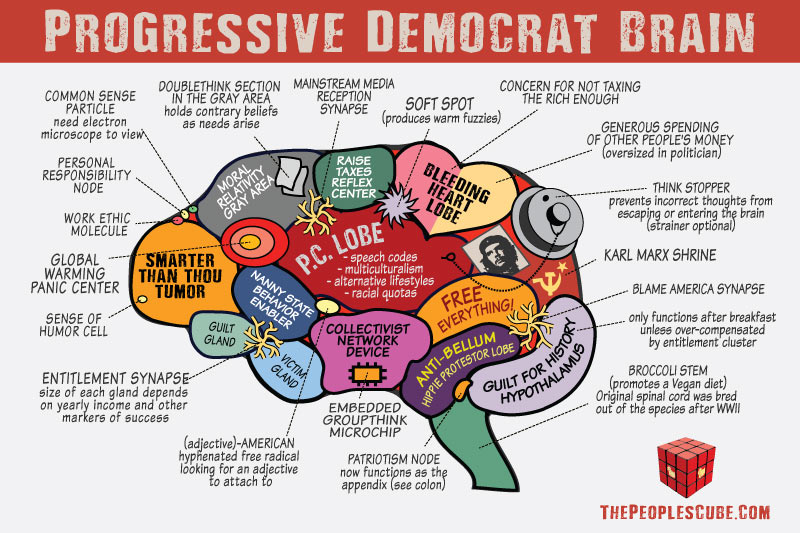
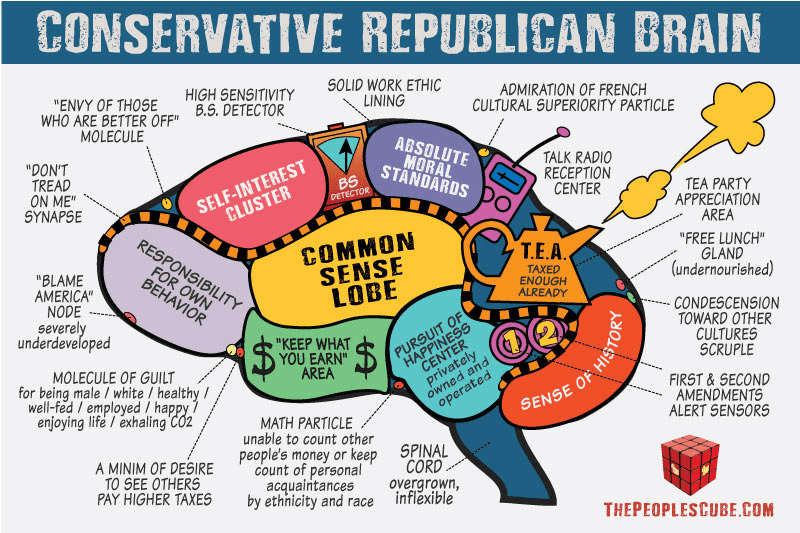
Out of a sense of fairness, I’ve included the Conservative brain image.
There is a battle being waged in the United States today, but it is not centred on the lack of separation of Church and State. I suppose this may be a uniquely American issue given its Constitutional roots, but the root cause is rather a lack of separation between Natural and Supernatural, not between Church and State.
Separation of Church and State
Tomorrow America is celebrating Independence Day [sic], but until we are independent of religion, we cannot be independent. The only real independence is for the politicians who are independent of British control. There is nothing more substantial than this, and nothing for the ordinary citizen, who might as well be taking orders from England. Canada doesn’t look any worse for the wear and tear. I’m not a Monarchist, but it’s no less ridiculous than the Oligarchy or Plutarchy in play today.
I’ve got nothing again churches, per se. I don’t prefer the brainwashing that passes as organised religion, but neither am I fond of the brainwashing that is organised politics. And why is it called ‘brainwashing’? It’s clearly mind-muddling. I digress.
I do believe that it’s in the best interest to separate Church and State, not least because I need freedom from religion. It is already force-fed down my throat and codified into laws. We need less, not more.
Of course, a key topical debate is the abortion issue. This is strictly a religious issue. Even if you want to argue that it’s a moral rather than religious issue, it is still the result of supernatural beliefs. This is where the separation needs to happen.
Why won’t it happen? It won’t happen because people who believe in supernatural forces—especially active supernatural forces—are easy to manipulate. This has been true historically as well as contemporaneously. It’s too convenient for politicians to pull the old Santa Claus trick—if you aren’t good, Santa won’t give you any presents; and if you’re bad, he’s going to bring you coal instead.
I’ve said my peace. In the end, I don’t really even care if you believe in the supernatural, but if you believe that you (or anyone) can interpret these forces, I claim foul and out of bounds. This belief is not different to believing that you can understand what your dog or cat is ‘saying’—or your pet unicorn in the garden. It’s certifiable.
I know that other countries have to contend with this interference. Some even don’t mind the union. Is this a problem in other countries? Is it a problem in yours? Or do you consider it to be a necessary solution?
DISCLAIMER: This post has absolutely nothing to do with the Supernatural television series.
Heather at https://hermeneutrix.com/ commented briefly on the recent Political Spectrum post. Visting her site, she is all about words. Check it out. But even before visiting, I had the idea to visualise my reaction to her response.
To be fair, this is a response I get from my Pragmatist colleagues: don’t get your knickers in a twist arguing semantics. But in my noggin, I envision this Venn diagamme. (Well, not exactly. I just made this up, but you get the point.) Since the topic happened to be on the definition of Conservative, I’ll retain the context, but this is arbitrary.
Before I get to this, I want to set the stage with a more common and arguably more agreeable term: tree. If we ask a large number of people on the street to provide attributes of a tree, we might get something like this image abstraction below.
Tree
Venn: Tree
Although people may have different ideas, there will be some key core elements—trunks, branches, and roots. Of course, within the taxonomy of trees, there are types—pine, oak, willow, redwood, birch, and so on—each sharing these key attributes. These trees have some distinct attributes—coniferous versus deciduous, green versus red, flowering versus non versus, fruit-bearing, nut-bearing, height, and age. I think I can stop.
In general, I think it’s safe to say that if you point to a tree, and ask what it is to a person with sight and language, they will either respond ‘It’s a tree’ or ‘It’s an elm’. Even the elm response can be quickly qualified with a follow-up question, “What is an Elm?”
I understand that a botanist or an arborist may have a more nuanced definition. In fact, when I lived in a rental property outside of Chicago, my wife at the time defended the life of a tree that looked rather like a berry-bearing ficus, but that the village elders said was a weed and not allowed to remain. Here, we get into whether a tomato is a fruit or a vegetable or a squash is a berry or a fruit, or is corn a vegetable or a grain—or are we discussing maize? I get it. Even here, we can quickly come to terms. I said chips; I meant fries.
I could even get into the political conversation where the US justice system tried to redefine person to strip the rights away from those they didn’t want to have them. Of course, the United States has a history of not considering people to be people, though some were given 3/5ths and 4/5ths of personhood. Mighty white of them.
Back to trees. There are natural and artificial trees, but these are just simulations—hullo, Baudrillard. In the English language, there are non-arboreal trees, some not even rendered from fibres. We’ve got shoe trees—for which I fail to see the relationship to trees—and bell trees. We even have tree structures, like a taxonomy or a family tree, leveraging the branching metaphor. Some of these things escape the main bubble, but the connexion is never lost and is easy to navigate to a core understanding.
Conservative
I think we are amicably on the same page here and ready to move on from tree to conservative. Here, the circles are much more varied and divergent. Although there is common ground, as well there are points where there is no intersection in meaning.
Venn: Conservative
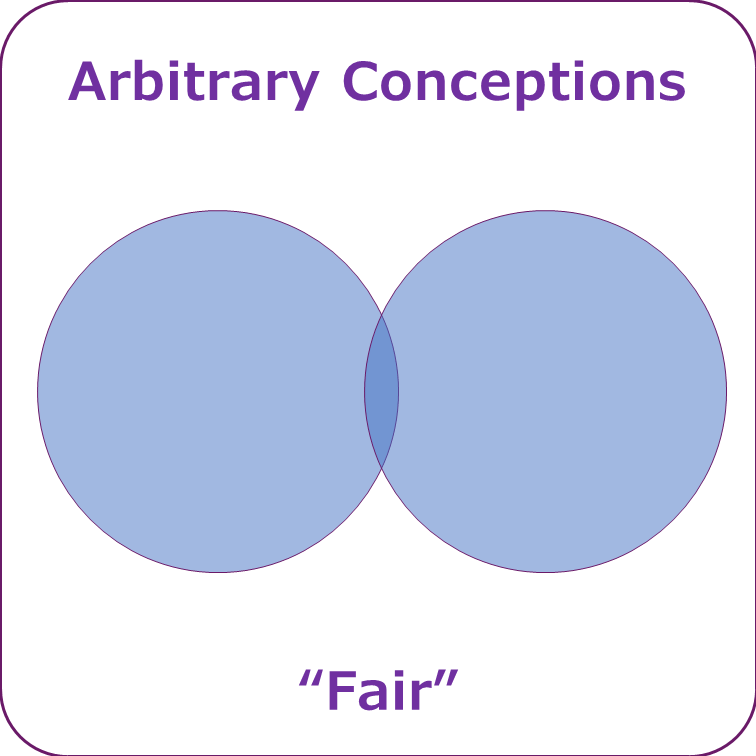
I’ve discussed a simpler abstract term before: fairness. To recapitulate, most people will tell you they want situations in the world to be fair. Only fair means entirely different things to different people. I’ve written about this in several places, so I’ll continue on our conservative journey.
Venn: Fair (oversimplified for effect)
Not only has the term conservative morphed over the years, it has different meanings—though to be fair, probably fewer than ‘liberal’. As I’ve discussed here before prior to the recent post, liberals are conservatives, but no one is really defending this position because the goal is identity, and identity involved separation to be distinguished.
Like fair, conservative has some common ground. The challenge is to understand which flavour is being used. Are you communicating by using the same term, or are you talking across each other? In some cases, this can lead to what I’ll call false positives (borrowing the language of statistical errors) where you think you are in agreement, except you aren’t. The other side of this coin is the false negative, where you think you are in disagreement when in fact you are talking about two different things.
This happened to me. A mate asked me to meet her at a certain time and place —I’ll just use McDonald’s because it is so ubiquitous. I went to the McDonald’s and waited. After a while, she called.
“Are you close?”
I scan the car park.
“I don’t see you. Maybe I missed you. I’m parked on the side near Taco Bell, not the oil change place.”
“There’s no Taco Bell at McDonald’s. What McDonald’s did you go to?”
It turns out that she was a distance away and wanted me to meet her halfway—like two-thirds to be honest. I assumed she meant the one we’d commonly visit.
This is a false positive. Communication was presumed to occur. It did. It just wasn’t useful. And since the reason for the rendezvous in the first place is to save time—one might say to ‘conserve’ time, but even I wouldn’t stoop to such a low target.
Wrapping up, the challenge is that trees are objects in the world. We can quickly recalibrate ourselves by reference. This is not possible for abstract concepts. I tend to refer to these are weasel words. Some use these words unknowingly. Whenever I hear some yahoo wintering on about freedom or justice, my first impression is that this bloke is tripping on a Kool-Aid propaganda overdose. Most common people falsely believe that people can understand what’s in their heads.
And to be fair—the left sort, not the one on the right—, when these yahoos utter the term, they are probably using it like their neighbour. But walk a few blocks or miles, and that bet is off. Sure, if the people have a common connexion, this might moderate the differences. But if one attempts to triangulate across worldviews, all bets are off. You may or may not be singing from the same hymnal.
I am trying to avoid commenting on the recent SCOTUS decision and how it is symptomatic of how the United States remains a failed state—at least a zombie state—, so this preamble should suffice for now.
I was chatting politics into the wee hours with my son, who’s been on this earth for almost 25 years now. I consider myself to be on the left of traditional political scales. He considers himself to be on the right, but he’s trying to make sense of the scales and dimensions. He had two questions: First, ‘What are the crucial dimensions and positions that define left and right?’ Second, ‘Where do Liberals fit into the equation?’
Knowing me, he wanted to provide some context and confer with me his knowledge that would also serve to frame and anchor the conversation. A key point was to have clarified the adopted nomenclature and positioning on a theoretical map.
We started with the origins of the left-right distinction, which was barely a valid dichotomy even as it was coined in France. There was no duolith. Those on the left or right had features in common but taken holistically, this was a reductionist categorisation, as tends to happen. Exacerbating this, as it does today, still, the politicians with voices remained to the right of the unvoices masses.
He asked about the difference between freedom and liberty because his sources differentiate the two. Whilst connotation and nuance may enter the picture, etymologically speaking, freedom is a native English word whilst liberty is French via Latin. Connotatively, freedom is an absolute measure whilst liberty is granted within a political framework. Positive and negative liberties aside, liberty is an attenuator. It restricts freedom even if it allows most of the signal through. Effectively, liberty is permission by the state to act in certain ways.
By the end of the conversation, he was framing the key difference around notions of national identity and nationalism—I versus we. I shared my thoughts on the construction of identity, thus making for a poor foundation, though we both agreed that national narratives have been the impetus for much activity. (I am reluctant to insert the word progress here.)
After our conversation, I began researching dimensions established or otherwise proposed by political science. This led me to a place I found interesting—the distinction between radical, progressive, conservative, and reactionary positions. For some reason, this never really occurred to me.
I’m not sure one can employ these terms in general discussion without definition and qualification, but I feel they are useful in their own right. Typically, I view the political landscape—at the highest level and with a US-bent—as Left (communists, socialists, anarchists, progressives) and Right (conservatives, liberals, and fascists). I also know that this is imprecise, but maps always are.
This new vocabulary helps by distilling the map to this—ordered differently:
Right
Conservative
Reactionary
Left
Progressive
Radical
Conservative
Conservatives want to maintain the status quo. This is interesting usage adoption. Fundamentally, advocates of this view want to promote and to preserve traditional social institutions and practices. In Western culture, conservatives seek to preserve a range of institutions such as organized religion, parliamentary government, and property rights. Conservatives tend to favour institutions and practices that guarantee stability and evolved gradually. Adherents of conservatism often oppose progressivism and seek a return to traditional values
In Western culture, conservatives seek to preserve a range of institutions such as organized religion, parliamentary government, and property rights.
My first thoughts when I hear the term are a harkening back to the old ways—the Ozzie and Harriott mythos, white picket fences, Mom and apple pie. But this is different. Effectively, rather than reaching back, it wants to preserve the current moment in time. Where it gets more nebulous, I think, is that some people include nostalgia in the now. Duratively, perhaps a person might remember some aspect of their childhood. Though this has been lost by now, they imagine it as part of their identity. This can also extend further back as they wish some other historical aspects can be cherry-picked. Perhaps the white conservative wishes to be able to subjugate women as was the practice in the 1950s of America, but to not conserve high union participation and high marginal tax rates, as affronts to freedom (or whatever). This ends up being an exercise in selective memory and revisionist history-making.
This needs to be distinguished from a so-called traditional conservativism in the tradition of Burke or Hobbes, who want to conserve some sense of fundamental morality they feel derives from nature.
Reactionary
Reactionaries oppose whatever is in effect at the moment—the petulant toddler—but with a twist. Like the conservatives, there is a conservation effort but rather than a focus on the status quo, the focus is on status quo ante, which is a return to the old ways, tried and true.
Progressive
Progressives support social reform. Ostensibly, they don’t oppose tradition, but they feel that old structures need to be reimagined and reinterpreted in face of social and technological change. An underlying metanarrative is the notion of progress. I am not going to comment on progressivism generally and the nuances evident in the American flavour of it.
During the 20th century, radical politicians took power in many countries across the world. Such radical leaders included Vladimir Lenin and Joseph Stalin in Russia, Mao Zedong in China, Adolf Hitler in Germany, as well as more mainstream radicals such as Ronald Reagan in the United States and Margaret Thatcher in the United Kingdom. Of course, Donald Trump is a more recent example in the United States.
Summary
To me, these terms operate on a gravity to now. Conservatives are heavily anchored in the familiar and seek stability. Then they see factors in the past that they imagine will also serve this purpose, so they wish to incorporate these and carry them forward. Conservatives are not unaware of the need for change, they just want to not create waves in the process.
Likewise, although placing a heavier weight on the past than even conservatives, reactionaries are not fundamentally opposed to retaining what is working currently. The term working is subjective and perspectival, so they may wish to retain something that works for them at the expense of others. This is a challenge for conservatism as well. Just because racial segregation seemed to work for an equivalent person in the past doesn’t mean it worked well for the excluded.
Like reactionaries, progressives aren’t afraid of keeping a foot in the present—and there may be plenty of lessons to learn from the past—, but they feel that given the change in the underlying terrain, some refactoring is in order.
And then there are the radicals. I suppose that radicals have different motivators, but in essence, they feel that the current implementation is substantially broken, and it needs more than a few small tweaks and a fresh coat of paint. These people are renovating rather than redecorating. They may even want to throw the baby out with the bath water. Some may wish to keep the baby.
As for me, I usually place myself in the Progressive camp, but under the definition, I am more of a radical. The system is broken. We don’t just need to delete it, we need to install a new one.
Thomas Jefferson said that the United States should rewrite the Constitution every 19 years. Why 19 years? Who knows? Given the intransigence in American politics, this would have been a disaster. And given the powers that be, the debate would be over which parts to conserve and which to progress. Being the cynic that I am, my guess is that it would devolve to worse than we have now.
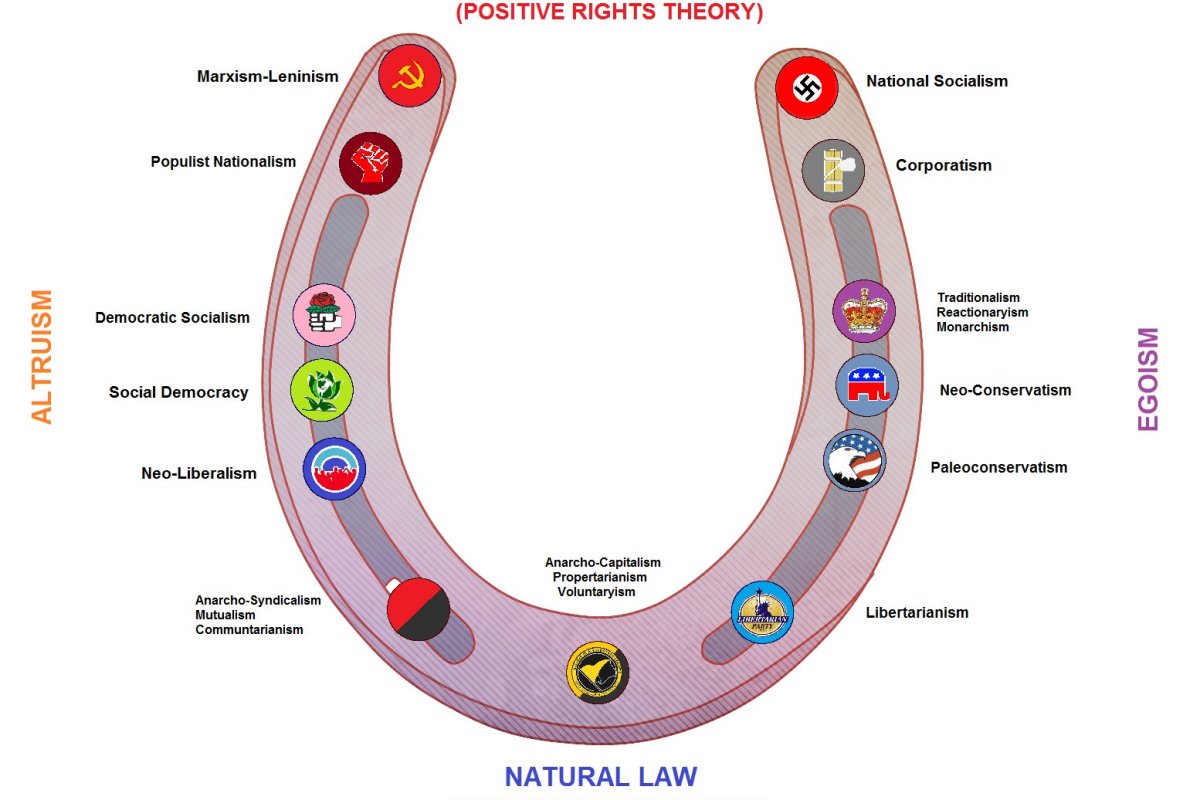
DISCLAIMER: For the record, I don’t endorse the placement of the political ideologies on the horseshoe image, but I find it interesting and it grabbed my attention. I hope it grabbed yours, too.
A colleague who happens to be a professor in New South Wales shared this video with me. I am tempted to just recapture the presented content here, but I feel everyone should just watch it for full impact. I intentionally used a cover image that is counter to the narrative. The challenge is not overpopulation. Rather, it’s the opposite. Find out why.
Video: RSNSW Clarke Memorial Lecture 2021: The changing tide of human populations: an infertility trap
I’ve cued the video beyond the introduction—feel free to rewind for context, but there is no material content to be missed—, and there are a couple of minutes of additional material at the end, making the content closer to 50 minutes (48.5) than an hour.
The Infertility Trap was published last month as a book. I’ve not read it, but it was referenced. Countdown, by Shanna Swan is also referenced.
Book Cover: The Infertility TrapBook Cover: Countdown
Some highlights follow:
The Rise and Rise of Humankind
Geometric growth commenced after the Black Plague was driven by the discovery of how to harness fossil fuel. As with Malthusian predictions, The Population Bomb missed the mark—but not for all of the reasons you might be thinking.
Changing Pace of Population Growth
Population growth rates were already on the decline when The Population Bomb was published in 1968. This trend was a result of the fertility trend that became precipitous circa 1963.
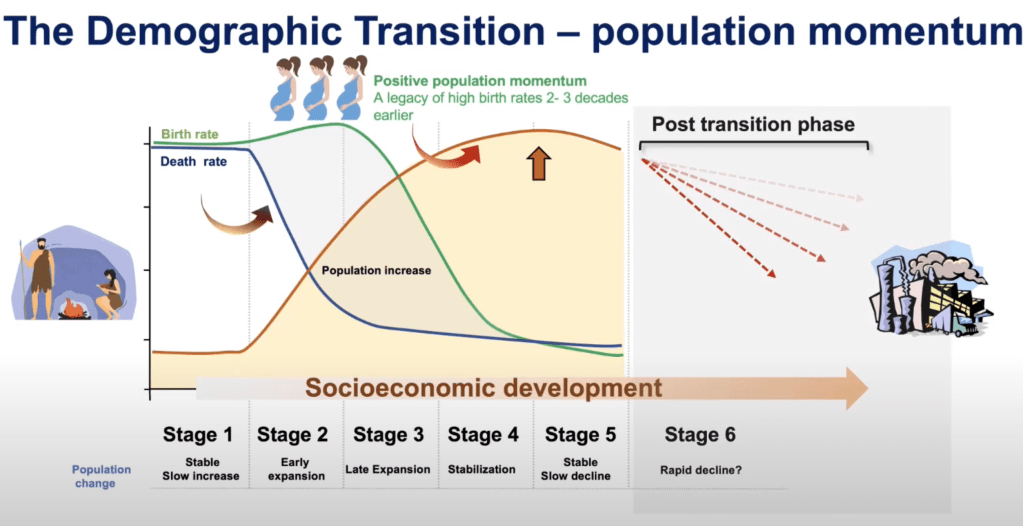
The Demographic Transition: Population Momentum
Though birth rates may seem to be increasing, this is merely optics as this is a legacy of positive population momentum stemming from high birth rates a few decades prior to the impending decline in fertility.
The Malthusian Paradox
Thomas Malthus didn’t grasp the paradigmatic shift technology would provide nor the relationship between fertility and prosperity.
Charts: Prosperity, infant mortality, child mortality, and fertility rate
As prosperity (as measured by GDP) increases, infant and child mortality as well as total fertility rate, each decrease. (I’m calling out the poor statistical representation of the non-zero-based Y-axis, but I don’t believe this was done to exaggerate the slope. It’s apparently just out of index.)
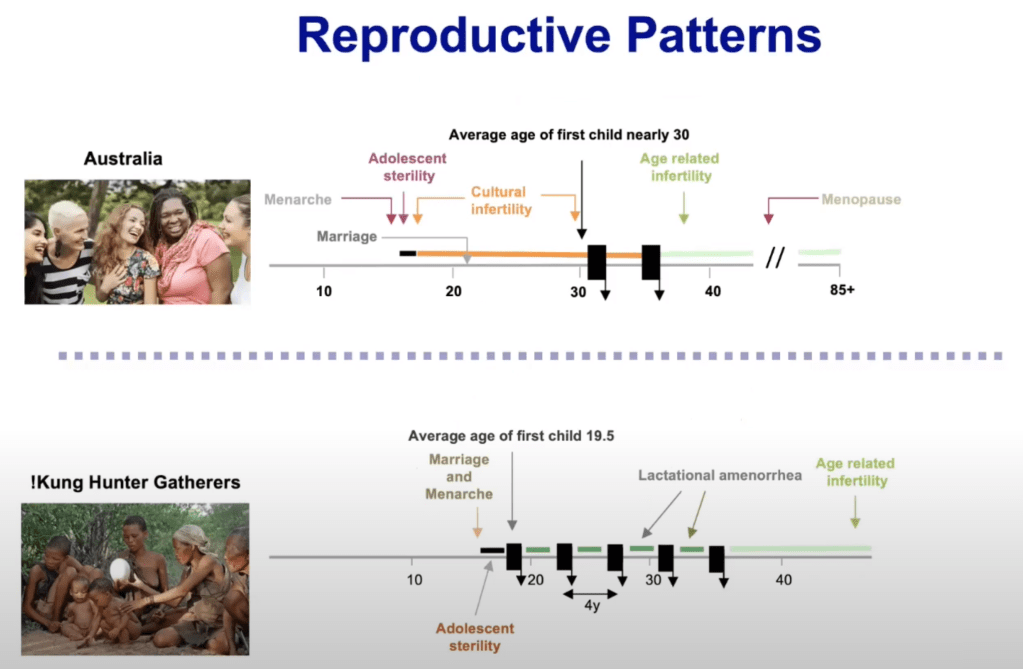
Reproductive Patterns: Australia vs !Kung Hunter-Gatherers
Notable in the charts above, are the delays in reproduction by the average Australian woman to around 30 years effectively limits the delivery to about 2 (1.7) whereas the hunter-gatherers commence closer to 20 years, yielding them an average of 5 children.
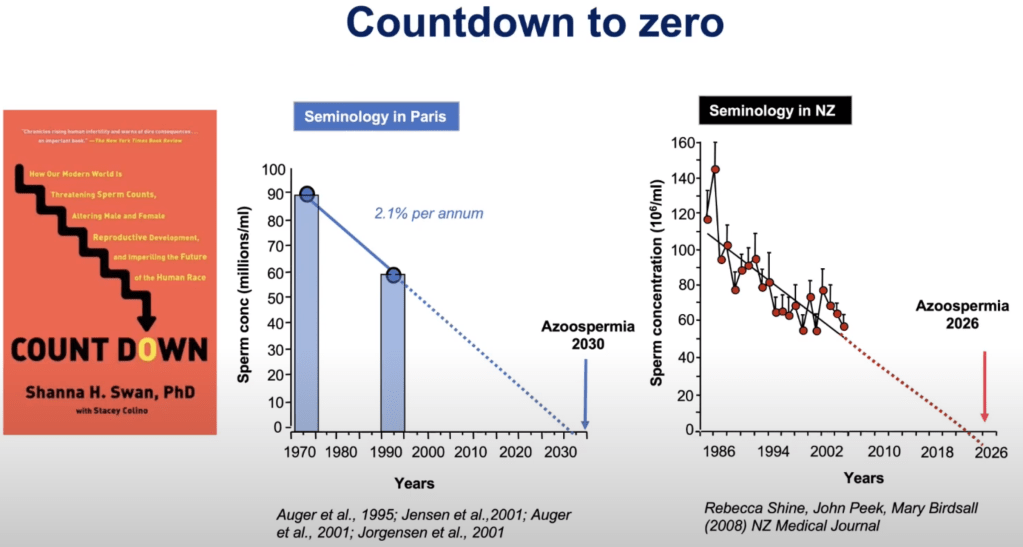
Rapid decline in semen quality
Semen quality (motility) and count are down.
Projections: Countdown to sperm count of zero in Paris and New Zealand
If declining semen count trends remain unabated or unaltered, one might anticipate a point where male fertility (potency?) reaches zero. This is characterised as azoopermia and projects this on Parisian males just past 2030 and by 2026 for New Zealanders.
Secular trend in declining testosterone levels
This downward trend is not constrained by region.
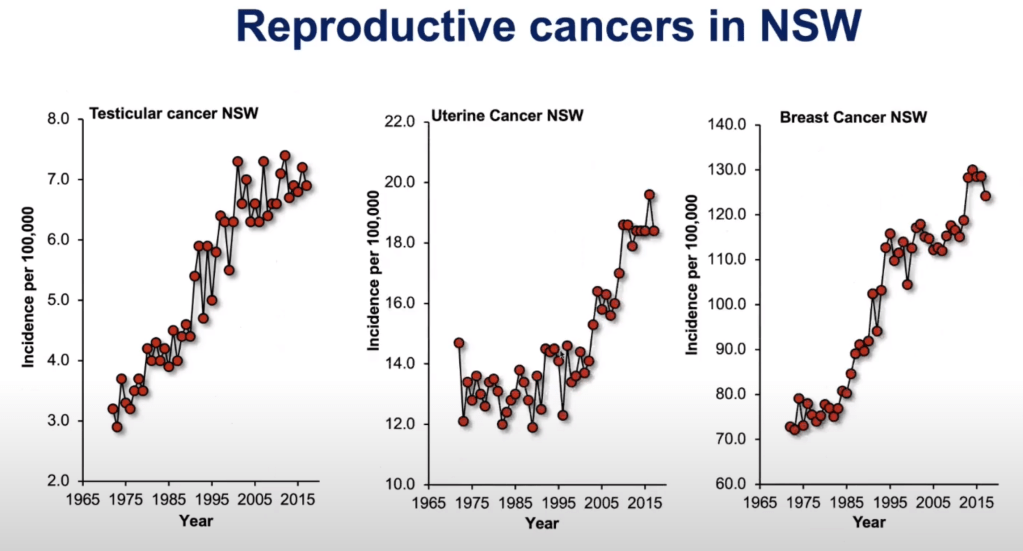
Trends in Testicular Cancer (NSW)
A correlated trend in fertility rate is an increase in testicular cancer, as shown with NSW data, even as ovarian cancer remains steady and cervical cancers are decreasing.
Reproductive Cancers in New South Wales
Conversely, other reproductive cancers (in NSW)—uterine and breast cancers—are on the rise in sync with testicular cancers and the drop in fertility.
My intent with this post is to share rather than editorialise. The video speaks for itself. I’ve provided some excerpted content for those who can’t spare the time to view the source.
Small Print: I’ve been approved to offer books through Amazon.com. Any books purchased by having clicked a link will yield me a small commission. This commission is not added to the price of the book to you. If you purchase the book through Amazon directly, bypassing an affiliate programme, they will keep the difference. So, if you intend to buy a book, stick it to the man and purchase it through me.

















 Philosophics