I question whether reviewing a book chapter by chapter is the best approach. It feels more like a reaction video because I am trying to suss out as I go. Also, I question the integrity and allegiance of the author, a point I often make clear. Perhaps ‘integrity’ is too harsh as he may have integrity relative to his worldview. It just happens to differ from mine.
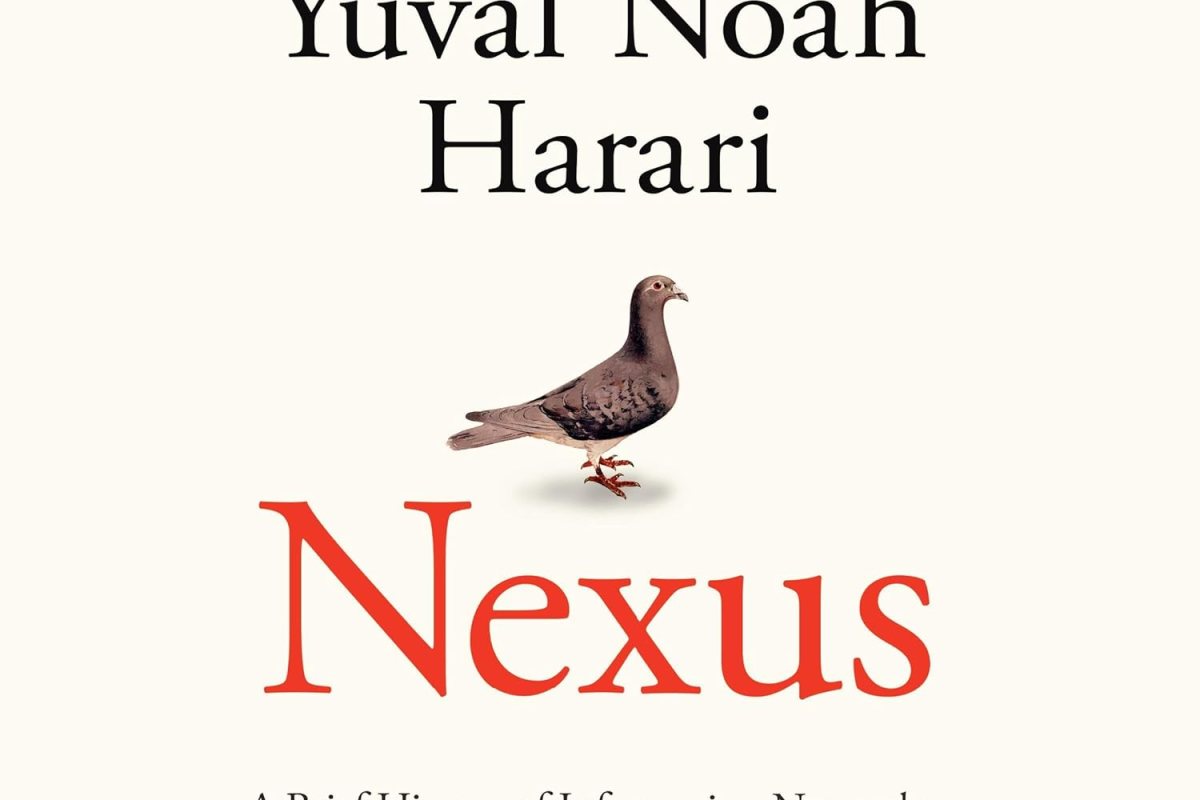
Chapter 1 of Yuval Noah Harari’s Nexus, ironically titled “What is Information?” closes not with clarity but with ambiguity. Harari, ever the rhetorician, acknowledges the difficulty of achieving consensus on what ‘information’ truly means. Instead of attempting a rigorous definition, he opts for the commonsense idiomatic approach—a conveniently disingenuous choice, given that information is supposedly the book’s foundational theme. To say this omission is bothersome would be an understatement; it is a glaring oversight in a chapter dedicated to unpacking this very concept.
Audio: Podcast related to this content.
Sidestepping Rigour
Harari’s rationale for leaving ‘information’ undefined appears to rest on its contested nature, yet this does not excuse the absence of his own interpretation. While consensus may indeed be elusive, a book with such grand ambitions demands at least a working definition. Without it, readers are left adrift, navigating a central theme that Harari refuses to anchor. This omission feels particularly egregious when juxtaposed against his argument that information fundamentally underlies everything. How can one build a convincing thesis on such an unstable foundation?
The Map and the Terrain
In typical Harari fashion, the chapter isn’t devoid of compelling ideas. He revisits the map-and-terrain analogy, borrowing from Borges to argue that no map can perfectly represent reality. While this metaphor is apt for exploring the limitations of knowledge, it falters when Harari insists on the existence of an underlying, universal truth. His examples—Israeli versus Palestinian perspectives, Orthodox versus secular vantage points—highlight the relativity of interpretation. Yet he clings to the Modernist belief that events have an objective reality: they occur at specific times, dates, and places, regardless of perspective. This insistence feels like an ontological claim awkwardly shoehorned into an epistemological discussion.
Leveraging Ambiguity
One can’t help but suspect that Harari’s refusal to define ‘information’ serves a rhetorical purpose. By leaving the concept malleable, he gains the flexibility to adapt its meaning to suit his arguments throughout the book. This ambiguity may prove advantageous in bolstering a wide-ranging thesis, but it also risks undermining the book’s intellectual integrity. Readers may find themselves wondering whether Harari is exploring complexity or exploiting it.
Final Thoughts on Chapter 1
The chapter raises more questions than it answers, not least of which is whether Harari intends to address these foundational gaps in later chapters. If the preface hinted at reductionism, Chapter 1 confirms it, with Harari’s Modernist leanings and rhetorical manoeuvres taking centre stage. “What is Information?” may be a provocative title, but its contents suggest that the question is one Harari is not prepared to answer—at least, not yet.
I’ve just begun reading Yuval Noah Harari’s Nexus. As the prologue comes to a close, I find myself navigating an intellectual terrain riddled with contradictions, ideological anchors, and what I suspect to be strategic polemics. Harari, it seems, is speaking directly to his audience of elites and intellectuals, crafting a narrative that leans heavily on divisive rhetoric and reductionist thinking—all while promising to explore the nuanced middle ground between information as truth, weapon, and power grab. Does he deliver on this promise? The jury is still out, but the preface itself raises plenty of questions.
Audio: Podcast reflecting on this content.
The Anatomy of a Polemic
From the outset, Harari frames his discussion as a conflict between populists and institutionalists. He discredits the former with broad strokes, likening them to the sorcerer’s apprentice—irrational actors awaiting divine intervention to resolve the chaos they’ve unleashed. This imagery, though evocative, immediately positions populists as caricatures rather than serious subjects of analysis. To compound this, he critiques not only populist leaders like Donald Trump but also the rationality of their supporters, signalling a disdain that reinforces the divide between the “enlightened” and the “misguided.”
This framing, of course, aligns neatly with his target audience. Elites and intellectuals are likely to nod along, finding affirmation in Harari’s critique of populism’s supposed anti-rationality and embrace of spiritual empiricism. Yet, this approach risks alienating those outside his ideological choir, creating an echo chamber rather than fostering meaningful dialogue. I’m unsure whether he is being intentionally polemic and provocative to hook the reader into the book or if this tone will persist to the end.
The Rise of the Silicon Threat
One of Harari’s most striking claims in the preface is his fear that silicon-based organisms (read: AI) will supplant carbon-based life forms. This existential anxiety leans heavily into speciesism, painting a stark us-versus-them scenario. Whilst Harari’s concern may resonate with those wary of unchecked technological advancement, it smacks of sensationalism—a rhetorical choice that risks reducing complex dynamics to clickbait-level fearmongering. How, exactly, does he support this claim? That remains to be seen, though the sceptic in me suspects this argument may prioritise dramatic appeal over substantive evidence.
Virtue Ethics and the Modernist Lens
Harari’s ideological stance emerges clearly in his framing of worldviews as divisions of motives: power, truth, or justice. This naïve triad mirrors his reliance on virtue ethics, a framework that feels both dated and overly simplistic in the face of the messy realities he seeks to unpack. Moreover, his defence of institutionalism—presented as the antidote to populist chaos—ignores the systemic failings that have eroded trust in these very institutions. By focusing on discrediting populist critiques rather than interrogating institutional shortcomings, Harari’s argument risks becoming one-sided.
A Preface Packed with Paradoxes
Despite these critiques, Harari’s preface is not without its merits. For example, his exploration of the “ant-information” cohort of conspiracy theorists raises interesting questions about the weaponisation of information and the cultural shifts driving these movements. However, his alignment with power concerns—notably the World Economic Forum—casts a shadow over his ability to critique these dynamics impartially. Is he unpacking the mechanisms of power or merely reinforcing the ones that align with his worldview?
The Promise of Middle Ground—or the Illusion of It
Harari’s stated goal to explore the middle ground between viewing information as truth, weapon, or power grab is ambitious. Yet, the preface itself leans heavily toward polarisation, framing AI as an existential enemy and populists as irrational antagonists. If he genuinely seeks to unpack the nuanced intersections of these themes, he will need to move beyond the reductionism and rhetorical flourishes that dominate his opening chapter.
Final Thoughts
I liked Hararis’ first publication, Sapiens, that looked back into the past, but I was less enamoured with his prognosticating, and I worry that this is more of the same. As I move beyond the preface of Nexus, I remain curious but sceptical. Harari’s narrative thus far feels more like a carefully curated polemic than a genuine attempt to navigate the complexities of the information age. Whether he builds on these initial positions or continues entrenching them will determine whether Nexus delivers on its promise or merely reinforces existing divides. One thing is certain: the prologue has set the stage for a provocative, if polarising, journey.
As the clock ticks us into 2025, a peculiar tale has surfaced in the blogosphere: a dark twist on the classic fable of the “wolf in sheep’s clothing,” served with a side of nihilistic absurdity. If you haven’t read it yet, you can find the original story over at Blog for Chumps. It’s a biting little narrative that turns traditional moralising on its head. Here’s why it deserves your attention.
Audio: NotebookLM Podcast on this topic.
The Tale in Brief
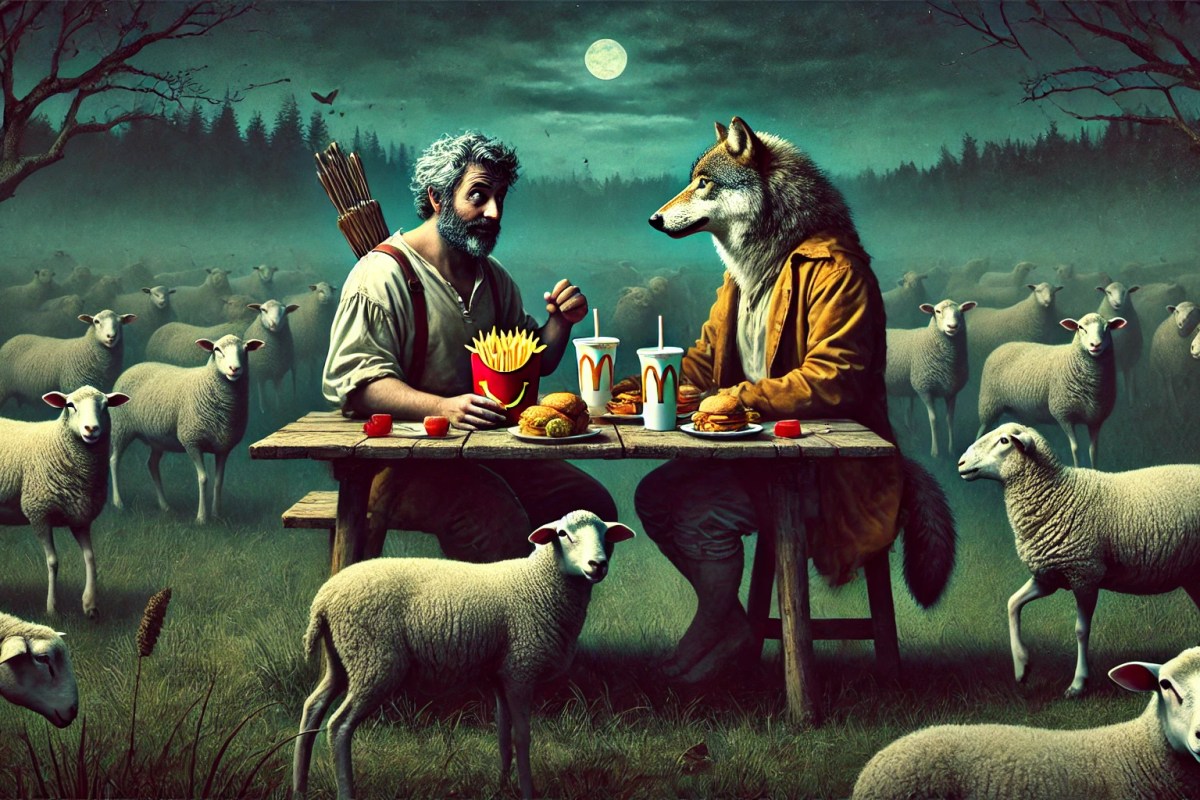
A hungry wolf, tired of dodging vigilant shepherds, decides to forgo subterfuge altogether. He waltzes into the flock, making no effort to hide his predatory nature. A naïve lamb follows him, and predictably, the wolf claims his meal. Later, the wolf returns to the sheepfold, where the shepherd — instead of protecting his flock — teams up with the wolf. Together, they butcher a sheep before abandoning the scene entirely to indulge in McDonald’s, leaving the traumatised sheep to accept their grim new reality.
Not exactly bedtime reading for the kids.
Themes: A Cynical Mirror to Our World
This tale is not merely a grotesque subversion of pastoral simplicity; it’s a scalpel slicing into the rotting carcass of modern society. Here’s what lurks beneath its woolly surface:
1. Cynicism Towards Authority
In most fables, the shepherd embodies protection and care. Here, he’s a collaborator in senseless violence. The shepherd’s betrayal critiques the notion of benevolent authority, suggesting that those entrusted with safeguarding the vulnerable often act in their own interests or, worse, align themselves with destructive forces. Sound familiar? Think political complicity, corporate greed, or any number of modern failures of leadership.
2. Normalisation of Atrocity
The sheep, described as cognitively intact, accept their grim reality without resistance. This isn’t a story about oblivious innocence; it’s about the horrifying human capacity to adapt to systemic violence. It reflects how people, faced with injustice, often acquiesce to their oppressors rather than challenge the status quo.
3. Inversion of Expectations
The wolf doesn’t even bother with the traditional sheepskin disguise. His audacity mirrors the brazen nature of modern exploitation, where bad actors operate in plain sight, confident in the public’s apathy or resignation. It’s a commentary on the erosion of shame, accountability, and even the pretence of decency.
4. Absurdity and Nihilism
The shepherd and wolf ditch their victim to grab fast food, trivialising the violence they’ve inflicted. The juxtaposition of archaic brutality with banal consumerism is absurd yet disturbingly resonant. It suggests that, in our era, even cruelty can be relegated to a footnote in the pursuit of comfort or convenience.
Symbols: Layers of Meaning
The tale brims with symbolic resonance:
The Wolf: A stand-in for unchecked greed or predatory systems, the wolf’s brazen behaviour highlights the dangers of apathy and unchallenged power.
The Shepherd: His betrayal symbolises the failure of institutions — governments, corporations, or other entities — to protect those they claim to serve.
The Sheep: Far from being simple-minded, the sheep’s acceptance of their grim new reality is a biting critique of societal complacency.
McDonald’s: A modern symbol of triviality and consumerism, it underscores the absurdity of senseless violence in a world driven by shallow comforts.
A Stark Commentary on Power Dynamics
At its core, the story is a brutal satire of power and complicity. Though ostensibly adversaries, the shepherd and wolf unite to exploit the powerless. It’s a chilling reminder of how often power structures protect their own interests at the expense of the vulnerable.
The sheep’s passive acceptance is equally damning. It forces readers to confront their own role as silent witnesses or even complicit actors in systems of oppression. What happens when we’re no longer shocked by atrocity but instead integrate it into the fabric of our existence?
The Satirical Edge
What makes this story particularly effective is its dark, sardonic, and unapologetically hyperbolic tone. It revels in absurdity while delivering a grim truth about human nature. The shepherd and wolf’s nonchalance is as hilarious as it is horrifying, making the tale an unsettling mirror of a society where injustice and apathy often go hand in hand.
Final Thoughts
This fable may be short, but its implications are vast. It’s a cautionary tale about the dangers of complacency, the betrayal of trust, and the absurdity of modern priorities. More importantly, it’s a call to resist the normalisation of harm — to recognise wolves and shepherds for what they are and demand better from ourselves and those in power.
So, as we usher in a new year, let this tale serve as a grim reminder: the wolf doesn’t always need a disguise, and the shepherd isn’t always your friend. Sometimes, they’re just two blokes on their way to McDonald’s.
Imagine you’re alone in the desert, lost and desperate for water. The sun beats down mercilessly, and the sand stretches out in every direction, an endless sea of dunes. Just as you’re about to give up hope, you spot a palm tree in the distance, swaying gently in the shimmering heat. Your heart leaps – could it be an oasis, a chance for survival? You stumble towards it, but as you approach, the tree seems to flicker and dance, always just out of reach. Is it really there, or is it a mirage, a trick of the mind born of desperation and the desert’s cruel illusions?
Audio: Podcast conversation about this article.
This question – how do we distinguish between objective reality and our subjective perceptions – has haunted philosophers for centuries. From ancient debates between Protagoras and Plato to the radical scepticism of Descartes, thinkers have grappled with the nature of truth and our access to it. Is there an external world that exists independently of our minds, or is reality fundamentally shaped by our individual and collective experiences?
The rise of Enlightenment rationalism in the 17th and 18th centuries sought to establish a firm foundation for objective knowledge. Descartes’ methodological doubt, which questioned the reliability of sense perceptions, and Kant’s exploration of the a priori structures of reason were attempts to secure certainty in the face of relativistic challenges. Yet the spectre of relativism persisted, finding new expressions in
Nietzsche’s perspectivism and the linguistic turn of the 20th century.
Today, the debate between relativism and objectivism remains as pressing as ever. In a world of increasing cultural diversity, competing moral frameworks, and the proliferation of ‘alternative facts,’ the question of whether truth is relative or absolute has far-reaching implications. How do we navigate the labyrinth of subjective experiences and cultural norms whilst still maintaining a commitment to truth and rationality?
In this essay, we will explore the complex relationship between relativism and objectivism, drawing on insights from thinkers such as Thomas Kuhn, Richard Rorty, Michel Foucault, and Paul Feyerabend. By examining how our perceptions and beliefs are shaped by cognitive biases, cultural conditioning, and power dynamics, we will argue for a nuanced understanding of truth that recognises the inescapability of interpretation whilst still preserving the possibility of meaningful dialogue and consensus. Just as the desert wanderer must learn to distinguish between the mirage and the true oasis, we must develop the philosophical tools to navigate the shifting sands of relativism and objectivism. Only by embracing the complexity and ambiguity of the quest for truth can we hope to find our way through the wilderness of human experience.
Defining the Terrain: Objectivism, Subjectivism, and Relativism
Before we can navigate the complex landscape of relativism and objectivism, we must first establish a clear understanding of these core concepts. What do we mean when we speak of objective reality, subjective experience, and relativistic truth?
Objective Reality: The Elusive Ideal
At the heart of the objectivist worldview lies the notion of an external, mind-independent reality. This is the world of physical objects, natural laws, and brute facts – a realm that exists independently of our perceptions, beliefs, or desires. For the objectivist, truth is a matter of correspondence between our ideas and this external reality. When we say that the Earth orbits the Sun or that water boils at 100 degrees Celsius, we are making claims about objective features of the world that hold true regardless of what any individual or culture believes.
However, the concept of objective reality is not without its challenges. As Descartes famously argued in his Meditations, how can we be certain that our perceptions accurately represent the external world? Might we not be deceived by a malicious demon or, in a more modern vein, by a sophisticated simulation? The possibility of perceptual error or illusion suggests that our access to objective reality is always mediated by our subjective experiences.
Subjective Experience: The Inescapable Lens
In contrast to the objectivist emphasis on an external reality, the subjectivist perspective foregrounds the primacy of individual experience. Our perceptions, thoughts, feelings, and beliefs shape our unique engagement with the world, colouring our understanding of truth and meaning. Two individuals may look at the same work of art or confront the same ethical dilemma, yet come away with radically different interpretations based on their personal histories, cultural backgrounds, and emotional states. The subjectivist view finds support in the work of thinkers like David Hume, who argued that our ideas and beliefs arise not from direct access to objective reality, but from the associations and habits of our own minds. More recently, the field of cognitive psychology has revealed the myriad ways in which our perceptions and judgements are shaped by unconscious biases, heuristics, and emotional influences. From the confirmation bias that leads us to seek out information that reinforces our preexisting beliefs to the availability heuristic that causes us to overestimate the likelihood of vivid or easily remembered events, our subjective experiences are permeated by cognitive quirks that distort our understanding of reality.
Relativism: Navigating the Intersubjective Matrix
If objective reality is elusive and subjective experience inescapable, what are we to make of truth and knowledge? This is where relativism enters the picture. Relativism is the view that truth, morality, and meaning are not absolute or universal but are instead relative to particular individuals, cultures, or historical contexts. For the relativist, there is no single, objective standard by which to adjudicate between competing beliefs or values. Rather, truth is always situated within specific interpretive frameworks shaped by the language, norms, and practices of different communities.
One of the most influential articulations of relativism can be found in the work of Thomas Kuhn. In his landmark book, The Structure of Scientific Revolutions, Kuhn argued that even the supposedly objective realm of science is structured by paradigms – overarching theoretical frameworks that determine what counts as legitimate questions, methods, and evidence within a given scientific community. When paradigms shift, as happened during the transition from Newtonian to Einsteinian physics, it’s not simply a matter of uncovering new objective facts. Rather, the very nature of reality and truth undergo a radical transformation.
The relativist perspective highlights the ways in which our understanding of the world is always embedded within cultural and historical contexts. The beliefs and values that we take for granted as natural or self-evident are, in fact, the products of contingent social processes. Michel Foucault’s genealogical investigations into the history of madness, sexuality, and criminality, for example, reveal how our conceptions of normality and deviance have shifted dramatically over time, shaped by the interplay of power, knowledge, and discourse.
Yet relativism need not collapse into an ‘anything goes’ nihilism or scepticism. Richard Rorty argues that we can still engage in meaningful dialogue and work towards pragmatic consensus, even if we abandon the notion of a single, absolute truth. By recognising the contingency and fallibility of our beliefs, we open up space for genuine conversation and mutual understanding across differences.
Conclusion
Objectivism, subjectivism, and relativism offer competing visions of the nature of truth and our relationship to reality. Whilst the dream of objective certainty remains alluring, the challenges posed by perceptual variability, cognitive bias, and cultural diversity suggest that a more nuanced approach is needed. By embracing the insights of relativism – the recognition that truth is always shaped by interpretation and context – we can navigate the complex terrain of human experience with greater humility, openness, and creativity.
As we move forward in this essay, we will explore how the dialectic of objective reality and subjective experience plays out in specific domains, from the perception of physical objects to the construction of scientific knowledge. By engaging with thinkers like Kuhn, Foucault, and Rorty, we will map the contours of a relativistic understanding of truth that acknowledges the inescapability of perspective whilst still preserving the possibility of meaningful dialogue and pragmatic consensus. The path ahead is not a straight line to absolute certainty but a winding trail through the wilderness of interpretation – a journey that demands courage, curiosity, and a willingness to question our most cherished assumptions. The Dialectic of Perception and Interpretation
Having established the key concepts of objectivism, subjectivism, and relativism, we can now delve into the dynamics of how perception and interpretation shape our understanding of reality. This dialectical process unfolds across three interrelated moments: the cultural shaping of perception, the individual’s subjective experience of the world, and the relativistic synthesis of these experiences into a situated understanding of truth.
The Palm Tree: A Case Study in Perceptual Dynamics
To illustrate this dialectic, let us return to the example of the desert wanderer and the palm tree. At first glance, the palm tree seems to be a straightforward object of perception – a physical entity with distinctive features such as a tall, slender trunk and a crown of feathery fronds. Yet even this seemingly simple act of recognition is shaped by a complex interplay of cultural, cognitive, and subjective factors. Firstly, the very concept of a ‘palm tree’ is a product of cultural learning and categorisation. From an early age, we are taught to distinguish between different types of plants and to associate them with specific names, uses, and symbolic meanings. The palm tree, for instance, may evoke associations with tropical paradise, desert oases, or biblical imagery, depending on one’s cultural background and personal experiences. This cultural shaping of perception predisposes us to see the world in certain ways, priming us to recognise and interpret objects according to preexisting schemas and categories.
Secondly, the individual’s subjective experience of the palm tree is mediated by a range of cognitive and perceptual factors. As Kuhn’s off-colour playing card experiment demonstrates, our expectations and prior knowledge can lead us to overlook or misinterpret anomalous stimuli. In the case of the desert wanderer, the intense desire for water and the harsh environmental conditions may distort their perception, causing them to see a mirage where there is none. Moreover, the physiology of the human visual system itself imposes certain constraints on how we process and interpret sensory information, as evidenced by well-known optical illusions such as the Müller-Lyer illusion.
Thirdly, the relativistic synthesis of these cultural and subjective factors yields a situated understanding of the palm tree that is both shaped by and shapes the individual’s broader worldview. The desert wanderer’s recognition of the palm tree as a sign of an oasis is not simply a neutral act of perception but a meaning-making process that reflects their cultural knowledge, personal desires, and embodied experiences. This interpretation, in turn, influences their subsequent actions and beliefs, shaping their understanding of the world and their place within it.
The Science of Perception: From Descartes to Kahneman
The philosophical and scientific study of perception has long grappled with the challenges posed by subjectivity and relativism. Descartes, in his Meditations, famously questioned the reliability of sensory experience, arguing that our perceptions could be deceived by dreams, illusions, or even a malicious demon. This radical doubt laid the groundwork for the epistemological project of modernity, which sought to establish a firm foundation for knowledge based on clear and distinct ideas rather than fallible sensory impressions.
However, as the work of cognitive psychologists like Daniel Kahneman has shown, even our most basic perceptual judgments are subject to a wide range of biases and distortions. From the anchoring effect, which causes us to rely too heavily on the first piece of information we receive, to the availability heuristic, which leads us to overestimate the likelihood of vivid or easily remembered events, our minds are constantly shaping and filtering our experiences in ways that depart from objective reality.
The Relativistic Synthesis: Embracing Perspective
Given the complex interplay of cultural, subjective, and cognitive factors that shape our perceptions, how are we to make sense of truth and knowledge? The relativistic approach suggests that we must abandon the quest for a single, absolute truth and instead embrace the multiplicity of perspectives that arise from our situated experiences.
This is not to say that all interpretations are equally valid or that there are no constraints on our understanding of reality. As Rorty argues, we can still engage in meaningful dialogue and work towards pragmatic consensus by recognising the contingency and fallibility of our beliefs. The goal is not to eliminate perspective but to cultivate a reflexive awareness of how our perspectives shape and are shaped by the world around us.
In the realm of science, for instance, Kuhn’s notion of paradigm shifts highlights how even our most rigorous and objective forms of knowledge are structured by overarching theoretical frameworks that determine what counts as valid evidence and explanation. For example, the transition from Newtonian to Einsteinian physics was not simply a matter of accumulating new facts but a radical reconceptualisation of the nature of space, time, and gravity. By recognising the role of paradigms in shaping scientific understanding, we can appreciate the ways in which our knowledge is always situated within particular historical and cultural contexts.
Conclusion
The dialectic of perception and interpretation reveals the complex dynamics through which our understanding of reality is shaped by an interplay of cultural, subjective, and cognitive factors. From the cultural categorisation of objects to the cognitive biases that distort our judgments, our experiences of the world are always mediated by the lenses of our situated perspectives.
Embracing a relativistic approach to truth and knowledge does not mean abandoning the quest for understanding but rather recognising the inescapability of perspective and the need for ongoing dialogue and reflexivity. By engaging with the work of thinkers like Descartes, Kahneman, Kuhn, and Rorty, we can cultivate a more nuanced and self-aware understanding of how we make sense of the world around us.
As we continue our exploration of relativism and objectivism, we will delve deeper into the implications of this relativistic synthesis for questions of scientific knowledge, moral reasoning, and political discourse. The path ahead is not a simple one, but by embracing the complexity and multiplicity of human experience, we open up new possibilities for understanding and transformation.
Relativism and the Politics of Knowledge
Having explored the dialectical process through which our perceptions and interpretations of reality are shaped by cultural, subjective, and cognitive factors, we now turn to the broader implications of relativism for the nature of scientific knowledge and the influence of power and ideology on the production of truth.
The Social Construction of Scientific Knowledge
One of the key insights of relativistic approaches to science, as developed by thinkers like Thomas Kuhn and Paul Feyerabend, is that scientific knowledge is not a purely objective or value-neutral representation of reality but is instead shaped by the social, historical, and cultural contexts in which it is produced. Kuhn’s notion of paradigm shifts, as we have seen, highlights how even the most rigorous and empirical forms of knowledge are structured by overarching theoretical frameworks that determine what counts as valid evidence and explanation.
This social constructionist view of science challenges the traditional image of the scientist as a disinterested observer, carefully recording the facts of nature without bias or prejudice. Instead, it suggests that scientific knowledge is always informed by the assumptions, values, and interests of the communities that produce it. The questions that scientists ask, the methods they employ, and the conclusions they draw are all shaped by the prevailing paradigms and social norms of their time and place.
Feyerabend takes this critique even further, arguing that the very idea of a single, unified scientific method is a myth that obscures the pluralistic and often chaotic nature of scientific practice. In his view, science is not a monolithic enterprise guided by a set of fixed rules and procedures but a diverse array of practices and approaches that are constantly evolving in response to new empirical challenges and theoretical insights. By embracing a more anarchistic and pluralistic conception of science, Feyerabend suggests, we can open up new possibilities for creative and innovative thinking that are often stifled by the rigid orthodoxies of established paradigms.
The Power/Knowledge Nexus
The social constructionist view of science also highlights the ways in which the production of knowledge is intimately bound up with relations of power and ideology. As Michel Foucault argues in his genealogical investigations of madness, sexuality, and criminality, what counts as true or false, normal or deviant, is not an objective fact of nature but a product of historically contingent systems of discourse and practice that are shaped by the interests and agendas of those in positions of power.
This power/knowledge nexus operates at multiple levels, from the institutional structures that determine what kinds of research get funded and published to the broader cultural and political currents that shape public understanding and policy decisions. The pharmaceutical industry, for example, has been criticised for its role in shaping the research agenda around mental health and illness, promoting a narrow biomedical model that emphasises the use of drugs over other forms of treatment and downplaying the social and environmental factors that contribute to psychological distress.
Similarly, the fossil fuel industry has been accused of spreading misinformation and doubt about the reality and severity of climate change in order to protect its own economic interests and delay the transition to renewable energy sources. These examples illustrate how the production of scientific knowledge is never a purely disinterested or objective process but is always entangled with the material and ideological interests of powerful actors and institutions.
The Paradox of Relativism
The relativistic view of science and knowledge raises a number of important challenges and paradoxes. If all knowledge is socially constructed and shaped by relations of power, does this mean that there is no such thing as objective truth or that all claims to knowledge are equally valid? Does the recognition of multiple paradigms and perspectives lead to a kind of ‘anything goes’ relativism that undermines the very possibility of rational inquiry and debate?
These are serious questions that have been the subject of much debate and controversy among philosophers, sociologists, and historians of science. Some critics of relativism argue that it leads to a kind of self-defeating scepticism or nihilism, in which the very idea of truth or knowledge becomes meaningless. Others worry that relativism opens the door to a dangerous kind of subjectivism or irrationalism, in which any belief or opinion, no matter how baseless or harmful, can be justified on the grounds of cultural or personal perspective.
However, defenders of relativism argue that these fears are overblown and that a more nuanced and sophisticated understanding of the social and historical dimensions of knowledge need not lead to a complete rejection of truth or rationality. Rorty, for example, suggests that we can still engage in meaningful dialogue and debate across different paradigms and perspectives by adopting a pragmatic and fallibilistic approach that recognises the contingency and limitations of all knowledge claims whilst still striving for intersubjective agreement and consensus.
Similarly, Feyerabend argues that the recognition of multiple methodologies and approaches in science need not lead to a chaotic free-for-all but can instead foster a more open and creative dialogue between different traditions and ways of knowing. By embracing a more pluralistic and democratic conception of science, he suggests, we can challenge the dogmatism and authoritarianism of established paradigms and create space for new and innovative ideas to emerge.
Conclusion
The relativistic view of science and knowledge poses significant challenges to traditional conceptions of objectivity, truth, and rationality. By recognising the social, historical, and cultural dimensions of knowledge production, relativism highlights the ways in which even the most rigorous and empirical forms of inquiry are shaped by the assumptions, values, and interests of the communities that produce them.
At the same time, the power/knowledge nexus reminds us that the production of truth is never a neutral or disinterested process but is always entangled with relations of power and ideology that shape what counts as valid or legitimate knowledge. The pharmaceutical industry and the fossil fuel industry provide stark examples of how scientific research can be distorted and manipulated to serve the interests of powerful actors and institutions.
Whilst these insights can be unsettling and even destabilising, they need not lead to a complete rejection of truth or rationality. By adopting a more pragmatic and fallibilistic approach to knowledge, as suggested by thinkers like Rorty and Feyerabend, we can still engage in meaningful dialogue and debate across different paradigms and perspectives whilst recognising the contingency and limitations of all knowledge claims.
Ultimately, the relativistic view of science and knowledge invites us to cultivate a more reflexive and critical stance towards the production of truth, one that is attentive to the social, historical, and political dimensions of knowledge and open to the possibility of multiple ways of knowing and being in the world. By embracing a more pluralistic and democratic conception of science and knowledge, we can challenge the dogmatism and authoritarianism of established paradigms and create space for new and transformative ideas to emerge.
The Ethical and Political Implications of Relativism
Having explored the implications of relativism for scientific knowledge and the role of power in shaping the production of truth, we now turn to the ethical and political dimensions of relativism and consider how a more pluralistic and contextual understanding of truth might inform our approach to questions of social justice, democracy, and human rights.
Relativism and Moral Universalism
One of the most pressing challenges posed by relativism is the question of whether there are any universal moral principles or values that hold true across all cultures and societies. The idea of moral universalism – the belief that there are certain fundamental ethical norms that apply to all human beings, regardless of their particular social or historical context – has a long and venerable history in Western philosophy, from the Kantian idea of the categorical imperative to the utilitarianism of Bentham and Mill.
However, the relativistic view of truth and knowledge poses a serious challenge to the idea of moral universalism. If all truth claims are shaped by the particular social and historical contexts in which they arise, then how can we justify the idea of universal moral principles that transcend these contexts? Doesn’t the recognition of cultural diversity and the multiplicity of moral frameworks around the world undermine the very notion of a single, universal morality?
These questions have been the subject of much debate and controversy among moral philosophers and social theorists. Some defenders of moral relativism argue that the idea of universal moral principles is itself a product of Western cultural imperialism and that any attempt to impose a single moral framework on all societies is a form of ethnocentric domination. Others suggest that whilst there may be some common moral intuitions or sentiments shared by all human beings, these are always mediated by the particular cultural and linguistic contexts in which they are expressed and cannot be reduced to a set of abstract, universal principles.
On the other hand, critics of moral relativism argue that the rejection of universal moral principles leads to a kind of ethical nihilism or subjectivism, in which any action or belief can be justified on the grounds of cultural or personal preference. They point to the existence of widespread moral norms against murder, theft, and deception as evidence of a common human morality that transcends cultural differences and argue that without some notion of universal moral principles, we have no basis for condemning clear cases of injustice or oppression.
Relativism, Democracy, and Human Rights
The debate over moral relativism has important implications for how we think about democracy, human rights, and social justice in a globalised world. If we reject the idea of universal moral principles, then on what basis can we justify the idea of universal human rights, such as the right to life, liberty, and security of person, or the right to freedom of speech and association? How can we condemn human rights abuses or political oppression in other societies without appealing to some notion of universal moral standards? At the same time, the recognition of cultural diversity and the multiplicity of moral frameworks around the world poses challenges for how we think about democracy and political legitimacy. If different societies have different conceptions of the good life and the just society, then how can we adjudicate between these competing visions in a way that respects cultural differences whilst still upholding basic principles of human rights and democratic governance?
One possible response to these challenges is to adopt a more pragmatic and contextual approach to questions of ethics and politics, one that recognises the irreducible plurality of moral and political frameworks whilst still striving for some degree of cross-cultural dialogue and understanding. This approach, which has been developed by thinkers like Richard Rorty and Jürgen Habermas, emphasises the importance of democratic deliberation and the public use of reason as a way of navigating the tensions between cultural diversity and moral universalism.
On this view, the goal of ethics and politics is not to establish a single, universal set of moral principles that applies to all societies but rather to foster a more open and inclusive dialogue between different cultural and moral traditions, one that allows for the possibility of mutual learning and transformation. By engaging in this kind of intercultural dialogue, we can work towards a more nuanced and contextual understanding of human rights and social justice, one that takes into account the particular histories, struggles, and aspirations of different communities whilst still upholding basic principles of human dignity and democratic participation.
Conclusion
The ethical and political implications of relativism are complex and far-reaching and raise fundamental questions about the nature of morality, democracy, and human rights in a globalised world. Whilst the recognition of cultural diversity and the multiplicity of moral frameworks pose challenges to traditional notions of moral universalism, it need not lead to a complete rejection of universal moral principles or a descent into ethical nihilism.
By adopting a more pragmatic and contextual approach to ethics and politics, one that emphasises the importance of democratic deliberation and intercultural dialogue, we can work towards a more nuanced and inclusive understanding of social justice and human rights, one that takes into account the irreducible plurality of human experience whilst still striving for some degree of cross-cultural understanding and solidarity.
Ultimately, the challenge of relativism is not to abandon the search for truth or the quest for a more just and humane world but rather to recognise the complexity and contingency of these endeavours and to approach them with a spirit of humility, openness, and critical reflection. By embracing the insights of relativism whilst still upholding the values of democracy, human rights, and social justice, we can chart a path towards a more pluralistic and emancipatory vision of human flourishing.
Conclusion: Navigating the Labyrinth of Relativism
Throughout this essay, we have explored the complex relationship between relativism, objectivism, and the nature of truth. We have argued for a more nuanced and contextual understanding of truth that recognises the inescapable influence of culture, subjectivity, and power in shaping our knowledge and beliefs. By examining the paradoxes and tensions between the idea of an objective reality and the subjective nature of human experience, we have sought to challenge traditional assumptions about the neutrality and universality of knowledge.
In the first section, we introduced the central paradox of objectivism and subjectivism, highlighting the ways in which the lenses of perception, interpretation, and cultural conditioning always mediate our understanding of reality. Using the metaphor of the desert wanderer and the palm tree, we explored how even our most fundamental experiences of the world are shaped by a complex interplay of sensory input, cognitive processing, and cultural meaning-making.
In the second section, we delved deeper into the dialectic of perception and interpretation, drawing on insights from thinkers like Descartes, Kahneman, and Kuhn to show how a dynamic interplay between cultural frameworks, individual experience, and the social construction of meaning shapes our understanding of reality. We argued that embracing a more relativistic approach to truth need not lead to a complete rejection of objectivity or rationality, but rather invites us to cultivate a more reflexive and self-critical stance towards the production of knowledge.
In the third section, we explored the politics of knowledge, examining how scientific knowledge is shaped by social, historical, and ideological factors and how the power/knowledge nexus operates to privilege certain forms of knowledge and marginalise others. Drawing on the work of Foucault and other social constructionists, we challenged the traditional view of science as a neutral and objective enterprise and argued for a more pluralistic and democratic approach to knowledge production.
Finally, in the fourth section, we considered the ethical and political implications of relativism, discussing how a more contextual and dialogical understanding of truth might transform our approach to questions of moral universalism, human rights, and social justice. Whilst acknowledging the challenges and paradoxes posed by relativism, we suggested that a pragmatic approach based on democratic deliberation and intercultural dialogue offers a promising way forward.
Ultimately, the labyrinth of relativism is not a simple or straightforward path but rather a complex and challenging terrain that requires ongoing navigation and negotiation. By embracing a more relativistic understanding of truth, we are invited to confront the contingency and partiality of our own perspectives and to engage in a more honest and authentic dialogue with others. This demands a willingness to question our assumptions, to listen to alternative viewpoints, and to remain open to the possibility of transformation and growth.
At the same time, relativism’s insights need not lead to a complete abandonment of the search for truth or the quest for a more just and humane world. Rather, they can inspire us to approach these endeavours with a spirit of humility, curiosity, and critical reflection, recognising the irreducible complexity and diversity of human experience. By engaging in the kind of intercultural dialogue and democratic deliberation that relativism demands, we can work towards a more inclusive and emancipatory vision of knowledge, ethics, and politics.
In the end, the labyrinth of relativism is not a puzzle to be solved or a destination to be reached but rather an ongoing journey of discovery and transformation. It invites us to embrace the multiplicity and contingency of human experience, challenge our assumptions and biases, and remain open to the possibility of new and unexpected insights. Whilst the path may be difficult and the challenges profound, it offers a more honest, authentic, and liberating approach to understanding ourselves and our world.
As we navigate the twists and turns of this labyrinth, we must remember that the search for truth is not a solitary or isolated endeavour but a collective and dialogical one. It requires us to engage with others in a spirit of openness, empathy, and mutual respect, recognising the ways in which our own perspectives are shaped by the particular contexts and experiences that we bring to the table. By cultivating this kind of intercultural understanding and solidarity, we can work towards a more just and equitable world that honours all human beings’ diversity and dignity.
So, let us embark on this journey with courage and compassion, knowing that the path and destination are uncertain. Let us embrace the complexity and ambiguity of the human condition and remain committed to the ongoing search for truth, justice, and understanding. Only by navigating the labyrinth of relativism can we hope to glimpse the elusive and ever-changing nature of reality and create a world that is more inclusive, humane, and authentically our own.
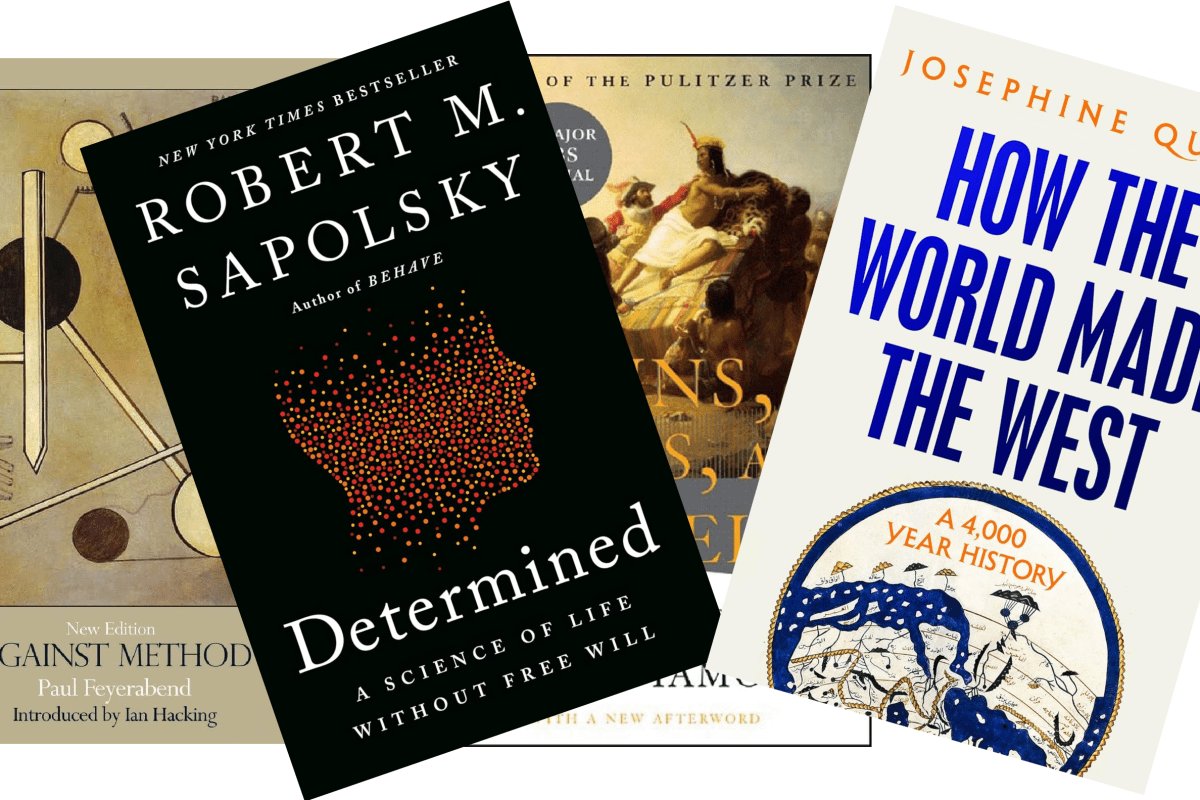
These are my favourite books I read in 2024. Only one was first published this year, so it seems I was playing catch-up and rereading. Two are about history; two are about the philosophy of science; and one is about biological free will or the lack thereof.
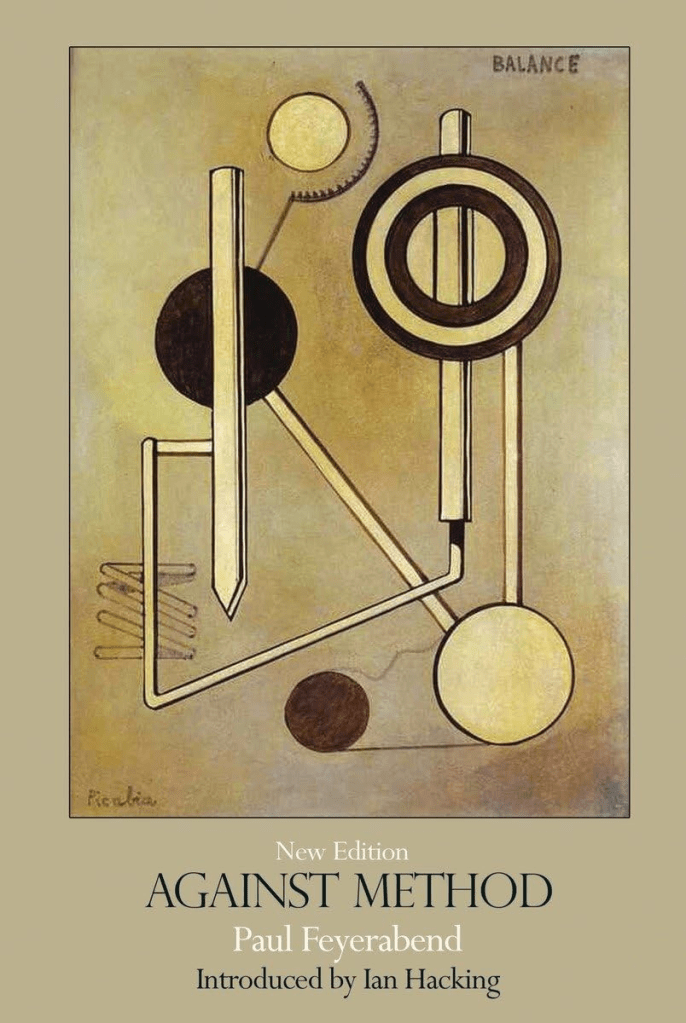
Against Method is a re-read for me. It makes the list on the coattails of a higher-ranked book. Feyerabend makes a compelling case against the Scientific Method™. To complete the set, I’d also recommend Bruno Latour‘s We Have Never Been Modern.
Determined arrives on the heels of Sapolsky’s Behave, another classic that I’d recommend even more, but I read it in 2018, so it doesn’t make the cut. In Determined, Sapolsky makes the case that there is no room or need for free will to explain human behaviour.
As with Against Method, Guns, Germs, and Steel makes the list only to complement my next choice. It views history through an environmental lens. To fill out the historical perspective, I recommend David Graeber’s The Dawn of Everything: A New History of Humanity (with David Wengrow). I’d recommend Yuval Noah Harari‘s Sapiens: A Brief History of Humankind, but it occupies a different category and is more about a plausible broad narrative than the detail explored in the others listed.
Quinn makes history approachable as she questions the uniformity of civilisations pushed by orthodoxy. Read this in context with the aforementioned historical accounts for a fuller perspective.
I was born in 1961. This should have been bedtime reading for me. I’d heard of this work, but one really has to read it. It’s less Modernist than I had presumed—though not to the extent of Feyerabend or Latour mentioned above. Again, reading all three provides a robust perspective on the philosophy of science.
Like Quinn, the writing is approachable. I had expected it to be stilted. It is academic, and it may boost your vocabulary, but give it a gander. It also works well in an audiobook format if you are so inclined.
This about closes out 2024. What do you think about these choices? Agree or disagree? What are your top recommendations?
I’ve written about this topic before. Metamodernism has been heralded as the great reconciler of Modernism and Postmodernism, a dialectical triumph that purports to synthesise these two oppositional paradigms. On the one hand, Modernism clings to its belief in objective truths, rationality, and universal principles. On the other, Postmodernism dismantles those certainties, exposing them as fragile constructs, rooted as much in ideology as in reason. The promise of metamodernism is to bridge this divide, to create a space where the objectivity of Modernism and the relativism of Postmodernism can coexist. But can it?
Audio: NotebookLM Podcast about this topic.
Spoiler alert: it cannot. In fact, metamodernism doesn’t even attempt to fulfil its stated goal. Instead, what it really does—intentionally or not—is meld Modernism’s objective framework with Pre-Enlightenment mysticism, offering a regressive concoction that romanticises the past while pretending to chart a bold new future. This isn’t synthesis; it’s nostalgia masquerading as innovation.
The Unbridgeable Divide: Objective vs. Relative
To understand why metamodernism’s claimed synthesis is untenable, we need to examine the fundamental incompatibility of its supposed components. Modernism rests on the firm foundation of objectivity: truth is universal, reason is supreme, and progress is inevitable. Postmodernism, however, thrives in the cracks of that foundation, pointing out that these so-called universal truths are culturally and historically contingent, and that “progress” often serves as a euphemism for domination or erasure.
Reconciling these two positions is like trying to mix oil and water. Modernism’s faith in absolutes cannot coexist with Postmodernism’s celebration of ambiguity and multiplicity without reducing one to a mere aesthetic flourish for the other. The result is not a synthesis but a superficial oscillation, an endless back-and-forth that achieves neither clarity nor coherence.
The Real Agenda: A Fusion of Objectivities
What metamodernism actually achieves is something quite different. Instead of bridging the gap between Modernism and Postmodernism, it fuses Modernism’s objective certainties with the equally objective but pre-rational framework of Pre-Enlightenment mysticism. In doing so, it abandons the critical lens of Postmodernism altogether, retreating to a worldview that is comfortingly familiar but intellectually regressive.
Consider the resurgence of myth, spirituality, and transcendence in metamodernist discourse. These elements hark back to a time when objective truths were dictated by divine authority or cosmological narratives rather than scientific inquiry. By incorporating these pre-modern ideas into its framework, metamodernism sidesteps the hard questions posed by Postmodernism, offering a fusion that is plausible only because both Modernism and Pre-Enlightenment mysticism share a common belief in absolute truths.
Plausible but Retrograde
This melding of Modernist and Pre-Enlightenment frameworks might seem plausible because, in truth, many Moderns never fully abandoned their mystical roots. The Enlightenment’s project of replacing religious dogma with reason was always incomplete; its foundational assumptions about universality and objectivity often carried an unspoken theological residue. Metamodernism taps into this latent nostalgia, offering a vision of the world that feels grounded and comforting, but at the cost of intellectual progress.
The problem is that this vision is fundamentally retrograde. By retreating to the certainties of the past, metamodernism ignores the most valuable insight of Postmodernism: that all frameworks, whether Modern or mystical, are ultimately constructed and contingent. To move forward, we need to grapple with this contingency, not escape from it.
Conclusion: Nostalgia in Disguise
Far from being a dialectical synthesis, metamodernism is a retreat. It cloaks itself in the language of progress while recycling old patterns of thought. Its attempt to reconcile Modernism and Postmodernism collapses into a fusion of Modernist objectivity and Pre-Enlightenment mysticism, leaving the critical insights of Postmodernism by the wayside.
If we are to truly progress, we must resist the siren song of metamodernism’s nostalgia. Instead, we should embrace the challenge of living without absolutes, grappling with the ambiguity and multiplicity that define our postmodern condition. Anything less is not synthesis but surrender.
This came across my feed, the laminated wisdom of our times: Your triggers are your responsibility. It isn’t the world’s obligation to tiptoe around you. A phrase so crisp, so confident, it practically struts. You can imagine it on a mug, alongside slogans like Live, Laugh, Gaslight. These are the language games I love to hate.
Now, there’s a certain truth here. Life is hard, and people aren’t psychic. We can’t reasonably expect the world to read our mental weather reports—50% chance of anxiety, rising storms of existential dread. In an adult society, we are responsible for understanding our own emotional terrain, building the bridges and detours that allow us to navigate it. That’s called resilience, and it’s a good thing.
Audio: NotebookLM Podcast on this topic.
But (and it’s a big but) this maxim becomes far less admirable when you scratch at its glossy surface. What does triggers even mean here? Because trigger is a shape-shifter, what I term Shrödinger’s Weasels. For someone with PTSD, a trigger is not a metaphor; it’s a live wire. It’s a flashback to trauma, a visceral hijacking of the nervous system. That’s not just “feeling sensitive” or “taking offence”—it’s a different universe entirely.
Yet, the word has been kidnapped by the cultural peanut gallery, drained of precision and applied to everything from discomfort to mild irritation. Didn’t like that movie? Triggered. Uncomfortable hearing about your privilege? Triggered. This semantic dilution lets people dodge accountability. Now, when someone names harm—racism, misogyny, homophobia, you name it—the accused can throw up their hands and say, Well, that’s your problem, not mine.
And there’s the rub. The neat simplicity of Your triggers are your responsibility allows individuals to dress their cruelty as stoic rationality. It’s not their job, you see, to worry about your “feelings.” They’re just being honest. Real.
Except, honesty without compassion isn’t noble; it’s lazy. Cruelty without self-reflection isn’t courage; it’s cowardice. And rejecting someone’s very real pain because you’re too inconvenienced to care? Well, that’s not toughness—it’s emotional illiteracy.
Let’s be clear: the world shouldn’t have to tiptoe. But that doesn’t mean we’re free to stomp. If someone’s discomfort stems from bigotry, prejudice, or harm, then dismissing them as “too sensitive” is gaslighting, plain and simple. The right to swing your fist, as the old adage goes, ends at someone else’s nose. Likewise, the right to be “brutally honest” ends when your honesty is just brutality.
The truth is messy, as most truths are. Some triggers are absolutely our responsibility—old wounds, minor slights, bruised egos—and expecting the world to cushion us is neither reasonable nor fair. But if someone names harm that points to a broader problem? That’s not a trigger. That’s a mirror.
So yes, let’s all take responsibility for ourselves—our pain, our growth, our reactions. But let’s also remember that real strength is found in the space where resilience meets accountability. Life isn’t about tiptoeing or stomping; it’s about walking together, with enough care to watch where we step.
Taking Moral Cues from Ants: Because Humans are Too Busy Defending the Indefensible
Ah, ants. Tiny, unassuming, and quite literally beneath us — unless you’re sprawled out on a picnic blanket fighting off a colony swarming your questionable sandwich. Yet, while humanity busies itself polluting oceans, strip-mining rainforests, and justifying corporate bloodsucking as “necessary for the economy,” ants are out here performing life-saving surgeries on their comrades.
ants are out here performing life-saving surgeries on their comrades
You heard that correctly.
Researchers have now observed certain ant species (yes, ants) performing amputations on their injured nestmates to prevent infections from spreading. Picture it: a worker ant limping home, leg shredded by some territorial skirmish, and the squad rolls up like a triage team, deciding whether to (a) gently clean the wound or (b) lop the limb off entirely. Amputation is precise and deliberate — snip at the hip joint if the upper leg is toast. Lower leg injuries? Too risky. Infection spreads faster there, so it’s all hands (or mandibles) on deck for some industrial-strength licking.
It’s a brutal but effective social health system. The results? Injured ants survive. They get patched up, return to work, and contribute to the collective. The colony benefits, everyone thrives, and not a single ant launches into a fevered tirade about how “it’s their individual right to rot from gangrene in peace.”
Contrast this with humanity, where the very notion of collective good seems to spark mass hysteria in certain corners. Here, defending dubious practices — say, unfettered pollution, exploitative labour conditions, or the kind of wealth-hoarding that would make a dragon blush — has become a full-time hobby for some. “Personal responsibility!” they scream whilst someone chokes on smog or shivers in a warehouse set to Arctic temperatures. Heaven forbid we intervene.
Imagine explaining to ants that humans argue about whether everyone deserves basic healthcare
Imagine explaining to ants that humans argue about whether everyone deserves basic healthcare. That we let industries poison rivers because regulations might “hurt innovation.” Some believe that letting people suffer and die without help is somehow noble.
Ants would stare at us — or they would if they had discernible faces. Then they’d probably do what they always do: get back to work ensuring their colony survives and thrives, as any halfway intelligent species might.
A Case for the Collective
What makes this ant behaviour so fascinating isn’t just that it exists, but that it demonstrates something humanity supposedly prides itself on: adaptability. Faced with an existential threat to one of their own, ants don’t moralise. They don’t argue about the costs or logistics of care. They don’t abandon the injured because helping them isn’t “profitable.” They just act. Quickly, efficiently, and for the collective good.
Meanwhile, humans act like the collective good is some leftist fever dream. Suggest tax-funded healthcare or basic environmental protections, and someone inevitably starts shrieking about “slippery slopes” toward tyranny, as though being able to breathe clean air or avoid bankruptcy after surgery is the thin edge of some Orwellian wedge.
We have entire systems built on the premise that it’s fine for some to suffer if others can profit
We have entire systems built on the premise that it’s fine for some to suffer if others can profit. Does that sound hyperbolic? I’ll wait while you Google “externalised costs.” Spoiler alert: your cheap burger came at the expense of rainforest ecosystems and underpaid workers. But hey, as long as we’re prioritising shareholder value, all’s fair, right?
The Ants Would Like a Word
Here’s the thing: ants don’t amputate limbs because they’re altruistic softies. They do it because it makes sense. An injured worker can still contribute to the colony, and the colony’s survival depends on its members pulling together. It’s cold, pragmatic, and effective.
Now consider our own global “colony.” Why do we resist solutions that would make all of us more resilient? Healthcare, environmental protections, workers’ rights — these aren’t radical. They’re practical. Just like amputating a leg to save an ant, safeguarding the vulnerable helps everyone. Yet here we are, letting metaphorical infections spread because someone’s feelings about rugged individualism got in the way.
If Ants Can Do It, So Can We
At this point, humanity doesn’t need a lofty moral awakening. We just need to be marginally smarter than ants. Think about it: they’re tiny-brained insects who figured out that collective care improves survival rates. What’s our excuse?
Perhaps it’s time we take a page out of the ants’ playbook: diagnose the problem, take decisive action, and prioritise the common good. Amputate the rot. Treat the infection. And for the love of whatever deity or science you hold dear, stop defending systems that sacrifice the many for the few.
If ants can do it, we have no excuse.
In Conclusion:
Ants: 1. Humans: 0.
When ants are more socially responsible than we are, it’s time to ask some tough questions. Now get it together, or the ants are going to outlive us all.
I thought I was done wittering on about Brian Thompson, the late CEO of United Healthcare, but here we are. His name lingers like the corporate perfume of systemic rot—an enduring testament to how we’ve elevated unethical behaviour into performance art. It got me thinking: what if we brought back a bit of old-school accountability? In Ancient Rome, outlaws lost their citizenship, legal protections, and status as people. That’s right—booted out of polite society. Meanwhile, we’ve done the opposite: we hand out golden parachutes and slap their faces on business magazine covers.
To some, Brian Thompson was a good man – apart from the insider trading, of course. He was successful, a nice guy, funny, and had a good family, and a few million-dollar homes. What else could you ask for? But his success came in the way of blood money. It seems we need fewer people who think like this, not more.
Then I recalled The Purge franchise. And sure, The Purge is a dystopian fantasy, but let’s up the stakes. Picture this: bounties on corporate villains. Not literal carnage, of course—let’s leave that for the big screen—but the return of real consequences. Instead of allowing their PR teams to smooth it all over with buzzwords and philanthropy crumbs, what if we made it socially unacceptable to be a snake in a suit? What if moral suasion—the lost art of persuading someone to do right because it’s, you know, right—actually came back into fashion?
Nietzsche nailed it ages ago. We’ve got two moral codes: one for people and one for money. And guess which one wins every time? All it takes is enough cash and the right rhetoric, and suddenly, everyone forgets who’s really getting fleeced. This is the banality of evil in its purest form: not grand acts of villainy but a shrugging normalisation of corruption. We don’t even consider it corruption. We see it as business as usual. We support and work for these businesses.
The tragedy is that we’ve become so desensitised to it that we are adept at ignoring the stench of moral failure that even calling it out feels quaint. But it’s not hopeless. Some of us still notice. Some of us still care. The real question is, how long can we keep tolerating this farce before we remember that morality isn’t just for the powerless?
Meantime, I just imagine these grubbers being stripped of power and protection, running scared from the likes of Luigi Mangioni.
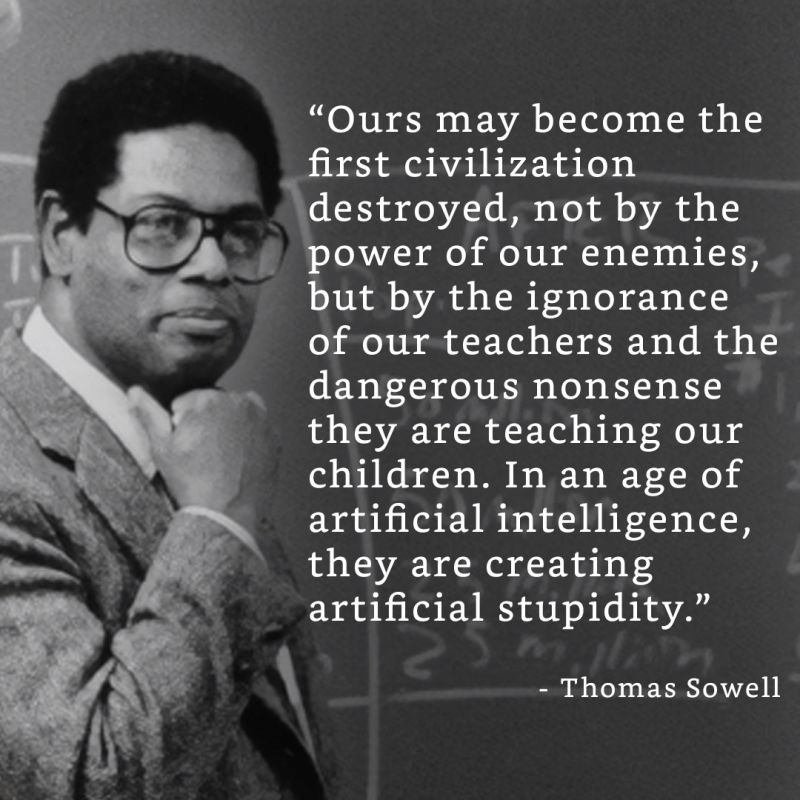
“Ours may become the first civilisation destroyed, not by the power of our enemies, but by the ignorance of our teachers and the dangerous nonsense they are teaching our children. In an age of artificial intelligence, they are creating artificial stupidity.”
Image: Thomas Sowell with superimposed quotation cited above.
What a delightfully loaded statement. Sowell—a man whose intellectual credentials are as impeccable as his sweeping generalisations – manages, in a single breath, to malign teachers, dismiss contemporary education, and suggest that we’re hurtling towards some dystopian abyss because children today aren’t being taught…what, exactly? Latin declensions? The works of Burke? Perhaps the art of deference to authority? He never specifies. And why should he? Specifics would ruin the vibe.
This statement is a masterpiece of rhetorical dog-whistling. To those predisposed to Sowell’s worldview, it’s just common sense. Teachers are ignorant, modern education is a farce, and our children are doomed to a future of robotic ineptitude. It sounds plausible enough, provided you don’t stop to ask pesky questions like, “Which teachers? What nonsense? How, exactly, does one create artificial stupidity?”
The Cult of Common Sense
Let’s take a moment to examine the talismanic invocation of “common sense,” a concept as revered as it is elusive. Voltaire’s quip that “common sense is not so common” seems particularly apt here. What Sowell calls common sense is really shorthand for a monolithic worldview where civilisation is a neatly defined entity under siege by radical educators and their progressive agendas.
The problem? This worldview collapses under even cursory scrutiny. Civilisation is not a singular, static entity but an ever-evolving tapestry of conflicting ideas, cultures, and innovations. Teachers are not a homogenous cabal conspiring to dismantle society but an underpaid, overworked group trying their best to navigate a minefield of bureaucracy and societal expectations. And as for the “dangerous nonsense” being taught? Well, your guess is as good as mine. Critical thinking? Equity? Heaven forbid, empathy?
Ignorance as a Natural State
Sowell’s fans bristle at any suggestion that their intellectual idol might be guilty of hyperbole. But let’s consider the claim that teachers are “creating” stupidity. This presupposes that stupidity is an artificial construct rather than the natural baseline of humanity. The average IQ is, after all, 100 by design. For Americans, it hovers slightly below that at 97. This isn’t new. Stupidity doesn’t need to be created; it’s the default. Education’s job is to chip away at this deficit, not conjure intelligence ex nihilo.
To cast educators as villains in this endeavour is a disingenuous sleight of hand. Are there systemic issues in education? Of course. But to claim that teachers are actively fostering stupidity is akin to blaming firefighters for the existence of fires.
The Paradox of Intellectual Elitism
Here’s the kicker: Sowell himself is an intellectual. An elitist, no less, if we’re using his own fans’ definition. Yet his critique of intellectuals resonates with his audience precisely because they perceive him as an exception to the rule. “He’s one of us,” they say, failing to notice the irony. It’s the classic populist manoeuvre: position yourself as the voice of the people while enjoying all the privileges of the elite.
This paradox is not unique to Sowell. It’s the same dynamic that fuels the cult of Jordan Peterson, another intellectual who rails against intellectualism while wielding its tools. The result is a rhetorical echo chamber where dissent is dismissed as ignorance and agreement is lauded as truth.
The Dog Whistle Symphony
Sowell’s statement is, at its core, a symphony of dog whistles. It’s designed to resonate with those who already believe that modern education is a hotbed of progressive indoctrination. To this audience, it’s not a call to debate but a rallying cry. The terms – civilisation, ignorance, nonsense, artificial stupidity – are intentionally vague, allowing listeners to project their own fears and grievances onto them.
This vagueness is both the strength and the weakness of the argument. It’s compelling to those who share Sowell’s worldview but collapses under scrutiny. What is civilisation? What constitutes dangerous nonsense? Without definitions, these are just buzzwords masquerading as profundity.
Reframing the Conversation
So, how do we engage with such rhetoric? First, by refusing to accept its premises without question. Who are these teachers, and what are they allegedly teaching? What does Sowell mean by “civilisation”? Without specifics, his statement is not an argument but an incantation.
Second, by exposing the contradictions. If intelligence is the antidote to societal decline, as Sowell implies, then dismissing intellectuals wholesale is self-defeating. If education is the solution, then scapegoating teachers undermines the very people tasked with implementing it.
Finally, by recognising the emotional appeal at play. Sowell’s rhetoric taps into a deep-seated fear of change and loss. Addressing this fear requires empathy and nuance – qualities absent from his statement but essential for meaningful dialogue.
Conclusion
Thomas Sowell’s warning about “artificial stupidity” is less a diagnosis of societal decline than a litmus test for ideological allegiance. It’s a brilliant piece of rhetoric but a poor substitute for critical analysis. By unpacking its assumptions and exposing its contradictions, we can move beyond the echo chamber of dog whistles and engage in the kind of nuanced, constructive debate that Sowell’s own critique ostensibly calls for.
But then, nuance has never been common sense, has it?










 Philosophics