Unknown Dimensions

I mentioned in my last post about how Artificial Intelligence discovered a new variable—or, as the claim suggests, a new physics. This was a tie-in to the possible missing dimensions of human perception models.

Without delving too deep, the idea is that we can predict activity within dynamic systems. For example, we are all likely at least familiar with Newtonian physics—postulates such as F = ma [Force equals mass times acceleration or d = vt [distance equals velocity times time] and so on. In these cases, there are three variables that appear to capture everything we need to predict one thing given the other two that need to remain constant. Of course, we’d need to employ calculus instead of algebra if these are not constant. A dynamic system may require linear algebra instead.

When scientists represent the world, they tend to use maths. As such, they need to associate variables as proxies for physical properties and interactions in the world. Prominent statistician, George Box reminds us that all models are wrong, but some are useful. He repeated this sentiment many times, instructing us to ‘remember that models are wrong: the practical question is how wrong do they have to be to not be useful‘. But no matter how hard we try, a model will never be the real thing. The map cannot become the terrain, no matter how much we might expect it to be. By definition, a model is always an approximation.

All models are wrong but some are useful

George Box

In the Material Idealism post, the embedded video featuring Bernardo Kastrup equated human perception to the instrumentation panels of an aeroplane. Like the purported observer in a brain, the pilot can view the instruments and perform all matters of actions to manipulate the plane, including taking off, navigating through the environment, avoiding obstacles, and then landing. But this instrumentation provides only a representation of what’s ‘really’ outside.

Like mechanisms in the body, instrumentation can be ‘wired’ to trigger all sorts of warnings and alerts, whether breached thresholds or predictions. The brain serves the function of a predictive difference engine. It’s a veritable Bayesian inference calculator. Anil Seth provides an accessible summary in Being You. It relies on the senses to deliver input. Without these sense organs, the brain would be otherwise unaware and blinded from external goings on.

The brain cannot see or hear. It interprets inputs from eyes and ears to do so. Eyes capture light-oriented events, which are transmitted to the brain via optic nerves, and brain functions interpret this information into colour and shape, polarisation and hue, depth and distance, and so on. It also differentiates these data into friend or foe signals, relative beauty, approximate texture, and such. Ears provide a similar function within their scope of perception.

As mentioned, some animals have different sense perception capabilities and limitations, but none of these captures data not also accessible to humans via external mechanisms.

Some humans experience synesthesia, where they interpret certain stimuli differently, perhaps hearing colours or smelling music. We tend to presume that they are the odd ones out, but this assumption does not make it so. Perhaps these people are actually ahead of the rest of us on an evolutionary scale. I suppose time might sort that one out.

But here’s the point. Like the pilot, we can only experience what we are instrumented to experience, as limited to our sense perception and cognition faculties. If there are events not instrumented, it will be as if they don’t exist to the pilot. Can the pilot hear what’s happening outside?

This is the point of the AI experiment referenced above. Humans modelled some dynamic process that was presumed to be ‘good enough’, with the difference written off as an error factor. Artificial Intelligence, not limited to human cognitive biases, found another variable to significantly reduce the error factor.

According to the theory of evolution, humans are fitness machines. Adapt or perish. This is over-indexed on hereditary transmission and reproduction, but we are more vigilant for things that may make us thrive or perish versus aspects irrelevant to survival. Of course, some of these may be benign and ignored now but become maleficent in future. Others may not yet exist in our realm.

In either case, we can’t experience what we can’t perceive. And as Kastrup notes, some things not only evade perception but cannot even be conceived of.

I am not any more privileged than the next person to what these missing factors are nor the ramifications, but I tend to agree that there may be unknown unknowns forever unknowable. I just can’t conceive what and where.


I can’t wait to get back to my Agency focus.

Houston, we have a problem

EDIT: Since I first posted this, I’ve discovered that computer algorithms and maths are not playing well together in the sandbox. Those naughty computer geeks are running rogue from the maths geeks.

In grade school, we typically learn a form of PEMDAS as a mnemonic heuristic for mathematical order of operations. It’s a stand-in for Parentheses, Exponents, Multiplication, Division, Addition, and Subtraction. This may be interpreted in different ways, but I’ve got bigger fish to fry. It turns out that many (if not most) programming languages don’t implement around a PEMDAS schema. Instead, they opt for BODMAS, where the B and O represent Brackets and Orders—analogous to Parentheses and Exponents. The important thing to note is the inversion of MD to DM, as this creates discrepancies.

And it doesn’t end here. HP calculators interject a new factor, multiplication by juxtaposition, that mathematician and YouTuber, Jenni Gorham, notates as J resulting in PEJMDAS. This juxtaposition represents the implied multiplication as exemplified by another challenge;

1 ÷ 2✓3 =

In this instance, multiplication by juxtaposition instructs us to resolve 2✓3 before performing the division. Absent the J, the calculation results in ½✓3 rather than the intended 1/(2✓3). As with this next example, simply adding parentheses fixes the problem. Here’s a link to her video:

And now we return to our originally scheduled programming…

Simplifying concepts has its place. The question is where and when. This social media war brings this back to my attention.

As depicted in the meme, there is a difference of opinion as to what the answer is to this maths problem.

6 ÷ 2 ( 1 + 2 ) =

In grade school, children are taught some variation of PEMDAS, BOMDAS, BEDMAS, BIDMAS, or whatever. What they are not taught is that this is a regimented shortcut, but it doesn’t necessarily apply to real-world applications. The ones defending PEMDAS are those who have not taken maths beyond primary school and don’t use maths beyond some basic addition and subtraction. Luckily, the engineers and physicists who need to understand the difference, generally, do.

Mathematicians, scientists, and engineers have learned to transform the equation into the form on the left, yielding an answer of 1. If your answer is 9, you’ve been left behind.

Why is this such a big deal?

When I taught undergraduate economics, I, too, had to present simplifications of models. In practice, the approach was to tell the students that the simplification was like that in physics. At first, you assume factors like gravity and friction don’t exist—fewer variables, fewer complexities. The problem, as I discovered in my advanced studies, is that in economics you can’t actually relax the assumptions. And when you do, the models fail to function. So they only work under assumptions that cannot exist in the real world—things like infinite suppliers and demanders. Even moving from infinite to a lot, breaks the model. Economists know this, and yet they teach it anyway.

When I transitioned from undergrad to grad school, I was taken aback by the number of stated assumptions that were flat out wrong.

When I transitioned from undergrad to grad school, I was taken aback by the number of stated assumptions that were flat out wrong. Not only were these simplifications flat out wrong, but they also led to the wrong conclusion—the conclusion that aligned with the prevailing narratives.

This led me to wonder about a couple of things

Firstly, if I had graduated with an English degree and then became a PhD candidate in English, would I have also learnt it had mostly been a lie for the purpose of indoctrination?

Secondly, what other disciplines would have taught so much disinformation?

Thirdly, how many executives with degrees and finance and management only got the fake version?

Fourthly, how many executives hadn’t even gotten that? Perhaps they’d have had taken a class or two in each of finance and economics and nothing more. How many finance and economics courses does one need to take to get an MBA? This worries me greatly.

To be honest, I wonder how many other disciplines have this challenge. I’d almost expect it from so-called soft sciences, but from maths? Get outta here.

Half-life of knowledge

This also reminds me of the notion of the half-life of knowledge. What you knew as true may eventually no longer be. In this case, you were just taught a lie because it was easier to digest than the truth. In other cases, an Einstein comes along to change Newtonian physics into Oldtonian physics, or some wisenheimer like Copernicus determines that the cosmic model is heliocentric and not geocentric.

If you’ve been keeping up with my latest endeavour, you may be surprised that free will, human agency, identity, and the self are all human social constructs in need of remediation. Get ready to get out of your comfort zone or to entrench yourself in a fortress of escalating commitment.

Is human consciousness creating reality?

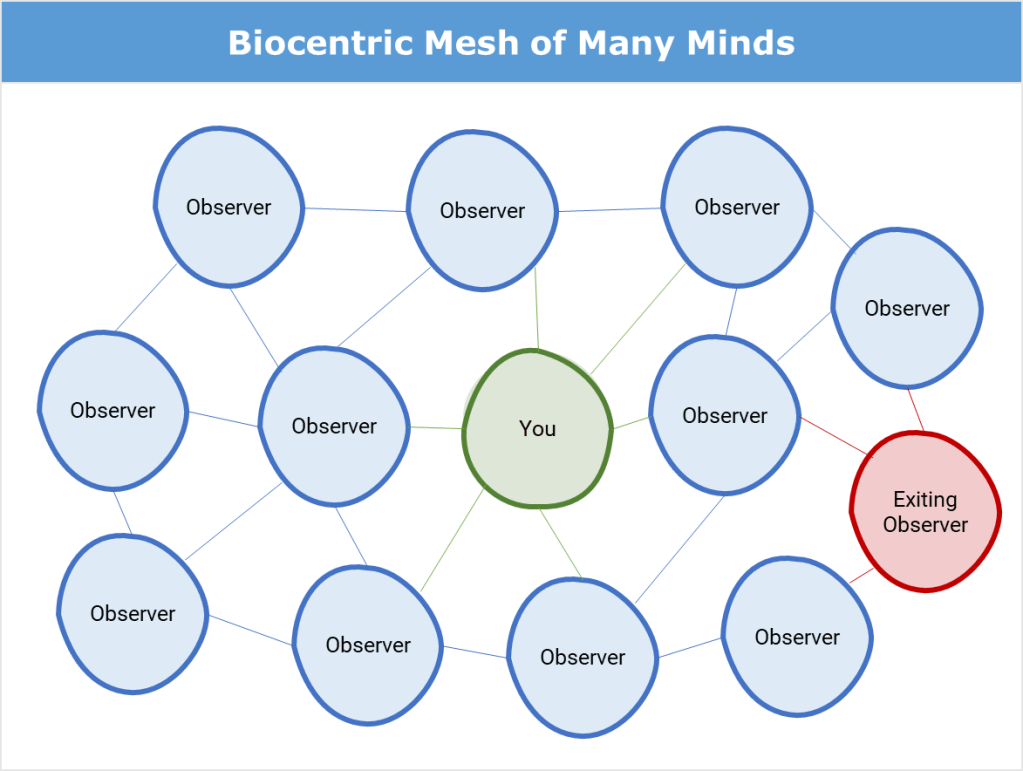
Perhaps, and as much as I see social aspects as constructed, I wouldn’t count on reality being constructed whole cloth from a web of observers. This is ostensibly what  Robert Lanza’s biocentric view attempts to say. I’m not buying it.

Biocentric Mesh of Many Minds

As I understand it—admittedly from a single BigThink article, so there’s that—Lanza is trying to one-up Descartes and jump into the domain of Wittgenstein’s many minds conundrum. I suppose that this is another dualistic theory, but I am not likely to spend many cycles on it in the near term.

My question is that if at Time0, a reality is projected—my word—by the many minds, and at Time1, You enter the picture, and at Time2, the Exiting Observer is leaving the picture. how is reality shaped by these events? And are they events, or are they merely imagined? Is this an entirely solipsistic endeavour? Is this like Star Trek’s Borg? You will be assimilated. Resistance is futile.

Borg: You will be assimilated. Resistance is futile.

This also feels a lot like Jung’s Collective Unconscious on steroids. I’ll stop commenting here for now and consider this nothing more than a distraction. And I am not ready to jump on a panpsychism bandwagon any time soon.