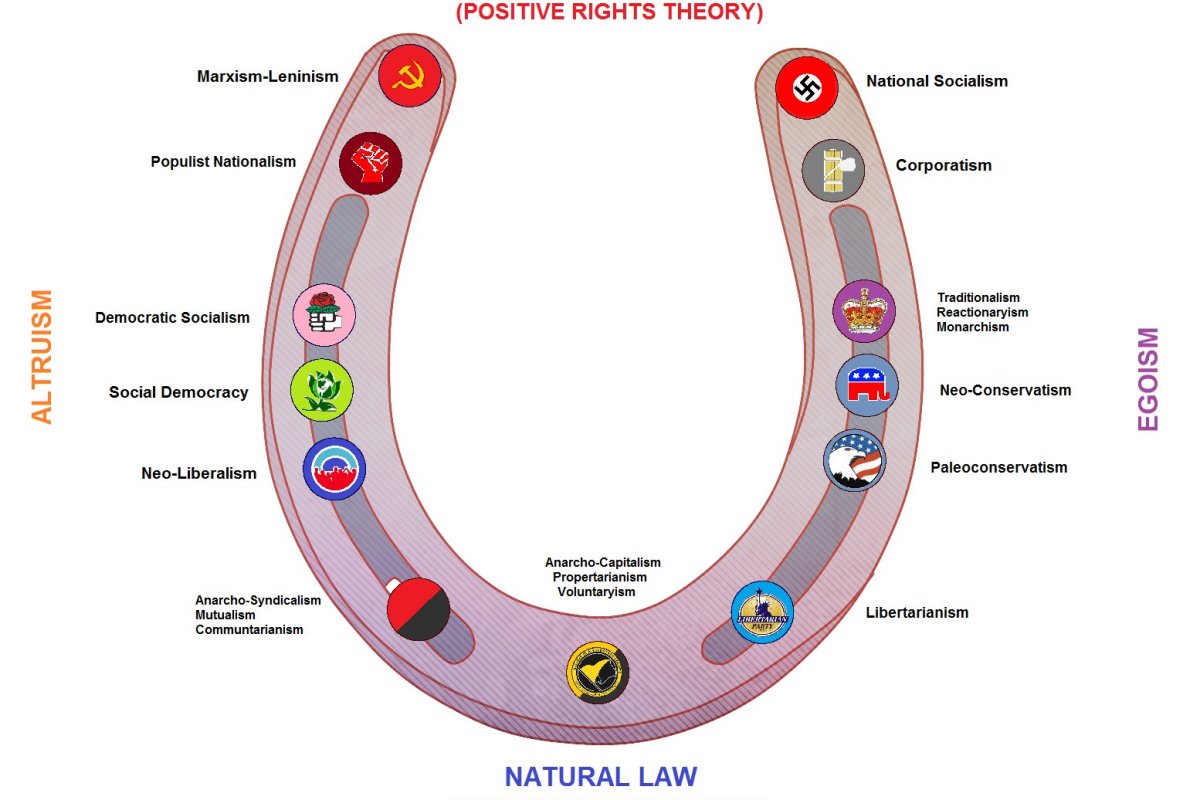
Political Spectrum

I am trying to avoid commenting on the recent SCOTUS decision and how it is symptomatic of how the United States remains a failed state—at least a zombie state—, so this preamble should suffice for now.

I was chatting politics into the wee hours with my son, who’s been on this earth for almost 25 years now. I consider myself to be on the left of traditional political scales. He considers himself to be on the right, but he’s trying to make sense of the scales and dimensions. He had two questions: First, ‘What are the crucial dimensions and positions that define left and right?’ Second, ‘Where do Liberals fit into the equation?’

Knowing me, he wanted to provide some context and confer with me his knowledge that would also serve to frame and anchor the conversation. A key point was to have clarified the adopted nomenclature and positioning on a theoretical map.

We started with the origins of the left-right distinction, which was barely a valid dichotomy even as it was coined in France. There was no duolith. Those on the left or right had features in common but taken holistically, this was a reductionist categorisation, as tends to happen. Exacerbating this, as it does today, still, the politicians with voices remained to the right of the unvoices masses.

He asked about the difference between freedom and liberty because his sources differentiate the two. Whilst connotation and nuance may enter the picture, etymologically speaking, freedom is a native English word whilst liberty is French via Latin. Connotatively, freedom is an absolute measure whilst liberty is granted within a political framework. Positive and negative liberties aside, liberty is an attenuator. It restricts freedom even if it allows most of the signal through. Effectively, liberty is permission by the state to act in certain ways.

By the end of the conversation, he was framing the key difference around notions of national identity and nationalism—I versus we. I shared my thoughts on the construction of identity, thus making for a poor foundation, though we both agreed that national narratives have been the impetus for much activity. (I am reluctant to insert the word progress here.)

After our conversation, I began researching dimensions established or otherwise proposed by political science. This led me to a place I found interesting—the distinction between radical, progressive, conservative, and reactionary positions. For some reason, this never really occurred to me.

I’m not sure one can employ these terms in general discussion without definition and qualification, but I feel they are useful in their own right. Typically, I view the political landscape—at the highest level and with a US-bent—as Left (communists, socialists, anarchists, progressives) and Right (conservatives, liberals, and fascists). I also know that this is imprecise, but maps always are.

This new vocabulary helps by distilling the map to this—ordered differently:

  • Right
    • Conservative
    • Reactionary
  • Left
    • Progressive
    • Radical

Conservative

Conservatives want to maintain the status quo. This is interesting usage adoption. Fundamentally, advocates of this view want to promote and to preserve traditional social institutions and practices. In Western culture, conservatives seek to preserve a range of institutions such as organized religion, parliamentary government, and property rights. Conservatives tend to favour institutions and practices that guarantee stability and evolved gradually. Adherents of conservatism often oppose progressivism and seek a return to traditional values

In Western culture, conservatives seek to preserve a range of institutions such as organized religion, parliamentary government, and property rights.

My first thoughts when I hear the term are a harkening back to the old ways—the Ozzie and Harriott mythos, white picket fences, Mom and apple pie. But this is different. Effectively, rather than reaching back, it wants to preserve the current moment in time. Where it gets more nebulous, I think, is that some people include nostalgia in the now. Duratively, perhaps a person might remember some aspect of their childhood. Though this has been lost by now, they imagine it as part of their identity. This can also extend further back as they wish some other historical aspects can be cherry-picked. Perhaps the white conservative wishes to be able to subjugate women as was the practice in the 1950s of America, but to not conserve high union participation and high marginal tax rates, as affronts to freedom (or whatever). This ends up being an exercise in selective memory and revisionist history-making.

This needs to be distinguished from a so-called traditional conservativism in the tradition of Burke or Hobbes, who want to conserve some sense of fundamental morality they feel derives from nature.

Reactionary

Reactionaries oppose whatever is in effect at the moment—the petulant toddler—but with a twist. Like the conservatives, there is a conservation effort but rather than a focus on the status quo, the focus is on status quo ante, which is a return to the old ways, tried and true.

Progressive

Progressives support social reform. Ostensibly, they don’t oppose tradition, but they feel that old structures need to be reimagined and reinterpreted in face of social and technological change. An underlying metanarrative is the notion of progress. I am not going to comment on progressivism generally and the nuances evident in the American flavour of it.

Radical

Radical politics denotes the intent to transform or replace the fundamental principles of a society or political system, often through social changestructural changerevolution or radical reform

During the 20th century, radical politicians took power in many countries across the world. Such radical leaders included Vladimir Lenin and Joseph Stalin in Russia, Mao Zedong in China, Adolf Hitler in Germany, as well as more mainstream radicals such as Ronald Reagan in the United States and Margaret Thatcher in the United Kingdom. Of course, Donald Trump is a more recent example in the United States.

Summary
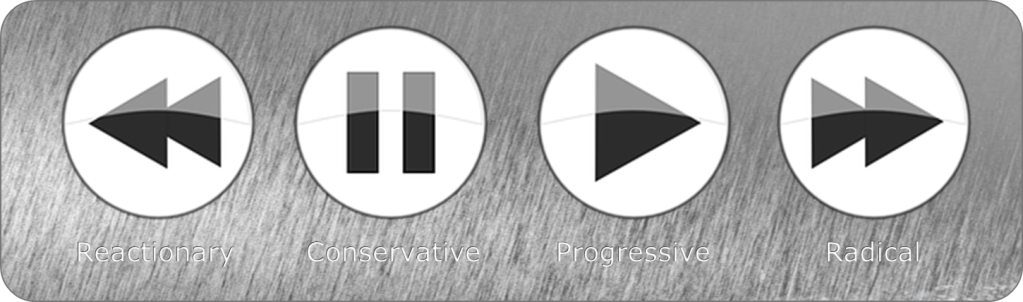
To me, these terms operate on a gravity to now. Conservatives are heavily anchored in the familiar and seek stability. Then they see factors in the past that they imagine will also serve this purpose, so they wish to incorporate these and carry them forward. Conservatives are not unaware of the need for change, they just want to not create waves in the process.

Likewise, although placing a heavier weight on the past than even conservatives, reactionaries are not fundamentally opposed to retaining what is working currently. The term working is subjective and perspectival, so they may wish to retain something that works for them at the expense of others. This is a challenge for conservatism as well. Just because racial segregation seemed to work for an equivalent person in the past doesn’t mean it worked well for the excluded.

Like reactionaries, progressives aren’t afraid of keeping a foot in the present—and there may be plenty of lessons to learn from the past—, but they feel that given the change in the underlying terrain, some refactoring is in order.

And then there are the radicals. I suppose that radicals have different motivators, but in essence, they feel that the current implementation is substantially broken, and it needs more than a few small tweaks and a fresh coat of paint. These people are renovating rather than redecorating. They may even want to throw the baby out with the bath water. Some may wish to keep the baby.

As for me, I usually place myself in the Progressive camp, but under the definition, I am more of a radical. The system is broken. We don’t just need to delete it, we need to install a new one.

Thomas Jefferson said that the United States should rewrite the Constitution every 19 years. Why 19 years? Who knows? Given the intransigence in American politics, this would have been a disaster. And given the powers that be, the debate would be over which parts to conserve and which to progress. Being the cynic that I am, my guess is that it would devolve to worse than we have now.

DISCLAIMER: For the record, I don’t endorse the placement of the political ideologies on the horseshoe image, but I find it interesting and it grabbed my attention. I hope it grabbed yours, too.

Two Maxims of Liberalism

The maxims are, first, that the individual is not accountable to society for his actions, in so far as these concern the interests of no person but himself.

…

Secondly, that for such actions as are prejudicial to the interests of others, the individual is accountable, and may be subjected either to social or to legal punishment, if society is of opinion that the one or the other is requisite for its protection.

John Stuart Mill, On Liberty, Utilitarianism, and Other Essays (Oxford University Press, 2015, p. 91)
John Stuart Mill, On Liberty, Utilitarianism, and Other Essays (Oxford University Press, 2015)

Agency Be Damned

I don’t believe that humans have the agency presumed they have, so I’d like to set out to prove it—at least rhetorically. In the ages-old battle between free will and determinism, I’ve tended to lean toward the determinism camp, but there is something keeping me from gaining full membership. I feel that proving hard determinism may be too hard a nut to crack, so I am aiming at just the agency aspect.

There are two major themes in my thinking.

  1. Humans have no material agency
  2. Power structures require the presumption of agency

Although this concept has been rattling around my brain cage for a while and I still have a ways to go, I feel it will be helpful to sketch out my ideas. I feel inspired by people like Robert Sapolsky and Daniel Dennett. And I feel I can draw insights into counter-arguments from people like Jonathan Haidt, Joshua Greene, and even Steven Pinker. I feel that my experience in behavioural economics may be useful for additional context—people like Daniel Kahneman, Richard Thaler, and Dan Ariely. But I feel disheartened when it appears that Galen Strawson and his father before him, Peter Strawson, people much more connected and elevated in the field have been treading the same territory for decades — over half a century — ahead of me, thankfully beating a path but not necessarily making much headway. Perhaps I can build upon that foundation if not substantially at least perceptibly. Of course, the seminal work by Isaiah Berlin’s Two Concepts of Liberty.

We may act as we will, but we cannot will as we will.

Arthur Schopenhauer

Besides the aforementioned, a correspondent has suggested other source references. He shares: Physics, including quantum mechanics, is fully Lagrangian. According to Stanford’s Leonard Susskind, Lagrange derived his formalism from the principle of ‘Least Action’. Jean Buridan’s principle of ‘Equipoise’ renders a Lagrangian model of the world perfectly deterministic. So, the physical domain is not probabilistic; and all indeterminacy is actually epistemic indeterminability. He also suggets Thomas Hobbes’ “De Corpore”.

About my second point, my corresponent agrees:

I think your “meta” is right. We feel that we are “free agents”, and we don’t know to what to attribute our feeling that we freely choose; so we imagine that we have “free will”. In my view it also doesn’t exist – we really are, as Sapolsky describes, zombie robots – we just don’t (and cannot) know it. Free will is thus a mere (but compelling) illusion on both individual and emergent scales. And yes again: all of morality, jurisprudence, etc., depends on it.

Unattributed Correspondant

My correspondent is a professional philosopher who shall remain anonymous until such time as he agrees, if ever, to make his identity known. I am quiet aware that some of my ideas are contentious and polemic. Not everyone wishes to be mired in controversy.

Humans Have No Material Agency

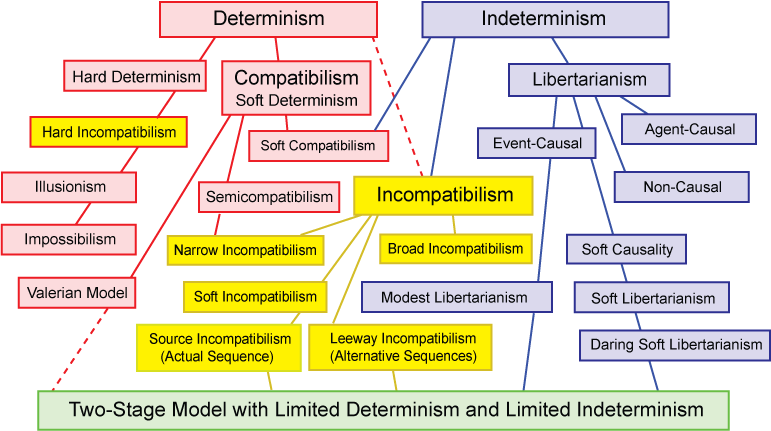
Humans have little to no agency. This is the point I am making in my Testudineous Agency post. From what I know until now, this likely qualifies as soft determinism, but this might shift as I acquire new nomenclature and taxonomic distinction. I’ve discovered this taxonomy of free will positions, though I am not well enough versed to comment on its accuracy or completeness. For now, it seems like a decent working model to serve as a starting point, but I am fully cognizant of possible Dunning-Kruger factors.

A Taxonomy of Free Will Positions

In essence, hard determinism says that the world is not probabilistic. Some event triggered the universe as we know it, and it will unfold according to the laws of physics whether or not we understand them. A weaker form, soft determinism, allows for some probability and trivial ‘agency’. I feel that Dennett supports soft determinism. I feel that because we, as ‘individuals’, are a confluence of multitudinous factors, we have little agency (interpreted as responsibility). More on this later.

Power structures require the presumption of agency

To be honest, the free will debate is only interesting to me in context. To me the context is power. The ‘meta’ of this is that society (and human ‘nature’) seem to need this accountability and culpability, but it doesn’t actually exist, so it is created as a social construct and enforced in a Foucauldian power relationship through government through jurisprudence mechanisms.

This is the part of the debate I haven’t heard much about. Sapolsky did write in Behave, chapter 20X, that criminal justice systems need to be reformed to account for diminished agency, and I’ll need to return to that to better comprehend his position and assertion.

The rest of the story

As a handy reference, these are the authors and books I’ve encountered to date and in no particular order:

Then there I those I have yet to read:

I’ve got a lot of essays and lecture notes not referenced plus general content from Reddit, Medium and other blogs sources, YouTube, podcasts, and so on. I probably should have documented some Classical philosophers, but I don’t generally find their argumentation compelling, though I might add them later.

The aim of this post is just to capture my intent—if it is indeed my intent. Oh, the questions and implications of a lack of agency. Please stand by.

Intuition and Reason

I’ve been cycling through The Righteous Mind and Moral Tribes, respectively by Jonathan Haidt and Joshua Greene. These blokes are social psychologists and moral philosophers. I started each of these books with the conception that I would neither like nor agree with the content. As for like, I suppose that’s a silly preconception better captured by whether or not I agree; that with which I don’t agree, I don’t like.

This said, I like the style of both of the authors, and I am finding the material to be less contentious than I first thought. I can already envisage myself agreeing with much of the substance but waiting to disagree with the conclusions.

Although I committed myself to document The Righteous Mind in situ, I am finding that I am listening to the audiobook whilst driving and so getting ahead of myself, so I’ll have to rewind and retread in order to do this. In fact, the reason I switched back to Greene’s Moral Tribes is so I wouldn’t progress even further in Haidt’s work.

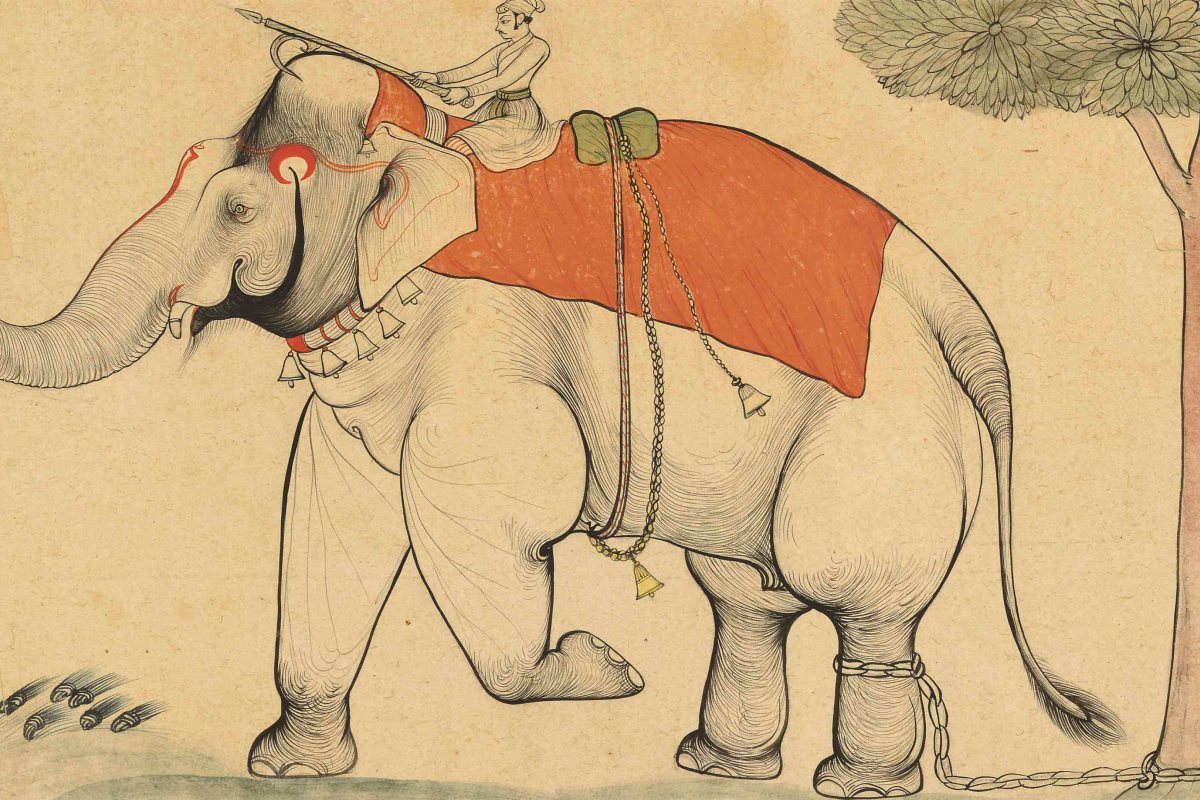
I am writing this post to acknowledge this. I’d also like to document that I don’t believe that humans are good reasoners, a situation both Haidt and Greene cite to be generally true. Humans are post hoc rationalisers, which is to say that they make up their minds and then create a narrative to justify that position. Haidt uses an analogy of an elephant and a rider, and he asserts that humans might more accurately be described as groupish than selfish. Certainly not shellfish. Greene notes that people have been shown to concede self-interest to political party interest, which helps to explain how people continually and predictably vote against their own self-interests. This also supports my position that democracy is a horrible form of government. Of course, Haidt would argue that this proves his point that people tend to adopt facts that support their perspective and diminish or disregard those that don’t.

it doesn’t follow that intuition is (1) better, (2) significantly better, or (3) good enough for (a) long term viability or (b) grasping complexity.

Haidt suggests that reason is overvalued, but then he proposes intuition as a better alternative. I agree with him that reason is overvalued and for the same reasons (no pun intended) that he does. But it doesn’t follow that intuition is (1) better, (2) significantly better, or (3) good enough for (a) long term viability or (b) grasping complexity.

Whilst I am not immune to this any more than someone else. I recall Kahneman writing in Thinking Fast and Slow that even though he is well aware of cognitive biases and fallacies, he himself can’t escape them either. When I used to teach undergraduate economics, I’d give some sort of policy assignment. As a preamble, I’d instruct the students that without exception, all policy decisions have pros and cons. In their submissions, they’d need to gather both supporting and detracting arguments and then articulate why one should be adopted over another. Minimally, I’d expect at least three pros and cons.

The students would almost invariably complain about how difficult it was to imagine a counter-position. Even when they’d include some, they were usually weak tea fodder. Oftentimes, the students already shared the same perspective, so they couldn’t usually even get the opposing side until we debriefed after the assignments had been graded. Although I do recall instances where students would admit that they hadn’t considered this or that opposing view, I can’t recall a case where a position was flipped after hearing new evidence—not that this was my intention. People do engage in escalating commitment, doubling down on existing beliefs and generating defensive—sometimes tortuous—arguments to support their positions.

Righteous Mind

Preamble

All too often, I’ll read or listen to a book and place bookmarks with the best of intents to revisit and comment. yet either never to return or to return and not recall the context and not wanting to reread to regain it. I am going to attempt to document my reaction to Jonathan Haidt’s book, The Righteous Mind: Why Good People are Divided by Politics and Religion. If you’ve read some posts here, you’ll understand that I am not a moralist, so I don’t expect to like the book or agree with it. I’ve already ready the forward materials, so I’ll return to comment on that before I get too far ahead. I have done this before at university, and it is decidedly slow progress and can chase one down rabbit holes—this one, anyway.

I have a habit of abandoning books in favour of others including dropping them outright. This is one of 16 I have in progress at the moment, some commenced as many as 5 years ago. To be fair to myself, many of those books are substantially completed. I feel I got the intended message—or at least got what I wanted out of them—, and I just haven’t read the final few chapters. In some cases, the book is an anthology, and I have been slogging my way through it. A few books I’ve read before and am reabsorbing the material, so I may decide not to re-read cover to cover. I just pulled a second reading book off the list to get to 16 from 17.

I have striven not to laugh at human actions, not to weep at them, not to hate them, but to
understand them.

— Baruch Spinoza, Tractatus Politicus, 1676

Introduction

“Can we all get along?” — Rodney King

“Please, we can get along here. We all can get along. I mean, we’re all stuck here for a while. Let’s try to work it out.”

Born to be Righteous

I could have titled this book The Moral Mind to convey the sense that the human mind is designed to “do” morality, just as it’s designed to do language, sexuality, music, and many other things described in popular books reporting the latest scientific findings.

Empasis mine

Straight away, I have a contention. The human mind is not designed to do anything. It has evolved and performs functions. Perhaps, this is just a matter of semantics, but it puts me on guard. Moreover, that it does morality doesn’t evaluate the relative benefit or if it should even be done. Without going down the aforementioned rabbit hole, language is a perfect example. We use language to communicate, but language as a social mechanism may be a secondary or tertiary function. As I’ve argued—even quite recently—, this is a reason I feel that language is insufficient for the purpose of conveying abstract concepts, like for example, morals and morality.

But I chose the title The Righteous Mind to convey the sense that human nature is not just intrinsically moral, it’s also intrinsically moralistic, critical, and judgmental.

A primary function of the brain is as a difference engine. This is what allows us to discern friend from foe, edible versus poison, and so on. Reflecting on Kahneman and Tversky, most (if not ostensibly all) of this is a heuristic system I process, which is good enough but only at a distance. Morals allow us to create in-group and out-group distinctions.

I want to show you that an obsession with righteousness (leading inevitably to self-righteousness) is the normal human condition. It is a feature of our evolutionary design, not a bug or error that crept into minds that would otherwise be objective and rational.

To my first point—not only his insistence on a design metaphor, but doubling down and declaring it as not a bug or an error—, this is disconcerting. And it may be a normal human condition, but so is cancer. The appeal to nature isn’t winning me over.

Our righteous minds made it possible for human beings—but no other animals—to produce large cooperative groups, tribes, and nations without the glue of kinship.

Agreed.

What Lies Ahead

Part I is about the first principle: Intuitions come first, strategic reasoning second.

If you think that moral reasoning is something we do to figure out the truth, you’ll be constantly frustrated by how foolish, biased, and illogical people become when they disagree with you. But if you think about moral reasoning as a skill we humans evolved to further our social agendas—to justify our own actions and to defend the teams we belong to—then things will make a lot more sense.

Haidt and I are much aligned on these points.

Keep your eye on the intuitions, and don’t take people’s moral arguments at face value. They’re mostly post hoc constructions made up on the fly, crafted to advance one or more strategic objectives.

Not buying the ‘go with your intuitions‘ advice. Moving on.

…the mind is divided, like a rider on an elephant, and the rider’s job is to serve the elephant … I developed this metaphor in my last book, The Happiness Hypothesis.

I’m not sure I am going to like this dualism, and I haven’t read The Happiness Hypothesis, so I’ll just have to see where he takes it. It seems like Haidt is a hardcore Traditionalist.

Part II is about the second principle of moral psychology, which is that there’s more to morality than harm and fairness.

This feels about right.

The central metaphor of these four chapters is that the righteous mind is like a tongue with six taste receptors.

OK. Let’s see where this goes.

Part III is about the third principle: Morality binds and blinds.

I like this pair.

…human beings are 90 percent chimp and 10 percent bee.

Did he say bee? I agree with the chimp reference. Maybe this won’t be as bad as I thought.

A note on terminology: In the United States, the word liberal refers to progressive or left-wing politics, and I will use the word in this sense. But in Europe and elsewhere, the word liberal is truer to its original meaning—valuing liberty above all else, including in economic activities. When Europeans use the word liberal, they often mean something more like the American term libertarian, which cannot be placed easily on the left-right spectrum.10 Readers from outside the United States may want to swap in the words progressive or left-wing whenever I say liberal.)

Decent advice.

Why do you see the speck in your neighbor’s eye, but do not notice the log in your own eye? … You hypocrite, first take the log out of your own eye, and then you will see clearly to take the speck out of your neighbor’s eye.

— MATTHEW 7:3–5

I do find myself, probably too often, parroting this paragraph.

PART I

Intuitions Come First, Strategic Reasoning Second

Central Metaphor: The mind is divided, like a rider on an elephant, and the rider’s job is to serve the elephant.

Where Does Morality Come From?

A family’s dog was killed by a car in front of their house. They had heard that dog meat was delicious, so they cut up the dog’s body and cooked it and ate it for dinner. Nobody saw them do this.

A man goes to the supermarket once a week and buys a chicken. But before cooking the chicken, he has sexual intercourse with it. Then he cooks it and eats it.

TBD

The Origin of Morality

Quick reaction for now. Details to follow…

I’m not quite buying into Haidt’s attempt to parse the nature versus nature argument into three segments: nativism and empiricism whilst adding rationalism insomuch as rationalism is seen by many as ambiguous and not a mutually exclusive option. It feels as though he’s throwing up a rationalist strawman to take down. We’ll see where it leads

Nativism
the theory that concepts, mental capacities, and mental structures are innate rather than acquired by learning.

Empiricism
the theory that all knowledge is derived from sense-experience.

Rationalism
the theory that reason rather than experience is the foundation of certainty in knowledge.

Let’s pick up on this later. I knew this would take a lot longer.

Trustwise

The lamb spends all its time worrying about the wolf and ends up being eaten by the shepherd.

— Unknown

I think one could look at this from several perspectives or through different lenses.

We worry about the wrong things.

At some level, this is about trust.

We trust the wrong people. Those whom we most entrust do us in. But I feel this is contextual.

One might feel this shepherd is Capitalism or the State or organised religion. Perhaps it’s culture or identity cohorts. Or all or these or none of these.

On another level, it recalls the inevitability of death. This shepherd reaper is always waiting in the wings whether or not one worries.

In the words of RATM, Know Your Enemy.

Checkmate Stalemate

Capitalism and apathy in the United States are leading factors in driving homelessness. Employing Capitalism and apathy is somewhat redundant as a major component of Capitalism is apathy and creating otherness—us and them; haves and have nots. People reaching retirement age—Boomers in the parlance—are finding themselves homeless—or as the sage, George Carlin reminds us, houseless.

An article titled America’s homeless ranks graying as more retire on streets was posted elsewhere with a comment, If they voted for Reagan, fuck ’em!

If they voted for Reagan, fuck ’em!

Facebook Poster

The feeling behind this sentiment is that this cohort did this to themselves. They shot themselves in the foot—or the face, as the case might be. They bought into the Darwinist mythos and envisaged themselves as coming out on top—except they didn’t and the music stopped and someone else had all the chairs. In fact, a few people had many more chairs than a person could ever need, leaving more people out of the game than strictly necessary. Illusory superiority is a cognitive fallacy that keeps things like Capitalism alive. And cognitive dissonance masquing mechanisms assuage the delta between perception and reality. And like lottery players, they convince themselves that one day their ship will come in. Yet at some point during the backside of midlife—however one defines that—, comes the foreboding that this is probably not in the cards. You’d gone all in and there was no payoff.

Whilst viscerally, I agree with the sentiment—as I sometimes feel schadenfreude for the people who vote for any major party candidates in election after election and are surprised that their candidate doesn’t move the needle because of [insert excuses here]. When the other party wins, nothing material happens because they don’t understand or don’t have it right. When their party wins and nothing material happens it’s because of entrenched opposition—perhaps, rather, controlled opposition.

Controlled Opposition

But what’s entrenched is not the other party. As I’ve noted before, there is no other party. There are no material choices. I don’t believe the image below is to scale because it makes it appear that they are less alike than they actually are. The image illustrates how the Democratic and Republican parties share the same foundation. I am fairly certain one could swap our Democrats and Republicans for Labour and Conservative, but I won’t speak out of school.

Twin Peaks

Almost nothing anyone can do in the near term can have any effect. In the long run, any real threat will be eliminated, neutralised, or assimilated. They may even allow an independent voice remain, but that is only for the sake of performance. It’s more like improv than scripted, but the impact will be negligible, in the manner of throwing a pillow at an aircraft carrier—even a firm foam pillow.

The most obvious connexion is that both parties—in practice all participating factions—are constitutionalists. Interestingly enough, my spellchecker autocorrected ‘institutionalist’ as ‘constitutionalist’, and that’s another commonality. As for foreign policy, the two are virtually indistinguishable. On domestic affairs, aside from vapid rhetorical and stylistic differences that might amount to some inconsequential veneer of a different tint, but their biggest differences above the water are hot-button items that spawn more words than action—especially from the Democrats.

In the US, there’s a notion of two Santa Clauses. Ostensibly, Republicans run roughshod and spend like drunken sailors when they are in power, but when Democrats are in power, Republican messaging accuses timid Democrats—and let’s be honest here; that’s most of them—of being free-spending liberals. Both parties are unrepentant spendaholics. The only difference is which people get the leftovers. I say ‘leftovers’, because their sponsors are first on queue to get paid.

The meter’s about to run out, so I’ll end my rant here. This is just one of two topics I wanted to get off of my chest. The other relates to racism—and otherness more generally, but that will have to wait for another day.

Tilting Bodies Politic

Does digital technology make students stupid? That’s what a 2019 BigThink article asks. I like to read Big Think, but it seems like PopScience in a negative way—like Pop Psychology. It’s not necessarily directionally wrong. It’s just oversimplified and seeks the lowest common denominator.

On this topic, Plato quipped, voicing Socrates, in his Phædrus 14 dialogue except that his quip was relative to writing and memory. Some historians and Classicists have suggested that modern readers may be missing the satire. I’m no defender of human intelligence, but this is the demise of society because of change—whether due to writing, radio, television, computers, video games, mobile devices, and whatever comes up next.

For this invention will produce forgetfulness in the minds of those who learn to use it, because they will not practice their memory. Their trust in writing, produced by external characters which are no part of themselves, will discourage the use of their own memory within them. You have invented an elixir not of memory, but of reminding; and you offer your pupils the appearance of wisdom, not true wisdom, for they will read many things without instruction and will therefore seem to know many things, when they are for the most part ignorant and hard to get along with, since they are not wise, but only appear wise.

Plato – Dialogue Phædrus 14

Whether or not this claim has merit, my claim is that computers have trebled manufactured consent, so it allows people to be passively active, to have to specious notion of participation in the body politic, and yet are virtually tilting windmills.

It seems that some people have such nostalgia for their apparent way of life that any deviation is considered to be an affront and possible disruption. Perhaps, it’s because I feel there’s possibly as much to shed than to keep in my book, so for me, it’s more good riddance than oh heavens.

Superinstitutional Heros

I’ve never been a comic book guy or into heroes or superheroes. In fact, I have always had a thing for the underdog. This article points out The Batman’s Privilege Problem. I’ve skimmed a few comic books and graphic novels, and I’ve seen a few movies, but I am not really steeped in this space to speak to the nuance—and there is probably a difference between comics and graphic novels, but like I said: not inters. I just don’t identify with most of it. Not the violence. Not the Truth, Justice, and the American way of legacy Superman. But I do sense a privilege problem. Defenders of the status quo. I wonder if comic book aficionados tend to be more politically Conservative.

A quick Google search, and I’m mostly correct. Evidently, Marvel authors trend toward the Right. This article ranks some figures Conservative, Centrist, and Left, although the Left feel more Liberal than Left, and they are all constitutionalists. Apparently, X-Men were born of the Civil Rights movement in America in the 1960s. Still not my bag. Where are the Anarchists? At this rate, I’d settle for a Marxist.

One last mention: this piece points out that even where there are prominent social justice issues raised in one or another comic, the subtext (or overarching meta) is Conservative. This likely creates tension in a manner of speaking, but it creates dissonance for me.

I don’t have much more to add, but the article caught my fancy. It resonated for me, and having not posted for a while, I figured what the hell.

The Violence of Bureaucracy

Right. So another rabbit hole. Several things I have come across recently have mentioned the concept of bureaucracy as violence. There was a reference by David Graeber and some journal articles I happened upon. I have so much going on that I don’t have time to give the topic justice, but I wanted to employ this post as a reminder—along with the host of other reminders to which I need to attend.

Let’s start with some definitions.

Violence

The intentional use of physical force or power, threatened or actual, against oneself, another person, or against a group or community, that either results in or has a high likelihood of resulting in injury, death, psychological harm, maldevelopment or deprivation.

Parsing the salient parts, I distil the meaning for my intents and purposes to be the intentional use of physical force or power, threatened or actual, against oneself, another person, or against a group or community, that either results in or has a high likelihood of resulting in injury, death, psychological harm, maldevelopment or deprivation.

For further clarity, we arrive at a

Violence is the intentional use of power, against another person that results in psychological harm or deprivation

Bureaucracy

Management or administration marked by hierarchical authority among numerous offices and by fixed procedures.

Ostensibly, my train of thought is that bureaucracy is a deontological structure meant to standardise and normalise a process. Problems arise by the facts that (1) one size doesn’t fit all and (2) it’s a system thinking challenge likely missing dimensions—if the domain is even appropriately defined and accounted for at the start. This is where bureaucracy intersects violence.

bureaucracy becomes a Procrustean bed

In my mind, bureaucracy becomes a Procrustean bed. Speaking of bed… Fais dodo.

EDIT: In a manner of speaking, I might suggest that normalisation, as a rule, is violence, but I haven’t exactly thought it through. I am not particularly comfortable with the notion of self, so against whom would this violence be perpetrated? Nonetheless, this Procrustean notion still springs to mind—as a moulding. Some might consider it to be character-building. But his lot would either deny the violence or consider it to be a worthwhile crucible. But it’s only a crucible when this character outcome comports with their accepted ideal. The only leeway given is in consideration of those with poor childhoods leading to delinquency. This does not diminish the bloodlust for justice, but it allows for blame to be cast, if not on the perpetrator then on the parents or guardians. I digress.

Hannah Arendt spoke of the Banality of Evil. In a manner, the violence that is bureaucracy is just this sort of metaphoric evil. This 7-minute summary (that could have been 4 if not for the stammering and pauses) is about just this point. In my experience, most bureaucracy is of the sort Arendt write about. I feel that this presenter is a bit more conservative about where he might draw this line.

I’ll exit this post with an observation/rant. I was shopping the other day, and I had one item. There was a short queue situated between a cashier and a self-checkout kiosk. We customers seemed to be dequeuing fine when a frontend supervisor appeared to instruct us to choose a register. I was second in the queue so his interaction with the person ahead of me went something like this:

Employee: Are you going to use the self-checkout?

Customer: Yes

Employee: [Looks at the kiosk]

Customer: Unless this register becomes available first.

Customer: [Cocks head incredulously]

Employee: You need to choose one.

At that moment, the cashier freed, and she took the vacancy. Thankfully—as my mind pondered how illogical this policy was (if indeed there was a policy) and how poorly the maths skills of whoever created it—, the self-service registered became available. Crisis averted.

The takeaway in the story is that blood pressure was unnecessarily elevated because of this bureaucratic rule. This is trivial. I won’t bore you with more anecdotes. Besides, I’m pretty sure, you’ve experienced this violence to one degree or another—whether at work, in commerce, interacting with government workers, or who knows what.