What is Information?

I question whether reviewing a book chapter by chapter is the best approach. It feels more like a reaction video because I am trying to suss out as I go. Also, I question the integrity and allegiance of the author, a point I often make clear. Perhaps ‘integrity’ is too harsh as he may have integrity relative to his worldview. It just happens to differ from mine.

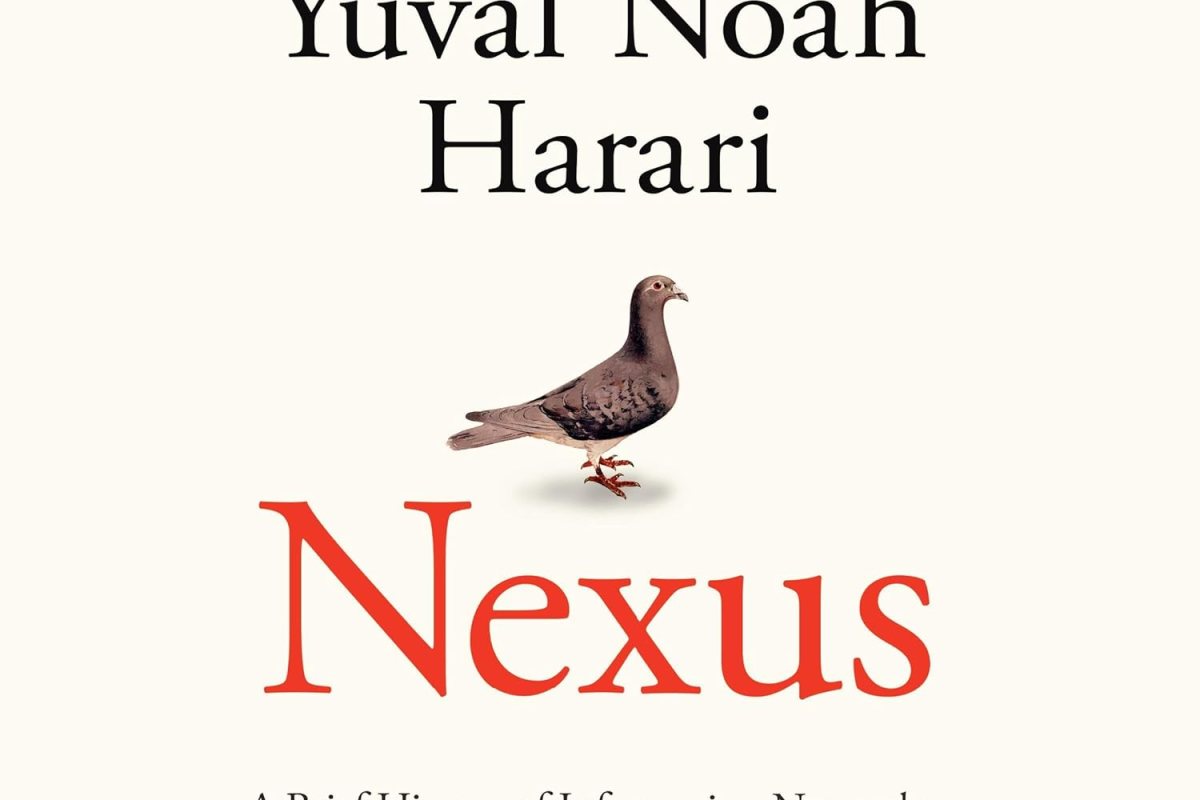
Chapter 1 of Yuval Noah Harari’s Nexus, ironically titled “What is Information?” closes not with clarity but with ambiguity. Harari, ever the rhetorician, acknowledges the difficulty of achieving consensus on what ‘information’ truly means. Instead of attempting a rigorous definition, he opts for the commonsense idiomatic approach—a conveniently disingenuous choice, given that information is supposedly the book’s foundational theme. To say this omission is bothersome would be an understatement; it is a glaring oversight in a chapter dedicated to unpacking this very concept.

Audio: Podcast related to this content.

Sidestepping Rigour

Harari’s rationale for leaving ‘information’ undefined appears to rest on its contested nature, yet this does not excuse the absence of his own interpretation. While consensus may indeed be elusive, a book with such grand ambitions demands at least a working definition. Without it, readers are left adrift, navigating a central theme that Harari refuses to anchor. This omission feels particularly egregious when juxtaposed against his argument that information fundamentally underlies everything. How can one build a convincing thesis on such an unstable foundation?

The Map and the Terrain

In typical Harari fashion, the chapter isn’t devoid of compelling ideas. He revisits the map-and-terrain analogy, borrowing from Borges to argue that no map can perfectly represent reality. While this metaphor is apt for exploring the limitations of knowledge, it falters when Harari insists on the existence of an underlying, universal truth. His examples—Israeli versus Palestinian perspectives, Orthodox versus secular vantage points—highlight the relativity of interpretation. Yet he clings to the Modernist belief that events have an objective reality: they occur at specific times, dates, and places, regardless of perspective. This insistence feels like an ontological claim awkwardly shoehorned into an epistemological discussion.

Leveraging Ambiguity

One can’t help but suspect that Harari’s refusal to define ‘information’ serves a rhetorical purpose. By leaving the concept malleable, he gains the flexibility to adapt its meaning to suit his arguments throughout the book. This ambiguity may prove advantageous in bolstering a wide-ranging thesis, but it also risks undermining the book’s intellectual integrity. Readers may find themselves wondering whether Harari is exploring complexity or exploiting it.

Final Thoughts on Chapter 1

The chapter raises more questions than it answers, not least of which is whether Harari intends to address these foundational gaps in later chapters. If the preface hinted at reductionism, Chapter 1 confirms it, with Harari’s Modernist leanings and rhetorical manoeuvres taking centre stage. “What is Information?” may be a provocative title, but its contents suggest that the question is one Harari is not prepared to answer—at least, not yet.
First Impressions of Nexus

I’ve just begun reading Yuval Noah Harari’s Nexus. As the prologue comes to a close, I find myself navigating an intellectual terrain riddled with contradictions, ideological anchors, and what I suspect to be strategic polemics. Harari, it seems, is speaking directly to his audience of elites and intellectuals, crafting a narrative that leans heavily on divisive rhetoric and reductionist thinking—all while promising to explore the nuanced middle ground between information as truth, weapon, and power grab. Does he deliver on this promise? The jury is still out, but the preface itself raises plenty of questions.

Audio: Podcast reflecting on this content.

The Anatomy of a Polemic

From the outset, Harari frames his discussion as a conflict between populists and institutionalists. He discredits the former with broad strokes, likening them to the sorcerer’s apprentice—irrational actors awaiting divine intervention to resolve the chaos they’ve unleashed. This imagery, though evocative, immediately positions populists as caricatures rather than serious subjects of analysis. To compound this, he critiques not only populist leaders like Donald Trump but also the rationality of their supporters, signalling a disdain that reinforces the divide between the “enlightened” and the “misguided.”

This framing, of course, aligns neatly with his target audience. Elites and intellectuals are likely to nod along, finding affirmation in Harari’s critique of populism’s supposed anti-rationality and embrace of spiritual empiricism. Yet, this approach risks alienating those outside his ideological choir, creating an echo chamber rather than fostering meaningful dialogue. I’m unsure whether he is being intentionally polemic and provocative to hook the reader into the book or if this tone will persist to the end.

The Rise of the Silicon Threat

One of Harari’s most striking claims in the preface is his fear that silicon-based organisms (read: AI) will supplant carbon-based life forms. This existential anxiety leans heavily into speciesism, painting a stark us-versus-them scenario. Whilst Harari’s concern may resonate with those wary of unchecked technological advancement, it smacks of sensationalism—a rhetorical choice that risks reducing complex dynamics to clickbait-level fearmongering. How, exactly, does he support this claim? That remains to be seen, though the sceptic in me suspects this argument may prioritise dramatic appeal over substantive evidence.

Virtue Ethics and the Modernist Lens

Harari’s ideological stance emerges clearly in his framing of worldviews as divisions of motives: power, truth, or justice. This naïve triad mirrors his reliance on virtue ethics, a framework that feels both dated and overly simplistic in the face of the messy realities he seeks to unpack. Moreover, his defence of institutionalism—presented as the antidote to populist chaos—ignores the systemic failings that have eroded trust in these very institutions. By focusing on discrediting populist critiques rather than interrogating institutional shortcomings, Harari’s argument risks becoming one-sided.

A Preface Packed with Paradoxes

Despite these critiques, Harari’s preface is not without its merits. For example, his exploration of the “ant-information” cohort of conspiracy theorists raises interesting questions about the weaponisation of information and the cultural shifts driving these movements. However, his alignment with power concerns—notably the World Economic Forum—casts a shadow over his ability to critique these dynamics impartially. Is he unpacking the mechanisms of power or merely reinforcing the ones that align with his worldview?

The Promise of Middle Ground—or the Illusion of It

Harari’s stated goal to explore the middle ground between viewing information as truth, weapon, or power grab is ambitious. Yet, the preface itself leans heavily toward polarisation, framing AI as an existential enemy and populists as irrational antagonists. If he genuinely seeks to unpack the nuanced intersections of these themes, he will need to move beyond the reductionism and rhetorical flourishes that dominate his opening chapter.

Final Thoughts

I liked Hararis’ first publication, Sapiens, that looked back into the past, but I was less enamoured with his prognosticating, and I worry that this is more of the same. As I move beyond the preface of Nexus, I remain curious but sceptical. Harari’s narrative thus far feels more like a carefully curated polemic than a genuine attempt to navigate the complexities of the information age. Whether he builds on these initial positions or continues entrenching them will determine whether Nexus delivers on its promise or merely reinforces existing divides. One thing is certain: the prologue has set the stage for a provocative, if polarising, journey.

Top 5 Books Read 2024

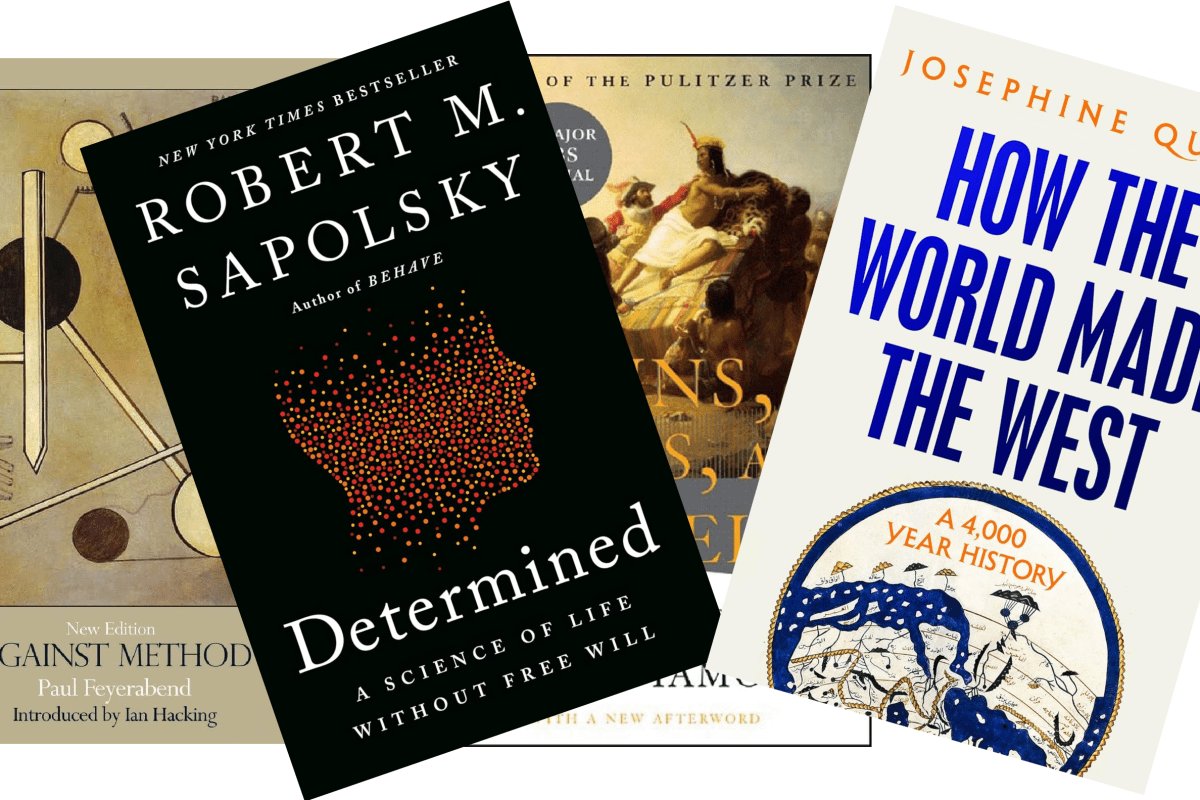
These are my favourite books I read in 2024. Only one was first published this year, so it seems I was playing catch-up and rereading. Two are about history; two are about the philosophy of science; and one is about biological free will or the lack thereof.

5

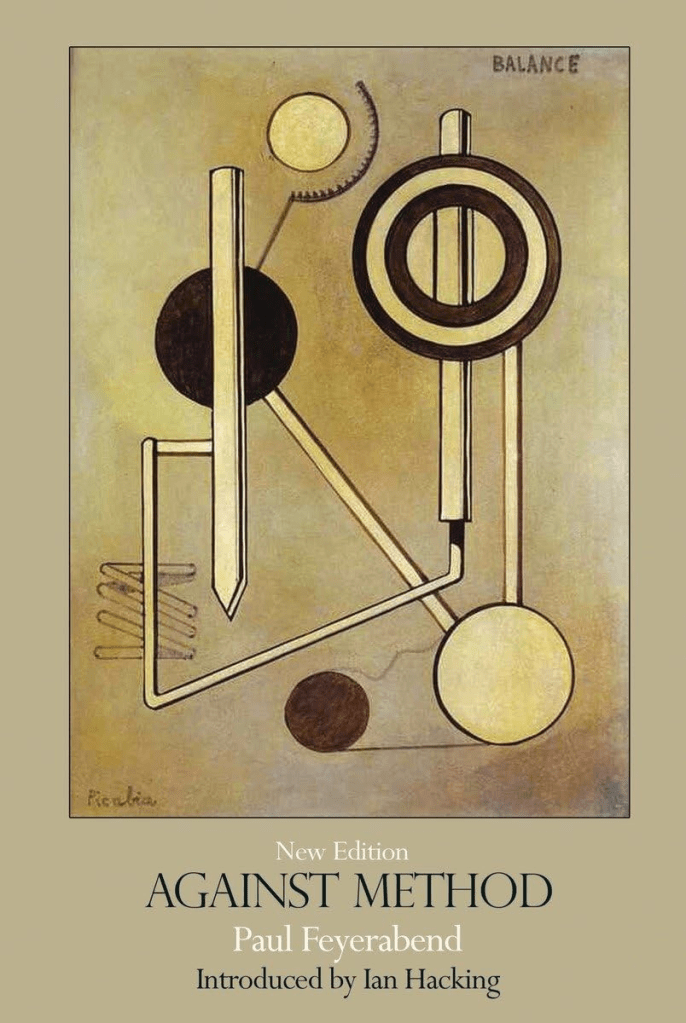
Against Method (2010)
Philosophy of Science

Against Method is a re-read for me. It makes the list on the coattails of a higher-ranked book. Feyerabend makes a compelling case against the Scientific Method™. To complete the set, I’d also recommend Bruno Latour‘s We Have Never Been Modern.

4

Determined: A Science of Life without Free Will (2023)
Neuroscience, Philosophy

Determined arrives on the heels of Sapolsky’s Behave, another classic that I’d recommend even more, but I read it in 2018, so it doesn’t make the cut. In Determined, Sapolsky makes the case that there is no room or need for free will to explain human behaviour.

3

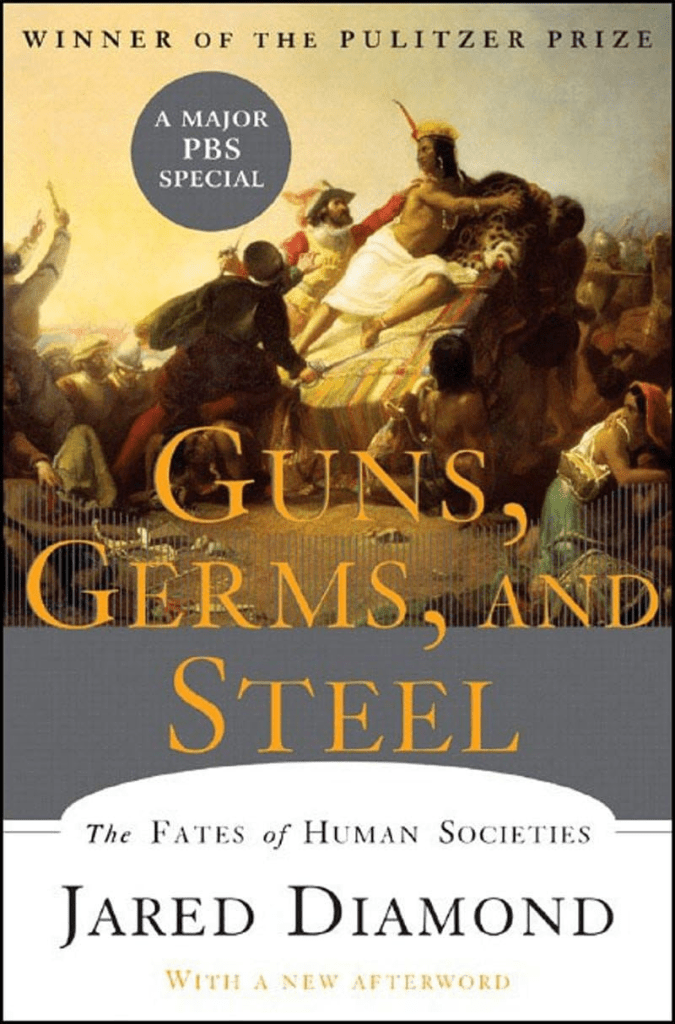
Guns, Germs, and Steel: The Fates of Human Societies (1998)
History

As with Against Method, Guns, Germs, and Steel makes the list only to complement my next choice. It views history through an environmental lens. To fill out the historical perspective, I recommend David Graeber’s The Dawn of Everything: A New History of Humanity (with David Wengrow). I’d recommend Yuval Noah Harari‘s Sapiens: A Brief History of Humankind, but it occupies a different category and is more about a plausible broad narrative than the detail explored in the others listed.

2

How the World Made the West: A 4,000 Year History (2024)
History

Quinn makes history approachable as she questions the uniformity of civilisations pushed by orthodoxy. Read this in context with the aforementioned historical accounts for a fuller perspective.

1

The Structure of Scientific Revolutions: 50th Anniversary Edition (1962/2012)
Philosophy of Science

I was born in 1961. This should have been bedtime reading for me. I’d heard of this work, but one really has to read it. It’s less Modernist than I had presumed—though not to the extent of Feyerabend or Latour mentioned above. Again, reading all three provides a robust perspective on the philosophy of science.

Like Quinn, the writing is approachable. I had expected it to be stilted. It is academic, and it may boost your vocabulary, but give it a gander. It also works well in an audiobook format if you are so inclined.

This about closes out 2024. What do you think about these choices? Agree or disagree? What are your top recommendations?

“Your Triggers Aren’t My Problem!”

…except, sometimes they are.

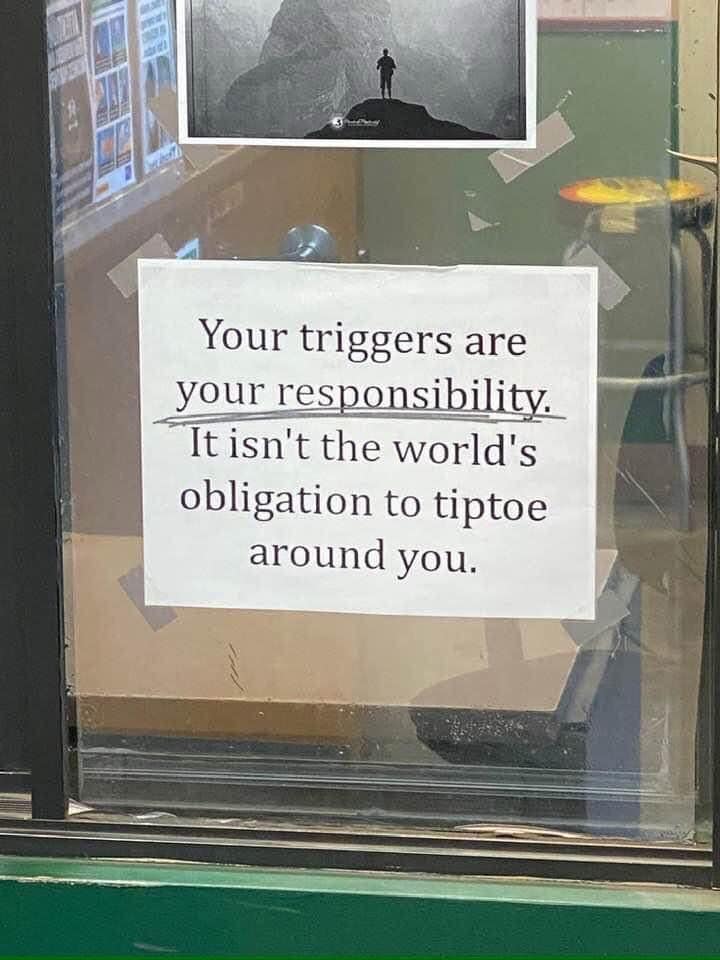
This came across my feed, the laminated wisdom of our times: Your triggers are your responsibility. It isn’t the world’s obligation to tiptoe around you. A phrase so crisp, so confident, it practically struts. You can imagine it on a mug, alongside slogans like Live, Laugh, Gaslight. These are the language games I love to hate.

Now, there’s a certain truth here. Life is hard, and people aren’t psychic. We can’t reasonably expect the world to read our mental weather reports—50% chance of anxiety, rising storms of existential dread. In an adult society, we are responsible for understanding our own emotional terrain, building the bridges and detours that allow us to navigate it. That’s called resilience, and it’s a good thing.

Audio: NotebookLM Podcast on this topic.

But (and it’s a big but) this maxim becomes far less admirable when you scratch at its glossy surface. What does triggers even mean here? Because trigger is a shape-shifter, what I term ShrĂśdinger’s Weasels. For someone with PTSD, a trigger is not a metaphor; it’s a live wire. It’s a flashback to trauma, a visceral hijacking of the nervous system. That’s not just “feeling sensitive” or “taking offence”—it’s a different universe entirely.

Yet, the word has been kidnapped by the cultural peanut gallery, drained of precision and applied to everything from discomfort to mild irritation. Didn’t like that movie? Triggered. Uncomfortable hearing about your privilege? Triggered. This semantic dilution lets people dodge accountability. Now, when someone names harm—racism, misogyny, homophobia, you name it—the accused can throw up their hands and say, Well, that’s your problem, not mine.

And there’s the rub. The neat simplicity of Your triggers are your responsibility allows individuals to dress their cruelty as stoic rationality. It’s not their job, you see, to worry about your “feelings.” They’re just being honest. Real.

Except, honesty without compassion isn’t noble; it’s lazy. Cruelty without self-reflection isn’t courage; it’s cowardice. And rejecting someone’s very real pain because you’re too inconvenienced to care? Well, that’s not toughness—it’s emotional illiteracy.

Let’s be clear: the world shouldn’t have to tiptoe. But that doesn’t mean we’re free to stomp. If someone’s discomfort stems from bigotry, prejudice, or harm, then dismissing them as “too sensitive” is gaslighting, plain and simple. The right to swing your fist, as the old adage goes, ends at someone else’s nose. Likewise, the right to be “brutally honest” ends when your honesty is just brutality.

The truth is messy, as most truths are. Some triggers are absolutely our responsibility—old wounds, minor slights, bruised egos—and expecting the world to cushion us is neither reasonable nor fair. But if someone names harm that points to a broader problem? That’s not a trigger. That’s a mirror.

So yes, let’s all take responsibility for ourselves—our pain, our growth, our reactions. But let’s also remember that real strength is found in the space where resilience meets accountability. Life isn’t about tiptoeing or stomping; it’s about walking together, with enough care to watch where we step.

The Morality of Ants

Taking Moral Cues from Ants: Because Humans are Too Busy Defending the Indefensible

Ah, ants. Tiny, unassuming, and quite literally beneath us — unless you’re sprawled out on a picnic blanket fighting off a colony swarming your questionable sandwich. Yet, while humanity busies itself polluting oceans, strip-mining rainforests, and justifying corporate bloodsucking as “necessary for the economy,” ants are out here performing life-saving surgeries on their comrades.

You heard that correctly.

Researchers have now observed certain ant species (yes, ants) performing amputations on their injured nestmates to prevent infections from spreading. Picture it: a worker ant limping home, leg shredded by some territorial skirmish, and the squad rolls up like a triage team, deciding whether to (a) gently clean the wound or (b) lop the limb off entirely. Amputation is precise and deliberate — snip at the hip joint if the upper leg is toast. Lower leg injuries? Too risky. Infection spreads faster there, so it’s all hands (or mandibles) on deck for some industrial-strength licking.

It’s a brutal but effective social health system. The results? Injured ants survive. They get patched up, return to work, and contribute to the collective. The colony benefits, everyone thrives, and not a single ant launches into a fevered tirade about how “it’s their individual right to rot from gangrene in peace.”

Contrast this with humanity, where the very notion of collective good seems to spark mass hysteria in certain corners. Here, defending dubious practices — say, unfettered pollution, exploitative labour conditions, or the kind of wealth-hoarding that would make a dragon blush — has become a full-time hobby for some. “Personal responsibility!” they scream whilst someone chokes on smog or shivers in a warehouse set to Arctic temperatures. Heaven forbid we intervene.

Imagine explaining to ants that humans argue about whether everyone deserves basic healthcare. That we let industries poison rivers because regulations might “hurt innovation.” Some believe that letting people suffer and die without help is somehow noble.

Ants would stare at us — or they would if they had discernible faces. Then they’d probably do what they always do: get back to work ensuring their colony survives and thrives, as any halfway intelligent species might.

A Case for the Collective

What makes this ant behaviour so fascinating isn’t just that it exists, but that it demonstrates something humanity supposedly prides itself on: adaptability. Faced with an existential threat to one of their own, ants don’t moralise. They don’t argue about the costs or logistics of care. They don’t abandon the injured because helping them isn’t “profitable.” They just act. Quickly, efficiently, and for the collective good.

Meanwhile, humans act like the collective good is some leftist fever dream. Suggest tax-funded healthcare or basic environmental protections, and someone inevitably starts shrieking about “slippery slopes” toward tyranny, as though being able to breathe clean air or avoid bankruptcy after surgery is the thin edge of some Orwellian wedge.

We have entire systems built on the premise that it’s fine for some to suffer if others can profit. Does that sound hyperbolic? I’ll wait while you Google “externalised costs.” Spoiler alert: your cheap burger came at the expense of rainforest ecosystems and underpaid workers. But hey, as long as we’re prioritising shareholder value, all’s fair, right?

The Ants Would Like a Word

Here’s the thing: ants don’t amputate limbs because they’re altruistic softies. They do it because it makes sense. An injured worker can still contribute to the colony, and the colony’s survival depends on its members pulling together. It’s cold, pragmatic, and effective.

Now consider our own global “colony.” Why do we resist solutions that would make all of us more resilient? Healthcare, environmental protections, workers’ rights — these aren’t radical. They’re practical. Just like amputating a leg to save an ant, safeguarding the vulnerable helps everyone. Yet here we are, letting metaphorical infections spread because someone’s feelings about rugged individualism got in the way.

If Ants Can Do It, So Can We

At this point, humanity doesn’t need a lofty moral awakening. We just need to be marginally smarter than ants. Think about it: they’re tiny-brained insects who figured out that collective care improves survival rates. What’s our excuse?

Perhaps it’s time we take a page out of the ants’ playbook: diagnose the problem, take decisive action, and prioritise the common good. Amputate the rot. Treat the infection. And for the love of whatever deity or science you hold dear, stop defending systems that sacrifice the many for the few.

If ants can do it, we have no excuse.

In Conclusion:

When ants are more socially responsible than we are, it’s time to ask some tough questions. Now get it together, or the ants are going to outlive us all.

From Homo Sacer to Wolf’s Head

A Stroll Through the Bloodstained Woods of Legal History

Ah, the Royal Forests of medieval England – a term so delightfully misleading that it could teach modern PR firms a thing or two. Far from evoking pastoral woodlands teeming with squirrels and picnic spots, these ‘forests’ were not defined by trees but by legal tyranny. Thanks to our favourite Norman conqueror, William the First (or William the Worst, if you were an unlucky peasant), these exclusive playgrounds for kings became the ultimate no-go zones for the hoi polloi.

Of Forests and Fictions

Contrary to what your Instagram influencer friends might think, a ‘forest’ back then didn’t need a single tree. It was the law, darling, not the foliage, that counted. These Royal Forests were terra sacra for the crown’s hunting pleasures, with laws so draconian they’d make Draco himself blush. Need firewood? Tough luck. Want to graze your sheep? Not unless you fancy forfeiting your flock – or perhaps a hand.

Speaking of hands, the forest laws weren’t just about controlling land; they were a petri dish for class warfare. Hunting deer without royal permission? You might not be ‘caught red-handed’ (hold that thought for later), but the penalties ensured your dignity – and possibly your anatomy – were left in the woods.

Enter the Outlaw: Homo Sacer in Doublet and Hose

Which brings us to that delightful medieval innovation: outlawry. To be declared an outlaw wasn’t just to be slapped with a fine or given a metaphorical wag of the finger. Oh no, you became a walking target, stripped of all legal protections. A medieval outlaw wasn’t just a criminal; they were legally dead – a status once reserved for the Roman homo sacer, the accursed man outside the pale of law and civilisation.

Declared an outlaw? Congratulations, you’re now a ‘wolf’s head.’ A charming term, really – essentially a poetic way of saying ‘fair game.’ Anyone could hunt you down without consequence. Add in a bit of medieval flair, and voilĂ : outlawry became less about justice and more about population control via recreational murder.

Caught Red-Handed: Scotland’s Contribution to the Blood-soaked Lexicon

Speaking of blood, let’s dissect that juicy phrase, ‘caught red-handed.’ Many would love to connect this idiom to poaching in Royal Forests, but alas, its origins are as Scottish as whisky and poor weather. The term ‘red hand’ first appeared in the Acts of Parliament of James I in 1432, long after the Normans had finished turning England into one giant gated community for deer.

Back then, being ‘caught reid hand’ wasn’t just a metaphor. It meant literally being caught with blood on your hands, usually from slaughtering someone else’s sheep – or worse, their lord’s. Fast-forward to Sir Walter Scott’s Ivanhoe in 1819, and the phrase gets a literary boost, morphing into ‘red-handed.’ By the Victorian era, it had become the darling of pulp crime writers everywhere.

Robin Hood: Outlaw Extraordinaire or Tudor PR Ploy?

And what’s a medieval blog post without a nod to Robin Hood, England’s most famous outlaw? Let’s be honest: Robin Hood probably didn’t exist, and if he did, he was less about redistributing wealth and more about ensuring his band of merry men didn’t starve. But Sherwood Forest’s association with this legendary thief cements the notion that outlaws weren’t always villains. Some were folk heroes – or at least, they were heroes to anyone who wasn’t a sheriff or a Norman noble.

Forests, Outlaws, and Bloodied Hands: A Legacy Worth Remembering

The legal forests of medieval England weren’t just about game preservation; they were a microcosm of royal power, social exclusion, and judicial brutality. The outlaw, stripped of all rights, was both a product and a victim of this system – a ‘wolf’s head’ wandering the wilderness, neither man nor beast in the eyes of the law.

And what of ‘caught red-handed’? A phrase born in blood-soaked Scottish pastures, far removed from the Royal Forests of England but just as evocative of humanity’s fixation on crime, punishment, and evidence that sticks – quite literally.

So next time you hear about forests, think less ‘enchanted woods’ and more ‘legal hellscape.’ And if you’re ever ‘caught red-handed,’ remember: at least you’re not a wolf’s head.

Thomas Sowell on Artificial Stupidity

A Masterpiece of Dog Whistle Rhetoric

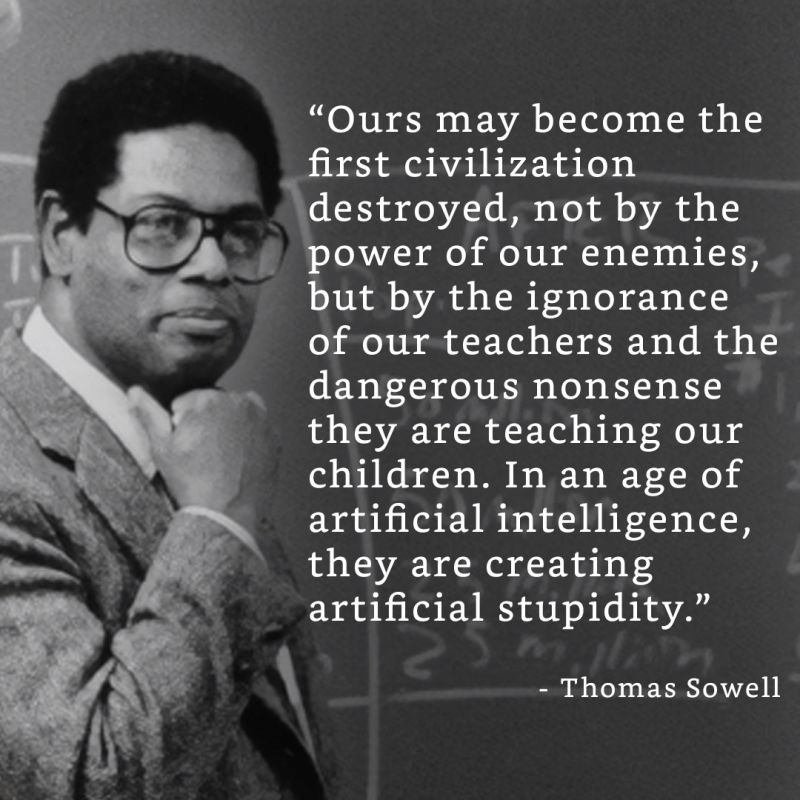
Thomas Sowell once opined:

Image: Thomas Sowell with superimposed quotation cited above.

What a delightfully loaded statement. Sowell—a man whose intellectual credentials are as impeccable as his sweeping generalisations – manages, in a single breath, to malign teachers, dismiss contemporary education, and suggest that we’re hurtling towards some dystopian abyss because children today aren’t being taught…what, exactly? Latin declensions? The works of Burke? Perhaps the art of deference to authority? He never specifies. And why should he? Specifics would ruin the vibe.

This statement is a masterpiece of rhetorical dog-whistling. To those predisposed to Sowell’s worldview, it’s just common sense. Teachers are ignorant, modern education is a farce, and our children are doomed to a future of robotic ineptitude. It sounds plausible enough, provided you don’t stop to ask pesky questions like, “Which teachers? What nonsense? How, exactly, does one create artificial stupidity?”

The Cult of Common Sense

Let’s take a moment to examine the talismanic invocation of “common sense,” a concept as revered as it is elusive. Voltaire’s quip that “common sense is not so common” seems particularly apt here. What Sowell calls common sense is really shorthand for a monolithic worldview where civilisation is a neatly defined entity under siege by radical educators and their progressive agendas.

The problem? This worldview collapses under even cursory scrutiny. Civilisation is not a singular, static entity but an ever-evolving tapestry of conflicting ideas, cultures, and innovations. Teachers are not a homogenous cabal conspiring to dismantle society but an underpaid, overworked group trying their best to navigate a minefield of bureaucracy and societal expectations. And as for the “dangerous nonsense” being taught? Well, your guess is as good as mine. Critical thinking? Equity? Heaven forbid, empathy?

Ignorance as a Natural State

Sowell’s fans bristle at any suggestion that their intellectual idol might be guilty of hyperbole. But let’s consider the claim that teachers are “creating” stupidity. This presupposes that stupidity is an artificial construct rather than the natural baseline of humanity. The average IQ is, after all, 100 by design. For Americans, it hovers slightly below that at 97. This isn’t new. Stupidity doesn’t need to be created; it’s the default. Education’s job is to chip away at this deficit, not conjure intelligence ex nihilo.

To cast educators as villains in this endeavour is a disingenuous sleight of hand. Are there systemic issues in education? Of course. But to claim that teachers are actively fostering stupidity is akin to blaming firefighters for the existence of fires.

The Paradox of Intellectual Elitism

Here’s the kicker: Sowell himself is an intellectual. An elitist, no less, if we’re using his own fans’ definition. Yet his critique of intellectuals resonates with his audience precisely because they perceive him as an exception to the rule. “He’s one of us,” they say, failing to notice the irony. It’s the classic populist manoeuvre: position yourself as the voice of the people while enjoying all the privileges of the elite.

This paradox is not unique to Sowell. It’s the same dynamic that fuels the cult of Jordan Peterson, another intellectual who rails against intellectualism while wielding its tools. The result is a rhetorical echo chamber where dissent is dismissed as ignorance and agreement is lauded as truth.

The Dog Whistle Symphony

Sowell’s statement is, at its core, a symphony of dog whistles. It’s designed to resonate with those who already believe that modern education is a hotbed of progressive indoctrination. To this audience, it’s not a call to debate but a rallying cry. The terms – civilisation, ignorance, nonsense, artificial stupidity – are intentionally vague, allowing listeners to project their own fears and grievances onto them.

This vagueness is both the strength and the weakness of the argument. It’s compelling to those who share Sowell’s worldview but collapses under scrutiny. What is civilisation? What constitutes dangerous nonsense? Without definitions, these are just buzzwords masquerading as profundity.

Reframing the Conversation

So, how do we engage with such rhetoric? First, by refusing to accept its premises without question. Who are these teachers, and what are they allegedly teaching? What does Sowell mean by “civilisation”? Without specifics, his statement is not an argument but an incantation.

Second, by exposing the contradictions. If intelligence is the antidote to societal decline, as Sowell implies, then dismissing intellectuals wholesale is self-defeating. If education is the solution, then scapegoating teachers undermines the very people tasked with implementing it.

Finally, by recognising the emotional appeal at play. Sowell’s rhetoric taps into a deep-seated fear of change and loss. Addressing this fear requires empathy and nuance – qualities absent from his statement but essential for meaningful dialogue.

Conclusion

Thomas Sowell’s warning about “artificial stupidity” is less a diagnosis of societal decline than a litmus test for ideological allegiance. It’s a brilliant piece of rhetoric but a poor substitute for critical analysis. By unpacking its assumptions and exposing its contradictions, we can move beyond the echo chamber of dog whistles and engage in the kind of nuanced, constructive debate that Sowell’s own critique ostensibly calls for.

But then, nuance has never been common sense, has it?

A Buddhist Critique of Modern Livelihoods

It’s interesting to me that as an atheist and non-cognitivist, I can take the moral high ground relative to health insurance concerns in the United States. So, I write about it.

Blood Money and Broken Principles

In the aftermath of the tragic killing of Brian Thompson, the CEO of a health insurance conglomerate, a striking narrative has emerged. Many Americans view this act—shocking though it is—as emblematic of the anger and despair born of a system that profits by exploiting human vulnerability. Such reactions compel us to examine the ethics of industries that flourish on what can only be described as blood money. From health insurance to tobacco, alcohol, and the arms trade, these livelihoods raise profound ethical questions when viewed through the lens of the Buddhist Noble Eightfold Path, specifically Right Livelihood and Right Action.

The Moral Framework: Buddhism’s Path to Ethical Livelihood

Buddhism’s Eightfold Path provides a blueprint for ethical living, with Right Livelihood and Right Action serving as its ethical cornerstones. These principles demand that one’s work and deeds contribute to the welfare of others, avoid harm, and align with compassion and integrity. In short, they urge us to earn a living in a manner that uplifts rather than exploits. The health insurance industry’s business model—which often prioritises profits over the preservation of life—challenges these tenets in ways that are difficult to overlook.

Consider the denial of coverage for life-saving treatments, the exploitation of legal loopholes to reduce payouts, or the systemic perpetuation of healthcare inequality. These actions, while legally sanctioned, conflict sharply with the Buddhist ideal of avoiding harm and promoting well-being. Yet, this industry is not alone in its ethical failings. Many others—both legal and illegal—fall similarly short.

Industries of Exploitation: Tobacco, Alcohol, and Arms

The tobacco and alcohol industries provide stark examples of livelihoods that thrive on human suffering. Their products, despite their legality, are designed to foster dependency and harm. They exact a heavy toll on both individual lives and public health systems, a reality that makes them incompatible with Right Livelihood. The arms trade—arguably the most egregious example—profits directly from conflict and human misery. How can such industries possibly align with the Buddhist ideal of ahimsa (non-violence) or the compassionate aspiration to alleviate suffering?

In these cases, the harm caused is not incidental; it is fundamental to their business models. Whether one manufactures cigarettes, brews alcohol, or sells weapons, the destruction wrought by these activities is integral to their profitability. The contradiction is stark: the greater the harm, the greater the profit. This stands in direct opposition to the Buddhist call for livelihoods that sustain and support life.

Organised Crime: The Dark Mirror

When we turn to organised crime, the parallels become even more unsettling. Whether it’s the drug trade, human trafficking, or financial fraud, these activities epitomise unethical livelihoods. They exploit the vulnerable, foster violence, and undermine social cohesion. Yet, when viewed alongside certain legal industries, the line between “organised crime” and “corporate enterprise” begins to blur. Is the denial of life-saving healthcare less egregious than a gang’s extortion racket? Both profit by preying on human suffering. Both thrive in systems that prioritise gain over humanity.

The Buddhist Response: From Outrage to Action

Buddhism does not condone violence, no matter how symbolic or righteous it may appear. Right Action demands non-violence not only in deeds but also in thoughts and intentions. The killing of Brian Thompson, though perhaps an act of desperation or symbolism, cannot align with Buddhist ethics. Yet this tragedy should not eclipse the broader systemic critique. The true challenge is not to exact retribution but to transform the systems that perpetuate harm.

To move forward, we must ask how our societies can pivot toward livelihoods that align with compassion and justice. This entails holding exploitative industries to account and fostering economic systems that prioritise well-being over profit. The Buddhist path offers not only a critique of harmful practices but also a vision for ethical living—a vision that demands courage, compassion, and unwavering commitment to the common good.

Conclusion: Choosing a Better Path

The case of Brian Thompson’s killing is a symptom of a much larger ethical crisis. It forces us to confront uncomfortable truths about the industries that shape our world. Whether we scrutinise health insurance, tobacco, alcohol, the arms trade, or organised crime, the moral calculus remains the same: livelihoods that thrive on harm cannot be reconciled with the principles of Right Livelihood and Right Action.

As individuals and societies, we face a choice. We can continue to turn a blind eye to the suffering embedded in these industries, or we can commit to transforming them. The Buddhist path challenges us to choose the latter, to build systems and livelihoods rooted in compassion and justice. In doing so, we can begin to heal not only the wounds of individual tragedies but also the deeper fractures in our collective soul.

The Trolley Problem of For-Profit Healthcare:

Loops of Death and Denial

The trolley problem is a philosophical thought experiment that pits action against inaction. In the original version, a person faces a choice: a trolley hurtles down a track toward five people tied to the rails, but a lever allows the trolley to be diverted onto another track, where one person is tied. The dilemma is simple in its grotesque arithmetic: let five die or actively kill one to save them. A perennial favourite of ethics classes, the trolley problem is most often used to explore Consequentialism, particularly Utilitarianism, and its cool calculus of harm minimisation. Over the years, countless variations have been conjured, but few approach the nightmarish reality of its real-world application: the for-profit healthcare system in the United States.

With the recent death of UnitedHealthcare CEO Brian Thompson, the trolley dilemma takes on a new and morbid relevance. Let’s reframe the challenge.

The Healthcare Trolley Loop

Picture the trolley again on a bifurcated track. The lever remains, as does the moral agent poised to decide its fate. This time, the agent is Brian Thompson. The setup is simple: one track leads to the deaths of five people, and the other is empty. But here’s the twist: the trolley doesn’t just pass once in this version—it’s on a loop. At every interval, Thompson must decide whether to pull the lever and send the trolley to the empty track or allow it to continue its deadly course, killing five people each time.

But Thompson isn’t just deciding in a vacuum. The track with five people comes with a financial incentive: each life lost means higher profits, better quarterly earnings, and soaring shareholder returns. Diverting the trolley to the empty track, meanwhile, offers no payout. It’s not a single moral quandary; it’s a recurring decision, a relentless calculus of death versus dollars.

This isn’t just a metaphor; it’s a business model. For-profit healthcare doesn’t merely tolerate death—it commodifies it. The system incentivises harm through denial of care, inflated costs, and structural inefficiencies that ensure maximum profit at the expense of human lives.

Enter the Shooter

Now, introduce the wildcard: the shooter. Someone whose loved one may have been one of the countless victims tied to the track. They see Thompson at the lever, his decisions ensuring the endless loop of suffering and death. Perhaps they believe that removing Thompson can break the cycle—that a new lever-puller might divert the trolley to the empty track.

Thompson is killed, but does it change anything? The system remains. Another CEO steps into Thompson’s place, hand on the lever, ready to make the same decision. Why? Because the tracks, the trolley, and the profit motive remain untouched. The system ensures that each decision-maker faces the same incentives, pressures, and chilling rationale: lives are expendable; profits are not.

The Problem of Plausible Deniability

The shooter’s actions are vilified because they are active, visible, and immediate. A single violent act is morally shocking, and rightly so. But what of the quiet violence perpetuated by the healthcare system? The denial of coverage, the refusal of life-saving treatments, the bankruptcy-inducing bills—all are forms of systemic violence, their harm diffused and cloaked in the language of economic necessity.

The for-profit model thrives on this plausible deniability. Its architects and operators can claim they’re simply “following the market,” that their hands are tied by the invisible forces of capitalism. Yet the deaths it causes are no less real, no less preventable. The difference lies in perception: the shooter’s act is direct and visceral, while the system’s violence is passive and bureaucratic, rendered almost invisible by its banality.

A System Built on Death

Let’s not mince words: the current healthcare system is a death loop. It’s not an accident; it’s a feature. Profit-seeking in healthcare means there is always a financial incentive to let people die. During the Affordable Care Act (ACA) debates, opponents of universal healthcare decried the spectre of “death panels,” bureaucrats deciding who lives and who dies. Yet this is precisely what for-profit insurance companies do—only their decisions are driven not by medical necessity or moral considerations, but by spreadsheets and stock prices.

This is the logic of capitalism writ large: maximise profit, externalise harm, and frame systemic failures as unavoidable. Healthcare is merely one example. Across industries, the same dynamic plays out, whether in environmental destruction, labour exploitation, or financial crises. The trolley always runs on tracks built for profit, and the bodies left in its wake are just collateral damage.

How to Break the Loop

The death of Brian Thompson changes nothing. The system will simply produce another Thompson, another lever-puller incentivised to make the same deadly decisions. Breaking the loop requires dismantling the tracks themselves.

  1. Remove the Profit Motive: Healthcare should not be a marketplace but a public good. Universal single-payer systems, as seen in many other developed nations, prioritise care over profit, removing the incentive to let people die for financial gain.
  2. Recognise Passive Harm as Active: We must stop excusing systemic violence as “inevitable.” Denying care, pricing treatments out of reach, and allowing medical bankruptcy are acts of violence, no less deliberate than pulling a trigger.
  3. Hold the System Accountable: It’s not just the CEOs at fault; the lawmakers, lobbyists, and corporations sustain this deadly status quo. The blood is on their hands, too.

Conclusion: The Real Villain

The shooter is not the solution, but neither is their act the real crime. The healthcare system—and by extension, capitalism itself—is the true villain of this story. It constructs the tracks, builds the trolley, and installs lever-pullers like Brian Thompson to ensure the loop continues.

When will it end? When we stop debating which track to divert the trolley toward and start dismantling the system that made the trolley inevitable in the first place. Until then, we are all complicit, passengers on a ride that profits from our suffering and death. The question isn’t who’s at the lever; it’s why the trolley is running at all.

Apologies

Apologies. The sacred cow of social rituals. We’re told they’re essential—an ego on its knees, a ritual cleansing of the proverbial moral ledger. And yet, for all their lofty promises of redemption and relationship mending, aren’t apologies just glorified public relations exercises?

If you don’t like my position, I apologise. This is my response to Philosophy Minis, a channel I follow.

The philosophical breakdown you provide is charmingly earnest: admit guilt, promise reform, and repair the damage. It sounds good, doesn’t it? But let’s not kid ourselves—this is an ideal that seldom leaves the page. In practice, apologies are often nothing more than a performance. The “I’m sorry if you took offense” genre is merely the tip of the iceberg; the whole construct is a social mirage, designed more to shield the offender than to restore the wronged.

Take the idea that a “good” apology must paint the apologizer as a villain. In the real world, does that happen? Rarely. Instead, we get the watered-down version—a careful choreography of noncommittal contrition, crafted to absolve the perpetrator while barely acknowledging the harm. It’s the politician’s bread and butter: “I made a mistake” becomes code for “I’m not actually sorry, but my PR team says I should say something.” Serial apologists thrive on this economy of empty gestures, repeating offences with impunity, because they know the script will always offer them an escape hatch.

Then there’s the supposed promise of change—“I will try my best not to do this again.” Admirable in theory, utterly laughable in execution. Actions speak louder than words, but apologies, divorced from tangible behavioural shifts, speak volumes about their futility. The self-flagellation of guilt is easy; reform is hard. The apology may declare, “This is not who I want to be,” but the track record often screams, “This is exactly who I am, and I’ll see you here next week.”

And let’s not forget the crowning jewel of the apology trilogy: relationship repair. The idea that an apology rebuilds bridges is as idealistic as it is naive. True repair requires more than words; it demands effort, time, and trust—not the performative recitation of a three-step apology handbook. Worse, the insistence on a good apology as a relationship panacea risks shifting the burden onto the harmed party. If they don’t forgive, they’re the villain. Apologies weaponized as moral obligations are nothing short of emotional coercion.

Even the social utility of apologies feels overstated. Sure, children may warm to those who apologise, but is this truly evidence of moral profundity, or just a reflection of our preference for surface-level niceties? If anything, our societal obsession with apologies perpetuates the illusion that words can magically undo harm. This is a comforting narrative for offenders, but it does little for the offended.

Ultimately, apologies are not the noble moral endeavour they are so often made out to be. At best, they are flawed attempts at social cohesion; at worst, they are phatic placeholders that substitute genuine accountability with a hollow facsimile. Before we canonise the “good apology,” perhaps we ought to ask whether its real purpose is to humble the ego—or to let it off the hook entirely.