jimoeba mentioned that he enjoyed an interview with Vervake and Fridman in a comment, so I thought I’d give it a listen. It turns out there are several including a 3-plus-hour version. Arbitrarily, I chose this one. Even if it’s not the particular interview on the meaning crisis, it gives me a sense of the two and their dynamics. I’m glad I listened to it. I like Vervaeke. I can’t say I’m much of a Fridman fan on first listen.
John Vervaeke and Lex Fridman interview: Human civilisation is facing a meaning crisis
This interview content provides an orientation of where Vervaeke is coming from. It helps to clarify his position. His claim seems to be that many people today identify as having no religion but being spiritual. By extension, he posits that this cohort is searching for meaning. I can’t disagree. What it tells me is that I am not in his target demographic. I have no religion, as I am an atheist. I have no spiritual void to fill. This is Vervaeke’s goal—to find something to perform the function of the religion without the, perhaps, baggage and dogma.
I sympathise with his goal. He brings up Nietzsche’s “God is dead” quote, famous or infamous depending on your worldview. Essentially, he wants to answer Nietzsche’s query of what to do now that it’s been revealed that humans created God, not the other way around. His aim is to replace the font of wisdom for this generation.
For me, wisdom is a heuristic, part of the Gestalt McGilchrist mentions. McGilchrist’s work is even referenced here. Of course, I interpret McGilchrist’s references in this space to be metaphorical. It seems that he views it as ‘real’. I’m not sure where Vervaeke places it. Somehow, I feel that if there is a spectrum, Vervaeke leans closer to McGilchrist than me, and that’s OK. They just happen to be wrong.
I still don’t get the need for meaning. I don’t feel despondent that there is no inherent meaning in anything, but we are free to invite or adopt one or many. I remember a Christian mate of mine who explained that people have a God-sized hole that can only be filled by God. Essentially, Vervaeke is making a similar claim, but his void is filled by wisdom. I suppose that I don’t feel I have a void doesn’t mean there isn’t one.
I’m not a fan of psychology as a discipline, so this WEIRD phenomenon comes as no surprise. In fact, it’s not even that new. If memory serves, I think I first stumbled upon the notion from Jonathan Haidt.
WEIRD—Western, Educated, Industrialised, Rich, and Democratic.
WEIRD is the bias underpinning most university psychology studies—the ones that make the best memes and we tend to recite. The problem is that a vast majority of psych subjects are WEIRD—Western, Educated, Industrialised, Rich, and Democratic. There is a marked selection bias, so the composition tends to be gullible first-year psych students. As even a neophyte in statistical methods will tell you that random samples are a key ingredient of a decent social study, and a broad demographic base is another.
But, “So what?”, you say. The problem is that these students are not only not a good representational cross-section, they’re actually outliers, which is to say statistically nothing like the average world citizen. So whilst these studies do reveal certain psychological propensities, they are of this subgroup.
Common sense is not so common
— Voltaire
By extension, this means, as per Voltaire’s quip about common sense, if you have been taught that a person behaves like this, you should immediately flip that on its head and presume that the ordination non-WEIRDo would behave contrariwise.
The bigger problem is that the US having only five per cent of the global population has the tendency to be jingoistic and wants to impose its worldview on the rest, but it often if not almost always doesn’t realise that the world is not like them and doesn’t necessarily want to be like them. Moreover, Americans tend to believe they are better and better off than the rest of the world. of course, through their own lens, perhaps they are, but this is a minority lens with a minority view. People in the US don’t tend to get out much, and when they do it’s as tourists like visiting a zoo rather than trying to acculturate, so most world travelling doesn’t realise the opportunity it otherwise might have.
Deconstructing WIERD, the Western portion is beyond obvious. This would remain a factor even if studies weren’t restricted to undergrads. Educated is a bit of an odd one. Who knows how many student progress beyond their first year? But they are industrialised. I’d argue perhaps postindustralised. Rich is an interesting notion I’ll come back to in a moment, and their democracy is in name only, though I know where they are coming from.
Returning to Rich, the mean income of a family in the US in 2021 was $97,962. The median was $69,717. Statistically, what this indicates is that there are a few high wage-earners skewing the figure from the median. This phenomenon is known all too well. Somehow, I feel this has a sort of halo or affiliation effect, similar to the feeling a city has when its sports team wins a championship. Even the poor people feel they are part of the prosperity that by and large spits on them and holds them down. These people are indoctrinated with this WEIRD pseudoscience.
I don’t have much more to say. I’ve been distracted and have been writing this since yesterday. Weird, that.
Ever since encountering Viktor Frankl’s Man’s Search for Meaning in my youth, I’ve pondered why people search for and indeed invent meaning. By meaning, I am speaking in terms of finding a higher purpose or some spiritual affinity rather than the meaning of why bad things happen, though there are undoubtedly some intersections of the concepts.
This lecture, Ep. 39 – Awakening from the Meaning Crisis – The Religion of No Religion, from a series by John Vervaeke was recommended to an associate in my social network by another trusted associate, and it’s got me going. I’ve long been a nihilist and existentialist. I am even partial to aspects of the philosophic framework of Zen Buddhism. But I’ve never felt there was some higher meaning or raison d’être that isn’t self-imposed. How else would it be imposed? A person may be indoctrinated, but in the end, ignorance is no excuse from self-imposition.
I guess I can’t quite understand what drives this search for meaning. As Vervaeke notes, even some noted atheists like Richard Dawkins have suggested that we should find a secular proxy for the religion—or the namesake religion of no religion. I understand the social function of religion as well as some psychological functions, but the disconnect for me is that I have no such drive. I am admittedly an introvert, so whilst I admit the need for social cohesion and coöperation, I don’t understand the fabrication of religions or the personal, not only belief in meaning, but a yearning for it and even a belief that one has found it.
some people don’t search for meaning so much as they feel they have discovered meaning, but when their discovered meaning doesn’t jibe with another’s discovered meaning, the result is a search to justify or reconcile this conflict
I am empathetic to people like Iain McGilchrist who asserts that there is exogenous meaning out there to be had. He’d probably also assert that asking for proof is a left-hemisphere cerebral request but that absent the imposition by the left hemisphere, one would just feel it and know it. I just can’t abide.
Vervaeke does touch on the postmodern critique of religion as a power play, which is how I feel about it, but this is about the social aspect and doesn’t touch on the personal search for meaning. What I can’t say is whether a person would have this drive to search for meaning if they were either absent socialisation or exposed only to people who are not going to suggest meaning. I understand that previous generations have shown this propensity, but are there cultures that don’t? And is there a common thread to those who do?
In the past, many cultures have asserted gods and higher powers (whether or not as a power play), but could this simply prompt the people to search for alternative meanings, perhaps having noticed the dissonance between certain dogma and their lived lives?
Interestingly, some people don’t search for meaning so much as they feel they have discovered meaning, but when their discovered meaning doesn’t jibe with another’s discovered meaning, the result is a search to justify or reconcile this conflict.
It’s late. Time to retire for the evening. I have none of these answers, but I will jot the questions down on my to-do list just above the search for meaning.
I’ve been a longstanding fan of science. I’ve never been a fan of Scientism™, which is the dogmatic belief that science is the gate to all knowledge and that the discipline is incorruptible. I’ve even complained in the past about the self-correcting aspect that has sometimes taken centuries and millennia.
In the case of the article that spawned this post, peer review has always felt a bit specious to me. Just getting picked to get into the review queue is political at the start, and few people are actually equipped to perform the review with any material degree of diligence.
Science being peer-reviewed was like a knee-jerk credibility play. Of course, this also reeked of the police department or CIA reviewing their own misdeeds. On the other hand, who else is going to review it? The problem is there is no downside for the shoddy reviewer. There might be three referees who review your work and provide commentary—and so what if they miss some things?
As shoddy as soft sciences are, even hard sciences had reproducibility challenges—and that’s if the domain is reproducible. Models about climate change are not exactly suitable for laboratory reproduction.
Science is getting less and less credible these days. Besides being coopted by moneyed interests, you’ve got the politicos subverting it for their own purposes. Of course, the mismanagement and propagandising of the Covid debacle is still a fresh wound. And as we watch many of the conspiracy claims being shown to be correct and the official message shown to be wrong and intentionally disinformative, it’s hard not to become a jaded cynic. What’s a sceptic to do?
There, I said it. Perhaps I need to help find this quote a home in a story.
Some people love to hide behind facts, convinced that they are somehow inviolable truths. There are facts, but then there are interpretations of them. Therein lies the rub.
As my day taught me, there are three sides to every story. One side, the other side, and the truth. This truth is analogous to the fact of the matter, but it is never directly accessible, and so any started fact is necessarily a constructed fiction, no matter how committed we are to it. This includes tautological facts, which are simply whims of nomenclature.
I’ve already said that justice is a weasel word, but let’s pretend that it’s actually something more substantial and perhaps even real. I’ve spoken on the notion of blame as well. I have been thinking about how untenable retributive justice is and it seems to include restorative justice, too. But let’s focus on the retributive variety for now.
In short, retributive justice is getting the punishment one deserves, and I think desert is the weak link. Without even delving into causa sui territory, I feel there are two possible deserving parties. The agent and society. Let’s regard these in turn.
The Agent
An agent, or more specifically moral agents, are entities that can be deemed responsible for their actions on moral grounds. Typically, moral agency assumes that an agent, an actor, is fully aware of the cultural rules of a given society, whether norms or legislated. Under this rationale, we tend to exclude inanimate objects with no agency, non-human life forms, children, and persons with diminished cognitive faculties. In some cases, this diminution may have been self-imposed as in the case of chemically induced impairment, for example by drugs or alcohol. We might consider these entities as being broken. In any case, they do not qualify as having agency. An otherwise moral agent until duress or coercion may no longer be expected to retain agency.
Unless an informed and unimpaired agent commits an act with intent … there can be no moral desert
Unless an informed and unimpaired agent commits an act with intent, another weasely word in its own right, there can be no moral desert. But let’s hold this thought for a bit and turn our attention to society.
Society
For the purposes of this commentary, society is a group of like-minded persons who have created norms, customs, laws, and regulations. In most cases, people come into societies whose structure is already formed, and they need to acculturate and adapt, as changing the fabric of society generally takes time. Even in the case of warfare where a society is subsumed, cultural norms will persist for at least a time.
Whilst it is incumbent for a person to become aware of the rules of engagement and interaction with a society, this is reciprocally a responsibility of society to impart its norms through signalling and performance as well as through more formal training, such as public fora, schools, and activities. Even media and entertainment can serve to reinforce this function.
So What?
I argue that retributive justice is bullshit (to employ technical language) is because if an informed and unimpaired agent does violate some standard or protocol, the society is at least partially to blame—perhaps fully so. Again, if the person is not unimpaired, a pivotal question might be why is s/he uninformed? If the person has the information but ignores it, to what extent is the person impaired and what responsibility does society have for being unaware?
Special Case?
What if a particularly predacious person from Society A infiltrates Society B? Is the person broken or is Society A responsible to creating a person that would prey on some other unsuspecting society? Again, the person is never entirely responsible unless s/he is broke, in which case, s/he is exempt and not morally responsible.
When Then?
As I’ve said before, a person who commits an act against the interest of a society may be quarantined or perhaps exiled or shunned as some cultures practice, but these are meant to preserve the cohesion of the society and not meant to exact a point of flesh in retribution.
In the end, I just don’t see a use case where retribution would fall upon a single actor. If some transgression is made, how then do we ensure society pays its dues as well? In my mind, society is more apt to fail the individual than the other way around, but maybe that’s just me and my world.
I have a confession to make. I finished reading the first volume of The Matter with Things about a month ago, and I took a break from reading more of it. I finally got around to continuing, and I read chapter twenty. When I got to the end and turned to the next chapter—chapter twenty-one—, it dawned on me that volume I ended at chapter nine. I had inadvertently skipped volume II and began volume III. Oopsie. I’m lucky it wasn’t a novel, having skipped ten chapters.
Since I’ve read it, I might as well summarise it, Spoiler alert: there are no spoilers to alert. As this chapter is more about exposition and colour, this summary will be much shorter than the summaries of the first volume. I don’t know if this will be a continuing trend. We’ll find out together.
This chapter is labelled the coincidentia oppositorum, the coincidence of opposites. Effectively, the chapter wants to impart three main points.
Symmetry
Firstly, asymmetry is the norm. Symmetry is the exception. We perceive things in opposites. This brings attention to bear. Line straight lines, symmetry does not exist in nature. It is something the left hemisphere perspective approximates. No face is symmetrical; planets are not symmetrical. In fact, if one manipulates an image of a face and mirrors one side as both to appear as a face, it becomes obvious that something is amiss.
Excess
The Ancient Greeks had a penchant for moderation. Buddhists have the Middle Path. Everything is poisonous in large enough quantities. Even poisons can be therapeutic at low doses. The point is to retain this perspective.
To be or not to be…or both
This is not about Schrodinger’s cat. We need to break ourselves of the habit of thinking in opposites. Not everything is a dichotomy—black and white. Some things are black and white—and not just a draughts board. McGilchrist opens the chapter with a nice Iriqois about two brothers who were seeming opposites but were nonetheless necessary. In a manner, this is the good versus evil story. Opposition strengthens us. Trees raised in a windless environment don’t have the strength of natural-grown trees.
This story is encapsulated in a story told by Rabbi Jonathan Sacks.
A faithful man finds in the scriptures that Rabbi X said that a certain thing was true. Later he finds that Rabbi Y said that the very same thing was false. He prays for guidance: ‘Who is right?’ God answers: ‘Both of them are right.’ Perplexed, the man replies: ‘But what do you mean? Surely they can’t both be right?’ To which God replies: ‘All three of you are right.’
In the chapter summary, McGlichrists ends with this:
Just as there is an asymmetry in the relationship of the hemispheres, there is an asymmetry in the coincidentia oppositorum. We need not just difference and union but the union of the two; we need, as I have urged, not just non-duality, but the non-duality of duality with non-duality; and we need not just asymmetry alone, or symmetry alone, but the asymmetry that is symmetry-and-asymmetry taken together.
Summary
As I mentioned at the start, this is a short summary. I really enjoyed this chapter and its lessons. It’s nice to be reminded of such things. This extends to the asymmetry of the hemispheres of the brain. As much as I don’t appreciate the imbalance of the left hemisphere in Modernity, I need to be reminded that we just need to tweak the dial a tab to the right. We don’t need the right hemisphere operating at eleven, to share a reference to Spinal Tap.
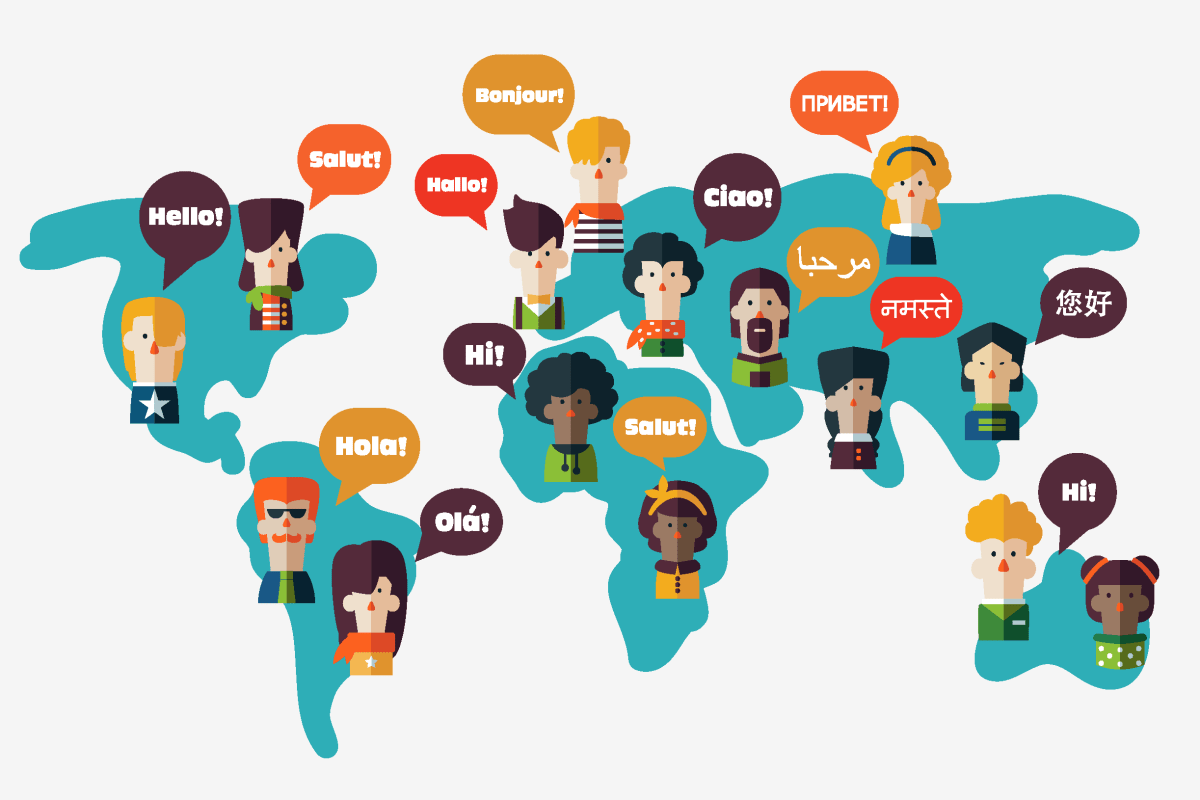
The link between language and cognition is interesting though not entirely grasped.
VIDEO: TED Talk on YouTube — Lera Boroditsky
“I speak Spanish to God, Italian to women, French to men and German to my horse.”
― Charles V, Holy Roman Emperor (probably not, but whatevs…)
Perspective
In the West, we tend to be quite self-centric. We are the centres of our universes, and this has several implications. Firstly, we orient conversation around ourselves; occasionally, we orient conversation around others. Instead, some cultures orient themselves around their world.
Self as Centre
Ordinarily, if a Westerner is asked which is their dominant hand, they might answer left or right. If they are asked to describe where something is spatially, one might answer on my left or right or above or below me. If the person asking is present, they may simply point to the object as a gesture.
Other as Centre
In some cases, we might feel it necessary to orient relative to another? The answer to the question, “Where is the book?” might be, “On your left”, or “You’ve got something on your left cheek”.
Terrain as Centre
In the West, we have notions of cardinal directions—North, East, West, and South—, but we still tend to orient communication around ourselves or others. In some regions, the use of cardinal directions is more prominent than in others. For example, when I am in Boston, I didn’t find many people reference places by cardinal directions, but when I am in Los Angeles, much conversation is relative to head north or head east. I notice that Google Maps tend to employ this. It’s often confusing when I am in an unfamiliar place, and the voice instructs me to travel west toward Avenue X. If I happen to have remembered where Avenue X is, I might internally orient toward that. Otherwise, I head in some direction until Google reinforces my choice or it rather recalculates based on my bad choice, if even nonjudgmentally.
In some cultures, this cardinality includes the body, so in comparison with the aforementioned self-as-centre dominant hand query, the response would depend on which way the subject was facing. Were they a southpaw (lefthander) facing north, they would respond that their west hand is dominant. But if they were facing south, it would be their east hand. This may seem to be confusing to a Westerner, but to a native, they would explicitly understand because they would be intimately oriented. As Lera relates in the video, someone might point out an ant crawling on your southwest leg.
To be fair, this space is not entirely alien to some Westerners. For example, mariners can shift the conversation from themselves to their ship or boat. Rather than left and right, relative to themselves or another, they might refer to port and starboard relative to the vessel. Being on the vessel and facing front (the bow), left is port and starboard is right; however, facing the rear (the stern), left is not starboard and right is now port. So, if someone asks where the lifeboat is, landlubbers may say it’s on their left whilst a sailor might say it’s on the starboard side.
Centring Time
Time is another aspect we centre on ourselves. I won’t even endeavour to raise the circular notion of time. If an English speaker thinks about a timeline, we would likely configure it from left to right equating with past to future. This aligns with our writing preference. For native Arabic or Hebrew speakers, they might naturally opt to convey this from right to left in accordance with their preferred writing system.
For the Aboriginal Kuuk Thaayorre in Australia, their rendition of time was contingent on their orientation in the world. Essentially, time flows from east to west, perhaps in accordance with the apparent movement of the sun across the sky relative to Earth. Facing south or north, they rendered time left to right and right to left, respectively. When they faced east, time came toward the subject, with time moving away from the body when facing west.
Counting
So-called modern or advanced societies have developed number systems, but some cultures either have no counting or limited counting, having systems that might extend 1, 2, many, or 1, 2, 3, many. This means that tasks we learn like accounting, inventory management, or comparing counts of apples and oranges are not only not available to these people, they are irrelevant to them.
Categorical Imperitive
Lera tells us about the blues. Not B.B. King Blues, but the categorisation of blue, blues, and colours more generally. I’ve discussed this before in various places. As with numbers, some languages have a lot and some have few; some have only distinctions for light and dark, or equivalents of white, black, red, and so on. Colour names are typically added to a language in a similar order based on the frequency within the visual colour spectrum. I may have written about that earlier as well if only I could find it.
Different cultures and languages categorise colours differently, subdividing them differently. In many non-English languages, pink is simply light red. English opts to assign it a unique label. On the other hand, blue is basically one colour name in English whilst it is further broken down in Russian to goluboi (light blue, голубой) and siniy (darker blue, синий). This mirrors the pattern of pink (lighter red) and red (darker red) in English, a distinction not prevalent in other languages. Of course, we also have variations of reds and blues such as crimson or cyan, but this is rather second-order nuance.
Interestingly, in neurological studies, when measuring a person with a language that splits a colour, say a Russian looking at blues, the instruments capture the event of the subject having noticed the category shift. No such shift occurs in speakers without such a switch. I would be interested to know what the results would be for a bilingual speaker to be asked to respond in each language. Informally, I asked a Russian mate of mine if he experienced anything differently seeing blue whilst thinking in Russian versus English. He said yes, but couldn’t really provide any additional information. If a reader happens to be fluent in two or more languages, I’d be interested in hearing about your experiences.
One last note on colour, I’ve read studies that claim that women on balance have more colour names than men, which is to say where a typical male only sees shades of blue, the typical woman sees periwinkle, ultramarine, cyan, navy, cobalt, indigo, cerulean, teal, slate, sapphire, turquoise, and on and on. Of course, many English-speaking males may be defensive about now, arguing, “I know cyan. I know teal. Who doesn’t know turquoise?” Knowing is different to employing, and perhaps you’re not typical. You’re an atypical male. Let’s not get into gender challenges. Rather, let’s.
Gender Problems
Yet again, gender rears its ugly head. I am wondering when people are going to start demanding fluidity among gendered nouns. Sticking with Lera’s examples, a bridge happens to be grammatically feminine in Germans and masculine in Spanish. When asked to describe a bridge, German speakers are more apt to choose stereotypically feminine adjectives, beautiful or elegant whilst Spanish speakers opted for stereotypically masculine terms, strong or long. I suppose she was reaching for laughter on that last reference.
Structured Events
Objects and subjective injection are other possible conventions. Lera mentions a tourist bumping into a vase. In English, one would be comfortable declaring, “The man knocked the vase off the pedestal.” In Spanish, the same event might more often be described as “The vase fell off the pedestal”. Notice the shift in agency and dispersion of blame. In English, we have some apparent need to inject not only a cause but an agent as a source of the cause. As I see it, one might have these several (possibly inexhaustive) options:
He knocked the vase off the stand.
Someone knocked the vase off the stand.
The vase got knocked off the stand.
The vase fell off the stand.
I decided to note the relationship between the case and the stand. I suppose this is not strictly necessary and might seem superfluous in some contexts.
In case 1, a specific agent (he) is responsible for knocking off the vase. This does not suggest intent, though even negligence carries weight in many circles.
In case 2, the agent becomes indefinite. The speaker wants to specify that the vase didn’t just fall over on its own.
In case 3, agency is not only indefinite, but it also may not have a subject. Perhaps, a cat knocked it off—or the wind or an earth tremor.
In the final case, 4, the agent is removed from the conversation altogether, All that is conveyed is that the vase fell from a stand.
One might want to argue, “So what?” but this is not simply a convention of language; it stems from perception—or perhaps perception was altered by language through acculturation, but let’s not quibble here. It determines what someone pays attention to. When an event was witnessed, people from cultures where agency is a strong component, the witness is more apt to remember the culprit, whereas a non-agency-focused witness, would not be as likely to recall attributes about the person who may have knocked it over. Practically, this leads to issues of blame and culpability. Clearly, a culture with an agent orientation might be quicker to assess blame, where this would be further removed from the conversation from a different cultural perspective. I am speculating here, but I don’t feel it’s a large logical leap.
In a retributive justice system, the language that assigns agency is more likely to mete out harsher punishments because he broke the vase, it wasn’t simply broken. The use of language guides our reasoning. This leads me to wonder whether those who are ‘tough on crime‘ use different language construction than those who are more lenient.
Enfin
I just wanted to share my thoughts and connect language with cognition. I don’t think that the connection is necessarily strong or profound, but there is something, and there are more language nuances than noted here.
An online colleague published an essay on another essay (en français). The gist was to say that their ideas were the same save for whether a core foundation was reality or truth. I am going to stylise these and derivatives in capital initials, e.g., Real and Truth. I am not sure I see the connexion, and perhaps Lance will chime in here directly to correct any misunderstandings and fill in any holes.
Podcast: Audio rendition is this page content
At least in English vernacular, True and Real are close synonyms. I don’t feel they are as close as we may assume at first glance. I think each of these terms carries with it its own ambiguity and connotation, so a meaningful discussion may prove to be difficult.
I’m not sure if it’s a fair characterisation, but I feel that most people consider Real as what they can sense or experience. Some may not even allow for the experiential component. In my mind, metaphorically thinking, of course, a book might be real; an idea might be real; even the idea of a unicorn might be real, but unicorns are not real. If we want to claim unicorns as part of Reality or include it in the set of Reality, then it would be a second-order sort. Substituting Harry Potter for unicorns, the idea of Harry Potter is real, but Harry Potter is a figment. Of course, Harry Potter may be the name of a human or your pet otter, but this is not the manifest Harry Potter of the idea. And Harry Potter is not a unicorn.
Harry Potter is not a unicorn
I mention Harry Potter and, indeed, unicorns, because I have had people argue that these things are real. For me, they are off the table, whether real or imagined. I feel that some people may also reduce Real to material, so a Realist would be the same as a Materialist. That’s fine except we end up with obvious non-material stuff on the cutting room floor. What do we do with emotions and so-called qualia? Sure, some might equate emotions with biochemical reactions and some synaptic exchange in some parts of the brain, further articulated through facial and bodily expressions and gestures. For the Materialist, we may not yet know the mechanism, but it’s only a matter of time—in the same manner as atoms became protons and electrons, which became quarks with spins and colour, and this morphed into fields.
Being sympathetic to Analytic Idealism, I might argue that none of this is real because all we can experience is what we can sense, but what we sense is a second order of Reality. We can’t even experience the first-order variety. The usual analogy is to look at computer bits or the funky Matrix code, and it doesn’t reveal what we see or experience through the interface. In the case of the Matrix, the interface is their perceived reality. But perception isn’t Reality. At least Descartes suggests as much. If first-order Reality is unattainable, we can either consider this sensed and experienced world second order. This leaves our unicorns and Harry Potter to be third order. In this case, we might idiomatically consider the first-order to be understood to exist, but our use of Reality extends only to the second-order variety.
In any case, I don’t expect to resolve the mystery of Reality here and now, but it is a dialogue where accord is necessary to be on the same proverbial page.
But then what is True? What is Truth? I’ve written about this previously. Here, we are explicitly invoking the capital-T version of Truth, not the minuscule-t version where it’s synonymous with pedestrian ‘facts’ and tautologies. By True, are we asking what is objectively real—unadulterated by subjective experience, some universal and invariable condition? And is this Truth what is Real? Are there Truths that are not Real?
To sum it up, it is quite standard—although not universal by a long shot—to consider Real what we can experience whilst True is something that requires proof. A physical table might be real. Like unicorns, mathematic concepts may be true—I’d argue that this is tautological whilst others might defend some Platonic ideal—, but they are not real. They are an abstraction. I suppose my point is to not take these words for granted and presume they can be directly interchanged. I suppose in the adjective form, they are more apt to coincide—Is that a true Picasso? Is that a real Picasso? Clearly, when we are asking if it is real, we are asking if it is truly genuine rather than questioning its materiality.
It may be true that I am wittering away online in some masturbatory pseudo-intellectual frenzy, and the results may be virtually real, but I needed to let my mind wander for a bit. If you’ve gotten this far, bless your heart, and leave a comment.
God be in my head, And in my understanding; God be in mine eyes, And in my looking; God be in my mouth, And in my speaking; God be in my heart, And in my thinking; God be at mine end, And at my departing.
Podcast: Audio rendition of this page content
Sir Henry Walford Davies put this traditional prayer to music as a hymn. Iain McGilchrist recited it as a poem after a brief setup in an interview.
I am an atheist, and the closest I get to gods is through metaphor, allegory, or allusion. And I don’t engage in it, but I understand when others invoke it. And to be completely honest, I was multitasking when Iain was reciting, and I misheard it, and this miss was more profound for me.
God be in my head, And in my understanding; Don’t be in mine eyes, And in my looking;
That’s what prompted me to seek it out and pen a post. In the original form, it’s more of an invocation. In my misinterpretation, I felt he was saying to keep God in your head as a metaphorical reference—as an archetype—, but God is not for the eyes and the looking. God is a matter of faith.
As for the rest, it flows the same. Speak as you understand it. Feel God in your heart, if you should so choose. Think about him if you wish. And carry this thought with you until the end if it brings you comfort.
Myself, I get no comfort from the notion. I don’t feel I need it, but it is a cultural phenomenon, so to be aware is a part of cultural and emotional intelligence.
I feel that I’ve always intuitively understood metaphor. I remember listening to Joseph Campbell in the 1980s as he was describing how one of his biggest challenges was to get people to understand the embodiment of metaphor and not just the vapidity of simple simile.





 Philosophics