The Hard Problem Was Never Consciousness

3–5 minutes

It Was Language All Along.

This whole misadventure began sometime in 2018, when I started documenting what has now metastasised into the Language Insufficiency Hypothesis. If I weren’t typing this, I’d be doing the honourable thing and finishing the index, but here we are, procrastinating with purpose. I had a suspicion, even then, that language was up to something. Something slippery. Something evasive. At first, it was just a motley catalogue of weasel words that refused to sit still long enough to be given a meaning. I should have taken the hint when the list kept expanding like a Victorian railway: terminally over-budget and convinced of its own grandeur.

But, naturally, I pressed on.

Audio: NotebookLM summary podcast and conversation around this topic.

At the time I had that slow-burn itch about identity, selfhood, free will, agency – you know, the usual metaphysical tat we’re reared on like a Victorian child raised on laudanum. It wasn’t that these things didn’t exist; it was that the words simply couldn’t bear the conceptual load we’d been piling onto them. And so I found myself in the company of philosophers who either tried to rescue these terms (Dennett, ever the valiant firefighter with a damp match), complicate them (Searle, constructing houses of cards under wind machines), or dissolve them outright (Parfit, smiling serenely as the rest of us panic).

Meanwhile, Strawson was somewhere in the corner insisting experience is all there is, Putnam was in his perennial retraction phase, and I was merely trying to keep my own conceptual apparatus from collapsing like an undercooked soufflé.

I’ll admit I had a long-standing soft spot for Dennett’s consciousness-as-emergence hypothesis. It made a certain intuitive sense at the time: pile up enough neural machinery, sprinkle in some feedback loops, and consciousness would bubble up like steam from a kettle. It felt elegant. It felt mechanistically honest. And, crucially, it made perfect sense within the inherited Realist framework I was still tacitly lugging around. Of course, experience ’emerges’ from physical processes if you start from a worldview already partitioned into physical substrates and mental phenomena waiting to be accounted for. Dennett wasn’t wrong so much as operating within the same architectural error the rest of us had been marinating in. Once I began reframing the whole encounter through mediation rather than emergence, the elegance dissolved. What had looked like metaphysics turned out to be a conceptual afterimage generated by a language that couldn’t model its own limitations.

And then there was Chalmers.

Ah, the ‘hard problem’. I lost count of how many times it surfaced. Like mould. Or a debt collector. Chalmers’ dilemma – how physical processes give rise to experience – is purportedly the Mount Everest of metaphysics. Yet the more I thought about it, the more it reeked of a linguistic parlour trick. A conceptual magic eye puzzle: stare long enough and a unicorn appears, provided you’ve surrendered your scepticism and a good measure of oxygen.

The problem isn’t that consciousness is ‘hard’. The problem is that the linguistic scaffolding we’re using was never built for this terrain. ‘Experience’. ‘Physical’. ‘Mental’. ‘Explain’. These words pretend to be steel beams when they’re actually damp cardboard.

What remains isn’t a cosmic riddle but a linguistic artefact. A conceptual false path carved by centuries of grammatico-metaphysical enthusiasm – the unfortunate habit of mistaking grammatical symmetry for metaphysical necessity.

Which brings me to the present, having at last gelled the LIH and published the Mediated Encounter Ontology of the World – a relational metaphysics that has the decency not to hallucinate substances it can’t justify. MEOW clears the fog rather neatly: the so-called ‘hard problem’ is only ‘hard’ because we continue to treat ‘mind’ and ‘world’ as two independent substances requiring metaphysical reconciliation. Together, LIH and MEOW provide a double exposure of the problem: LIH shows why the language fails; MEOW shows what the language was failing to describe.

So here we are. I’d like to reconsider Chalmers through the dual lenses of LIH and MEOW – not to ‘solve’ the hard problem, but to show it was never the right problem to begin with. The difficulty isn’t consciousness; it’s the language we’re forced to use, the same language that refuses to sit still, the same language that keeps trying to trick us into mistaking grammatical symmetry for metaphysical necessity.

In a coming post, I intend to pry open that illusion with a crowbar. Delicately, of course. One must be civilised about these things.

Because if language is insufficient – and it is – then perhaps what Chalmers discovered was not the abyss of consciousness, but the limit of the dictionary.

The Mediated Encounter Ontology of the World

Philosophers adore two things: inventing problems and then fainting when someone solves them. For decades, we’ve been treated to the realism–idealism tug-of-war, that noble pantomime in which two exhausted metaphysical camps clutch the same conceptual teddy bear and insist the other stole it first. It’s almost touching.

Try out the MEOW GPT language parser.

Enter Nexal Ontology, my previous attempt at bailing water out of this sinking ship. It fought bravely, but as soon as anyone spotted even a faint resemblance to Whitehead, the poor thing collapsed under the weight of process-cosmology PTSD. One throwaway comment about ‘actual occasions’, and Nexal was done. Dead on arrival. A philosophical mayfly.

But MEOW*The Mediated Encounter Ontology of the World – did not die. It shrugged off the Whitehead comparison with the indifference of a cat presented with a salad. MEOW survived the metaphysical death match because its commitments are simply too lean, too stripped-back, too structurally minimal for speculative cosmology to get its claws into. No prehensions. No eternal objects. No divine lure. Just encounter, mediation, constraint, and the quiet dignity of not pretending to describe the architecture of the universe.

And that’s why MEOW stands. It outlived Nexal not by being grander, but by being harder to kill.

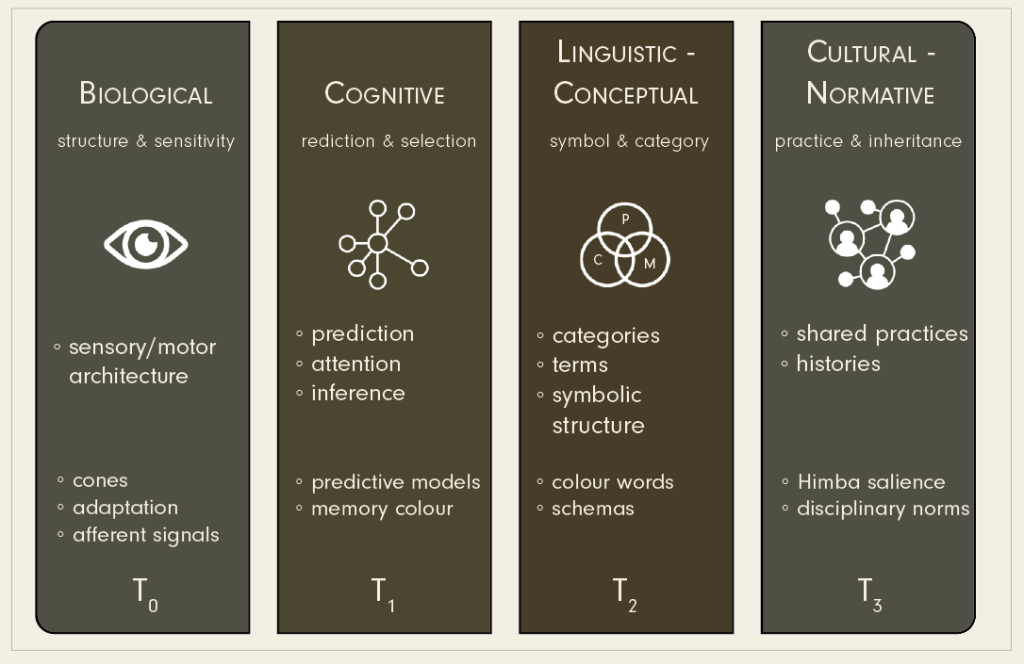
Image: The Four Mediation Layers – Biological, Cognitive, Conceptual, Cultural – structuring every encounter we mistake for ‘direct’.

This little illustration gives the flavour:
T0 Biological mediation – the body’s refusal to be neutral.
T1 Cognitive mediation – the brain, doing predictive improv.
T2 Linguistic–conceptual – words pretending they’re objective.
T3 Cultural–normative – the inheritance of everyone else’s mistakes.

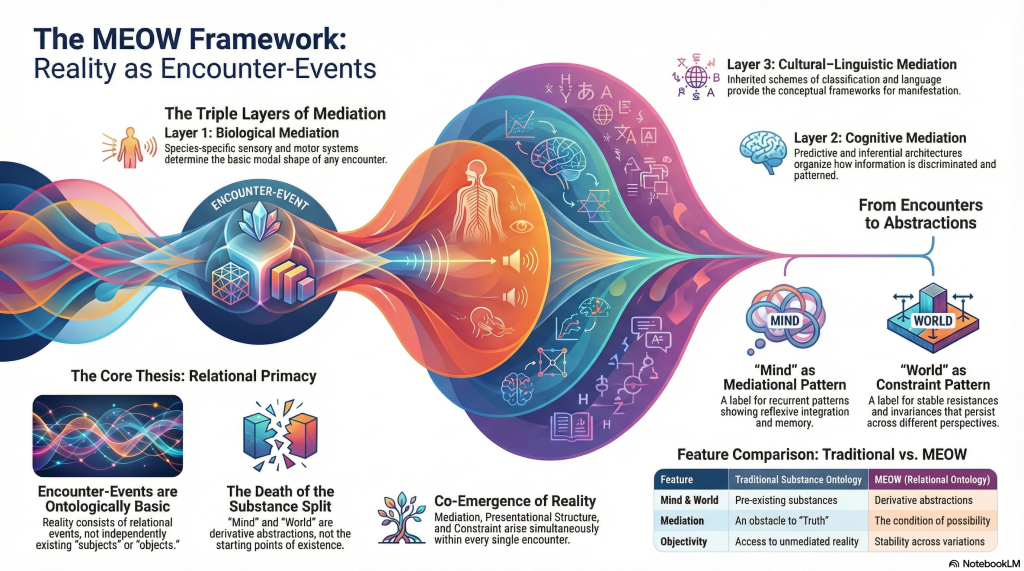
The essay argues that what we call ‘mind’ and ‘world’ are just abstractions we extract after the encounter, not the metaphysical scaffolding that produces it. Once you begin with the encounter-event itself – already mediated, already structured, already resistive – the mind–world binary looks about as sophisticated as a puppet show.

Image: NotebookLM Infographic (merges cognitive-linguistic, which I don’t support)

What the essay actually does

The Mediated Encounter Ontology of the World is the first framework I’ve written that genuinely sheds the Enlightenment scaffolding rather than rebuking it. MEOW shows:

  • Mediation isn’t an epistemic flaw; it’s the only way reality appears.
  • Constraint isn’t evidence of a noumenal backstage; it’s built into the encounter.
  • Objectivity is just stability across mediation, not a mystical view-from-nowhere.
  • ‘Mind’ and ‘world’ are names for recurring patterns, not metaphysical hotels.
  • And – importantly – MEOW does all of this without drifting into Whiteheadian cosmological fan-fiction.

The full essay is now published and archived:

DOI: https://doi.org/10.5281/zenodo.17685689

If you prefer a soft landing and the sound of a passable human voice explaining why metaphysics keeps tripping over its shoelaces, a NotebookLM discussion is here:

Audio: NotebookLM summary podcast of this essay.

MEOW is the survivor because it does the one thing philosophy is terrible at: it refuses to pretend. No substances, no noumena, no grand metaphysical machinery—just a clean, relational architecture that mirrors how we actually encounter the world.

And frankly, that’s quite enough ontology for one lifetime.


* To be perfectly honest, I originally fled from Michela Massimi’s Perspectival Realism in search of a cleaner terminological habitat. I wanted to avoid the inevitable, dreary academic cross-pollination: the wretched fate of being forever shelved beside a project I have no quarrel with but absolutely no desire to be mistaken for. My proposed replacement, Nexal Ontology, looked promising until I realised it had wandered, by sheer lexical accident, into Whitehead’s garden – an unintentional trespass for which I refused to stick around to apologise. I could already hear the process-metaphysics crowd sharpening their teeth.

Early evasive action was required.

I preferred nexal to medial, but the terminology had already been colonised, and I am nothing if not territorial. Mediated Ontology would have staked its claim well enough, but something was missing – something active, lived, structural. Enter the Encounter.

And once the acronym MEO appeared on the page, I was undone. A philosopher is only human, and the gravitational pull toward MEOW was irresistible. What, then, could honour the W with appropriate pomp? The World, naturally. Thus was born The Mediated Encounter Ontology of the World.

Pretentious? Yes. Obnoxious? Also yes.

And so it remains—purring contentedly in its absurdity.