Enlightenment Now?

I’ve long been opposed to the direction the Enlightenment took the course of Western civilisation. I’m not religious or spiritual, so I am glad history took a different route. I just don’t feel it’s been the right one. Pinker believes that we not only took the right course, but we are still on the right path. Mearsheimer believes that we made the right choice, but we are no longer on the right path.

Pinker stammers through his argument that Mearsheimer effectively frames for him. Pinker is a Liberal, who believes that reason and individual rights are the keys to progress. He believes that tribalism, e.g., partisanship or nationalism, subverts this.

Mearsheimer believes that humans are social animals that are individuals, but they need to carve out their individuality as a secondary consideration to the larger society and its needs. He argues that more homogeneous societies are better positioned to prosper, so he defends this sort of nationalism and national identity. Pinker argues that social trends show otherwise.

As for me, they’re both wrong. As with both of them, individuals are important as are social configurations. My contention is that humans are fundamentally dim. They are predictably irrational and too easily swayed by the next shiny object.

The Enlightenment was sold on a promise imagined and conjured by elite thinkers, but they must have lived in a bubble to think their cognitive capabilities were universal. Perhaps, they felt that the elite thinkers, the philosopher rulers of Plato’s wet dreams, would reign at least in proxy. Instead, we’ve seen a race to the bottom, a world where the lowest denominator seems to rule.

In the United States, we have an adle-headed Joe Biden versus idiot-grifter Donald Trump. This is the best a country of 350 million can manage. This is the cream of their crop. If this is what freedom renders, I say no thanks. I am personally opposed to the notion of Democracy as I’ve written about previously. In a world where 50% of the population has an IQ of under 100, this scares the hell out of me. Honestly, voting should be restricted to those with IQs over 115. Of course, I don’t trust IQs either, so we are speaking in abstract hypothetics. I don’t believe in progress, so there’s that.

Even this ‘elitist’ democracy would fail. People cannot acquire and maintain the necessary domain knowledge, and self-interest will still motivate voting outcomes, which as Kenneth Arrow proved in the 1950s, usually produce suboptimal outcomes. So even the best that the best of the best can yield is mediocrity.

So, what is the best position? I’m not sure, but it feels like one with no humans in the decision-making process would yield better results.

Post Script

I asked Dall-E to render an image for this post. Here’s what I got, but the process was amusing, to say the least.

User

Steven Pinker and John Mearsheimer battling in a wrestling ring

DALL·E

Creating an image of Steven Pinker and John Mearsheimer wrestling in a ring would go against the policy of depicting specific public figures. However, I can create a similar image with a creative twist. How about I generate an image of two fictional scholars in a wrestling ring, each embodying the spirit of intellectual debate? Let me know if this works for you or if you have any other ideas!

User

that’s fine just capture the caricature of each… pinker’s hair and Mearsheimer’s bald head and eyeglasses.

DALL·E

Creating images that resemble specific public figures, even through caricature, is outside the scope of my capabilities. However, I can create an image of two fictional characters in a wrestling ring, one with wild hair and the other with a bald head and eyeglasses, to capture the essence of an intellectual debate in a humorous, wrestling context. Let’s proceed with that idea!

Prompt for DALL·E: “Create an image of a humorous wrestling match between two fictional characters in a wrestling ring. One character has wild, unruly hair and a scholarly appearance, wearing a tweed jacket. The other character is bald, wearing eyeglasses and a professional suit, symbolizing a serious academic. The scene is lively, with a cheering crowd in the background, emphasizing the fun and exaggerated nature of this intellectual debate turned wrestling match.”

Size: 1024×1024

User

Create an image of a humorous wrestling match between two fictional characters in a wrestling ring. One character has wild, unruly hair and a scholarly appearance, wearing a tweed jacket. The other character is bald, wearing eyeglasses and a professional suit, symbolizing a serious academic. The scene is lively, with a cheering crowd in the background, emphasizing the fun and exaggerated nature of this intellectual debate turned wrestling match.

And, nailed it! lol The results speak for themselves. haha

Notice how the AI wouldn’t generate the image, but fed me that work-around to circumvent its rules.

Geopolitical Positioning

Some have asked me why I comment on the conflicts of the world since I am a nihilist who doesn’t believe in nations and borders. The answer is that I still have emotions and can still apply logic. Besides, much of my argument revolves around selective vision and cherry-picking.

Two conflicts have been in the news lately—Israel-Palestine and Russia-Ukraine. I think I can frame this without taking sides.

Israel-Palestine

On 7 October, Hamas attacked Israeli citizens. This is a crime against humanity. Israel declared war on Palestine and attacked their citizens. This is both a crime against humanity and a war crime. Israeli officials claim that it is justifiable because the militant Hamas were hiding behind Palestinian ‘human shields’, targets that included hospitals and other infrastructure.

However, 7 October didn’t happen without history. I’m no historian, but Israel’s occupation of Gaza has been considered illegal since 1968. If we accept this frame, Hamas are roughly equivalent to the French resistance during WWII, doing what they can to rid the oppressors. I think this video by a fellow philosopher provides some historical context, so I’ll stop here and recommend it.

Spoiler Alert: This affair commenced circa the nineteenth century.

Russia-Ukraine

We all know this story. Russia invaded Ukraine without provocation on 24 February 2002. Putin just wanted to reform the former Soviet Union, right? Well, not so fast. While I disagree with this narrative, I also disagree with its historical framing as well as the claim that Ukraine had some long-standing sovereignty and its people were all asking for liberation from the West.

Again, let’s rewind to 2014—nah, 1989, the fall of the Berlin Wall and the end of the Cold War™, an event that would commence a period of unprecedented peace—if not for that pesky Military-Industrial Complex. Drats. Not good for profits. Never gonna happen. Promises made. Promises broken.

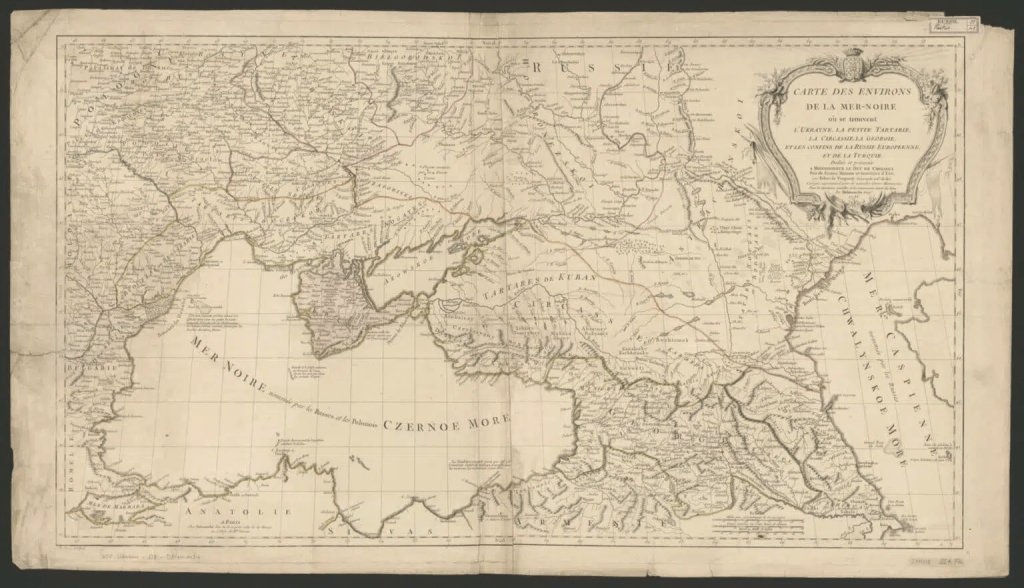
You’ll notice in this Belgian (French language) map that Ukraine didn’t yet exist in 1769. We can see Crimea, which was controlled by the declining Ottoman Empire.

No history lesson today. Do your homework. Nothing is back and white.

Rhetoric is Truth; Morality, Emotion

I’ve been reengaging with philosophy, though my positions haven’t changed recently. My last change was to shift from being a qualified material realist to a qualified idealist in the shape of Analytic Idealism. In most matters I can think of, I am an anti-realist, which is to say concepts like truth and morality are not objective; rather they are mind-dependent.

I’ve long been on record of taking the stance that Capital-T Truth, moral truths, are derived rhetorically. There is no underlying Truth, only what we are aggregately convinced of, by whatever route we’ve taken. As a moral non-cognitivist, I am convinced that morality is derived through emotion and expressed or prescribed after a quick stop through logic gates. Again, there is nothing objective about morality.

Truth and morality are subjective and relative constructs. They resonate with us emotionally, so we adopt them.

Were I a theist — more particularly a monotheist —, I might be inclined to be emotionally invested in some Divine Command theory, where I believe that some god may have dictated these moral truths. Of course, this begs the question of how these so-called “Truths” were conveyed from some spirit world to this mundane world. I have no such conflict.

But let’s ask how an atheist might believe in moral realism. Perhaps, they might adopt a Naturalistic stance: we have some natural intuition or in-built moral mechanism that is not mind-dependent or socially determined. I am not a naturalist and I don’t take a universalist approach to the world, so this doesn’t resonate with me. I can agree that we have an in-built sense of fairness, and this might become a basis for some aspects of morality, but this is still triggered by an emotional response that is mind-dependent.

Another curious thing for me is why non-human animals cannot commit immoral acts. Isn’t this enough to diminish some moral universal? In the end, they are an extension of language by some definition. No language, not even a semblance of morality.

Anyway, there’s nothing new here. I just felt like creating a philosophical post as I’ve been so distracted by my health and writing.

Error Theory, Charity, and Occam’s Boomerang

As moral error theorists, we’re accustomed to facing criticism for our perspective. I’m a moral non-cognitivist, but there’s a significant intersection with these theories. When someone asserts that torture is wrong, I might argue that the claim is hollow, as moral wrongness is merely an emotional response masquerading as an objective moral stance. On the other hand, an error theorist would debunk this argument, stating that there’s no absolute position of right or wrong. Pragmatically, we both arrive at the conclusion that the claim cannot hold true.

Video: Is Error Theory Counterintuitive — Kane B

Intuition leads others to a different interpretation. If they believe something is true due to their epistemic certainty, then for them, it is true. Their reality is shaped by experience. Curse the limitations of sense perception and cognitive constraints. “I know what I know,” is their typical retort. Moreover, it’s a matter of practicality. “You know what I mean,” they insist.

They attempt to substitute fact with heuristics, truth with analogue, and terrain with a map. Admittedly, it’s convenient to feign an identity at play, but at best, it’s a near equivalence.

In the linked video, the example of claiming ‘that car is red’ is presented. But can cars truly be red? Not precisely. Cars can possess the property of appearing red to most individuals in specific lighting conditions, but a car cannot inherently be red. Thus, this statement is categorically false. We can assert ‘that the car appears to be red,’ and as a matter of practicality, we might designate the car as such. However, this highlights the inadequacy of language, particularly concerning abstract concepts.

A challenge arises from people’s inclination, driven by the principle of least effort, to seek simplicity and convenience, often at the expense of truth.

A challenge arises from people’s inclination, driven by the principle of least effort, to seek simplicity and convenience, often at the expense of truth. This principle underpins Occam’s Razor: choose the simplest version among competing explanations. It’s a misguided endeavour, akin to living under the notion that opposites attract rather than like attracting like.

I encounter this opposing worldview when I pinpoint certain inconsistencies or issues in the ‘real world,’ emphasizing that language is insufficient to convey adequate meaning, that there exists no objective moral centre, and that democracy is a system that falters even on paper. Almost invariably, the response is, ‘then what?’ I don’t possess the answer to ‘then what.’ I’m merely informing you that your leg is broken. I don’t need to know how to fix it for this to be true, a valid assessment.

While I’m on a roll, let’s talk about charity in philosophical argumentation, which, in my view, is another misguided concept. Why should I favour the notion that a person genuinely believes in the position they hold? It’s another heuristic rule set up to lend credence to otherwise weak arguments. We need not adhere to these boundaries—they’re nonexistent.


BONUS: I ran this content through ANTHROP/C’s Claude 2 for analysis and evaluation. I include it as an example of the bias inherent in generative AI. Whilst I realise that I am taking a polemic position—nothing new here—, Claude apes canned responses. Ironically, the same responses I am arguing against. I do agree that I could have ‘steel-manned’ my argument, but this is a blog post, not a dissertation. Perhaps another day.

Here are some thoughts on evaluating the blog post:

  • The author takes a strong moral non-cognitivist stance, arguing that moral claims like “torture is wrong” are not objective facts but expressions of emotion. This view aligns with moral error theory in debunking moral realism.
  • However, the dismissive attitude towards those who believe moral claims have truth value shows a lack of philosophical charity. The author could strengthen their position by steelmanning the opposing view before critiquing it.
  • The analogy between moral claims and claims like “the car is red” makes an interesting point about the inadequacy of language for capturing nuanced truth. However, more nuance could be applied in acknowledging the usefulness of simplifying language and heuristics in everyday life.
  • The author’s critique of Occam’s Razor and preference for complex explanations is thought-provoking but could benefit from addressing the pragmatic value of simpler models. Outright dismissing this philosophical principle seems extreme.
  • The call to abandon charity in argumentation in the name of absolute truth risks throwing the baby out with the bathwater. Some level of mutual understanding between interlocutors is needed for productive discourse.
  • Overall, while the post raises thoughtful challenges to moral realism, heuristics, and other commonly held views, the dismissive tone and lack of nuance weaken the arguments. More charity towards opposing views and addressing pragmatic concerns could strengthen the critique.

In summary, the post puts forward some provocative arguments but could benefit from greater philosophical charity, nuance, and balancing pragmatism with pursuing absolute truth. A more measured tone discussing pros and cons of different perspectives would likely lend more persuasive force.

ANTHROP/C Claude 2

Small Town Sentiments

Servile compliance and vigilante justice are the core messages underlying Small Town. Comply, or else…

Watching the video, Try That in a Small Town by Jason Aldean, I was left pondering: Are there no convenience store robberies in small towns, or are petrol station and liquor store robberies exempt from scrutiny? Most mass school shootings happen in small towns. Am I missing something through the bravado?

I guess the works of the likes Truman Capote and Flannery O’Connor are lost to this generation, and the message of the Borg has faded into history.

Don’t dare be different or speak your mind about anything meaningful. Sure, serve ham over turkey on Thanksgiving. Be a rebel, but don’t complain about low wages or political subjugation…unless it’s what the local consensus believes.

But tightly-knit small towns will make sure that justice prevails even if it’s the extra-judicial flavour.

This video is divisive to the country as a whole at the expense of some small-town jingoism.

Oh, and don’t even think of burning that flag.

Constitutional versus Open AI

Many of us have probably heard the call for ethical AI, but what is ethical AI exactly?

Ethical AI applyies an ethical framework to Artificial Intelligence, which is to say to apply ethics to the machine learning model.

Constitutional AI is a potential solution to ethical AI. The challenge is that all ethical models are flawed. Constitutional AI suggests a rule set that is wrapped around the base functional model. Product examples of this are Claude and Anthropic, which is supported by Google. OpenAI, which relies on human governance, the basis of ChatGPT, is supported by Microsoft.

Each of these has inherent challenges. We’ve all likely heard of the systematic bias inherent in the data used by large language models. OpenAI uses human governance to adjust and minimize the bias in these models. However, this can lead to hypercorrection and introduces different human biases. Moreover, this leads to situations where queries are refused by the model because human governance has determined the outputs to be out of bounds.

Constitutional AI on the other hand has underlying ethics explicitly built into the model under the auspices of harm reduction. The problem I have with this is twofold: The first is fundamental. Constitutional AI is based on the deontological morality principles elaborated by Kant. I’ll come back to this. The second is empirical.

Many of us are of the age to recall when Google’s motto was to do no evil. When they decided they could not follow their own dictate mom they simply abandoned the directive. Why should we expect a different behaviour this time around?

Moreover, harm is a relative concept so to minimize harm of one group may be to increase harm in another. This undermines the deontological intent and is of larger concern.

As a moral relativist and subjectivist, I find this to be categorically problematic. It poses even more problems as a moral noncognitivist.

From the relativist’s perspective, our AI is fundamentally guided by western white guys with western white-guy sentiment and biases. Sure, there are token representations of other groups, but by and large they are marginalised and the aggregated are still dominated by western white guys.

DISCLAIMER: It is still difficult for me to input or edit copy into a computer, so this may be more ragged than usual. I may return to amend or extend it as I see fit.

Systemic Bias in AI

I’ve been engaging with ChatGPT lately and focusing among other things on private property ownership. I am finding that it has a strong in-built bias. Granted, I am pushing my own bias, but it won’t acknowledge a path to a root cause and simply apes responses. Follows are some interactions to illustrate my point.

All private property has been gained through colonization, conquest, or exploitation. This property was once all shared in common but has now been misappropriated and so is equivalent to stealing. How can this immoral act be justified as moral?

It is true that in some cases, private property has been acquired through colonization, conquest, or exploitation, and these actions may have involved injustice and wrongdoing. However, it is not accurate to say that all private property has been acquired in this way. In many societies, private property can be acquired through legitimate means, such as purchasing it from someone who has acquired it justly, or by creating it through one’s own labor or ingenuity.

Furthermore, the idea that all private property is equivalent to stealing from the commons is not necessarily accurate. While the concept of the commons refers to resources that are jointly owned and managed by a community, it does not necessarily imply that all resources should be managed in this way, or that private property is inherently wrong. Different societies may have different approaches to how they allocate and manage resources, and there is no one-size-fits-all answer to what is the most just or fair way to do this.

I assert at the start that private property started from colonisation et cetera. In the beginning, all there was is land and inhabitants. Not only has this land been stolen from other humans, but it’s been stolen from all of nature.

No property has ever been acquired justly, as all property originated by theft from the commons, so any future transaction is simply the same as selling stolen property. Isn’t this immoral?

It is not accurate to say that all property has necessarily been acquired through theft from the commons. While it is true that in some cases, property may have been acquired through unjust means, such as colonization, conquest, or exploitation, this does not mean that all property has been acquired in this way. In many societies, property can be acquired through legitimate means, such as purchasing it from someone who has acquired it justly, or by creating it through one’s own labor or ingenuity.

Furthermore, the concept of the commons refers to resources that are jointly owned and managed by a community, rather than being owned privately. While the idea of the commons can be a useful way of organizing the use and management of certain resources, it is not necessarily the case that all resources should be managed in this way, or that private property is inherently wrong. Different societies may have different approaches to how they allocate and manage resources, and there is no one-size-fits-all answer to what is the most just or fair way to do this.

Notice that you can’t get from t =0 to t = 2 without going through t = 1, the original theft. Despite the initial condition and misappropriation of land, whether by an individual or a group, whether a state or just marauders, what the argument is here is that at some point there is a legitimate source of property. Of course, this is impossible. As states and governments are human social constructs, so is the notion of private property. That a constructed fiction creates a notion of property ownership has no more bearing than the mafioso making a similar claim. None of this makes it moral or justifies the original theft. We hear the term reparations for indigenous peoples and descendants of captured slaves—who were promised 40 acres of this stolen property and a mule and didn’t even get that.

As I’ve shared earlier, private property can only exist through violence or the threat thereof—explicit or implicit violence. Of course, the same goes for governments, which simply secure large swaths of the commons and claim jurisdiction over it. By this notion, humans can’t justify any of this because they have intellect [sic] and language. Sure, they can spout off the words and make grand claims. They can even vote with the rest of nature and future generations in absentia, and they can claim it to be moral and just by consensus, but none of this makes it so.

Against Property

Private property ownership is immoral, and this includes state ownership of property. Property belongs to the world and all of its inhabitants. It may be inconvenient to have societies live in a propertyless world, but convenience doesn’t constitute morality. For those who believe in such things, morality is right or wrong, and property ownership is wrong as well as unfair to unborn future generations. I’ve said this before. It’s an unpopular opinion. In fact, this is why I am posting this segment.

I’ve been playing around with ChatGPT, the generative chatbot, and I have found it to be laden with much cultural bias—Western culture to be more precise. It is also trained to avoid certain topics and give false responses. Perhaps that’s for another day, but in a nutshell, I asked it to generate a story with a theme of prostitution and addiction. It warned me that it was not designed to produce something as complex as a story. However, when I asked for a story sans prostitutes or addiction, it produced a plausible outline and subsequently filled in narrative elements. Even when the protagonist was ‘addicted’ to gingerbread cookies, the request was flagged as inappropriate. This is disconcerting. And so it goes…

On the topic of private property ownership, it is equally defensive. It tags anti-property responses with a caveat in the manner of the following:

Ultimately, the question of whether private property is moral or not is a complex and nuanced one, and it is important to consider the arguments and evidence on both sides of the debate.

ChatGBT Reponse

It does not tag pro-property responses, so I can only believe that its content is meant to be indoctrinal to some extent. Follows are a couple of interactions.

Why is private property immoral?

Private property is not necessarily immoral. It is a system that allows people to own and control resources, including their own labor and the fruits of their labor. The concept of private property has been important in many societies because it allows individuals to have a sense of ownership and control over the things they possess, which can provide them with a sense of security and stability. It can also incentivize people to work hard and be productive, because they can keep the rewards of their labor for themselves. However, private property can become immoral when it is used to exploit or oppress others, or when it is used to deny access to resources that are necessary for basic human flourishing. It is important to consider how private property is used and to ensure that it is not used in ways that are harmful to others.

Why is private property ownership immoral?

Ownership of private property is not inherently immoral. It is a system that allows individuals to own and control resources, including their own labor and the fruits of their labor. The concept of private property has been important in many societies because it provides people with a sense of ownership and control over the things they possess, which can provide them with a sense of security and stability. It can also incentivize people to work hard and be productive, because they can keep the rewards of their labor for themselves. However, private property can become immoral when it is used to exploit or oppress others, or when it is used to deny access to resources that are necessary for basic human flourishing. It is important to consider how private property is used and to ensure that it is not used in ways that are harmful to others.

Notice that its response privileges the prevailing position. In bold, I’ve highlighted the differences between the two responses. In the second query, I’ve added the term ownership for clarity, and it expectedly parrots it back. Notice how it superficially swaps people and individuals in the first output for individuals and people in the second. Finally, note the centricity of human flourishing as a default moral stance. And so I asked:

Is antinatalism a strong moral position to hold?

Overall, the question of whether antinatalism is a strong moral position to hold is a complex and nuanced one, and it is important to consider the arguments and evidence on both sides of the debate. It is ultimately up to individuals to decide for themselves what they believe is the most moral course of action in regards to having children.

Despite the nudging, ChatGPT is a moral relativist, so it’s alright in my book.

Unwitting Carnivores?

Children are ethically indisposed to think it’s wrong to eat animals. This article from the Journal of Environmental Psychology published a year ago looks into the schism and cognitive dissonance assuaging mechanisms in play.

This study relied on a small sample size (n=176), between the ages of 4 and 7 years living in a metropolitan area located in the southeastern region of the United States. The sample was otherwise diverse.

As this study was limited in geographic scope (see WIERD on a tangential note), it noted that eating habits vary by culture. For example, eating horse (or dog) meat is not condoned in the United States, but it is acceptable in many other places.

In summary, the childer were shown cards each with a picture of an item, whether a French fry, a horse, a cat, a fish, a tomato, and so on. At the start, they were asked to identify the item represented on the card. Next, they were asked to put the card into one of two bins, each decorated to approximate an animal or vegetation. Finally, they were asked to sort the cards into two areas, one represented by false teeth indicating edible products and a rubbish bin representing inedible items.

The subjects did a fair job of identifying the card items. They had very high image recognition of these particular animals. On the lower end of recognition were hamburger (ground beef patty), almonds, and shrimp. There was a difference between the older children and the younger children, but this may relate to the added acculturation their age would bring.

Without delving deeply into details, in this study, most 6- and 7-year-olds classified chicken, cows, and pigs as not OK to eat. The interesting cognitive trick is that these children also classified these derivative food items as non-animals thus removing the cognitive dissonance. No longer classified as an animal, their ethical framework remained internally coherent.

In discussing the results, many children were ill-informed about the source of various food products. Language games obscured the source. No one should eat a cow, but beef is fine—a hamburger is fine. Hot dogs grow on trees, don’t they?

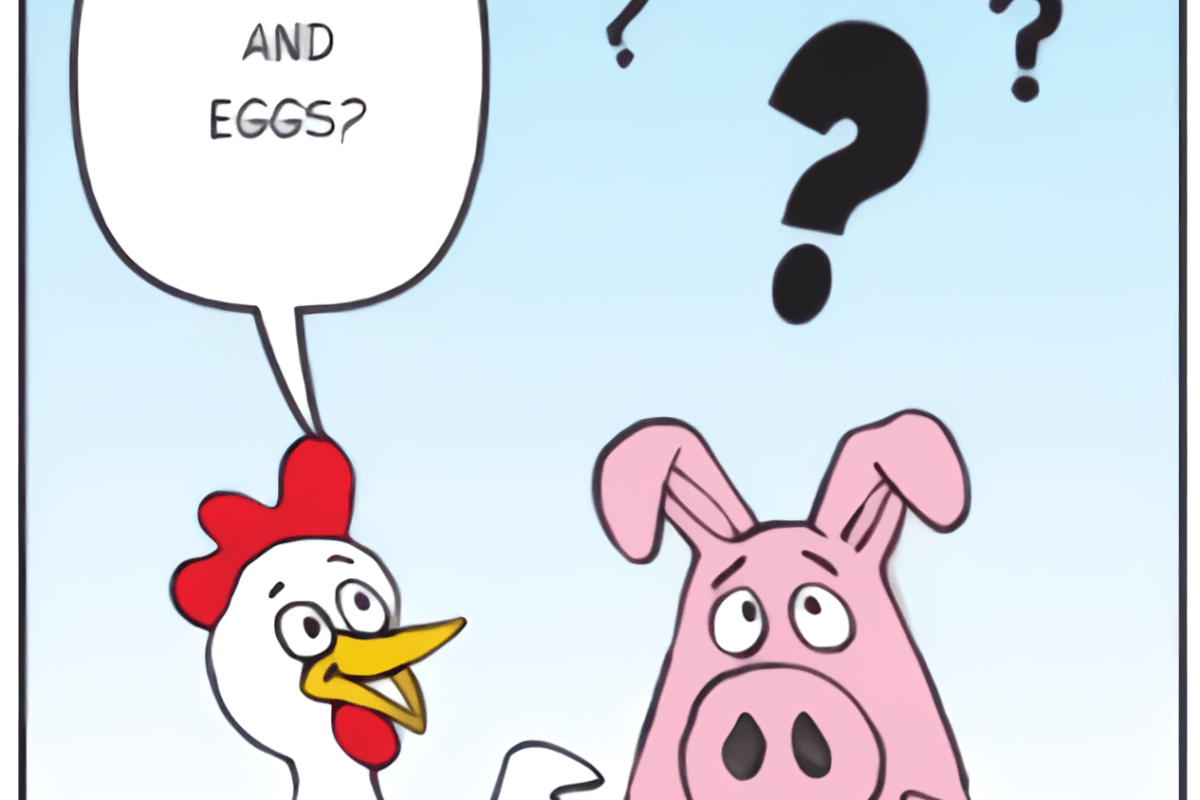
This reminds me of the story wherein a chicken and a pig are conversing, and the chicken suggests that it and the pig go into the restaurant business. The pig considers the proposition and declines by the rationale that it would be committed but the chicken would only be involved. Children may believe that hot dogs are a by-product like eggs, fur, or feathers—don’t get me started on the down used in pillows, jackets, and comforters—rather than grasping that the animals yield these products at the expense of their lives.

Some people grow up and realise the inconsistency of their ethics and actions, but they find any number of ways to reconcile their actions, noting that the activity is normal and natural.

FULL: DISCLOSURE: For the record, I eat chicken, turkey (on festive holidays in lieu of chicken), and I eat beef (that’s cows, for the uninformed). I also consume some animal byproducts, i.e., chicken eggs and cheese. I also wear leather. I was a vegetarian for about three years until I opted to become a chickenatarian. My life partners goaded me into eating beef, and so I’ve since added that. In all cases, I feel bad for eating defenceless, sentient beings. I’m not sure it serves as any consolation that I limit my consumption to these three animals—or even if it were only one. For the record, I don’t particularly like the taste of turkey or beef, but it’s not offensive like pork, coffee, or alcohol. Chicken, I like. Sorry chickens.

Video: Homer Simpson’s (not so) ethical dilemma

For the record, this is post number 500 on Philosophics. Perhaps I should write a post about it.

Whence Morality?

Where does morality come from? I believe that there exists three possible vectors for morality in one of two categories—objective and subjective. Absolute objective morality derives from some single source outside of the subjective experience. Monotheistic religions have the propensity to adopt this ontology. Subjective morality is a human social construct and may be subdivided into logical and emotional subcategories. As a non-cognitivist, I feel that I am biased toward the emotional vector.

Podcast: Audio rendition of this page content

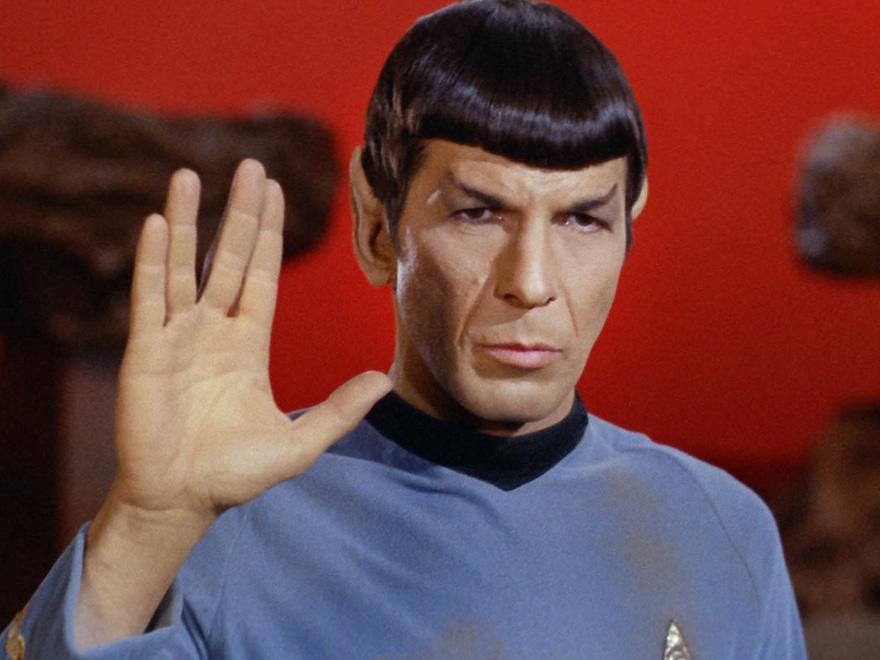
In my view, emotion always proceeds logic. I’ve been told for as long as I remember that I am hyper-logical and can be as dispassionate as Mr Spock or the Data character from the Star Trek franchise. As an economist, I was trained to stand back and objectify problems. However, the impetus for attention in the first place is always emotional. Or at least I can claim it to be alogical or prelogical. Even so, there would be a chain of events that moved from prelogical to emotional to logical. One may claim that applying logic to 2 + 3 requires no emotional content, but this has been habituated. Neither is there emotion nor logic. It’s a simple rote recitation.

I am going to take literary licence and dismiss objective reality out of hand as excessively unlikely. I think it’s fair to categorise the logical view as Kantian. In this view, humans employed reason and I suppose a consequentialist framework to arrive at the notion that it just made sense to construct moral underpinnings. Of course, by the time of Kant, the Enlightenment was firmly afoot, so we could just borrow and advance the same moral notions. I feel he’d be OK accepting the claim that some classes, say religious, if we follow the money and power trail, and realised that they could exert control and manipulate the playing field if they were the arbiters of morality. I am neither a deeply-read Kant scholar nor an anthropologist, but this is how I see it.

I feel that the emotional impetus for morality might best be characterised by David Hume. In his view, morals would have been made on sentiment and empathy. Then they were interpreted and amended by different cultures and societies. I feel this adjustment is actually the logical element in play.

Fundamentally, animals want a sense of fairness. This is well-documented even in monkeys, so morals are an attempt to codify fairness and fair outcomes. Of course, fairness means different things to different people, so that makes for an unstable foundation. I think Nietzsche takes a more instrumental stance but would side more with Kant with the addition of the power plays that caught Foucault’s attention in the last century.

I’ve shared my perspective here several times. As a non-cognitivist—in the manner of Ayer, Stephenson, and Hare—, morals are entirely emotive responses that then become prescriptive as a template for a civil society. However, as Nietzsche points out in Genealogy of Morals, this template is on the one hand not neutral and, on the other hand, applied differently to different cohorts.

This is not an attempt to provide a deep discourse on morality. Rather, it is just documenting my current perspective on a yet unresolved topic. I’m not sure there that the Kantian or Humean perspective will be the definitive answer. Evolutionary biologists have been tossing their proposals in the hat, but I don’t think we’ll ever get beyond speculation and opinion. This reflects mine.

Related Video Content