Airplanes 🙱 æroplanes

To the chagrin of many of my colleagues in the United States, I’ve long adopted international English for spelling. My first love was language and linguistics, and I never had a thing for American authors (until I encountered an undergrad literature course where the teacher only reviewed American fiction), so I wasn’t exposed much to American spelling. I had another Lit course, where the teacher exclusively assigned female authors without regard to national origin. Her advice to me for my choice: Be consistent. I still have an interest in language. Recently, I came across some trivia.

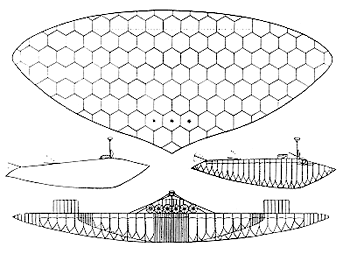
The word aeroplane was introduced in the late 19th century by the French aéroplane, from aéro- ‘air’ + Greek -planos (πλάνος) ‘wandering’. Joseph Pline coined the name ‘aeroplane’ in 1855 to refer to a powered, bird-shaped dirigible.

Subsequent to the original French, aéroplane, had been trisyllabic, often written aëroplane. Aeroplane had been the preferred spelling in the United States until the term was re-coined as airplane. At some point, æroplane, spelt with the initial ash (æsc) diagraph ligature was in vogue.

So-called American English favours spelling aeroplane as airplane. Interestingly, this spelling is a back formation from aeroplane to conventionally comply with airship and aircraft. ‘American English, ‘airplane’ was first recorded in 1907, four years after the first flight of the Wright brothers.

In 1913, Marshall B. Gardner’s, A Journey to the Earth’s Interior: Have the Poles Really Been Discovered? Evidence or Hollow Earth, reads, ‘When in the near future an æroplane or dirigible shall actually travel over all these regions, the observers thereon shall see much that no Arctic explorer has ever told us about’.

Industrial Society and Its Future

I was writing a post about cop and crime shows and fittingly commenting on cops and crime, when my girlfriend turned on Manhunt: Unabomber, a series about serial bomber Ted Kaczynski. I remember when the FBI finally caught Ted and publicised this story, but I don’t know how much of the series was dramatised versus the facts, so my comments will be on the series and not the underlying events.

I title this post after his published ‘manifesto’, Industrial Society and Its Future, but it otherwise has nothing to do with this topic or his manifesto. To me, Ted Kaczynski seems to be a contemporary Thoreau or Rousseau, a primitivist born into the wrong century.

From a philosophical position, the series depicted the perils of taking a deontological approach. Process prevailed over consequences, which resulted taking 18 years to identify and capture Kaczynski. Time and again, process and pushing paper were promoted over new methods.

criminal profiling is the astrology of forensics

As people familiar with me know, I find the discipline of psychology to be pseudoscience (or perhaps simply a parascience), and so-called criminal profiling is the astrology of forensics, which are already a bit sketchy from the start.

Television promotes the logical rationalism underlying forensic science, connecting the dots to a forgone conclusion, if only the right dots are found. As with most law enforcement and court dramas, the focus is on the good guys overcoming the bad guys. Sometimes, it’s the good cop rooting out the bad cops or the perils of a cop who crosses the line to the dark side. These shows want to show how procedural criminology is in order to dissuade people from taking this path.

Knowingly or otherwise, this is propaganda. The fact is that most crime goes unsolved. Most criminals don’t get caught. Many who get caught are not convicted. Some convicted didn’t commit the crime they have been charged with. From an economic perspective, the vast monetary value is taken by white collar professionals with MBAs not burglars and bank robbers.

Systems need people to have confidence in systems. It’s self-serving. The propaganda is important to shore up confidence in the system of law & order, but it’s analogous to slot machines in Vegas or Atlantic City or wherever. When a person wins, there are bells and lights to increase the excitement in the room. But this misses the losers. If the sound was for losers and not winners, the cacophony might be deafening.

Henry Ford failed at 7 business before succeeding

This propaganda overplays winners and concentrates focus. This is classic cognitive survivorship bias. But don’t ask about the losers. This framing isn’t limited to law enforcement. It is also employed in the prevailing Capitalist narrative, but it under advertises the fact that most entrepreneurs fail. Counter arguments are presented in the likes of Henry Ford failed at 7 business before succeeding. If you fail, just try again. It has to work out for you eventually—unless, of course, you aren’t working hard enough—not working as hard as the winners, not paying your dues.

Whilst watching, I found myself scoffing time and again. I am not a Romantic and not a Primative, so I didn’t exactly side with Kaczynski, but I definitely didn’t side with the system, even if that’s not what he was railing against.

Of interest to me was the forensic linguistics. Humourous to me was his choice of spelling. Like me, he wrote in international English. The series represented his spelling as accepted variants, but this is a US-centric position. In fact, most the the world that speaks English employes the British flavour, which is closer to international English than so-called American English, which is only spoken in the US and Central and northern South America. The rest of the world doesn’t use American English. I chose to use international English after high school. Occasionally I get comments and criticisms, but my grammatical footing is stronger than the vast majority of these. The biggest factor is that I don’t identify as an American. Rather, I am a citizen of the world. Perhaps Esperanto?

Problem of Evil

I’m not religious, so that might be why I don’t understand the so-called ‘problem of evil’. To me, it’s a sophomoric question: If God exists—and is all-good, all-loving, and created everything—, then explain how evil came to be and why it seems to be so prevalent. There’s no reason to accept Occam’s Razor, but this might be a good time to adopt it. A narrative of God is created, and then—as with retrograde planetary motion to justify a geocentric ‘solar’ system—one needs to create odd sub-narratives to fill holes in the main storyline.

The problem of evil is that it doesn’t exist. Evil doesn’t exist. Denotatively, it can be defined as very bad. Connotatively, a moral element is manifest in the term, but the word is unnecessary judgmental hyperbole.

Etymologically, the word evil derives from the

Old English yfel (Kentish evel) "bad, vicious, ill, wicked," from 
Proto- Germanic *ubilaz (source also of Old Saxon ubil, Old Frisian 
and Middle Dutch evel, Dutch euvel, Old High German ubil, 
German übel, Gothic ubils), from PIE *upelo-, from root *wap- "bad, evil"
 (source also of Hittite huwapp- "evil").

In Old English and other older Germanic languages other than
Scandinavian, "this word is the most comprehensive adjectival
expression of disapproval, dislike or disparagement" [OED]. 
Evil was the word the Anglo-Saxons used where we would use bad, cruel, 
unskillful, defective (adj.), or harm (n.), crime, misfortune, disease (n.). 
In Middle English, bad took the wider range of senses 
and evil began to focus on moral badness. 
Both words have good as their opposite. 
Evil-favored (1520s) meant "ugly." Evilchild is attested as an 
English surname from 13c.

The adverb is Old English yfele, originally of words or speech. 
Also as a noun in Old English, "what is bad; sin, wickedness; 
anything that causes injury, morally or physically." Especially of 
a malady or disease from c. 1200. The meaning "extreme moral
wickedness" was one of the senses of the Old English noun, but it did
not become established as the main sense of the modern word until
 18c. As a noun, Middle English also had evilty. 

Adolf Hitler is evil. Pol Pot is evil. Charles Manson is Evil. This employment of evil intends to communicate that these are bad (versus good) people. The intent is that these people are possessed by evil—as in an evil metaphysical spirit controlling these people. They were born with an evil soul. That’s how the term is typically employed, but this is a kin to a 4-year-old. Having yet to adopt the term, a child might, upon reflection, assert that these so-called evil people as very, very, very, very (…) bad.

One could argue that the term is shorthand for the 4-year-old’s version, but this missing the connotative subtext.

Nietzsche gave an interesting account of the origins of the term in Beyond Good and Evil. I recommend reading it along with the Genealogy of Morals. I don’t have more to add, but somehow got on this tangent after reading Nagel’s defence of religion.

What Reason?

Any system built on the presumption of widespread capacity for reason is bound to fail. The ability for most humans to ‘reason’ is clearly abridged and homoeopathic. And this is before one factors in cognitive deficits and biases. This is separate from sense perception limitations.

Nietzsche was right to separate the masters from the herd, but there are those in both classes with these limited capacities, though in different proportions.

People are predictably irrational

In economics, we have to define reason so narrowly just to create support the barebones argument that humans are rational actors—that given a choice, a person will take the option that leaves them relatively better off—, and even with this definition, we meet disappointment because people are predictably irrational, so they make choices that violates this Utilitarian principle. And it only gets worse when the choices require deeper knowledge or insights.

Democracy is destined to fail

This is why democracy is a destined to fail—it requires deeper knowledge or insights. The common denominator is people, most of whom are fed a steady diet of the superiority of humans over other species and lifeforms and who don’t question the self-serving hubris. They don’t even effectively evaluate their place in the system and their lack of contribution to it.

To the masters, who are aware of the limited abilities of the herd to reason, it seems like hunting fish in a barrel. If we convince the herd that they have some control over their destinies, that’s as far as it needs to go, but among the masters, there are subclasses, so people in these factions are also vying for position, so each employs rhetoric to persuade herd factions.

No one is sheltered from the limitations of reason

To the people out reading and writing blogs and such, confirmation bias notwithstanding, they may more likely to be ‘reasonable’ or able to reason, but try as they may, no one is sheltered from the limitations of reason.

More on this later…

Hopeful Rhetoric

My base belief is that what people believe is their truth, and rhetoric is a primary way to convince them. Part of the rhetorical mechanism is to introduce evidence, but this, too, is shrouded in rhetoric.

I’m not talking about the evidence that ‘standard’ water boils at 100°C at sea-level. This is tautological. Water is defined as H₂O. Literally, 100°C is the definition of where water boils under these conditions.

But things that cannot be repeated in controlled environment with the ability to alter parameters within the environment rely on rhetoric. This is why Newton’s laws seemed som compelling until a new narrative (somewhat) supplanted it. Still, this is not the point I want to make. I want to concentrate on the socio-poliotical domain.

I feel that given two equally viable explanations, the one offering more hope will prevail. Donald Trump knows this. This is why in the midst of the COVID-19 pandemic, he railed at a presser how he chastised a reporter for questioning his (false) narrative of hope. Politics relies on more than one rhetorical thread, and many already have the disposition of reviling Trump, so any messages from him are discounted at the start.* But, ceteris paribus, if a person assesses two equally probable outcomes—a typical door number 1 or door number 2 scenario—, and (for whatever exogenous reason) hope is associated to particular door.

In a survival scenario, perhaps you are one of three people lost in a cave and there are two possible paths forward. One person asserts that s/he feels that—without evidence—the left path is best way out but adds logically there is no way to tell, that you might as well flip a coin. The other person confidently conveys that s/he knows—without evidence—that the right path is the path to salvation. Being otherwise indifferent, you are likely to acquiesce to the second person, the one who offers hope over logic.

I fully admit that this is 100 per cent fabricated whole cloth from thin air, but the reason I come to this point is when you compare atheists to theists, anarchists to statists, nihilists to Existentialists, and any such analogic pair, the right side gets more traction and requires much more evidence to sway people to the left.

So when Occupy Wall Street (effectively anarchists) made demands, the status (read: the general population) asked ‘Who’s your leader?’ When the media-industrial complex broadcast this, the public was immediately sympathetic to the structured system. This is slightly different in that it’s not necessarily hope, rather a comfort zone—an endowment effect. It’s a benefit accruing to the incumbent.

My point is: hope floats. It acts to buoy otherwise rhetorically equivalent arguments. Or perhaps hope is simply an employed rhetorical device, so it’s unnecessary to call it out. Now, I’ve convinced myself to adopt this position.

* This is why ad hominem attacks can be effective, as persons swayed by the attack discount messages delivered by this person despite there not being a necessary connection between the grounds for debasement and the claim being asserted.

Not Just a Number

That perception and memory work hand in hand is mostly taken for granted, but this case reminds us that this sometimes breaks down. This is not the case of the neurotypical limitations to fallible sense organs and standard cognitive boundaries and biases. This subject can’t discern the arabic numerals from 2 through 9.

To recap the study, the man can perceive 0 and 1 as per usual, but numerals 2 through 9 are not recognisable. Not even in combination, so A4 or 442 are discernible.

In a neurotypical model, a person sees an object, a 3 or a tree, and perhaps learns its common symbolic identifier—’3′, ‘three’, or ‘tree’. The next time this person encounters the object—or in this case the symbol—, say, 3, it will be recognised as such, and the person may recite the name-label of the identifier: three.

It might look like this, focusing on the numerals:

Encounter 1: 3 = X₀ (initial)
Encounter 2: 3 = X₁ ≡ X₀ (remembered)
Encounter 3: 3 = X₂ ≡ X₀ (remembered)

In the anomalous case, the subject see something more like this:

Encounter 1: 3 = X₀ (initial)
Encounter 2: 3 = Y₀ = { } (no recollection)
Encounter 3: 3 = Z₀ = { } (no recollection)

For each observation, the impression of 3 is different.

Phenomenologically, this is different to the question of whether two subjects share the same perception of, say, the colour red. Even if you perceive red as red, and another perceives red as red, as long as this relative reference persists to the subject, you can still communicate within this space. When you see a red apple, you can remark that the apple is red—the name marker—, and the same is true for the other, who can also communicate to you that the apple is indeed red because the word ‘red’ become a common index marker.

But in the anomalous case, the name marker would have little utility because ‘red’ would be generated by some conceivably unbounded stochastic function:

Colourₓ = ƒ(x), where x is some random value at each observation

It would be impossible to communicate given this constraint.

This, as I’ve referenced, is anomalous, so most of us have a stronger coupling between perception and memory recall. Interesting to me in this instance is not how memory can be (and quite often is) corrupted, but that fundamental perception itself can be corrupted as well—and not simply through hallucination or optical illusion.

Misunderstanding

As part of my indictment against language and its insufficiency to facilitate precise and accurate transmission of abstract concepts, I happened upon a quote by Karl Popper:

It is impossible to speak in such a way that you cannot be misunderstood.

—Karl Popper

“However, the problem still remains: what should we do in order to make our meaning clearer, if greater clarity is needed, or to make it more precise, if greater precision is needed? In the light of my exhortation the main answer to this question is: any move to increase clarity or precision must be ad hoc or ‘piecemeal’. If because of lack of clarity a misunderstanding arises, do not try to lay new and more solid foundations on which to build a more precise ‘conceptual framework’, but reformulate your formulations ad hoc, with a view to avoiding those misunderstandings which have arisen or which you can foresee. And always remember that it is impossible to speak in such a way that you cannot be misunderstood: there will always be some who misunderstand you. If greater precision is needed, it is needed because the problem to be solved demands it. Simply try your best to solve your problems and do not try in advance to make your concepts or formulations more precise in the fond hope that this will provide you with an arsenal for future use in tackling problems which have not yet arisen.

— Unended Quest: An Intellectual Autobiography, Karl Popper

Popper’s point here is more that some people won’t understand what you are saying, which differs from my concept that some ideas just can’t be conveyed. Some people will assume their interpretation is the true meaning, but this assumption may be incorrect. Even more problematic is when different people assume to know the true meaning, yet their definitions differ materially.

Charles makes another point commenting on this quote on his Thing Finder blog.

And there will be even more who deliberately choose to misunderstand you. The man in search of truth will always be at risk from the man of conviction.

Charles Bayless, Thing Finder blog

Some if not most of this deliberate misunderstanding is captured in Upton Sinclair’s quip:

It is difficult to get a man to understand something, when his salary depends upon his not understanding it!

—Upton Sinclair

But this still doesn’t capture the point the some concepts are actually nebulous; there is nothing there there.

I’ll leave this post with a quote from Le Petite Prince:

Language is the source of misunderstandings.

—Antoine de Saint-Exupéry

Indeed, language is simultaneously expanding and limiting, but like faith in technology, faith in language may lead to an untimely end.

Diversity of thought

Je m’accuse. I’m such a bad blogger. I haven’t been focusing much lately, but given the recent events around #BlackLivesMatter, I’ve been doing some thinking. A lot has been said about diversity and inclusion—whether for black lives, females, LGBTQ+, or some other class—, but the issue is more complex and dimensional than a problem with intersectionality.

There is something to be said for experiential diversity, and the benefits of virtual cross-pollination may have some advantages, but much of this is superficial diversity-washing, enough to claim a public relations participation award.

I keep Simone de Beauvoir’s The Second Sex close to the top of my mind much of the time, but this is more than just about feminism. It’s about otherism—the otherness that creates outgroups.

In Beauvoir’s parlance, there are men and there are not-men—others. This is similar to Baudrillard’s dog/not-dog distinction but with more intention, so we arrive at an orthodox/not-orthodox pairing.

Taking workplace diversity as a frame, that they accept blacks, or women, or disabled, or some other identified class is superficial because the common thread is an acceptance of the prevailing meta-narratives, not only of Capitalism, Democracy, meritocracy, authority structures, and the like. As long as you comply with this mindset, sex and gender, the colour of one’s skin, or disability is cosmetic.

To some extent, there will be some diversity of thought. There will be some cultural perspectives, some generational perspectives, and some gender perspectives, but all of these are aligned to the overarching narrative.

In the world—in the United States anyway—, it’s OK to be black or Hispanic as long as you act ‘white’ or ‘American’. Speak with a neutral accent. Listen to mainstream pop. Don’t wear culturally identifiable clothing. This will ensure acceptance. In a way, this is a faux pas of Donald Trump. He comes across as vulgar to those who hold this perspective.

The diversity that’s missing is one that would do things differently. When a woman ascends to a CEO position, she has done so by more or less mimicking the path a man would probably have taken, making similar decisions. Ditto for a black. Double ditto for a black woman.

People outside of this narrow path will not ascend. I’ll ignore the question of whether this is even a worthwhile aim, A woman who takes this path may have to break through a glass ceiling, but for those of us with a more diverse mindset, the ceiling is stainless steel—a meter thick.

But this is for more than CEOs. I am a self-aware eccentric, and although I colour within the lines my thought is typically outside of accepted boundaries. Luckily, I’ve had the good fortune to work with the right people in the right environments to capitalise rather than be hampered by this difference. I’ve been lucky enough to operate with relative autonomy because over the years I’ve generally met or exceeded expectations on my own path.

During a review—or at least a conversation—about a decade ago, a manager told me that he had no idea how I operated but that he didn’t want to interfere for fear of breaking the goose laying the golden eggs. I know this was difficult for him to do and to admit because he is a very structured thinker and felt compelled to create repeatable structures (despite ignoring the structure when it came to him—and, thankfully, me).

This same person—whom I admire despite our having different worldviews—also noted that I operate as a director or orchestrator rather than a typical leader. I feel this is spot on. Even as early as high school, I articulated that I did not consider myself to be either a leader or a follower. I was a self-professed adviser, so it’s no surprise that I find myself in consulting and advisory roles. I realise that in the United States, the world is constructed to be more diametrically than it would otherwise need to be, so I end up being a veritable unicorn in most settings.

As those who know me, my first career was in the entertainment field, where diversity is more part of the rule than the exception—though there are still many normies there, too. My ex-wife asked me countless time why I left the music industry, or didn’t stick to academics or activism, each with their own level of interest to me.

The problem is that this diverse perspective is not something a resume can convey very well as there needs to be a great deal of trust, which is not typically in place for new hires, so many, let’s say, organic and creative thinkers, get left out of the equation to the detriment of cultural diversity.

Vantage

A runner helps a competing runner to complete and win a race. The competitor had been confused, as signage was in a language foreign to him, so the other helped him out.

Iván Fernández Anaya and Adel Mutai Race

Although the debate in the comments thread on LinkedIn of whether the rules of the event supersede the overarching human condition leans heavily toward cooperation over competition, some are vehemently opposed to the thought of ‘breaking the rules’ of the contest.

I suggest that this is an issue of framing. Sporting events are a wholly contained subset of the human condition. If you visualise this as a Venn diagramme envisaged as camera lenses, you’ll see that the event is a deliberate tight shot. One with the broader human experience cropped out. But the viewer has the ability to pull back and capture a wider shot. This shot recognises factors other than winning a petty sporting event. It emphasises cooperation over competition.

There is no moral imperative here. One may adopt either lens without shame. As for me—and apparently most—, the wider shot is preferred. But a wider lens is not always the default view for humans.

Humanism

When it comes to how, as people, we fit into the larger universe, we tend to adopt a human-centric view. And one doesn’t need to be a Humanist to take this position. Most religions do this by proxy, where the gods have appointed humans as the Ones.

How can one not be a racist?

This is the same choice as whether to adopt a tight or a wide shot. And some people take an even tighter shot, where the focus is on nationality or race or colour or sex or gender or affluence or whatever. But the wide shot captures all species on the same plane. Peter Singer is the leading Western philosopher in this space. In his world, Humanism, this human-centred view, is Speciesism.

The most common responses to this charge are to dismiss it on the grounds that ‘humans are superior for reasons’ or that ‘as long as we consider the biosphere as a system, we can still take an elevated position’. I don’t truly accept either of these positions. The first is, frankly, narcissistic, as is the second, but humans have an abysmal track record when systems thinking and complexity are involved.

How can one not be a Speciesist?

The obvious question, then, akin to, ‘How can one not be a racist?’ in these #BlackLivesMatter times, is ‘How can one not be a Speciesist?’ But there are still wider lenses as we pull back to capture the entire taxonomy. We can elevate species to genus to family, order, class, phylum, kingdom, domain, or life. And why stop there except for moral convenience?

Ask yourself: What lens are you using? What is your frame? Where is your focus? What is your depth of field?

Critique of ‘Some Problems with the Intellectual Left’

This post is a commentary on this post, which I happened upon through this other post on via this blog that I follow but that I haven’t yet read because I was distracted by the source. As the title suggests, the source post is about the author’s perspective on ‘some problems with the intellectual left‘. I am not sure who he includes in this group, so I am not defending anyone in particular.

I’ll disclose at the start that although I am sympathetic to the author, I feel he has a worldview I don’t share. He is obviously very frustrated and does not feel his voice is heard. It’s evident that he wants to persuade, yet he hasn’t mastered the art of rhetoric. Not having read his other posts and the concept of political Left and Right being somewhat nebulous, I’ll presume him to identify with the Right rather than the Centre. He seeks and finds solidarity among his brethren on the Right, people it seems who share his perspective, and yet feel alienated from the Left and from society as they envisage it.

I can’t speak for the rest of the world, but in the United States, there is very little conservatism or liberalism in politics. These have been coöpted by the brand politics of Republicans and Democrats. My Conservative and Liberal colleagues are all pretty much fed up with the lack of an ideological anchor in the US. Each claim that neither of the dominant political parties represent them or their ideologies. That might be a topic for another day. What this means is that I will be commenting by referencing the political party brand names, which in the UK translate to Tories and Labour parties.

What I can critique is this polemic. I am neither Conservative or Liberal, though a Conservative may deem me to be a Progressive.

First, it’s nice to see you begin with an admission that you are reacting from a place of emotion. I’ll try to comment on each paragraph in sequence and as necessary.

« A general issue that tends to recur is the arrogance of assumed or presumed access to truth and reality. »

This is an interesting claim. Two things:

(1) Most rational people presume whatever opinion they hold to be true at the time they express it. This is a known cognitive phenonenon for all humans. I am not sure how this is only attributable to Left intellectuals.

(2) Let’s estabish some working definitions. When I read ‘Right’, I presume Conservatism, a fundamental element of which is about traditionalism. ‘Left’, I presume to equate either to Liberalism (non-Classical, so from a US-biased perspective) or Progressivism, which views much of the past as flawed and wishes to remdeiate it.

If we accept as a simple attribute of Conservatism that there is a desire to take what has seemed to work in the past and continue to rely on it now and going forward, then it would seem to me this past would be the single truth upon which to operate. For the Progressive, there are many possible solutions, though, admitedly, a person might choose one as being more apt to be the best past forward, which I sup0pose could be characterised as the truth.

I disagree that the person on the Left would assume this to be the only path forward, so the claim of truth intransigence seems a bit overblown.

« They will take a complicated issue with many ambiguities to it, and present dogmatically one party line as fact. »

I have not experienced this. In practise, I see that the Right is able to signal simplistic slogans and sound bites, where the Left is required to be mired in nuance to explain, thereby losing the attention span of its constituents. Again, I am speaking from the perspective of the US. It may be different elsewhere.

« Not only this, they will try to ridicule and humiliate anyone who disagrees with them. This kind of shaming approach so common on the left to force a sham public consensus, extends as a tactic also and especially to intellectuals on the left. »

As there is no discernable Left or Right in American politics, there is only us and them relative to the two dominant competing brands, each clumps of mud and spercial interests, but neither with a recognisable underlying poltical ideology.

I am going to fast-forward because the tendency to single out one party when both parties are equally guilty continues.

« For all that they may try to condescendingly diagnose people who oppose them as suffering from one from of irreality or another… »

This is not limited to one side or another.

« At no point is there respect for some reality they could be missing »

Neither is this limited to one side or another.

« This is a ludicrous state of affairs. Can you imagine anyone on the right, or just independently minded, being willing or even able to engage in a reasonable dialogue with a group of people who have such strong attachment to their values… »

Notice how we distinguish Left from Right, but we also attempt to associate Right with ‘independantly minded’. I can imagine a so-called indepenant to be able to engage in ‘reasonable dialogue’. I can’t as much image the same for a person on the Right.

« And don’t think this is not the case, because it clearly is a fact… »

This is ironic given the previous claim that the Left is steadfast in owning the truth, yet the claim here is the writer owns the truth. Anything counter to his beliefs is opinion.

« The problem I think is that there is this general tendency among more intelligent people … have been insulated from reality more… »

I’m guess I need to get clarity on how intelligent people are shielded from reality. Is the claim that these people somehow live apart from reality? Apparently intelligent people are some monolithic group.

« …they prefer to hide in theoretical realms and not face the judgement of the practical world. »

What is this hiding mechanism? Does this hiding allow one to avoid reality as we know it? Is the practical world different to the real world?

« As a result, they try to hide their assertions behind claims of neutral fact, camouflaging opinionated things in this way, and by sneaky tactics of exploiting the human desire to fit in, in order to shame people into line with these opinions. »

I am not sure I am able to parse this sentence, but somehow there are sureptitious claims that shame people into compliance. I was under the impression that people of the Left were the free sex hippies of bygone days and Conservatives were ostensibly The Man. Moving on…

« They are not sure enough of themselves and their values… »

I thought the Left were the ones with ‘presumed access to truth and reality’. How would you be unsure if this were the case?

« so they must resort to all this underhand stuff, and once it spreads worldwide we get the kind of climate we are now in today. A climate where a tautological assertion such as climate change, becomes a calling card for worldwide shame and conformity. »

If I am interpreting this correctly, the Left is bludgeoning the general populace into conformity with shame. Again, the Left is not not monolithic entity, so I am not sure what conformity is being forged.

Also, there is a claim that ‘climate change’ is a tautological assertion, yet this missing the point that the assertion is an ‘anthropogenic climate change’ rather than a generalised claim that the climate is changing, an important distinction and not nuance.

« Another issue I have with intellectuals on the left is their disingenuous cherry picking of reality. »

Some examples would be nice.

« They think by obsessing on one “truth” in a much larger debate… »

Again, I believe that the concept of a single truth is one adopted by Conservatives, and I feel this is why more Conservatives believe in the notion of a monotheistic existence because it allows them to believe in a single source of Truth.

« …somehow saves them from criticism and gives them free reign to criticise and ridicule anyone else who questions that “truth”. »

Ditto

« Of course a person questioning it may only be making a point of nuance to distinguish an aspect of truth to it, and an aspect that is not true. »

There are a few possibilities here:

(1) That a thing can be simultaneously true and untrue, such as in a quantum place as exemplified by Schrodengers cat.

(2) That the definition of the thing being discussed is not common, so we are talking about a different reference.

(3) The definition is ambiguous, as captured by the old Groucho Marx joke, ‘I once shot an elephant in my pyjamas; how he got in my pyjamas, I’ll never know.’

(4) The topic being discussed can be further broken down or clarified, as portrayed by the African story of the man walking down the street wearing a hat coloured red on one side and blue on the other. Asked to recount, the people on one side declared his hat to be red, and the other that it was blue. In fact, they only had access to a partial truth based upon their own limited vantage.

(5) Neither side has access to the truth, as exemplified by the stoey of the blind men and the elephant, one who envisions the tail as a rope and another who envisions the ears as a carpet.

« But once you try to go into that debate, they have achieved their aim which was solely to get you on the defensive… »

Pretty sure this is a fundamental Debating 101 tactic we learn in high school

« …so now they can just belabour their same dumb point over and over and look like they know what they are talking about. »

Perception is reality, as the adage goes.

« All these kinds of underhand tactics… »

This author sounds bitter and has a difficult time communicating his position or gaining traction on his ideas. A person coming from this position will likely be defensive and put others on the defensive from the start. I’ll presume that these ideas are ones associated to the Right. I haven’t read any of his other writings, so I don’t have a broader or deeper perspective.

« Individuals must rebel against this encroaching totalitarianism… »

Again, the author is tilting windmills or strawmen as the case might be. I’m not sure I can parse this final paragraph, so I’ll just end here.