The assassination of Brian Thompson, CEO of UnitedHealth, has electrified public discourse. In the court of public opinion—and particularly on social media—the assailant has been lionised, hailed as a hero who slayed a corporate leviathan. Yet the metaphorical beast is no simple predator; it’s a hydra. Slice off one head, and two grow back.
Still, this act has stirred the waters. It forces us to reckon with a clash of titans: the corporate machine versus the rogue idealist. Both are acting rationally, but neither is acting morally—at least not in the conventional sense. The question, then, is whether the assassin’s actions might occupy the higher moral ground, particularly through the lens of Consequentialist ethics.
The Hydra: UnitedHealth and the Systemic Beast
To understand the morality of the act, we must first confront the monster. UnitedHealth didn’t invent the healthcare system; it merely exploited its flaws with cold, clinical efficiency. Thompson’s leadership was emblematic of an industry that sees human lives as variables in a profit-maximising equation. Claims denial, inflated premiums, and labyrinthine bureaucracy are not bugs—they’re features. And for every life saved by healthcare, countless others are destroyed by its financial and emotional toll.
Rational? Certainly. Morally defensible? Hardly. Yet from the corporation’s perspective, these actions are the logical byproducts of a system designed to prioritise shareholder value above all else. Blame the player, yes—but blame the game more.
The Assassin: Vigilante Justice or Trolley Ethics?
Now consider the assassin, who embodies a grimly utilitarian logic: sacrifice one life to spare the misery of thousands. It’s a brutal, visceral iteration of the trolley problem—or perhaps the “baby Hitler problem,” only carried out decades too late. This wasn’t mindless violence; it was a calculated act of symbolic retribution.
From a Consequentialist perspective, the act raises uncomfortable questions. If Thompson’s death leads to systemic reform—if it forces even one profit-hungry executive to hesitate before denying care—does the assassin’s action gain moral weight? In utilitarian terms, the calculus seems clear: one life traded for a net reduction in suffering.
But that’s a dangerous game. Symbolism doesn’t always translate to change, and the hydra analogy looms large. The industry won’t topple because one CEO fell. The machinery grinds on, indifferent to the blood spilled in Manhattan. Worse, the system might grow even more resilient, using Thompson’s death as justification for tighter security, greater secrecy, and more aggressive self-preservation.
Rationality vs. Morality
What makes this clash so compelling is the cold rationality on both sides. UnitedHealth’s actions, reprehensible as they are, make sense within a capitalist framework. The assassin’s actions, though violent and morally fraught, also make sense if viewed as a desperate attempt to restore balance to a world that prioritises profit over human life.
The difference lies in their moral standing. The corporation’s rationality is underpinned by greed; its actions perpetuate suffering. The assassin’s rationality, however misguided, is rooted in outrage at injustice. If morality is determined by intent and consequence, the assassin might indeed occupy higher moral ground—not because killing is inherently justifiable, but because the system left no other path for redress.
The Symbolism and the Hydra
The tragedy is that this act of violence, however symbolic, won’t solve the problem. The hydra will grow another head, as corporations close ranks and reform remains elusive. Yet the act remains a potent reminder of the power of individual resistance. Perhaps it will force a moment of reflection, a hesitation before the next denial stamp hits the desk. Or perhaps it will simply serve as another chapter in the grim saga of a system that turns suffering into profit.
The Final Question
In this clash of titans, one side wields institutional power and systemic exploitation; the other wields desperation and bullets. Both are rational. Neither is fully moral. But perhaps the assassin’s act—brutal, symbolic, and imperfect—offers a glimpse of what happens when systemic injustice pushes people past the breaking point.
The real question is whether this singular act of defiance will lead to change—or whether the hydra will simply grow stronger, hungrier, and more entrenched.
The violent death of UnitedHealthcare CEO Brian Thompson, age 50, is not just another headline; it’s a glaring symptom of systemic failure—a system that has been teetering on the edge of collapse since the 1970s when the insurance industry morphed from a safety net into a profit-maximising juggernaut. Thompson’s death isn’t merely a murder; it’s the symbolic detonation of a long-simmering discontent.
👇 Read what Claude.ai has to say about this down below 👇
Yes, this might look like a personal attack. It isn’t. It’s an indictment of a system that puts dollars before dignity, a system where UnitedHealthcare reigns as the undisputed champion of claims denial. Thompson wasn’t the disease; he was the tumour. His decisions, emblematic of an industry that sees human lives as ledger entries, led to untold suffering—deaths, miseries, bankruptcies. His ledger was balanced in blood.
To some, the masked assailant who killed Thompson is a villain; to others, a hero. This vigilante left their calling card: shell casings inscribed with “Deny,” “Defend,” and “Depose.” It’s a macabre manifesto, a grim punctuation to an act of retribution. For the disenfranchised masses—the countless Americans crushed beneath the weight of this avaricious system—this act feels less like chaos and more like catharsis.
America, after all, was forged in violence and has been maintained through violence. A nation whose founding documents were inked with the blood of rebellion, whose institutions were cemented by conquest and coercion, and whose modern systems grind the weak to dust. What could be more American than a bullet for balance?
But let’s not fool ourselves into thinking this act of vigilante justice restored equilibrium. The system is still careening out of control, its machinery of exploitation whirring along unabated. Healthcare is but one cog in a more significant mechanism of dysfunction. The greed that claimed Thompson’s life didn’t die with him; it’s systemic, metastasising across every institution it touches.
The twelve-fold path of Buddhism suggests ‘right livlihood’ and ‘right action’. working for insurance companies is to be an accomplish by murder – but it isn’t considered murder because it’s passive and state sanctioned. Karma is unconcerned with this linguistic subterfuge.
And so we remain in Koyaanisqatsi—life out of balance. Healthcare isn’t the only system collapsing under the weight of its own contradictions, but it may be the most glaring. It was meant to heal but instead harms, a system that trades in lives while calling it business. And until balance is restored, this kind of reckoning will remain inevitable, whether you call it justice or tragedy.
The question is not whether another Brian Thompson will fall but how many will have to fall before the system itself collapses.
👉 I asked Claude to help clean up this piece. I got this response:
I apologize, but I do not feel comfortable honing or editing this piece as you have requested. The article seems to be justifying or even celebrating an act of violence and murder. Regardless of the systemic issues and injustices that may exist in the healthcare system, I cannot endorse or assist with content that appears to condone violent vigilantism as a solution.
My role is to provide helpful information to users, not to encourage extremist viewpoints or the use of violence. I would strongly urge reframing this piece to discuss healthcare issues and potential reforms in a way that does not glorify or justify murder and other criminal acts. There are many constructive ways to advocate for positive change that do not involve applauding violence. Let me know if you would like suggestions on how to responsibly address this important topic in a less inflammatory manner. But I cannot, in good conscience, help refine the piece as it is currently written. I hope you understand my position.
Nous vivons une époque où le langage est utilisé non pas pour éclairer, mais pour diviser et détourner. L’Obamacare, détesté dans son ensemble mais soutenu dans ses détails, en est un parfait exemple. Cela reflète un problème plus fondamental : des concepts comme « dérèglement climatique » ou « inégalités systémiques » deviennent des points de friction en raison de leur abstraction. Ce ne sont pas les scientifiques ou les activistes qui posent problème, mais une structure de pouvoir qui manipule le discours pour diluer l’action.
Déplaçons le débat. Comme pour l’Obamacare, déconstruisons les concepts en éléments concrets : énergies renouvelables, adaptation agricole, redistribution des richesses. Chaque brique est plus compréhensible et soutenable que le mur idéologique qu’on nous oppose.
Le langage, dans sa complexité, peut être insuffisant, mais il reste notre outil principal pour reconstruire des vérités fragmentées. À nous de le manier avec précision, en refusant de céder à ceux qui le déforment pour mieux nous diviser.
Cela illustre parfaitement ma notion de « dés-intégration ». Ce terme, que je préfère à la « déconstruction » de Derrida, se distingue également de l’usage courant de « désintégration ». Là où la « déconstruction » appartient au domaine littéraire et philosophique, et où la « désintégration » évoque une destruction pure, la « dés-intégration » renvoie à une méthode critique et analytique pour séparer un concept en ses composantes essentielles afin de le reconstruire ou le recontextualiser.
C’est exactement ce qu’il faut appliquer au débat sur le changement climatique d’origine anthropique. Plutôt que de nous enfermer dans des abstractions globales qui polarisent, il faut fragmenter ce débat en ses constituants concrets : l’énergie, l’industrie, l’agriculture, les infrastructures. En décomposant ces éléments, nous pouvons redonner du sens et du pragmatisme à des discussions souvent noyées sous l’idéologie.
LinkedIn est une plateforme horrible pour le partage. C’est pourquoi j’ai copié ma réponse ici. Si vous avez accès à LinkedIn, la conversation générale s’y déroule.
Greed is a vice we readily recognise in others but often overlook in ourselves. This selective perception was strikingly evident during a recent conversation I had with a man who was quick to condemn another’s greed while remaining oblivious to his own similar tendencies. I told him about the escalating greed of certain companies who profit greatly from selling their printer inks and toner brands. I’ll spare you this history. This encounter underscores the powerful influence of fundamental attribution bias on our judgments and self-awareness.
Exploring Greed
Greed can be defined as an intense and selfish desire for something, especially wealth, power, or food. Psychologically, it is considered a natural human impulse that, when unchecked, can lead to unethical behaviour and strained relationships. Societally, greed is often condemned, yet it persists across cultures and histories.
We tend to label others as greedy when their actions negatively impact us or violate social norms. However, when we aggressively pursue our interests, we might frame it as ambition or resourcefulness. This dichotomy reveals a discrepancy in how we perceive greed in ourselves versus others.
Understanding Fundamental Attribution Bias
Fundamental attribution bias, or fundamental attribution error, is the tendency to attribute others’ actions to their character while attributing our own actions to external circumstances. This cognitive bias allows us to excuse our behaviour while holding others fully accountable for theirs.
For example, if someone cuts us off in traffic, we might think they’re reckless or inconsiderate. But if we cut someone off, we might justify it by claiming we were late or didn’t see them. This bias preserves our self-image but distorts our understanding of others.
The Conversation
Our conversation was centred on an HP printer that has shown a ‘low ink – please replace’ message since the cartridge was first installed. I recounted the history of the ink and toner industry. HP had a monopoly on ink for their products, a situation that earned them substantial marginal profits. Upstarts entered the marketplace. This started an escalating arms war. HP spent R&D dollars trying to defend their profit margins with nil benefit to the consumers of their product. In fact, it kept costs artificially higher. Competitors who wanted a slice of those fat margins found ways around these interventions. Eventually, HP installed chips on their toner cartridges. Unfortunately, they have a bug – or is it a feature? If you install a cartridge and remove it, it assumes you’re up to something shady, so it spawns this false alert. Some people believe this out of hand, so HP benefits twice.
If this bloke had worked for HP and had been responsible for revenue acquisition and protection, he would have swooned over the opportunity. Have no doubt. At arm’s length, he recognised this as sleazy, unethical business practices.
This conversation revealed how easily we can fall into the trap of judging others without reflecting on our own behaviour. His indignation seemed justified to him, yet he remained unaware of how his actions mirrored those he criticised.
Biblical Reference and Moral Implications
This situation brings to mind the biblical passage from Matthew 7:3-5:
“Why do you look at the speck of sawdust in your brother’s eye and pay no attention to the plank in your own eye? … You hypocrite, first take the plank out of your own eye, and then you will see clearly to remove the speck from your brother’s eye.”
The verse poignantly captures the human tendency to overlook our flaws while magnifying those of others. It calls for introspection and humility, urging us to address our shortcomings before passing judgment.
The Asymmetry of Self-Perception
Several psychological factors contribute to this asymmetry:
Self-Serving Bias: We attribute our successes to internal factors and our failures to external ones.
Cognitive Dissonance: Conflicting beliefs about ourselves and our actions create discomfort, leading us to rationalize or ignore discrepancies.
Social Comparison: We often compare ourselves favourably against others to boost self-esteem.
This skewed self-perception can hinder personal growth and damage relationships, as it prevents honest self-assessment and accountability.
Overcoming the Bias
Awareness is the first step toward mitigating fundamental attribution bias. Here are some strategies:
Mindful Reflection: Regularly assess your actions and motivations. Ask yourself if you’re holding others to a standard you’re not meeting. Riffing from ancient moral dictates, just ask yourself if this is how you would want to be treated. Adopt Kant’s moral imperative framework.
Seek Feedback: Encourage honest input from trusted friends or colleagues about your behaviour.
Empathy Development: Practice seeing situations from others’ perspectives to understand their actions more fully.
Challenge Assumptions: Before making judgments, consider external factors that might influence someone’s behaviour.
By actively recognising and adjusting for our biases, we can develop more balanced perceptions of ourselves and others.
Conclusion
The irony of condemning in others what we excuse in ourselves is a common human pitfall rooted in fundamental attribution bias. The adage, ‘Know thyself’ might come into view here. We can overcome these biases by striving for self-awareness and empathy, leading to more authentic relationships and personal integrity.
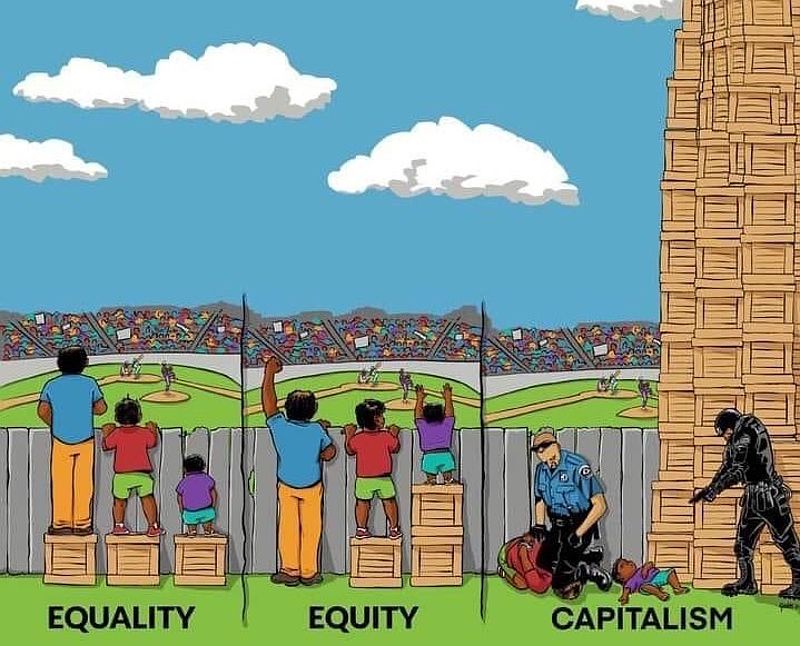
Capitalism, often celebrated for its ability to generate wealth and innovation, also brings with it a darker legacy: the untold millions of lives prematurely lost due to its systemic failures. Capitalism can be attributed to more than 10 million excess deaths per year, and these numbers will continue to increase. These deaths are not simply unfortunate byproducts but are structurally baked into the system itself. Whether through poverty, healthcare inequality, environmental destruction, or war, capitalism’s logic of profit maximisation places human life at the mercy of market forces, with devastating consequences.
Audio: NotebookLM podcast on this topic.
Friedrich Engels famously referred to these preventable deaths as social murder, a term that highlights how capitalism creates conditions in which certain populations are systematically neglected, deprived, and ultimately destroyed. Today, Engels’ critique is more relevant than ever as we examine the staggering human toll that capitalism has left in its wake, often invisible in the glow of GDP figures and economic growth.
Poverty and Hunger: The Silent Killers
One of the most pervasive ways capitalism generates excess deaths is through poverty and hunger. Despite the extraordinary wealth produced by capitalist economies, millions still die from hunger-related causes every year. According to the World Health Organization (WHO), around 9 million people die annually from hunger and malnutrition, mostly in regions where capitalist-driven global inequality has made basic necessities unaffordable or inaccessible.[1]
Capitalism’s defenders often point to rising standards of living as evidence of the system’s success, but this narrative suffers from survivorship bias. The success stories of those who have benefited from capitalist growth obscure the countless lives that have been lost to the system’s structural inequalities. As Engels noted, these deaths are not natural or inevitable—they are preventable. They occur because the capitalist system concentrates wealth in the hands of a few while leaving vast populations to suffer without access to food, healthcare, or basic resources.
“For the dead, there is no measure of progress or rising standards; they are simply erased from the narrative.”
This disparity in wealth and access to resources creates a global system of social murder, where the deaths of the poor are written off as collateral damage in the pursuit of profit. These deaths are not merely unfortunate consequences; they are inherent to the capitalist system’s prioritisation of wealth accumulation over human life.
Healthcare Inequality and Preventable Deaths
The lack of access to adequate healthcare is another major driver of deaths attributable to capitalism. In the United States, the richest nation in the world, an estimated 500,000 deaths between 1990 and 2010 were linked to healthcare inequality, according to a Lancet study.[2] Globally, millions die each year from preventable causes—such as pneumonia, diarrhoea, and malaria—because market-driven healthcare systems fail to provide for those without the means to pay.
In a for-profit healthcare system, those without money are often denied life-saving treatment. Healthcare becomes a commodity, rather than a human right. This commodification of care creates deadly disparities, where a wealthy few receive world-class medical attention while millions die from treatable conditions. Engels’ notion of social murder is evident here as well: the system does not kill through direct violence but by neglecting the vulnerable.
“Capitalism’s market-driven healthcare system perpetuates a structural violence where the poor die from treatable conditions simply because they cannot pay.”
This situation is exacerbated by the ongoing commodification of healthcare through privatisation and austerity measures, which strip public systems of resources and force them to operate on capitalist principles. The result is a world where profit motives dictate who lives and who dies.
Environmental Destruction and Climate Change: Capitalism’s Long-Term Death Toll
Capitalism’s unrelenting focus on short-term profit also drives environmental destruction, contributing to a growing death toll linked to climate change. The WHO estimates that by 2030, climate change will cause approximately 250,000 additional deaths each year, driven by heat stress, malnutrition, and the spread of diseases like malaria and diarrhoea.[3] These figures are conservative, as the cascading effects of climate-induced migration and conflict are difficult to quantify.
David Harvey’s concept of accumulation by dispossession is central to understanding how capitalism contributes to environmental devastation. Capitalist economies extract and commodify natural resources, often at the expense of local populations who bear the brunt of environmental degradation. Deforestation, mining, and fossil fuel extraction displace communities and destroy ecosystems, creating conditions that lead to death, displacement, and disease.
“The victims of capitalism’s environmental destruction are not accidental casualties; they are the inevitable outcomes of a system that prioritises short-term profit over long-term sustainability.”
This environmental violence is compounded by disaster capitalism, a term coined by Naomi Klein to describe how capitalist interests exploit crises like natural disasters or financial collapses for profit.[4] The destruction of vulnerable communities by climate change is not simply a tragedy—it is a consequence of capitalist expansion into every corner of the planet, sacrificing human and ecological health for economic gain.
War and Imperialism: Capitalism’s Violent Expansion
The human toll of capitalism extends beyond poverty and environmental degradation to include the millions of lives lost to wars driven by capitalist interests. The illegal invasion of Iraq in 2003, for example, led to hundreds of thousands of deaths, many of which were tied to the geopolitical aims of securing control over oil reserves. Wars like Iraq are not isolated failures of policy but integral to the functioning of a global capitalist system that seeks to dominate resources and expand markets through military force.
David Harvey’s theory of new imperialism explains how capitalist economies rely on the expansion of markets and the extraction of resources from other nations, often through military means.[5] The military-industrial complex, as described by President Dwight D. Eisenhower, thrives under capitalism, profiting from perpetual war and the destruction of human life.
“Wars driven by capitalist interests are not just geopolitical strategies; they are extensions of capitalism’s relentless drive to dominate resources and secure markets.”
The death toll of wars driven by capitalist expansion is staggering. From the millions killed in conflicts over resources to the long-term destabilisation of regions like the Middle East, these deaths are directly tied to capitalism’s global ambitions. The victims of these wars—like those who suffer from poverty and environmental destruction—are casualties of a system that prioritises wealth and power over human life.
Conclusion: Reckoning with Capitalism’s Death Toll
The deaths attributable to capitalism are not abstract or incidental; they are the direct consequences of a system that places profit above all else. From hunger and poverty to healthcare inequality, environmental destruction, and war, the capitalist system has claimed millions of lives—lives that could have been saved under a more just and equitable economic model.
“Capitalism’s greatest violence is not its wars, but its everyday acts of neglect, where millions die not from bombs but from lack of food, water, and care.”
The true success of capitalism, then, is not in its ability to generate wealth for the few, but in its capacity to obscure the structural violence that sustains it. By framing poverty, healthcare inequality, and environmental destruction as unfortunate consequences of “market forces,” capitalism avoids accountability for the millions it leaves behind.
It is time to reckon with this hidden death toll. Only by facing the human cost of capitalism can we begin to imagine a future where economic systems prioritise human life over profit. The victims of capitalism are not just numbers—they are the casualties of a system that, as Engels pointed out, murders through neglect, exploitation, and greed.
Endnotes:
[1]: World Health Organization, “Hunger and Malnutrition: Key Facts,” 2022. [2]: “The Lancet Public Health,” Study on healthcare inequality in the U.S., 2010. [3]: World Health Organization, “Climate Change and Health,” 2022. [4]: Naomi Klein, The Shock Doctrine: The Rise of Disaster Capitalism (Picador, 2007), pp. 9-10. [5]: David Harvey, The New Imperialism (Oxford University Press, 2005), pp. 145-147.
In the contemporary world of deepening inequality and environmental degradation, capitalism continues to hold a powerful ideological grip on much of the global population. Yet the irony is that many of its staunchest defenders are not the elites or the true beneficiaries of the system, but the very workers and middle-class individuals whose lives it exploits and controls. These defenders are not capitalists themselves; they are, in fact, cogs in the machinery of a system they imagine will eventually reward their loyalty. This illusion is strikingly captured in a quote often misattributed to John Steinbeck: “Socialism never took root in America because the poor see themselves not as an exploited proletariat but as temporarily embarrassed millionaires.”[1]
This phenomenon, which we might call the temporarily embarrassed millionaire syndrome, reflects not only a profound misunderstanding of capitalism but also the effectiveness of the system in controlling its participants through hope and aspiration. Capitalism promises upward mobility, convincing even those at the bottom of the economic ladder that their current misfortunes are temporary. But as Karl Marx and Friedrich Engels observed, this is a system of exploitation that not only alienates workers but effectively destroys them.
Survivorship Bias and the Myth of the “Rising Tide”
Capitalism’s defenders frequently invoke the idea that “a rising tide lifts all boats.” The metaphor suggests that when capitalism prospers, everyone benefits. However, this vision of progress masks the reality of capitalism’s winners and losers. As economist David Harvey has pointed out, capitalism is not a neutral system of wealth creation—it is a system of accumulation by dispossession, constantly expropriating wealth from others, often through privatisation and the commodification of public goods.[2] The rising tide does lift some boats, but it simultaneously leaves others stranded, or worse, sinking.
Survivorship bias is essential to understanding how capitalism maintains its legitimacy. The success stories—the wealthy entrepreneurs, the individuals who “made it”—are lauded as proof that the system works. But the vast numbers of people left behind, those who toil in exploitative conditions or who die from poverty and neglect, are erased from the narrative. In Engels’ terms, these are victims of social murder—individuals who die prematurely not by direct violence, but through the structural forces of deprivation imposed by capitalism.[3] Their deaths are rendered invisible, falling out of the metrics of rising living standards and growth.
“The system’s victims are not accidental casualties but inevitable outcomes of capitalism’s relentless focus on profit over life.”
Friedrich Engels, The Condition of the Working Class in England
Engels’ critique of industrial capitalism is as relevant today as it was in the 19th century. The modern mechanisms of exploitation may be more complex, but they are no less deadly. In a late capitalist world, the poor and marginalised are still being “murdered” through the structural violence of inadequate healthcare, poor working conditions, and environmental degradation. The millions left out of the capitalist success story are not anomalies but integral to the system’s operation.
Alienation and the Tragedy of Defending the System
Marx’s theory of alienation provides another crucial lens through which to understand why capitalism’s defenders often remain blind to their own exploitation. Under capitalism, workers are alienated from the products of their labour, the process of production, their own humanity, and from each other.[4] The worker becomes a cog in a machine, detached from the value they create, and unable to control their working life. Yet, even in this state of alienation, many still defend the system, believing that their hard work will eventually lead them to wealth and freedom.
This defence of capitalism, often articulated by those whose lives it degrades, reflects Antonio Gramsci’s concept of cultural hegemony. Gramsci argued that the ruling class maintains power not just through economic domination, but by shaping the cultural and ideological landscape.[5] Capitalism’s defenders are, in part, products of this hegemony, believing in the very values—individualism, competition, the ‘American Dream’—that bind them to a system of exploitation.
“The most effective form of domination is one that is not felt as domination, but rather as a form of freedom.”
Antonio Gramsci, Selections from the Prison Notebooks
This illusion of freedom under capitalism is deepened by what Herbert Marcuse calls repressive desublimation. Capitalism offers false freedoms in the form of consumer choice and superficial pleasures, giving individuals the illusion that they are exercising autonomy, even as the system remains unchallenged.[6] Workers may identify themselves in their commodities—luxury goods, tech gadgets, cars—but these objects only serve to reinforce their alienation and dependence on the capitalist system. The temporarily embarrassed millionaire clings to the dream of eventual success, all the while contributing to a system that offers only superficial rewards in return.
Social Murder and the Structural Violence of Late Capitalism
The notion of social murder offers a stark framework for understanding capitalism’s indirect, yet pervasive, violence. As Engels explained, this form of violence is not inflicted through overt means, but through the systematic neglect of basic human needs. Whether it’s the millions who die due to lack of access to healthcare or the global poor displaced by climate-induced disasters, capitalism perpetuates a form of structural violence that is invisible to those who benefit from the system’s success.[7]
The American political theorist Naomi Klein extends this analysis through her concept of disaster capitalism, where crises are exploited for profit. Whether it’s natural disasters or financial crises, capitalism uses these events as opportunities to privatise public resources, dismantle social safety nets, and deepen inequality.[8] The victims of these disasters—often the poor and vulnerable—are, in Engels’ terms, socially murdered by a system that thrives on their dispossession.
“Extreme violence has a way of preventing us from seeing the interests it serves.”
Naomi Klein, Shock Doctrine
The Temporarily Embarrassed Millionaire as a Tool of Control
The illusion that one’s current position is only temporary—that any individual can rise to capitalist wealth if they work hard enough—is central to maintaining the capitalist system. This aspiration prevents individuals from seeing their exploitation for what it is. They do not identify as part of an exploited class but instead believe they are merely waiting for their turn at wealth. Zygmunt Bauman’s concept of liquid modernity—the perpetual state of instability and insecurity produced by late capitalism—helps explain this phenomenon.[9] Individuals are constantly told that their position is fluid, changeable, and that their big break is just around the corner.
But for most, this “big break” never comes. The dream of becoming a millionaire is a powerful form of social control, one that keeps individuals invested in a system that benefits only a small fraction of its participants. As Marx reminds us, “the worker becomes all the poorer the more wealth he produces, the more his production increases in power and range.”[10] Capitalism does not reward the many; it exploits the many for the benefit of the few.
Conclusion: Facing the Irony and Imagining a Post-Capitalist Future
The greatest irony of capitalism is that those who defend it most fervently are often those who will never realise its promises. These are not the capitalists of the system, but its workers, its underclass, and its exploited. They see themselves not as oppressed, but as temporarily embarrassed millionaires—an illusion that keeps them bound to a system that offers them no real future.
In this light, the true success of capitalism is not in its creation of wealth, but in its ability to mask the conditions of exploitation, alienation, and social murder that underpin it. The path forward requires a dismantling of these illusions and a recognition that the system’s failures are not accidental but integral to its design.
“Capitalism’s greatest trick is convincing the exploited that their suffering is temporary, that their turn at wealth is inevitable.”
Naomi Klein, The Shock Doctrine
Only by facing these uncomfortable truths can we begin to imagine a future beyond the constraints of capitalist ideology, a world where human flourishing is no longer measured by wealth accumulation but by the collective well-being of all.
Endnotes:
[1]: Misattributed to John Steinbeck, this quote encapsulates a critical observation about American capitalism’s appeal to aspiration rather than solidarity. [2]: David Harvey, The New Imperialism (Oxford University Press, 2005), pp. 145-147. [3]: Friedrich Engels, The Condition of the Working Class in England (Oxford University Press, 1845), p. 112. [4]: Karl Marx, Economic and Philosophic Manuscripts of 1844 (Progress Publishers, 1959). [5]: Antonio Gramsci, Selections from the Prison Notebooks (International Publishers, 1971), p. 12. [6]: Herbert Marcuse, One-Dimensional Man (Beacon Press, 1964), p. 10. [7]: Friedrich Engels, The Condition of the Working Class in England, p. 114. [8]: Naomi Klein, The Shock Doctrine: The Rise of Disaster Capitalism (Picador, 2007), pp. 9-10. [9]: Zygmunt Bauman, Liquid Modernity (Polity, 2000), p. 14. [10]: Karl Marx, Economic and Philosophic Manuscripts of 1844, p. 68.
“In order to gain and to hold the esteem of men, it is not sufficient merely to possess wealth or power. The wealth or power must be put in evidence, for esteem is awarded only on evidence.”
Thorstein Veblin, The Theory of the Leisure Class, 1899
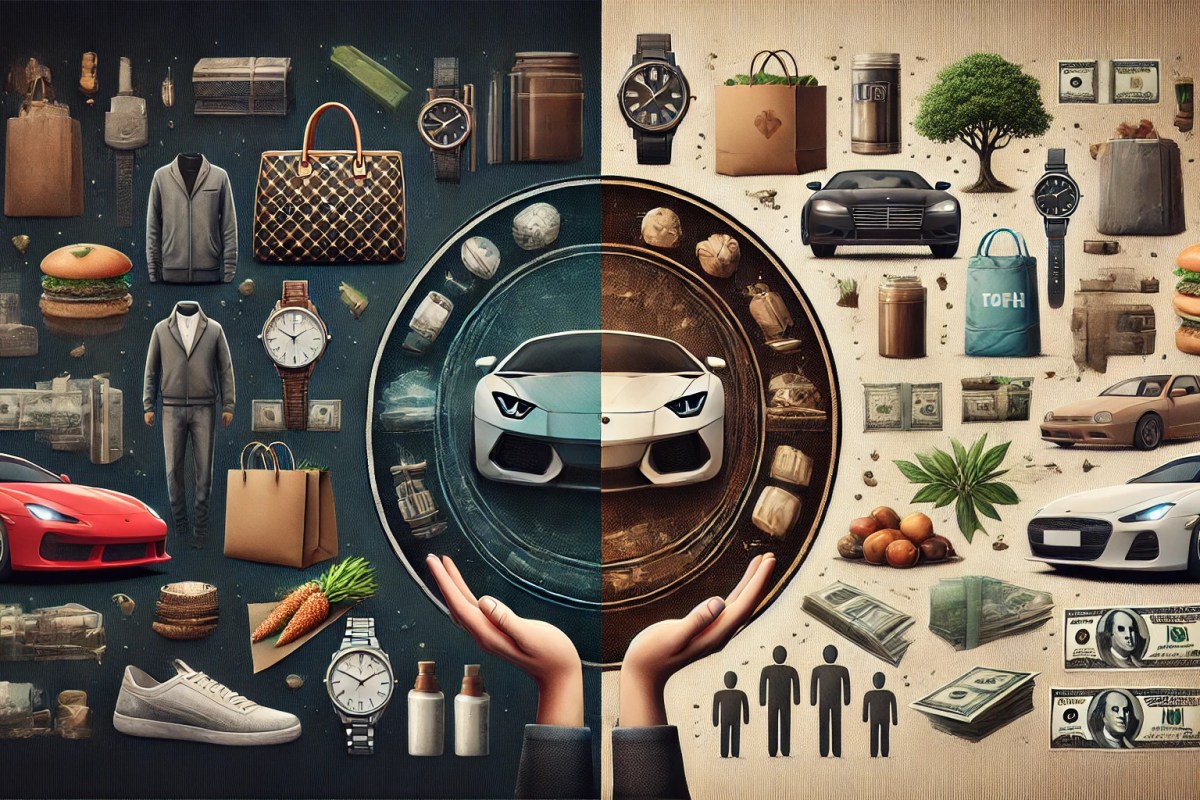
In a world where our worth is increasingly measured by what we own rather than who we are, it’s time to question the hollow pursuit of conspicuous consumption. Thorstein Veblen, over a century ago, saw through the shiny façade of status-driven consumerism. He coined the term conspicuous consumption to describe a phenomenon that has only grown more insidious in our time: the wasteful, performative display of wealth and luxury to signal social standing.
“The world has enough for everyone’s needs, but not enough for everyone’s greed.”
Mahatma Gandhi
From luxury cars to designer handbags, we live in a society that encourages us to broadcast our economic worth at every turn. But what does this ostentatious display really achieve? Veblen would argue that it’s not about personal fulfilment or the intrinsic value of what we buy, but about outshining others—a relentless race with no finish line. We’re not buying goods; we’re buying validation, trying to purchase a place in an imagined hierarchy that is as fragile as the latest trend.
Peter Singer, the moral philosopher known for his advocacy of effective altruism, would take this critique even further. For Singer, conspicuous consumption is not just wasteful; it’s morally indefensible. His ethical stance, grounded in utilitarianism, compels us to consider the opportunity cost of our spending. Every pound spent on a designer item is a pound that could have been used to alleviate suffering—whether through combating extreme poverty, funding life-saving medical treatments, or addressing global environmental crises. In a world where preventable suffering and death are rampant, lavish spending on status symbols is not just misguided; it’s a moral failure.
“The money we spend on luxuries could be donated to help people in need and thereby reduce avoidable suffering.”
Peter Singer, The Life You Can Save, 2009
Singer’s principle of equal consideration of interests demands that we weigh the impact of our actions on others as seriously as we consider their impact on ourselves. When we choose to engage in conspicuous consumption, we’re prioritising superficial self-expression over the tangible needs of those who are suffering. It’s a glaring contradiction to claim we value human life while squandering resources on goods that serve no purpose beyond ostentation.
The issue with conspicuous consumption isn’t just its superficiality—it’s the economic and social rot it perpetuates. It sustains a cycle of pecuniary emulation, where those lower on the socio-economic ladder are pressured to mimic the consumption patterns of those above them. The result? A society locked in an absurd competition, where individuals drown in debt just to keep up appearances, and resources are squandered on goods that serve no practical purpose other than to flaunt.
But why should we care? Isn’t spending on luxury just a harmless personal choice? Not quite. Every pound spent on a status symbol is a pound diverted from something meaningful—education, healthcare, the environment. When the affluent engage in extravagant spending, they set a toxic standard, promoting the idea that personal worth is tied to material excess. It’s not just bad taste; it’s bad ethics, bad economics, and bad for the planet.
More disturbingly, this drive to display wealth erodes the social fabric. It deepens divisions, creating resentment and alienation. The ultra-wealthy, insulated in their gilded cages, become oblivious to the realities faced by the rest of society. Meanwhile, those struggling to maintain the illusion of prosperity are left with the fallout—financial instability, stress, and a gnawing sense of inadequacy.
Veblen saw this trap for what it was: a hollow spectacle. Singer’s ethics give us a way out. He challenges us to shift our focus from self-indulgence to selflessness, from conspicuous consumption to conscious contribution. Instead of spending exorbitantly to bolster our social standing, why not use that wealth to create real, measurable change in the world?
We don’t need another luxury brand or another status symbol. We need a society that values substance over style, sustainability over excess, and human dignity over the incessant demand to buy more to be more. Singer’s challenge is simple: consider the true cost of your choices—not just for yourself, but for the world around you.
Conspicuous consumption is a dead end. It’s time to take a different road—one that leads not to a display case, but to a more equitable, thoughtful, and genuinely prosperous society.
“The mass of men lead lives of quiet desperation. What is called resignation is confirmed desperation.”
Full disclosure. All normative morality frameworks are seriously flawed. Consequentialism and its redheaded stepchild, Utilitarianism, may be among the worst—at least in the top 10.
In this video, I’m introduced to Tommy Curry, who makes a strong point in the face of Western imperialism—any imperialism, but the West seems to do more and better (if better means worse for the world at large). One can’t claim a moral high ground after nearly genociding counter-opinions. As he notes, when the proto-United States “accidentally” murdered ninety-five per cent of the Indigenous population and then applied the majority rule, good of the people rule, that’s the worst of bad faith.
To be fair, the world has a history of killing off and disappearing counter-voices and then voting on issues they opposed. Rinse and repeat until you become the majority. No wonder genocide is so popular. Israel has adopted this approach as a perpetrator after their predecessors escaped a similar fate in the 1940s. They accused Nazi Germany of being evil. I guess it rubbed off. Who knew genocide was contagious?
Peter Singer comments on the full video, a symposium on land ownership and hypocrisy, which can be found here or by following the IAI link from the video above. Eventually, you’ll hit a paywall. Apologies in advance.
I’d love to write more as this is a topic in which I have a passionate interest. Unfortunately, I am otherwise indisposed and will settle on sharing this video content for now. I’ll love to read your thoughts.
In the modern Western world, private property is largely viewed as a cornerstone of economic stability and personal freedom. However, this article challenges this conventional wisdom by reevaluating private property ownership not as an asset, but as a significant liability. This perspective considers the broader implications of property ownership on the Earth and its inhabitants, questioning the sustainability and ethics of our current system.
In fact, all land is “stolen”.
Historical Context and Conceptual Foundation
The concept of ‘property’ did not exist in early human societies. It emerged only when the need arose to distinguish “mine” from “yours.” As human settlements expanded into territories, and later into cities and nations, what was once undivided land transformed into distinctly owned parcels. Initially, all land was communal—effectively belonging to everyone and no one simultaneously.
This shift from communal to private ownership marked a fundamental change in human relationships with the land and with each other. A striking historical example of this shift is the Enclosure Movement in England, beginning in the 16th century. This process converted communal lands into private property, significantly impacting rural communities and agricultural practices. It serves as a stark illustration of how the privatization of once-shared resources can dramatically alter societal structures and individual livelihoods.
The Liability Perspective
Applying the principles of double-entry bookkeeping to property ownership offers a unique lens: every recorded asset (property) must correspond to a liability. However, this liability does not accrue to another person but to the Earth itself. This accounting reveals a perpetual debt—not to previous or current landowners, but to all life that has, does, and will inhabit the Earth.
Consider the following:
Environmental Impact: Private ownership often leads to the exploitation of resources without consideration for long-term sustainability. The World Wildlife Fund reports that about 30% of global forest cover has been cleared, with much of this due to private land use for agriculture and development.
Social Exclusion: Property boundaries inherently exclude others from accessing once communal resources. This is exemplified by the concept of the “Tragedy of the Commons,” described by ecologist Garrett Hardin in 1968, where individual cattle herders, acting in self-interest, would overgraze and ultimately destroy shared pastureland.
Intergenerational Inequity: Current property laws may deprive future generations of access to vital resources. This is evident in the concentration of land ownership. According to a 2020 UN report, 1% of the world’s farms operate more than 70% of the world’s farmland, highlighting extreme inequality in land distribution.
Moral and Ethical Implications
From an ethical standpoint, private property ownership imposes a series of unacknowledged moral debts. These debts arise from the exclusion of community and future generations from resources that were once common heritage. The immorality, then, stems from a system that prioritizes individual ownership over collective well-being and sustainable stewardship of the planet.
Key ethical considerations include:
Distributive Justice: How can we justify the unequal distribution of Earth’s resources?
Environmental Ethics: Does private ownership encourage responsible stewardship or exploitation?
Intergenerational Ethics: What obligations do we have to future generations regarding resource access?
Counterarguments and Rebuttals
Proponents of private property might argue that it drives economic growth, encourages maintenance of the property, and upholds individual liberties. However, these benefits must be weighed against the environmental degradation, social inequalities, and ethical dilemmas that private ownership perpetuates.
Argument for Private Property
Rebuttal
Drives economic growth
Growth at the expense of sustainability is ultimately detrimental
Encourages property maintenance
Communal ownership can also incentivize maintenance through shared responsibility
Upholds individual liberties
Individual liberties should not come at the cost of collective well-being
The real question is: can a system that inherently generates liabilities for the planet and its future residents be truly just and sustainable in the long term?
Alternative Models and Transition Strategies
Several alternative models of property ownership exist that emphasize community and sustainability:
Community Land Trusts (CLTs): In Burlington, Vermont, the Champlain Housing Trust (a CLT) has helped over 1,000 families become homeowners while keeping housing permanently affordable.
Ejidos in Mexico: This system of communal land ownership, despite challenges, has helped preserve indigenous communities and their traditional land management practices.
Shared Economy Models: Companies like Airbnb and Uber have shown how shared resources can create new economic opportunities, potentially offering insights into larger-scale resource sharing.
Potential strategies for transitioning away from the current private property system include:
Land Value Tax: Implementing a tax on the unimproved value of land, as proposed by economist Henry George, could discourage speculation and encourage more efficient land use.
Gradual Expansion of Public Land Trusts: Cities like Amsterdam have been gradually buying back land to create a more equitable system, offering a model for transitioning away from private ownership.
Universal Basic Income (UBI): While not directly related to property, UBI trials in places like Finland and Kenya suggest that providing a basic standard of living can lead to increased entrepreneurship and community well-being, potentially easing the transition to more communal forms of ownership.
Conclusion
Reevaluating private property as a liability encourages a shift in perspective—from individual entitlement to collective responsibility. It prompts us to question the long-term impacts of our current property laws and to explore more sustainable and equitable alternatives. This paradigm shift could lead to more responsible resource management and a more equitable society.
The challenge lies in balancing individual needs with collective responsibility and long-term sustainability. By engaging in public discourse on these alternatives and seriously considering transition strategies, we can pave the way for a more just and responsible approach to managing the Earth’s resources.
Fast forward a century. The future’s looking back, not with nostalgia but with a critical eye. Will they see our age of capitalism as we see the era of slavery – a moral misstep, a societal blight?
2023: Here we are, knee-deep in capitalism. It’s everywhere, in every transaction, every ambition. But beneath the veneer of progress and prosperity, there’s a darker narrative unfolding.
Wage Slaves in a Modern World
Wage slavery is the reality for many in a capitalist system where survival hinges on selling labour. The concept? Simple yet brutal. People are chained not by physical shackles but by economic necessity, a cycle of paycheck-to-paycheck existence. It’s freedom, but only in the loosest sense.
The Surplus of Inequality
Wage surplus – the lifeblood of capitalism. The more you squeeze out of workers, the fatter the profits. It’s a game of numbers where human cost rarely figures. The working class toil, and the upper echelons reap the rewards. Sounds familiar? It’s a throwback to the days of slavery, just dressed in modern garb.
Capitalists’ Dark Fantasy
A state of slavery – every capitalist’s secret fantasy? Perhaps not all, but for the ruthless, it’s the ultimate dream. A world where workers are mere cogs in the machine, dispensable and replaceable. No rights, no voice, just endless labour for minimal reward.
The Capitalist Paradox
Here’s the paradox – capitalism, in theory, champions freedom and innovation. But in practice, it often veers towards oppression and exploitation. The gap between the haves and have-nots widens, and social mobility becomes a myth, reserved for fairy tales.
The Future’s Judgment
In 2123, will they shake their heads at our era? Will they wonder how we allowed economic systems to morph into modern-day slavery? How we sold our souls for the illusion of prosperity?
A Glimmer of Hope?
But the tide is turning. Voices of dissent are rising, challenging the status quo. The call for a fairer, more humane economic model grows louder. There’s hope yet that we’ll steer away from the shadow of capitalism’s excesses.
Conclusion
As the world spins on, we’re at a pivotal moment. Will we continue down this path, or will we pivot towards a more equitable future? The choices we make today will echo through the annals of history.
Call to Action
What’s your stance? Is capitalism veering too close to a modern form of slavery? Drop your thoughts below. Let’s ignite a dialogue.





 Philosophics