Diversity Frame

One if the biggest foci of postmodern philosophy is the metanarrative. Employment diversity is a place that the metanarratives go unquestioned by most. The most predominant aspect is the frame. Don’t accept it.

Inside this frame, some uncritically adopted narratives are as follows:

  • Work is good
  • Work builds character (proportionately to the effort exerted)
  • Work defines your value or worth as a human
  • Work signifies your place in society
  • Work is its own reward (except for monetary payment and recognition)
  • Value is defined by monetary achievement
  • Worth is defined by your place in an enterprise

And so on…

In this HBR article*, the frame has been established as a corporation and the diversity within this context. What this say by omission is that money and power is the measure of a meaningful existence. If only women were afforded a seat at this table—proportional to their population in society—, things will be even.

Women should start their own successful companies. Women should rise to the top of existing companies. Especially if they buy into the aforementioned narratives. Many women and men buy into this story lock, stock, and barrel (whatever that means), but only is you accept this as a frame is this relevant.

It’s easy to imagine a world where money is unnecessary, where labouring is unnecessary.

It’s easy to imagine a world where money is unnecessary, where labouring is unnecessary. Some have imagined a world without work, where people could instead pursue artistic endeavours, but this is just adopting a different set of narratives—like the person who exchanges drugs or alcohol for Jesus or some such. Out of the frying pan into the fire. This is the lie.

Interestingly, the HBR article makes these points:

  1. Quantify gender equity in terms of economic gains for the company.
  2. Hold leaders accountable for change by tying DEI metrics to performance reviews.
  3. Offer development opportunities to increase gender intelligence, empathy, and self-efficacy.
  4. Pull back the curtain on misperceived social norms.
  5. Establish cross-gender professional relationships.
  6. Frame, focus, and integrate interventions into core business outcomes and mission.

Notice that each of these operates from the perspective of the company. Granted, this is HBR, where the B is for Business, but still. Here’s the low down.

  1. Gender equity will at some point increase your bottom line.
  2. Create diversity metrics (and incentives) and tie them to performance review—presumably tied to the economic performance expected in bullet 1.
  3. Offer diversity training—notwithstanding the body of evidence and long history that diversity programmes are not only ineffective but sow seeds of discontent.
  4. Educate your executives and staff to the misconceptions—so long as you don’t question the deeper metanarratives.
  5. Essentially, the ask here is to establish male-female protégé-mentor relationships. Of course, this could be expanded to break binary gender stereotypes, too.
  6. Back to business, frame the frame. But to tell the truth, I don’t even know how to interpret and summarise the provided example. It seems this is an admixture of points 1 and 2, given metrics should ladder up to stated objectives and outcomes.

asking for this equity in diversity is a short-term fix

In any case, asking for this equity in diversity is a short-term fix, but it’s unimaginative and buys into the worldview of the patriarchy. There is no reason to accept this prima facie. As with the notion of Democracy, I’d be willing to argue that the system itself is the problem and that any tinkering within the system is limited by the system itself.


* Apologies in advance if HBR has a paywall. Typically, the first 3 articles are free, but if you are like me that exhausts on day one.
Sans Raison

How does one justify reason without reason? Isn’t this just circular reasoning— circular logic? Can one justify reason without employing reason? Can there be logic without reason?

The Age of Enlightenment is simultaneously the Age of Reason. Reason is the best path forward, and yet one can’t even board the train without a predisposition toward reason at the start.

This reminds me of the troubles the logical positivists encountered by claiming that everything need to be falsifiable, and yet this claim could not be falsified. It’s Hume’s ought problem.

One could employ empiricism, but can one arrive there alogically?

Is there a term for ‘not logical’ without the same baggage as illogical?

  • Alogical
  • Antilogical
  • Contralogical
  • Counterlogical
  • Delogical
  • Dislogical
  • Inlogical
  • Mislogical
  • Nonlogical
  • Oblogical
  • Unlogical

For example, a work of art is not (necessarily) logical, but neither is it illogical; this feels like improper usage. So, what prefix modifier would one employ to communicate ‘not within the sphere of logic’ in shorthand? Or is it just ‘not logical‘. That doesn’t seem quite right either.

Clearly, shambling down some rabbit hole…

Watch Dogs: Legion

I’m not a gamer. OK, so I have been known to play some games, but I’m not very good at them and don’t justify committing any significant time improving my playing skills. Besides, I’m fairly occupied outside of the gaming experience. Part of it, I think, is that games I don’t identify with the experience gaming offers. Driving games? No. Flying games? Nope. Shooting games? Nah. Puzzle games. For a few moments, then naw. Building games? Farming games? Role play games? Not so much. That said, many friends and associates play games, so I remain somewhat aware and occasionally participate badly. My son plays certain games, so I am aware enough to allow for a communication thread in the same way I am somewhat conscious of sports because my brother steeps himself in sports. But in practise, I couldn’t tell you the difference between Marcus Rashford and Alex Verdugo.

All of this said, I come upon a piece from a few months ago. Ultimately, it reads like a philosophy on gaming. In the piece, the author, Austin Walker reviews Watch Dogs: Legion and explains why it doesn’t live up to its meta potential. I haven’t played any of the Watch Dog games and might not ever, but his point seems to be that they had the best talent and could have been edgy, but they didn’t. He offers some possible solutions on the edge, but he leaves a fuller solution to the game makers.

For those unfamiliar with the context of Watch Dogs: Legion (as I was), it’s a collaborative anti-establishment game. It promises to rail against the oppressive, ultraconservative, fascist powers through collective action, but as Walker writes, this activity is performative. In the end, nothing changes beyond some superficiality.

Perhaps, this, itself, is the commentary: Nothing changes except at the margins, but I don’t think this was the intent. Instead, it’s about a place to redirect one’s anger and frustration, except there is no resolution. Perhaps it’s supposed to be more about the journey than the destination, but I’m not buying that either.

In any case, rather than summarise Walker’s work, I link to it to speak for itself. And despite its deficits, it still feels it reserves a space not yet occupied by other properties yet, so a little more imagination could inch it into just the right place.

Ref: https://www.vice.com/en/article/pkdy5y/watch-dogs-legion-review

For the record, the last game I enjoyed playing with friends was 7 Days to Die, which I’ve played on and off since 2013 or so. It’s come a long way since it was first released. Interestingly, it’s still in Alpha—some 8 years later, so I’m not sure what that even means anymore.

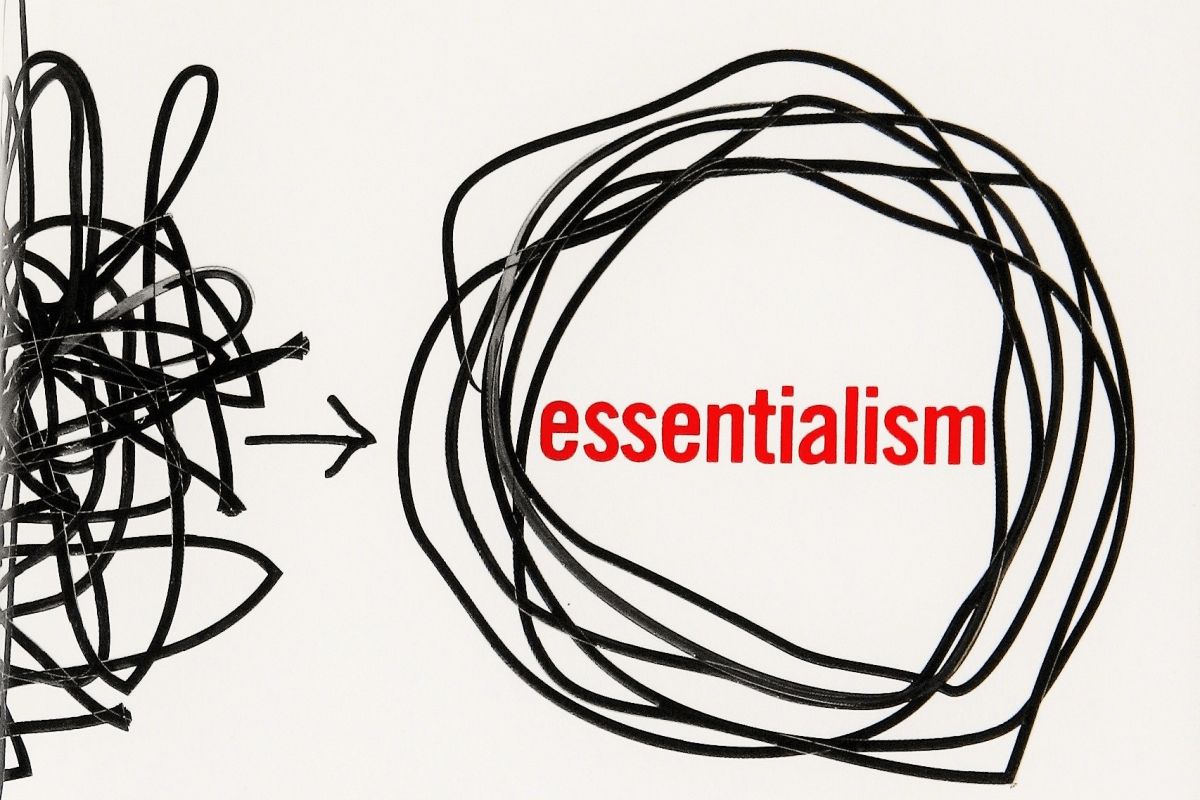
Žižek’s Essentialism

So, I’ve gone down a rabbit hole. Again. This time, it’s Žižek. Again. I’ve still not read any of Žižek’s own work, but people mention him often and he is a shameless self-promoter. In this video clip, he responds to whether gender is a social construct. Unfortunately, he conflates gender with sex, and his examples cite transsexuals not transgenders.

sex is about biological sex assignment

To set the stage, sex is about biological sex assignment—the sex category you are assigned into at birth: male, female, or other for some 1.8%. This is a simplistic categorisation: penis = male; vagina = female; both or neither: rounding error. In some cases, a decision is made to surgically conform the child to either male or female and ensure through prophylactic treatment that this isn’t undone hormonally in adolescence.

gender is about identity

Gender is about identity. As such, it is entirely a social construct. All identity of this nature is a function of language and society. In this world—in the West—, females wear dresses (if they are to be worn at all) and males don’t—kilts notwithstanding. In this world, sex and gender have little room for divergence. so the male who identifies as this gender (not this sex) is ostracised.

The example I usually consider first is the comedian Eddie Izzard—a cross-dresser. He’s probably a bad example because he does identify as a male. He just doesn’t wish to be constrained by male role restrictions and wants to wear the makeup that’s been reserved for women in the West at this time.

Žižek eventually gets to an argument about essentialism—so we’re back at Sorites paradoxes and Theseus again. At the start, I could argue that the sexual distinction has few meaningful contexts. For me, unless I am trying to have sex and/or procreate, the distinction is virtually meaningless. For others, only procreation remains contextually relevant. In this technological world, as Beauvoir noted in the late 1940s, strength differentials are not so relevant. End where they are, sex is not the deciding factor—it’s strength.

Žižek’s contention seems to be that the postmoderns (or whomever) disclaim essentialism in favour of constructivism but then resolve at essentialism as a defence because ‘now I am in the body originally intended’. I’ll argue that this is the logic employed by the person, but this person is not defending some academic philosophical position. They are merely engaging in idiomatic vernacular.

I am not deeply familiar with this space, and if the same person who is making a claim against essentialism is defending their actions with essentialism, then he’s got a leg to stand on. As for me, the notions of essentialism and constructivism are both constructed.

Mindfulness*

Mindfulness, as with yoga and other Eastern concepts, gets diluted for consumption by the West becoming McMindfulness. I learnt Buddhism circa 1980 in Japan, introduced by a friend from New Zealand. He translated for me because all services and teachings were given in Japanese. I won’t get into how the mind-body-spirit connection of yoga has devolved into an exercise regimen in the West.

Yoga

a Hindu theistic philosophy teaching the suppression of all activity of body, mind, and will in order that the self may realize its distinction from them and attain liberation

Most Westerners have attention spans of gnats, so many Eastern concepts need to be homogenised for the Western consumer and then dosed homoeopathically. Only then can the typical Westerner performatively claim to understand these Eastern notions. To be fair, some of the loss occurs because of the lack of depth of cultural understanding—the same loss happens from West to East as well—and some is language—the concept doesn’t have a direct translation, so we end up with close enough.

A simple but hopefully instructive anecdote might help. Westerners, especially English-speakers, are typically well-aware of the native Japanese speaker’s inability to articulate the L sound, and so ‘fried rice‘ is rendered something like ‘flied lice‘. Only, this not what’s being said. What we are hearing only approximates an L to our ears, but the L sound is not what’s being uttered. The Japanese language doesn’t have L or R phonemes, respectively /l/ and /r/. So the absence of the R-sound in Japanese and the lack of this alveolar sound in English brings us close to the L sound we presume to perceive. What they are saying is /ɹ/, which is in between these two sounds. They don’t have /l/ or /r/, and we don’t have /ɹ/, so the misinterpretation goes both ways. Only a person trained in this aspect of linguistics can map the relationship, but this mapping is imperfect but satisfactorily explanatory.

Mindfulness

the practice of maintaining a nonjudgmental state of heightened or complete awareness of one’s thoughts, emotions, or experiences on a moment-to-moment basis

Mindfulness is a member of the eightfold path of Buddhist doctrine. Mindfulness is about being conscious of ‘the world’ of one’s environment and yet not be focused or ‘attached’ to any particular aspect of it. it’s simply being aware. In Buddhism, the scope of mindfulness is particular to the dharma, of which the Four Noble Truths and the Eightfold Path are constituents, so technically speaking, one would need to have these aspects available in inventory.

* This post is a reaction to Landzek’s post, Mindfulness Mythology.

Whom do you serve?

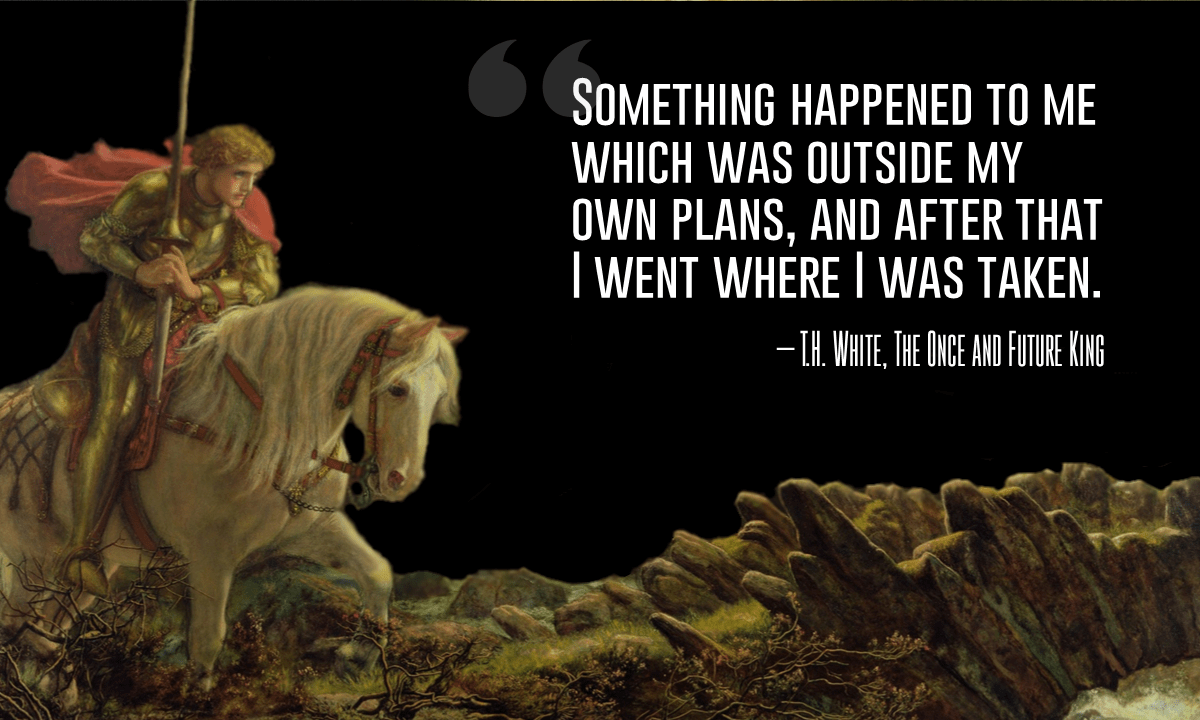
Something happened to me which was outside my own plans, and after that I went where I was taken.

TH White, The Once and Future King

An Internet friend led me to this quote. I felt it was appropriate to share in reflection of 2020, not only for me but many people who were forced to go with the flow.

The quote reminded me of the mid-1990s, a time when I was steeped in the archetypal and depth psychology of Jung and Hillman. I also read a lot of works pertaining to the Holy Grail. I decided to composite the quote onto the cover image. I’m not asking for a holy grail. Let’s just hope 2021 fares better than 2020 by most accounts.

Future Forward

How Soon Is Now? Is there anything beyond now—is there a future? Was there a past? What better occasion to reflect on this than the turn of a new year, of a new decade?

Now is easy. It right here, and here, and here, and here… and interminable series of heres. The past is easy, too, we were there—the accumulation of former heres—, so at least we can claim it was real at the time—or as real as we could perceive and can imagine. Memory frailties notwithstanding, the past is indelible. Whether we are or can be aware is another story.

Past is different to history. Past is an event or events. We may not even become aware of these events until they have passed—perhaps centuries or millennia later. These may be historicised. History is a story. In French, the terms aren’t even separated. L’histoire is simultaneously a story and history, a reminder of how inextricable they are.

But what about the future? A conceptual future is a fairly new human construct. Some events occuring after now have happened since the beginning of time. In fact without time or the invention of a notion of time, there can be no future or past. It’s been said that time is what keeps everything from happening at once.

“Time is what keeps everything from happening at once.”

Ray Cummings

We talk about the future, but when we reference it now, it’s only some speculative future—some admixture of uncertainty and probabilities. There are no guarantees any given event will actually manifest, whether we will be there to experience it, or whether any future will even arrive. This is a known limitation of empiricism. That the sun has risen for some 4 billion years doesn’t guarantee it will rise tomorrow. There is nothing necessarily preventing the universe from ceasing to exist tomorrow or in an instant, pardoning the nomenclature of time.

Where our perception of now is already quite limited in scope and experience, any notion of future is decidedly worse. And of all of the possible threads and imagined threads, only one will manifest—unless you subscribe to parallel universe models, in which case you can still only experience one and only one, at least for the time being.

From the perspective of now, the future, like history, is just a story. In these times of COVID, we should realise that some stories hadn’t been written. Similar storylines had been imagined and authored, but the one that manifest was different still. Truth is stranger than fiction—and worse.

But does the future exist? Can we discuss the future other than conceptually? Is the notion of future reserved for a privileged few? One so-called cognitive bias is that humans favour now and near-term events over further future events? From an evolutionary perspective, this makes perfect sense. First, I am here now, and whether I am here to experience the future remains to be seen. This bias is the basis for why most people don’t save enough for a comfortable retirement—a retirement with a comparable standard of living and quality of life as one’s ‘productive’ years.

One consideration is expected lifespan. Actuarially, a person might be expected to live on average, say, 76 years. If people my family historically live to 65 and I expect to retire thereabouts, saving past that is inefficient—transferring wealth across generations notwithstanding. If I die at 65, there is no mismatch. If I die at 76, then oopsie. Retirement income and savings is predominantly a First-world problem—a challenge for people who live in an income-based, consumerist society, so worrying about the future takes on a more relevance.

Even if I expect my village, tribe, or family care for me in my twilight years, there is still a notion of future to consider. Will they be there for me. But from an evolutionary perspective, this doesn’t necessitate a future beyond a generation, so the probability of an uncertain event is lower than, say, a thousand years from now.

NB: What had been a concept riffing on Hoffman’s evolutionary argument against reality was intercepted by the related notion of the future. I hope to return to Hoffman presently—if the future allows.

Perspective on Theseus

Chump in Chief* wrote a piece on dementia using analogue of the ship of Theseus. As a topic, Hobbes’** Theseus thought experiment has been well-covered, but that’s never stopped me before.

This is all about identity. Essentially, there are two perspectives. To an observer not on the ship or aware of the transformation, they would be none the wiser. For all intents and purposes, if they had ever seen the ship before, it’s the same. But what about those on the ship?

For nearly all of these observers, it’s almost unquestionably still the same ship. In a manner paralleling a person’s cells being sloughed off every 7 years, the cells in place at the start aren’t there after 7 years. Most will not doubt that you are the same person.

the average human cell is about 7 to 10 years old

As cells are continually dying and replacing themselves, for an adult the average human cell is about 7 to 10 years old, which might be interpreted as saying in the fashion of Theses’ ship that a person is anew each 7 to 10 years. Let’s ignore that this is an average, and many cells have a lifespan of only a few days whilst others—cerebral cells in particular—are here from the start and so are as old as the person.

Another perspective is to consider the replacement parts: would it matter if the colour of the parts changed in the process? What about the materials? What about the underlying architecture? What if the departing sloop arrived a schooner? Weight? What then?

My favourite extension of this thought experiment is to ask the question two-fold: Not only do we ask if this ship built with new materials is still Theseus’ ship—which to be fair is more a question of ownership than of identity—, but what if I reconstruct the original ship with the original materials. Are these both Theseus’ ships? Can we continue this exercise with new material ad infinitum?

As far as I know, we can’t repurpose cells in this fashion, but what if we could? There are many such Star Trek transporter mishap thought experiments, or the Duplicates Paradox.

In these experiments, a transporting device disintegrates the subject, and replicates the subject at a distance—but this replication presumably uses different atoms and cells, and so what if a duplicate copy is made rather than the replacement copy? Who’s identity prevails? Is it murder to eliminate one of the duplicates? Similar questions have played out in the science fiction / fantasy space.

Locke and others suggest that for people, memory and the continuity of thought are key, but your thoughts of me are not the same as my thoughts of me. This is why an amnesiac may no longer maintain some original identity, and yet to the familiar outside observer, this shell of a person remains intact. This is pretty much how it plays out with zombies and dementia patients. This sense of identity is projected upon the person rather than exuded from them.

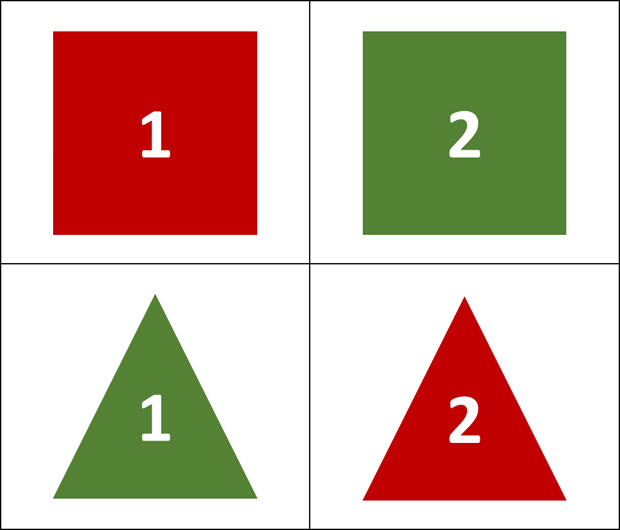
So what is my perspective? Rather than a paradox, it is more a problem of vaguity or ambiguity and how we’re defining sameness. There are many dimensions to similarity. I can present you a red square, a green square, a blue triangle, and a green triangle and play the Sesame Street ‘one of these things is not like the other game.

Is the sameness the colour, the shape, or the number? Could one be comparing area or perimeter?

So, I’ve gone off the reservation. I don’t put a lot of weight in notion of identity. It has evolutionary merit and is an effect of humans’ nature (as it were) to categorise and taxonomise.

* This Chief Chump charge may be unwarranted or even understated, as I don’t know this bloke.
** This is the same Hobbes with the ‘solitary, poor, nasty, brutish, and short’ claim to fame.

Airplanes 🙱 æroplanes

To the chagrin of many of my colleagues in the United States, I’ve long adopted international English for spelling. My first love was language and linguistics, and I never had a thing for American authors (until I encountered an undergrad literature course where the teacher only reviewed American fiction), so I wasn’t exposed much to American spelling. I had another Lit course, where the teacher exclusively assigned female authors without regard to national origin. Her advice to me for my choice: Be consistent. I still have an interest in language. Recently, I came across some trivia.

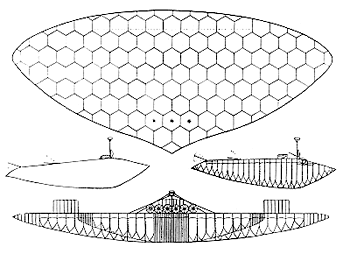
The word aeroplane was introduced in the late 19th century by the French aéroplane, from aéro- ‘air’ + Greek -planos (πλάνος) ‘wandering’. Joseph Pline coined the name ‘aeroplane’ in 1855 to refer to a powered, bird-shaped dirigible.

Subsequent to the original French, aéroplane, had been trisyllabic, often written aëroplane. Aeroplane had been the preferred spelling in the United States until the term was re-coined as airplane. At some point, æroplane, spelt with the initial ash (æsc) diagraph ligature was in vogue.

So-called American English favours spelling aeroplane as airplane. Interestingly, this spelling is a back formation from aeroplane to conventionally comply with airship and aircraft. ‘American English, ‘airplane’ was first recorded in 1907, four years after the first flight of the Wright brothers.

In 1913, Marshall B. Gardner’s, A Journey to the Earth’s Interior: Have the Poles Really Been Discovered? Evidence or Hollow Earth, reads, ‘When in the near future an æroplane or dirigible shall actually travel over all these regions, the observers thereon shall see much that no Arctic explorer has ever told us about’.

Police State

Bad police dramas on TV have gotten me in the mood to rail. First, there was the topic of lying, and then there was the Unabomber. This post is broader.

We laugh of the notions of Barney Fife, Chief Wiggum, and Paul Blart, but in my estimation these are closer to the norm than the stereotype of the bad-ass cop.

My armchair pop-psychology assessment is that people who are drawn to police work are underachievers with power and control issues and conformity and morality fetishes.

Advantage goes to the house

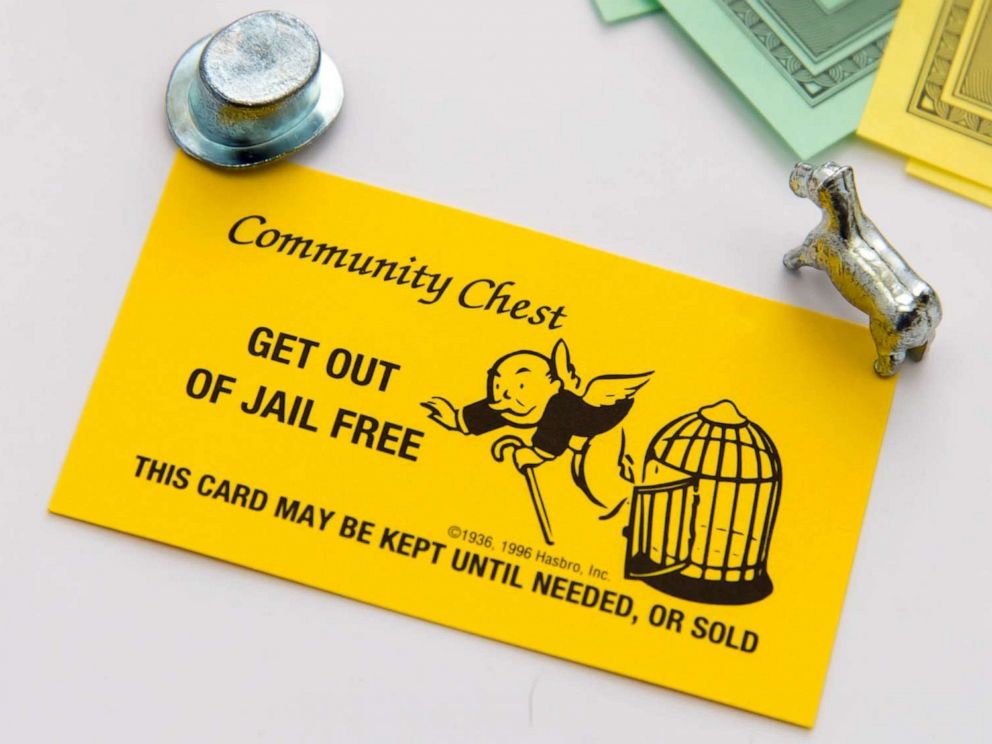
Law enforcement and jurisprudence systems wouldn’t work if they didn’t stack the decks in their favour. They give themselves get out of jail free cards and rely on lies and deception to create an advantage. Watching these TV shows, they have permission to lie, withhold, misrepresent, coerce, and entrap without repercussion. They make ‘deals’ in domains where they have no authority. They are even allowed to engage in criminal activity if it serves the better interests of a case. They can buy drugs and property, engage with prostitutes, and any number of otherwise illegal activities.

I won’t even spend more digital ink commenting on the lack of due process judges commit in the courtroom—personal fiefdoms.

Domestic abuse

Over 40% of active police officers have domestic abuse histories.

Over 40% of active police officers have domestic abuse histories. These people have records of abusing the wives, children, domestic partners, and pets. And these are only the ones who have been caught. Statistically, the percentage is very likely to be over 50%. This is not shining endorsement. Sadly, domestic abuse is inversely correlated with IQ, so this doesn’t fair well with the next topic.

Low IQs

The average IQ of a police officer in the United States is about 104. In and of itself, this might not seem strange. This seems to imply that these IQs are in line with average, but there’s a problem. The courts have ruled that is not discriminatory to exclude people with high IQs from being police officers because they are more likely to be independent thinkers and not conformant.

Conformity

Because cops are usually and expectedly conformant, it should come as no surprise that they feel the urge to prescribe this conformity on others. Given the opportunity, I’d argue that in many instances this conformity is superficial and performative, but that’s a topic for another day.