Time Reborn

Einstein was wrong. Time is not the relative factor in space-time. Space is. Time is constant. Here’s a lecture on the topic of the book.

Lee Smolin Public Lecture: Time Reborn

As a result of a discussion with a colleague, on the possibility of variability or mutability of so-called physical laws, he recommended Lee Smolin’s book Time Reborn: From the Crisis in Physics to the Future of the Universe. He mentioned that it would be suitable as an audiobook. Since I had a credit on Audible, I decided to use it so I could listen to this without deep scrutiny and a need for taking notes.

There is a nice review in the Guardian from 2013. I suppose I am a bit behind the times.

Whilst running errands, I listened to the Preface and Introduction. I stopped at the start of the first chapter, and am debating whether to continue. Given his setup, I don’t believe I am Smolin’s target audience. Many of the beliefs he is attempting to dispel, I already don’t hold. Yet I don’t feel that I need to hold time as a constant to hold them. He seems to feel otherwise.

Preface

For the record, Lee Smolin is a theoretical physicist, who has written several books in this space. Quickly, recapping some of his points:

He provides examples of various illusions humans tend to be swayed by:

  • Matter appears to be smooth but turns out to be made of atoms
  • Atoms seem indivisible but turn out to be built of protons, neutrons, and electrons
  • Protons and neutrons are further made of still more elementary particles called quarks
  • The sun appears to go around the Earth, but it’s the other way around

Smolin relates that the prevailing perspective today is that time is an illusion—name-dropping Plato and Einstein, who hold this view. He conveys that he used to share this belief, but now he disagrees—whence the book. He tells us:

Not only is time real, but nothing we know or experience gets closer to the heart of nature than the reality of time.

— Lee Smolin, Time Reborn

Next, he posits that some people believe in timeless events—events outside of time, eternal and not a function of time. Here’s where he goes off the rails in my book.

“We perceive ourselves as living in time, yet we often imagine that the better aspects of our world and ourselves transcend it. What makes something really true, we believe, is not that it is true now but that it always was and always will be true.”

Evidently, he feels or felt this way. I am sure many others. I am not among them.

“What makes a principle of morality absolute is that it holds in every time and every circumstance.”

My position is that all morality is a social construct, so this doesn’t resonate with me.

“We seem to have an ingrained idea that if something is valuable, it exists outside time.”

Again, I am not in his intended audience.

“We yearn for “eternal love.” We speak of “truth” and “justice” as timeless.”

Love, truth, and justice are all human constructs—weasel words.

“Whatever we most admire and look up to — God, the truths of mathematics, the laws of nature — is endowed with an existence that transcends time. We act inside time but judge our actions by timeless standards.”

Yet again, I am unburdened by these beliefs.

Nothing transcends time, not even the laws of nature. Laws are not timeless. Like everything else, they are features of the present, and they can evolve over time.

— Lee Smolin, Time Reborn

I think that this quote is a reason this book was recommended to me. I do believe that the properties that comprise laws can evolve over time. I’m not sure if this is by a probabilistic process or something else. There are a few possible implications. One is that the laws at the onset of the universe may have been different, making the understanding of that time more challenging if not impossible. I don’t know if I believe in multiverses, and I doubt I may ever live long enough to discover. However, even if there is only one universe, per the name, perhaps universes can exist sequentially and when one dies another appears with a different set of initial conditions and properties. Borrowing from evolution, perhaps these survive or perish based on the viability of this combination.

Smolin goes on to posit that, ‘thinking in time is not relativism but a form of relationalism‘.

He continues,

“Truth can be both time-bound and objective when it’s about objects that exist once they’ve been invented, either by evolution or human thought.”

— Lee Smolin, Time Reborn

I’m not sure he is going to define truth, but I believe he conflates moral truths with axiomatic or tautological truths. Perhaps it doesn’t matter because both are constructed.

Smolin makes it clear that he is not a determinist, but unless you take the view he is proposing, as a physicist, you almost have to be. As he says regarding Determinism, theoretically. a person could suss out a mathematical equation to predict every future event. He also considers this belief to be a metaphysical vestige of religion.

Introduction

According to [the] dominant view, everything that happens in the universe is determined by a law, which dictates precisely how the future evolves out of the present. The law is absolute and, once present conditions are specified, there is no freedom or uncertainty in how the future will evolve.

— Lee Smolin, Time Reborn

He continues to describe a deterministic system without mentioning indeterminism, which may be a more prominent belief given what we understand about quantum mechanics. He claims that this perspective diminishes time for several reasons. Inflating or at least elevating time is important for his thesis, and I am thinking that this is more an act of wishful thinking.

He takes a stab at the inherent reductionism of physics—it reduces everything to parts until there are no longer subparts, at which point the process fails—and explains that by adopting this approach, one needs to get outside of the universe to make some evaluations, but this is impossible. And this might be a true statement, but so what? The answer is not to make up a story that creates an environment where that’s no longer necessary.

Smolin reiterates over and again about timeless laws in a time-bound universe, but I question his notion of timelessness. He admits that he has no grand theory—just an idea he hopes others can pursue and build upon. Emergent properties appear to be an emerging theme.

Leibniz is next up, in particular his principle of sufficient reason. Leibniz’ vision is a relational universe composed of a network of relationships—the space is simply the absence of things. He contrasts this with Newton’s view that space is absolute and serves as the container for things. He sets up a future chapter that he says establishes that Leibniz’ vantage precludes the possibility of absolute time, but I don’t see this as a challenge for those of us who believe that time is constructed in the first place.

The Newtonian view prevailed until Einstein resurrected Leibnitz with his general relativity theory of space and time. The trending vogue is about relationalism, whether biology or information science.

He cites the challenges of maintaining Locke’s views on autonomy and personal liberties in a deterministic world (again leaving indeterminism unmentioned).

And he’s back on the emergence of emergence. (I was in the midst of writing a post on emergence when this interrupted my flow. I suspect it should be forthcoming in time.)

Falling

As it turned out, I ran another errand and listened to the first chapter of part 1. It is about gravity and parabolas, but I shan’t recount it here, save to note that he seems to be of the opinion that many people have the desire to transcend the bounds of human life. He may be right. I am not one of these people.

I don’t feel that I am in his target market.
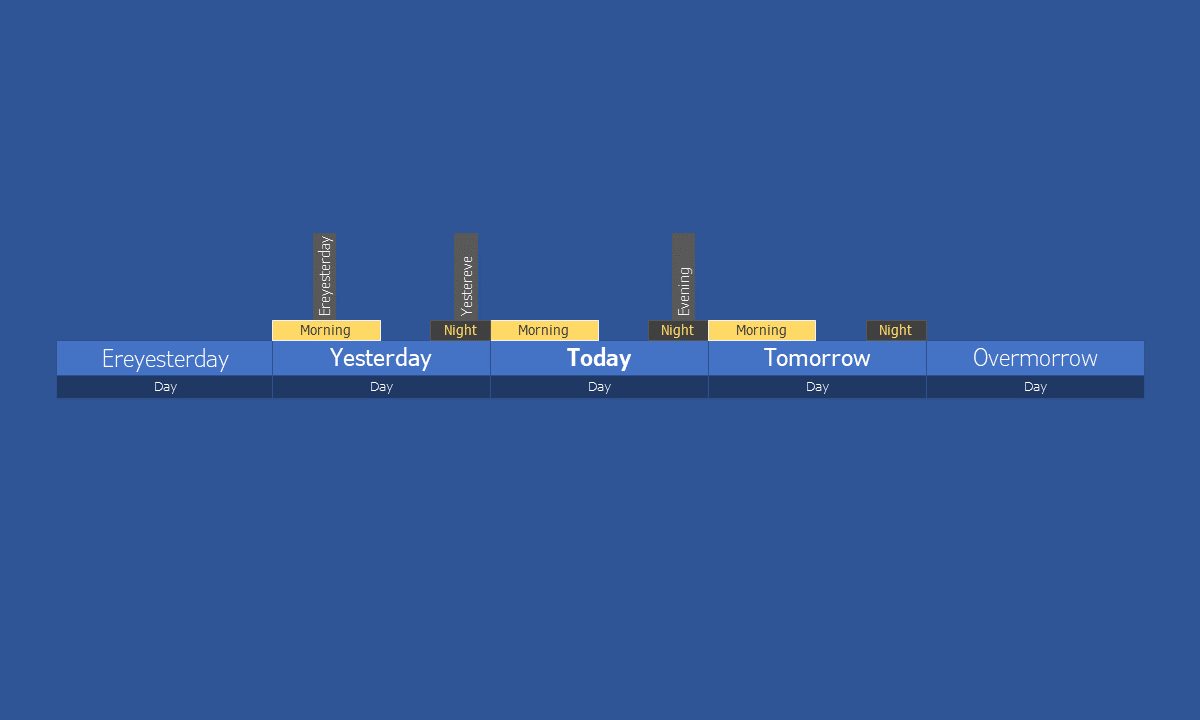
It’s about time…

Rather it’s about days.

Have you even just let your mind and fingers wander?

The English language morphs, and sometimes some useful notions are lost to the dustbin of history. I take it especially hard when other languages retain these aspects.

I tend to evaluate much in terms of time. In practice, this is why I dispute notions of self and identity—Plank-sliced frames stitched in time.

Although ‘today’ is the central reference and I could start with ‘today’, I’m going to unfold this chronologically, instead. First some background.

Getting Down to Basics

Day

In its original incarnation, day meant the ‘period during which the sun is above the horizon’ and was expanded to comprise the entirety of a cycle.

Fun Fact: Days used to be measured starting at sunset rather than midnight as is the current custom. So time was relative in a different sense to today.

Evening

Originally referring to the time just before sunset—parallel to the morning having meant the time just before sunrise—, it’s been expanded to mean the time from sunset (post the original intent) and bedtime.

Morning

Although morning had originally been limited to the time just before sunrise, its domain has been expanded to encompass the part of the day between midnight and noon, exclusively.

Morrow

Morrow simply means morning. Good morrow would have been taken as ‘good morning‘.

Night

Night is ostensibly the dark part of a day.

Yester

I don’t want to be the one to break it to you, but yester (from gester) means yesterday. More on this later.

Putting It All Together

Ereyesterday

Ereyesterday can be disintegrated into three components. Ere means before or previous, so reintegrating, we get something like the day before yesterday or the day prior to yesterday.

Yestermorrow

Yestermorrow is a rendition of yesterday with a focus on the morrow—the morning.

Yesterday

If you’ve been following the breadcrumbs, there is no big reveal here. Given that yester already means ‘the day before today‘, yesterday disintegrates into yesterday day—’the day before today day‘. That’s the English language for you. It could be worse.

Yesternight

Yesternight is the flip side of yestermorrow, but it should be more recognisable as the night of the prior day—yesterday.

Yestreen

I debated whether to include this yestreen the mix. Yestreen is more of a Scottish word that is a synonym for yesternight. And we don’t use either of them anymore. Such a shame.

Today

As with tomorrow, today was generally written as a hyphenated word—to-day—until about 100 years ago. It had been two words until the 1500s. Essentially, today refers to this day—the current day.

Tomorrow

As with today, tomorrow was generally written as a hyphenated word—to-morrow—until about 100 years ago. It had been two words until the 1500s. Effectively, tomorrow refers to the next morning, though we have extended the meaning to account for the entirety of the next day.

Overmorrow

If you’ve been paying attention and following the progression, you’ll have guessed that overmorrow is the day over tomorrow—after tomorrow.

And so it goes…

I understand that many (at least some) languages retain some of these time markers—German and Dutch come to mind. There are other markers such as the English fortnight—meaning fourteen days or two weeks, but I wanted to limit my focus around today.

No Escape from Moral Responsibility

Harvard’s Bob Doyle submits that people have free will in an indeterministic universe (read: agency) because if in the face of some random event an agent can make a choice, then s/he is responsible for that choice. I believe he is mischaracterising or misinterpreting the situation. I’ve composited an illustration to show where he and I interpret the random event differently. I’ve linked and cued the video to where he makes the statement I am reacting to.

The illustration depicts three event chains. My interpretation of Bob’s case is at the top followed by that of a Deterministic universe, followed by that of an indeterministic universe. At the bottom of the illustration is an index running from t-2 to t2, representing time, where t0 represents now, a decision point.

Determinism

Let’s set the table with the simplest narrative—Determinism. Here, every event that occurs was known since the beginning of time. Every state is the result of past events in a causal chain. Nothing can happen that isn’t caused by a prior event. This is the motion picture we just haven’t seen yet. But anyone who has already seen it can spoil the ending because it’s already known without a doubt.

Regarding the illustration, event t-2 causes t-1 that causes t0 all the way to t2 and beyond.

No Escape from Moral Responsibiliy Chart

Bob Doyle, an Interpretation

Although Bob’s case is an interpretation of Indeterminism, let’s consider his position first. Then I’ll suggest where he’s gone astray.

As with the other cases, Bob’s transition from t-2 to t-1 is Deterministic and uncontested. The difference starts where t-1 transitions to t0. In Bob’s world, a random or perhaps a probabilistic event occurs given the agent to make a choice not having been previously determined. Referring to the illustration, because of this event, the agent chooses yes and embarks on the top chosen path, even if the subsequent path is again determined. Bob argues that at t0, the agent has free will, or if we focus our language, is responsible for the decision. By definition, this means that whatever path might be embarked had our agent chosen the lower path will never be known. And that has made all the difference.

Indeterminism

Herein lies the rub. As with the prior two event chains, we arrive at t0, as with Bob’s scenario, we encounter a probabilistic (random, stochastic, aleatory, indeterministic) event. It does not follow that this event confers agential responsibility.

For example—not a moral consideration—, the random event involves the outcome of a match by their favourite sports team—or perhaps s/he’s won at Lotto—, our agent had no say in the outcome of the event. From the agent’s perspective—considering the illustration—s/he remains on a path. S/he can wish s/he rooted for the other team or had chosen a different number or ticket, but she had no choice.

To anticipate Bob’s response, perhaps she had won and now chooses to quit her job or take holiday. This should have been predictable knowing our agent’s disposition, character, and propensities. At no point did the agent actually possess even a modicum of agency.

Freedom & Creativity

I don’t know much about Bob or his work, but earlier in the video clip he discusses freedom and creativity. My sense is that he interprets creativity as a sort of emergent property that manifests at the moment. I fundamentally disagree with this assertion. The notion reminds me of Hume’s position that unicorns are simply the mental merger of horses and horns. This is not creation so much as a remix.

Later in the video, Bob clarifies that if something randomly pops into our heads and we make a different decision because of it, this is free will. My counterargument is that he is misusing the term random. An unknown origin does not necessarily mean randomly manifest.

Video

It’s All About You

Stop me if you’ve heard this one before. I’ve gotten myself down a free will rabbit hole, and as I’ve said before the problem isn’t about free will. That’s a red herring. The issue ultimately distils down to agency and how one defines you or the self.

Image: There may be free will, but you can’t have it

First, the notion of you or self is a construct.

Second, the notion that this constructed self somehow has autonomous agency is a meta-construct. It’s all smoke and mirrors.

Tea or Coffee

Let’s say for the sake of argument that free will is possible in the face of determinism or indeterminism, which is to say that it is compatible with other of these options. Daniel Dennett seems to say that these things can be compatible, but where they matter are trivial. We have free will to decide if we want tea or coffee, whether to add cream or milk, and whether to add two or three spoonfuls of sugar—or was that honey or unsweetened? But so what?

My argument is that (1) there is no you to decide and (2) even if I accept the notion of you, nothing about you is of your making. Everything about you comes from external forces. The only information you can process comes exogenously from without, and any endogenous interpretive processes rely on external inputs. You are on the titanic, and the best you can do is to rearrange deck chairs.

Happiness is for Opportunists

Happiness was never important.
The problem is that we don’t know what we really want.
What makes us happy is not to get what we want.
But to dream about it.
Happiness is for opportunists.
So I think that the only life of deep satisfaction is a life of eternal struggle, especially struggle with oneself.
We all remember Gordon Gekko, the role played by Michael Douglas in Wall Street.
What he says, breakfast is for wimps, or if you need a friend buy yourself a dog.
I think we should say something similar about happiness.
If you want to remain happy, just remain stupid.
Authentic masters are never happy; happiness is a category of slaves.

— Slavoj Žižek (Guardian Web Chat, 6 October 2014 (revised 8 October 2014))

I agree with most of Ĺ˝iĹľek’s sentiment here. I dissect it into four elemental blocks, three of which I care about.

Žižek talks Happiness

Element One

Happiness was never important. The problem is that we don’t know what we really want. What makes us happy is not to get what we want. But to dream about it. Happiness is for opportunists.

Seeking happiness is similar to the enterprise seeking growth. Like growth, happiness is an outcome or a side effect. There is no sense in pursuing it for its own sake.

Herbert Simon noted in the mid-1950s that people satisfice—a portmanteau of satisfying and sufficing—rather than optimise. Behavioural economics has run with this in the past few decades.

The challenge is that people don’t know what they want, so they are easy prey for marketers hoping to attract their interest. These are the opportunists.

Most people tend to behave like they are on rudderless ships easily buffeted this way and that. Easily lured by the call of the sirens, the call of marketers and other hucksters peddling happiness. There is the occasional Odysseus cum Ulysses, the metaphor for restraint—but not of self-control because even Homer realised how ridiculous of a notion that is.

Self-help and fashion industries extract billions from not-quite happy consumers who buy into the false promises and hype. Social media is toxic with these same promises, like the life coach earning some 30K a year dispensing advice.

You need to dream. Dream big. Such and such and so and so had dreams, and look at them. If they didn’t have a dream, they wouldn’t have attained whatever it was they had dreamed. These other losers? They don’t have the right dreams or they aren’t big enough. The universe isn’t going to pay attention to small dreams. You need to attract its attention. Perhaps, these other people just don’t know how to dream. They aren’t doing it right. But I can teach you how to dream for a few shekels.

The problem is that research shows that happiness—by whatever measure—is fleeting. And it fleets fast—usually a matter of weeks. Some people have dispositions that facilitate their happiness. It just takes less for these people to be content. Perhaps they define happiness subjectively as being content. Maybe your threshold is too high. Maybe they are kidding themselves. Does it matter? Perhaps they are not comparing themselves with others, the root of unhappiness.

John Lennon penned a lyric, dream, dream away. What more can I say?

Element Two

So I think that the only life of deep satisfaction is a life of eternal struggle, especially struggle with oneself.

I disagree with Ĺ˝iĹľek here, but perhaps I am deluding myself. I don’t subscribe to the notions of self or of identity. These are fictions. Finding oneself is just as much a distraction as anything else. You might do this, read books, write blogs, play piano, play cricket, learn Tai Chi, or drink chai tea.

This is where I find myself at odds with Existentialist—the philosophers who admit that there is no meaning to life but who insist people must make it, e.g., Sartre with politics, Camus with Art, or Kierkegaard with his personal religious experience.

Element Three

We all remember Gordon Gekko, the role played by Michael Douglas in Wall Street. What he says, breakfast is for wimps, or if you need a friend buy yourself a dog. I think we should say something similar about happiness.

I’ve got nothing to write here, which is why I left it out of the graphic. Go buy yourself a dog.

Element Four

If you want to remain happy, just remain stupid. Authentic masters are never happy; happiness is a category of slaves.

This is an obvious nod to Nietzsche and his master and her aesthetic. Masters have their own ethics and outlook, but the pursuit or maintenance and appearance of power are more important than happiness. The herd, which is to say most people, seek the elusive goal of happiness.

Determinism and Indeterminism

Without worrying about free will, here’s a quick look at determinism and indeterminism.

Determinism

Determinism effectively says that whatever happens in a causal chain results from what has happened before. If we could turn back time, the events would unfold identically.

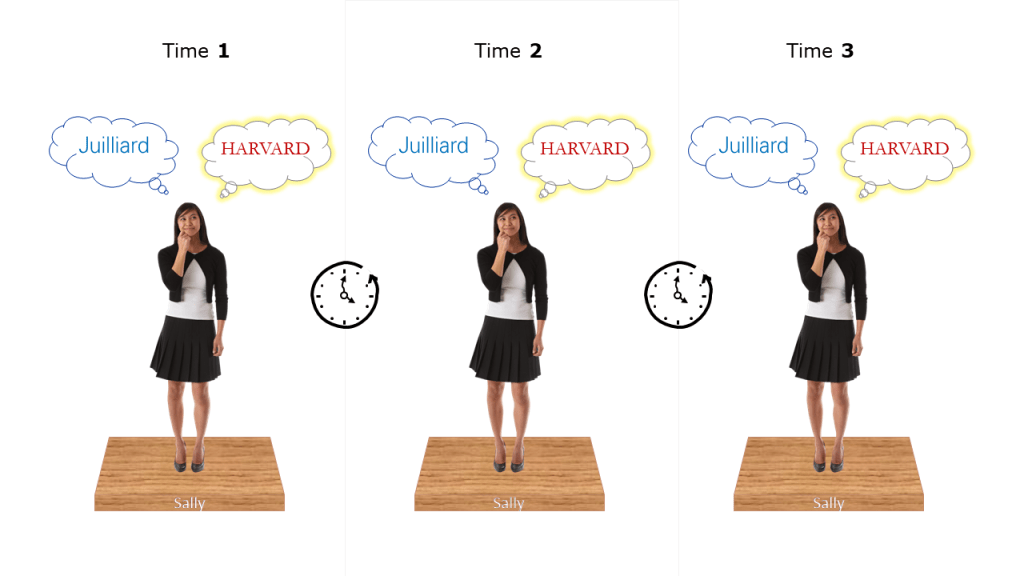
In a deterministic universe, borrowing from Peter van Inwagen’s example, if Sally has to choose between Julliard and Harvard, if she ‘chooses’ Harvard, the first time, and subsequent instance would see her making the same choice.

Indeterminism

Indeterminism effectively says, that whatever happens in a causal chain results from what has happened before. However, random events could alter the outcome. If we could turn back time, although events could unfold identically, they don’t have to.

In an indeterministic universe, borrowing again from Peter van Inwagen’s example, if Sally has to choose between Julliard and Harvard, if she ‘chooses’ Harvard, the first time, a subsequent instance might see her choosing Harvard again, but she might also choose Julliard. Since we have not entered free will into the arena, her choice was indeterminate but based on something entirely outside of her control. At some point, RNG entered the picture and tossed a 1 instead of a 0 thereby sealing her fate, as it were.

Again, absent the notion of free will, perhaps Sally was particularly inspired by a music teacher or a musician. Perhaps she just watched the Johnny Depp and Amber Heard trial and was compelled to fight for justice. Perhaps she was hungry or full. Perhaps she was stuck in traffic. Perhaps she was deciding during shark week.

Groundhog Day and Butterfly Effect

Another popular trope is that if we could rewind time, we could either effect change in the rerun through learning or just altering the past. We’ve seen this played out in movies like Groundhog Day, Butterfly Effect, the Back to the Future series, and so on. Time travel stories present several thought experiments that clearly play on the concept that we do have power over our environment. We’ll save this narrative for another day.

Houston, we have a problem

EDIT: Since I first posted this, I’ve discovered that computer algorithms and maths are not playing well together in the sandbox. Those naughty computer geeks are running rogue from the maths geeks.

In grade school, we typically learn a form of PEMDAS as a mnemonic heuristic for mathematical order of operations. It’s a stand-in for Parentheses, Exponents, Multiplication, Division, Addition, and Subtraction. This may be interpreted in different ways, but I’ve got bigger fish to fry. It turns out that many (if not most) programming languages don’t implement around a PEMDAS schema. Instead, they opt for BODMAS, where the B and O represent Brackets and Orders—analogous to Parentheses and Exponents. The important thing to note is the inversion of MD to DM, as this creates discrepancies.

And it doesn’t end here. HP calculators interject a new factor, multiplication by juxtaposition, that mathematician and YouTuber, Jenni Gorham, notates as J resulting in PEJMDAS. This juxtaposition represents the implied multiplication as exemplified by another challenge;

1 ÷ 2✓3 =

In this instance, multiplication by juxtaposition instructs us to resolve 2âś“3 before performing the division. Absent the J, the calculation results in ½✓3 rather than the intended 1/(2âś“3). As with this next example, simply adding parentheses fixes the problem. Here’s a link to her video:

And now we return to our originally scheduled programming…

Simplifying concepts has its place. The question is where and when. This social media war brings this back to my attention.

As depicted in the meme, there is a difference of opinion as to what the answer is to this maths problem.

6 Ă· 2 ( 1 + 2 ) =

In grade school, children are taught some variation of PEMDAS, BOMDAS, BEDMAS, BIDMAS, or whatever. What they are not taught is that this is a regimented shortcut, but it doesn’t necessarily apply to real-world applications. The ones defending PEMDAS are those who have not taken maths beyond primary school and don’t use maths beyond some basic addition and subtraction. Luckily, the engineers and physicists who need to understand the difference, generally, do.

Mathematicians, scientists, and engineers have learned to transform the equation into the form on the left, yielding an answer of 1. If your answer is 9, you’ve been left behind.

Why is this such a big deal?

When I taught undergraduate economics, I, too, had to present simplifications of models. In practice, the approach was to tell the students that the simplification was like that in physics. At first, you assume factors like gravity and friction don’t exist—fewer variables, fewer complexities. The problem, as I discovered in my advanced studies, is that in economics you can’t actually relax the assumptions. And when you do, the models fail to function. So they only work under assumptions that cannot exist in the real world—things like infinite suppliers and demanders. Even moving from infinite to a lot, breaks the model. Economists know this, and yet they teach it anyway.

When I transitioned from undergrad to grad school, I was taken aback by the number of stated assumptions that were flat out wrong.

When I transitioned from undergrad to grad school, I was taken aback by the number of stated assumptions that were flat out wrong. Not only were these simplifications flat out wrong, but they also led to the wrong conclusion—the conclusion that aligned with the prevailing narratives.

This led me to wonder about a couple of things

Firstly, if I had graduated with an English degree and then became a PhD candidate in English, would I have also learnt it had mostly been a lie for the purpose of indoctrination?

Secondly, what other disciplines would have taught so much disinformation?

Thirdly, how many executives with degrees and finance and management only got the fake version?

Fourthly, how many executives hadn’t even gotten that? Perhaps they’d have had taken a class or two in each of finance and economics and nothing more. How many finance and economics courses does one need to take to get an MBA? This worries me greatly.

To be honest, I wonder how many other disciplines have this challenge. I’d almost expect it from so-called soft sciences, but from maths? Get outta here.

Half-life of knowledge

This also reminds me of the notion of the half-life of knowledge. What you knew as true may eventually no longer be. In this case, you were just taught a lie because it was easier to digest than the truth. In other cases, an Einstein comes along to change Newtonian physics into Oldtonian physics, or some wisenheimer like Copernicus determines that the cosmic model is heliocentric and not geocentric.

If you’ve been keeping up with my latest endeavour, you may be surprised that free will, human agency, identity, and the self are all human social constructs in need of remediation. Get ready to get out of your comfort zone or to entrench yourself in a fortress of escalating commitment.

Peter van Inwagen – Big Questions in Free Will

Peter van Inwagen is a personality I’ve had on my radar, but I haven’t spent any time with him because he is a referenced influence of Robert Kane or Derk Pereboom, who hold positions I disagree with.

Video: Peter van Inwagen – Big Questions in Free Will

Still, I was interested, so I thought watching a short 13-minute video interview might introduce me to him. I’ve enjoyed other Closer to the Truth content, so I gave it a go. I feel that Peter sets up the problem perfectly. No faults whatsoever. As I see it, the same problem and solution proposal arises that Galen Strawson adopts, yet this is where I disagree with them both.

As noam chomsky has speculated maybe our minds are just put together in the wrong way to find this fault we got a certain set of cognitive modules tossed up to us in our evolutionary history maybe we got the wrong ones for thinking about this problem

— Peter van Inwagen

[TBD]

Unless I decide to unpack the rest, I’ll cut to the chase. The argument is as follows:

  1. Humans are somehow hardwired to blame. (I do not know if this is universally true, but let’s accept this premise as being true.)
  2. Without the notion of free will (or at least human agency), we cannot assign blame.
  3. Therefore, in order to assign blame, free will has to be true.

I don’t disagree with this syllogism. However, in ‘free will has to be true’ , there are ostensibly two possibilities.

  1. Free will exists as a fact in nature—a priori
  2. Free will is a construction—a posteriori

Of course, the general consensus for proponents of free will is that it exists a priori. My contention is that this is not the case. Free will is an a posteriori construction.

Inwagen is falling into a heuristic trap: It feels like it’s true, so it’s obviously true. Borrowing from Daniel Kahneman, he and others are relying on System I and failing to trigger System II, where System II is required. Moreover, I take this position because I don’t think System II has what it needs to accurately analyse and assess the situation holistically. We can’t get outside of the system, so we make up a story that presumably serves our purposes.

I am not one who believes ‘the universe is a simulation’, but I do believe it serves as an apt metaphor. We are player characters in the game and we can’t see outside of it.

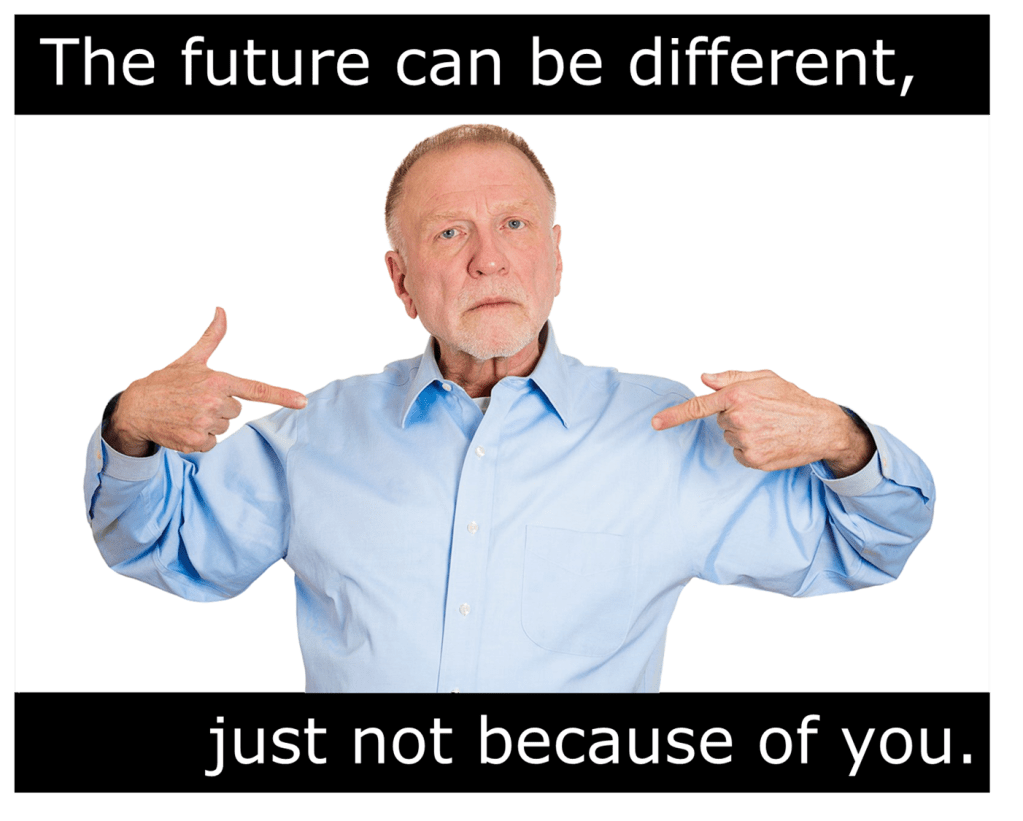
I like to sum it all up with the expression, the future can be different, just not because of you.

Taste Buds of the Righteous Mind

Ok, so it turns out that I lied. I’ve been reading Jonathan Haidt’s The Righteous Mind and not annotating as I progress. As much as I want to, I’ve got competing interests that prevail. I find there’s a lot I want to comment on, but I also wish to continue reading this and other things. And then there’s sleep. Damn it!

I like Haidt’s style and approach, BUT… and there it is. I am waiting for the sword of Damocles to fall, for the other shoe to drop. I have found a few things to be disconcerting, and I am waiting to exclaim at some pint, “See, I told you so.”

As I haven’t commented on the previous chapter, yet I hope to, I’ll keep my commentary short. I have a general feeling that as much as he understands the need to remain objective (as a subject with a POV), I can’t help but to feel that he is encasing his data points in an anecdotal wrapper, which in turn shapes his narrative into something a lot less universal than he may think. This is very much his journey and his story, but I am still interested in seeing how it plays out.

He establishes a story to create an analogy between taste receptors—sweet, sour, salty, bitter, and savoury (also called umami)—and moral receptors.

I’ll develop the analogy that the righteous mind is like a tongue with six taste receptors. In this analogy, morality is like cuisine: it’s a cultural construction, influenced by accidents of environment and history, but it’s not so flexible that anything goes.

Johnathan Haidt, The Righteous Mind, Ch. 6. Taste Buds of the Righteous Mind

His basic premise is that a typical human essentially has taste and moral receptors. Having these receptors doesn’t mean we all have the same ‘tastes’ and like the same food, but it means we have in-built propensities. And some things just don’t mix.

Haidt sets the table with a history, citing Plato in passing, and shining lights on Bentham, Kant, and Hume. Haidt and I are both partial to Hume. I’ve never been a fan of Bentham’s Utilitarianism, and I just can’t Kant.

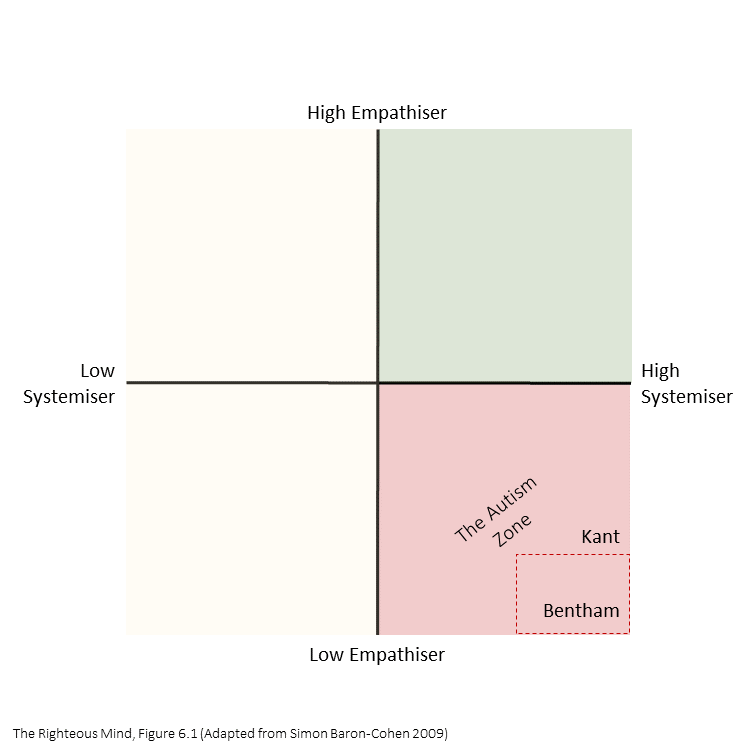
Haidt borrows from Baron-Cohen (hailed as “Ali G’s smarter cousin”, thanks to being first-cousin of the comic actor Sacha), using an adaptation of his Systemiser-Empathiser matrix.

Haidt’s Systemiser-Empathiser Matrix.

The two axes depict systemising on the X-axis and empathy on the Y-axis. The point he makes (notably anticipating ad hominem charges) is that Bentham would likely be labelled on the autism spectrum as having Asperger’s Syndrome these days and Kant fared only slightly better. Hume, on the other hand—and though not plotted—, would have exhibited more empathy than these other blokes. And empathy had theretofore been mostly absent with moral philosophy to date—notwithstanding Hume. I can only imagine that Haidt would situate himself in the favourable green box.

I wondered whether Baron-Cohen’s original version used isocurves or some such, so I found his original paper that depicted the plane space as shown below.

Children’s Empathy Quotient and Systemising Quotient Matrix

A cursory review of the study of boys and girls with and without autism spectrum diagnoses was interesting but way off-topic, so I return to complete this chapter summary.

For Benthem, everything boiled down to utility, and Kant, with his categorical imperative, followed a deontological path searching for a universal law, an objective morality, centred on justice. Bentham used maths whilst Kant opted for logic.

Haidt prefers Hume, but this is advanced by Shweder. Here he doubles down on the receptor analogy but wants to avoid creating just-so stories, acknowledging how easy it is to fall into this trap. He borrows the idea of modularity from cognitive anthropologists Sperber and Hirschfeld and establishes in-built genetic mechanisms, citing examples of fear of snakes (capability: snake detecting) and human facial recognition. Then he distinguishes between the evolution by natural selection and that of a more dominant cultural adaptation once it manifests.

Harking back to the taste buds, he reiterates that just because we all have the same moral receptors, it doesn’t follow that we’ll share the same moral code.

He presents a summary of his Moral Foundations Theory, which I’ll abridge even further here. He posits 6 dimensions:

  • Care/harm
  • Fairness/cheating
  • Loyalty/betrayal
  • Authority/subversion
  • Sanctity/degradation
  • Liberty/oppression

For each of these, he constructs a description and an evolutionary narrative.

And then he summarises the chapter as follows.

The second principle of moral psychology is: There’s more to morality than harm and fairness. In this chapter I began to say exactly what more there is:

  • Morality is like taste in many ways—an analogy made long ago by Hume and Mencius.
  • Deontology and utilitarianism are “one-receptor” moralities that are likely to appeal most strongly to people who are high on systemizing and low on empathizing.
  • Hume’s pluralist, sentimentalist, and naturalist approach to ethics is more promising than utilitarianism or deontology for modern moral psychology. As a first step in resuming Hume’s project, we should try to identify the taste receptors of the righteous mind.
  • Modularity can help us think about innate receptors, and how they produce a variety of initial perceptions that get developed in culturally variable ways.
  • Five good candidates for being taste receptors of the righteous mind are care, fairness, loyalty, authority, and sanctity.

What I like about Haidt is that he admits that all of morality is fully constructed and humans have receptors that are just waiting for something to plug into them. I believe his prceconceived notions will play a part in connecting these. I am also concerned with the possible limitations of his ordered pairs—care-harm and so on.

In closing, I am still leery that in spite of claiming ‘in psychology our goal is descriptive‘, he will presently be sharing his prescription.

Do What Is Right

Do what is right, not what is easy. This was posted on LinkedIn, the Instagram of business networking, and these vapid concepts are as ubiquitous as the believers. I don’t know if there is an overlap between these people and the religious, but I have my suspicions.

Right‘ is another weasel word. As I like to separate ‘Truth‘ from ‘fact‘, I prefer to distinguish ‘right‘ from ‘correct‘. It seems that one could simply predicate ‘truth‘ and ‘fact‘ with ‘moral’ to yield ‘moral truth‘ and ‘moral right‘ in a similar manner to the way we prefix science as pseudoscience when we want to call out its bullshit nature.

On one level, I understand directionally what these terms mean, but it still irks me. Do what is right translates most directly to ‘Do what I think you should do‘, once removed from ‘Do what I believe my preferred peer group or authority group believes you should do‘. This is what moral right distils down to.

But people who employ these terms and, more importantly, buy into them, feel very strongly that it means more than that. Generally speaking, they believe they have tapped into some universally applicable vein.

Disclaimer: I’ve been reading more of Johnathan Haidt’s Righteous Mind, so it might have tipped my sensitivity meter to 11.