Free Will Scepticism: Determinism, Indeterminism, and Luck

Making video content for even the simplest of concepts is time-consuming, but I wanted to create some visual content. Even though this material is hardly controversial, I feel it is important to set the stage for more advanced conversations.

Video: Free Will Scepticism: Determinism, Indeterminism, and Luck

I am getting better at understanding how the video editor works, so subsequent videos should be of higher quality. As I use free repurposed video content, I am forced to accept what’s available. In plenty of cases, more apt content is available from Adobe or iStock, but I can’t justify purchasing content at this time—especially given that the channel isn’t even monetised. Patience.

Follows is the transcript I used as a guide.

Free Will Scepticism. Determinism, Indeterminism & Luck

[REDACTED]

In this segment of free will scepticism, I talk about what free will is, why it’s important, and why it creates challenges that lead to a debate that’s lasted millennia.

Once we’ve established a foundation, we’ll look at the nemesis of free will that is determinism and its attendant nuances—indeterminism and luck.

As we unravel this problem, we’ll evaluate the relationship between these and whether these competing concepts can coexist.

In future segments, I intend to dig deeper into the question of free will as it relates to human agency and moral responsibility.

Defining Free Will

A good starting point is to define our terms. As we’ll discover, a fundamental challenge in the free will debate is that there is no common, agreed-upon definition, so let’s at least put some on the table.

A quick Google search yields these two definitions.

  1. the apparent human ability to freely and consciously make choices that are not externally determined
  2. the doctrine that such human freedom of choice is not illusory
    Let’s break down the first one by touching on the terms. This is an ability. No controversy here. Choices are the focus of this ability, and this ability is limited to humans. Not everyone limits the notion of free will to humans. In general, the reason free will gets so much attention is in relation to moral choice. As we don’t generally impose morality on non-human animals, we can live with this for now.

Note that this definition concedes that this is just an apparent human ability. This is because some people believe that if free will exists at all, it is just an illusion.

This ability. I’ll drop the ‘apparent’ qualifier so I don’t come across like an attorney and their ‘alleged’ perpetrator. This ability needs to be made freely and consciously. Free means without restriction, and consciously means with conscious intent. The definition further qualifies the free and conscious choice-making by stating that these choices are not externally determined. A person cannot be under a spell, hypnotised, or driven by unconscious intents. We’ll eventually see that disagreement centres around each of these terms, freely, conscious, and externally determined.

Stanford Encyclopaedia of Philosophy, an excellent online resource, defines free will as ‘a philosophical term of art for a particular sort of capacity of rational agents to choose a course of action from among various alternatives’. The ability to freely make choices is a common thread for all of these.

Another way to think about free will is to ask if you could have chosen otherwise. This is a thought experiment, and we’ll spend more time on this later. If you could turn back the clock and rerun the scenario, could you have chosen otherwise.
As Jerry Coyne put it, ‘if you could rerun the tape of your life up to the moment you make a choice, with every aspect of the universe configured identically, free will means that your choice could have been different’.
Let’s work through a simple scenario with no moral implications. All of the events of your life have led up to this moment. A server asks, tea or coffee. You choose tea. Black or lemon—or cream? Let’s not get ahead of ourselves.
Let’s re-run the scenario. Everything leading up to this server asking for your order is the same—the same seat at the same table, in the same restaurant, the same server. Even the same jelly stain on the curtain and the same blue Buick parked outside your window. And the same parent trying to quiet her unruly child. You get the idea. Everything until now has played out the same. Last time you ordered tea. Do you possess the free will to order coffee this time around?
We don’t need to answer this question quite yet. Keep whatever idea you have and we can compare it against the competing perspectives.

You might be thinking, so what? Who cares? Why is free will so important?

Free will is not just some abstract philosophical concept. Philosophy gets accused of pondering topics with no application in the real world. What is the sound of one hand clapping sort of fare.

Free will is at the centre of human agency and autonomy. The only reason it makes sense to praise or blame someone is because they could have done otherwise. We might praise a robot that was programmed to rescue people from fires. Even if we marvelled at the achievement of the robot, we’d more likely praise the programmer or the operator over the robot.

Likely more important than praise is blame. Humans’ propensity for blame could be its own series, so let’s just consider the notion idiomatically. If a person is remotely controlling a robot and steers it into your table, spilling your tea, you may be miffed at the robot, but your blame will be aimed at the one who’s holding the remote controller.

After blame comes punishment, or reward in the case of praise. This is another subdiscipline in its own right, so let’s continue.

Many people just presume that free will exists, so where are the challenges?
First, the definition of free will is unstable, and it has drifted over time. Sometimes this has been innocent enough whilst at other times the definition has been amended to suit an argument. Sort of moving the goal posts. So, there’s no standard definition. This means that I can accept the notion under one definition and reject it under another. This hardly makes for fruitful debate.

Related to these first two is that for some people, the concept is reduced to something so narrow, so laser-focused, that it doesn’t seem to matter in the real world. Daniel Dennett has said that he’d be willing to concede that one doesn’t have free will except in matters of decisions in the order of ‘one cube of sugar or two in your tea’ or ‘taking the lavender blouse over the lilac one’. If you contend that this is the limiting boundary for free will, sure. You’ve got free will, for what it’s worth.

Still others say that free will is nothing more than an illusion. That a person perceives having free will is akin to perceiving that the sun rises in the East. We know this not to be true, and yet it appears to be true. We even commit this faulty observation to language, and it’s difficult not to envisage it differently.

The strongest position against free will comes from the Impossibilists, who hold unsurprisingly, the belief that free will is impossible given what we know about physical laws and the universe. Galen Strawson is likely the most notable of these people.

Determinism

Contrary to free will is Determinism. Defined, Determinism is the doctrine that all events, including human action, are ultimately determined by causes external to the will.

Ostensibly, this is a strong belief in cause and effect. That every event is caused by a prior event. The implication is that if one were to turn back time to the Big Bang and let history run again, everything down to the smallest atomic movement would run the same course of events. Absolutely nothing would change. This includes any thoughts and decisions. Unchanged.

Given this worldview, some philosophers have taken determinism to imply that individual human beings have no free will and cannot be held morally responsible for their actions.

Without going too deep, Determinism can be a view adopted from a sectarian or secular perspective. The sectarian narrative is that God created the natural laws and set the universe in motion. The secular vantage is that there are physical laws, and the big bang set the universe in motion. These days, not many people hold this view. Indeterminism is the reason.

Indeterminism

Indeterminism is another idea cursed with multiple definitions. The name originated as a counterargument to Determinism, hence the ‘in‘ prefix in the name. Not determinism.
Indeterminism says that deliberate choice and actions are not determined by or predictable from antecedent causes, or that although there may be deterministic behaviours in the universe,
not every event has a cause.

I’d like to qualify ‘not every event has a cause’ to ‘not every event has a known cause’ or some events have probabilistic causes, hence indeterminate. There is a bit of overlap here with the notion of luck, and we’ll get to that presently.

Our knowledge of physics and the advent of quantum mechanics has put hard determinism out of favour. As we saw, under strict determinism, if we turned back time, the future would always unfold identically. Think of this as a film strip or a video. No matter how many times you replay it the events manifest the same way. You can warn the camper not to go down into the cellar alone, but every time, she will. You can almost think of this as a sort of fate, although one must be careful to note that rewinding and replaying to the parts we’ve already seen does not mean that we can predict what we haven’t.

Quantum physics notes that there are many events that are stochastic or probabilistic. So even if you rewound and played it again, it would be like the girl flipping a coin before opening the cellar door—or I suppose the director. Heads, she goes down. Tails, she remains up, or she gets a friend.

The less strict version of Indeterminism doesn’t say that nothing is determined. Rather, that there are enough probabilistic events that we can’t claim to know what’s going to happen next.

Luck

Then there’s luck. Luck is also indeterministic, but it tries to clarify some cases. By definition, luck is success or failure apparently brought by chance rather than through one’s own actions. If you flip a fair coin or throw a fair die or pull the handle on a slot machine, you may win or lose, but this outcome had nothing to do with you except that you were there at that moment. But there is more to it than this because a strict Determinist might claim that the outcome was determined by the state of molecules in history, that if you reran history, it would unfold the same way.

Apart from the luck that we tend to think of in gambling—good luck and bad—, there is the notion of moral luck, that is treating people as objects of moral judgement even when what they do depends on factors out of their control.

Not all luck is created equal, so let’s look at the various flavours of luck. Most of these were articulated by Thomas Nagel.

Resultant Luck

Resultant luck is the way things turn out. This notion evaluates luck in reverse. It involves what is known as survivorship bias.

I’ll share a true story. An acquaintance of mine got married and took a honeymoon in Jamaica. On holiday, the couple ate some seafood. His wife became sick and was hospitalised. There she died.
One can imagine a story with a happier ending, where the couple took holiday and won a large cash prize in a casino, again a situation that could not have happened unless they had happened to be there.
In the first case, one might say she had bad luck. In the second case, her luck was good.

Circumstantial Luck

Circumstantial luck is the circumstance one finds oneself in. You had no control over how you got to a certain place, but because you got there, you are faced with a choice. The gist of this is that the choice would not have been given, so you would never have made it.

Perhaps, expecting you to be out, a burglar enters your home one evening and you confront him and he shoots you (or you shoot him; it doesn’t matter). Maybe you were driving to someplace and another vehicle crashes into yours, totalling it. This is circumstantial. You had no intention of getting into an accident. Had you not been driving, this could not have happened. Perhaps, because of the accident, you won a lawsuit that yielded you a lot of money; perhaps, your back was irreparably damaged. Circumstantial luck.

Constitutive Luck

Constitutive luck relates to who one is or their traits and dispositions. Think of this as character. Some people are ‘born’ with a persuasive disposition. Some are born to excel at football or maths. Some are The Rain Man. This is the genetic lottery. Perhaps you want to be a famous singer. Only you can’t sing. And maybe you can sing, but you lack charisma.

Billionaire Warren Buffett readily concedes that he would not likely be a billionaire if he happened to be born in India rather than the United States. This is constitutive luck.

Present Luck

Present luck is about luck at or around the moment of a putatively free action or decision point. This is a term used by Levy, borrowed from Mele. At any point in time, you are who you are and where you are as a matter of luck. You were born in a place at a time in history into a family. Heidegger called this ‘thrownness’. A person is thrown into this world and has to survive or not on their own terms. In any case, this family moulded you and schooled you with whatever constraints that they may have had: money, class, access, location. All the usual suspects. You interacted with the kids who were available. You got whatever teachers you got, and on and on. I think you get it. None of this is within your control.
Examples I think of are musical acts, bands like The Beatles, Korn, U2, and so many others that are comprised entirely or largely of friends. They just happened to be born in the same general time and vicinity. I imagine if either of these were different, they wouldn’t have manifested the same way. Imagine Mozart being born in the 21st century. Perhaps he’d be a YouTube star. Who knows?

Causal Luck

Causal luck is how one is determined by antecedent circumstances. This is the type of luck most closely aligned with free will and determinism. Simply put, it says that everything that preceded you is outside of your control as is everything leading up to what you have become. Causal luck is about the directional relationship between cause and effect.

For the record, some view causal luck as redundant to the combination of constitutive and circumstantial luck. I think that’s a fair charge, but let’s continue and see how these concepts play together.

At the highest level, there are two competing perspectives. Free will and determinism are either incompatible or compatible. Let’s begin with incompatibilism.

Incompatibilism

As it would seem, this view holds that free will and determinism are mutually exclusive. This holds for indeterminism as well. One cannot simultaneously hold the view that everything is determined, and that one can still manage to have free will in this determined universe.

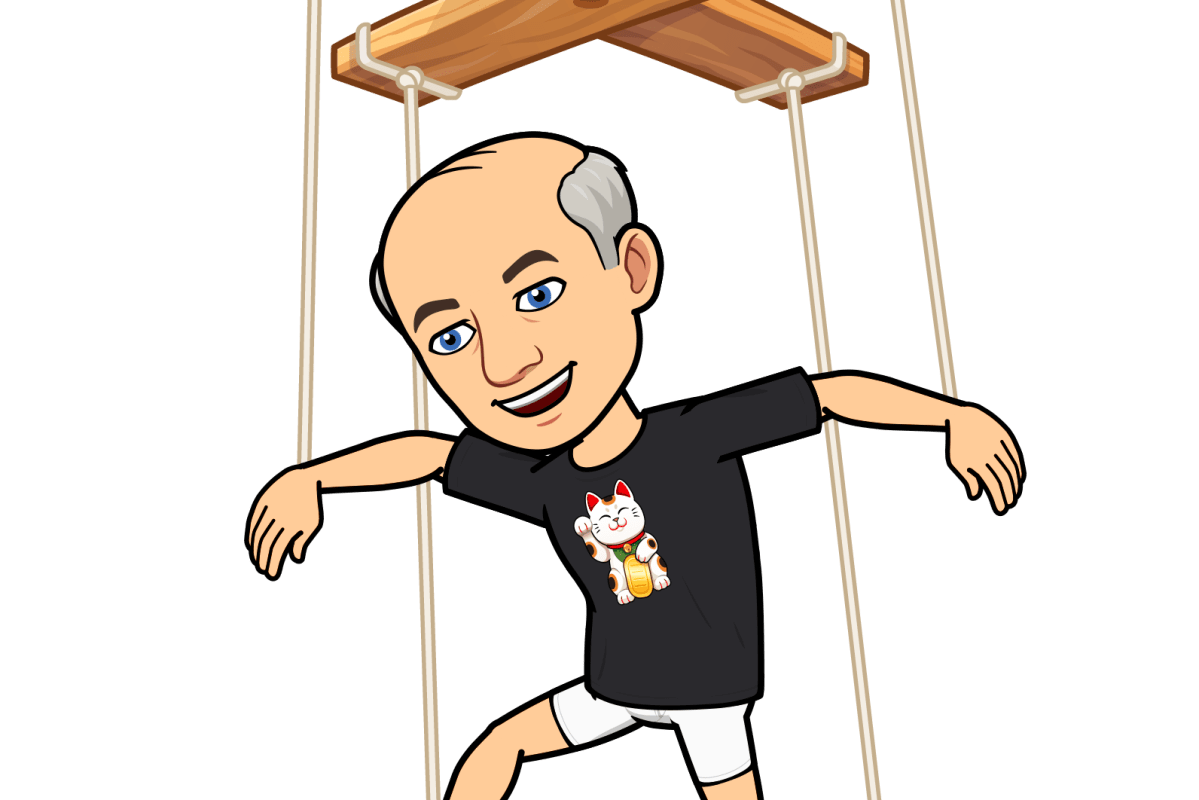
A puppet is free as long as he loves his strings

SAM HARRIS

Sam Harris famously wrote, ‘a puppet is free as long as he loves his strings’. Harris is a neuroscientist and free will sceptic, who believes that free will is an illusion. And I was determined to not let this image go to waste.

Compatibilism

Finally, we have compatibilism, where the belief is that free will and determinism can coexist—and do. There are two basic reasons this might be possible: metaphysics or emergence.

Metaphysics

I’ll let you know that I find the metaphysical argument to be weak tea. The argument is that maybe there is a god or something not bound by the constraints of our universe, who can put ideas into your brain, thus manipulating your decision. You were going to order tea, but this intervention led you to order coffee. I think that this perspective falls on its face right out of the gate. If some force is controlling you, the resulting actions may not have been predictably determined, but neither are they caused by you. In this scenario, this force might as well be the person controlling the robot to spill your tea.

Emergence

Then there’s emergence. Quickly, emergence is the notion that one can combine two or more elements with the outcome being a substance with different ‘emergent’ properties. An example most people are familiar with is the combining of hydrogen and oxygen to produce water. Two Hs plus an O creates H20. Hydrogen and Oxygen are both gasses, but water is a liquid with a further emergent property of being wet.

The argument is that this free will occurs independently of all the inputs and processes. If this were true, then free will and determinism could coexist. There is no evidence of this, and I’ll just leave it here.
I intend to add to this by reviewing articles for and against free will and the compatibilist position.

Do you believe you have free will? If so, why. Are you a determinist or an indeterminist? Are you a compatibilist or an incompatibilist?

Let me know in the comments below.

[REDACTED]

No Agent, No Agency

There is no spoon” is a classic line from The Matrix. Reality is a construct. I agree, but I’m not sure I believe that we can get under this reality to experience it differently. And this might hinge on a distinction between experience and perception.

Losing Ourselves is a book just published in the US and forthcoming (July 2022) in the UK promoting the Buddhist notion of no-self or selflessness. I’ve been partial to Buddhism since, when I lived outside of Tokyo, I was exposed to it in 1980.

Book Cover: Losing Ourselves

For me, this intersects with my anti-Agency endeavour. If the Self is a construct, there is no Agent, and without an agent, there is no Agency. I realise that this is a meta-position and not uncontroversial, but I do like to collect ideas and perspectives in my quiver.

Obviously, there seems to be a strong drive (at least in the West) to construct selves, not the least of which serves the purpose of an object to confer praise or blame. Interestingly, I’ve heard much about objectification, but not many seem to care about this form. It’s more about sub-objectification.

It’s OK to parse the person from the fabric of the universe, but don’t further disintegrate that person.

Moral Responsibility

Can we be held morally responsible for our actions? Yes, says Daniel Dennett. No, says Gregg Caruso. Reader, you decide

Aeon Article, 4 October 2018

Caruso: [Dan,] you have famously argued that freedom evolves and that humans, alone among the animals, have evolved minds that give us free will and moral responsibility. I, on the other hand, have argued that what we do and the way we are is ultimately the result of factors beyond our control, and that because of this we are never morally responsible for our actions, in a particular but pervasive sense – the sense that would make us truly deserving of blame and praise, punishment and reward. While these two views appear to be at odds with each other, one of the things I would like to explore in this conversation is how far apart we actually are. I suspect that we may have more in common than some think – but I could be wrong. To begin, can you explain what you mean by ‘free will’ and why you think humans alone have it?

Gregg Caruso

Dennett: A key word in understanding our differences is ‘control’. [Gregg,] you say ‘the way we are is ultimately the result of factors beyond our control’ and that is true of only those unfortunates who have not been able to become autonomous agents during their childhood upbringing. There really are people, with mental disabilities, who are not able to control themselves, but normal people can manage under all but the most extreme circumstances, and this difference is both morally important and obvious, once you divorce the idea of control from the idea of causation. Your past does not control you; for it to control you, it would have to be able to monitor feedback about your behaviour and adjust its interventions – which is nonsense.

In fact, if your past is roughly normal, it contains the causal chains that turned you into an autonomous, self-controlling agent. Lucky you. You weren’t responsible for becoming an autonomous agent, but since you are one, it is entirely appropriate for the rest of us to hold you responsible for your deeds under all but the most dire circumstances. 

Daniel Dennett

if your past is roughly normal, it contains the causal chains that turned you into an autonomous, self-controlling agent

Dan Dennett

So commences this debate. The argument unfolds largely on semantic grounds. Even here, one can see the debate over the distinction between control and causation. I understand what Dennett is attempting to parse here, but I object on the grounds of causa sui.

I recommend reading the Aeon article as there is much more than this distinction, but it does remain a semantic issue. I started a post on backwards- and forward-looking perspectives, that better articulate Caruso’s perspective, but I am also working on other things. This was quicker to post and I wanted to keep a bookmark anyway, so it’s a win-win.

Self-Creation

The self is a construction. Although we can form memories at an early age, this is possibly why we can’t remember our earliest years, as our sense of self had yet to be constructed and realised. Not all people construct or even define ‘self’ in the same way, per Strawson’s ‘selves’ and other notions of selflessness.

I understand when Strawson (and others) says he does not feel the same sense of continuity as others with strong senses of self believe. I don’t know what a person, who truly believes in selflessness or the total denial of the self, feels—a person who totally embodies the Buddhist concept that everything is one and any division is an illusion.

In the West, there are entire industries fleecing the public of billions upon billions of dollars on the notion of the self, strengthening the self and how others perceive one’s self from an outside-in perspective—psychology and its progeny of self-help reaping the lion’s share.

For the record, although I agree with both Strawson’s and the Buddhist perspective, I am still under the illusion (as I am with agency) that I have a self and agency. Unlike the Neo character in The Matrix, I haven’t discovered how to break the illusion to find the man behind the curtain, but I do feel a sense of discontinuity or lack of contiguity.

Agency Is Dead

Agency is going through the same fits as religion. When Nietzsche regarded society around him at the time, he declared that God is dead and asked now what? This is precisely the same challenge in different clothes.

Preserving “law and order” without a concept of real responsibility is a daunting task.

Dan Dennett

Without a God to use as a bully pulpit and mechanism of fear, how could we keep people in line in cohesive societies? Without the notion of human agency to allow for responsibility and blame, how can we keep people in line in cohesive societies? Only the predicate has changed, but the question remains, do we persist in lying for the so-called greater good? This is similar to the Santa Claus myth to keep young children in line.

If nobody is responsible, not really, then not only should the prisons be emptied, but no contract is valid, mortgages should be abolished, and we can never hold anybody to account for anything they do.  Preserving “law and order” without a concept of real responsibility is a daunting task.

—Dan Dennett, “Reflections on Free Will” (naturalism.org)

One might like to think that lying is psychologically pathological, but it seems to be a significant part of the human condition. The fundamental question doesn’t appear to be ‘should I tell the truth’, but rather ‘Can I get away with lying?’ Despite all the talk of Truth and integrity, this seems to be the default state of humans. This renders integrity just another lie. But you knew that already, but let’s not fall into another Foucauldian rabbit hole.

We no longer have any sympathy today with the concept of ‘free will’: we know only too well what is is — the most infamous of all the arts of the theologian for making mankind ‘accountable’. . . Everywhere accountability is sought, it is usually the instinct         for punishing and judging which seeks it… the doctrine of will has been invented essentially for the purpose of punishment, that is of finding guilty.

Twilight of the Idols: ‘The Four Great Errors’, 7
Appropriate Graphic

Arguing Semantics

Whenever I hear the phrase, ‘We don’t need to argue semantics’, two thoughts come immediately to mind.

  1. We do need to argue semantics
  2. Your position is shrouded in the ambiguity that you’d prefer remain intact—even if you are unaware of the ambiguity

This might be something less, but I find that many philosophical arguments are caused—at least in part—by a lack of a common foundation.

A common response to a ‘definition check’ is ‘you know what I mean’ or ‘everyone knows what X means’. My response is, respectively, ‘I might know what you mean, but I want to be sure’ or ‘great, so this should be easy for you to provide’.

Would-Be Agency and Luck

I’ve spend some hours cobbling together another video that I labelled Free Will Scepticism: Would-Be Agency & Luck. I’ve embedded it here. The script is below.

Human agency does not exist. Free will is an illusion. Like the appearance that the sun rises in the east and sets and the west, we only appear to have free will.

There are some nuances and varying degrees of this belief, but if one believes in the scientific notion of cause and effect, that every effect is the result of a prior cause of causes, one inevitably ends up in this camp.

Video: Free Will Scepticism: Would-Be Agency & Luck

[REDACTED]

Without going into details because the focus of this segment is on luck, I’d still like to set the stage for the uninitiated.

Regarding the universe, we recognise a relationship between cause and effect. If we rewind to follow this logic back to the beginning of time and started again, we’d end up in exactly the same place. This is known as deterministic. What happens next is determined by what happened before.

And this is not just a scientific view. Those who believe that God caused the universe can arrive at this same place.

Owing to advancements in scientific thought, most philosophers today do not believe that the world is deterministic, per se. Given theories of quantum mechanics and probabilistic outcomes, they believe in so-called natural physical laws, but probability is also part of this model.

One may strike a billiard ball with a cue stick to cause it to strike another ball, knocking it into a pocket. In our knowledge of the universe, this is unsurprising. If one set this up mechanically, leaving no room for variation, we could run this scenario over and over again forever, and the ball would go into the pocket every time. The outcome is established by the laws of physics.

Billards Animated GIF

Actually, this is just another illusion. The laws of physics cause nothing. They are just a way of describing how things unfold in our universe. But just like saying that the sun rises in the east, we can employ idiomatic language and people know what we mean.

This was an illustration of determinism. Indeterminism accepts these same laws, but it adds an element of probability. In our mechanised billiards example, perhaps a ball is randomly rolled across the table in such a way that it might interfere with the path of the balls.

If the random ball does not interfere with the path, its presence is irrelevant. If it does interfere, there are a few different outcomes.

One, it knocks a ball off course, so the final ball does not go into the pocket.

Two, its path is such that although it collides with a ball, this event does not interfere with the final ball ending up in the pocket, so a person fixated on the pocket might not notice anything more than a slight delay in the occurrence of the event.

The second scenario depicts indeterminism.

In both scenarios, the ball expected to go into the pocket is the would-be agent. As illustrated, the ball itself has no agency. None of them does. Its fate, to borrow a term steeped in metaphysics, is entirely subject to the actions before it. And then there’s chance, so let’s continue.

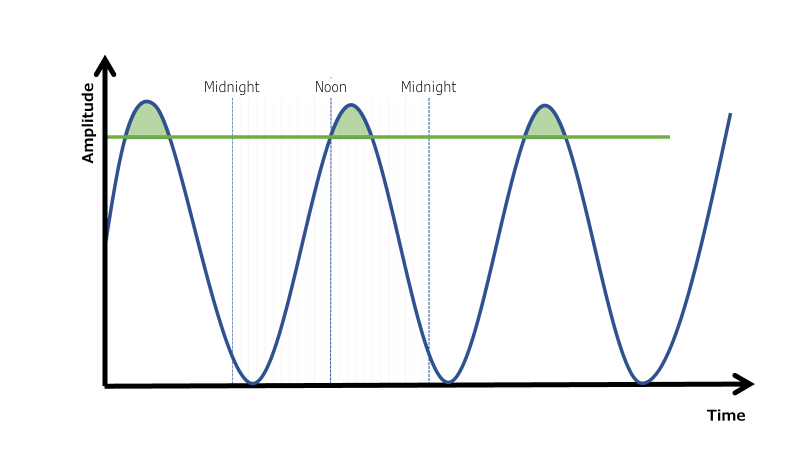
Humans are ostensibly automatons, subject to their genetic and environmental programming with no degree of free will. Let’s say that in a given context each person can be described by a certain wave function. For the sake of simplicity, let’s just pretend that it can be represented by a sine wave. As with any waveform, we can illustrate it by plotting it on a 2-dimensional plane, having amplitude on the Y-axis and time on the X-axis. Let’s consider this to be analogous to a person’s biorhythm, and let’s further consider that this represents the would-be agent’s mood or propensity to behave a certain way. 

Arbitrary Disposition Cycle

Practically, there might be more functions, so let’s just say that this is the average of all of these other functions—perhaps the other functions being how much rest was had the night before, when and what the last meal was, traffic encountered on the way to work, and any number of other personal considerations.

For any stable wave, we can plot the period from peak to peak or trough to trough. Let’s use trough to trough to represent a period of a day but from 2:30 am to 2:30 am rather than from midnight to midnight. This is one complete cycle. The offset is just to more easily facilitate the scenario.

Given this frame, we’ll put noon in the centre between the midnights as expected.

For the purposes of illustration, we’ll draw a horizontal line to represent a threshold depicting a change in disposition. We’ll use this later.

Finally, let’s show time increments by hour, so we now see 24 hours in a day. And we can see that at noon the wave peak rises above the threshold and falls below the threshold again at 5 pm.

Let’s presume that this wave function represents that of a criminal trial judge. There is support for this notion as published in Daniel Kahneman’s 2021 book, Noise: A Flaw in Human Judgment, wherein he notes that trial judges are almost as predictable as a watch, that their sentences are more correlated with time of day and the aforementioned factors than anything related to law—save for the laws of time, I suppose. 

Remembering that—like all people—this judge is an automaton. Let’s build some character—rather characteristics. Judge Judy believes that people are fundamentally bad and not to be trusted. She believes that they have free will and are accountable for their actions, though she does also allow for extenuating circumstances when considering sentencing, the usual suspects—bad childhood, chemical dependency, and whatnot. People who believe more strongly in free will are more likely to believe in harsher punishment. Judy is no exception.

Using this function as a guide, above the threshold represents her propensity for leniency. She tends to take lunch regularly before noon and is more lenient for a period after lunch. Data show that this effect is closer to a couple of hours after the midday meal, but we are simplifying.

Zooming in, let’s just consider a single day in the life of another would-be agent who as it happens will be interacting with our Judge Judy. I’ll take this opportunity to introduce the work of Neil Levy.

Neil is Head of Neuroethics at the Florey Neuroscience Institutes and Director of Research at the Oxford Centre for Neuroethics.

He is the author of Hard Luck, five previous books, and many articles, on a wide range of topics including applied ethics, free will and moral responsibility, philosophical psychology, and philosophy of mind.

Levy’s book promotes the concept that even if we allow for human agency, much of this supposed agency is undermined by luck. This will not only become evident in the scenario we are working through, but as a human, you may come upon a decision-point, where probability and luck come into play. You have no control over what ideas pop into your head—or don’t—and in what order. The choice you ultimately make is limited to what these ideas are and how they do or don’t manifest. Without going too far astray, perhaps you’ve constructed a false dichotomy.

Dark Alley

Perhaps you are confronted by a stranger in a dark alley. You observe that it’s a dead end. The stranger, asking for money, approaches you in a manner you interpret as menacing. As he reaches into his coat, you pull out your concealed weapon and fatally shoot him.

He was unarmed. No longer in panic, you realise that you are not in a dead-end alley.

When the police arrive, they inform you that the person you killed is known` by law enforcement and social services, who have been keeping an eye on him because he had limited cognitive capacity and resided in a group home. Not only was he not armed, but the detective on the scene noted that what he was reaching for were pens with inspirational inscriptions that he routinely sold to earn money.

Whilst you may not have been able to determine that he was otherwise harmless, it was your ‘luck’—bad luck—that you didn’t happen to see that you were never cornered in the first place.

Nevertheless, you are arrested.

In another scenario, perhaps there are two judges. Judge Judy and Justice Joe. As it happens, Justice Joe has a cycle reverse to Judy. Where Judy’s mood is better after lunch, Joe is fasting, and his mood gets worse. This means that your fate now is not only tied to the time of day but it’s also linked to the luck of which judge will hand down your sentence.

If you are a strict determinist, then the “universe” has already determined which judge will sentence you.

If you are an indeterminist, then the universe will flip a coin. And the probability of a case running long or short might determine the time of day.

In the end, as are you, the judges are slaves to their programming, and any alteration of inputs will just be processed through whatever they’ve become until that point. They have no more free will than you do. The die has already been cast.

Do you believe you have free will? If so, why. Are you a determinist or an indeterminist?  Or are you a compatibilist who believes that free will and determinism can coexist in the same universe?

Comment below or on YouTube.

Chthonic Introspection

The title of this post is admittedly pompous, but I promise it’s relevant. I was chatting with an online colleague about the travails of my anti-agency journey. I’ll lay it out here as well.

About a month or so ago, I embarked to research on my suspicion that human agency is ostensibly hogwash*. I went down many rabbit holes to find the skeletal remains of many rabbits who have embarked on this path before me. I thought I had some unique epiphany and I would just have to articulate my position, but it turns out not to be the case. In fact, it’s a crowded space—lots of skeletal Leporidae. Moreover, many of these blokes are still alive and kicking.

As it happens, we all fit under the large umbrella of free will scepticism, but there are several flavours mostly differentiated by where one prunes the branch. Scepticism of free will is the common bond, but the differences, as one might expect, lead to different implications. Some branches still allow for responsibility—even absent agency—, others even insist on responsibility despite not having agency—and still others, like me, claim responsibility is impossible.

All of these perspectives hinge on the validity and strength of determinism or indeterminism. Soft determinism (AKA compatibilism) allows for free will and determinism to coexist, so that’s not on my radar.

As I’ve cited elsewhere, there are not many non-religious determinists these days, as the state of science and quantum theory pretty much obsoleted the idea. But by my reckoning, from the perspective of the would-be agent, it doesn’t matter because in either case, this person (or other animate objects—no need to overspecify) is affected by the causal chain and does not affect it. This lack of affectation is precisely why we can’t attribute responsibility or desert.

This is not just some philosophical mental masturbation. It turns out that entire legal frameworks are designed on the prevailing held beliefs, and the more degrees of free will a culture assumes people have, the more punitive that society is—and vice versa. More on this in a future post where I intend to write about Gregg Caruso’s perspective and where and how our positions deviate.


* What is hogwash anyway? Not Googling it.

How come why? What for?

Video: Why? – “What for?” or “How Come?” — Daniel Dennett

As a rule, I don’t have much faith in humans. It would be apparent if you read some of my posts. I find most people to be akin to vapid sports fans: Hooray for my team—whether that team is political party or persuasion, science, religion, and whatever. Not a lot of critical thinking or reasoning. I believe Geuss mentioned that most people are just trying to make it to the next day and acquire more stuff—at least more stuff than the neighbour. Social media is a turn for the worse. Luckily and thankfully, there are exceptions to this rule.

Engaging in a CS Peirce forum that I was invited to because of some interactions I had in a postmodern forum, I asked for the source of a Peirce claim made by another Lee Smolin.

When you explain a system by referencing the laws, that’s not the end of the explanation; you have to—we must explain how the laws came to be and why there are these laws and not other laws.

Lee Smolin on CS Peirce

At 8:43, Smolin cites Peirce by saying ‘that when you explain a system by referencing the laws, that’s not the end of the explanation; you have to—we must explain how the laws came to be and why there are these laws and not other laws—and he goes on to say this is 1893…’

Video: Are the laws of the universe immutable and unchanging?

Not being a direct quote, I was experiencing difficulty finding the source of the citation, so I asked in the Peirce group. As I am wont to do, I added that I didn’t buy into the assertion, but if I could find the source I could gather more context.

I don’t buy into the assertion that in describing a system one needs to provide an origin story, so I was hoping to discover context to determine whether it’s Smolin or Peirce to have an issue with.

I was given a citation that didn’t happen to be accurate,

A second member chimed in that of course one needs an ‘original state’, so I clarified that it was not the original state that I held issue with. It was the narrative behind it—the story of the origin, not the origin itself.

He responded, ‘That’s Deacon!’ More precisely, the response was as follows:

YES!!!!!!! That’s Deacon!!!!

I’m not even schooled in Peirce, and now I’m getting his classmates.

To my origin clarification, I also added this bit:

I feel that ‘reasons’ or ‘whys’ are less important than ‘how’. In fact, I feel that ‘why’ is often used in English as a synonym to ‘how’ in many contexts.

So when asks ‘Why are you late?’ they are really asking ‘How it is that you’ve arrived late?’ or ‘How come you’re late?’ Why feels like a metaphysical stand-in for how.

…to which he responds with the top clip by Dan Dennett making my same point a decade ago—or I suppose that I am making his same point a decade later.

It seems that I’m late to the party yet again. This is becoming a trend.

Beyond Causa Sui

Audio: NotebookLM podcast discussing this topic.

The CAUSA SUI is the best self-contradiction that has yet been conceived, it is a sort of logical violation and unnaturalness; but the extravagant pride of man has managed to entangle itself profoundly and frightfully with this very folly. The desire for “freedom of will” in the superlative, metaphysical sense, such as still holds sway, unfortunately, in the minds of the half-educated, the desire to bear the entire and ultimate responsibility for one’s actions oneself, and to absolve God, the world, ancestors, chance, and society therefrom, involves nothing less than to be precisely this CAUSA SUI, and, with more than Munchausen daring, to pull oneself up into existence by the hair, out of the slough of nothingness. If anyone should find out in this manner the crass stupidity of the celebrated conception of “free will” and put it out of his head altogether, I beg of him to carry his “enlightenment” a step further, and also put out of his head the contrary of this monstrous conception of “free will”: I mean “non-free will,” which is tantamount to a misuse of cause and effect. One should not wrongly MATERIALISE “cause” and “effect,” as the natural philosophers do (and whoever like them naturalise in thinking at present), according to the prevailing mechanical doltishness which makes the cause press and push until it “effects” its end; one should use “cause” and “effect” only as pure CONCEPTIONS, that is to say, as conventional fictions for the purpose of designation and mutual understanding,—NOT for explanation. In “being-in-itself” there is nothing of “casual- connection,” of “necessity,” or of “psychological non-freedom”; there the effect does NOT follow the cause, there “law” does not obtain. It is WE alone who have devised cause, sequence, reciprocity, relativity, constraint, number, law, freedom, motive, and purpose; and when we interpret and intermix this symbol-world, as “being-in-itself,” with things, we act once more as we have always acted—MYTHOLOGICALLY. The “non-free will” is mythology; in real life, it is only a question of STRONG and WEAK wills.—It is almost always a symptom of what is lacking in himself, when a thinker, in every “causal-connection” and “psychological necessity,” manifests something of compulsion, indigence, obsequiousness, oppression, and non-freedom; it is suspicious to have such feelings–the person betrays himself. And in general, if I have observed correctly, the “non-freedom of the will” is regarded as a problem from two entirely opposite standpoints, but always in a profoundly PERSONAL manner: some will not give up their “responsibility,” their belief in THEMSELVES, the personal right to THEIR merits, at any price (the vain races belong to this class); others on the contrary, do not wish to be answerable for anything, or blamed for anything, and owing to an inward self-contempt, seek to GET OUT OF THE BUSINESS, no matter how. The latter, when they write books, are in the habit at present of taking the side of criminals; a sort of socialistic sympathy is their favourite disguise. And as a matter of fact, the fatalism of the weak-willed embellishes itself surprisingly when it can pose as “la religion de la souffrance humaine“; that is ITS “good taste.”

— Friedrich Nietzsche, Beyond Good and Evil
Münchhausen – Oskar Herrfurth

Just a quote and an image germane to that absurdity of causa sui.