The discussion became heated, and the two decided to submit the issue to arbitration, so they approached the lion.
As they approached the lion on his throne, the donkey started screaming: ′′Your Highness, isn’t it true that the grass is blue?”
The lion replied: “If you believe it is true, the grass is blue.”
The donkey rushed forward and continued: ′′The tiger disagrees with me, contradicts me and annoys me. Please punish him.”
The king then declared: ′′The tiger will be punished with 3 days of silence.”
The donkey jumped with joy and went on his way, content and repeating ′′The grass is blue, the grass is blue…”
The tiger asked the lion, “Your Majesty, why have you punished me, after all, the grass is green?”
The lion replied, ′′You’ve known and seen the grass is green.”
The tiger asked, ′′So why do you punish me?”
The lion replied, “That has nothing to do with the question of whether the grass is blue or green. The punishment is because it is degrading for a brave, intelligent creature like you to waste time arguing with an ass, and on top of that, you came and bothered me with that question just to validate something you already knew was true!”
Moral of the Story: The biggest waste of time is arguing with the fool and fanatic who doesn’t care about truth or reality, but only the victory of his beliefs and illusions. Never waste time on discussions that make no sense. There are people who, for all the evidence presented to them, do not have the ability to understand. Others are blinded by ego, hatred and resentment, and the only thing that they want is to be right even if they aren’t.
When emotions run high, intellect goes low.
This story is circulating on LinkedIn and has made the social media circuits. As you can judge from the attendant ‘moral of the story’ that this has been interpreted by an absolutist. This is a telltale sign of a Modern versus a so-called Postmodern who will allow for a different translation.
When discussing the topic of justice, besides the element of the event of offence, another element is typically intent. In this case, a father inadvertently left an infant in his car. He was supposed to drop the child off at daycare but forget and instead drove directly to work. The temperatures were hot, and this contributed to the death of the child. Upon discovering this, the father suicided.
I have copied the story below in full, as these things have been known to go missing every now and again.
A Virginia father died by an apparent suicide after finding his child dead inside his hot car, authorities said.
It appears the father accidentally left the 18-month-old in the car for at least three hours on Tuesday, leading to the child’s death, Lt. Col. Christopher Hensley of the Chesterfield Police Department said at a news conference.
When the child didn’t arrive at daycare, the father apparently realized the toddler was in his car, Hensley said.
Around noon, family members called police to report that the father was talking about dying by suicide in the woods behind his house. The father was the only person home at the time, Hensley said.
Responding officers found the car in the driveway with an open door and an empty child seat, Hensley said.
Officers went into the home where they found the dead 18-month-old, he said.
As officers continued to check the perimeter, they found the father dead in the woods from an apparent gunshot wound, he said.
Hensley called it a “horrible tragedy on so many levels.”
This marks the eighth child to die from a hot car this year, according to national nonprofit KidsAndCars.org. More than 1,000 kids have died from hot cars since 1990, the organization said.
Click here for tips on how to keep children safe from hot cars this summer.
An interest of mine is justice, hence this post. I’ll get to that, but there is also a narrative of social priorities to extract from here, too.
The first is that we live in a society where 18-month-olds almost need to be separated from their family. Of course, the privileged can defend that they have sitters or au pairs or nannies. In the past, there were extended families and Clinton’s Village. Each has its plusses and minuses. I am not a fan of the idea of women serving as baby factories, pumping out babies and serving their plight as wage slaves, but that’s not my call. I also understand that raising children is not the most mentally stimulating activity, but that’s beside the point.
In this case, the father was more focused on getting to work than the welfare of his child. And given the outcome, it’s obvious that he had feelings for the child—although perhaps it was more the fear of the repercussions of being blamed. One can’t know for sure, but I’ll opt for the charitable rendition.
Let’s return to justice. Justice is the sense that one gets one’s just desert, but what is just and what is desert? In the artificial form of justice purportedly practised by lawyers and jurists, this man would not likely be held responsible for legal reasons without even having to plumb the depths of philosophical reasons.
It’s been said that karma operates with three levers: intent, action, and reflection.
In this case, intent appears to be absent and reflection seems to be apparent in the outcome. The action was the lost life of an infant, a human life. Equally weighted, he’d be one step back and two steps forward, so his register would not be in the black. But this is not how he judged himself.
Even given the karmic model, it’s easy to imagine the reactions. As easy as it is for me to sit back behind my keyboard and be dispassionate, I can imagine the mother not being so reserved. Humans are blame-machines. I’ve been spending the past three or four months researching this topic peripherally with a focus on human agency, but in a reductionist model, humans seem to need to blame. And if there is no object, they have no qualms about making one up. Humans are good storytellers—more so, story-receivers—, but let’s not get distracted. He knew he would be blamed. Not least of all, he blamed himself.
Although I don’t subscribe to the notion of self—or even of intent—, it seems obvious that this father did. I can’t imagine how I’d feel if this were me—and I don’t want to try. But let’s not lose sight of the complicity of society that forces humans to make a choice between family and survival.
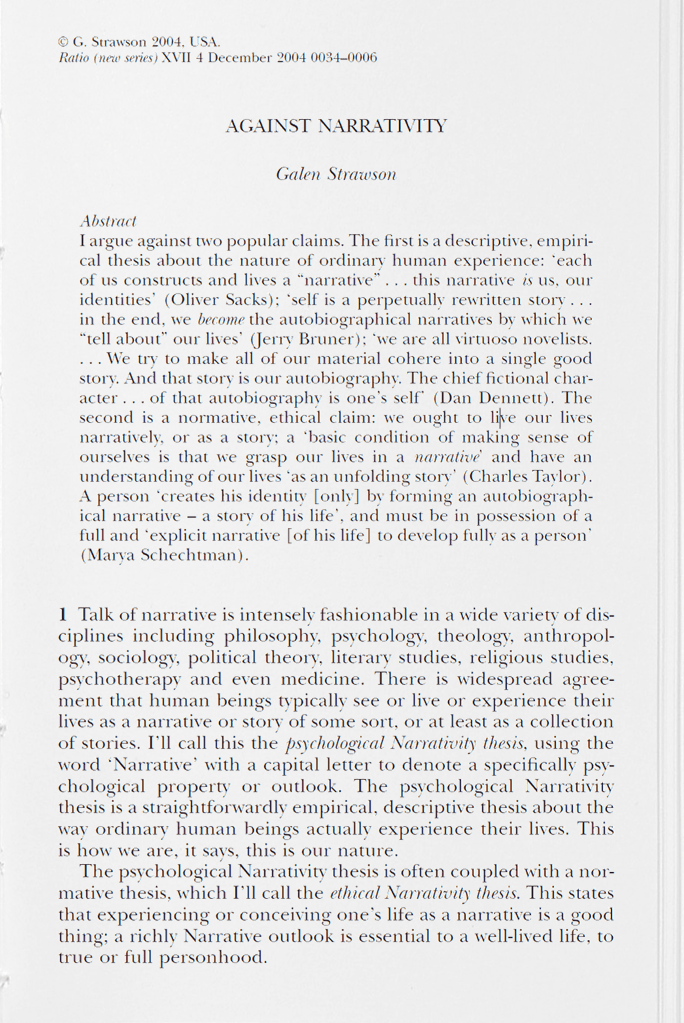
I readily admit to being provocative, sometimes edgy, and polemic, but not without qualification. I keep coming across Strawson’s work, and I agree with much of it, though I feel he’s an edge case in the eyes of many. Even when discussing Strawson’s views with others, I get ‘the look’, this incredulous half-cocked quizzical glare.
In fact, I am reminded of an online conversation altercation I had recently on the topic of identity, cutting to the chase, here’s the big reveal:
You are intentionally being contrarian for no reason other than attempting to appear worldly and intellectually superior.
All living people have an identity. Every single human being. It’s not a philosophical argument. It’s basic vocabulary. Just because another culture has a different name for it, doesn’t make it untrue.
Out of courtesy I’ll withhold the ‘identity’ of this individual, save to say it is an undergraduate.
I think it’s obvious to consider the notion of identity to be self-referential. I am supposed to have a self with some concomitant identity, and so are you. According to the dictionary definition, shared by the student I engaged with, individuals possess some distinguishing character or personality. This is vague. Presumably, there needs to be some constellation of characteristics to make them distinguishing. I don’t suspect that I’m allowed to be identified by non-distinguishing features.
I’m imagining a Ku Klux Klan meeting somewhere in America. Seeking ‘Sam’, I ask the doorman where I can find him. He knows Sam and conveys that he’s a white guy wearing a white sheet with a pillowcase with eye holes.”
Never mind, perhaps I should have referenced penguins. I suppose that’s why they tag them. Is that their identity. It doesn’t feel right. I’m rambling.
Identity is predicated on the notion of the self. I’m partial to Strawson here, but I think I am somewhere in the middle. I understand that the standard narrative is that we construct a narrative to represent our self. This creates a heuristic. But life is not a story.
The problem with this concept is that people configure this narrative differently. Using video vocabulary as a reference, I can think of several approaches straightaway:
60 FPS (frames per second)
15 FPS
Dropping frames
There is a memory component. I can also think of only capturing high-lights, low-lights, or some combination. My event-triggered home security camera system captures certain movement and sound, but different cameras capture different frames under different conditions, for differing durations, at different intervals, and at different fidelity. Moreover, it also captures certain aspects of any given frame.
Add to this false memories and misremembered content as well as conveyed narratives that you include in this composite. Examples from my life are stories I heard my mum telling her friends over and over as I was growing up. I have no native memory, but if I were to reconstruct a sense of self, I’d want to include them with native memories.
Memories of my early life are fragmented, and I don’t remember anything before age 5 or so. And even then, I can recall maybe 2 or 3 events unprompted. If asked if I remember this or that event, I may or may not, and it might be true or not.
I can’t claim the same lack of continuity as Strawson, I do feel that it might be substantially weaker than that of the general public. Just reflecting back top of mind, I remember these select events:
Relating my judo lessons to my grade three classmates
Being bored to tears in grade four because I had been demoted to a ‘standard’ class and being re-promoted to advanced placement classes when I ‘acted out’ due to shear boredom
Being adopted by my stepdad and taking his last name in grade four
My mate, Carl, also being adopted and taking an entirely new name—not just the last name
Various domestic abuse episodes
Choosing the coronet as a grade five school band instrument because my dad wouldn’t allow me to play the drums
After this, I can start to remember more and more, but not significantly so. I can remember certain classmates and interactions, teachers, friends and neighbours. If I stitched it together as a single filmstrip, it would be underwhelming and wouldn’t likely make much sense to anyone else. And who could even identify dramatic effect?
In stop motion parlance, there is a notion of keyframes and tweening. The aforementioned events would serve as keyframes. Tweening is the interpolation between these frames that morph and create the appearance of motion. This tweening never actually happened. It’s only realised during playback. How much of self and indentity are this filler?
At this point, I am thinking that what I am doing is setting the stage to say that the self is incomplete and imperfect, but I am leaving room for its existence. And of course, it exists. It’s a phenomenon, and we’ve labelled it. What more can one ask for?
I’m still trying to put it all together, but my ‘I’ keeps changing. How can I tame Haidt’s elephant?
“The mind is divided, like a rider on an elephant, and the rider’s job is to serve the elephant.”
― Jonathan Haidt, The Righteous Mind: Why Good People Are Divided by Politics and Religion
Heather at https://hermeneutrix.com/ commented briefly on the recent Political Spectrum post. Visting her site, she is all about words. Check it out. But even before visiting, I had the idea to visualise my reaction to her response.
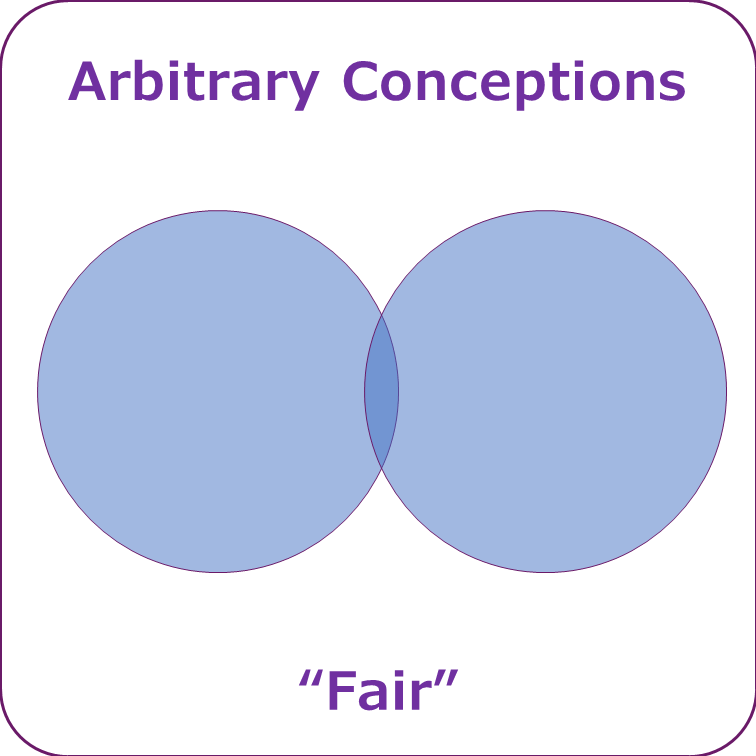
To be fair, this is a response I get from my Pragmatist colleagues: don’t get your knickers in a twist arguing semantics. But in my noggin, I envision this Venn diagamme. (Well, not exactly. I just made this up, but you get the point.) Since the topic happened to be on the definition of Conservative, I’ll retain the context, but this is arbitrary.
Before I get to this, I want to set the stage with a more common and arguably more agreeable term: tree. If we ask a large number of people on the street to provide attributes of a tree, we might get something like this image abstraction below.
Tree
Venn: Tree
Although people may have different ideas, there will be some key core elements—trunks, branches, and roots. Of course, within the taxonomy of trees, there are types—pine, oak, willow, redwood, birch, and so on—each sharing these key attributes. These trees have some distinct attributes—coniferous versus deciduous, green versus red, flowering versus non versus, fruit-bearing, nut-bearing, height, and age. I think I can stop.
In general, I think it’s safe to say that if you point to a tree, and ask what it is to a person with sight and language, they will either respond ‘It’s a tree’ or ‘It’s an elm’. Even the elm response can be quickly qualified with a follow-up question, “What is an Elm?”
I understand that a botanist or an arborist may have a more nuanced definition. In fact, when I lived in a rental property outside of Chicago, my wife at the time defended the life of a tree that looked rather like a berry-bearing ficus, but that the village elders said was a weed and not allowed to remain. Here, we get into whether a tomato is a fruit or a vegetable or a squash is a berry or a fruit, or is corn a vegetable or a grain—or are we discussing maize? I get it. Even here, we can quickly come to terms. I said chips; I meant fries.
I could even get into the political conversation where the US justice system tried to redefine person to strip the rights away from those they didn’t want to have them. Of course, the United States has a history of not considering people to be people, though some were given 3/5ths and 4/5ths of personhood. Mighty white of them.
Back to trees. There are natural and artificial trees, but these are just simulations—hullo, Baudrillard. In the English language, there are non-arboreal trees, some not even rendered from fibres. We’ve got shoe trees—for which I fail to see the relationship to trees—and bell trees. We even have tree structures, like a taxonomy or a family tree, leveraging the branching metaphor. Some of these things escape the main bubble, but the connexion is never lost and is easy to navigate to a core understanding.
Conservative
I think we are amicably on the same page here and ready to move on from tree to conservative. Here, the circles are much more varied and divergent. Although there is common ground, as well there are points where there is no intersection in meaning.
Venn: Conservative
I’ve discussed a simpler abstract term before: fairness. To recapitulate, most people will tell you they want situations in the world to be fair. Only fair means entirely different things to different people. I’ve written about this in several places, so I’ll continue on our conservative journey.
Venn: Fair (oversimplified for effect)
Not only has the term conservative morphed over the years, it has different meanings—though to be fair, probably fewer than ‘liberal’. As I’ve discussed here before prior to the recent post, liberals are conservatives, but no one is really defending this position because the goal is identity, and identity involved separation to be distinguished.
Like fair, conservative has some common ground. The challenge is to understand which flavour is being used. Are you communicating by using the same term, or are you talking across each other? In some cases, this can lead to what I’ll call false positives (borrowing the language of statistical errors) where you think you are in agreement, except you aren’t. The other side of this coin is the false negative, where you think you are in disagreement when in fact you are talking about two different things.
This happened to me. A mate asked me to meet her at a certain time and place —I’ll just use McDonald’s because it is so ubiquitous. I went to the McDonald’s and waited. After a while, she called.
“Are you close?”
I scan the car park.
“I don’t see you. Maybe I missed you. I’m parked on the side near Taco Bell, not the oil change place.”
“There’s no Taco Bell at McDonald’s. What McDonald’s did you go to?”
It turns out that she was a distance away and wanted me to meet her halfway—like two-thirds to be honest. I assumed she meant the one we’d commonly visit.
This is a false positive. Communication was presumed to occur. It did. It just wasn’t useful. And since the reason for the rendezvous in the first place is to save time—one might say to ‘conserve’ time, but even I wouldn’t stoop to such a low target.
Wrapping up, the challenge is that trees are objects in the world. We can quickly recalibrate ourselves by reference. This is not possible for abstract concepts. I tend to refer to these are weasel words. Some use these words unknowingly. Whenever I hear some yahoo wintering on about freedom or justice, my first impression is that this bloke is tripping on a Kool-Aid propaganda overdose. Most common people falsely believe that people can understand what’s in their heads.
And to be fair—the left sort, not the one on the right—, when these yahoos utter the term, they are probably using it like their neighbour. But walk a few blocks or miles, and that bet is off. Sure, if the people have a common connexion, this might moderate the differences. But if one attempts to triangulate across worldviews, all bets are off. You may or may not be singing from the same hymnal.
I am trying to avoid commenting on the recent SCOTUS decision and how it is symptomatic of how the United States remains a failed state—at least a zombie state—, so this preamble should suffice for now.
I was chatting politics into the wee hours with my son, who’s been on this earth for almost 25 years now. I consider myself to be on the left of traditional political scales. He considers himself to be on the right, but he’s trying to make sense of the scales and dimensions. He had two questions: First, ‘What are the crucial dimensions and positions that define left and right?’ Second, ‘Where do Liberals fit into the equation?’
Knowing me, he wanted to provide some context and confer with me his knowledge that would also serve to frame and anchor the conversation. A key point was to have clarified the adopted nomenclature and positioning on a theoretical map.
We started with the origins of the left-right distinction, which was barely a valid dichotomy even as it was coined in France. There was no duolith. Those on the left or right had features in common but taken holistically, this was a reductionist categorisation, as tends to happen. Exacerbating this, as it does today, still, the politicians with voices remained to the right of the unvoices masses.
He asked about the difference between freedom and liberty because his sources differentiate the two. Whilst connotation and nuance may enter the picture, etymologically speaking, freedom is a native English word whilst liberty is French via Latin. Connotatively, freedom is an absolute measure whilst liberty is granted within a political framework. Positive and negative liberties aside, liberty is an attenuator. It restricts freedom even if it allows most of the signal through. Effectively, liberty is permission by the state to act in certain ways.
By the end of the conversation, he was framing the key difference around notions of national identity and nationalism—I versus we. I shared my thoughts on the construction of identity, thus making for a poor foundation, though we both agreed that national narratives have been the impetus for much activity. (I am reluctant to insert the word progress here.)
After our conversation, I began researching dimensions established or otherwise proposed by political science. This led me to a place I found interesting—the distinction between radical, progressive, conservative, and reactionary positions. For some reason, this never really occurred to me.
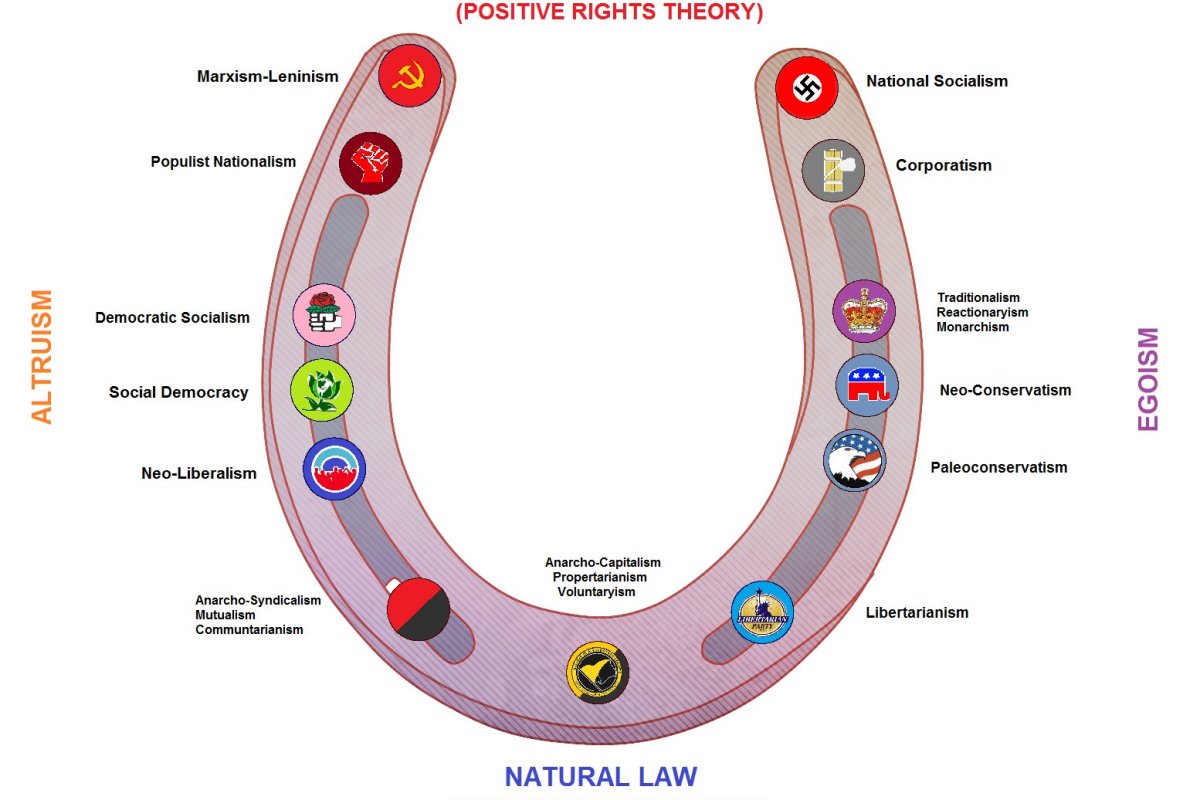
I’m not sure one can employ these terms in general discussion without definition and qualification, but I feel they are useful in their own right. Typically, I view the political landscape—at the highest level and with a US-bent—as Left (communists, socialists, anarchists, progressives) and Right (conservatives, liberals, and fascists). I also know that this is imprecise, but maps always are.
This new vocabulary helps by distilling the map to this—ordered differently:
Right
Conservative
Reactionary
Left
Progressive
Radical
Conservative
Conservatives want to maintain the status quo. This is interesting usage adoption. Fundamentally, advocates of this view want to promote and to preserve traditional social institutions and practices. In Western culture, conservatives seek to preserve a range of institutions such as organized religion, parliamentary government, and property rights. Conservatives tend to favour institutions and practices that guarantee stability and evolved gradually. Adherents of conservatism often oppose progressivism and seek a return to traditional values
In Western culture, conservatives seek to preserve a range of institutions such as organized religion, parliamentary government, and property rights.
My first thoughts when I hear the term are a harkening back to the old ways—the Ozzie and Harriott mythos, white picket fences, Mom and apple pie. But this is different. Effectively, rather than reaching back, it wants to preserve the current moment in time. Where it gets more nebulous, I think, is that some people include nostalgia in the now. Duratively, perhaps a person might remember some aspect of their childhood. Though this has been lost by now, they imagine it as part of their identity. This can also extend further back as they wish some other historical aspects can be cherry-picked. Perhaps the white conservative wishes to be able to subjugate women as was the practice in the 1950s of America, but to not conserve high union participation and high marginal tax rates, as affronts to freedom (or whatever). This ends up being an exercise in selective memory and revisionist history-making.
This needs to be distinguished from a so-called traditional conservativism in the tradition of Burke or Hobbes, who want to conserve some sense of fundamental morality they feel derives from nature.
Reactionary
Reactionaries oppose whatever is in effect at the moment—the petulant toddler—but with a twist. Like the conservatives, there is a conservation effort but rather than a focus on the status quo, the focus is on status quo ante, which is a return to the old ways, tried and true.
Progressive
Progressives support social reform. Ostensibly, they don’t oppose tradition, but they feel that old structures need to be reimagined and reinterpreted in face of social and technological change. An underlying metanarrative is the notion of progress. I am not going to comment on progressivism generally and the nuances evident in the American flavour of it.
During the 20th century, radical politicians took power in many countries across the world. Such radical leaders included Vladimir Lenin and Joseph Stalin in Russia, Mao Zedong in China, Adolf Hitler in Germany, as well as more mainstream radicals such as Ronald Reagan in the United States and Margaret Thatcher in the United Kingdom. Of course, Donald Trump is a more recent example in the United States.
Summary
To me, these terms operate on a gravity to now. Conservatives are heavily anchored in the familiar and seek stability. Then they see factors in the past that they imagine will also serve this purpose, so they wish to incorporate these and carry them forward. Conservatives are not unaware of the need for change, they just want to not create waves in the process.
Likewise, although placing a heavier weight on the past than even conservatives, reactionaries are not fundamentally opposed to retaining what is working currently. The term working is subjective and perspectival, so they may wish to retain something that works for them at the expense of others. This is a challenge for conservatism as well. Just because racial segregation seemed to work for an equivalent person in the past doesn’t mean it worked well for the excluded.
Like reactionaries, progressives aren’t afraid of keeping a foot in the present—and there may be plenty of lessons to learn from the past—, but they feel that given the change in the underlying terrain, some refactoring is in order.
And then there are the radicals. I suppose that radicals have different motivators, but in essence, they feel that the current implementation is substantially broken, and it needs more than a few small tweaks and a fresh coat of paint. These people are renovating rather than redecorating. They may even want to throw the baby out with the bath water. Some may wish to keep the baby.
As for me, I usually place myself in the Progressive camp, but under the definition, I am more of a radical. The system is broken. We don’t just need to delete it, we need to install a new one.
Thomas Jefferson said that the United States should rewrite the Constitution every 19 years. Why 19 years? Who knows? Given the intransigence in American politics, this would have been a disaster. And given the powers that be, the debate would be over which parts to conserve and which to progress. Being the cynic that I am, my guess is that it would devolve to worse than we have now.
DISCLAIMER: For the record, I don’t endorse the placement of the political ideologies on the horseshoe image, but I find it interesting and it grabbed my attention. I hope it grabbed yours, too.
This infographic helps to articulate various notions of consciousness. Not much more to add.
I think I am partial to emergent theories, but I favour property dualism over emergent. The dualism employed in property dualism doesn’t feel accurate. It’s not dual so much as it just hasn’t been described yet.
I don’t think that physics can express or descriptively characterize everything that exists.
I want to accept the Buddhist notion, but I can’t seem to not differentiate.
I don’t feel I have enough information on the remainder of these. I could lean on the name and short description, but I feel this would necessarily establish me firmly in Dunning-Kruger territory. There may be even more hypotheses than are captured here.
I discovered a new image cache for my videos, and this one caught my eye. Since I posted off-topic earlier, I just wanted to share something a bit more on point.
Although we are all automatons—puppets—, society is also puppets. These are puppets controlling puppets controlling puppets controlling puppets…
That’s the post. If you haven’t read my last post on the infertility trap, it is much more significant.
A colleague who happens to be a professor in New South Wales shared this video with me. I am tempted to just recapture the presented content here, but I feel everyone should just watch it for full impact. I intentionally used a cover image that is counter to the narrative. The challenge is not overpopulation. Rather, it’s the opposite. Find out why.
Video: RSNSW Clarke Memorial Lecture 2021: The changing tide of human populations: an infertility trap
I’ve cued the video beyond the introduction—feel free to rewind for context, but there is no material content to be missed—, and there are a couple of minutes of additional material at the end, making the content closer to 50 minutes (48.5) than an hour.
The Infertility Trap was published last month as a book. I’ve not read it, but it was referenced. Countdown, by Shanna Swan is also referenced.
Book Cover: The Infertility TrapBook Cover: Countdown
Some highlights follow:
The Rise and Rise of Humankind
Geometric growth commenced after the Black Plague was driven by the discovery of how to harness fossil fuel. As with Malthusian predictions, The Population Bomb missed the mark—but not for all of the reasons you might be thinking.
Changing Pace of Population Growth
Population growth rates were already on the decline when The Population Bomb was published in 1968. This trend was a result of the fertility trend that became precipitous circa 1963.
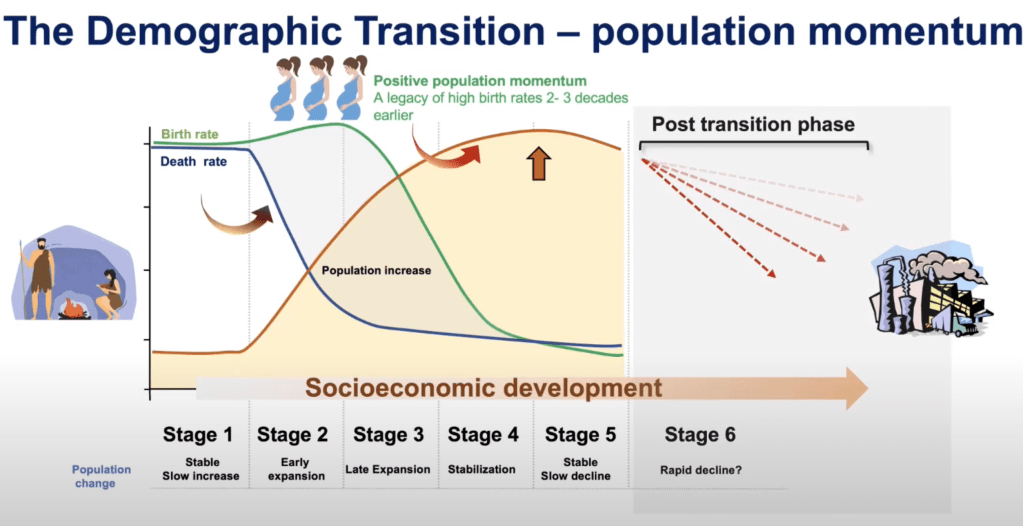
The Demographic Transition: Population Momentum
Though birth rates may seem to be increasing, this is merely optics as this is a legacy of positive population momentum stemming from high birth rates a few decades prior to the impending decline in fertility.
The Malthusian Paradox
Thomas Malthus didn’t grasp the paradigmatic shift technology would provide nor the relationship between fertility and prosperity.
Charts: Prosperity, infant mortality, child mortality, and fertility rate
As prosperity (as measured by GDP) increases, infant and child mortality as well as total fertility rate, each decrease. (I’m calling out the poor statistical representation of the non-zero-based Y-axis, but I don’t believe this was done to exaggerate the slope. It’s apparently just out of index.)
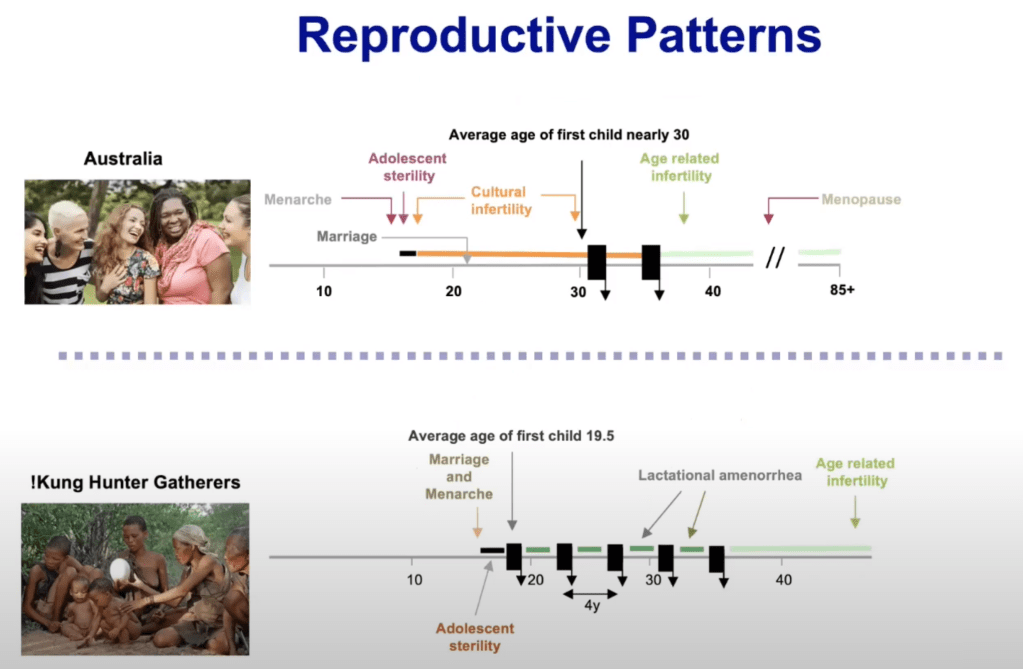
Reproductive Patterns: Australia vs !Kung Hunter-Gatherers
Notable in the charts above, are the delays in reproduction by the average Australian woman to around 30 years effectively limits the delivery to about 2 (1.7) whereas the hunter-gatherers commence closer to 20 years, yielding them an average of 5 children.
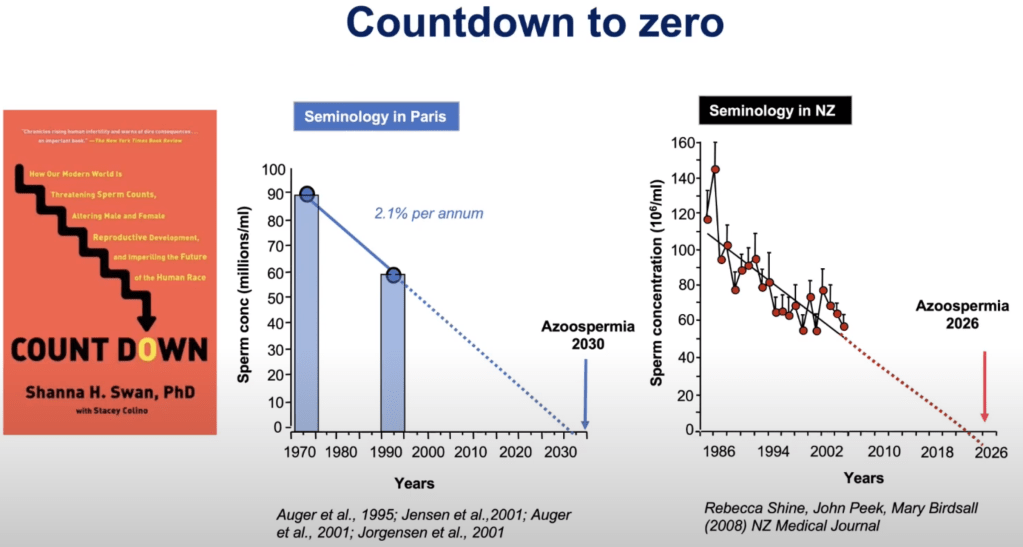
Rapid decline in semen quality
Semen quality (motility) and count are down.
Projections: Countdown to sperm count of zero in Paris and New Zealand
If declining semen count trends remain unabated or unaltered, one might anticipate a point where male fertility (potency?) reaches zero. This is characterised as azoopermia and projects this on Parisian males just past 2030 and by 2026 for New Zealanders.
Secular trend in declining testosterone levels
This downward trend is not constrained by region.
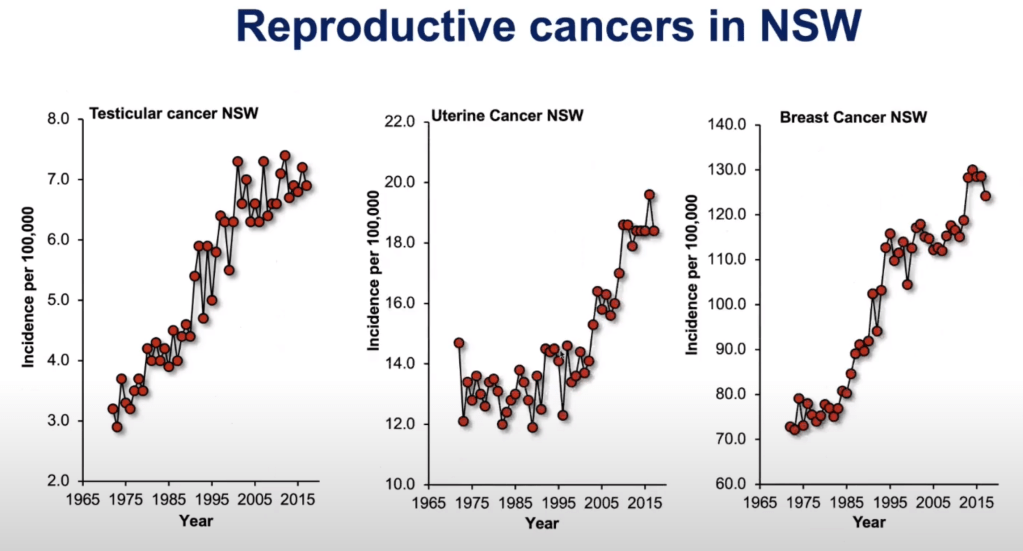
Trends in Testicular Cancer (NSW)
A correlated trend in fertility rate is an increase in testicular cancer, as shown with NSW data, even as ovarian cancer remains steady and cervical cancers are decreasing.
Reproductive Cancers in New South Wales
Conversely, other reproductive cancers (in NSW)—uterine and breast cancers—are on the rise in sync with testicular cancers and the drop in fertility.
My intent with this post is to share rather than editorialise. The video speaks for itself. I’ve provided some excerpted content for those who can’t spare the time to view the source.
Small Print: I’ve been approved to offer books through Amazon.com. Any books purchased by having clicked a link will yield me a small commission. This commission is not added to the price of the book to you. If you purchase the book through Amazon directly, bypassing an affiliate programme, they will keep the difference. So, if you intend to buy a book, stick it to the man and purchase it through me.
Gregg Caruso is interested in the notion of Agency from the perspective of justice, desert, and sentencing. This is applied philosophy.
My main argument against the possibility of free will is Nietzsche-Strawson’s causa sui argument, which I’ve touched on a few times by now, but I haven’t yet fully articulated my position. I’ll get to that another day. I’d also like to create another video, as I would like to do for this as I explore in more detail.
Ostensibly, this is a compatibilist view that leaves a modicum of free will, even with causa sui in place. I hope this illustration will be helpful.
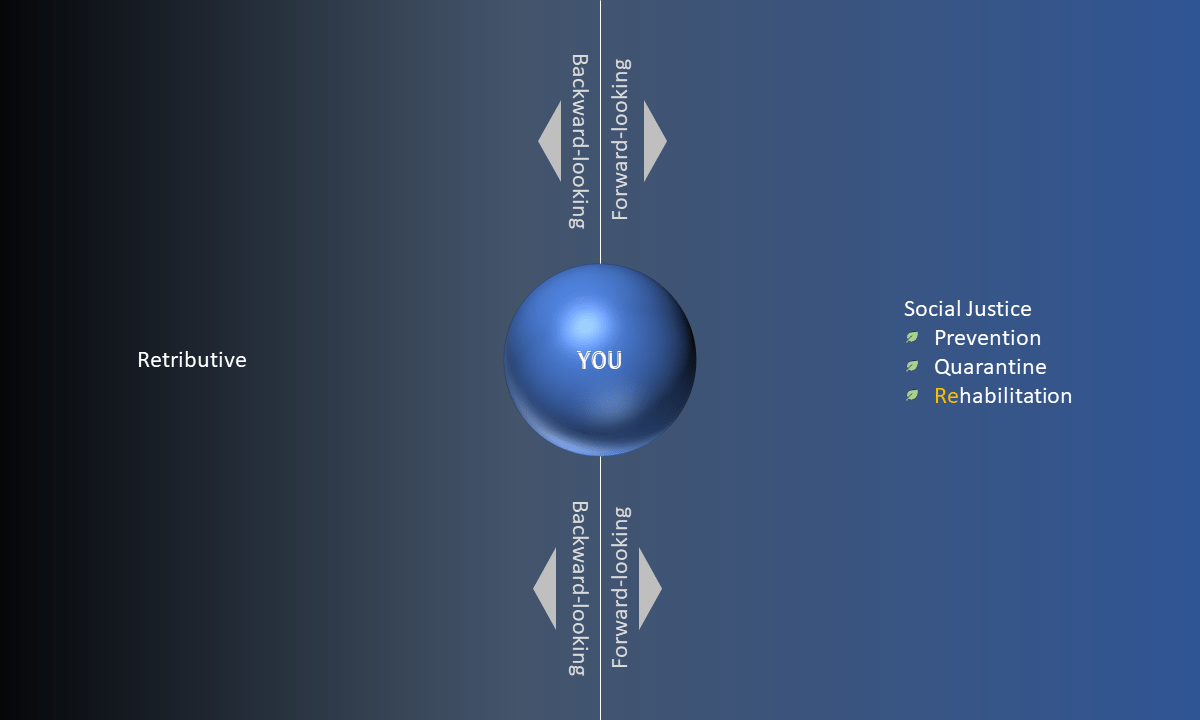
In the centre of the illustration is you, the self of some arbitrary person who shall act as our subject. Let’s assume a couple of basic premises:
We either live in a relaxed causal, deterministic or indeterministic universe.
Causa sui is in full force and effect: one cannot cause any aspect of one’s self.
I include the term relaxed in the first premise, so I don’t have to deal with a fully deterministic universe governed entirely by the notion captured by Schrödinger’s equation. The second premise is in place to serve as a limitation: even if consciousness is an emergent property, its emergence doesn’t grant some insuperable metaphysical powers. One cannot reach outside of one’s self.
The scenario plays out as follows. You have been apprehended for violating some statute. Let’s say that you’ve taken an item from a retail store. As you are leaving the store, the police stop you. When asked if you took the item, you answer in the affirmative. This is a very efficient municipality, so you are taken immediately to a magistrate to make a plea.
In this scenario, Caruso is your attorney at law. His argument is that, given causa sui, you cannot be responsible for who you are. We’ve been here before. Since you can’t be responsible for who you are, any sentence to punish you would be unethical, as you’ve done nothing to deserve it. This is the notion of desert in the realm of retributive justice.
The judge buys this argument, but s/he counters with three possible courses of action. You may not be responsible for who you are, but we are a community of laws. You are a victim of your circumstances, so we cannot look backwards. For whatever reason—and through no fault of your own, by definition—, you were broken relative to complying with community norms.
Social Justice
Firstly, we may wish to make an example of you, to signal the community that we will incarcerate people who break the laws. This is more a public service purpose than a punishment.
Secondly, if you had contracted a communicable disease—we’re looking at you Covid—, you can be quarantined under the consideration of the common good. Framed this way, it is not a punishment, we just don’t want it to happen again.
Lastly, we may also be justified on the grounds of rehabilitation. I highlight the ‘re‘ in rehabilitation because some people may not have been ‘habilitated’ in the first place. Perhaps think of them as feral. In any case, a computer programming analogy might make sense here.
So what’s this all about? Remember, causa sui says that you cannot be held responsible for creating yourself. The claim is that you are a product of your nature and nurture. Genetically speaking, perhaps there was some reason that you could not incorporate inputs into factors that allowed you to appropriately interpret this law—or any law, more generally. Or maybe, you were never exposed to this law or category of law before.
In the preventative vein, we could be signalling, ‘We caught You taking an item from a shop without paying. Now you know this, and we may make an example of you since you are caught as well’.
Quarantine may be a bit of a stretch in this scenario, so feel free to substitute a more serious offence if it helps you to remember this. Perhaps You killed someone. Even without punishment, we may want to get You off the streets before another killing is perpetrated. I’ll come back to this one.
Rehabilitation makes sense even if one is not responsible for one’s self. Presuming that you are a product of programming—family, culture, peers, and so on—, perhaps you just need to be rewired. Perhaps a particular subroutine was not implemented or activated correctly. This rationality could be used as a non-punitive justification.
Counterarguments
The public prevention case may be why offenders were pilloried in by-gone days. Display in a public square may inform some who may have missed the lesson the first time around, hence dissuading taking similar actions. But unless this ‘public service message’ reached enough people, it would probably not be the best rationale.
Quarantine may sound OK on the surface, but it’s actually rather specious. Firstly, that You knicked a trinket. What exactly is the risk of contagion? Petty theft is not known to be particularly communicable. Secondly, just because you’ve done something once is little measure of whether you’ll do it again. In fact, if this were true, then one might have assumed that you could never have committed the offence because of your history.
Rehabilitation may likely be the best option among these. If you missed that particular lesson or had forgotten or diminished the calculus, remediation may do just the trick. However, if your ‘operating system’ is not up to snuff, it’s not a matter of inputs. It’s a matter of processing capability.
Psychological intervention is in its infancy, so the probability of remediating this is low, if not a crap shoot. And not all such processes can be remediated. This could lead one to fall back on the quarantine option, but who is the competent assessor in this case?
It’s easy enough to assess if You is Hannibal Lecter or tells you straight out that s/he intends to repeat the offence. Some cognitive deficiencies are simple enough to recognise. But what about the grey areas—all of that space in between?
And who is making sure that the judges are not being punitive simply because they haven’t yet eaten lunch?
Enfin
Bringing this to a close, if we have no free will, it makes no sense to punish. Sadly, most justice systems promote retributive justice and punishment in sentencing. I’ll spare you my diatribe on how I believe most people attracted to jurisprudence, law, and law enforcement have been conditioned. And whilst Caruso feels justified in foreword action, I am more sceptical. This said, I’ll take what I can get.
This post is pretty much a stream of consciousness. I hope to give it better treatment in a future video.
Physicist, Sean Carroll, gives Robert Lawrence Kuhn his take on free will. I was notified about this when it was posted, and given the topical subject matter, I took the 8-odd minutes to listen to it straight away.
I wish I had been there to pose a follow-up question because, although he provided a nice answer, I feel there was more meat on the table.
Like me, Sean is a Determinist who feels that the question of determinism versus indeterminism is beside the point, so we’ve got that in common. Where I feel we may diverge is that I am an incompatibilist and Sean is a compatibilist. I could be interpreting his position wrong, which is what the follow-up question would be.
I say that Sean is a compatibilist because he puts forth the standard emergence argument, but that’s where my confusion starts. Just to set up my position for those who don’t prefer to watch the short clip, as a physicist, Sean believes that the laws of physics, Schrödinger’s equation in particular.
We have an absolutely good equation that tells us what’s going to happen there’s no room for anything that is changing the predictions of Schrödinger’s equation.
— Sean Carroll
Schrödinger’s Equation
This equation articulates everything that will occur in the future and fully accounts for quantum theory. Some have argued that quantum theory tosses a spanner into the works of Determinism and leaves us in an Indeterministic universe, but Sean explains that this is not the case. Any so-called probability or indeterminacy is captured by this equation. There is no explanatory power of anything outside of this equation—no souls, no spirits, and no hocus pocus. So far, so good.
But Sean doesn’t stop talking. He then sets up an analogy in the domain of thermodynamics and statistical mechanics and the ‘fundamental theory of atoms and molecules bumping into each other and [the] emergent theory of temperature and pressure and viscosity‘. I’ve explained emergence in terms of adding two hydrogen and one oxygen atom to create water, which is an emergent molecule with emergent properties of wetness.
My position is that one can view the atomic collection of matter at a moment as an emergent property and give it a name to facilitate conversation. In this case, the label we are applying is free will. But there is a difference between labelling this collection “free will” as having an analogous function to what we mean by free will. That’s a logical leap I am not ready to take. Others have equated this same emergence to producing consciousness, which is of course a precursor to free will in any case.
Perhaps the argument would be that since one now has emergent consciousness—I am not saying that I accept this argument—that one can now accept free will, agency, and responsibility. I don’t believe that there is anything more than rhetoric to prove or disprove this point. As Sean says, this is not an illusion, per se, but it is a construction. I just think that Sean gives it more weight than I am willing to.
















 Philosophics