Unknown Dimensions

I mentioned in my last post about how Artificial Intelligence discovered a new variable—or, as the claim suggests, a new physics. This was a tie-in to the possible missing dimensions of human perception models.

Without delving too deep, the idea is that we can predict activity within dynamic systems. For example, we are all likely at least familiar with Newtonian physics—postulates such as F = ma [Force equals mass times acceleration or d = vt [distance equals velocity times time] and so on. In these cases, there are three variables that appear to capture everything we need to predict one thing given the other two that need to remain constant. Of course, we’d need to employ calculus instead of algebra if these are not constant. A dynamic system may require linear algebra instead.

When scientists represent the world, they tend to use maths. As such, they need to associate variables as proxies for physical properties and interactions in the world. Prominent statistician, George Box reminds us that all models are wrong, but some are useful. He repeated this sentiment many times, instructing us to ‘remember that models are wrong: the practical question is how wrong do they have to be to not be useful‘. But no matter how hard we try, a model will never be the real thing. The map cannot become the terrain, no matter how much we might expect it to be. By definition, a model is always an approximation.

All models are wrong but some are useful

George Box

In the Material Idealism post, the embedded video featuring Bernardo Kastrup equated human perception to the instrumentation panels of an aeroplane. Like the purported observer in a brain, the pilot can view the instruments and perform all matters of actions to manipulate the plane, including taking off, navigating through the environment, avoiding obstacles, and then landing. But this instrumentation provides only a representation of what’s ‘really’ outside.

Like mechanisms in the body, instrumentation can be ‘wired’ to trigger all sorts of warnings and alerts, whether breached thresholds or predictions. The brain serves the function of a predictive difference engine. It’s a veritable Bayesian inference calculator. Anil Seth provides an accessible summary in Being You. It relies on the senses to deliver input. Without these sense organs, the brain would be otherwise unaware and blinded from external goings on.

The brain cannot see or hear. It interprets inputs from eyes and ears to do so. Eyes capture light-oriented events, which are transmitted to the brain via optic nerves, and brain functions interpret this information into colour and shape, polarisation and hue, depth and distance, and so on. It also differentiates these data into friend or foe signals, relative beauty, approximate texture, and such. Ears provide a similar function within their scope of perception.

As mentioned, some animals have different sense perception capabilities and limitations, but none of these captures data not also accessible to humans via external mechanisms.

Some humans experience synesthesia, where they interpret certain stimuli differently, perhaps hearing colours or smelling music. We tend to presume that they are the odd ones out, but this assumption does not make it so. Perhaps these people are actually ahead of the rest of us on an evolutionary scale. I suppose time might sort that one out.

But here’s the point. Like the pilot, we can only experience what we are instrumented to experience, as limited to our sense perception and cognition faculties. If there are events not instrumented, it will be as if they don’t exist to the pilot. Can the pilot hear what’s happening outside?

This is the point of the AI experiment referenced above. Humans modelled some dynamic process that was presumed to be ‘good enough’, with the difference written off as an error factor. Artificial Intelligence, not limited to human cognitive biases, found another variable to significantly reduce the error factor.

According to the theory of evolution, humans are fitness machines. Adapt or perish. This is over-indexed on hereditary transmission and reproduction, but we are more vigilant for things that may make us thrive or perish versus aspects irrelevant to survival. Of course, some of these may be benign and ignored now but become maleficent in future. Others may not yet exist in our realm.

In either case, we can’t experience what we can’t perceive. And as Kastrup notes, some things not only evade perception but cannot even be conceived of.

I am not any more privileged than the next person to what these missing factors are nor the ramifications, but I tend to agree that there may be unknown unknowns forever unknowable. I just can’t conceive what and where.


I can’t wait to get back to my Agency focus.
Material Idealism

Synchronicity is in full force and effect. I’ve been on holiday for the past week and a half during which time I’ve read twice over Being You by neuroscientist Anil Seth, who also competently narrates an audio version. I enjoyed it, though it was on one hand too general and on the other hand oddly specific. I expect to summarise it presently.

Meantime, I just watched this interview with Bernardo Kastrup, of whom I’ve only recently become aware, and he makes some of the points Anil makes, but I feel his logical leap to the spiritual realm is a bit premature and wishful thinking on his part—sort of a God of the gaps approach.

Bernardo is the author of Why Materialism Is Boloney.

Russell Brand interviews philosopher and author Bernardo Kastrup

I find his analogy equating human perception and an aeroplane cockpit on instrument control is apt, and I fully agree that humans are limited by their sense organs and limited cognitive faculties. so there exists more than we can measure or even perceive.

I recently read an article about a recent discovery where artificial intelligence identified a new dynamic variable in physics.

It stands to reason that there are a great many things about nature that are flat out not only NOT PERCEIVABLE by us but INCONCEIVABLE by us

Bernardo Kastrup

Aristotle is responsible for the notion that humans are limited to 5 senses, a myth still propagated by education systems. We are all familiar with the five basic senses:

SensePerceptionSensory Organ
VisionVisionEye
HearingAuditoryEar
TouchTactileSkin
TasteGustatoryMouth
SmellOlfactoryNose

Touch limits the scope of the somatosensory system that extends tactile mechanoreception perception with thermoception, which not only perceives the temperature of external objects and environments but includes receptors necessary to regulate internal body temperatures.

SensePerceptionSensory Organ
VestibularEquilibrioceptionInner Ear

Equilibrium or balance is yet another sense.

Perhaps it’s that vestibular sensation feels different to the rest, and so it gets marginalised.

Apart from the senses in and of themselves, we know that different life forms with analogous sense receptors perceive the world with different levels of acuity and resolution as well as range.

Dogs hear sounds at higher frequencies. Whales hear lower frequencies.

Birds see at a faster ‘frame rate’ than humans. In fact, a bird watching a film would not see the contiguous frames as fluid motion but would likely perceive the frames like a flip book progressing too slowly. Their visual acuity is also sharper, effectively giving them a higher DPI resolution. Thankfully, our visual system doesn’t provide a dithered or pixelated representation.

Some animals also ‘see’ images on infrared or ultraviolet frequencies.

Human eyes are front-mounted and provide binocular vision and depth perception. Internal mechanisms give the appearance of a continuous view. In fact, our eyes have a very small focal width, but they flit and flitter to capture snippets that are stitched together to give the impression of a scene. This is a Gestalt consideration.

Side-mounted eyes operate at a different level. For example, a pigeon needs to continually bob its head to render a stereoscopic view. Similarly, internal mechanisms stitch these images into a cogent environment.

And then there are compound eyes. Despite the manner these are depicted in movies, it’s likely that the visual system composites the facets into a single view.

Where humans can sense depth, distance, and direction with their eyes and ears, sharks can sense direction with their ‘nose’s.

Whilst humans have some ‘awareness’ of pheromones, this awareness is heightened in other animals via vomeronasal organ perception.

The notion of time is another perception, but we don’t even have a decent definition or understanding of time, so we’ve got a while before we figure this one out.

In addition to these human faculties, we understand that animals have others we had discovered.

SensePerceptionExample Species
MagnetoceptionMagnetic fieldsbirds, cattle, bacteria
EcholocationSpatialbats, cetaceans
ElectroceptionElectric fieldsfish
HygroreceptionMoisture levelsinsects

The addition of these other senses is borderline trivial insomuch as they each sense known phenomena. The question is whether some animals sense phenomena yet unknown.

I had more I wanted to say, but my time was occupied gathering these lists. Perhaps when I return to comment on Being You, I’ll share more.

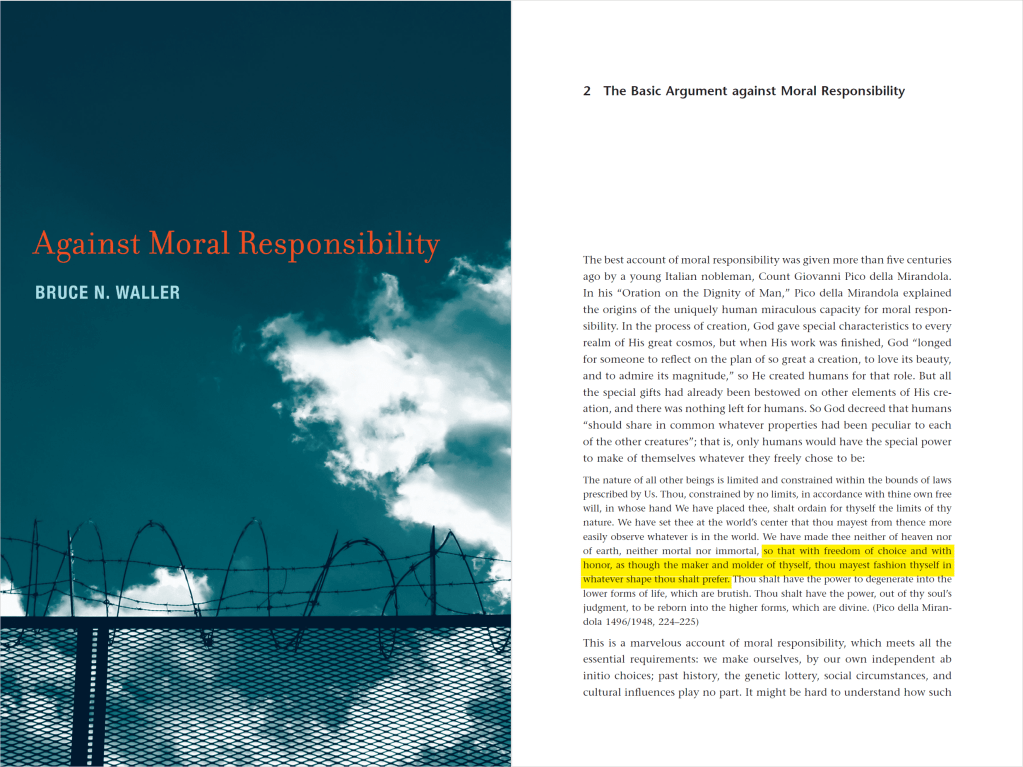
Against Moral Responsibility

We have made thee neither of heaven nor of earth, neither mortal nor immortal, so that with freedom of choice and with honor, as though the maker and molder of thyself, thou mayest fashion thyself in whatever shape thou shalt prefer.

Bruce Waller
Bruce Waller, Against Moral Responsibility

Nothing really to add here now, but more on the way. Meantine, sharing this for reference.

Violence and Rules

I haven’t yet shared my thoughts that equate bureaucracy with violence, but this is somewhat tangential or perhaps orthogonal.

Humanity does not gradually progress from combat to combat until it arrives at universal reciprocity, where the rule of law finally replaces warfare; humanity installs each of its violences in a system of rules and thus proceeds from domination to domination. The nature of these rules allows violence to be inflicted on violence and the resurgence of new forces that are sufficiently strong to dominate those in power. Rules are empty in themselves, violent and unfinalised; they are impersonal and can be bent to any purpose. The successes of history belong to those who are capable of seizing these rules, to replace those who had used them, to disguise themselves so as to pervert them, invert their meaning, and redirect them against those who had initially imposed them; controlling this complex mechanism, they will make it function so as to overcome the rulers through their own rules.

Michel Foucault, Nietzsche, Genealogy, History 1977

Taking holiday, so taking shortcuts in posting. Here, Foucault discusses Nietzsche.

Institutionalised

Jordan Peterson is decidedly not my cup of tea. I can tolerate Pinker and Haidt. I agree with much of what they have to say, but in this video, the dissonance finally dawns on me. Interestingly, I can tolerate Peterson within the scope of this discussion.

I don’t agree with much of what these three are saying, but it is refreshing to hear Peterson outside of a philosophical domain, a place where he has no place. And although I don’t agree with him here, it is on the basis of his argumentation rather than his abject ineptitude.

I disagree with this trio. This video reveals these three people as Institutionalists. Peterson may be a political Conservative versus Pinker’s and Haidt’s enlightened Liberalism, but this is a common core value they defend with escalating commitment. Typically, we find these to be polar opposites, but here they have a common enemy that is not necessarily anti-institutionalists or anarchists but people who don’t understand venerable institutions and thereby risk tipping the apple cart or toppling the Jenga tower because they just don’t understand. Not like them. Besides constitutionalism, the common thread is Paternalism. They may disagree on the specifics, but one thing is true: We know more than you, and this knowledge is embedded in the sacred institutions. If only the others understood.

In this video, we hear these three commiserate about the diversity and inclusion forces in University today, and where this movement is off base.

Finding Husserl

When I was seriously exploring music, I started from the artists I enjoyed and searched their roots and influences and cascaded back. In the 1970s, this was to look at the roots of Eric Clapton, Jimmy Page, and Keith Richards. I’d be brought back to James Burton or Elmore James; I’d find Robert Johnson, BB King, Muddy Waters and Hubert Sumlin (Howlin’ Wolf); and I’d find John Lee Hooker, and Chuck Berry. And then, I’d dg further to find Son House, T-Bone Walker, and Big Bill Broonzy. Although I grew to appreciate these originals, I still preferred the reinvigorated versions of my youth.

In philosophy, I seem to have taken a somewhat similar path. In particular, it’s a journey back to Husserl. I was exposed to essence and being most probably through Sartre. this brought me to Heidegger that brought me to Husserl. To be fair there was a large gap between Sartre and Heidegger and a fairly long gap from then until Husserl. I’ve come upon Husserl’s name time and again but I deprioritised him, He seemed always to be the AND of Heidegger, sort of like how Garfunkel was the AND of Simon.

But I thought that Heidegger was the root—the source, as Son House might have been to the Blues. Given the connection of Husserl and Heidegger, I’m not sure that Dasein‘s genesis is clear cut. Moreover, I believe it’s a pedestrian German world, that fancy pants academes wish to evermore preserve in amber as a stand-in to being there, though Heidegger insisted that the meaning was more nuanced and in some way I could consider that it prefigured Derrida’s privileged pairs highlighted in his Deconstruction.

I’ve commenced reading Husserl’s’ Ideas, and my takeaway at this point is his eidetic facts.

Death and Dying

Not explicitly about Kübler-Ross. In the 1990s, I enjoyed listening to the stories of a cantadora—keeper of the stories—, Clarissa Pinkola Estes and her Theatre of the Imagination. Many inspirational stories. That I deem psychology as a pseudoscience does not mean that it serves no purpose. It runs aground where they interpret metaphor for the actual—the symbol for the object. There is a lot to glean from symbols as representations, and one can even apply them to their lives, but never conflate the map for the terrain.

I loved Baba Yaga, but the one I am reminded of today regards candles as measures of life remaining. In this story, a person on a deathbed pleads with Death.

Death explains that the candles represent peoples’ lives and their life force.

Some are tall and burning brightly whilst others are on the verge of being snuffed out

The Dying assumes that all the tall and bright candles must represent young children and that the ones with almost no wax and wick to burn are the elderly.

Death explains:

Some children have very short candles.

And some of the very tall and very bright ones are very old people.

‘Look, here is yours’, Death tells him.

The Dying is directed to one of the dimmest, most pathetic, struggling-for-its-last-few-moments-of-burning-candle in all the land.

He understands.

Psychology As Pseudoscience

Psychology is to neuroscience
as astrology is to astronomy
and alchemy is to chemistry

I’ve been referring to psychology as pseudoscience for years. I’ve even written about it. This evening, the leading pull quote came to me, so I Googled it and was not disappointed. Confirmation bias? Indeed.

I’m glad others have already broken ground here. It saves me from getting lost down another unpopular rabbit hole.

Neuropath book cover and passage by E. Scott Bakker, MacMillan, 2009

Why should I even care?

On one hand, it disturbs me that this discipline not only gets elevated well above its station, it also affects lives because, as astrology before it, but it also affects people’s lives whether they believe it or not. Psychology creates arbitrary categories, asserts specious definitions, and the weak-minded accept it as gospel. Sadly, intelligent people haven’t yet seen behind the curtain in a manner reminiscent of the countless hours Issac Newton wasted on alchemy or Descartes spent trying to prove God.

It feels that most people have finally abandoned alchemy, though I don’t dare look. But many people still believe in astrology, zodiac, and horoscopes.

The core of psychology is based on metaphysical claims of the mind. The physical aspects lie in the realm of neuroscience.

Not so fast

To be fair, neuroscience is still in its infancy, and there are still more things they don’t know than they do. Where astronomy is able to look at the universe through the James Webb Space Telescope, neurology is peering through binoculars—or perhaps only the hollow core of a paper towel roll.

Although fMRIs and such look to us as advanced as, say, the Janes Webb Space telescope as seen in the image below.

James Webb Space Telescope as metaphor for possibilities

The fidelity might be better conveyed by this star-gazing implement.

Peering through paper towel roll as analogue to available neuroscience implements

Moreover, the base understanding of processes and mechanisms is lacking.

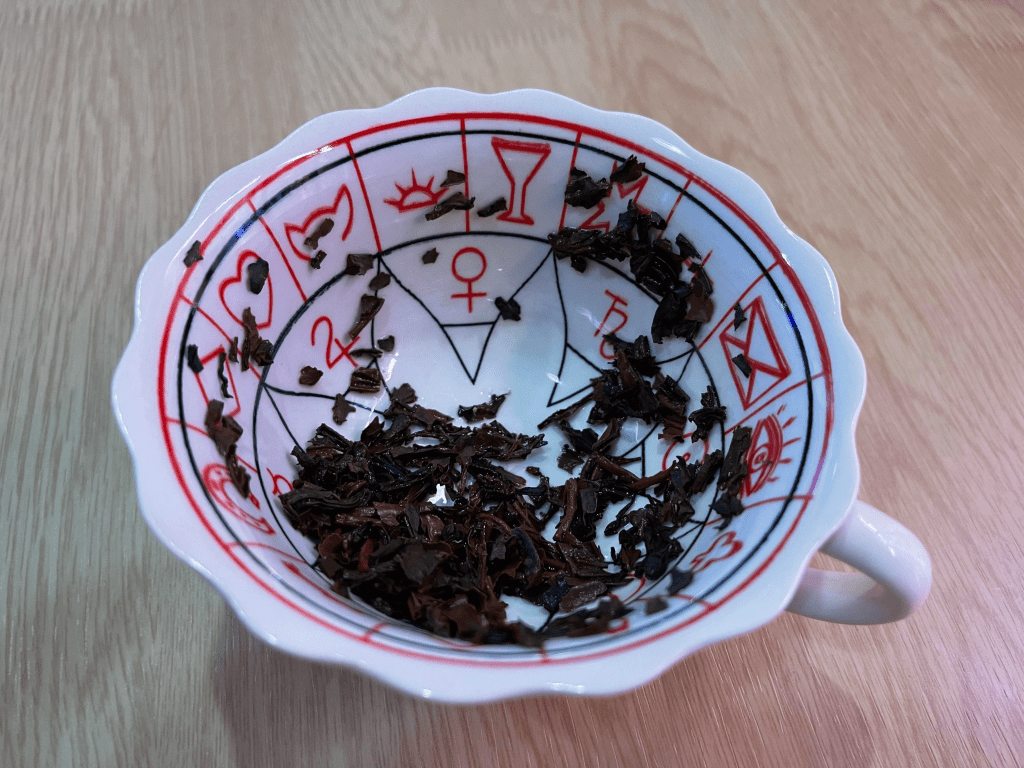
Even so, it beats this analogy to psychology.

Reading Tea Leaves analogue to psychology

This image of Carina Nebula’s so-called Cosmic Cliffs demonstrated the resolution and clarity we might expect from neuroscience in future.

NASA

This image represents where neuroscience is today.

NASA, ESA, and The Hubble Heritage Team (STScI/AURA)

So now I’ve said it. I feel better.

Cover Image Credit: NASA / ESA / CSA / STScI

Blame

Even the moral sceptic is not immune from his own form of the wish to over-intellectualize such notions as those of moral responsibility, guilt, and blame. He sees that the optimist’s account is inadequate and the pessimist’s libertarian alternative inane; and finds no resource except to declare that the notions in question are inherently confused, that ‘blame is metaphysical’.

PF Strawson, Freedom and Resentment
Quote from Freedom and Resentment and Other Essays by PF Strawson

Part of my central thesis of non-agency is centred on the notion of blame, and it seems PF Strawson has a lot to contribute in this arena. In short, given my lack of belief of material human agency, I wish to investigate the connection between seemingly innate impulses to project blame and the absence of a blameworthy object.

In order to devote more time to researching and writing my thesis and less time editorialising elsewhere, I may post some shorter content such as these gems that I stumble upon along the way. This facilitates my desire to create and share content without the burden of devoting hours to render it. It also gives me places to come back to.

I only hope that you don’t blame me for doing so.


Meantime, indulge my recording my thoughts here in the public space.

What is blame?

We don’t have very precise definitions of blame, we have an intuitive sense of what it means. There is a subject (or object, as the case might be) that creates (or has been attributed to have created) an action that results in an interaction on an object (or process) with a subsequent effect and a notion of intentionality. But we have to parse casual effect, responsibility, and blame as they are not strictly equivalent. Let’s begin with a causal event.

I believe that on balance the causal event process and object interaction is uncontroversial. A billiard ball (Object A), through directed (or undirected) motion, collides (action) with a second billiard ball (Object B) with the subsequent effect of displacing the second ball.

What we can claim in this scenario is that A → B, A causes B to move. Except in the loosest of idiomatic speech, we can’t really extend this causal relationship to claim that A is responsible for B’s movement. Even further removed, one can’t claim that A is to blame for B’s movement.

Responsibility and blame are different moral claims attributed to an agent. I feel I am safe to claim that a billiard ball has no agency. Whilst human agency is defined as an individual’s capacity to determine and make meaning from their environment through purposive consciousness and reflective and creative action (Houston, 2010), an agent in a more general sense is a being with the capacity to act, and ‘agency’ denotes the exercise or manifestation of this capacity.

The word blame is infused with negative connotations. Praise is a loose antonym with positive connotations, but I won’t focus on it because it is not nearly as heavy and operates semantically differently. In any case, I feel justified to cross blame from the list of possible qualifiers for the billiard ball scenario.

Is A responsible for B? Again, I believe that most people do not assign responsibility to inanimate objects—notwithstanding animism, pantheism, and possibly panpsychism.

Here are some diagrammes.

Above, there is only cause and effect. We can intuit that the movement of Object A is not uncaused. Even so, it careens into Object B, causing it to move. And while one could say A is responsible for moving B, this would be non-standard English language use.

If one pulls back to catch a wider glimpse, one can see that the cause of Object A striking Object B, was a person striking Object A (possibly with a cue stick). Here, the casual event chain is the person causing A to strike B. Two cause-effect relationships at a macro level. However, in this case, we can also say that the person is responsible for the event to set A into motion. We can also say that the person caused B to move (by the way of Object A). Even here, blame would be inappropriate to assert.

We may be able to reframe the scenario slightly differently to get blame into the picture, but let’s take a short detour and create a praise situation. If Object B is hit into a pocket, we can praise the person. Perhaps this shot wins the game. The person is responsible for making the shot.

In scenario B, the person misses the shot. Moreover, Object A does collide with Object B, but perhaps Object B is the 8 ball, and it was not supposed to be pocketed yet. Or perhaps the cue ball deflects off of Object B causing A to scratch because it falls into a pocket. Either of these situations might cause the person to lose the match. A mate may blame this person for being responsible for the loss.

Before moving on, I’ll point out that one distinction that affords blame more weight than praise is the ongoing psychology. Whilst with praise, a person may reflect fondly on a positive event, there is not really a counter to a grudge in the case of blame. And while praise can be misattributed with benefits to social capital, misdirected blame can result in a loss of social capital with longer-term implications.

Perhaps someone unseen pushes you into another person causing them to be injured. You may have been the cause of this person being injured, but like the billiard ball, Object B, you are not morally responsible. Moreover, you may be the target of blame.

These are rather low-stakes scenarios. Imaging these as legal negligence or in a criminal setting. Innocent people are routinely convicted for crimes they never committed. Perhaps, they had been previously unaware of any of the actors or events, yet they are blamed and fined or incarcerated.

This isn’t my interest to discuss at the moment. This is a different scope, so let’s return to the main theme.

In the low-stakes billiards example we can say that the person seems to have agency. For trivial events, we can ignore whether this is more than seeming. In essence, we can ignore the antecedent event arrow that caused the person to be in a situation to have the opportunity to strike the ball in the first place. We’ll return to this later.