Pursuit of Happiness

Owing to the cover image, I produced a short video on the folly of the pursuit of happiness. The image is purportedly a work of Banksy. It looks like a bad Photoshop, but that’s unimportant. I’m responding to the sentiment. The motivational blurb is half right: You can’t make someone else happy. But neither should you seek happiness. It’s a fool’s errand. Check out the 60-second short video on YouTube.

Several motivators have been identified as motivators for humans—ostensibly, human nature. One is happiness. John Stuart Mill and Jeremy Betham had a hand in this. In economics, they substitute utility for happiness. And then there’s Freud’s pleasure-pain dichotomy. I’ve got a longer form of content in the works. Please stand by.

Fiction Nation: Conclusion

Conclusion

In our exploration of fictions—nations, economies, money, legal systems, and even sports—we have uncovered the profound ways in which these constructs shape our reality. These fictions, born from collective agreements and sustained by shared belief, play pivotal roles in organizing societies, guiding behaviors, and fostering a sense of belonging and purpose. While they may not correspond to an objective, external reality, their effects are undeniably real and impactful.

Recognizing the fictional nature of these constructs challenges us to rethink our assumptions about truth and reality. It reveals the power of human imagination and the social nature of our existence. This awareness empowers us to question, reform, and innovate the fictions we live by, opening up possibilities for creating new social constructs that better align with our evolving values and aspirations.

The historical and philosophical perspectives we have explored underscore the contingent and constructed nature of truth. Thinkers like Michel Foucault and Jean Baudrillard remind us that what we accept as truth is often a product of social and historical processes, shaped by power dynamics and collective narratives. This critical awareness invites us to engage with our social constructs more thoughtfully and responsibly.

The practical implications of this perspective are far-reaching. By understanding that economic systems, national identities, and legal frameworks are human-made, we can envision and implement alternative models that prioritize sustainability, equity, and inclusivity. Recognizing the power of belief and narrative in shaping our realities encourages us to foster transparency, inclusivity, and critical engagement in the construction and perpetuation of social fictions.

Ethically, we must approach the creation and maintenance of fictions with a commitment to the common good. The manipulation of these constructs for narrow interests can lead to exploitation and injustice. Therefore, it is crucial to ensure that our social constructs serve the interests of all members of society and reflect our collective values and aspirations.

In conclusion, living in a world of fictions is both a profound and practical reality. By embracing the constructed nature of our social realities, we affirm the human capacity for imagination and creativity. This recognition opens up possibilities for envisioning and creating new fictions that better reflect our values and guide us toward a more just, equitable, and sustainable future. Through critical engagement and thoughtful innovation, we can navigate the complexities of our social world with greater insight and intentionality, fostering a more dynamic and harmonious society.

⬅ Fiction Nation: Can This Be True? (section 7)

⬅ Fiction Nation: The Concept of Fiction (section 1)

References

  1. Graeber, David. Debt: The First 5,000 Years (2011).
  2. Foucault, Michel. Discipline and Punish: The Birth of the Prison (1975).
  3. Baudrillard, Jean. Simulacra and Simulation (1981).
  4. Anderson, Benedict. Imagined Communities: Reflections on the Origin and Spread of Nationalism (1983).
  5. Giddens, Anthony. The Consequences of Modernity (1990).
  6. Beck, Ulrich. Cosmopolitan Vision (2006).
  7. Cover, Robert. “Nomos and Narrative” (1983).

Fiction Nation: Can This Be True?

Section 6: Can This Be True?

The Nature of Truth in Fictions

In exploring the concept that nations, economies, money, legal systems, and even sports are fictions, we confront a fundamental question: can this be true? The answer hinges on our understanding of truth and reality. If we define truth as correspondence to an objective, external reality, then fictions, by their nature, are not “true” in a literal sense. However, if we recognize that truth can also be a construct shaped by human perception and social agreements, then fictions hold a different kind of truth.

Fictions are true in the sense that they have real effects on our lives. They shape our behaviours, influence our decisions, and structure our societies. The value of money, the authority of laws, and the significance of national identities are all real because we collectively believe and act as if they are. This shared belief and action give fictions their power and their truth.

Philosophical Perspectives

Philosophers have long grappled with the nature of truth and reality. The concept of social constructs aligns with the ideas of thinkers like Michel Foucault, who argued that knowledge and power are intertwined, and that what we accept as truth is often a product of social and historical processes. Similarly, Jean Baudrillard’s concept of hyperreality suggests that in the postmodern world, the line between reality and simulation becomes blurred, and fictions can become more real than reality itself.

These perspectives challenge the notion of an objective, immutable truth, suggesting instead that truth is often contingent, context-dependent, and constructed through human interactions. In this light, the fictions that structure our world are as true as any other aspect of our lived experience.

Empirical Evidence

Empirical evidence supports the idea that fictions have real effects. For instance, studies in economics and sociology demonstrate how beliefs and narratives shape market behaviours and social norms. The placebo effect in medicine, where patients experience real improvements in health due to their belief in a treatment, exemplifies the power of belief in creating tangible outcomes.

Historical examples further illustrate this point. The Treaty of Westphalia in 1648, which established the modern system of nation-states, was a legal and diplomatic construct that reshaped political boundaries and identities. The creation of fiat currencies, which derive their value from collective trust rather than intrinsic worth, has revolutionized global economies.

Practical Implications

Recognizing the constructed nature of our social realities has practical implications. It empowers us to critically examine and potentially reshape the fictions we live by. This critical awareness fosters adaptability and innovation, allowing us to address contemporary challenges more effectively.

For example, understanding that economic systems are human-made constructs can inspire alternative models that prioritize sustainability and equity. Similarly, recognizing the fictional nature of national identities can promote more inclusive and cosmopolitan forms of belonging.

Ethical Considerations

While fictions can be powerful tools for organizing society, they also carry ethical considerations. The manipulation of fictions for political or economic gain can lead to exploitation and injustice. It is crucial to approach the construction and perpetuation of fictions with a sense of responsibility and a commitment to the common good.

Transparency, inclusivity, and critical engagement are key to ensuring that the fictions we create serve the interests of all members of society. This requires ongoing dialogue and reflection to align our social constructs with our evolving values and aspirations.

Conclusion

The notion that we live in a world of fictions is both profound and practical. It challenges us to rethink our assumptions about truth and reality, and to recognize the power of collective belief and social constructs in shaping our lives. By embracing this perspective, we gain the ability to question, reform, and innovate the fictions that structure our world, fostering a more just and dynamic society.

In acknowledging the constructed nature of our social realities, we affirm the human capacity for imagination and creativity. This recognition opens up possibilities for envisioning and creating new fictions that better reflect our values and aspirations, guiding us toward a more equitable and sustainable future.

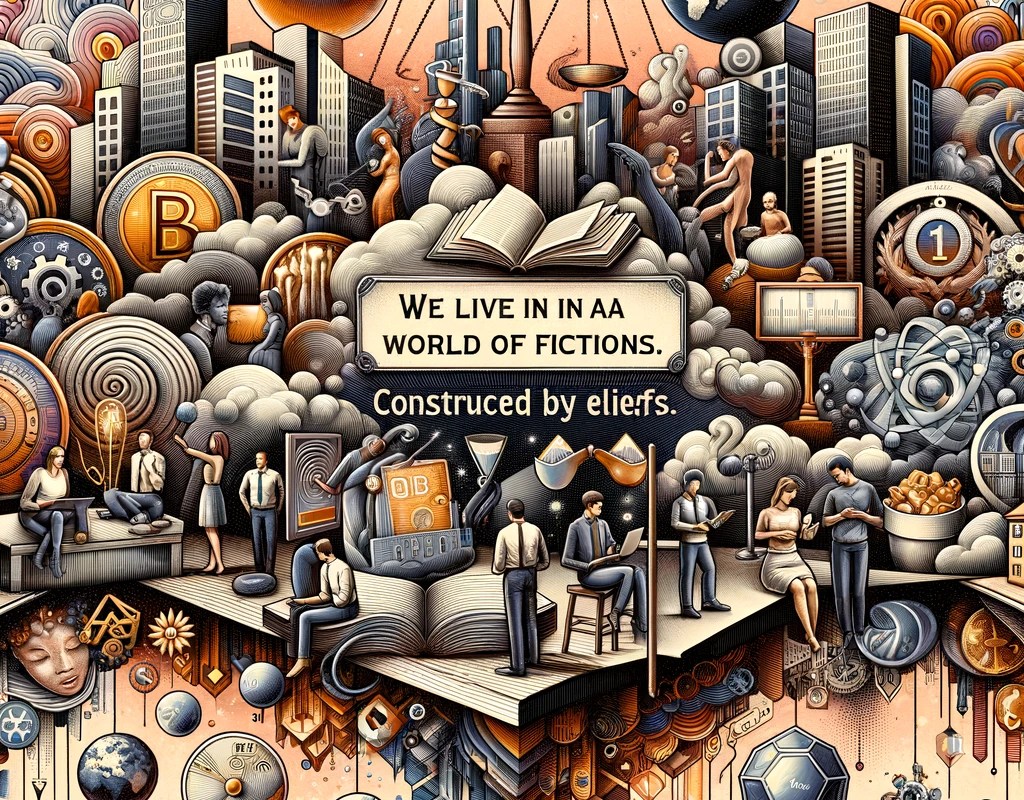
PS: Apologies for the AI typo in the thumbnail image. I fixed it once, and it went missing. Perhaps. I’ll mend it later.

References

  1. Graeber, David. Debt: The First 5,000 Years (2011).
  2. Foucault, Michel. Discipline and Punish: The Birth of the Prison (1975).
  3. Baudrillard, Jean. Simulacra and Simulation (1981).
  4. Anderson, Benedict. Imagined Communities: Reflections on the Origin and Spread of Nationalism (1983).
  5. Giddens, Anthony. The Consequences of Modernity (1990).
  6. Beck, Ulrich. Cosmopolitan Vision (2006).

Fiction Nation: Living in a World of Fictions


Section 5: Living in a World of Fictions

The Ubiquity of Fictions

In examining nations, economies, money, and legal systems, it becomes evident that much of what structures our daily lives is founded on fictions—collective agreements and constructs that shape our reality. Recognizing this opens a new perspective on how we understand and interact with the world. These fictions, while not inherently negative, demonstrate the power of human imagination and the social nature of our existence.

From the moment we wake up, we engage with these fictions. The money we use, the laws we abide by, and the national identities we hold are all part of a complex web of social constructs that provide order and meaning to our lives. These fictions create a shared reality that allows for coordination, cooperation, and coexistence on a large scale.

The Power and Potential of Fictions

Fictions are powerful because they shape our perceptions and behaviors. They provide frameworks for understanding our place in the world and guide our interactions with others. For instance, the belief in the value of money enables complex economic transactions, while national identities foster a sense of belonging and community.

However, the power of these fictions also means they can be manipulated. Political narratives, economic policies, and legal decisions can be crafted to serve particular interests, often at the expense of others. This underscores the importance of critically examining the fictions we live by and questioning whose interests they serve.

The potential of fictions lies in their flexibility. Because they are constructed, they can be deconstructed and reconstructed. This offers opportunities for innovation and change. By reimagining our social constructs, we can address contemporary challenges such as inequality, climate change, and global conflicts. For example, the emergence of new economic models, such as the sharing economy or digital currencies, illustrates how rethinking foundational fictions can lead to transformative change.

Sports as Fiction

Sports provide a compelling example of another pervasive fiction in human society. Like money and legal systems, sports are constructed through a set of agreed-upon rules, rituals, and narratives. The games we play, the leagues we follow, and the teams we support are all part of a shared fiction that brings people together, creates communities, and evokes strong emotions.

The rules of sports are arbitrary yet accepted by all participants and fans, creating a framework within which competition and achievement are celebrated. These rules can be changed, and often are, to adapt to new circumstances or to improve the game. This flexibility highlights the constructed nature of sports, similar to other social systems.

Moreover, sports narratives—stories of underdogs triumphing, legendary performances, and historic rivalries—are powerful fictions that shape our collective memory and identity. They provide a sense of continuity and shared experience, connecting individuals across different backgrounds and generations.

Challenges of Living with Fictions

Living in a world of fictions comes with challenges. One significant challenge is the tension between reality and fiction. When the fictions we live by are mistaken for immutable truths, it can lead to rigidity and resistance to change. This can be seen in the reluctance to reform outdated legal systems, economic models, or national identities that no longer serve the common good.

Another challenge is the potential for disillusionment. Recognizing that much of what we consider to be real is, in fact, a construct can lead to a sense of instability and uncertainty. This awareness requires a balance between skepticism and pragmatism—understanding that while fictions are not inherently true, they are necessary for social cohesion and functioning.

The Role of Critical Awareness

Critical awareness is crucial in navigating a world of fictions. This involves questioning the assumptions and narratives that underpin our social constructs and being open to alternative perspectives. Education, media literacy, and public discourse play vital roles in fostering this critical awareness.

By understanding the constructed nature of our realities, we can become more active participants in shaping them. This empowers individuals and communities to advocate for changes that reflect their values and address their needs. It also encourages a more inclusive and equitable approach to social organization, recognizing the diverse ways in which people experience and contribute to society.

Imagining New Fictions

The future will undoubtedly bring new fictions that will shape our lives in unforeseen ways. As technology advances, new forms of social organization, identity, and interaction will emerge. For example, the rise of virtual reality and artificial intelligence will create new spaces and entities that challenge our current understanding of reality.

Imagining new fictions involves creativity and collaboration. It requires us to envision possibilities beyond our current constructs and to work together to bring those visions to life. This imaginative process is fundamental to human progress and the continual evolution of our societies.

Conclusion

Living in a world of fictions is both a profound and practical reality. By recognizing and understanding the fictions that structure our lives, we gain the power to question, reform, and innovate. This critical awareness allows us to navigate the complexities of our social world with greater insight and intentionality, fostering a more just and dynamic society.

⬅ Fiction Nation: Legal and Jurisprudence Sytems (section 4)

➡ Fiction Nation: Can This Be True (section 6)

References

  1. Graeber, David. Debt: The First 5,000 Years (2011).
  2. Anderson, Benedict. Imagined Communities: Reflections on the Origin and Spread of Nationalism (1983).
  3. Giddens, Anthony. The Consequences of Modernity (1990).
  4. Beck, Ulrich. Cosmopolitan Vision (2006).
  5. Cover, Robert. “Nomos and Narrative” (1983).

Fiction Nation: Legal and Jurisprudence Systems


Section 4: Legal and Jurisprudence Systems as Fictions

The Nature of Legal Systems

Legal and jurisprudence systems are among the most complex and entrenched fictions in society. Laws are human-made rules that govern behaviour, established by governments and enforced by judicial institutions. While laws aim to create order and justice, they are ultimately constructs, products of human agreement and cultural evolution.

The concept of law varies significantly across cultures and historical periods. Ancient legal codes, such as the Code of Hammurabi or Roman law, illustrate the long-standing tradition of codifying rules to govern society. However, these codes, like modern laws, are not natural phenomena but rather inventions designed to regulate human interactions and maintain social cohesion.

The Evolution of Legal Fictions

Legal systems have evolved alongside societies, adapting to changes in cultural norms, technological advancements, and political landscapes. The development of common law, for example, is a testament to the adaptive nature of legal systems. Common law, which originated in medieval England, is based on judicial precedents and case law rather than written statutes. This system relies heavily on the interpretation and application of past decisions, demonstrating how legal principles are constructed and reconstructed over time.

Moreover, legal fictions are often used within these systems to achieve practical outcomes. For instance, the concept of corporate personhood, where a corporation is treated as a legal person with rights and responsibilities, is a legal fiction designed to facilitate business operations and protect individual shareholders from certain liabilities. This illustrates how legal constructs can shape economic activities and social relations.

Implications of Legal Fictions

The recognition that legal systems are fictions has profound implications for how we understand and engage with the law. It highlights the role of human agency in creating and modifying legal norms, suggesting that laws are not immutable truths but rather adaptable tools for governance.

Legal systems are often seen as impartial and objective, but they are deeply influenced by the values, beliefs, and power dynamics of the societies that create them. This can lead to biases and inequalities being embedded within legal frameworks. For example, historical laws that discriminated based on race, gender, or class demonstrate how legal fictions can perpetuate social injustices.

Understanding the fictional nature of legal systems also opens the door to questioning and reforming these systems. It encourages us to consider alternative approaches to justice and governance that may better reflect contemporary values and address the needs of diverse populations.

The Role of Legal Narratives

Legal narratives, the stories told through laws and legal decisions, play a crucial role in shaping public perceptions and societal norms. These narratives construct realities that influence how individuals and communities understand their rights, responsibilities, and relationships with the state.

The work of scholars like Robert Cover, who in “Nomos and Narrative” (1983) argued that law is a system of meaning-making through narratives, underscores the importance of storytelling in the legal realm. By examining these narratives critically, we can uncover the underlying assumptions and power structures that they reinforce.

Future of Legal Systems

As societies continue to evolve, so too will their legal systems. The rise of international law, human rights conventions, and transnational legal frameworks reflects the growing interconnectedness of the world. These developments challenge traditional notions of state sovereignty and domestic legal autonomy, suggesting a future where legal systems may become even more complex and intertwined.

By recognizing legal systems as fictions, we are better equipped to navigate and influence these changes. This awareness can lead to more inclusive and equitable legal frameworks that serve the broader goals of justice and human flourishing.

References

  1. Cover, Robert. “Nomos and Narrative” (1983).
  2. Graeber, David. Debt: The First 5,000 Years (2011).
  3. Anderson, Benedict. Imagined Communities: Reflections on the Origin and Spread of Nationalism (1983).
  4. Giddens, Anthony. The Consequences of Modernity (1990).
  5. Beck, Ulrich. Cosmopolitan Vision (2006).

Fiction Nation: Economies & Money (part 3)

➡ Fiction Nation: Living in a World of Fictions (section 5)

Fiction Nation: Economies and Money

Section 3: Economies and Money as Fictions

The Concept of Money

Money is one of the most pervasive fictions in human society. Traditionally, it is thought that money evolved from barter systems, where goods and services were directly exchanged. However, anthropologist David Graeber, in his book “Debt: The First 5,000 Years” (2011), argues that this narrative is largely a myth. According to Graeber, there is little historical evidence to support the idea that societies primarily relied on barter before the advent of money. Instead, he suggests that credit systems were more prevalent, where people kept track of debts and credits in the absence of physical currency.

Graeber’s perspective challenges the conventional economic narrative by emphasizing the role of social relationships and trust in early economic transactions. Rather than evolving from barter to commodity money (like gold and silver coins) and then to fiat money, economies often operated on the basis of mutual obligations and social bonds long before the invention of physical currency. This underscores the idea that money, in all its forms, is a social construct—a fiction agreed upon by the members of a society.

Fiat money, which is currency that a government has declared to be legal tender but is not backed by a physical commodity, relies entirely on trust and belief in its value rather than any intrinsic worth. Its value comes from the collective agreement that money can be used for transactions, illustrating how deeply embedded fictions can shape our economic reality.

Economies as Constructs

Economies, much like money, are constructed systems designed to organize and facilitate the production, distribution, and consumption of goods and services. The idea of a market economy, where supply and demand determine prices and allocation of resources, is a theoretical construct that has been widely adopted and adapted across the globe. Economic theories and models, while rooted in empirical observations, are also shaped by human assumptions and values.

For example, capitalism, the dominant economic system in much of the world, is built on the principles of private property, free markets, and competition. These principles are human-made constructs that have been institutionalized through laws, regulations, and cultural norms. The notion of “economic growth” itself is a concept that has been prioritized and pursued, shaping policies and societal goals.

Implications of Economic Fictions

Understanding economies and money as fictions highlights their dependence on collective belief and participation. This perspective allows us to critically examine the assumptions underlying economic systems and consider alternative models. For instance, the rise of digital currencies like Bitcoin challenges traditional notions of money by introducing decentralized and peer-to-peer forms of exchange.

Moreover, recognizing the fictional nature of economies can lead to more flexible and adaptive economic policies. It encourages innovation and experimentation with new economic frameworks that may better address contemporary challenges such as inequality, environmental sustainability, and technological disruption.

By exploring the fictions of economies and money, we gain insight into the powerful influence of human-made constructs on our daily lives. This awareness can inspire us to question and potentially reshape these constructs to create more equitable and resilient economic systems for the future.

References

  1. Graeber, David. Debt: The First 5,000 Years (2011).
  2. Giddens, Anthony. The Consequences of Modernity (1990).
  3. Beck, Ulrich. Cosmopolitan Vision (2006).
  4. Anderson, Benedict. Imagined Communities: Reflections on the Origin and Spread of Nationalism (1983).

Fiction Nation: Nations as Fictions (part 2)

Fiction Nation: Legal and Jurisprudence Systems (part 4)

Fiction Nation: Nations as Fictions

Section 2: Nations as Fictions

Historical Perspective

Nations, as we understand them today, are relatively modern constructs. The idea of a nation-state—a defined territory governed by a sovereign entity representing a unified people—emerged prominently in Europe following the Peace of Westphalia in 1648, which marked the end of the Thirty Years’ War. This treaty is often cited as the beginning of the modern state system, where sovereign states with defined territorial boundaries became the norm. Before this, the world was organized into empires, kingdoms, and tribal territories, with fluid and often disputed boundaries. For example, the Holy Roman Empire, the Ottoman Empire, and various feudal systems in Europe and Asia did not conform to the modern notion of a nation-state.

Benedict Anderson, in his seminal work “Imagined Communities” (1983), argues that nations are socially constructed communities, imagined by the people who perceive themselves as part of that group. Unlike face-to-face communities, the members of a nation will never know most of their fellow members, meet them, or even hear of them, yet they maintain an image of their communion. This collective imagination, fostered by shared symbols, languages, and media, forms the bedrock of national identity.

Modern Nations

In the contemporary world, the concept of a nation is reinforced by various symbols and rituals that create a sense of belonging and loyalty among its citizens. National borders, for instance, are often seen as immutable lines on a map, but they are essentially human-made demarcations that can and have changed over time. Flags, anthems, and other national symbols serve as powerful tools to unite individuals under a common identity, often evoking strong emotions and a sense of pride.

Moreover, governments and institutions perpetuate the fiction of nationhood through laws, education systems, and public ceremonies. These elements contribute to a shared national narrative, instilling values and beliefs that align with the idea of a unified nation. For example, national holidays commemorate historical events deemed significant in the collective memory, reinforcing the notion of a continuous and coherent national story.

The role of modern media cannot be understated in this context. News outlets, social media platforms, and entertainment industries all play a part in maintaining and shaping national identities. They disseminate stories that resonate with the public’s sense of nationhood, whether by celebrating achievements, mourning losses, or rallying against perceived threats.

Future of Nations

Some scholars suggest that nation-states may not have a long lifespan due to globalization, supranational organizations, and transnational networks. For example, the European Union represents a move towards supranational governance, challenging the traditional notion of sovereign nation-states. The processes of globalization, including economic interdependence, the rise of multinational corporations, and international communication networks, are often seen as factors that could erode the sovereignty and relevance of nation-states. Scholars like Anthony Giddens discuss how globalization impacts traditional forms of governance and national identity.

Theories of cosmopolitanism and post-nationalism propose that future identities may be more global or regional rather than tied to specific nation-states. Ulrich Beck and other sociologists have explored the idea of a “cosmopolitan society” where global citizenship takes precedence over national citizenship.

By exploring the fiction of nations, we open the door to questioning how these constructs influence our perceptions, behaviours, and interactions on both a personal and global scale. This awareness can lead to a more nuanced understanding of international relations, global conflicts, and the potential for fostering more inclusive and flexible identities in an increasingly interconnected world.

Fiction Nation: The Concept of Fiction (section 1)

Fiction Nation: Economies and Money as Fictions (section 3)

Fiction Nation: The Concept of Fiction

Video: YouTube rendition of the content on this page.

Introduction

In our daily lives, we encounter numerous constructs that shape our understanding of the world. These constructs, though deeply ingrained in our societies, may be more fictional than factual. We accept the existence of nations, economies, money, and legal systems as fundamental aspects of our reality, yet these entities are human-made inventions. In this article, we will explore the notion that many of the pillars supporting our world are, in fact, fictions. By examining the nature of these fictions, we can better understand their impact on our lives and how they shape our perceptions and interactions.

Section 1: The Concept of Fiction

Definition of Fiction

Oxford Languages via Google defines fiction as:

fic·tion /ˈfɪkʃən/ noun

  1. literature in the form of prose that describes imaginary events and people.
  2. something that is invented or untrue.
    they were supposed to be keeping up the fiction that they were happily married

Fiction, in its most common sense, refers to imaginative literature—stories created from the author’s mind, describing events and characters that do not exist in reality. However, fiction also encompasses broader definitions, including any invented or untrue concept. This dual definition highlights the versatility of fiction: it is not only the realm of novels and stories but also the domain of societal constructs and beliefs that, while not grounded in tangible reality, exert a powerful influence over our lives.

Examples of Fiction in Everyday Life

Fiction extends beyond the pages of a book or the scenes of a movie. It permeates various aspects of our everyday existence. For instance, consider the concept of a corporation. Legally, a corporation is an entity that possesses many of the rights and responsibilities of a person, yet it is not a physical being—it is a construct, a legal fiction, created to facilitate economic activities. Similarly, brands and trademarks are fictions designed to create distinct identities for products and services, influencing consumer behaviour and shaping market dynamics.

The significance of these fictions lies in their ability to organize and structure society. They provide frameworks within which we operate, enabling complex interactions and collaborations. However, it is crucial to recognize their invented nature, as this awareness allows us to question and, if necessary, reshape these constructs to better serve our collective needs.

By acknowledging the fictional basis of many societal elements, we can unravel the layers of assumptions and beliefs that underpin our reality. This understanding sets the stage for a deeper exploration of specific fictions—nations, economies, money, and legal systems—and their profound impact on our world.

Continue to Fiction Nation: Section 2

Neglect and a Quarter Dozen

I am going to neglect this blog for at least another day. I’ve got too many irons in the fire.

Why do we routinely say ‘half dozen’ but don’t tend toward ‘quarter dozen’ or ‘third of a dozen’? I know many people have maths deficits, but still. I don’t think even I will attempt to start this trend, but this thought crossed my head today.

I hope to return to reengage with this block, but until then, adieu.

Perfect and Relative Pitch and Reality

Perception of Reality™ is akin to having relative pitch. Unlike pitch, where some people have perfect pitch – the ability to name a note or chordal composition without any other reference – it is unlikely that anyone has or will have access to objective reality – analogically: perfect pitch for reality.

As I’ve mentioned, I believe that all our experiences and interactions with reality are relative, if not wholly subjective. There may exist an objective reality, but for reasons already noted – cognitive and sense perception deficits –, we can never access it.

Musically, If someone plays and identifies a reference note, say A (or do in movable do solfège), and then plays a major fifth above (or sol), a person with relative pitch can hear that fifth interval and identify it as an E. Everything is about relationships. In music, the relationships are intervalic, but we know where we are based on where we’ve been. A person with perfect pitch requires no such priming. They can identify the first A note without prompting.

Our experience with reality is also relative, but no one has the equivalence of perfect pitch. No one has access to objective reality – if there even is one.

I don’t deny that there could be an objective reality. I just believe it’s inaccessible. I am a qualified realist – so, not a physicalist –, but I don’t believe in supernatural or paranormal events. A so-called ‘supernatural’ event is merely an event that hasn’t yet been described in ‘natural’ terms.

Now that I got that off my chest, what are your thoughts on objective reality? Lemme know.