NB: I reviewed the credentials of the hosts and revised my critique at the end of this piece.
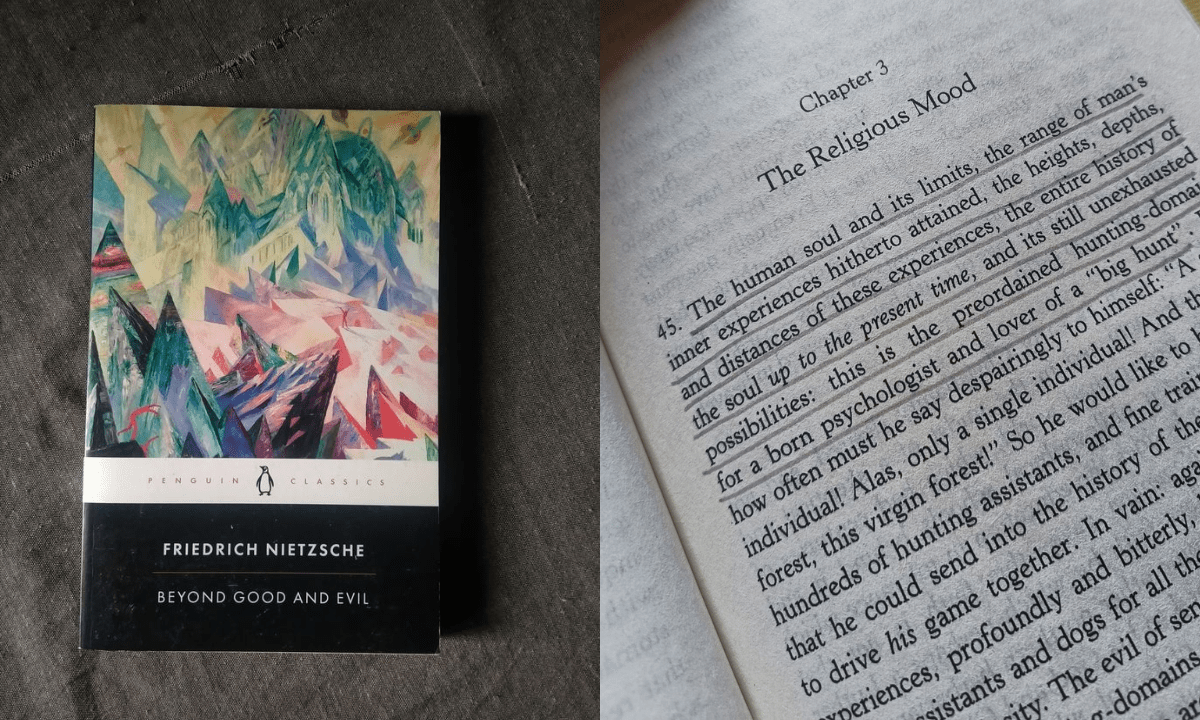
I joined a scheduled close reading of Nietzsche’s Beyond Good and Evil recently and came away less refreshed than exasperated. I will spare the platform and the hosts, not out of charity exactly, but because the problem is broader than two particular men fumbling through a canonical text in public. What disappointed me wasn’t that they disagreed with Nietzsche, nor even that they may have misunderstood him in places. Misreading is inevitable. The problem was that they seemed not to have brought much of a reading to begin with.
I had read Beyond Good and Evil years ago and thought a return to it might do me some good, or at least less evil than the usual intellectual content mill. The format sounded promising enough: two interested hosts working through the introduction live, sentence by sentence, in a supposedly close reading. Both had apparently read the book before. One therefore assumed they might arrive with at least a provisional grasp of its architecture, key provocations, and habitual traps. That assumption, in the event, turned out to be embarrassingly optimistic.
As one host read line by line, the discussion lurched forward by way of hesitant paraphrase, speculative gloss, and the occasional verbal shrug. He offered the more substantive guesses, such as they were, while the other contributed mostly vague assent, half-memory, and the sort of foggy commentary one gives when one dimly recalls having once encountered a difficult book in a previous phase of life. It was less a close reading than a public rehearsal of not quite knowing what one was doing.
Now, I am not demanding exegetical perfection. Nietzsche is not a writer one simply ‘gets’ and files away like a user manual. Nor am I naïve enough to think authorial intention settles everything. Barthes is right enough to remind us that the text exceeds the author’s sovereign control. But the death of the author is not a licence for the death of preparation. If one is going to host a close reading of a notoriously elliptical and performative philosopher, the least one might do is arrive having done some prior work. Read the introduction carefully beforehand. Refresh the major themes. Check the loaded terms. Develop an argument, or at least a point of view.
That point of view may be wrong. Fine. Better that than the contemporary preference for the curated shrug, where one mistakes visible uncertainty for intellectual seriousness. There is a difference between interpretive openness and simple lack of preparation. One is a virtue. The other is an aesthetic.
I find this especially grating because I cannot imagine teaching a class that way. When I taught, I’d spend hours preparing before entering the room. Not because I imagined myself infallible, but because students deserve more than watching a lecturer discover the material in real time. A formed point of view is not a dogma. It is a starting position. It gives the discussion shape, stakes, and resistance. Without it, one is not leading inquiry but merely simulating it.
The second host did little to improve matters. Rather than complicating or sharpening the reading, he mostly echoed the first. There was very little friction, and thus very little illumination. One of the virtues of reading Nietzsche in company is that he invites productive disagreement. He is slippery, aphoristic, ironic, and often strategic in his provocations. A good discussion can tease out the tensions in his prose, test competing emphases, and ask whether a claim is literal, tactical, genealogical, or satirical. None of that really happened. Instead, one host fumbled, and the other nodded. The result was a kind of interpretive ventriloquism in which agreement substituted for insight.
The accompanying chat made things worse, or perhaps simply made the missed opportunity more obvious. Viewers were offering questions and interpretations, yet the hosts largely ignored them. Aside from one participant, who seemed likely to have some prior relationship with them, the chat was treated as background furniture. This was especially irritating because the event was live. If one is going to perform reading in public, the public should not be reduced to silent witnesses of one’s uncertainty. Otherwise, the ‘community’ aspect is just branding, another little liturgy of digital participation in which the audience is invited to attend but not to matter.
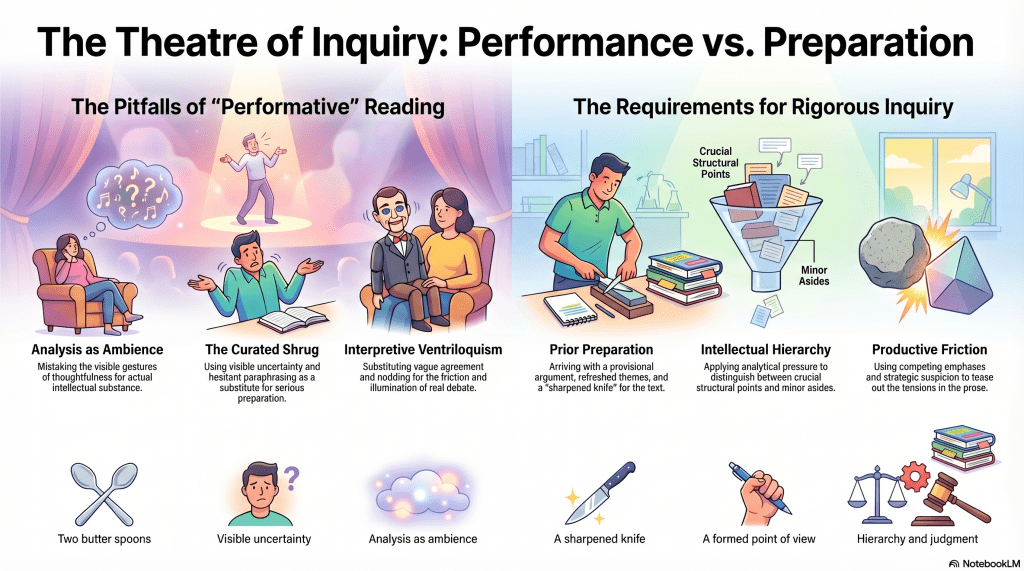
To be fair, even when they did read from the chat, they handled those comments much as they handled Nietzsche: superficially, without much analytical pressure, as though any sentence placed before them deserved the same tone of vague consideration. This flattening effect was revealing. It suggested not generosity but a lack of discrimination. A close reading requires hierarchy, emphasis, and judgement. One must be able to say: this is a crucial phrase; this term matters; this apparent aside is actually structural; this comment in the chat opens something worth pursuing; that one does not. Without such judgement, everything becomes equally interesting, which is another way of saying that nothing really is.
What emerged, then, was not close reading but the theatre of close reading. The ritual gestures were all in place: slow pace, sentence-by-sentence attention, occasional lexical speculation, the performance of thoughtfulness. But the substance was strangely absent. One had the form of seriousness without much seriousness of form. It was analysis as ambience.
This points to a broader problem in online intellectual culture. Much of it now confuses exposure with engagement. To read a difficult text aloud is not yet to wrestle with it. To host a discussion is not yet to lead one. To hesitate publicly is not yet to think. Somewhere along the line, people began mistaking the visible performance of inquiry for inquiry itself. The result is a style of pseudo-seriousness in which the host need not know very much, so long as he can sound tentative in the correct register.
Nietzsche, of all people, deserves better than that. He is not an author who yields his force to the merely dutiful or the casually adjacent. He requires energy, suspicion, historical feel, and the willingness to risk a reading. One need not become a priest of correctness. But one should at least bring a sharpened knife to the table, rather than two butter spoons and a podcast voice.
What disappointed me, then, was not simply that these hosts stumbled. Everyone stumbles with Nietzsche. It was that the stumbling seemed to be the content. No deep framework, no clear prior preparation, little tension between the readers, and scant engagement with the audience. The whole affair felt less like a serious encounter with Beyond Good and Evil than a performance of cultural literacy: a way of being seen near an important book.
And perhaps that is the real irritation. One expects difficulty. One can even forgive error. What is harder to forgive is the peculiar modern tendency to make a spectacle of one’s underpreparedness and call it interpretation.
To be fair, I later learned that the co-host was not a philosopher by training but came from Literature. That in itself is no objection. Indeed, a pairing like that could have worked very well. Nietzsche is precisely the sort of writer who benefits from both conceptual and stylistic scrutiny. A philosopher can situate the argument, trace its targets, and identify the intellectual inheritance under pressure. A literary reader can pick up tone, irony, rhetorical staging, and the peculiar way Nietzsche so often performs thought rather than merely stating it.
The problem, then, was not the pairing but the execution. The session might have worked if both hosts had prepared properly and if each had leaned into his own strength. Instead, what emerged was a flatter sort of exchange, with the philosopher soliciting the literary co-host’s ‘opinion’ on semantic content as though interpretive adequacy were simply a matter of free-floating textual impressions. What was missing was any real division of labour, any methodological self-awareness, or any sense that different competences might illuminate different aspects of the text.
 Philosophics