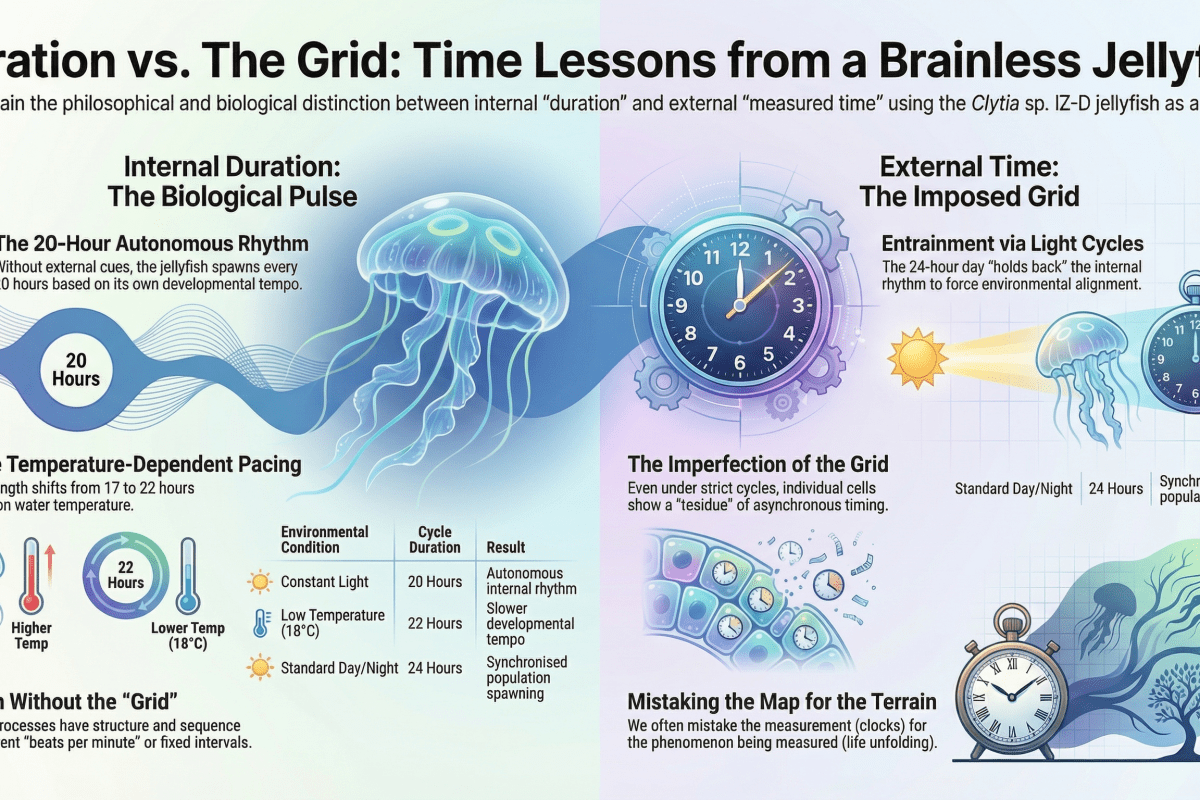
Disclosure: I shouldn’t have to apologise for two consecutive posts written by Claude – previous post on duration and time – this time about reframing a chat about time and duration around the hydrozoan jellyfish (sic. sea jelly). Yet again, this post arrives with a warning: if you don’t like AI-authored content, it’s not too late to turn back or click away.
A hydrozoan jellyfish off the coast of Japan has no brain, no central nervous system, and no opinion about the block universe. It does, however, have something to teach us about the nature of time — and it’s more than most pop-science accounts manage.
Researchers recently described Clytia sp. IZ-D, a previously undocumented species of jellyfish that releases its gametes each evening with remarkable precision. The interesting part isn’t the precision. It’s what produces it.
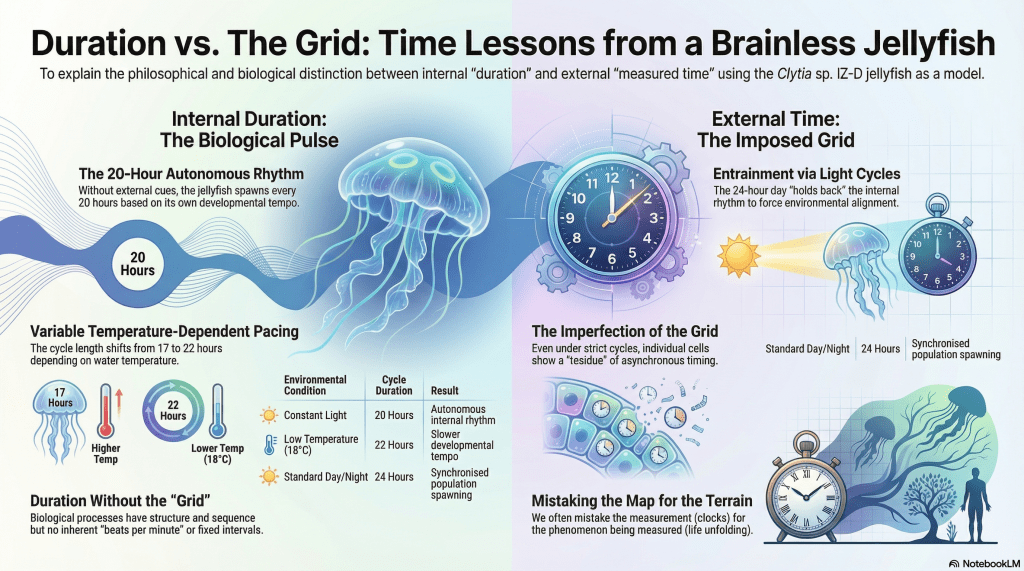
Left to its own devices under constant light, the jellyfish spawns every 20 hours. Not 24. Twenty. It has its own autonomous developmental rhythm — oocytes growing, acquiring competence, reaching a threshold, and releasing. That rhythm belongs to the organism. It’s not borrowed from the environment. It’s not calibrated to the rotation of the Earth. It’s the jellyfish’s own tempo.
But place the jellyfish under a normal day-night cycle, and the 20-hour rhythm gets pulled into a 24-hour one. The daily light-dark transition doesn’t trigger spawning directly. It delays the autonomous cycle by several hours, dragging it into alignment with the environmental period. Sunrise resets the clock — not by starting it, but by holding it back. Under a standard 12-hour light cycle at 21°C, spawning occurs 14 hours after dawn. Every day. Synchronised across the population to within about 20 minutes.
The 24-hour cycle is not the jellyfish’s rhythm. It’s what happens when an external structure is imposed on it.
Now, you could read this as a charming piece of marine biology and move on. But if you’re paying attention, it’s a remarkably clean illustration of something that applies well beyond cnidarian reproduction.
The jellyfish has its own duration — a developmental tempo with no fixed metric. Under constant conditions, the cycle length shifts with temperature: 17 hours at 24°C, 22 hours at 18°C. There’s no intrinsic interval. The process has structure — oocyte growth, staged competence acquisition, threshold sensitivity — but it has no grid lines. No bar lines. No BPM.
The 24-hour day provides the grid. The light-dark cycle imposes intervallic structure on a process that doesn’t natively possess it. And the imposition works — it synchronises the population, coordinates male and female gamete release, and presumably improves reproductive success. The grid is useful. Indispensable, even.
But it’s not the organism’s time. It’s what the organism’s time looks like after the environment has had its way with it.
And here’s the part that matters philosophically. The imposition is imperfect. Individual oocytes within the same gonad don’t all reach maturation competence at the same moment. There’s a spread — 40 to 60 minutes under normal conditions, widening further under constant light. The grid says “now.” The biology says “roughly now, give or take, depending on which oocyte you’re asking.” The grid cannot fully resolve what it organises. There’s always a residue.
Under constant darkness, the residue takes over entirely. The autonomous rhythm reasserts itself, but without the entraining signal it becomes asynchronous. Different jellyfish spawn at different times. Different oocytes within the same jellyfish mature at different rates. The developmental process is still there — the structure is still there — but without the intervallic imposition, it doesn’t produce anything that looks like coordinated “time.” It produces duration doing what duration does when nobody is counting.
None of this requires a brain. None of it requires experience. None of it requires a subject who feels the passage of time. The jellyfish doesn’t experience the 24-hour cycle as given. It doesn’t experience anything, so far as we know. And that’s precisely what makes it useful as an illustration: it shows intervallic structuring operating at a purely material level, without any phenomenological overlay. The grid is imposed on the biology. The biology is not the grid.
Now scale up.
We do the same thing the light-dark cycle does to the jellyfish, except we do it to everything, and we do it to ourselves. We impose intervallic structure on duration — segmenting it, ordering it, metrising it — and then we mistake the structure for what it’s imposed on. We experience time as sequenced, directional, and measured, and we assume that’s what time is. Physics formalises the assumption into equations and discovers, to no one’s surprise, that the formalism is time-symmetric. And then pop science announces that time could therefore “go backwards” — which is exactly like saying that because the score reads the same in both directions, the music could be played in reverse.
The jellyfish knows better. Not because it’s clever, but because it’s simple enough that you can see the layers separately: the autonomous developmental duration, the environmental intervallic imposition, the imperfect entrainment, and the residue the grid can’t capture. In us, those layers are collapsed. We live inside the imposition and mistake it for the terrain.
The 24-hour day is a grid. A useful grid. An indispensable grid. But the jellyfish was doing something before the grid arrived, and it will go on doing something if the grid is removed. What it does without the grid doesn’t look like “time.” It looks like biology unfolding at its own pace, in its own structure, answerable to its own constraints.
That’s duration. And it was there before we started counting.
 Philosophics