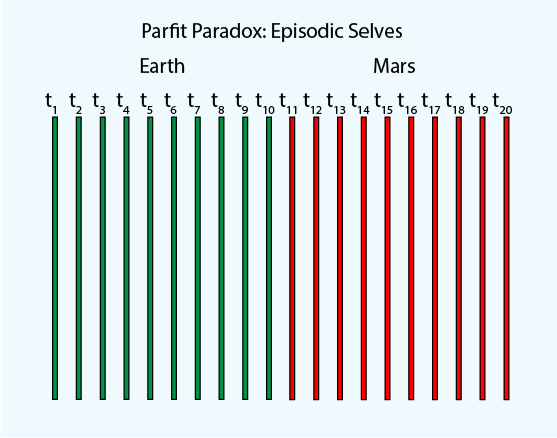
A thought experiment by Derek Parfit, here’s the setup: ostensibly, a human is cloned, but they aren’t so much cloned as teleported to Mars, à la Star Trek – there, not here, particle by particle.
The question and seeming paradox is whether the reconstructed person and the original are the same, identical.
In deference to my upcoming book, The Architecture of Encounter, I want to revisit this problem and show how there is no paradox. Let’s take a look.
Parfit’s Teletransporter Is Not a Paradox. It Is a Hangover.
Derek Parfit’s teletransporter thought experiment has become one of philosophy’s favourite parlour tricks. A person steps into a machine on Earth. The machine records their physical structure in total detail, destroys the original body, and reconstructs an exact counterpart on Mars from local matter. The person on Mars wakes with the same memories, the same character, the same projects, and the same unearned confidence that philosophers are asking sensible questions. Parfit uses such cases to press the thought that personal identity may not be what matters; psychological continuity may matter more.
The supposed paradox is familiar enough: is the person on Mars the same person, or has the original died and been replaced by a copy?
My answer is that there is no paradox here, unless one insists on dragging in precisely the assumptions that ought to be under suspicion.
This is where my forthcoming book, The Architecture of Encounter, becomes relevant. The teletransporter puzzle only looks deep if one begins with a poor ontology and a clumsy model of selfhood. Once those are withdrawn, the mystery evaporates.
The first mistake: substance nostalgia
The teletransporter story is framed as though a human being were fundamentally a thing made of parts, a self-identical object that might either persist through rearrangement or fail to do so. We are invited to imagine a body atomised here and recomposed there, then asked whether the ‘same person’ has survived. But this framing already cheats.
If substance ontology is not basic, then there is no hidden metaphysical pellet of selfhood waiting to be shepherded from Earth to Mars. On a relational picture, what is fundamental is not a stockpile of little self-identical things but organised relation, structured energetic differentiation, constraint, response, and persistence-pattern. The old metaphysics of enduring stuff survives mostly because grammar flatters it.
So the first reason the teletransporter is not paradoxical is that it begins by treating persons as though they were furniture.
The second mistake: reifying the self
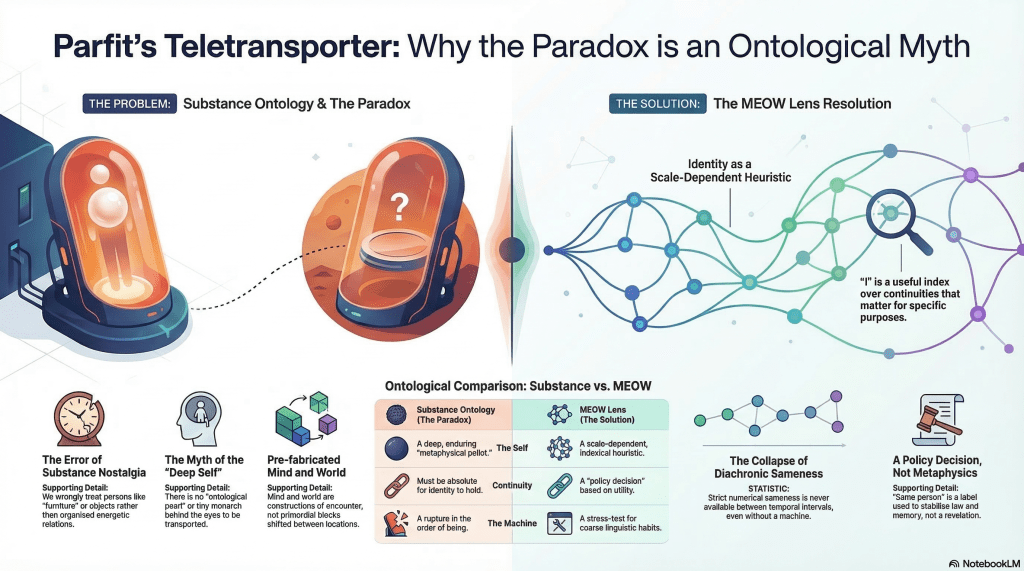
The second assumption is just as dubious. The problem presumes that there must be a deep self, some enduring owner of experience, whose fate the machine must settle. I don’t grant that either.
I am much closer here to Galen Strawson’s episodic flavour than to the pious diachronic picture in which one’s life forms a single, extended inner possession. Strawson’s distinction is useful because it reminds us that not everyone experiences themselves as a long, narratively unified entity stretching robustly across time. An episodic self need not deny practical continuity, memory, or biography; it simply refuses to inflate them into a metaphysical core.
That is also how I think identity should be understood more generally: as a scale-dependent heuristic.
The self is not nothing. But neither is it an ontological pearl. It is a compression. A convenience. A useful index over continuities that matter for some purposes and not others. At one grain, sameness appears stable enough. At another, it dissolves into drift, revision, replacement, and selective narrative smoothing.
The “I” is not a tiny monarch enthroned behind the eyes. It is an indexical function within organised experience.
The third mistake: treating mind and world as pre-fabricated blocks
The teletransporter story also inherits a bad picture of mind and world. It imagines a ready-made mind confronting a ready-made external world, then asks whether one of those ready-made minds has been shifted from one location in the world to another. I reject that framing, too.
Mind and world, on my view, are post hoc constructions of mediated interface. Encounter comes first. Organisation comes first. Constraint comes first. Only later do we abstract “mind” on one side and “world” on the other as though these were primordial blocks of reality instead of conceptual products of a deeper relation.
Once one starts there, the question changes. We are no longer asking whether some occult owner-substance has been preserved. We are asking what kind of continuity, if any, is being tracked across interruption, re-instantiation, and resumed encounter. That is a very different matter.
Under episodic time, the paradox collapses immediately
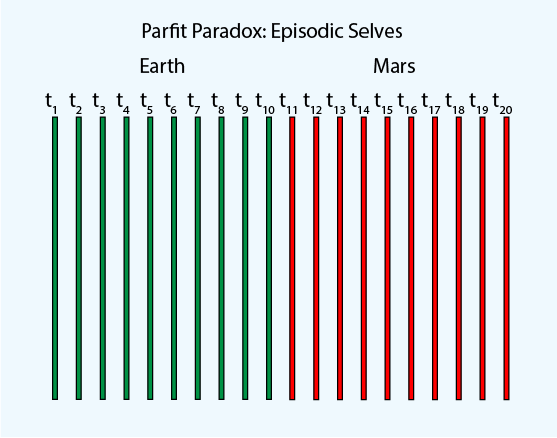
If one takes the episodic view seriously, Parfit’s machine is mostly theatre.
Why? Because strict numerical sameness was never available between temporal intervals in the first place. The self at one interval and the self at the next are not joined by a metaphysical thread hidden beneath change. They are linked, where linked, by organised continuity, practical function, memory inheritance, bodily persistence, and narrative convenience.
The teletransporter does not introduce some unprecedented rupture into an otherwise pristine metaphysical order. It merely exaggerates what was true all along: selfhood is not an invariant core but a heuristic over organised succession.
That means the Mars person is not paradoxical. They are simply a case in which our ordinary identity-compression is being stress-tested.
Call them the same person if your explanatory threshold is coarse enough. Refuse the label if your threshold is stricter. There is no further hidden fact trembling in the wings.
Even under diachronic time, the issue is still heuristic
Suppose, however, that one relaxes the episodic commitment and grants a diachronic self. Even then, the machine does not resurrect a deep identity problem. It only relocates the issue to threshold-setting.
How much continuity is enough?
Enough for legal identity?
Enough for moral responsibility?
Enough for marriage?
Enough for debt?
Enough for grief?
Enough for survival?
These are not one question. They never were one question. Philosophy often gets itself into trouble by pretending that practical, phenomenological, ethical, and metaphysical criteria must all cash out in the same currency. They do not.
Parfit himself is famous precisely for pressing the thought that what matters may be psychological continuity and connectedness rather than some further fact of identity. My complaint is that one can go further still. Once identity is treated as a heuristic rather than a metaphysical absolute, the need for a single all-purpose answer begins to look like a bad demand rather than an unsolved mystery.
Why the duplicate case makes the illusion obvious
The variant with duplication makes the point even more brutally. If one person enters on Earth and two successors emerge elsewhere, both inheriting the same memories and both insisting “I am the original,” then the problem is no longer whether identity has become spooky. The problem is that our ordinary identity-talk has finally been pushed beyond its comfort zone.
Once there are two successors, the inherited continuity-profile has branched. That does not produce metaphysical magic. It produces two loci of encounter with the same initial macro-organisation.
At time-nought, perhaps we may stipulate identical configuration for the sake of the thought experiment. Fine. Humans adore their stipulations. At the first non-zero interval thereafter, they are already different. Different position, different sensory input, different salience, different bodily relation, different thermal and spatial microconditions, different affordances. Their trajectories begin to separate immediately. So even there, no paradox. Only the collapse of a coarse heuristic under finer scrutiny.
The real lesson
Parfit’s teletransporter is often presented as though it reveals some terrible instability in personal identity. I think it reveals something duller and more devastating. It reveals that our language of identity was never as deep as we pretended.
We say “same person” because it is useful. We use it to stabilise law, memory, blame, love, property, and biography. Fair enough. But utility should not be mistaken for metaphysical revelation. The thought experiment merely embarrasses that confusion.
So when asked whether the reconstructed person on Mars is really the same person, my answer is:
Under an episodic model, strict sameness was never on offer across temporal intervals anyway.
Under a diachronic model, sameness is still a heuristic judgement about acceptable continuity.
In neither case is there a paradox. There is only an old habit of substance-thinking refusing to die.
The shorter version
The teletransporter does not expose a contradiction in selfhood. It exposes the poverty of the ontology brought to the problem.
If selves are indexical, scale-dependent heuristics arising from organised encounter, then the machine does not pose a metaphysical puzzle about whether some hidden essence made it to Mars. It only asks how much continuity we are willing to treat as enough.
That is not a paradox. That is a policy decision disguised as metaphysics.
 Philosophics