Jordan Peterson is decidedly not my cup of tea. I can tolerate Pinker and Haidt. I agree with much of what they have to say, but in this video, the dissonance finally dawns on me. Interestingly, I can tolerate Peterson within the scope of this discussion.
I don’t agree with much of what these three are saying, but it is refreshing to hear Peterson outside of a philosophical domain, a place where he has no place. And although I don’t agree with him here, it is on the basis of his argumentation rather than his abject ineptitude.
I disagree with this trio. This video reveals these three people as Institutionalists. Peterson may be a political Conservative versus Pinker’s and Haidt’s enlightened Liberalism, but this is a common core value they defend with escalating commitment. Typically, we find these to be polar opposites, but here they have a common enemy that is not necessarily anti-institutionalists or anarchists but people who don’t understand venerable institutions and thereby risk tipping the apple cart or toppling the Jenga tower because they just don’t understand. Not like them. Besides constitutionalism, the common thread is Paternalism. They may disagree on the specifics, but one thing is true: We know more than you, and this knowledge is embedded in the sacred institutions. If only the others understood.
In this video, we hear these three commiserate about the diversity and inclusion forces in University today, and where this movement is off base.
Why do non-linguists think they can disintegrate language. As this rant targets a certain class of illiterate feminists, I’ll disclaim at the start that I fully support feminism and egality across all intersections. The rant is aimed at wilful ignorance and has been a peeve of mine since at least the 1980s. This is further a subset of PC speech, this rampant scourge of Liberal political correctness by the American Liberal establishment.
The problem I have is of people who have no understanding of the meaning or origin of the word man—people who insist on extracting it from everything. I don’t have any need for waitresses, actresses, or even mistresses, dominatrixes and other gender-marked terms. I’ll even add a further disclaimer: I don’t support gendered terms. Case in point: I love French, but I feel it’s time to lose the gendered nouns. It serves little purpose. I’d go as far as to say that it serves no purpose, but then I’d be as guilty as these feminists I’m railing on about. I also have to issue with referring to people as it and they rather than the typical he, she, him, and her. In fact, I’ve been called out for calling a human it.
Feminist Philosophy of Language, a guide on sexism in language and feminist language reform, also discourages the usage of man and -man as gender-neutral because it has male bias and erases women under a masculine word.
As a male, I may come across as mansplaining. I don’t even care about retaining some old word out of tradition. Get rid of it, and good riddance, but don’t do so on the grounds of faulty reasoning. George Carlin shared my sentiment, but his take here is on the use of euphemism to obscure meaning.
I am well aware that meaning drifts over time, and I am wholly sympathetic to the insufficiency of language. Let’s crack on.
Considering the root, in Latin, we had homo—an undifferentiated human being—and vir—an adult male, whence comes virtue. Old French gave us human, which derives from the older term, ghomon, which meant earthling, obviously non-gendered.
The word man comes from Old English and meant person with no gender intent. This is the same man as mankind and the still non-gendered, yet somehow offensive, man. The genesis of the confusion is when man split off and was also used to refer to a human adult male. Evidently, this is confusing to some.
The word man comes from Old English and meant person with no gender intent. This is the same man as mankind and the still non-gendered, yet somehow offensive, man. The genesis of the confusion is when man split off and was also used to refer to a human adult male. Evidently, this is confusing to some.
Before man was split to also refer to an adult male, Old English had distinguished the sexes by wer and wif. Wer came from the aforementioned Latin vir, which had heretofore already merged into its ungendered vulgate form. It is retained in English the word werewolf, common to most English-language speakers. Less common human-animal hybrids bearing the were- prefix are werebears, wereboars, and the rest as illustrated in this page from Giants, Monsters, and Dragons: An Encyclopedia of Folklore, Legend, and Myth. Note the lack of gender specificity.
At one point, wifman was used to distinguish a woman-man from a generic man. For the most part, wer was replaced by man, though its universal sense was also retained as it was as well in homo. In Old English, Man was also employed as an indefinite pronoun.
Obviously, wife is retained still as a gender-marked term indicating the woman in a marriage arrangement. I’m sure I had a point here, but I may have lost it, so before I quit, the last term I’d like to mention—just because—is queen, which had originally meant a woman, become a wife, and then to a king’s wife, and finally (though this last sense remains), a female sovereign ruler irrespective of marital status. There are the queens of queer culture, but I think I’ll end on this note.
First, this is an extension of sorts from a prior post on No-Self, Selves & Self, but I wanted to create a short video for my YouTube channel to establish somewhat of a foundation for my intended video on the causa sui argument. Related content can be found on this one of the Theseusposts.
This video is under 8-minutes long and provides some touch-points. I had considered making it longer and more comprehensive, but since it is more of a bridge to a video I feel is more interesting, I cut some corners. This leaves openings for more in-depth treatment down the road.
As has become a routine, I share the transcript here for convenience and SEO relevance.
Transcript
In this segment of free will scepticism, we’ll establish some perspectives on the notion of the self. Most of us in the West are familiar with the notion of the self. What’s your self? It’s me. For the more pedantic crowd, It is I.
We’re inundated with everything from self-help to self-awareness to self-esteem to selfies and self-love. We’ve got self-portraits, self-image, and self-harm. We’ve got self-ish and self-less. We’ve even got self-oriented psychological disorders like narcissism. Attending to the self is a billion-dollar industry.
And whilst psychology and pop-psychology seem to consider the self to be a nicely wrapped package fastened tightly with a bow, it’s a little more contentious within philosophy. But there are other perspectives that don’t include the self, from no-self to slices of discontiguous selves. Let’s shift gears and start from the notion of having no self, what Buddhism calls no-self.
No-Self
Buddhism is an Eastern discipline, so it does not have the same foundations as the West. According to this system of belief, the notion of a personal identity is delusional, so there is no self at all. This obsession and clinging to this delusional self is a major cause of suffering.
the notion of a personal identity is delusional, so there is no self at all.
In this view, all is one and indivisible, but self-deception leads us to believe we are individuals, each with a discrete self. In fact, the Buddhist notion of Enlightenment—as opposed to the Western notion of Enlightenment—is precisely this realisation that there is only one self, and this is the collective self. But, to be fair, except for the times where the self has yet to be developed—we’ll get to this in a bit—, this notion of no-self is aspirational in the sense of losing one’s self in order to reduce suffering.
The concept of selflessness exists in language, but this is more aimed at sublimating the self in favour of a greater collective good.
Self
The self is the central feature of many personality theories from Sigmund Freud and Carl Jung to Rollo May and Abraham Maslow. From individuation to self-actualisation. The self is self-referenced as I and me. Historically, the self had been considered to be synonymous with some metaphysical soul. Nowadays, psychology has taken the reigns on definitions.
One version of the self can be thought of as a single thread connecting beads of experience through time, time-slices of experience. We’ll come back to this. This sense of self extends backwards in time until now and contains aspirations projected forward in time as viewed from the perspective of now.
This sense of self extends backwards in time until now and contains aspirations projected forward in time as viewed from the perspective of now.
Whilst we use terms like ‘person’, ‘self’, and ‘individual’ somewhat synonymously, they each have different meanings. Whereas ‘individual’ is a biological term; ‘person’ is sociological or cultural; ‘self’ is psychological. Although the default position in the West is the adoption of the psychological notion, where each person has a self, there is also a philosophical notion. Given that the perspective of self is so ubiquitous with people accepting it as obvious, that it feels like I shouldn’t even spend time producing content to fill this space. But for a sense of completeness, I shall.
Psychologist William James distinguished between the ‘I’ and ‘me’ sense of the self, but let’s not parse this and consider each a stand-in for the self as experienced by the self. In this view, the self is generally considered to be the aggregation of continuous phenomenological moments and how we interpret them into a sense of ‘identity’.
In the West, the notion of having a self is imposed by convention. To feel otherwise is considered to be a sign of mental illness. As much as I want to share Foucault’s perspective on how delineating mental illness operates to the benefit of power structures, let’s just consider this out of scope. The Diagnostic and Statistical Manual of Mental Disorders, DSM-5, notes that a key symptom of borderline personality disorder, BPD, is a ‘markedly and persistently unstable self-image or sense of self’. Become selfless at your own peril.
There are challenges with the notion of self even in psychology. In developmental psychology, the self—differentiating one’s self into an identity separate from the world—, is not acquired until about the age of 18 months. Lacan had suggested that this so-called mirror stage developed at around 5 months as part of ego formation, but further research disputes this.
Although I won’t go into detail, individualist cultures experience the self differently than collectivist cultures. The origin of the concept of the individualistic view of self can be traced to early Christianity. In American culture, Protestantism seems to be a primary driver of the individualistic view of self. Let’s continue.
Selves
Heraclitus quipped, ‘No man ever steps in the same river twice, for it’s not the same river and he’s not the same man’. This is a nod to the impermanence of the self. Instead, there are selves.
No man ever steps in the same river twice, for it’s not the same river and he’s not the same man
Heraclitus
Galen Strawson proposes that although he understands intellectually what others mean when they use the word self, he doesn’t share this experience emotionally. Unlike the phenomenological slices connected by a thread, he doesn’t feel he has a thread. He posits that he experiences this prevailing sense of narrativity episodically without continuity.
A typical view of the self is that one feels narratively connected to past slices—the 5-year-old self with the 20-year-old self and with the 50-year-old self, whether that 50-year-old self is in the past, present, or future. Even though we are not the same person, there is some felt affinity.
My View
As for me, I consider the self to be a constructed fiction that serves a heuristic function. I don’t feel as disconnected as it seems Strawson does, but I don’t feel very connected to my 7 or 8-year-old self. And I can’t even remember before that. I’m not even sure I’ve got one data point for each year between 8 and 12, and it doesn’t get much better until 18 or 20. From there, I may be able to cobble together some average of a dozen or so per year without prompting, but I don’t even feel like the same person. Many of my views and perspectives have changed as well.
I don’t even feel like the same person
I was in the military until I quit as a Conscientious Objector. During that time, I became aware of Buddhism, and I doubled down on my musical interests. I worked in the Entertainment industry until I became an undergrad student, transitioning to become a wage slave whilst also attending grad school until I graduated. I’ve had several career foci since then. With each change, I’ve had a different self with a different outlook.
Can I connect the dots? Sort of. But I can also create a thematic collage out of magazine clippings or create art with found objects. I can tell a disjointed story of how I transitioned from X to Y to Z. It may even contain some elements of truth. Given how memory operates, who can tell?
In any case, what about you? In the next segment, I’m going to be discussing why we may not have free will owing to a lack of agency based on a causa sui argument.
Do you feel like you have a self? Does your sense of self have any gaps or inconsistencies? Do you feel you don’t have a self at all?
A colleague who happens to be a professor in New South Wales shared this video with me. I am tempted to just recapture the presented content here, but I feel everyone should just watch it for full impact. I intentionally used a cover image that is counter to the narrative. The challenge is not overpopulation. Rather, it’s the opposite. Find out why.
Video: RSNSW Clarke Memorial Lecture 2021: The changing tide of human populations: an infertility trap
I’ve cued the video beyond the introduction—feel free to rewind for context, but there is no material content to be missed—, and there are a couple of minutes of additional material at the end, making the content closer to 50 minutes (48.5) than an hour.
The Infertility Trap was published last month as a book. I’ve not read it, but it was referenced. Countdown, by Shanna Swan is also referenced.
Book Cover: The Infertility TrapBook Cover: Countdown
Some highlights follow:
The Rise and Rise of Humankind
Geometric growth commenced after the Black Plague was driven by the discovery of how to harness fossil fuel. As with Malthusian predictions, The Population Bomb missed the mark—but not for all of the reasons you might be thinking.
Changing Pace of Population Growth
Population growth rates were already on the decline when The Population Bomb was published in 1968. This trend was a result of the fertility trend that became precipitous circa 1963.
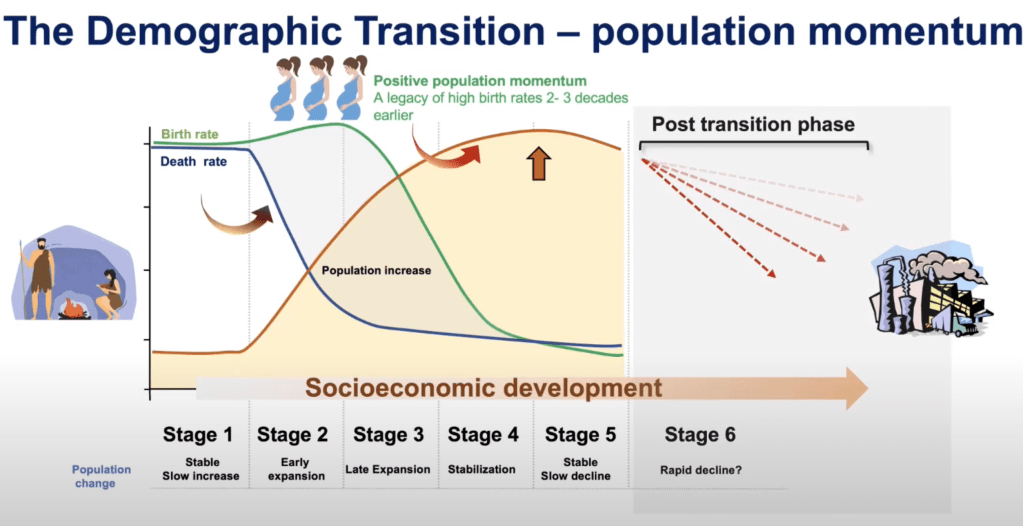
The Demographic Transition: Population Momentum
Though birth rates may seem to be increasing, this is merely optics as this is a legacy of positive population momentum stemming from high birth rates a few decades prior to the impending decline in fertility.
The Malthusian Paradox
Thomas Malthus didn’t grasp the paradigmatic shift technology would provide nor the relationship between fertility and prosperity.
Charts: Prosperity, infant mortality, child mortality, and fertility rate
As prosperity (as measured by GDP) increases, infant and child mortality as well as total fertility rate, each decrease. (I’m calling out the poor statistical representation of the non-zero-based Y-axis, but I don’t believe this was done to exaggerate the slope. It’s apparently just out of index.)
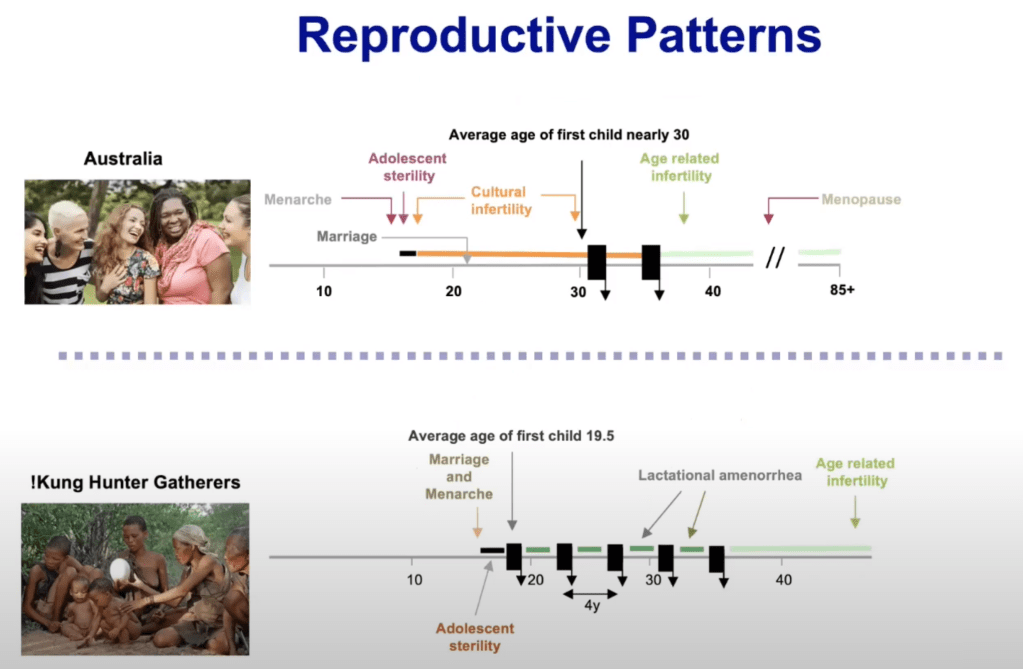
Reproductive Patterns: Australia vs !Kung Hunter-Gatherers
Notable in the charts above, are the delays in reproduction by the average Australian woman to around 30 years effectively limits the delivery to about 2 (1.7) whereas the hunter-gatherers commence closer to 20 years, yielding them an average of 5 children.
Rapid decline in semen quality
Semen quality (motility) and count are down.
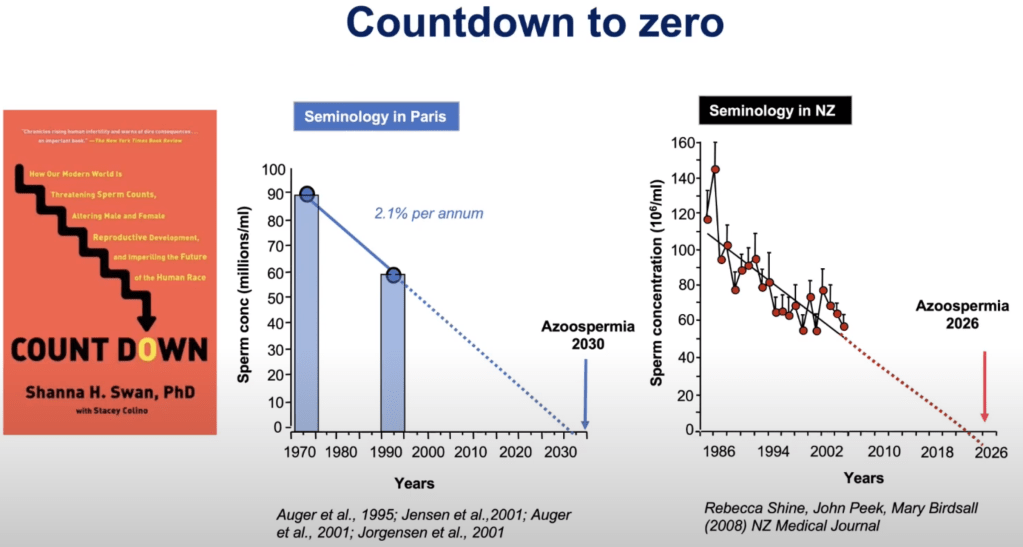
Projections: Countdown to sperm count of zero in Paris and New Zealand
If declining semen count trends remain unabated or unaltered, one might anticipate a point where male fertility (potency?) reaches zero. This is characterised as azoopermia and projects this on Parisian males just past 2030 and by 2026 for New Zealanders.
Secular trend in declining testosterone levels
This downward trend is not constrained by region.
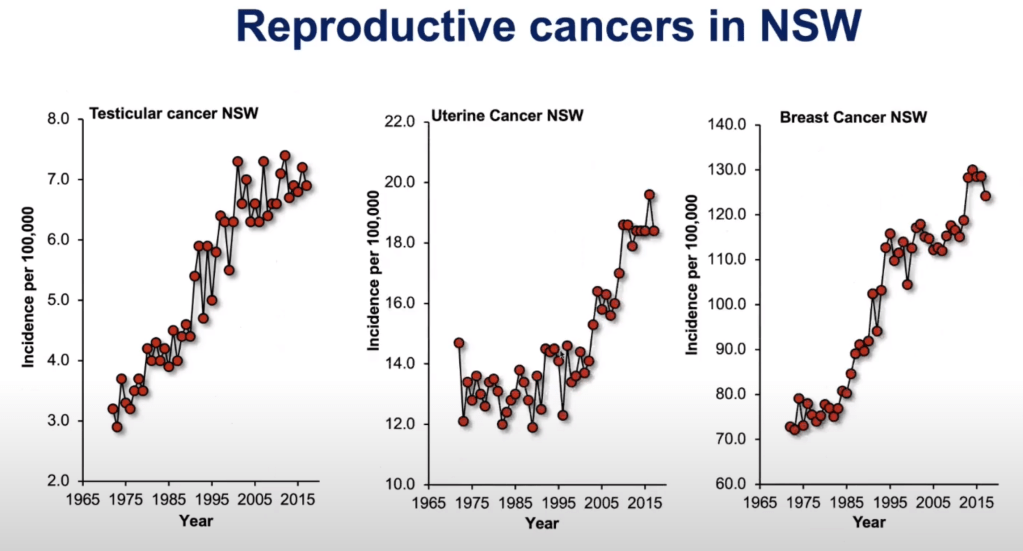
Trends in Testicular Cancer (NSW)
A correlated trend in fertility rate is an increase in testicular cancer, as shown with NSW data, even as ovarian cancer remains steady and cervical cancers are decreasing.
Reproductive Cancers in New South Wales
Conversely, other reproductive cancers (in NSW)—uterine and breast cancers—are on the rise in sync with testicular cancers and the drop in fertility.
My intent with this post is to share rather than editorialise. The video speaks for itself. I’ve provided some excerpted content for those who can’t spare the time to view the source.
Small Print: I’ve been approved to offer books through Amazon.com. Any books purchased by having clicked a link will yield me a small commission. This commission is not added to the price of the book to you. If you purchase the book through Amazon directly, bypassing an affiliate programme, they will keep the difference. So, if you intend to buy a book, stick it to the man and purchase it through me.
Physicist, Sean Carroll, gives Robert Lawrence Kuhn his take on free will. I was notified about this when it was posted, and given the topical subject matter, I took the 8-odd minutes to listen to it straight away.
I wish I had been there to pose a follow-up question because, although he provided a nice answer, I feel there was more meat on the table.
Like me, Sean is a Determinist who feels that the question of determinism versus indeterminism is beside the point, so we’ve got that in common. Where I feel we may diverge is that I am an incompatibilist and Sean is a compatibilist. I could be interpreting his position wrong, which is what the follow-up question would be.
I say that Sean is a compatibilist because he puts forth the standard emergence argument, but that’s where my confusion starts. Just to set up my position for those who don’t prefer to watch the short clip, as a physicist, Sean believes that the laws of physics, Schrödinger’s equation in particular.
We have an absolutely good equation that tells us what’s going to happen there’s no room for anything that is changing the predictions of Schrödinger’s equation.
— Sean Carroll
Schrödinger’s Equation
This equation articulates everything that will occur in the future and fully accounts for quantum theory. Some have argued that quantum theory tosses a spanner into the works of Determinism and leaves us in an Indeterministic universe, but Sean explains that this is not the case. Any so-called probability or indeterminacy is captured by this equation. There is no explanatory power of anything outside of this equation—no souls, no spirits, and no hocus pocus. So far, so good.
But Sean doesn’t stop talking. He then sets up an analogy in the domain of thermodynamics and statistical mechanics and the ‘fundamental theory of atoms and molecules bumping into each other and [the] emergent theory of temperature and pressure and viscosity‘. I’ve explained emergence in terms of adding two hydrogen and one oxygen atom to create water, which is an emergent molecule with emergent properties of wetness.
My position is that one can view the atomic collection of matter at a moment as an emergent property and give it a name to facilitate conversation. In this case, the label we are applying is free will. But there is a difference between labelling this collection “free will” as having an analogous function to what we mean by free will. That’s a logical leap I am not ready to take. Others have equated this same emergence to producing consciousness, which is of course a precursor to free will in any case.
Perhaps the argument would be that since one now has emergent consciousness—I am not saying that I accept this argument—that one can now accept free will, agency, and responsibility. I don’t believe that there is anything more than rhetoric to prove or disprove this point. As Sean says, this is not an illusion, per se, but it is a construction. I just think that Sean gives it more weight than I am willing to.
I’ve spend some hours cobbling together another video that I labelled Free Will Scepticism: Would-Be Agency & Luck. I’ve embedded it here. The script is below.
Human agency does not exist. Free will is an illusion. Like the appearance that the sun rises in the east and sets and the west, we only appear to have free will.
There are some nuances and varying degrees of this belief, but if one believes in the scientific notion of cause and effect, that every effect is the result of a prior cause of causes, one inevitably ends up in this camp.
Video: Free Will Scepticism: Would-Be Agency & Luck
[REDACTED]
Without going into details because the focus of this segment is on luck, I’d still like to set the stage for the uninitiated.
Regarding the universe, we recognise a relationship between cause and effect. If we rewind to follow this logic back to the beginning of time and started again, we’d end up in exactly the same place. This is known as deterministic. What happens next is determined by what happened before.
And this is not just a scientific view. Those who believe that God caused the universe can arrive at this same place.
Owing to advancements in scientific thought, most philosophers today do not believe that the world is deterministic, per se. Given theories of quantum mechanics and probabilistic outcomes, they believe in so-called natural physical laws, but probability is also part of this model.
One may strike a billiard ball with a cue stick to cause it to strike another ball, knocking it into a pocket. In our knowledge of the universe, this is unsurprising. If one set this up mechanically, leaving no room for variation, we could run this scenario over and over again forever, and the ball would go into the pocket every time. The outcome is established by the laws of physics.
Billards Animated GIF
Actually, this is just another illusion. The laws of physics cause nothing. They are just a way of describing how things unfold in our universe. But just like saying that the sun rises in the east, we can employ idiomatic language and people know what we mean.
This was an illustration of determinism. Indeterminism accepts these same laws, but it adds an element of probability. In our mechanised billiards example, perhaps a ball is randomly rolled across the table in such a way that it might interfere with the path of the balls.
If the random ball does not interfere with the path, its presence is irrelevant. If it does interfere, there are a few different outcomes.
One, it knocks a ball off course, so the final ball does not go into the pocket.
Two, its path is such that although it collides with a ball, this event does not interfere with the final ball ending up in the pocket, so a person fixated on the pocket might not notice anything more than a slight delay in the occurrence of the event.
The second scenario depicts indeterminism.
In both scenarios, the ball expected to go into the pocket is the would-be agent. As illustrated, the ball itself has no agency. None of them does. Its fate, to borrow a term steeped in metaphysics, is entirely subject to the actions before it. And then there’s chance, so let’s continue.
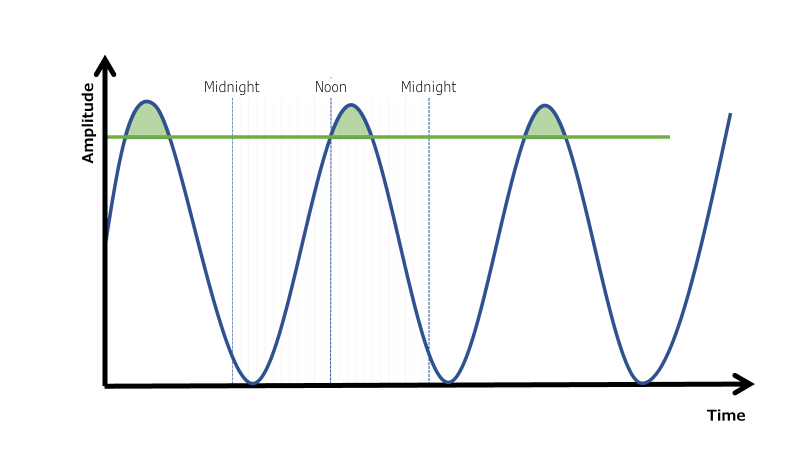
Humans are ostensibly automatons, subject to their genetic and environmental programming with no degree of free will. Let’s say that in a given context each person can be described by a certain wave function. For the sake of simplicity, let’s just pretend that it can be represented by a sine wave. As with any waveform, we can illustrate it by plotting it on a 2-dimensional plane, having amplitude on the Y-axis and time on the X-axis. Let’s consider this to be analogous to a person’s biorhythm, and let’s further consider that this represents the would-be agent’s mood or propensity to behave a certain way.
Arbitrary Disposition Cycle
Practically, there might be more functions, so let’s just say that this is the average of all of these other functions—perhaps the other functions being how much rest was had the night before, when and what the last meal was, traffic encountered on the way to work, and any number of other personal considerations.
For any stable wave, we can plot the period from peak to peak or trough to trough. Let’s use trough to trough to represent a period of a day but from 2:30 am to 2:30 am rather than from midnight to midnight. This is one complete cycle. The offset is just to more easily facilitate the scenario.
Given this frame, we’ll put noon in the centre between the midnights as expected.
For the purposes of illustration, we’ll draw a horizontal line to represent a threshold depicting a change in disposition. We’ll use this later.
Finally, let’s show time increments by hour, so we now see 24 hours in a day. And we can see that at noon the wave peak rises above the threshold and falls below the threshold again at 5 pm.
Let’s presume that this wave function represents that of a criminal trial judge. There is support for this notion as published in Daniel Kahneman’s 2021 book, Noise: A Flaw in Human Judgment, wherein he notes that trial judges are almost as predictable as a watch, that their sentences are more correlated with time of day and the aforementioned factors than anything related to law—save for the laws of time, I suppose.
Remembering that—like all people—this judge is an automaton. Let’s build some character—rather characteristics. Judge Judy believes that people are fundamentally bad and not to be trusted. She believes that they have free will and are accountable for their actions, though she does also allow for extenuating circumstances when considering sentencing, the usual suspects—bad childhood, chemical dependency, and whatnot. People who believe more strongly in free will are more likely to believe in harsher punishment. Judy is no exception.
Using this function as a guide, above the threshold represents her propensity for leniency. She tends to take lunch regularly before noon and is more lenient for a period after lunch. Data show that this effect is closer to a couple of hours after the midday meal, but we are simplifying.
Zooming in, let’s just consider a single day in the life of another would-be agent who as it happens will be interacting with our Judge Judy. I’ll take this opportunity to introduce the work of Neil Levy.
Neil is Head of Neuroethics at the Florey Neuroscience Institutes and Director of Research at the Oxford Centre for Neuroethics.
He is the author of Hard Luck, five previous books, and many articles, on a wide range of topics including applied ethics, free will and moral responsibility, philosophical psychology, and philosophy of mind.
Levy’s book promotes the concept that even if we allow for human agency, much of this supposed agency is undermined by luck. This will not only become evident in the scenario we are working through, but as a human, you may come upon a decision-point, where probability and luck come into play. You have no control over what ideas pop into your head—or don’t—and in what order. The choice you ultimately make is limited to what these ideas are and how they do or don’t manifest. Without going too far astray, perhaps you’ve constructed a false dichotomy.
Dark Alley
Perhaps you are confronted by a stranger in a dark alley. You observe that it’s a dead end. The stranger, asking for money, approaches you in a manner you interpret as menacing. As he reaches into his coat, you pull out your concealed weapon and fatally shoot him.
He was unarmed. No longer in panic, you realise that you are not in a dead-end alley.
When the police arrive, they inform you that the person you killed is known` by law enforcement and social services, who have been keeping an eye on him because he had limited cognitive capacity and resided in a group home. Not only was he not armed, but the detective on the scene noted that what he was reaching for were pens with inspirational inscriptions that he routinely sold to earn money.
Whilst you may not have been able to determine that he was otherwise harmless, it was your ‘luck’—bad luck—that you didn’t happen to see that you were never cornered in the first place.
Nevertheless, you are arrested.
In another scenario, perhaps there are two judges. Judge Judy and Justice Joe. As it happens, Justice Joe has a cycle reverse to Judy. Where Judy’s mood is better after lunch, Joe is fasting, and his mood gets worse. This means that your fate now is not only tied to the time of day but it’s also linked to the luck of which judge will hand down your sentence.
If you are a strict determinist, then the “universe” has already determined which judge will sentence you.
If you are an indeterminist, then the universe will flip a coin. And the probability of a case running long or short might determine the time of day.
In the end, as are you, the judges are slaves to their programming, and any alteration of inputs will just be processed through whatever they’ve become until that point. They have no more free will than you do. The die has already been cast.
Do you believe you have free will? If so, why. Are you a determinist or an indeterminist? Or are you a compatibilist who believes that free will and determinism can coexist in the same universe?
Harvard’s Bob Doyle submits that people have free will in an indeterministic universe (read: agency) because if in the face of some random event an agent can make a choice, then s/he is responsible for that choice. I believe he is mischaracterising or misinterpreting the situation. I’ve composited an illustration to show where he and I interpret the random event differently. I’ve linked and cued the video to where he makes the statement I am reacting to.
The illustration depicts three event chains. My interpretation of Bob’s case is at the top followed by that of a Deterministic universe, followed by that of an indeterministic universe. At the bottom of the illustration is an index running from t-2 to t2, representing time, where t0 represents now, a decision point.
Determinism
Let’s set the table with the simplest narrative—Determinism. Here, every event that occurs was known since the beginning of time. Every state is the result of past events in a causal chain. Nothing can happen that isn’t caused by a prior event. This is the motion picture we just haven’t seen yet. But anyone who has already seen it can spoil the ending because it’s already known without a doubt.
Regarding the illustration, event t-2 causes t-1 that causes t0 all the way to t2 and beyond.
No Escape from Moral Responsibiliy Chart
Bob Doyle, an Interpretation
Although Bob’s case is an interpretation of Indeterminism, let’s consider his position first. Then I’ll suggest where he’s gone astray.
As with the other cases, Bob’s transition from t-2 to t-1 is Deterministic and uncontested. The difference starts where t-1 transitions to t0. In Bob’s world, a random or perhaps a probabilistic event occurs given the agent to make a choice not having been previously determined. Referring to the illustration, because of this event, the agent chooses yes and embarks on the top chosen path, even if the subsequent path is again determined. Bob argues that at t0, the agent has free will, or if we focus our language, is responsible for the decision. By definition, this means that whatever path might be embarked had our agent chosen the lower path will never be known. And that has made all the difference.
Indeterminism
Herein lies the rub. As with the prior two event chains, we arrive at t0, as with Bob’s scenario, we encounter a probabilistic (random, stochastic, aleatory, indeterministic) event. It does not follow that this event confers agential responsibility.
For example—not a moral consideration—, the random event involves the outcome of a match by their favourite sports team—or perhaps s/he’s won at Lotto—, our agent had no say in the outcome of the event. From the agent’s perspective—considering the illustration—s/he remains on a path. S/he can wish s/he rooted for the other team or had chosen a different number or ticket, but she had no choice.
To anticipate Bob’s response, perhaps she had won and now chooses to quit her job or take holiday. This should have been predictable knowing our agent’s disposition, character, and propensities. At no point did the agent actually possess even a modicum of agency.
Freedom & Creativity
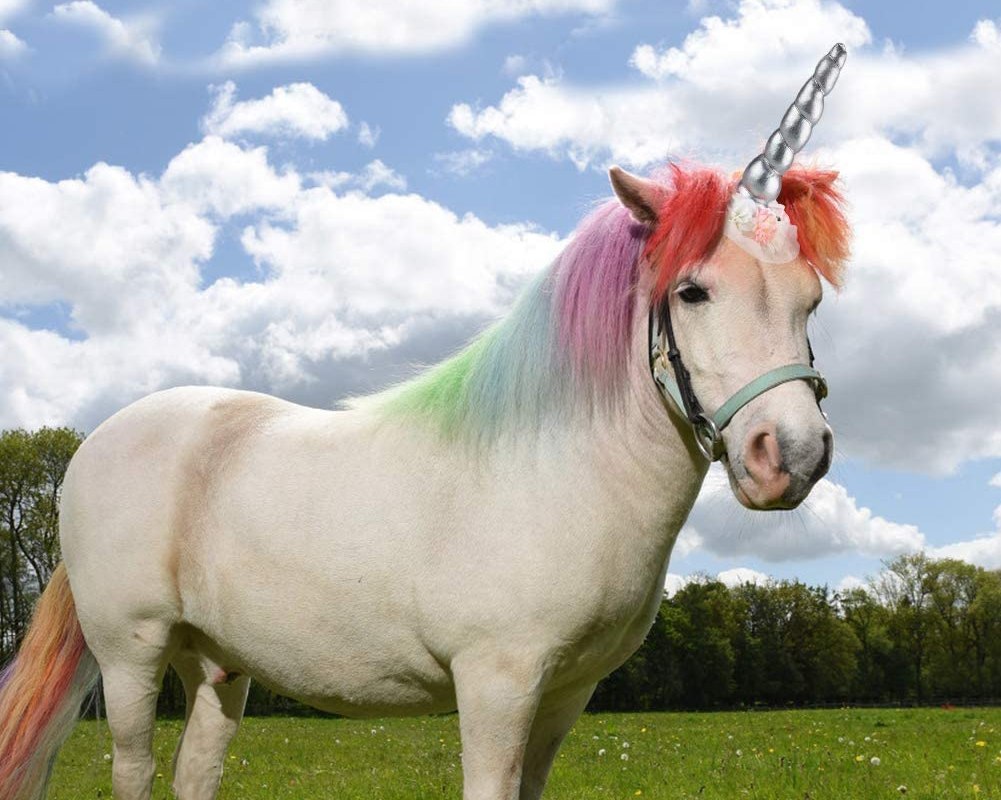
I don’t know much about Bob or his work, but earlier in the video clip he discusses freedom and creativity. My sense is that he interprets creativity as a sort of emergent property that manifests at the moment. I fundamentally disagree with this assertion. The notion reminds me of Hume’s position that unicorns are simply the mental merger of horses and horns. This is not creation so much as a remix.
Later in the video, Bob clarifies that if something randomly pops into our heads and we make a different decision because of it, this is free will. My counterargument is that he is misusing the term random. An unknown origin does not necessarily mean randomly manifest.
Peter van Inwagen is a personality I’ve had on my radar, but I haven’t spent any time with him because he is a referenced influence of Robert Kane or Derk Pereboom, who hold positions I disagree with.
Video: Peter van Inwagen – Big Questions in Free Will
Still, I was interested, so I thought watching a short 13-minute video interview might introduce me to him. I’ve enjoyed other Closer to the Truth content, so I gave it a go. I feel that Peter sets up the problem perfectly. No faults whatsoever. As I see it, the same problem and solution proposal arises that Galen Strawson adopts, yet this is where I disagree with them both.
As noam chomsky has speculated maybe our minds are just put together in the wrong way to find this fault we got a certain set of cognitive modules tossed up to us in our evolutionary history maybe we got the wrong ones for thinking about this problem
— Peter van Inwagen
[TBD]
Unless I decide to unpack the rest, I’ll cut to the chase. The argument is as follows:
Humans are somehow hardwired to blame. (I do not know if this is universally true, but let’s accept this premise as being true.)
Without the notion of free will (or at least human agency), we cannot assign blame.
Therefore, in order to assign blame, free will has to be true.
I don’t disagree with this syllogism. However, in ‘free will has to be true’ , there are ostensibly two possibilities.
Free will exists as a fact in nature—a priori
Free will is a construction—a posteriori
Of course, the general consensus for proponents of free will is that it exists a priori. My contention is that this is not the case. Free will is an a posteriori construction.
Inwagen is falling into a heuristic trap: It feels like it’s true, so it’s obviously true. Borrowing from Daniel Kahneman, he and others are relying on System I and failing to trigger System II, where System II is required. Moreover, I take this position because I don’t think System II has what it needs to accurately analyse and assess the situation holistically. We can’t get outside of the system, so we make up a story that presumably serves our purposes.
I am not one who believes ‘the universe is a simulation’, but I do believe it serves as an apt metaphor. We are player characters in the game and we can’t see outside of it.
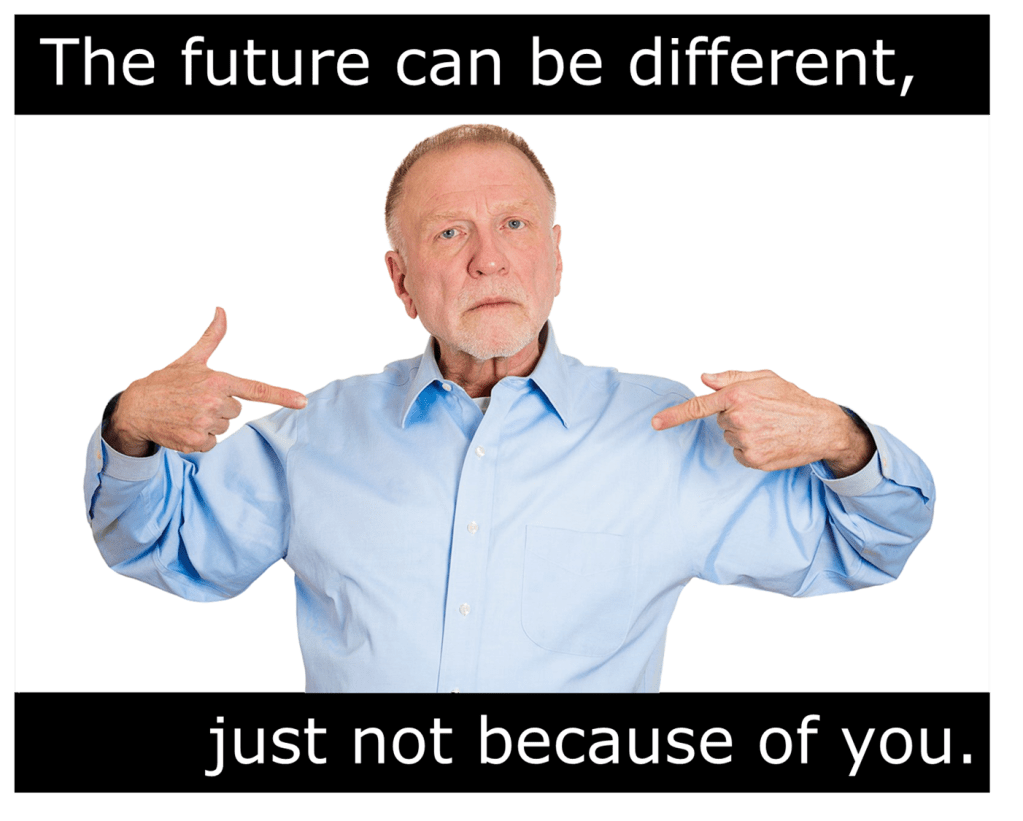
I like to sum it all up with the expression, the future can be different, just not because of you.
Judith Thomson published an essay named ‘A Defense of Abortion‘ in 1971 where she uses a house and invaders as an analogy to defend the right to abortion. Her defence resonates with David Guignion, and David’s approach to summarising philosophy resonates with me.
Disclaimer: I listen to most of David’s work, which should be a testament to the interest I have in the material he covers as well as the accord I have for his positions—content and vehicle. In this case, he feels that Thomson employs a solid argument in defence of abortion, but I’m not sure I agree. I also freely admit that—given I feel that all morality is socially constructed—I am not likely among the intended cohort for this nuanced argument.
Firstly, I’m no misanthrope, but I don’t feel humans deserve some privileged position over other lifeforms simply because they have some limited sense of awareness.
Secondly, I’m not a strong anti-natalist, I feel this is a defensible position to adopt, so I could rely on this position to defend abortion.
Thirdly, I don’t believe that bodily autonomy is anything more than a social construct. Foreshadowing David’s line of argumentation, It’s not a matter of Liberal autonomy over dictatorial oppression. I feel that this is first a false dichotomy and second a competition between social constructs.
Whilst I do understand that Thomson’s position is intended to counter Americans who do subscribe to the myths of autonomy, sovereignty, agency, rights, and property, this is also why I feel the entire argument depends on rhetoric and emotion. Perhaps, the rest of us aren’t going to be anti-abortion in the first place, so why expend energy trying to formulate a deeper argument to convince us.
I had previously heard of the model Thomson employed that drew an analogy between an accomplished violinist and a fetus. I hadn’t read the source essay and didn’t know that Thomson had authored it. I wasn’t familiar with her extended arguments either.
I had originally planned to regard each proposed scenario separately, but I’m going to exercise the principle of least effort and just share some general observations, leaving the door open to revisit these when time and interest align. In general, I don’t feel that Thomson makes a strong logical argument. Her approach relies on emotion and rhetorical tactics.
Thomson frames a Consequentialist argument and colours it with a dash of Virtue ethics. By establishing the accomplished musician, she establishes a frame that taps into elitism. She takes a high art versus low art approach, an approach often adopted by virtue ethicists. For me, this always triggers a red flag.
Next, she triggers the home invasion reflex for people who believe in private property as an extension of bodily autonomy, so she is relying on fear as legerdemain, even if unintentionally.
In each case, the autonomous actor is given a privileged position in the story. In the first case, the tethered musician is unconscious and has no voice—like a fetus or a pet. She is generous enough to afford the musician full human status and bodily autonomy, yet without agency.
Thomson creates a false dichotomy that she expects one to adopt uncritically. Is she a reliable narrator? Are there no intermediate options available? Let’s ignore this, as she hopes one does. It’s you or the musician in a zero-sum game of life and death. In a scenario where the musician or fetus has no agency, it’s easy to take the self-righteous high road and claim decision authority.
Allow me to take a detour for a moment. Let’s say that you and the musician were both tethered without consent and that each of you came to and your inextricable plights were conveyed to you. In this case, each of you may wish to exercise autonomy and in this deathmatch, only one would prevail; the other would die. Given this elitist setup, you are the underdog—some shlub versus Paganini in his prime. Even a fetus might have this privilege. Perhaps you are carrying the proto-progeny of Einstein or a king with no heirs? Handmaid’s Tale, yes. But I digress.
The next sleight of hand is introducing an emotional self-defence trope. The setup is that given the choice of the other person being an existential threat, who wouldn’t agree that you have a right to defend yourself?—not delving into the fiction of rights.
David jumps right onto Thomson’s bandwagon, which was her intent, but it is not obvious that self-defence is some inalienable right. In practice, the right is abridged by the state often. This is true in the United States as well as Canada. I’m imagining David overloading the meter on a connected galvanic skin testing device. Pure emotion.
I fully sympathise with David’s position, but this doesn’t change the fact whether a person has autonomy or not is an arbitrary decision. Many cultures now and even Western cultures in the past had little notion of personal autonomy. Trepidation aside, there is little reason to presume this will continue to persist.
EDITORIAL NOTE: I was writing this near the end of April 2022 when I got distracted by my anti-agency interest. This was left unfinished, but I feel it’s complete enough to post. I am not sure where my mind was headed at the time.
Self and identity are cognitive heuristic constructions that allow us to make sense of the world and provide continuity in the same way we create constellations from the situation of stars, imagining Ursa Major, the little dipper, or something else. The self and identity are essentially expressions of apophenia.
Consider this thought experiment about responsibility. Rob decides to rob a bank. He spends weeks casing the target location. He makes elaborate plans, drawing maps. and noting routines and schedules. He gets a gun, and one day he follows through on his plans, and he successfully robs the bank, escaping with a large sum of money in a box with the name of the bank printed on it. Rob is not a seasoned criminal, and so he leaves much incriminating evidence at the scene. To make it even more obvious, he drops his wallet at the scene of the crime containing his driver’s licence with fingerprints and DNA on the licence and other contents of his wallet. He leaves prints and DNA on the counter where he waited for the money. This wallet even contains a handwritten checklist of steps to take to rob this bank—the address of the bank, the time and date. All of this left no doubt about who robbed the bank.
The self and identity are essentially expressions of apophenia.
Using this evidence, the police show up at Rob’s apartment to arrest him. They knock on the door and identify themselves as law enforcement officers. Rob opens the door and invites them in. All of the purloined money is still in the box with the name of the bank printed on it. It’s on a table in plain sight next to the gun he used. All of his maps, plans and, surveillance notes are in the room, too. They read him his rights and arrest him. Things aren’t looking good for Rob.
Before I continue this narrative, ask yourself is Rob responsible for robbing the bank? Let’s ignore the question of whether Rob has agency. For this example, I am willing to ignore my contention that no one has or can have agency. Besides, the court will continue to presume agency long after it’s been determined that it is impossible because agency is a necessary ingredient to law and jurisprudence.
Is Rob responsible? Should he be convicted of armed robbery and sentenced to incarceration? Let’s make it even easier. This isn’t Rob’s first offence. In fact, he’s been in prison before for some other crimes he committed. He’s no first-time offender. Why do you think that he’s responsible? More importantly, why should he be convicted and sentenced? What should his sentence be?
Consider that the money has been recovered, no one was injured, and Rob didn’t resist arrest. At first glance, we might consider both restorative and retributive justice. I’ve purposely made it easy to ignore restorative justice as all the money was recovered. This leaves us with retributive justice. What should happen to Rob? What would you do if you were the judge? Why? Hold that thought.
Let’s continue the narrative. All of the above happened, but I left out some details. Because of course I did. After the heist, Rob returned home and he lost his balance and hit his head rendering him an amnesiac—diagnosed with permanent retrograde and dissociative amnesia. Because of the retrograde amnesia, Rob can’t remember anything prior to hitting his head. Because of the dissociation, Rob has no recollection of anything about himself, not even his name. In fact, he now only responds to the name Ash. (This is where I debate whether to have Rob experience a gender-identity swap, but I convince myself to slow my roll and focus on one thought experiment at a time.)
Because of the retrograde amnesia, Rob can’t remember anything prior to hitting his head. Because of the dissociation, Rob has no recollection of anything about himself
To make this as obvious as I can consider, Ash has no recollection of Rob, robbing the bank, or anything about Rob. Ash doesn’t know Rob’s friends or family. Ostensibly Ash is a different person inhabiting former-Rob’s body. To make it even easier, Ash is not feigning this condition. So, let’s not try to use that as an out when I ask you to reconsider responsibility.
If my experience serves as a guide, if I asked you about your response to whether Rob was responsible and what his sentence should be, you would be committed to your same response and for the same reasons, so I won’t ask again.
What I ask now is if Ash is responsible and what his sentence should be. Keep in mind that we should be able to ignore the restorative element and focus on the retributive aspect. What should happen to Ash? What would you do if you were the judge? Whether your response has changed or remained the same, why would you judge Ash this way?
Here are some considerations:
Retributive justice might serve as a lesson to other would-be offenders.
The public may not believe the amnesia excuse—even though you, as judge, are convinced thoroughly.
Ash does not believe he committed the crime and does not comprehend the charges.
Ash was surprised to discover the money and gun and was pondering how it got there and what to do with it when the police arrived at his apartment.
If released, Ash would not commit a crime in the future. (My thought experiment, my rules; the point being that Ash was no threat to society.)
From my perspective, Ash is a different person. Sentencing Ash is ostensibly the same as sentencing any person arbitrarily.
The purpose of this experiment is to exaggerate the concept of multiple selves. Some have argued that there is no self; there is just a constructed narrative stitching discrete selves together to create a continuous flow of self-ness.
Is Ash responsible for Rob’s action?
I’m interested in hearing what you think. Is Ash responsible for Rob’s action, and why or why not? Let me know.

















 Philosophics