In bygone days, national governments asserted power and prevailed over relgion, in essence forming a ceasefire partnership that has, save in pockets, pretty much held fast in most of the Western world. Religion is still somewhat of a factor in many corners — in some circles dominant —, but the latest challenger are the acquisitive corporate defenders: multinational (wannabe supernational) entities, whose aspirations of dominance is stifled by the prevailing power structure.
As many in government are Capitialist converts, they each and collectively have an Achilles heel, as captured by the adage probably misattributed to Lenin, ‘The capitalists will sell us the rope with which to hang them’.
The capitalists will sell us the rope with which to hang them.
not Vladimir Ilich Lenin
Contemporary politics see the orgy of strange bedfellows and the slow poisoning of Democracy by lobbyists and their palliative care of the deligates of the People. Some of the polis see this and react in horror to decisions such as Citizens United in the United States, as more and more foxes are voted into the hen house — and wolves into Congress. This is not limited to the United States.
Along the way, some government officials attempt to cozy up to the predators to enriched themselves personally at the expense of their citizenry and on the way to the killing floor. They’ll have been fattened by scraps, only to be consumed in the abbatoir. In some cases — perhaps many — the leaders are themselves part of this acquisitive class, so they are not in particular need of a country.
Even if the acquisatives are aware that they’re destroying the host and the structure that invented them, these petulent progeny run roughshod anyway. But the permissive parents don’t wish to bite the hands that feed them.
So far, the acquisitive corporatists have been able to snuggle up with the ruling class, and this class perceives themselves as being part of this class. Most aren’t. They are entourage at best — pathetic sycophantic hanger-ons. Once they realise that they are not members of the club and try to wrest control, the real fight will commence, but it will likely be too little and too late. The real losers will be the people, no longer having evern the semplence of protection. Libertarians will finally see that their dream was a nightmare from the start.
And then we await the next paradigm shift.
Backstory
What prompted this post?
A colleague on Facebook posted a Scientific American article about oversimplification of sex determination in response to a transphobe, and Facebook took it down. Having had a couple similar responses myself, I have come to the conclusion that Facebook and the other social media giants need external governance. I don’t want to endure what ass hats like Donald Trump have to say any more than the next person, but this censorship needs to happen in a different way. Given my perspective on Truth, we need to assess how best to keep devisive speech in control. In some cases, these people are simply lying. They claim that I didn’t say that, wasn’t with that person, wasn’t in that place, and so on when these are all demonstrably false. This is not generally illegal behaviour.
When Trumps says, I’ll be president again in August, or I’ll be Speaker of the House, this is a prediction. It’s like saying, ‘This is the winning lottery ticket’. Language allows for this speculative hyperbole. Again, bad form and taste are not illegal. Even if some assclown riles up some portion of the populace, who’s to say whatever they’re hawking isn’t for some future greater good at the expense of some near-term disruption.
I’m rambling. The point is that the overreach of Facebook is just another instance of corporations taking power into their own hands and uncontested. It will come to a head. Perhaps not in my lifetime, but mark my words.
We’re all familiar with the scenario: a representative from law enforcement appears at a door and flashes a badge or an ID. It’s in most of the police movies. A gaggle of people in official-looking uniforms. One of them pulls out a warrant, and they make their way into the residence. You still with me?
Here’s the rub? How does one know with any degree of certainty higher than blind faith?
Do you know what an ‘official’ badge or ID looks like? How do you know it’s not counterfeit?
Do you even know what a search warrant looks like? It’s signed, do you know the person it’s signed by? Perhaps it’s a judge. Is the warrant real or fake? What about the uniforms or official-looking vehicles?
Indoctrination and cognitive dissonance are key factors
The answer is most people would have no idea. Indoctrination and cognitive dissonance are key factors. In movies, apart from the documentation, there’s the intimidation factor. And maybe guns for full effect.
To be sure, people have performed variations of this script, and they’ve been punked. So, the question remains: How can one tell? And when does when get to call bullshit?
And what are the down sides? If these cats are legit, and after the bullying and indignity, you’ll probably be facing accusations of obstruction or resisting. Of course, you’ll be justified, but justification is asymmetrical and out of your favour. The house holds the advantage, and you aren’t the house.
But let’s pretend that justice is symmetrical and does have meaning beyond its application as a power tool, how far would one need to go to be sure?
Take the case of the warrant signed by a judge. S/he shows up in person and says, ‘Yup. I signed that warrant’. Has that gotten you anywhere? Probably not. You don’t know this person, and you have no way of evaluating the authenticity of the claim. Does it take the governor? The president? The head of the UN?
And even if you trust the entire process thus far, what say do you have in justifying the merit of issuance of the warrant?
Postmodernism seems to have as many definitions as the number of people who encounter it, and that’s just not very useful. It’s less useful still when people with ulterior motives control the narrative. I’d like to take back the narrative and offer a succinct definition or description and offer reasons why some of the competing definitions are fundamentally incorrect. My journey commenced on my Descriptive Postmodernism post.
Each year, I start with a new notion to explore. For 2021, it’s postmodernism. I identify as practicing postmodernist, but it seems to have a nebulous definition, and many people assume it means different things. Some definitions seem to comport and others are curious takes. I am well-aware that some people in this space have opinions at least as strong as mine, and many have deeper and/or broader exposure than I do. Nonetheless, I feel confident that my logic will resonate.
Audio: NotebookLM podcast conversation about this content
As I pursue this definition, I will explore a line of inquiry that I hope will help to frame the issue.
These are my initial questions:
What is the core definition of postmodernism?
Why hate postmoderns?
Why can’t postmodernism be constructive?
Why do postmoderns deny Truth?
When did postmodernism, a critical, dis-integrative concept become identified as being integrative?
How does one parse the theory of postmodernism from the personality who espouses a perspective on it?
Postmodernism can be viewed as a reaction to so-called modernism, but it’s not so cut and dry. Postmodernism as an intellectual pursuit was in full force in the 1970s and 80s. But Modernism was still the main thrust, as is remains today. Post- is likely an overstatement, as it did not supersede. In comparison, post-Enlightenment thought—reason and logic—still competes with pre-Enlightenment thinking—metaphysical and superstition—, but even persons holding post-Enlightenment views still cling to traditional beliefs. Contrarily, people holding modern beliefs are not likely to simultaneously hold postmodern beliefs and vice versa. For moderns, postmodernism is a hot button, trigger item. For this cohort, any association will set them off.
What is the core definition of postmodernism?
From early on, postmodernism has been used as a pejorative term by its detractors. Many academics associated to postmodernism do not identify as postmoderns. They have been categorised as such, as something they have said or written is heretical to the Modern orthodoxy.
These days—if not from the start—postmodernism is nebulous. It has long since lost its brand to detractors, and its definition is undergoing some revisionist history by this cohort. What started as a perspective or lens to disintegrate content and context is now seen by many as possessing a point of view for constructing, for building.
The Condition of Postmodernity Before defining philosophical postmodernism, let’s first exclude a possible source of confusion: postmodernity. Postmodernity is a periodical distinction, a cultural state where it occurs chronologically subsequent to the period referenced as Modernity.
Postmodernity is a condition or a state of being associated with changes to institutions and conditions and with social and political results and innovations, globally but especially in the West since the 1960s, whereas postmodernism is an aesthetic, literary, political or social philosophy, the cultural and intellectual phenomenon, especially since the 1920’s new movements in the arts and literature.
To be fair, the philosophy of postmodernism is a reaction to the philosophy of Modernism, but there was a diversion of the periodic reference from the philosophical. If we adopt this definition, the only requirement for inclusion is to have been active in this period. Since Feminism and Marxism were coincidentally prevalent phenomena, it would be easy to include these by virtue of chronology, but it doesn’t follow that these fall into the philosophical notion of postmodernism. It may be a simple matter of the ambiguity of language.
Some social theorists and sociologists—Scott Lash, Ulrich Beck, Zygmunt Bauman, and Anthony Giddens—deny that there is a postmodern condition. Instead, they suggest that modernity has simply extended into a state of late or liquid modernity.
Simplifying to the extreme, I define postmodern as incredulity toward meta-narratives.
Jean-Francois Lyotard
To establish a grounding and because he got there first, let’s see how Lyotard defines it in the introduction to his Postmodern Condition:
Simplifying to the extreme, I define postmodern as incredulity toward meta-narratives. This incredulity is undoubtedly a product of progress in the sciences: but that progress in turn presupposes it. To the obsolescence of the metanarrative apparatus of legitimation corresponds, most notably, the crisis of metaphysical philosophy and of the university institution which in the past relied on it. The narrative function is losing its functors, its great hero, its great dangers, its great voyages, its great goal. It is being dispersed in clouds of narrative language elements – narrative, but also denotative, prescriptive, descriptive, and so on. Conveyed within each cloud are pragmatic valencies specific to its kind. Each of us lives at the intersection of many of these. However, we do not necessarily establish stable language combinations, and the properties of the ones we do establish are not necessarily communicable.
The simple definition is captured by the first sentence. The rest is exposition. But let’s rewind for a bit and establish a frame. Admittedly, even at the start this is ‘simplifying to the extreme‘. Moreover, the context is relative to hard sciences. Lyotard admits he was over his head. In fact, he later referred to the book as his worst. But books have lives of their own, a sentiment with which Barthes might agree.
The central point here is to question metanarratives. Period. Full stop. The next task is to ask how a postmodern might accomplish this task and what might be their perspectives and tools?
In Reclaiming a Scientific Anthropology, Lawrence Kuznar claimed that « the primary tenets of the postmodern movement include: (1) an elevation of text and language as the fundamental phenomena of existence, (2) the application of literary analysis to all phenomena, (3) a questioning of reality and representation, (4) a critique of metanarratives, (5) an argument against method and evaluation, (6) a focus upon power relations and hegemony, and (7) a general critique of Western institutions and knowledge. » [See end note 1]
Postmodernism is a disintegrative system. It disassembles, deconstructs, atomises, and lays bare. It is suspicious of underlying metanarratives—and I’d be willing to argue that it is equally suspicious of stated narratives as well. It questions who is served by a given narrative, who gains and loses power by one interpretation over another.
[tools and systems]
In the end, a reader may disagree with what I am proposing here, and the reader may even be correct in claiming that my definition is too reductive. Perhaps, I should abandon the postmodern label and simply recast my definition as Disintegrationism or some such. Deconstruction is already taken, so why not?
Why hate postmoderns?
One problem I notice is that postmodernism, long being applied as a pejorative term in a similar vein to the use of SJW, is a way to discredit personalities and ideologies they disagree with. We see entire ideologies being besmirched as postmodern theories. We might see Stephen Hicks misrepresent postmodernism and conflate feminism with it. Moderns are by nature traditionalists or conventionalists, so whether postmodernism, feminism, Marxism, and the like, these are unconventional. It may be a simple heuristic trick to paint all of these with a broad brush. Nuance and difference be damned. [See end note 2] Jordan Peterson‘s bete noir is cultural Marxism, that he insists is part of the blight of postmodernist thought.
Many have attempted to conflate social theories with postmodernism, whether Marxism, feminism, identity politics, and so on. But this is inherently wrong. Lyotard provided postmodernism with its original definition in his book, but detractors have been annexing other unpopular concepts to it in order to create a sort of critical mass for the uncritical opposition.
Why can’t postmodernism be constructive?
Postmodernism necessarily can’t be constructive, because after one disintegrates a perspective into its primitive elements, any reconstruction needs another narrative to serve as a foundation. It is true that one may reconstitute a disintegrated narrative through a different lens, as cited above Marxist, and so on, but all this does is to shift perspective, point of view, and creates a new power play.
There is nothing wrong with this approach, but neither is there a reason to privilege this interpretation over the original or some other. A Marxist perspective may resonate better with Marxists, and Feminist perspective with Feminists, but this doesn’t make the interpretation better or more generally applicable. It just brings it into clearer focus for that cohort. As near-sighted lenses help the hyperopic and far-sighted lens aid the myopic, neither is inherently better outside of the defined context. And each solution would create a distortion for a person neither near- or far-sighted. There is no lens that is all things to all people.
On balance, I think it’s fair to say that postmodernism is descriptive and not prescriptive, so whilst one can play at disintegrating and reintegrating, but this is simply to gain a new perspective and new insights. In literature, we might consider, say, Philip K Dick’s, The Man in the High Castle. In this, Dick explores what might have been if the Axis led by Nazi Germany had prevailed. This alternate historical rendering can be evaluated as a postmodern exercise. Dick is not promoting this outcome, he is merely playing what-if—reordering the actors to create speculative new narratives. Although the Amazon.com version takes liberties and injects additional narrative perspective, the reintegration is still evident.
As well, postmodernism cannot be constructive because it would be infinitely recursive. For each construction, there would exist a deconstruction. All that’s occurred is a rearrangement. From the same Lego pieces, we apply a new map—a new narrative. From the position of purpose, one construction may be deemed better or preferred, but this is not likely to persist from another.
Disintegration – Reintegration Cycle
Whilst I am more interested in the philosophical, postmodernism has much application to literature. This might be better defined as poststructuralism.
Why do postmoderns deny Truth?
Some people have argued that postmodern thinkers don’t believe in the notion of Truth.
There are a few things to clarify first: the definition of truth and the context of a truth claim.
There are different and competing theories on what truth is—whether correspondence, coherence, or some other version—but that’s beyond the scope of this content. Some people use ‘truth’ as a synonym for ‘fact’, but in the name of clarity, we should separate the two concepts even if idiomatically the terms can be used interchangeably. [See end note 3] In creating this bond, it’s easy to see how these people might be confused. Virtually no one is proposing that ‘facts’ are not ‘facts’. It may be that postmodernism should have a weak and a strong version.
If the colour red is defined as the reflection by an object having a wavelength between 625 and 700 nanometres and a corresponding frequency between 400 and 480 THz, and a ball as a 3-dimensional object where every point on the surface is the same distance from the centre, and all of the incumbent terms are similarly defined and accepted with concordant definitions, then a sighted person with no colour vision perception deficiencies in an environment with natural full-spectrum lighting, will agree with the fact that the sphere is red. If one prefers to label the correspondence of a red sphere and the perception of the red ball as true, then this trivial relationship is valid.
2-dimensional render of a 3-dimensional red sphere
It may be a correct assessment that some thinkers deny all truth, but it’s more likely that these thinkers are suspicious of the person claiming to know the truth because of the relationship between truth claims and power. Although Lyotard’s commentary was directed at hard science and underlying metanarratives such as progress, most postmoderns are more concerned with claims of moral truths.
This is related to the context of a claim. Per Foucault, if one context gives me power, I am more apt to adopt that perspective in order to manifest that power. I am not going to delve into some political discourse at the moment. Apart from this, Truth—where synonymous with fact—is contextual.
Using a typical example, one can evaluate the moral claim that killing another human is immoral. In fact, many—not all—people may agree with this as a general principle. But when we apply context—say, self-defence, military action, or capital punishment—, we discover that some of the same people now evaluate that killing another human is moral. So, we arrive that this moral assessment is subject to be either true or false depending on the context it’s evaluated in. Myself, being a non-cognitivist, I find moral claims to be lacking truth aptness, but that’s another story.
When did Postmodernism become a constructive rather than decompositional philosophy?
I’ll reserve the option to finish this section later. A quick internet search finds that David Ray Griffin coined the term constructive postmodernism. Griffin appears to have an agenda to return to modernism, particularly, it seems at first glance, Pragmatism.
My initial thought is that it was not thinkers fully invested in postmodernism; rather it was people with ulterior motives. Infusing Christian elements appear to be the most common thread. This line of thought is entirely speculative, so please stand by for an update or retraction. Metamodernism appears to have similar attributes, though perhaps simply metaphysical rather than Christian in nature.
How does one parse the theory of postmodernism from the personality who espouses a perspective on it?
Many people identified as postmoderns don’t self-identify as such. Kuznar labels postmodern anyone whose thinking includes most or all of these elements, but there is a compositional challenge inherent in this claim.
There are several compositional problems. First, one can apply postmodernism to a narrow domain and operate fully as a modern in the rest—perhaps even the majority of situations. Second, one can apply a postmodern lens theoretically, but be more pragmatic in more mundane matters. Third, one might apply a postmodern lens among many lenses, defending each in turn. Fourth, one may have had strong postmodern tendencies at one point in life but not held this perspective at other points.
Taking Foucault as an example—as well as one who eschewed the postmodern label—, he did disintegrate history and did question the underlying narratives, hitting all of Kuznar’s touchpoints. For one, I would categorise him as a postmodern thinker. Moreover, his disintegration led to the discovery of a common power thread throughout. Much of his writing was focused on this power relationship and illustrated how it was manifest.
Foucault was also a vocal Marxist. This is a constructive (integrative) worldview. This perspective gives privilege to Marxism, which is antithetical to postmodernism. As a rational interpreter, Foucault determined that this was a better form of government—but clearly, that’s because he accepted the underlying narrative and historicity proposed by Marx. Does this invalidate his postmodern credentials? Do we revoke his PoMo card?
Disclaimer
Excuse me for occasionally using this space as a scratchpad, but it serves the purpose well. I’ve never delved deeply in to critical theory, though I suppose I suppose that at least some of it resonates with me.
Note that I approach this as a stream of consciousness. It’s not meant to be a robust academic treatment. Although, I do cite source documents in some cases, many of my points are anecdotal or pulled from memory, understanding fallibility and so on. I expect to return to flesh out some details, but I figure I’ll publish my thoughts now and make updates in future. I may even correct spelling, grammar, and redundancies.
My goal at the start was two-fold (at least). First, is to describe the domains of postmodernism from the perspective of a proponent (as opposed to accepting a definition imposed by detractors). Second, is to assess where critical disintegration diverged to an integration theory. It’s obvious that you hold that deconstruction and discourse analysis fall within the domain. They are certainly orthodox post-structural concepts, so I suppose a third goal might be to define the boundaries of poststructuralism relative to postmodernism.
[2] This modern cohort has a similar tendency to paint any form of Socialism as Communism, and they see the Soviet Union’s failed experiment of whatever they attempted to do as Communism. Therefore all forms of Socialism are destined to fail. The failure to appreciate nuance and detail is the common thread. I might posit that it’s similar to the phenomenon where, on average, women tend to perceive more colours (or colour names) than men.
[3] Aping logical empiricism, idiomatic language allows for broader definitions of truth and allows it to be synonymous with fact. This is similar to the idiomatic similarity of sex and gender, though this distinction is necessary for technical and academic discussion.
Among other things, my girlfriend likes cop and crime movies and TV series. I don’t see the reason, but I watch some with her. Most recently, my post on the Unabomber interrupted this one. Philosophically, I key into two things in particular: deception and conformity.
I recall Jung saying that cops and criminals are two sides of the same coin. The best criminals understand the mind of the police, and the best cops have criminal minds. But for the grace of God, we go…
lying to serve the greater good is OK
Cops and law enforcement live by deception. The philosophy here is consequentialist, lying to serve the greater good is OK. This feels somewhat akin to the ‘God works in mysterious ways’ line. The end is more important than the means.
Afterall, lying is not illegal, and it is only immoral if taken out of this ‘greater good’ context.
Biblically, the only lying off limits is ‘bearing false witness’, so I suppose no one is going to hell for this transgression.
It seems that lying by law enforcement might fall into the same category of a ‘Do these jeans make me look fat?’ response.
In fact, people in positions of power routinely justify their own lying for the better good, which I’ll translate as self-preservation, which for the uninitiated further translates to ‘my/our system is the best system, and we must maintain it’.
I’ve been in several situations where police officers lied blatantly.
no mechanism exists to call lying police officers to task
In one, I was on a jury in Beverly Hills. The police accused a Mexican man of armed robbery. The thing is that the lie was so poorly constructed, it wasn’t even close to consistent with the events they said happened. And this wasn’t one bad police officer. It was a conspiracy of at least two, as they shared corroborating accounts. The problem was that the lie superimposed on the physical layout and timeline couldn’t have possibly happened—Schrödinger’s criminal notwithstanding. I won’t restate the evidence beyond this. The jury proclaimed his to be innocent, Sadly, no mechanism exists to call lying police officers to task. Perjury is not an option in these cases. In my opinion, they should at the very least be fined. I’d rather see them fired and jailed.
I was once stopped for running an amber light. I protested and received a citation for running a red light. I immediately brought this the attention of the issuing officer, with whom I had just had a dialogue about running amber lights, and he said ‘tell it to the judge. He was quite willing to lie about something as trivial as a traffic citation. This was before the days of dash cams.
To be fair, I was once stopped for making a turn at stop sign without stopping. I thought I stopped, so when the cop pulled me over, I protested that I had stopped. He offered to review the dash cam on the spot. He rewound it, and sure enough I barely slowed down. I apologised, commended him for the ‘customer experience’, and accepted the citation without further incident. I’ll admit when I am wrong.
Conformity is the other dimension, but I’ll defer this to another post…
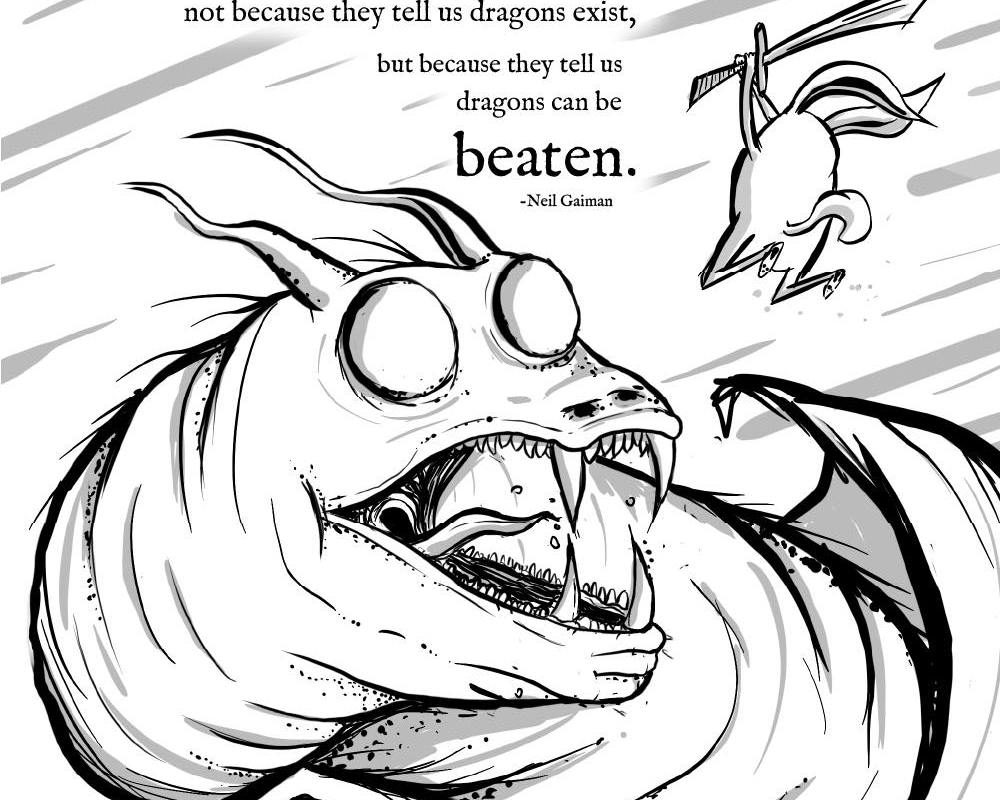
Neil Gaiman, an articulate, imaginatory writer. He makes a claim:
Fairy tales are more than true — not because they tell us dragons exist, but because they tell us that dragons can be beaten.
Neil Gaiman
To me, this is a problem with correlating imagination with truth. Moreover, many a war was lost on the story that it could be won.
Of course, we can still play the metaphor game. I’ve been a fan of metaphor since Joseph Campbell. Metaphor is strength. There was a time when I read Jung and had a stronger interest in Depth and Archetypal Psychology. And fairy tales per Marie-Louise von Franz or her more contemporary cantadora, Clarissa Pinkola Estes. Archetypes are metaphor, but this doesn’t render them real. Still, we can operate as if they are. The trick is to remember that they are not.
Please note that this content has been subsumed into the originating article: The Truth about Truth.
This is a response to this comment by Landzek from The Philosophical Hack regarding the notion of intended truth in communication, the fourth amendment in a series of posts extending the concept commenced in The Truth about Truth.
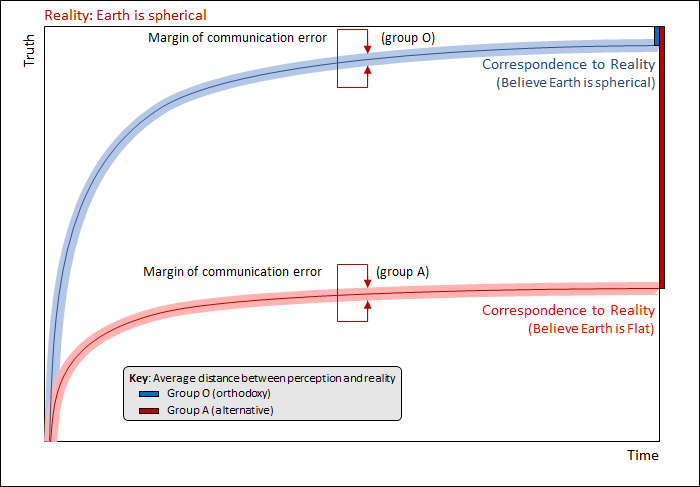
Extending the simple asymptotic function from the first amend, we might see (in Graph 4a) a slight variation in interpretation due to the insufficiencies of language—providing us with a close enough for the government approximation to some shared perception. People in this group will tend to agree on some perception, say, that the earth is spherical.* The average distance from perception to reality is the same for all in-group members, give or take some small variance that I’ll dismiss as an insignificant rounding error.
Graph 4a: Correspondence of Truth to Reality (Simplified in-group concurrence)
Graph 4b, however, illustrates two opposing perceptions of reality. In this example, I show proponents of orthodoxy (group O), who claim the earth to be roughly spherical, arbitrarily closer to reality than proponents of an alternative theory (group A), who claim that the earth is flat.
Each in-group has some variance from the mean notion, but ex-group members are orders of magnitude apart, as measured by the blue and red bars to the right of the chart. If we assume some binary condition that the earth is either spherical or flat with no other options, one of these might be considered to be right whilst the other would be wrong. We can establish this situation relative to the ex-groups, but, still, neither of these is comparable to Reality™ .
Graph 4b: Correspondence of Truth to Reality (Simplified ex-group concurrence)
The intent of each group may be to promote the perspective of the group—each claiming to be closer to the truth than the other. It is easy to imagine a situation where both claimants are equally distant from the truth:
Imagine two groups, each making opposing claims:
Tarot is superior to Astrology in predicting the future.
Astrology is superior to Tarot in predicting the future.
I’ll go out on a limb here and create a reality where the future is not predictable by either measure, irrespective of what each in-group believes.
* I understand that the earth being an oblate spheroid is primarily an analytical distinction, so is tautologically true, but I am using a simplification of a commonly accepted fact.
Please note that this content has been subsumed into the originating article: The Truth about Truth.
THIRD: Rhetoric is a primary driver to fashion our sense of how close or distant we are from reality. Rhetoric shapes and focuses the frame.
War Is Peace, Freedom Is Slavery, and Ignorance Is Strength
— 1984, George Orwell
I’ve already commented at length about the primacy of rhetoric. To recap for the purpose of this disquisition, the only meaningful arbiter of truth is rhetoric—the ability to persuade the larger populace to accept something as true.
Here, I’d expect someone to counter with, ‘Just because people are convinced that something is true doesn’t make it so’, and they’d be right. However, as we cannot access the underlying reality accept through our admittedly fallible senses, who’s to argue?
Moreover—going off on a tangent—, we know that other lifeforms—let’s stick with the animal kingdom—have different senses than humans, and some humans perceive things differently to the normie (if I may adopt a spectrum term) .
Sharks have electroreception (re: The Ampullae of Lorenzini), which allows them to perceive small changes in electrical fields as well as what’s termed a lateral line ( mechanoreceptor function), which allows them to recognise changes in environmental pressure. Other known sensory adaptations are echolocation in bats and dolphins and chemoreceptors (notably in insects and snails).
We are probably also aware that different animals have differing degrees of sense acuity compared to humans. Dogs hear frequencies above the human threshold and have better olfactory discrimination. Birds of prey have superior vision. Women typically have a broader colour vocabulary.
And then there’s synesthesia, a condition in which one sense is simultaneously perceived as if by one or more additional senses. A person with synesthesia may perceive sound as colour (chromesthesia) or perhaps taste.
Given concepts of normality, we presume we are synesthesia are normal and these other people are somehow not, but for all we know, we normies are evolutionary dead ends, soon to be displaced by synesthesiacs. (Is that even a word? It is now.)
But I digress.
Perception is reality. If one can convince you of something, e.g. Donald Trump is a good president, then it’s ostensibly true to you. If one can convince an entire population that something is true, e.g. the plot of Orwell’s 1984, or The Matrix, then who’s to say otherwise.
Please note that this content has been subsumed into the originating article: The Truth about Truth.
SECOND: We have no idea if any changes to our perception move us closer to or further from Reality.
Rather than being asymptotic, perhaps the relationship to is polynomial (or the result of some stochastic function). See the graph above. As we move into the future (in red) and look back, we may perceive that we’ve reversed against some notion of progress. Common wisdom is that progress is directly, positively related to time. But is it?
In my last post, I reference how Einstein progressed and refined Newtonian physics, but in the future, this could be shown to be wrong. In our minds, what had seemed like progress may in retrospect turn out to have been a false assertion.* Moreover, we’ll dutifully accept this updated notion of truth if the rhetoric is sufficient to fit our concept of evidence, especially given humans’ propensity for pareidolia.
Taking our understanding of gravity as the fabric of space-time, we still have no idea what’s going on or how it operates, but this doesn’t prevent us from accepting it as a black box and making pragmatic predictions from there. So, for all intents and purposes, the ‘truth’ mechanism is less important than the functional relationship, just as I can tell time on a watch I have no idea how it operates.
I am no true Sceptic, but neither do I accept the prevailing meta-narrative whole cloth. Unfortunately, I am in no better position than the next to discern proximity to the underlying structure of reality.
* I am not versed well enough in the history of science, but I’d be interested to know which, if any, scientific advances have been a step ‘backward’, that a belief had overtaken a prior belief only to have reverted to the former.
I am aware of the slow march of science and the ignorance of possibly valid assertions simply because the rhetoric was not strong enough or the PR just wasn’t adequate. An example might be the debate of theoretical Democracy versus Communism: which is better than the other. Of course, there are too many dimensions to consider, and the adoption or exclusion of one dimension over another might be enough to tilt the outcome.
In the real world—see what I did there—, the US spend billions upon billions of dollars to interfere with Communism—and I am not taking a position whether it would have succeeded or failed on its own terms—, just to be able to knock down the strawman some century later though propagandising and disinformation campaigns.
Please note that this content has been subsumed into the originating article: The Truth about Truth.
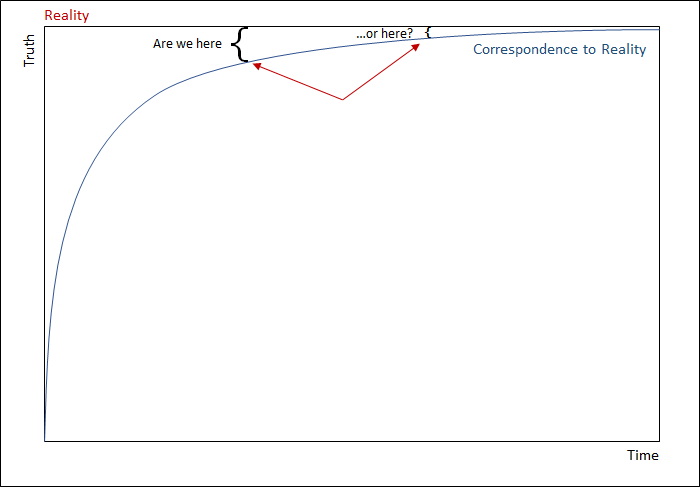
We have no idea how close or far we are from Reality on the Y (Truth) axis.
Graph: Correspondence of Truth to Reality (Asymptotic Curve)
Assuming for the time being that there is an approachable truth, we have no reference to understand how close to reality we might be. In practice, we seem to operate on a basis of always being within some level of statistical significance of where Truth = Reality, and when new information is introduced, we say, “Hooray for Science!” Aren’t we glad that science is self-correcting. And Empiricism has its own issues.
Historically, we’ve had ‘wrong’ correspondence between Truth and Reality, but then we got it ‘right’—until we didn’t.
We may all know how Einstein progressed and refined Newtonian physics. What Einstein did is to create a new narrative—a synchronous shift of paradigm and rhetoric—, which has been accepted into a new orthodoxy. In our mind, this feels like progress. How close are we to the real truth?
Taking our understanding of gravity or of the fabric of space-time, we still have no idea what’s going on or how it operates, but this doesn’t prevent us from accepting it as a black box and making pragmatic predictions from there. So, for all intents and purposes, the ‘truth’ mechanism is less important than the functional relationship, just as I can tell time on a watch I have no idea how it operates.
The notion of Truth is not as cut-and-dry as it might appear at first glance. As a non-cognitivist, I don’t believe in the notion of objective Truth, so I am not entirely sure why it matters enough to me to continue to talk about it. I suppose I’m an Emotivist and Prescriptivist, if these terms capture the essence of my feelings. The Emotivism is what attracts me to an issue whilst Prescriptivism is why I feel the urge to transmit my beliefs. I’ll also suppose, if I adopt an evolutionary survival framework, that people do this to enhance probability of survival by minimising otherness. It also identifies me to those with a similar perspective. The inherent risk is that this attempt at community-building also broadcasts my potential—and let’s be real here, actual—otherness.
In practice, I’d venture that most people simply take the notion of truth for granted, and given an inquiry would defend it with an ‘of course it’s true‘ response with no need for additional justification. But as with human language more generally, Truth is an approximation of a notion. I like to categorise it as Archetypal.
The issue with Truth and other virtues (and pretty much everything else not analytically tautological), is that people don’t seem to believe that they operate asymptotically. They believe there is a truth, it’s objective and accessible, with enough inquiry, can be discovered.
I am self-aware that employing the language of maths and science is a problem adopted for many in philosophy, as they attempt to legitimatise a position by explaining it relative to the currently adopted metanarrative framework. I also know that by adopting this frame, I (or anyone in a similar position) am (is) twisted into convoluted knots. This is how science had been forced into retrograde motion models to explain a geocentric model of the universe, but when the paradigm was shifted to a heliocentric model, these off behaviours fell by the wayside. I suppose a superior approach would be to redefine the language and deposition the frame, but that’s easier said than done.
Graph: Correspondence of Truth to Reality (Asymptotic Curve)
The common assumption is that, over time, scientific inquiry will lead us closer to the truth. Correspondence theory supports the notion that more observations and perspectives will lead to a closer approximation, and eventually tools at our disposal will lead to more granular definitions, until we reach a point that and differences in the tangency to reality will be insignificant, a veritable rounding error. But there are several problems with these assumptions.
We have no idea how close or far we are from Reality on the Y-axis, representing Truth.
Graph: Correspondence of Truth to Reality (Asymptotic Curve)
Assuming for the time being that there is an approachable truth, we have no reference to understand how close to reality we might be. In practice, we seem to operate on a basis of always being within some level of statistical significance of where Truth = Reality, and when new information is introduced, we say, “Hooray for Science!” Aren’t we glad that science is self-correcting. Empiricism has its own issues.
Historically, we’ve had ‘wrong’ correspondence between Truth and Reality, but then we got it ‘right’—until we didn’t. Rinse and repeat.
We may all be familiar with the story of how Einstein progressed and refined Newtonian physics. What Einstein did is to create a new narrative—a synchronous shift of paradigm and rhetoric—, which has been accepted into a revised orthodoxy. In our mind, this feels like progress. But how close are we to the real truth?
Taking our understanding of gravity as the fabric of space-time, we still have no idea what’s going on or how it operates, but this doesn’t prevent us from accepting it as a black box and making pragmatic predictions from there. So, for all intents and purposes, the ‘truth’ mechanism is less important than the functional relationship, just as I can tell time on a watch I have no idea how it operates.
We have no idea if any changes to our perception move us closer to or further from Reality.
Rather than being asymptotic, perhaps the relationship to is polynomial (or the result of some stochastic function). See the graph above. As we move into the future (in red) and look back, we may perceive that we’ve reversed against some notion of progress. Common wisdom is that progress is directly, positively related to time. But is it?
In my first amendment, I reference how Einstein progressed and refined Newtonian physics, but in the future, this could be shown to be wrong. In our minds, what had seemed like progress may in retrospect turn out to have been a false assertion.* Moreover, we’ll dutifully accept this updated notion of truth if the rhetoric is sufficient to fit our concept of evidence, especially given humans’ propensity for pareidolia.
I am no true Sceptic, but neither do I accept the prevailing meta-narrative whole cloth. Unfortunately, I am in no better position than the next person to discern proximity to the underlying structure of reality.
Rhetoric is a primary driver to fashion our sense of how close or distant we are from reality. Rhetoric shapes and focuses the frame.
War Is Peace, Freedom Is Slavery, and Ignorance Is Strength
— 1984, George Orwell
I’ve already commented at length about the primacy of rhetoric. To recap for the purpose of this disquisition, the only meaningful arbiter of truth is rhetoric—the ability to persuade the larger populace to accept something as true.
Here, I’d expect someone to counter with, ‘Just because people are convinced that something is true doesn’t make it so’, and they’d be right. However, as we cannot access the underlying reality accept through our admittedly fallible senses, who’s to argue?
Moreover—departing on a tangent—, we know that other lifeforms—let’s stick with the animal kingdom—have different senses than humans, and some humans perceive things differently to the normie (if I may adopt a spectrum term) .
Sharks have electroreception (re: The Ampullae of Lorenzini), which allows them to perceive small changes in electrical fields as well as what’s termed a lateral line ( mechanoreceptor function), which allows them to recognise changes in environmental pressure. Other known sensory adaptations are echolocation in bats and dolphins and chemoreceptors (notably in insects and snails).
We are probably also aware that different animals have differing degrees of sense acuity compared to humans. Dogs hear frequencies above the human threshold and have better olfactory discrimination. Birds of prey have superior vision. Women typically have a broader colour vocabulary.
And then there’s synesthesia, a condition in which one sense is simultaneously perceived as if by one or more additional senses. A person with synesthesia may perceive sound as colour (chromesthesia) or perhaps taste.
Given concepts of normality, we presume we are synesthesia are normal and these other people are somehow not, but for all we know, we normies are evolutionary dead ends, soon to be displaced by synesthesiacs. (Is that even a word? It is now.)
But I digress.
Perception is reality. If one can convince you of something, e.g. Donald Trump is a good president, then it’s ostensibly true to you. If one can convince an entire population that something is true, e.g. the plot of Orwell’s 1984, or The Matrix, then who’s to say otherwise.
Intent in communicating perception does not get one closer to some corresponding reality. It merely converges perception.
This fourth entry is a response to this comment by Landzek from The Philosophical Hack regarding the notion of intended truth in communication.
Extending the simple asymptotic function from the first section, we might see (in Graph 4a) a slight variation in interpretation due to the insufficiencies of language—providing us with a close enough for the government approximation to some shared perception. People in this group will tend to agree on some perception, say, that the earth is spherical.** The average distance from perception to reality is the same for all in-group members, give or take some small variance that I’ll dismiss as an insignificant rounding error.
Graph 4a: Correspondence of Truth to Reality (Simplified in-group concurrence)
Graph 4b, however, illustrates two opposing perceptions of reality. In this example, I show proponents of orthodoxy (group O), who claim the earth to be roughly spherical, arbitrarily closer to reality than proponents of an alternative theory (group A), who claim that the earth is flat.
Each in-group has some variance from the mean notion, but ex-group members are orders of magnitude apart, as measured by the blue and red bars to the right of the chart. If we assume some binary condition that the earth is either spherical or flat with no other options, one of these might be considered to be right whilst the other would be wrong. We can establish this situation relative to the ex-groups, but, still, neither of these is comparable to Reality™ .
Graph 4b: Correspondence of Truth to Reality (Simplified ex-group concurrence)
The intent of each group may be to promote the perspective of the group—each claiming to be closer to the truth than the other. It is easy to imagine a situation where both claimants are equally distant from the truth:
Imagine two groups, each making opposing claims:
Tarot is superior to Astrology in predicting the future.
Astrology is superior to Tarot in predicting the future.
I’ll go out on a limb here and create a reality where the future is not predictable by either measure, irrespective of what each in-group believes.
* I am not versed well enough in the history of science, but I’d be interested to know which, if any, scientific advances have been a step ‘backward’, that a belief had overtaken a prior belief only to have reverted to the former.
I am aware of the slow march of science and the ignorance of possibly valid assertions simply because the rhetoric was not strong enough or the PR just wasn’t adequate. An example might be the debate of theoretical Democracy versus Communism: which is better than the other. Of course, there are too many dimensions to consider, and the adoption or exclusion of one dimension over another might be enough to tilt the outcome.
In the real world—see what I did there—, the US spend billions upon billions of dollars to interfere with Communism—and I am not taking a position whether it would have succeeded or failed on its own terms—, just to be able to knock down the strawman some century later though propagandising and disinformation campaigns.
** I understand that the earth being an oblate spheroid is primarily an analytical distinction, so is tautologically true, but I am using a simplification of a commonly accepted fact.
DISCLAIMER: In order to keep generating new content (or even content) on this blog, I will occasionally adopt a new approach of publishing unfinished thoughts instead of waiting to complete the thought. This means, I may be editing pages in place to correct my position and alter narrative flow, of not the narrative itself.
EDIT: I’ve included my amendments in line above, though I’ve retained links to the original content.