He doesn‘t, but he accidentally demonstrates the problem.
There is a certain kind of person who loathes Nietzsche for the same reason they loathe earthquakes. Not because he causes damage, but because he refuses to pretend the ground was ever stable.
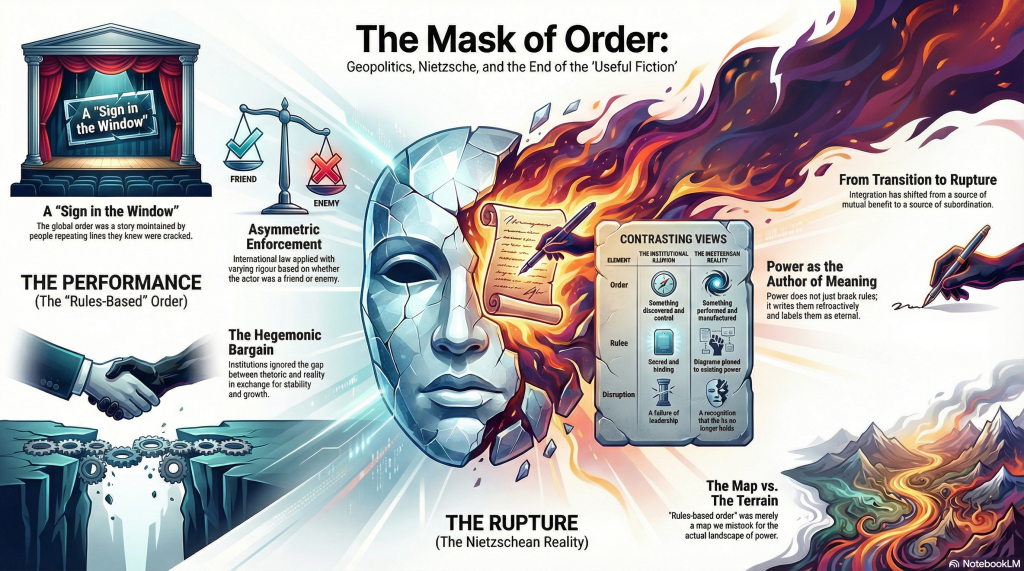
In a recent address, Mark Carney says something that would have been unutterable in polite company a decade ago. He admits that the ‘rules-based international order’ was always a partial fiction. Not false enough to abandon, not true enough to believe in without effort. A story everyone knew was cracked, but which continued to function so long as enough people kept repeating the lines.
“We knew that the story about the rules-based order was partially false… We knew that international law applied with varying rigour depending on the identity of the accused and the victim. This fiction was useful [because of the goods provided by American hegemony]… So we placed the sign in the window. We participated in the rituals. And we largely avoided calling out the gaps between rhetoric and reality. This bargain no longer works. Let me be direct. We are in the midst of a rupture, not a transition… You cannot live within the lie of mutual benefit through integration when integration becomes the source of your subordination.“
Audio: NotebookLM podcast of this topic.
International law, he concedes, applied unevenly. Power decided enforcement. Friends received nuance. Enemies received principle. This was not ignorance. It was a bargain. The illusion delivered goods, stability, growth, a sense of moral hygiene. So the sign stayed in the window. The rituals continued. The gaps between rhetoric and reality were politely ignored. That bargain, Carney says, no longer works.
This is framed as geopolitical realism, but it is really an ontological admission. The mask slipped, and everyone is suddenly offended by the face underneath.
Image: NotebookLM infographic of this content.
This is why people hate Friedrich Nietzsche. Not because he celebrates cruelty or chaos, but because he insists that order is something we perform, not something we discover. He refuses the comfort of believing that the rules were ever neutral, universal, or self-enforcing. He points at the scaffolding and says: this is what is holding things up, not the sky.
When enough people play along, the game feels like reality. When someone refuses to play, panic sets in.
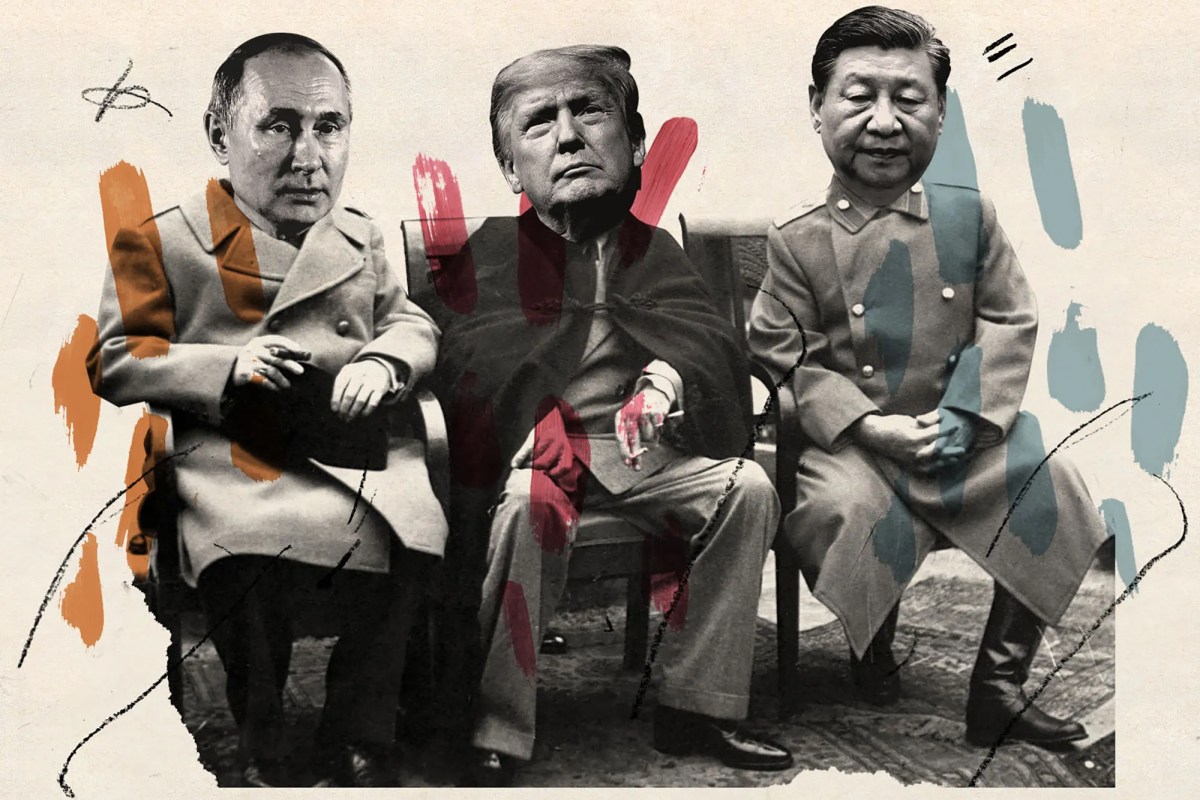
Enter Donald Trump. Trump did not invent the asymmetries of power. He refused to speak them politely. This created a moral crisis for institutions built on the assumption that everyone would continue to pretend. When a designated enemy like Vladimir Putin does this, it is filed under Evil. When an ally does it, the response bifurcates: either frantic appeasement, or embarrassed silence disguised as strategy.
Image: Foreignsentiment
Carney tries to walk a middle path. He neither genuflects nor detonates the stage. He acknowledges the fiction without fully abandoning it. This makes him interesting, but also symptomatic. He wants the audience to notice the set wobbling without asking them to leave the theatre.
When he says the old rules-based order is not coming back, what he really means is that the illusion has been interrupted. Whether permanently or only until someone builds a more convincing façade is left diplomatically unresolved. This is where Nietzsche becomes unavoidable.
People often lump Nietzsche together with vague talk of “power,” as though this were a crude obsession shared with Michel Foucault. But Nietzsche’s contribution is sharper and more unsettling. He is not merely describing power as something exercised. He is describing power as something that manufactures meaning, legitimacy, and moral vocabulary after the fact. Power does not break the rules. It writes them retroactively and calls them eternal.
This is the kind of power later adopted by Adolf Hitler, by Putin, and now by Trump. Not brute force alone, but the refusal to treat inherited norms as sacred simply because they are inherited. This is precisely what terrifies people who mistake procedural continuity for moral truth.
The United States borrowed Montesquieu’s separation of powers as though it were a lock rather than a suggestion. Anyone paying attention could see how easily it could be gamed. That this came as a shock says less about constitutional brilliance than about selective vision. The system functioned not because it was impregnable, but because its participants agreed, tacitly, to behave as though it were.
Nietzsche would call this decadence. Not decline as catastrophe, but decline as denial. The refusal to look directly at the conditions that make order possible, preferring instead to moralise their breakdown.
Carney’s speech is not radical. It is late. It says aloud what everyone already knew but preferred not to articulate: that the world was never neat, the order never neutral, and the rules never binding on those strong enough to ignore them.
What comes next is the uncomfortable part. Once the illusion is acknowledged, it cannot simply be re-believed. You can rebuild institutions. You can repaint the signage. But you cannot unknow that the coffee was always bitter.
Nietzsche does not tell us what replaces the façade. He only insists that pretending it was ever a window onto truth is the most dangerous fiction of all.
What Carney inadvertently demonstrates is not a failure of leadership but a failure of language. ‘Rules-based order’ was never a description of the world; it was a map we mistook for the terrain because it worked often enough to feel true. Nietzsche’s crime was pointing at the legend and saying it was doing the real work. Once that admission is made, you do not get to return to innocence. You can draw a new map, call it reform, integration, or renewal, but you will know it is a diagram pinned to power, not a window onto justice. The unease people feel now is not about chaos. It is about recognition. The lie no longer holds because too many have noticed the pins.
“All that is necessary for evil to triumph is for a few words to go missing from the bylaws.” — not Edmund Burke, but it ought to be.
The Trump administration—America’s reigning monarch of meaningless bombast—has done it again. This time, with an executive order so linguistically cunning it deserves a Pulitzer for Subtextual Menace.
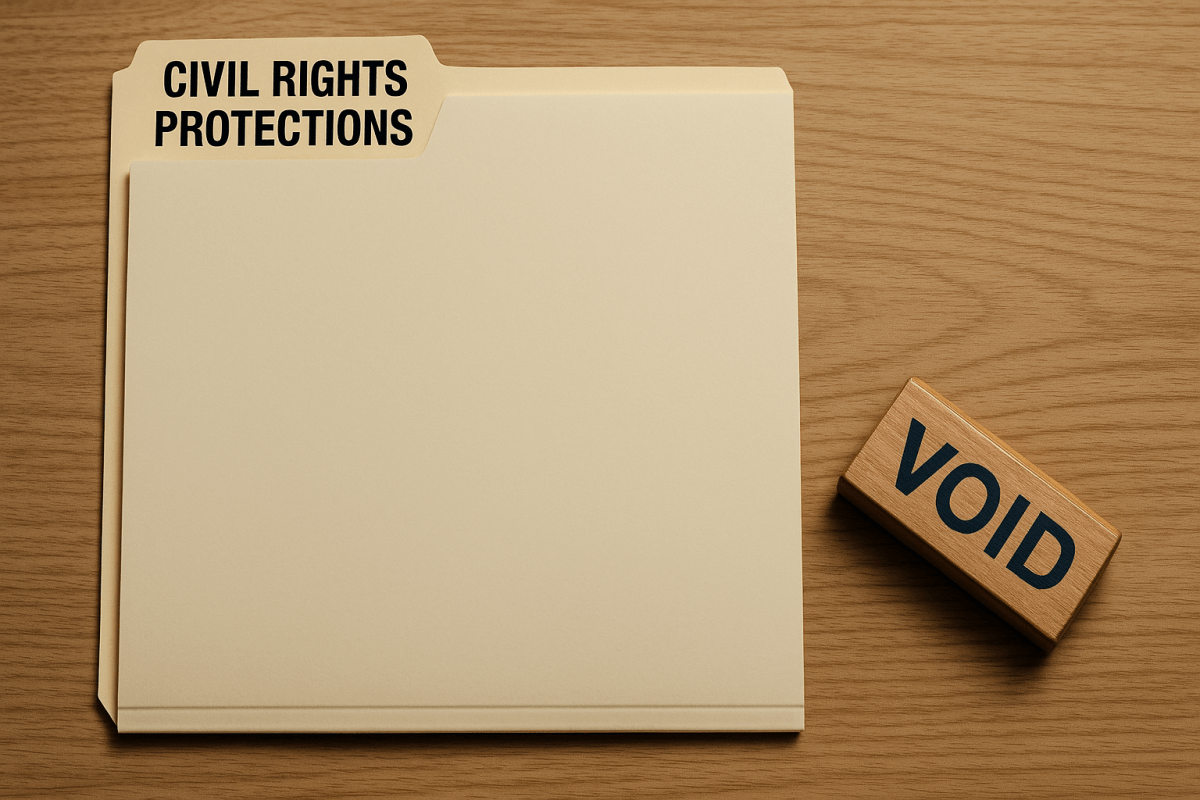
Issued on 30 January 2025, the decree known as “Defending Women from Gender Ideology Extremism” (because, of course, it couldn’t just be called Let’s Erase Legal Protections for People We Don’t Like) removed “political affiliation” and “marital status” from the list of protected classes within certain federal frameworks.
And the result? According to documents unearthed by The Guardian, VA doctors can now legally refuse treatment to patients based on their politics or marital status. You know, because being a Democrat apparently makes you too much of a pre-existing condition.
Naturally, the VA and White House are insisting this means absolutely nothing. “Don’t worry,” they coo. “No one’s actually doing it.” Ah yes, the old Schrödinger’s Protections defence—simultaneously removed and unchanged, invalid but somehow still effective.
But here’s the point—and where it ties to the Language Insufficiency Hypothesis I’ve been peddling like a raving madman at the crossroads of post-structuralism and bureaucratic despair: language isn’t just failing to communicate meaning—it’s being weaponised to obscure it.
The Erosion of Meaning Through Omission
This isn’t the blunt-force idiocy of Orwell’s Newspeak. This is something more elegant—more insidious. This is legislative lacunae. It’s what happens when not saying something says everything.
The words “political affiliation” and “marital status” weren’t replaced. They weren’t clarified. They were simply deleted. Erased like a bad tweet, like a conscience, like a veteran with the wrong bumper sticker.
This is language subtraction as a tool of governance.
We’re not criminalising dissent. We’re just making it legally ignorable.
We’re not discriminating against the unmarried. We’re just no longer required to treat them the same.
It’s the bureaucratic cousin of the dog-whistle: not quite audible in court, but perfectly clear to the base.
The Slippery Slope is Now a Slip-n-Slide
This is how you rewrite civil rights without the fuss of saying so. You just… remove the language that once held the dam in place. Then, when the flood comes, you feign surprise:
“Oh, dear. Who could have guessed that removing protections would result in people being unprotected?”
(Everyone. Everyone could have guessed.)
This is not a bug in the legal language. It’s the feature. The silence is the speech act. The absence is the argument.
This is what I mean by language insufficiency: not merely that our words fail to convey truth, but that their very structure is liable to be gamed—exploited by those who understand that ambiguity is power.
Beyond Intentionality: The Weaponised Void
In philosophy of language, we often debate intentionality—what the speaker meant to say. But here we’re in darker waters. This isn’t about intention. It’s about calculated omission.
The executive order doesn’t declare war on Democrats or single mothers. It simply pulls the thread and lets the tapestry unravel itself.
It’s an act of rhetorical cowardice disguised as administrative efficiency.
This is the Trumpian genius: use language like a stage magician uses sleeves. Distract with one hand, disappear with the other.
Final Diagnosis: Policy by Redaction
We now inhabit a political climate where what is not said carries more legal force than what is. Where bylaw gaps become policy gateways, and where civil rights die not with a bang, but with an elision.
So no, the VA hasn’t yet denied a Democrat a blood transfusion. But the table has been set. The menu revised. The waitstaff told they may now “use discretion.”
Language doesn’t merely fail us. It is being made to fail strategically.
Welcome to the new America: where rights aren’t removed—they’re left out of the memo.
Yet again, ChatGPT renders an odd image. Can’t be bothered to amend it.
Yuval Noah Harari, always ready with a digestible morsel for the TED-addled masses, recently declared that “democracy runs on trust, dictatorship on terror.” It’s a line with the crispness of a fortune cookie and about as much analytical depth. Designed for applause, not interrogation, it’s the sort of soundbite that flatters liberal sensibilities while sanding off the inconvenient edges of history.
Audio: NotebookLM podcast on this topic.
Let’s be honest: this dichotomy is not merely simplistic – it’s a rhetorical sedative. It reassures those who still believe political systems are like kitchen appliances: plug-and-play models with clear instructions and honest warranties. But for anyone who’s paid attention to the actual mechanics of power, this framing is delusional.
1. Trust Was Never Earned
In the United States, trust in democratic institutions was never some noble compact forged through mutual respect and enlightened governance. It was cultivated through exclusion, propaganda, and economic bribery. The post-WWII boom offered the illusion of institutional legitimacy – but only if you were white, male, middle-class, and preferably asleep.
Black Americans, Indigenous peoples, immigrants, women – none were granted the luxury of naïve trust. They were told to trust while being actively disenfranchised. To participate while being systemically excluded. So no, Harari, the machine didn’t run on trust. It ran on marketing. It ran on strategic ignorance.
2. Dictatorship Doesn’t Require Terror
Equally cartoonish is the notion that dictatorships subsist purely on terror. Many of them run quite comfortably on bureaucracy, passive conformity, and the grim seduction of order. Authoritarians know how to massage the same trust reflexes as democracies – only more bluntly. People don’t just obey out of fear. They obey out of habit. Out of resignation. Out of a grim kind of faith that someone – anyone – is in charge.
Dictatorships don’t extinguish trust. They re-route it. Away from institutions and toward strongmen. Toward myths of national greatness. Toward performative stability. It’s not that terror is absent—it’s just not the whole machine. The real engine is misplaced trust.
3. Collapse Is Bipartisan
The present moment isn’t about the erosion of a once-trustworthy system. It’s the slow-motion implosion of a confidence game on all sides. The old liberal institutions are collapsing under the weight of their hypocrisies. But the loudest critics – tech messiahs, culture warriors, authoritarian nostalgists – are no better. Their solutions are just new brands of snake oil in sleeker bottles.
Everyone is pointing fingers, and no one is credible. The public, caught between cynicism and desperation, gravitates either toward restoration fantasy (“make democracy work again”) or authoritarian theatre (“at least someone’s doing something”). Both are dead ends.
4. The Only Way Forward: Structural Reimagination
The only viable path isn’t restoration or regression. It’s reinvention. Systems that demand unconditional trust – like religions and stock markets – are bound to fail, because they rely on sustained illusions. Instead, we need systems built on earned, revocable, and continually tested trust – systems that can survive scrutiny, decentralise power, and adapt to complexity.
In other words: stop trying to repair a house built on sand. Build something else. Something messier, more modular, less mythological.
Let the TED crowd have their slogans. We’ve got work to do.
Chapter 5 of Yuval Noah Harari’s Nexus feels almost unlistenable, like polemic propaganda, painting cherry-picked anecdotes with a broad brush for maximal effect. If I hadn’t agreed to read this in advance, I’d have shelved the book long ago. It is as though Harari has never set foot on Earth and is instead relying on the optimistic narratives of textbooks and travel guides. His comparisons between democracy, dictatorship, and totalitarianism are so heavily spun and biased that they verge on risible. Harari comes across as an unabashed apologist for democracy, almost like he’s part of its affiliate programme. He praises Montesquieu’s separation of powers without noting how mistaken the idea as evidenced by modern-day United States of America. Not a fan. If you’re a politically Conservative™ American or a Torrey in the UK, you’ll feel right at home.
A Trivial Freedom – At What Cost?
Harari ardently defends the “trivial freedoms” offered by democracies whilst conveniently ignoring the shackles they impose. It’s unclear whether his Pollyanna, rose-coloured perspective reflects his genuine worldview or if he’s attempting to convince either himself or his audience of democracy’s inherent virtues. This uncritical glorification feels particularly out of touch with reality.
The Truth and Order Obsession
Once again, Harari returns to his recurring theme: the tradeoff between truth and order. His obsession with this dynamic overshadows more nuanced critiques. Listening to him defend the so-called democratic process that led to the illegal and immoral US invasion of Iraq in 2002 is nothing short of cringeworthy. Even more egregious is his failure to acknowledge the profound erosion of freedoms enacted by the PATRIOT Act, the compromised integrity of the offices of POTUS and SCOTUS, and the performative partisanship of Congress.
The Role of Media and Peer Review
Harari cites media and peer review as essential mechanisms for error correction, seemingly oblivious to the fallibility of these systems. His perception of their efficacy betrays a glaring lack of self-awareness. He overlooks the systemic biases, self-interest, and propaganda that permeate these supposed safeguards of democracy.
A Flimsy Narrative
Whilst many Modernists might uncritically embrace Harari’s perspective, his argument’s veneer is barely a nanometre thick and riddled with holes. It’s not merely a question of critiquing metanarratives; the narrative itself is fundamentally flawed. By failing to engage with the complexities and contradictions inherent in democratic systems, Harari’s defence feels more like a sales pitch than a rigorous examination.
Final Thoughts
Harari’s Chapter 5 is a glaring example of uncritical optimism, where the faults of democracy are brushed aside in favour of a curated narrative of its virtues. This chapter does little to inspire confidence in his analysis and leaves much to be desired for those seeking a balanced perspective.
The United States have just finished another presidential election cycle. Given the choices, I didn’t vote, but I recently had a chat with my twenty-something son. He identifies with the policies of the Democratic Party of yore but reckons they’ve abandoned their position, so he’s taken an ‘anyone but them’ stance.
Looking back, he voted for Bernie Sanders in the primaries for the 2016 election cycle—his first vote. He wanted a voice for change over the status quo. Without going into details, Bernie was back-stabbed and kicked in the groin by the DNC, the corporation in charge of the Democratic Party, because Hillary Clinton wanted to run. The rest is history, and my son reflected the sentiment. He wanted something other than status quo. If it wouldn’t be Sanders, it would be Trump, and he cast his vote accordingly.
The Democrats have lost touch with their base, whilst the Republicans have become the Big Tent party—a feature of the old Democratic party. Let’s rewind to see where it all fell apart.
It started during the Bill Clinton era—or rather, with the opposition against him. Before Clinton, politics were more like mates competing in sport. There were always sore losers, but by and large, people got behind the next administration, and we had peaceful transitions of power.
With Bill Clinton, a Democrat, the Republicans swore to hinder every possible policy or position he took. Despite this, he ran the first federal budget surplus to burn down the national debt for three of his eight years—the first since Lyndon B Johnson in 1969—and reversed a trend established by Ronald Reagan of leveraging debt, heaping it on future generations in the name of generating positive economic figures. Reagan ran the country like a bloke who’d found someone else’s limitless credit card. Americans are still paying off his binge.
When Clinton termed out, Republican Bush II was elected. The Democrats were furious. Then his cabal engaged in illegal crimes against humanity in the Middle East with the full support of the Democratic Party. When Bush II termed out, there was a lot of noise that he was going to commandeer the administration. This is the first I heard this rhetoric used, and the fear-based messaging has remained ratcheted up ever since. I heard this again at the end of Obama’s term and then Trump’s term.
Any semblance of world-based ideology has been drained, replaced with party fealty. In this election, the Harris campaign heavily messaged university-educated females. This was a strategic blunder as this was already her base. Meanwhile, Trump’s campaign targeted his former weak spots, taken for granted and left withering on the vine by the Harris campaign.
In the end, Harris ran a tepid campaign as a status quo candidate. No one is happy with the status quo save for those at the top. Democrats used to be about the average working-class Joe and Jane. Now, they’re about themselves. They never did any soul-searching after their loss in 2016. They thought they turned things around with Obama’s campaign of ‘Hope’, but he was another status quo turncoat whose actions didn’t match his rhetoric. He had two years where his party had full control of the House and Senate. Like a boxer throwing a fight, he sat on his hands for two years and then complained that he couldn’t get anything done.
Neither party has any material prospects for the future. They should just turn the page on this chapter of history—better still, they should open a new book.




 Philosophics