Modernity Worldview Survey: Update 1

It’s nice to see responses still coming in from the Modernism Worldview Survey, so I thought I’d share some interim insights. Several people have shared their results with me privately. I’d be interested to know if any takers felt this was a fair and accurate assessment, given that this might be as relevant as the zodiac reading on a restaurant placemat. I’m an ox, if you’re wondering.

All aggregated responses resolve within the violet parallelogram that encompasses the population average (the blue dot). So, survey-takers have a slight propensity toward Modernist ideals with a tinge of Postmodernism. The force is weak, given how far the dot resides from the vertex. There were responses close to the green shading on the Modern side, but none indicated a strong Modernist worldview.

Firstly, no respondents are choosing “Pure Premodernity” (lower right). This doesn’t mean that no one abides by Premodern perspectives. It’s that they feel these ideas are filtered through Modern (mostly) and Postmodern (less so) lenses.

Secondly, respondents generally moderated their approach, avoiding any extremes. Although some responses were close to the Modern triangle (the green shading), none occupied the space, and points were even further removed from the other two corners. There were several scores in the white triangle. This space would be ripe for a Metamodernist to be positioned, but the survey would need to be restructured to determine whether this was mere happenstance.

Before the survey was published, I thought that the blue dot would be higher (toward Modernity) and further right (more Premodern), but this is likely due to the bias of people who visit this site and follow my content more generally. I need to share links in places without this bias. Of course, someone having even the slightest interest in the subject matter already represents a bias.

Modernity Survey Results

I’ve added a permanent page to summarise the modernity worldview categories. If you haven’t yet taken the survey…

Click here to take the survey

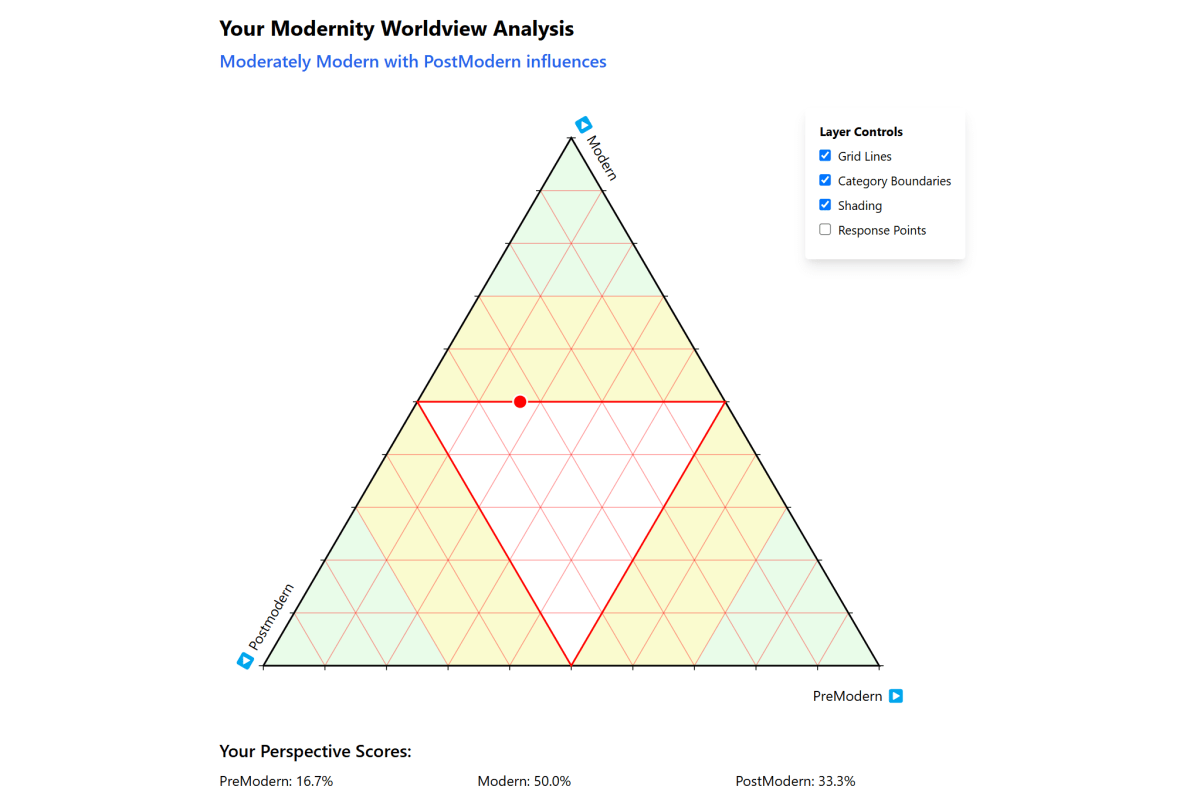
This post explains how to interpret the ternary plot chart’s visualisation. The ternary chart on the survey results page will render something like this. This is an admin page with additional functionality, but it’s similar enough. The blue dot represents the average of all responses. The star represents where I guessed the average would land–mostly modern with some residual premodernity and a touch of postmodernity.

Under the title in the header is a textual assessment of the visualisation. In this case, the response illustrates someone moderately modern with postmodern influences. Although this person also has some premodern tendencies, they are relatively insignificant to the context.

The three possible worldviews are at the vertices (the corners) of the triangle. Each side is a scale progressing from 0% to 100%—100% coincident with the label. For example, the bottom side runs from 0 on the left to 100 on the right, which would indicate a score of 100 per cent Premodern, which the output deems Pure Premodern.

Notice that each vertex has green and yellow shading that serves as visual aids representing the strength of the relationship to the corner. Green is strong, and yellow is moderate. The white section outlined by an interior triangle with a red border is decidedly mixed, showing no strong inclination to any of the extremes.

In the example above, the red plot point illustrates a response (as shown below the chart) that is 20.7% Premodern, 52.1% Modern, and 27.2% Postmodern. These numbers should always sum to 100, though there will be some drift due to rounding. The star represents where I thought the average response would be. Follow the tickmarks on each side, and you’ll notice they correspond with the plot point as a 3-tuple (20, 70, 10).

In the future, I expect to render a view that plots the average survey response as a reference.

Below this chart is an expository account of the response choices. You can render this content as a PDF for your personal archive.

Final Word

If you have any questions or suggestions related to this topic, please feel free to leave them in the comments below.

Surveying Modernity

A Brief, Brutal Experiment in Categorising Your Worldview

This month, I’ve been tinkering with a little project—an elegant, six-question survey designed to assess where you land in the great intellectual mess that is modernity.

Audio: Podcast discussion about this post.

This isn’t some spur-of-the-moment quiz cooked up in a caffeine-fueled haze. No, this project has been simmering for years, and after much consideration (and occasional disdain), I’ve crafted a set of questions and response options that, I believe, encapsulate the prevailing worldviews of our time.

It all began with Metamodernism, a term that, at first, seemed promising—a bold synthesis of Modernism and Postmodernism, a grand dialectic of the ages. But as I mapped it out, it collapsed under scrutiny. A footnote in the margins of intellectual history, at best. I’ll expand on that in due course.

The Setup: A Simple, Slightly Sadistic Ternary Plot

For the visually inclined (or the masochistically curious), I initially imagined a timeline, then a branching decision tree, then a Cartesian plane before landing on a ternary plot—a three-way visual that captures ideological leanings in a way a boring old bar chart never could.

The survey itself is brief: six questions, each with five possible answers. Submit your responses, and voilà—you get a tidy little ternary chart plotting your intellectual essence, along with a breakdown of what your answers signify.

Methodology: Half-Rigorous, Half-Reckless

I am, after all, a (recovering) statistician, so I’ve tried to uphold proper methodology while also fast-tracking certain safeguards for the sake of efficiency. If there’s enough interest, I may expand the survey, adding more questions or increasing response flexibility (tick boxes instead of radio buttons—revolutionary, I know).

Privacy Concerns? Relax. I’m not harvesting your data for some nefarious scheme. No personally identifiable information is collected—just a timestamp, session ID, and your browser’s language setting. I did consider tracking IP addresses to analyze regional trends but ultimately scrapped that idea.

In the future, I may add an optional email feature for those who wish to save and track their responses over time (assuming anyone is unhinged enough to take this more than once).

The Rest of the Story: Your Feedback, My Amusement

Since this is a personal project crafted in splendid isolation, I’d love to hear your thoughts. Are the questions reasonable? Do the response options make sense? Does the summary feel accurate? Is the ternary chart decipherable, or have I constructed a glorified inkblot test?

As an academic, economist, and statistician, I had never encountered a ternary chart before embarking on this, and now I rather enjoy it. That said, I also find Nietzsche “intuitive,” so take that as you will.

If this gains traction, expect follow-up content—perhaps videos, podcasts, or further written explorations.

Your Move

Take the survey. It’s painless, requiring mere minutes of your life (which is, let’s be honest, already wasted online). And because I’m feeling generous, you can even generate a PDF to stick on your fridge, next to your collection of expired coupons and disappointing takeout menus.

Click here to take the survey.

Let’s see where you stand in the grand, chaotic landscape of modernity. Or at least, let’s have a laugh trying to make sense of it.

DISCLAIMER: The Modernity Worldview Survey is not scientific. It is designed as an experiment to provide directional insights. It is hosted on Google Cloud and subject to its availability and performance limitations.

Modern Spectrum: 1 Dimension

I’ve been pondering how to effectively dimensionalise the spectrum that illustrates the relationship among premodern, modern, and postmodern—and potentially, metamodern. I was researching and happened upon a YouTube video from a few years back by Rick Durst, a Conservative Evangelical professor. He was diagramming the chronological path from pre to post.

I think at this point it’s important to distinguish between Modern and Modernity and PostModern and PostModernity1. I feel that the noun form, Modernity, can be used to describe the chronology whilst the adjective form, Modern, describes the philosophy. I’m not sure that this is a standard distinction. If I adhere to this difference, then Rick is discussing Modernity rather than Modern. Perhaps I’m being pedantic.

I’ve taken liberties to rerender Rick’s model.

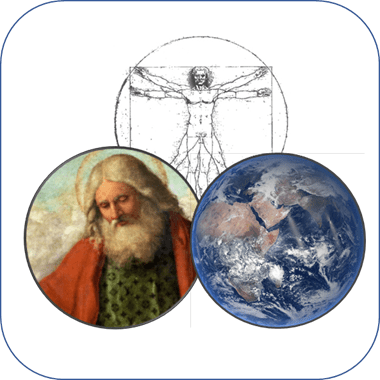
In his view, the stages are from God to Man to Earth. I don’t fully agree with the transition from Man to Earth, but the God to Man or Humanism doesn’t feel very controversial. Although Rick is describing modernity against a temporal backdrop, this doesn’t invalidate the God-Man-Earth aspect—leaving open the possibility that it may be invalid for other reasons.

Following the chronology, Rick points out that the overlapping periods between PreModern and Modern and Modern and PostModern are not clean breaks. As I’ve suggested before, in illustration B, some people today retain PreModern beliefs and others hold PostModern beliefs. On balance, I feel that the Western world today remains substantially Modern, philosophically speaking. I am not sure that I am qualified to assess this relative to contemporary Eastern cultures.

Again, without otherwise critically evaluating Rick’s model, belief and God and in particular, Catholocism was the hallmark of the PreModern, PreEnlightenment world—the supernatural and superstition ruled the day.

Many consider Modernity to have commenced with the Renaissance, roughly from the 14th to the 17th century—describing it as early modern. Given the prevalence of superstitious beliefs, I’d be more comfortable with something more along the lines of proto-modern rather than modern. Scientific discoveries were evident, but this was reserved for the elite.

Given the Protestant Reformation that occupied the 15th century, it’s clear that a declaration of Modern should be considered to be premature. One might even argue that even with the advent of the Age of Enlightenment, which spanned the 17th and 18th centuries, Secular Humanism become the theme for the empowered elites, but the masses never relinquished their PreModern belief systems. If we are to start the Modern clock at all, this seems to be as good a place as any.

Although Modernism is marked by Humanism, in the United States, federal and state government is still predicated on PreModern principles, so it is not unfair, twisting Lyotard’s phrase, to question, Have We Ever Been Modern? It is somewhat interesting how—at least anecdotally—how many people do not find it inconsistent to have faith in humanity to solve the ills of the world through technology whilst simultaneously believing in gods, angels, tarot, and homoeopathic and other anachronistic healing modalities.

Chronologically, Rick demarcates Modern and PostModern with the ecological crises of the 1970s, which turned the focus from Man to the Earth. Seeds of postmodernism were sewn post-WWII and even post-WWI with the devastation and realisation of the limits of human capacity.

For the purpose of the ternary plot, it seems easy enough to assess where a person might feel relative to gods versus humans. And whilst I could argue that the belief in gods and the supernatural is a discrete binary state rather than on a continuous scale, I could argue as well that someone could feel that their gods are in control but they retain some degree of what’s known as free will. As a matter of degree, one could be a Deist—believing in some Prime Mover—but feel that now humans are on their own. God is like a crocodile slithering into the darkness having enabled the next generations. On a 1 to 10 spectrum, they might get 90% Modern and 10% PreModern. A believer in astrology, tarot, and the like, might also have faith in Man, yet they may reside more on the 60%-40% in favour of Modernity—or vice versa.

The question is how to get past Man to Earth. I am not sure how to frame this. Perhaps this wasn’t the right avenue to pursue.


  1. For the record, I chose to render the terms PreModern and PostModern in camel case for no particular reason, save to think that it seems to make the prefix more readily distinguishable.

Metamodernism on the Ternary Plot

I don’t have a strong grasp of Metamodernism, but at first glance, it doesn’t seem to be a place I wish to reside, and I don’t have the motivation to look deeper. Instead, I’ll rely on proponants and advocates to fill that void. They are already ahead of me on that curve and far more qualified to lead that charge. Moreover, I believe there are at least two paths to follow.

Metamodernism attempts to synthesise Modernism and Postmodernism, but from my perspective, it’s a Modern belief that simply preferences Premodern mysticism over Postmodernism. From what I understand about Metamodernism, all of it’s dimensions can be measured on the planar ternary plot I am architecting. From what I read by Metamodernists is that it is either operates to sublate or is a paradigm shift that transcends these worldviews.

If my characterisation is correct, Metamodernism is captured by the model and simply shifts the dot to the left. If one of the other persectives is correct, it either changes the shape of the plane itself, alters the pathing of the movement of the dot, or creates a need for a Z-axis to capture this Z-dimentional movement. To assess this, I’ll need more information. For now, I will adopt my perspective and see where I end up.

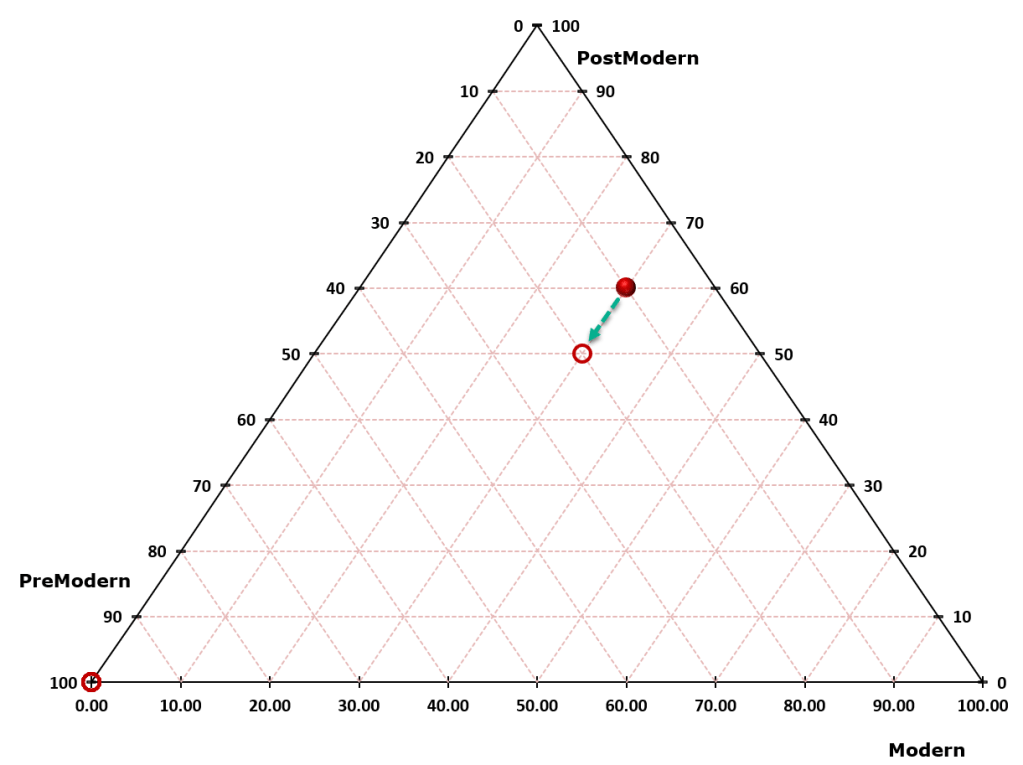
Usign this ternary chart as a reference, if I am the solid red dot at time-1, and adopt some Metamodern world views, my place at time-2 moves in the direction of PreModern, which is to say down and to the left.

To be clear, the direction of this shift is not inevitable. It depends on the initial orientation and the dimension under consideration. If I were lower on the chart (more Modern than PostModern), then the movement would more likely be from right to left horizontally and not angular as depicted. Moreover, even from the starting position shown, the movement might simply go left. What it won’t do is go up or to the right, the area shaded in red on the chart below.

My next step is still to dimentionalise this. Altought I have some canditates already in mind, I suspect this will be an emergant process. Feel free to come along for the ride.

Ternary Chart

I am working toward fleshing out my Modernity Triangle. Since I want to illustrate placement graphically, I’ve settled on using a ternary plot—at least for now. I’ve borrowed an existing Excel template, which already contained the simple maths and charting. This is really just the tip of the iceberg as creating appropriate dimensions, measures, and weights is the heavy lifting.

I may work on the aesthetics, but this is the underlying framework. I’ve already commenced a scoping conversation in a previous post. In a nutshell, there are three primative movements—the spectra are Premodern to Modern, Modern to Postmodern, and Postmodern to Premodern.

This chart is meant to be discriptive. As the adage goes, there is no correct placement. If you identify as a Modern, you may wish the dots to bias in that direction, but the same is true if you occupy one of the other corners. For those who prefer moderation as a stance—the Middle Path—, you may be tempted to find comfort in a dot occupying the centre. That’s fine. I’m not judging your worldview.

Taking a moment to mention prescription, the best I can offer at this point is that if you feel you should or want to occupy a particular place. Feel free to create a vector from where you are to where you aspire to be. My only caveat at this point is that sometimes it is hard to reverse tack once the genie’s been let out of the bottle. An example might be agriculture. Humans progressed from Hunter-Gatherers to Aggrarians. Some have ‘progressed’ to Industrial and Postindustrial worldviews. However, not all humans have taken these paths. But due to encroachment of Premodern humans by Moderns, the habitat of Premoderns has made hunting and gethering an untenable lifestyle, so in the contemporary world, only Hunter-Horticulturalist remain.

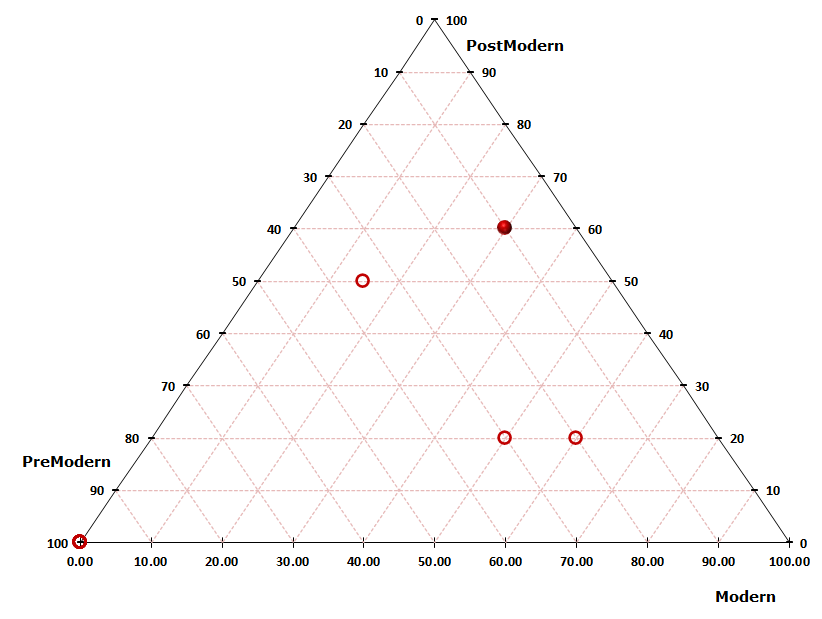
In the accompanying ternary chart, I clumsily place myself where I self-identify, though I could be way off base. As a matter of example, this dot could represent a single dimension as well as some aggregation of dimensions. At the most abstract level, the view should interpret as a person espousing a tendency toward Postmodernism over Modernism fairly far removed from Premodernism. The lower leftmost dot on the Premodern corner could represent a typical pre-Enlightenment peasant as well as a member of some contemporary indigenous tribe such as the Sentinelese.

In the contemporary Western world, I’d image that they might be represented by the 2 dots on the second horizontal, fairly Modern, a smidgeon of PostModern, and more PreModern than they’d likely be comfortable to admit.

Political Compass

I was inspired by the Political Compass conceived by Libertarians attempting to differentiate themselves from a strict Left-Right political frame. My intent is to create something similar. I don’t feel that I have four points to work with, so I settled for three. I discuss how Metamodernism fits into this model elsewhere. Here is how the Political Compass situated the UK parties in the 2019 general election.