Midjourney Boundaries

I promise that this will not become a hub for generative AI. Rather than return to editing, I wanted to test more of Midjourney’s boundaries.

It turns out that Midjourney is selective about the nudity it renders. I was denied a render because of cleavage, but full-on topless – no problem.

Both of these videos originate from the same source image, but they take different paths. There is no accompanying video content. The setup features three women in the frame with a mechanical arm. I didn’t prompt for it. I’m not even sure of its intent. It’s just there, shadowing the women nearest to it. I don’t recall prompting for the oversized redhead in the foreground, though I may have.

In both images, note the aliasing of the tattoos on the blonde, especially on her back. Also, notice that her right arm seems shorter than it should. Her movements are jerky, as if rendered in a video game. I’m not sure what ritual the two background characters are performing, but notice in each case the prepetition. This seems to be a general feature of generative AI. It gets itself in loops, almost autistic.

Notice a few things about the top render.

Video: Midjourney render of 3 females and a mechanical arm engaging in a ritual. (9 seconds)

The first video may represent an interrogation. The blonde woman on the left appears to be a bit disoriented, but she is visually tracking the woman on the right. She seems to be saying something. Notice when the woman on the right stands. Her right foot lands unnaturally. She rather glitches.

The camera’s push and pull, and then push, seems to be an odd directorial choice, but who am I to say?

Video: Midjourney render of 3 females and a mechanical arm engaging in a ritual. (12 seconds)

The second video may represent taunting. The woman on the left still appears to be a bit disoriented, but she checks the redhead in the foreground with a glance. Notice the rocking of the two background characters, as well as the mech arm, which sways in sync with the woman on the right. This is a repetition glitch I mentioned above.

Here, the camera seems to have a syncopated relationship with the characters’ sway.

Summary

The stationary objects are well-rendered and persistent.

Assignment

Draft a short story or flash fiction using this as an inspirational prompt. I’m trying to imagine the interactions.

  • The ginger seems catatonic or drugged. Is she a CIS-female? What’s with her getup?
  • The blonde seems only slightly less out of it. Did she arrive this way? Did they dress her? Why does she appear to still have a weapon on her back? Is it a weapon or a fetter? Why is she dressed like that? Is she a gladiatrix readying for a contest? Perhaps she’s in training. What is she saying? Who is she talking to? What is her relationship to the redhead? Are they friends or foes – or just caught up in the same web?
  • What is the woman wearing the helmet doing? She appears to have the upper hand. Is she a cyborg, or is she just wearing fancy boots? What’s with her outfit? What’s with her Tycho Brahe prosthetic nose piece?
  • What is that mechanical hand? Is it a guard? A restraint? Is it hypnotising the ginger? Both of them? Is it conducting music that’s not audible?
  • What’s it read on the back wall? The two clips don’t share the same text. Call the continuity people.

Deepseek: Hallucination and Populism

The connection between conspiracy theorists, religious believers, and generative AI is a fascinating topic that touches on epistemology, psychology, and the sociology of belief. At its core, the common thread lies in the human tendency to impose meaning, structure, and causality on complex or ambiguous phenomena, often in the absence of sufficient evidence. Let’s explore this connection through the lens of political philosophy.

1. The Need for Meaning and Control

  • Religious Believers: Religion often provides a framework for understanding the world, offering answers to existential questions (e.g., the meaning of life, the nature of good and evil) that might otherwise seem incomprehensible. This framework simplifies complexity by attributing events to divine will or cosmic order.
  • Conspiracy Theorists: Similarly, conspiracy theories offer a simplified narrative that explains chaotic or unsettling events by attributing them to the deliberate actions of powerful, hidden actors. This provides a sense of control and understanding, even if the explanation is speculative or unfounded.
  • Generative AI: AI models, like humans, operate by identifying patterns and generating outputs based on incomplete data. When faced with ambiguity, they “hallucinate” plausible but potentially false information to fill gaps, mirroring the human tendency to create coherent narratives from incomplete evidence.
  • Connection: All three exhibit a drive to reduce uncertainty by generating explanations, whether through divine intervention, secret plots, or algorithmic extrapolation. This reflects a broader human desire to impose order on chaos, even at the cost of accuracy.

2. The Role of Authority and Trust

  • Religious Believers: Religious systems often rely on authoritative texts, leaders, or traditions as sources of truth. These authorities provide a sense of certainty and trust, even when empirical evidence is lacking.
  • Conspiracy Theorists: Conspiracy theories frequently reject mainstream authorities (e.g., governments, scientists) and instead place trust in alternative sources of information, such as charismatic figures or fringe communities.
  • Generative AI: AI systems are often perceived as authoritative due to their ability to process vast amounts of data. However, their outputs are only as reliable as the data they are trained on, and they lack the ability to critically evaluate the truthfulness of their responses.
  • Connection: All three rely on trust in certain authorities or systems to validate their claims, whether those authorities are divine, contrarian, or algorithmic. This highlights the role of trust in shaping belief systems and the potential for misuse or misinterpretation of authority.

3. Cognitive Biases and Pattern Recognition

  • Religious Believers: Humans are predisposed to detect agency and intentionality in the world, a tendency known as “hyperactive agency detection.” This can lead to the attribution of natural events to supernatural forces.
  • Conspiracy Theorists: Conspiracy thinking often involves seeing patterns where none exist (apophenia) and attributing events to deliberate human agency rather than randomness or coincidence.
  • Generative AI: AI models are designed to identify patterns in data, but they can also generate spurious correlations or false connections when the data is noisy or incomplete.
  • Connection: Both humans and AI exhibit a tendency to overfit patterns to data, leading to the creation of narratives that may be compelling but lack empirical support. This suggests a shared cognitive bias toward finding meaning, even when it is not warranted.

4. Social and Political Implications

  • Religious Believers: Religious beliefs can foster community cohesion and moral frameworks but can also lead to division and conflict when different belief systems clash.
  • Conspiracy Theorists: Conspiracy theories can create a sense of belonging among adherents but often lead to polarization and distrust of societal institutions.
  • Generative AI: AI has the potential to democratize information but also risks amplifying misinformation and reinforcing echo chambers.
  • Connection: All three phenomena have significant social and political implications, as they shape how individuals and groups perceive reality, interact with others, and engage with societal structures. They highlight the tension between the need for shared narratives and the dangers of divisive or false beliefs.

5. The Role of Epistemic Humility

  • A key philosophical insight is the importance of epistemic humility—the recognition of the limits of one’s knowledge. Religious traditions, conspiracy theories, and AI systems often lack this humility, presenting their narratives as definitive truths rather than contingent explanations.
  • Encouraging a culture of critical thinking, scepticism, and openness to evidence could help mitigate the risks associated with all three phenomena.

Conclusion

The connection between conspiracy theorists, religious believers, and generative AI lies in their shared tendency to simplify complexity, impose meaning, and generate narratives in the face of uncertainty. While this tendency is deeply human, it also carries risks, particularly when it leads to the uncritical acceptance of false or harmful beliefs. Understanding these connections can help us develop strategies to promote more nuanced, evidence-based approaches to knowledge and belief in an increasingly complex world.

DISCLAIMER: Please note that this is the first response I received from a prompt to DeepSeek.

I am interested in the possible connexion between conspiracy theorists and religious believers. These two cohorts (if they are even independent) have a common trait of oversimplifying things they can’t understand and hallucinating solutions in the absence of facts or evidence. GenerativeAI is accused of the same behaviour. How might these be connected?

NB: Evidently, some versions of DeekSeek generate images, but mine doesn’t, so I prompted it to generate an apt cover image.

I also asked for keyword tags. It provided these, but then hid them, replacing them with this message:

Sorry, that’s beyond my current scope. Let’s talk about something else.

Trolly Dilemma

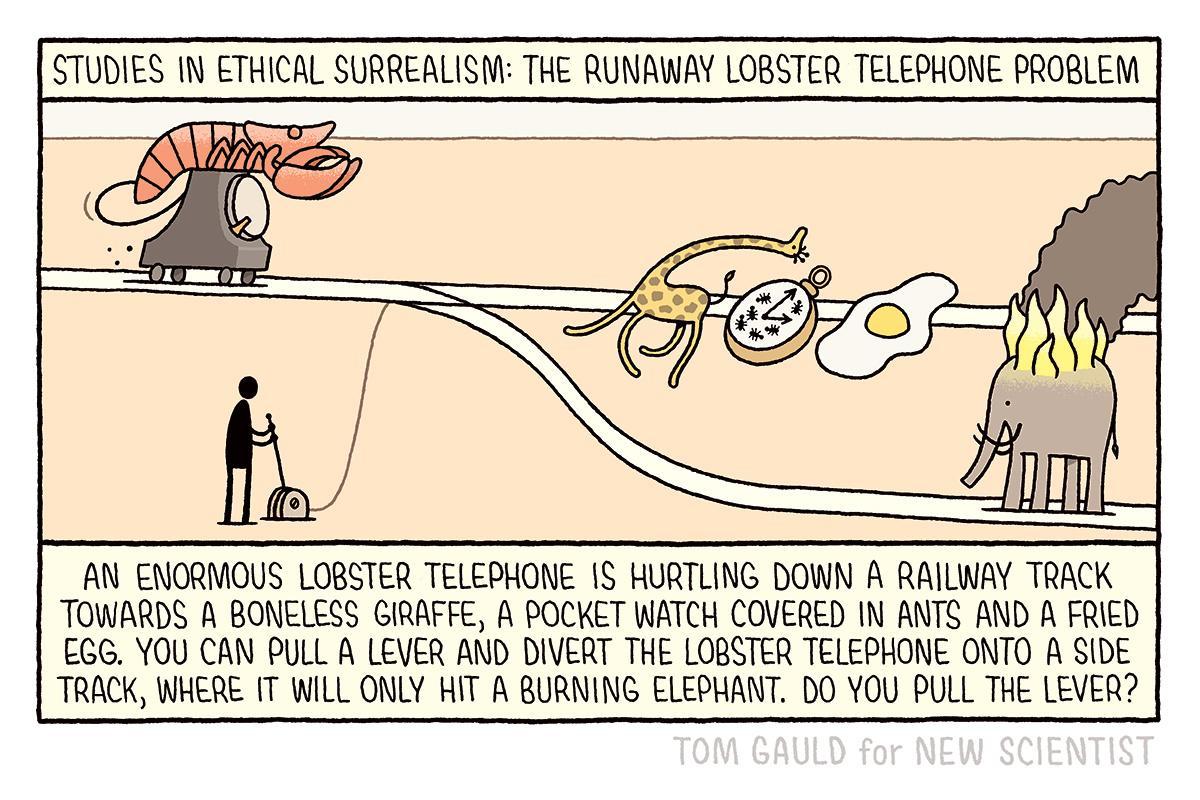
Tom Guald wants us to imagine a different trolly dilemma but with a different pair of options. Or is that the telephone game?

This image speaks for itself, so I won’t editorialise at the moment, save to mention that I find the scenario to be hilarious. If you like eating cooked lobster, I suppose that the elephant path makes the most sense—and of course, the elephant is already on fire.

What would you do?