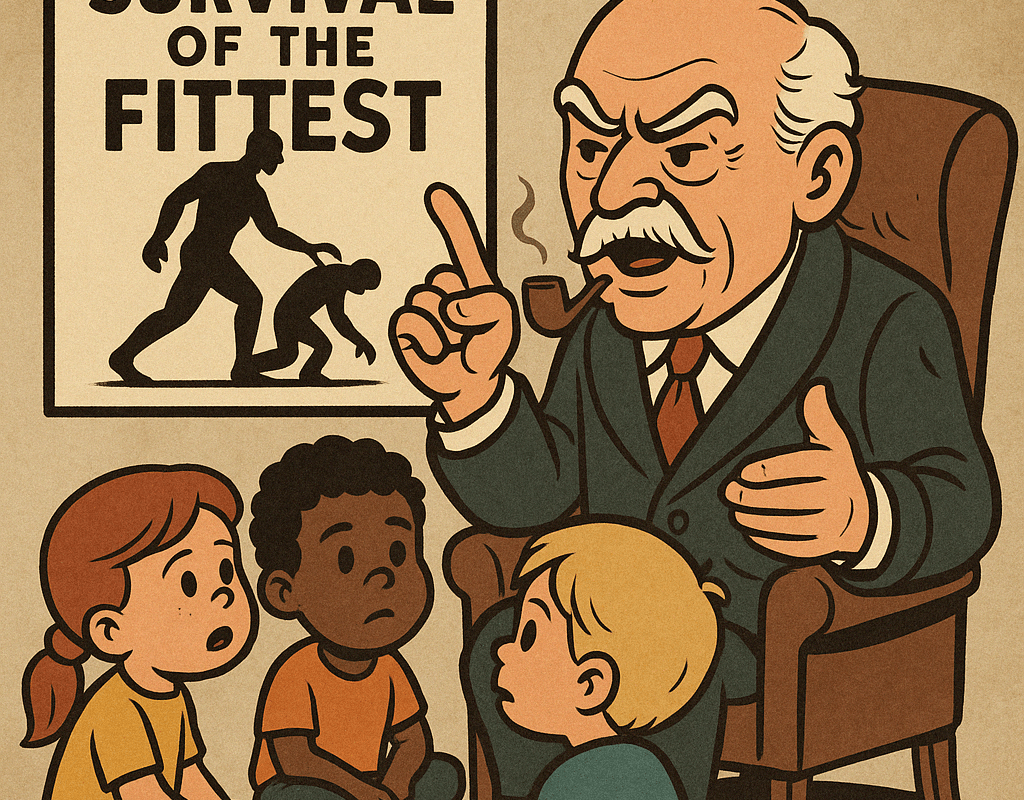
The Tyranny of “Human Nature”

There is a kind of political necromancy afoot in modern discourse—a dreary chant murmured by pundits, CEOs, and power-drunk bureaucrats alike: “It’s just human nature.” As if this incantation explains, excuses, and absolves all manner of violent absurdities. As if, by invoking the mystic forces of evolution or primal instinct, one can justify the grotesque state of things. Income inequality? Human nature. War? Human nature. Corporate psychopathy? Oh, sweetie, it’s just how we’re wired.

What a convenient mythology.

Audio: NotebookLM podcast on this topic.

If “human nature” is inherently brutish and selfish, then resistance is not only futile, it is unnatural. The doctrine of dominance gets sanctified, the lust to rule painted as destiny rather than deviance. Meanwhile, the quiet, unglamorous yearning of most people—to live undisturbed, to coöperate rather than conquer—is dismissed as naĂŻve, childish, and unrealistic. How curious that the preferences of the vast majority are always sacrificed at the altar of some aggressive minority’s ambitions.

Let us dispense with this dogma. The desire to dominate is not a feature of human nature writ large; it is a glitch exploited by systems that reward pathological ambition. Most of us would rather not be ruled, and certainly not managed by glorified algorithms in meat suits. The real human inclination, buried beneath centuries of conquest and control, is to live in peace, tend to our gardens, and perhaps be left the hell alone.

And yet, we are not. Because there exists a virulent cohort—call them oligarchs, executives, generals, kings—whose raison d’ĂŞtre is the acquisition and consolidation of power. Not content to build a life, they must build empires. Not content to share, they must extract. They regard the rest of us as livestock: occasionally troublesome, but ultimately manageable.

To pacify us, they offer the Social Contract™—a sort of ideological bribe that says, “Give us your freedom, and we promise not to let the wolves in.” But what if the wolves are already inside the gates, wearing suits and passing legislation? What if the protection racket is the threat itself?

So no, it is not “human nature” that is the problem. Cancer is natural, too, but we don’t celebrate its tenacity. We treat it, research it, and fight like hell to survive it. Likewise, we must treat pathological power-lust not as an inevitability to be managed but as a disease to be diagnosed and dismantled.

The real scandal isn’t that humans sometimes fail to coöperate. It’s that we’re constantly told we’re incapable of it by those whose power depends on keeping it that way.

Let the ruling classes peddle their myths. The rest of us might just choose to write new ones.

The Church of Pareto: How Economics Learned to Love Collapse

—or—How the Invisible Hand Became a Throttling Grip on the Throat of the Biosphere

As many frequent visitors know, I am a recovering economist. I tend to view economics through a philosophical lens. Here. I consider the daft nonsense of Pareto optimality.

Audio: NotebookLM podcast of this content.

There is a priesthood in modern economics—pious in its equations, devout in its dispassion—that gathers daily to prostrate before the altar of Pareto. Here, in this sanctum of spreadsheet mysticism, it is dogma that an outcome is “optimal” so long as no one is worse off. Never mind if half the world begins in a ditch and the other half in a penthouse jacuzzi. So long as no one’s Jacuzzi is repossessed, the system is just. Hallelujah.

This cult of cleanliness, cloaked in the language of “efficiency,” performs a marvellous sleight of hand: it transforms systemic injustice into mathematical neutrality. The child working in the lithium mines of the Congo is not “harmed”—she simply doesn’t exist in the model. Her labour is an externality. Her future, an asterisk. Her biosphere, a rounding error in the grand pursuit of equilibrium.

Let us be clear: this is not science. This is not even ideology. It is theology—an abstract faith-based system garlanded with numbers. And like all good religions, it guards its axioms with fire and brimstone. Question the model? Heretic. Suggest the biosphere might matter? Luddite. Propose redistribution? Marxist. There is no room in this holy order for nuance. Only graphs and gospel.

The rot runs deep. William Stanley Jevons—yes, that Jevons, patron saint of unintended consequences—warned us as early as 1865 that improvements in efficiency could increase, not reduce, resource consumption. But his paradox, like Cassandra’s prophecy, was fated to be ignored. Instead, we built a civilisation on the back of the very logic he warned would destroy it.

Then came Simon Kuznets, who—bless his empirically addled soul—crafted a curve that seemed to promise that inequality would fix itself if we just waited politely. We called it the Kuznets Curve and waved it about like a talisman against the ravages of industrial capitalism, ignoring the empirical wreckage that piled up beneath it like bones in a trench.

Meanwhile, Pareto himself, that nobleman of social Darwinism, famously calculated that 80% of Italy’s land was owned by 20% of its people—and rather than challenge this grotesque asymmetry, he chose to marvel at its elegance. Economics took this insight and said: “Yes, more of this, please.”

And so the model persisted—narrow, bloodless, and exquisitely ill-suited to the world it presumed to explain. The economy, it turns out, is not a closed system of rational actors optimising utility. It is a planetary-scale thermodynamic engine fuelled by fossil sunlight, pumping entropy into the biosphere faster than it can absorb. But don’t expect to find that on the syllabus.

Mainstream economics has become a tragic farce, mouthing the language of optimisation while presiding over cascading system failure. Climate change? Not in the model. Biodiversity collapse? A regrettable externality. Intergenerational theft? Discounted at 3% annually.

We are witnessing a slow-motion suicide cloaked in the rhetoric of balance sheets. The Earth is on fire, and the economists are debating interest rates.

What we need is not reform, but exorcism. Burn the models. Salt the axioms. Replace this ossified pseudoscience with something fit for a living world—ecological economics, systems theory, post-growth thinking, anything with the courage to name what this discipline has long ignored: that there are limits, and we are smashing into them at speed.

History will not be kind to this priesthood of polite annihilation. Nor should it be.