I’ve read about 85 per cent of James by Percival Everett. I recommend it. On the surface, it is simply a very good story set in the narrative universe of Mark Twain’s Huck Finn and Tom Sawyer. I will avoid spoilers as best I can.
The novel is set in the antebellum American South. James and the others move through Missouri, a state that openly supported slavery, and at one point into Illinois, a state that officially opposed it but quietly failed to live up to its own rhetoric. Illinois, it turns out, is no safe haven. Ideology and practice, as ever, are on speaking terms only when it suits them.
Audio: Short NotebookLM summary podcast of this content.
This is not a book review. I may write one later for my Ridley Park site once I’ve finished the book. What interests me here are two philosophical tensions Everett stages with remarkable economy.
There are two characters who are Black but able to pass as white. One of them feels profound guilt about this. He was raised as a slave, escaped, and knows exactly what it means to be treated as Black because he has lived it. Passing feels like theft. Survival, perhaps, but theft all the same.
The other is more unsettled. He was raised as a white man and only later discovers that he is not, as the language goes, “pure-bred”. This revelation leaves him suspended between identities. Should he now accept a Black identity he has never inhabited, or continue to pass quietly, benefitting from a system that would destroy him if it knew?
James offers him advice that is as brutal as it is lucid:
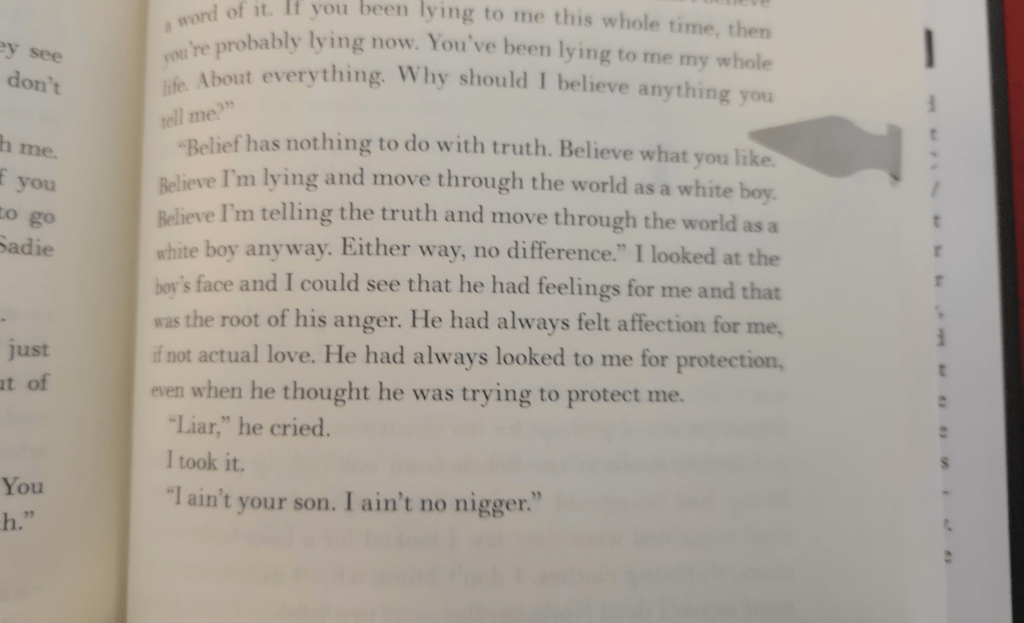
“Belief has nothing to do with truth. Believe what you like. Believe I’m lying and move through the world as a white boy. Believe I’m telling the truth and move through the world as a white boy anyway. Either way, no difference.”
This is the philosophical nerve of the book.
Truth, Everett suggests, is indifferent to belief. Belief does not mediate justice. It does not reorganise power. It does not rewire how the world responds to your body. What matters is not what is true, nor even what is believed to be true, but how one is seen.
The world does not respond to essences. It responds to appearances.
Identity here is not an inner fact waiting to be acknowledged; it is a surface phenomenon enforced by institutions, habits, and violence. The truth can be known, spoken, even proven, and still change nothing. The social machine runs on perception, not ontology.
In James, Everett is not offering moral comfort. He is stripping away a modernist fantasy: that truth, once revealed, obliges the world to behave differently. It doesn’t. The world only cares what you look like while moving through it.
Truth, it turns out, is perfectly compatible with injustice.
“What is up with us white people?” asks John Biewen in his TEDx talk The Lie That Invented Racism. It’s the sort of line that makes a roomful of middle-class liberals laugh nervously, because it’s the kind of question we’d rather leave to other people – preferably the ones already burdened with the consequences of our civilisational mess. But Biewen’s point, following Ibram X. Kendi, is that race is not some primordial fact, a tragic misunderstanding of melanin levels. It was invented, quite literally, by a Portuguese royal propagandist in the fifteenth century, and it has been paying dividends to “us” ever since.
Video: TEDx Talk with John Biewen
Yes, invented. Not discovered like a continent, not unearthed like a fossil, not deduced like a law of motion. Fabricated. Gomes de Zurara, a court chronicler under King Afonso V, was tasked with writing a stirring tale to justify Portugal’s shiny new business model: kidnapping Africans and selling them like cattle. Zurara obligingly lumped every tribe and tongue south of the Sahara into a single category – “the Blacks,” beastly and conveniently inferior – and thus performed the intellectual sleight of hand that would metastasise into centuries of racial taxonomy. It wasn’t science. It wasn’t reason. It was marketing.
And here lies the exquisite irony: this happened at the dawn of Modernity, that self-anointed Age of Reason. The Enlightenment’s sales pitch was universality – “all men are created equal,” etc. – but tucked in the fine print was the little caveat that “man” actually meant white, European, propertied man. Everyone else? Barbaric, uncivilised, or in need of civilising at the end of a whip. Modernity congratulated itself on escaping medieval superstition while simultaneously cooking up the most profitable superstition of all: that human worth can be ranked by pigmentation.
Audio: NotebookLM podcast discusses this topic.
This is why racism has proved so stubborn. If it were merely a misunderstanding, like thinking the Earth is flat, we’d have grown out of it. But racism was never about confusion; it was about utility. A well-tuned lie, weaponised to justify land theft, slavery, and empire, then codified into law, census, and property rights. As Kendi and others point out, race became the scaffolding for a political economy that had to square Christian salvation with chains and sugar plantations. Voilà: whiteness – not as an identity, but as a racket.
And yet, “good white people” (Dow’s term, delivered with that Minnesota-nice grimace) still act as though racism is a tragic but external drama: Black people versus hood-wearing villains, while we clap politely from the sidelines. But there are no sidelines. Whiteness was built to privilege us; neutrality is just complicity in better shoes. As historian Nell Irvin Painter reminds us, the Greeks thought they were superior, yes – but on cultural, not chromatic grounds. Race, as a concept, is a modern fix, not a timeless truth.
So what’s the moral? Stop romanticising the Enlightenment as though it were some grand emancipation. It was also a bureaucracy for inequality, a rationalisation engine that could make even human trafficking sound like a noble project. To dismantle racism is not to cleanse an ancient superstition but to tear out one of Modernity’s central operating systems.
The uncomfortable fact – the one Dow leaves hanging like smoke after the torch march – is this: if whiteness was invented for profit, then dismantling it is not philanthropy. It is debt repayment. And debt, as any bank will tell you, compounds with interest.
It’s not uncommon to label workers under the capitalist system as wage slaves.
As with the abolition of slavery in the United States, the future will one day recoil at Capitalism, wondering how humanity could ever have justified the exploitation of others for commerce and profit. Then again, that’s the same question, isn’t it?
As with the old story, a man asked a lady: “Would you be willing to sleep with me if I paid you £1,000,000?” Without hesitation, she answered, “Yes.” “And what if I only paid you £5?” The irate lady fumed: “£5? What do you think I am?” The man replied: “We’ve already established that. Now we’re trying to determine the degree.”
Capitalism is only a matter of degree from slavery. In practice, slavery is a Capitalist’s wet dream.
Reparations, Sovereignty, and the Enduring Legacy of Colonialism
The story of Indigenous peoples in the United States is a story of profound loss—loss of land, culture, and sovereignty. But perhaps the most painful and enduring losses are the broken promises: the hundreds of treaties signed in good faith and then systematically violated. These broken promises have not only left Native nations impoverished and disenfranchised but have also created a debt so immense that, by some estimates, it could run into the trillions if fully accounted for.
The Weight of Broken Treaties
From the earliest days of European settlement, treaties were used as a tool of diplomacy between the United States government and Native nations. These treaties, over 370 in total, were meant to secure peace, land agreements, and coexistence. In exchange, Native peoples were promised sovereign rights, land, and, crucially, compensation in the form of resources, healthcare, education, and protection. Yet, these promises were almost universally broken, often within years of being signed.
The true cost of these broken promises is impossible to measure in simple monetary terms.
The true cost of these broken promises is impossible to measure in simple monetary terms. Land, culture, and sovereignty are not commodities that can be easily priced. However, if one were to quantify the economic and material loss incurred by Native peoples—through stolen land, expropriated resources, and missed opportunities—the total would be staggering. Some estimates suggest the cost could run into the hundreds of billions if not trillions when factoring in centuries of economic injustice, treble damages, and interest.
Calculating Reparations: Land, Wealth, and Justice
Any serious discussion of reparations must start with the land. Native nations once held over 2 billion acres of land in what is now the United States, a vast expanse rich with natural resources. Through a series of coercive treaties, legislation, and outright theft, much of this land was lost, culminating in the General Allotment Act (or Dawes Act) of 1887, which further fragmented Native lands and opened millions of acres for white settlers.
Reparations would need to account for the value of this land and the resources extracted from it—timber, minerals, oil, gas, and agricultural produce
Reparations would need to account for the value of this land and the resources extracted from it—timber, minerals, oil, gas, and agricultural produce—that have enriched generations of non-Native Americans. The land itself is invaluable, not just in terms of its market price but as the foundation of Indigenous identity, culture, and sovereignty. The land is not only an economic asset but a spiritual and cultural one. In this context, mere monetary compensation seems inadequate.
However, if we were to calculate reparations based on these lost lands and resources, the numbers quickly skyrocket. Consider the Black Hills of South Dakota, illegally seized from the Lakota after the discovery of gold, despite an 1868 treaty guaranteeing their sovereignty over the region. The Lakota have refused financial compensation for the Black Hills, insisting instead on the return of the land. The value of the Black Hills alone, when adjusted for inflation and interest, would be immense. And this is just one example. If treble damages were applied—tripling the original valuation to account for the egregiousness of the theft—the total would become astronomical.
Interest on Injustice
A crucial factor in calculating reparations is the interest accrued over time. The land was not just taken, but taken centuries ago, meaning that any fair compensation would need to account for the economic opportunities missed due to that loss. Compounded interest, a financial mechanism commonly applied in lawsuits to reflect the time value of money, would exponentially increase the debt owed. This debt is not just economic but cultural, as the loss of land also meant the loss of a way of life.
Reparations could…easily run into the trillions.
Reparations could, therefore, easily run into the trillions. This is not merely hypothetical. In 1980, the U.S. Supreme Court ruled in United States v. Sioux Nation of Indians that the U.S. government had illegally taken the Black Hills, and the Sioux were entitled to compensation. The sum awarded was $106 million—today, with interest, that figure exceeds $1 billion. Yet the Sioux have refused the payment, demanding the return of their land instead. Their stance underscores the inadequacy of financial compensation for the cultural and spiritual dimensions of the loss.
Beyond Dollars: The Moral and Ethical Case for Reparations
While the financial dimension of reparations is essential, the moral and ethical dimensions are equally important. Reparations are not simply about writing a cheque; they are about justice. The broken treaties were not merely legal failures but moral failures, reflecting a systemic disregard for Native sovereignty and human dignity. The U.S. government’s persistent violations of treaties reveal a deep-rooted pattern of exploitation and dishonour that continues to reverberate through Native communities today.
broken treaties were not merely legal failures but moral failures
Reparations, in this broader sense, must include the return of lands, the restoration of cultural and political autonomy, and a fundamental rethinking of the relationship between Native nations and the U.S. government. The return of land—such as in the Land Back movement—is a critical component of this. Land is not only a material asset but a living connection to identity, tradition, and the future. Restoring land to Native nations would not only right historical wrongs but also empower them to rebuild their communities on their own terms.
The Political Challenge of Justice
Despite the moral clarity of the case for reparations, political challenges remain immense. Many Americans are unaware of the extent of Native dispossession or may see reparations as impractical or divisive. Yet, as the fight for racial justice has shown, justice is often uncomfortable. The fact that reparations would be costly, complex, and difficult is not an excuse to avoid the issue. If anything, it highlights how deep and enduring the injustice is.
Reparations are not a “handout” but a payment of a debt long overdue.
Reparations are not a “handout” but a payment of a debt long overdue. Native nations were once economically, politically, and culturally self-sufficient. The disruption of their societies, through land theft and broken treaties, is the root cause of the poverty, health disparities, and political marginalisation they face today. Addressing this requires more than just policy tweaks; it demands a fundamental reckoning with the past.
Conclusion: Trillions Owed, Promises to Keep
The reparations owed for centuries of broken treaties, stolen land, and unfulfilled promises are not simply about money but about honouring the sovereignty and humanity of Indigenous peoples. The debt is vast—financially, morally, and ethically—but it must be addressed if there is to be any hope for genuine reconciliation. Justice, long delayed, can no longer be denied. This underscores the larger point that the United States rarely follow through on their commitments, but this is a story for another day. Meantime, they’ll continue running roughshod over their people and the world, bullying their way through it.
Fast forward a century. The future’s looking back, not with nostalgia but with a critical eye. Will they see our age of capitalism as we see the era of slavery – a moral misstep, a societal blight?
2023: Here we are, knee-deep in capitalism. It’s everywhere, in every transaction, every ambition. But beneath the veneer of progress and prosperity, there’s a darker narrative unfolding.
Wage Slaves in a Modern World
Wage slavery is the reality for many in a capitalist system where survival hinges on selling labour. The concept? Simple yet brutal. People are chained not by physical shackles but by economic necessity, a cycle of paycheck-to-paycheck existence. It’s freedom, but only in the loosest sense.
The Surplus of Inequality
Wage surplus – the lifeblood of capitalism. The more you squeeze out of workers, the fatter the profits. It’s a game of numbers where human cost rarely figures. The working class toil, and the upper echelons reap the rewards. Sounds familiar? It’s a throwback to the days of slavery, just dressed in modern garb.
Capitalists’ Dark Fantasy
A state of slavery – every capitalist’s secret fantasy? Perhaps not all, but for the ruthless, it’s the ultimate dream. A world where workers are mere cogs in the machine, dispensable and replaceable. No rights, no voice, just endless labour for minimal reward.
The Capitalist Paradox
Here’s the paradox – capitalism, in theory, champions freedom and innovation. But in practice, it often veers towards oppression and exploitation. The gap between the haves and have-nots widens, and social mobility becomes a myth, reserved for fairy tales.
The Future’s Judgment
In 2123, will they shake their heads at our era? Will they wonder how we allowed economic systems to morph into modern-day slavery? How we sold our souls for the illusion of prosperity?
A Glimmer of Hope?
But the tide is turning. Voices of dissent are rising, challenging the status quo. The call for a fairer, more humane economic model grows louder. There’s hope yet that we’ll steer away from the shadow of capitalism’s excesses.
Conclusion
As the world spins on, we’re at a pivotal moment. Will we continue down this path, or will we pivot towards a more equitable future? The choices we make today will echo through the annals of history.
Call to Action
What’s your stance? Is capitalism veering too close to a modern form of slavery? Drop your thoughts below. Let’s ignite a dialogue.
Many places have histories of exploiting a group or groups to the advantage of others. Although this scenario applies to these people in a similar manner, I am thinking specifically of the exploitation and reparations due to the black and indigenous people of colour, BIPOC, in the United States.
I believe that many people are familiar with Monopoly, the board game where, among other things, one accumulates properties and extracts rents from the other players. My intent is to illustrate with Monopoly the need for reparations, to illustrate why reparations are necessary to restore justice. This is a twist on John Rawls’ veil of ignorance thought experiment.
Slave auction advertisement
I have heard some people say that the past is the past, or if there were injustices in the past, that was ages ago, and now everyone has an equal chance. No special accommodations or affirmative actions are necessary. I don’t agree that this is true, but let’s just say for the sake of this exposition that opportunities are equal for everyone in a given society.
There are parallels between a game of Monopoly and the way we are thrown into this world. No one differs in this regard. We are all subject to a loin lottery.
Imagine that I already own all of the properties. You own none. Irrespective of how the game came to this condition, your chances of winning are nil to none. Now imagine that the reason for the disparate ownership was the result of a system of injustice perpetrated by the player I inherited my position from on the player you inherited yours.
No matter how fairly the game is from now until the end, if your starting place leaves me with all of the property and you without, your chances of winning are slim to none. Favouring tradition and inheritance already benefits some people over others, but when the benefit is the result of a pattern of injustices, it feels more egregious. Worse yet, even if I ‘give’ you Whitechapel Road, Baltic Avenue, or Rue Lecourbe and keep the rest, your chances have only slightly improved.
With the end of US Civil War and the emancipation proclamation, affected blacks were promised 40 acres and a mule. For most, this never happened. This remains an outstanding debt. And whilst 40 acres in some places would be a boon, not many today really need a mule, so descendants of slaves need to be made whole. Reparations are a way to accomplish this.
Reparations are payments in arrears to attempt to compensate for the centuries of an unbalanced playing field. And reparations should allow you to recover more than Whitechapel, Baltic, or Rue Lecourbe properties. At least get Bond Street, Pennsylvania Avenue, or Boulevard des Capucines. If you’ve played Monopoly, you’ll understand that this is still not enough.
“Wage slavery is not the same as slavery, and this diminishes the experience of plantation slaves in the antebellum Southern US states” is a sentiment I’ve heard repeated over the years.
I’ll argue that it is the same. Saying wage slavery is like when the then-president of the United States, Bill Clinton, denied that oral sex was sex despite it being an obvious part of the name. When one says wage slavery is still slavery, s/he is making a commentary on the lack of agency, a lack of personal control. That the worker has a choice over which master to slave under is hardly a consolation. That a plantation slave has a choice of picking cotton or tobacco is of no consequence.
To disqualify wage slavery as slavery is to disqualify a 3-month pregnant woman as being not as pregnant as a 6-month pregnant woman. One might be closer to term, but they are equally pregnant.
That a plantation slave may have had less freedom and run the risk of physical beatings, torture, or even death is a sad commentary. That they may have separated from their families and have no autonomy is a matter of degree.
The slavery connexion occurs where the human needs to comply. Sure, a wage slave can opt out and live as a transient—ostensibly homeless; perhaps s/he can home-surf. Perhaps s/he can beg or live off the land.
Wage slavery is not the same as slavery
To me, the common missing element is to be able to operate as a functioning society, that as communities, we might contribute however we see fit. Of course, that narrative will quickly provoke an appeal to Tragedy of the Commons. People are selfish and act only in their own self-interests. And this is accepted uncritically as fact rather than evaluating whether this worldview is a consequence of Modernity or Capitalism, whichever nomenclature one has opted to adopt.
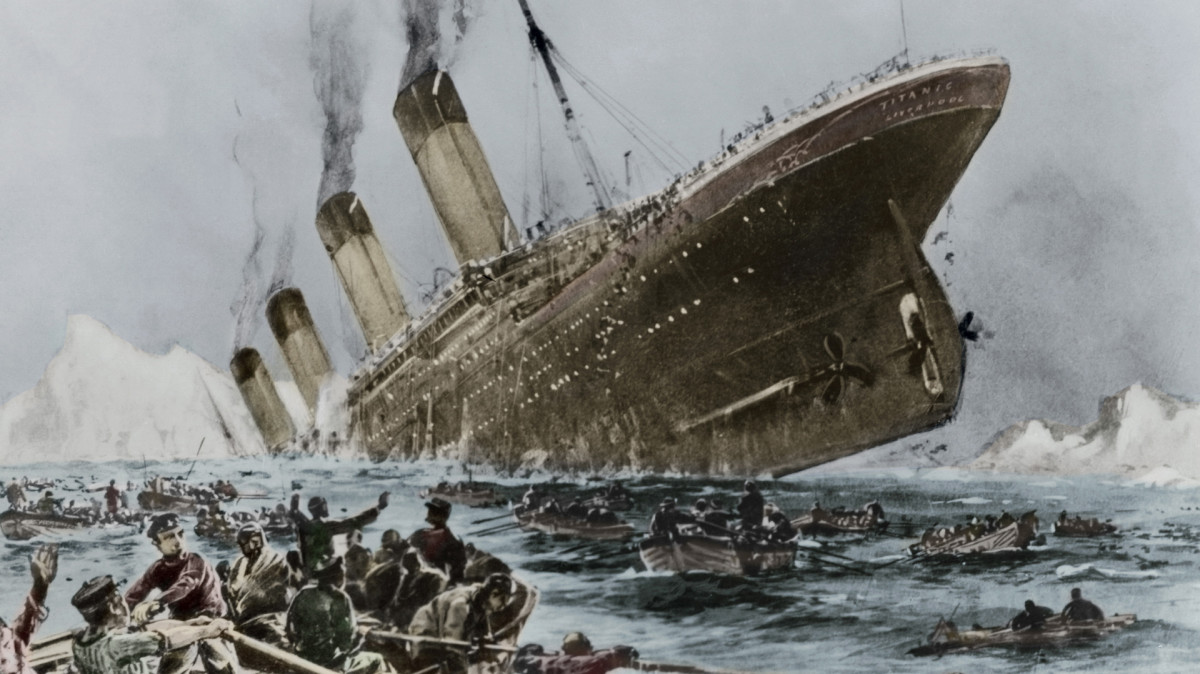
Wage slavery is slavery. Depending on the information source bout 50 per cent of Americans are a paycheque away from needing to deplete savings to survive; some have assessed a single paycheque from homelessness without intervention. One paycheque from poverty. Over two-thirds of Americans have been living paycheque-to-paycheque since the Covid-19 pandemic hit. If this describes you, it likely provides little solace that you are not alone. Who on the Titanic was relieved to know that other people shared their plight? Is there a silver lining for those who are paid fortnightly or monthly? And God forbid the ones whose paycheque arrive daily—perhaps in cash from the till.
Research from the Federal Reserve found that 4 in 10 Americans couldn’t afford a $400 emergency, and 22 per cent say they expect to forgo payments on some of their bills. It’s not much better in the UK, where the runway appears to end at 2.5 months rather than 1, although about two-thirds of renters would expect to make it more than a month.
Slavery, like turtles, all the way down. Just be thankful the worst that can happen is that one starves to death or pursues the life of Valjean. Dissociating wage slavery from plantation slavery is like separating the abbatoire from the butcher’s shop. When you’re the chattel it makes little difference.







 Philosophics