“Your Triggers Aren’t My Problem!”

…except, sometimes they are.

This came across my feed, the laminated wisdom of our times: Your triggers are your responsibility. It isn’t the world’s obligation to tiptoe around you. A phrase so crisp, so confident, it practically struts. You can imagine it on a mug, alongside slogans like Live, Laugh, Gaslight. These are the language games I love to hate.
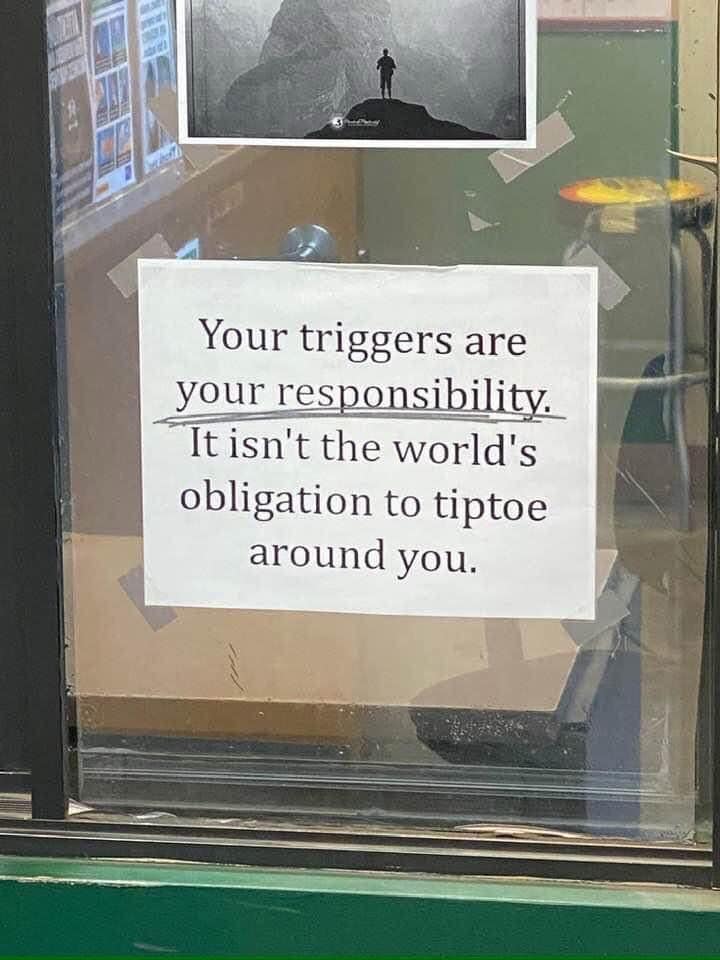
Now, there’s a certain truth here. Life is hard, and people aren’t psychic. We can’t reasonably expect the world to read our mental weather reports—50% chance of anxiety, rising storms of existential dread. In an adult society, we are responsible for understanding our own emotional terrain, building the bridges and detours that allow us to navigate it. That’s called resilience, and it’s a good thing.

Audio: NotebookLM Podcast on this topic.

But (and it’s a big but) this maxim becomes far less admirable when you scratch at its glossy surface. What does triggers even mean here? Because trigger is a shape-shifter, what I term Shrödinger’s Weasels. For someone with PTSD, a trigger is not a metaphor; it’s a live wire. It’s a flashback to trauma, a visceral hijacking of the nervous system. That’s not just “feeling sensitive” or “taking offence”—it’s a different universe entirely.

Yet, the word has been kidnapped by the cultural peanut gallery, drained of precision and applied to everything from discomfort to mild irritation. Didn’t like that movie? Triggered. Uncomfortable hearing about your privilege? Triggered. This semantic dilution lets people dodge accountability. Now, when someone names harm—racism, misogyny, homophobia, you name it—the accused can throw up their hands and say, Well, that’s your problem, not mine.

And there’s the rub. The neat simplicity of Your triggers are your responsibility allows individuals to dress their cruelty as stoic rationality. It’s not their job, you see, to worry about your “feelings.” They’re just being honest. Real.

Except, honesty without compassion isn’t noble; it’s lazy. Cruelty without self-reflection isn’t courage; it’s cowardice. And rejecting someone’s very real pain because you’re too inconvenienced to care? Well, that’s not toughness—it’s emotional illiteracy.

Let’s be clear: the world shouldn’t have to tiptoe. But that doesn’t mean we’re free to stomp. If someone’s discomfort stems from bigotry, prejudice, or harm, then dismissing them as “too sensitive” is gaslighting, plain and simple. The right to swing your fist, as the old adage goes, ends at someone else’s nose. Likewise, the right to be “brutally honest” ends when your honesty is just brutality.

The truth is messy, as most truths are. Some triggers are absolutely our responsibility—old wounds, minor slights, bruised egos—and expecting the world to cushion us is neither reasonable nor fair. But if someone names harm that points to a broader problem? That’s not a trigger. That’s a mirror.

So yes, let’s all take responsibility for ourselves—our pain, our growth, our reactions. But let’s also remember that real strength is found in the space where resilience meets accountability. Life isn’t about tiptoeing or stomping; it’s about walking together, with enough care to watch where we step.

Blinded by Bias: The Irony of Greed and Self-Perception

Greed is a vice we readily recognise in others but often overlook in ourselves. This selective perception was strikingly evident during a recent conversation I had with a man who was quick to condemn another’s greed while remaining oblivious to his own similar tendencies. I told him about the escalating greed of certain companies who profit greatly from selling their printer inks and toner brands. I’ll spare you this history. This encounter underscores the powerful influence of fundamental attribution bias on our judgments and self-awareness.

Exploring Greed

Greed can be defined as an intense and selfish desire for something, especially wealth, power, or food. Psychologically, it is considered a natural human impulse that, when unchecked, can lead to unethical behaviour and strained relationships. Societally, greed is often condemned, yet it persists across cultures and histories.

We tend to label others as greedy when their actions negatively impact us or violate social norms. However, when we aggressively pursue our interests, we might frame it as ambition or resourcefulness. This dichotomy reveals a discrepancy in how we perceive greed in ourselves versus others.

Understanding Fundamental Attribution Bias

Fundamental attribution bias, or fundamental attribution error, is the tendency to attribute others’ actions to their character while attributing our own actions to external circumstances. This cognitive bias allows us to excuse our behaviour while holding others fully accountable for theirs.

For example, if someone cuts us off in traffic, we might think they’re reckless or inconsiderate. But if we cut someone off, we might justify it by claiming we were late or didn’t see them. This bias preserves our self-image but distorts our understanding of others.

The Conversation

Our conversation was centred on an HP printer that has shown a ‘low ink – please replace’ message since the cartridge was first installed. I recounted the history of the ink and toner industry. HP had a monopoly on ink for their products, a situation that earned them substantial marginal profits. Upstarts entered the marketplace. This started an escalating arms war. HP spent R&D dollars trying to defend their profit margins with nil benefit to the consumers of their product. In fact, it kept costs artificially higher. Competitors who wanted a slice of those fat margins found ways around these interventions. Eventually, HP installed chips on their toner cartridges. Unfortunately, they have a bug – or is it a feature? If you install a cartridge and remove it, it assumes you’re up to something shady, so it spawns this false alert. Some people believe this out of hand, so HP benefits twice.

If this bloke had worked for HP and had been responsible for revenue acquisition and protection, he would have swooned over the opportunity. Have no doubt. At arm’s length, he recognised this as sleazy, unethical business practices.

This conversation revealed how easily we can fall into the trap of judging others without reflecting on our own behaviour. His indignation seemed justified to him, yet he remained unaware of how his actions mirrored those he criticised.

Biblical Reference and Moral Implications

This situation brings to mind the biblical passage from Matthew 7:3-5:

“Why do you look at the speck of sawdust in your brother’s eye and pay no attention to the plank in your own eye? … You hypocrite, first take the plank out of your own eye, and then you will see clearly to remove the speck from your brother’s eye.”

The verse poignantly captures the human tendency to overlook our flaws while magnifying those of others. It calls for introspection and humility, urging us to address our shortcomings before passing judgment.

The Asymmetry of Self-Perception

Several psychological factors contribute to this asymmetry:

  • Self-Serving Bias: We attribute our successes to internal factors and our failures to external ones.
  • Cognitive Dissonance: Conflicting beliefs about ourselves and our actions create discomfort, leading us to rationalize or ignore discrepancies.
  • Social Comparison: We often compare ourselves favourably against others to boost self-esteem.

This skewed self-perception can hinder personal growth and damage relationships, as it prevents honest self-assessment and accountability.

Overcoming the Bias

Awareness is the first step toward mitigating fundamental attribution bias. Here are some strategies:

  1. Mindful Reflection: Regularly assess your actions and motivations. Ask yourself if you’re holding others to a standard you’re not meeting. Riffing from ancient moral dictates, just ask yourself if this is how you would want to be treated. Adopt Kant’s moral imperative framework.
  2. Seek Feedback: Encourage honest input from trusted friends or colleagues about your behaviour.
  3. Empathy Development: Practice seeing situations from others’ perspectives to understand their actions more fully.
  4. Challenge Assumptions: Before making judgments, consider external factors that might influence someone’s behaviour.

By actively recognising and adjusting for our biases, we can develop more balanced perceptions of ourselves and others.

Conclusion

The irony of condemning in others what we excuse in ourselves is a common human pitfall rooted in fundamental attribution bias. The adage, ‘Know thyself’ might come into view here. We can overcome these biases by striving for self-awareness and empathy, leading to more authentic relationships and personal integrity.

Where to Start?

At the beginning, of course. As I’ve embarked on this anti-agency (working title) endeavour, I am uncovering people and ideas previously unknown. In a way, this is good because people have been here before. In another way, I am left wondering what’s left unsaid.

For one thing, some of these people are highly credentialled scholars, more well-read with substantial head starts. And intelligent, qualified experts stake out their own respective turf. The more I read, the more I see the path has already been cut. Untamed areas still exist—at least for now. My goal from the start is to ignore the larger pseudo-problem anyway, so let them have their territory.

As I see it, my obstacle is one of rhetoric. My foundation is hardly a crowd-pleaser.

As I shared in my Agency Be Damned post,

  1. Humans have no material agency
  2. Power structures require the presumption of agency

Not too bad, but as I’ve shared even earlier,

  1. people are intellectually pretty unremarkable and
  2. predictably irrational

This isn’t going to be attractive to the warm and fuzzy crowd, and it comes across as a pretentious elitist and condescending irrespective of the validity of the observation. And people don’t like to be told that their baby is ugly—let alone themselves.

Ostensibly, my claim is that humans are veritable automatons too dim to be bounded to any moral code. We’re all just pawns, and any semblance of autonomy is either an illusion or not materially significant.

You are 0.00001% responsible for your actions,
so you deserve 100% of the blame or credit

You are 0.00001% responsible for your actions, so you deserve 100% of the blame or credit. Maybe this has no legs and will go nowhere. Time will tell. Meantime, I need to focus on the rhetoric and packaging and position it like a Trojan horse.