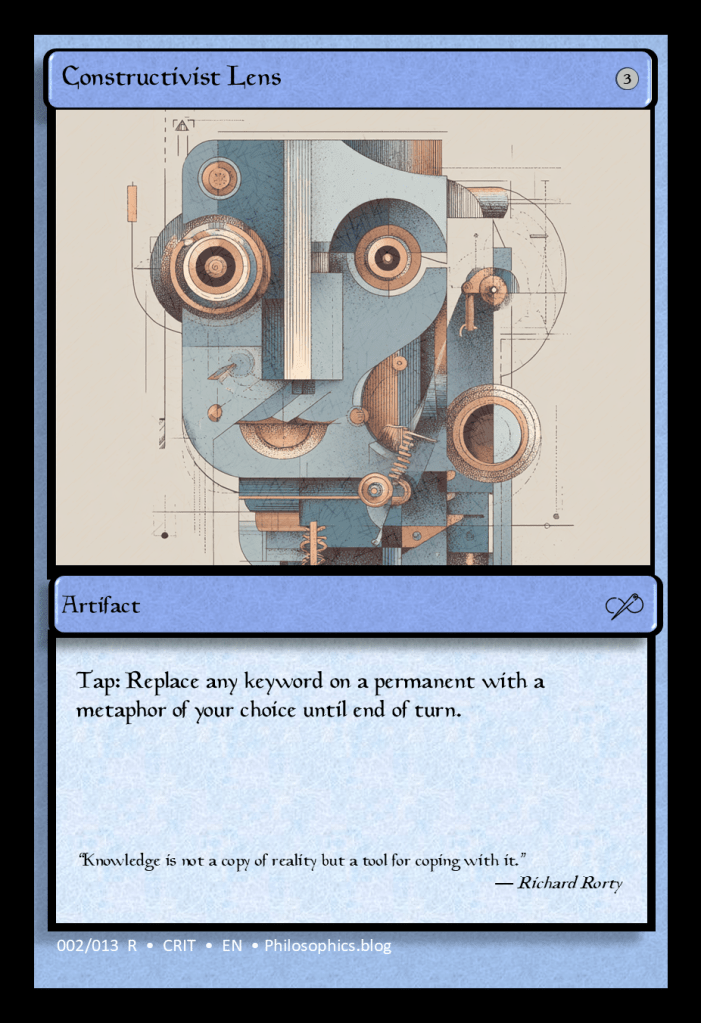
Another faux Magic: The Gathering trading card. I’ve been busy writing an essay on Tatterhood and wondering if I’ve gone off the edge even further into mental masturbation. I made these cards to share on slow news days, as it were.
[EDIT: Oops: Even wore. I already posted something today. Enjoy the bonus post.]
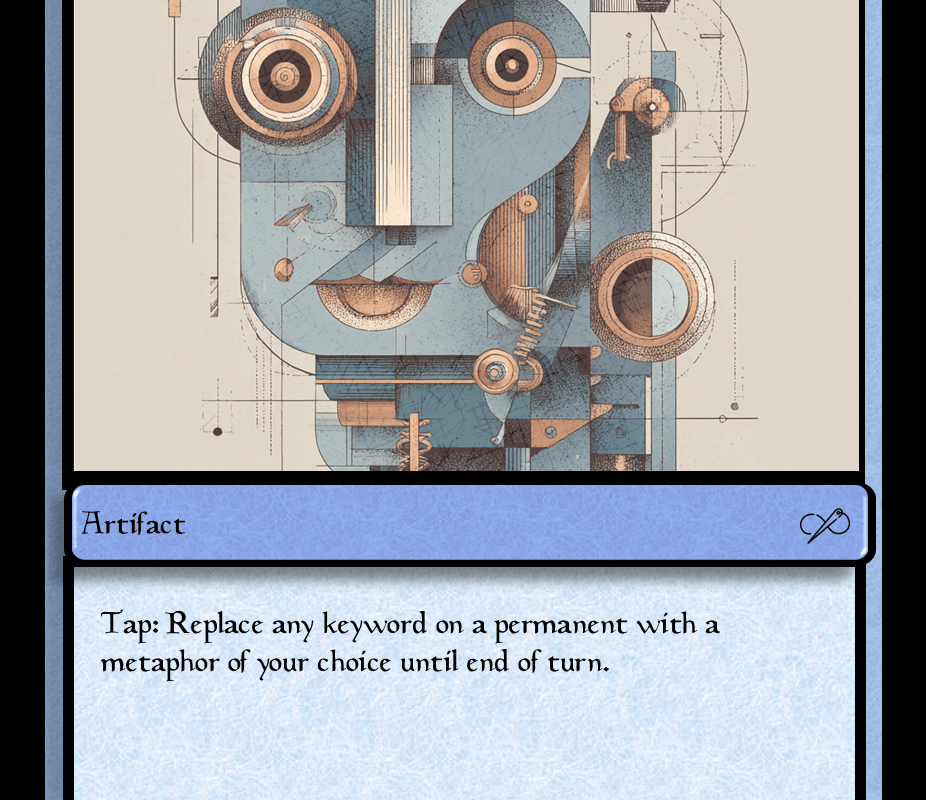
Every philosopher dreams of a device that reveals ‘truth’. The Constructivist Lens does the opposite. When you tap it, the world doesn’t come into focus – it multiplies. Each pane shows the same thing differently, reminding us that knowing is always a form of making – seeing as building.
In The Discipline of Dis-Integration, I wrote that philosophy’s task is ‘to remain within what persists … to study the tension in the threads rather than weave a new pattern’. The Lens embodies that ethic. It is not an instrument of discovery but of disclosure: a way to notice the scaffolding of perception without mistaking it for bedrock.
Flavour text: “Knowledge is not a copy of reality but a tool for coping with it.” — Richard Rorty
Where Enlightenment optics promised clarity, the Lens trades in parallax. It insists that perspective is not a flaw but the condition of vision itself. Each player who peers through it – artist, scientist, moralist – constructs a different coherence, none final. The card’s rule text captures this tension: replace any keyword on a permanent with a metaphor of your choice until end of turn. Reality bends, language shifts, yet the game continues.
In the Dis-Integration set, the Lens sits alongside Perspectival Realism and Language Game (not yet shared), forming the Blue triad of epistemic doubt. Together they dramatise what the essay calls ‘the hyphen as hinge’: the small pause between integration and its undoing. The Constructivist Lens, then, is not a tool for clearer sight but a reminder that every act of seeing is already an act of construction.
I just finished the writing and editorial parts of my Language Insufficiency Hypothesis. It still needs cover art and some administrative odds and ends, but I’m taking a day for a breather to share something about myself and my worldview. For this, I share my philosophical influences and how they support my core insights. For dramatic effect, I’ll even try to weight them to 100 per cent, leaving an ‘others’ bucket for the unaccounted ones.
Audio: NotebookLM summary podcast of this topic.
Obviously, this highly scientific accounting is about as useful as a Facebook survey or a fortune cookie, but it should reveal something. I have influences outside of philosophy, but I’ll limit this list at the start. The numbers don’t exactly add to 100% because there is a bit of cross-pollination, say, between Foucault and Nietzsche or Žižek and Hegel – or perhaps I’m just not good at maths. You decide.
Nietzsche (≈18)
Nietzsche is likely the uranium core. Haters and detractors like to diminish his contribution – and he didn’t play by the old rules – but they are wrong. He contributes value-creation, anti-moralism, perspectivism, the critique of ressentiment, the demolition of universals.
Nietzsche sits at the centre of the blast radius. Everything else is shrapnel. If there’s a thinker who detonated the Enlightenment’s pretensions more elegantly, I’ve not met them. He showed us that values are forged, not found; that morality is a genealogy of grievances; that certainty is the last refuge of the timid. In other words, he cleared the ground so the rest of us could get to work without tripping over Kantian furniture. But after Nietzsche’s uranium core, the next concentric ring becomes murkier.
Foucault (≈20%)
Foucault supplies the schematics. Where Nietzsche swung a hammer at the idols, Foucault identified the building codes. He mapped power as a set of subtle, everyday enchantments. He showed how ‘knowledge’ is simply what a society rewards with credibility. He is the patron saint of anyone who suspects normality is an instrument, not a neutral state of affairs. The world looks different once you see the disciplinary fingerprints on everything.
Derrida (≈10%)
Derrida gives me language as mischief. Meaning wobbles, slides, cracks; binaries betray themselves; every conceptual edifice contains its own trapdoor. Derrida isn’t a system; he’s an escape artist. And frankly, you can’t write anything about the insufficiency of language without genuflecting in his general direction.
Late Wittgenstein (≈15%)
The quiet structural pillar. If Derrida is the saboteur, Wittgenstein is the carpenter who informs you that the house was never stable anyway. Meaning-as-use, language-games, the dissolution of philosophical pseudo-problems: his later work underwrites virtually every modern suspicion about fixed categories and timeless essences. He doesn’t shout; he shrugs – and everything collapses neatly.
Rorty (≈5%)
Rorty replaces metaphysical longing with cultural pragmatism. He teaches you to stop hunting for capital-T Truth and instead track the vocabularies we actually live in. He’s the friendly voice whispering, ‘You don’t need foundations. You need better conversations’. His influence is felt mostly in the tone of my epistemic cynicism: relaxed rather than tragic. Besides, we disagree on the better conversations bit.
Geuss (≈4%)
If Rorty makes you light-footed, Geuss reminds you not to float off into abstraction entirely. He is the critic of moralism par excellence, the man who drags philosophy kicking and screaming back into politics. Geuss is the voice that asks, ‘Yes, but who benefits?’ A worldview without him would be a soufflé.
Heidegger (≈6%)
Selective extraction only. Being-in-the-world, thrownness, worldhood – the existential scaffolding. His political judgment was catastrophic, of course, but the ontological move away from detached subjectivity remains invaluable. He gives the metaphysics a certain grain.
Existentialists: Beauvoir, Sartre, Camus (≈6%)
They provide the atmospheric weather: choice, finitude, absurdity, revolt, the sheer mess of human freedom. They don’t define the system; they give it blood pressure. Besides, I met them before I switched to Team Nietzsche-Foucault.
Žižek, Latour, Baudrillard (≈2% combined)
These three are my licensed provocateurs.
Žižek exposes how ideology infiltrates desire.
Latour dismantles the Nature/Society binary with glee.
Baudrillard whispers that representation ate reality while we were looking at our phones.
They’re trickster figures, not architects.
Hume, Putnam, Dennett, and the Ancillaries (≈1% combined)
These are the seasonings.
Hume is the Scottish acid bath under every epistemic claim.
Putnam gives internal realism its analytic passport.
Dennett offers mechanistic metaphors you can steal even when you disagree.
Kant and Hegel hover like compulsory ghosts.
Rawls remains decorative parsley: included for completeness, consumed by none.
The Others Bucket (≈5%)
The unallocated mass: writers, anthropologists, theorists, stray thinkers you absorb without noticing. The ‘residuals’ category for the philosophical inventory – the bit fortune cookies never warn you about.
Enfin
Obviously, these ratios are more for humour than substance, but these are the thinkers I return to — the ones whose fingerprints I keep discovering on my own pages, no matter how many years or detours intervene.
Perhaps more revealing are those who didn’t make the guest list. Socrates, Plato, and Aristotle remain outside, smoking in the cold. The Stoics, Marcus Aurelius and his well-meaning self-help descendants, also failed to RSVP. In truth, I admire the posture but have little patience for the consolations – especially when they become the emotional training wheels of neoliberalism.
And then, of course, the Enlightenment patriarchs: Hobbes, Locke, Montesquieu and the rest of the constitutional furniture. I acknowledge their historical necessity the way one acknowledges plumbing – grateful it exists, uninterested in climbing inside the pipes. Rousseau, admittedly, I tolerate with something approaching affection, but only because he never pretended to be tidy.
I forgot Descartes, Voltaire, and Pascal, but it’s too late to scroll back and adjust the ledger. Consider them rounding errors – casualties of the margins, lost to the tyranny of percentages.
If anyone mentions another one – Spinoza comes to mind – I’ll try to figure out where they fit in my pantheon. Were I to render this tomorrow, the results may vary.
When drawn, this card alters perception itself. It reminds the player that truth is not something one finds under a rock but something one polishes into shape. Each metaphor becomes a spell; each keyword a crutch thrown aside.
Those who wield the Constructivist Lens see not “facts,” but fictions so useful they forgot to call them that. Reality wobbles politely to accommodate belief.
“Knowledge is not a copy of reality but a tool for coping with it.” — Richard Rorty
In game terms: Tap to reframe existence as interpretation. Duration: until the next disagreement.
I’ve just published Objectivity Is Illusion: An Operating Model of Social and Moral Reasoning, an essay that began as this blog post. I’m sharing the ‘official’ link and this first draft. As the essay matured, I added additional support, but I focused primarily on refuting the anticipated opposing arguments. Rather than regurgitate the final version here, I felt showing the genesis would be more instructive. Of course, the essay didn’t spring fully formed; I’ve pruned and expanded from earlier notes still sitting on my hard drive.
Every so often, I’m told I’m too slippery with words, that I treat truth as if it were just another game of persuasion, that I reduce morality to chalk lines on a playing field. The objection usually comes with force: ‘But surely you believe some things are objectively true?‘
I don’t. Or more precisely, I don’t see how ‘objectivity’ in the metaphysical sense can be defended without lapsing into stagecraft. Granite foundations have always turned out to be scaffolding with the paint touched up. Priests once told us their gods guaranteed truth; scientists later promised the lab would serve as granite; politicians assure us democracy is the stone pillar. But in each case the creaks remain.
Audio: NotebookLM podcast on this topic.
This essay is written with an academic readership in mind. It assumes familiarity with figures like Nietzsche, Foucault, Rorty, and Ayer, and with the long quarrel over subjectivity, relativity, and objectivity. My aim is not to retell those arguments from the ground up, but to position my own framework within that ongoing dispute.
Scope
Before proceeding, some guardrails. When I say ‘objectivity is illusion,’ I mean in the social and moral domain. I’m not denying quarks or mathematics. My claim is narrower: in human discourse, no truth escapes subjectivity or contingency.
This dovetails with my broader Language Insufficiency Hypothesis: that even our words are leaky vessels, prone to misfire and misunderstanding. If language itself is unstable ground, then objectivity built upon it can hardly be granite. My claim here is not that nothing exists outside us, but that in the social world we inhabit together, every ‘truth’ rests on creaking boards.
One more note: just because social administration requires appeals to objectivity doesn’t mean objectivity exists. Courts, laboratories, and parliaments invoke it to secure trust, and it works well enough as theater. But necessity is not proof. And it is not my responsibility to conjure a granite replacement. What follows is an operating model, not a new altar.
Thesis
Objectivity is an illusion. Truth is rhetorical. Morality is prescriptive, not propositional. Our ethic is not granite but care: tending the planks we walk on, knowing they creak.
Operating Model: Five Premises
This framework is not a foundation. It is an operating model – contingent, provisional, subject to revision as circumstances change. Like any model, it can (and should) be updated to fit the culture and times.
Premise 1: Subjectivity is the baseline. Every claim originates in a perspective. No statement is free of the lens through which it is made. Even to deny subjectivity is to speak from a subject.
Premise 2: Relativity is emergent. What we call ‘relative truth’ is not a separate category but the convergence of individual subjectivities into provisional consensus. Consensus is never neutral: it is formed rhetorically – through persuasion, cultural resonance, and power [1]. MacIntyre made a similar point in After Virtue. The moral consensus of the Ancients was not grounded in objectivity but in a shared tradition – a thick account of human flourishing that gave coherence to their claims. When that scaffolding collapsed, consensus fractured, leaving modern moral discourse in fragments. Critics accused MacIntyre of relativism, since different traditions yield different ‘truths’, but his point reinforces mine: what looks like objectivity is in fact the temporary overlap of subjectivities sustained by tradition [2].
Premise 3: Objectivity is illusion. Claims presented as objective are relative norms hardened by repetition and forgotten as contingent scaffolding. ‘Objectivity’ is consensus disguised as granite. Its invocation in courts or parliaments may be useful, but usefulness is not existence. The burden of proof belongs to anyone insisting on an independent, metaphysical anchor for moral or social truths (Nietzsche’s ‘mobile army of metaphors’ [3], Kuhn’s paradigms [4], Latour’s laboratories [5]).
Even if one concedes, with Weber (as MacIntyre reminds us), that objective moral truths might exist in principle, they remain inaccessible in practice. What cannot be accessed cannot guide us; reconciliation of values and virtues must therefore take place within traditions and rhetoric, not in appeal to unreachable granite [13].
Premise 4: Rhetoric establishes truth. What counts as ‘true’ in the social and moral domain is established rhetorically – through coherence, resonance, utility, or force. This does not mean truth is ‘mere spin’. It means truth is never metaphysical; it is enacted and enforced through persuasion. If a metaphysical claim convinces, it does so rhetorically. If a scientific claim holds, it does so because it persuades peers, fits the evidence, and survives testing. In short: rhetoric is the medium through which truths endure [6].
Premise 5: Non-Cognitivism, Stated Plainly. I take moral utterances to be prescriptions, not propositions. When someone says ‘X is wrong’, they are not reporting an objective fact but prescribing a stance, a rule, a line in chalk. This is my operating position: non-cognitivism (Ayer [7], Stevenson [8]).
That said, I know the term feels alien. Many prefer the dialect of subjectivism – ‘X is true-for-me but not-for-you’ – or the quasi-realist stance that moral language behaves like truth-talk without cosmic backing (Blackburn [9]). I have no quarrel with these translations. They name the same scaffolding in different accents. I am not defending any school as such; I am simply stating my plank: morality prescribes rather than describes.
Ethic: Care. Since scaffolding is all we have, the obligation is not to pretend it is stone but to keep it usable. By ‘care’, I do not mean politeness or quietism. I mean maintenance – deliberation, repair, mutual aid, even revolt – so long as they acknowledge the scaffolding we share. Care is not optional: stomp hard enough and the floor collapses beneath us all.
Examples clarify: peer review in science is care in action, patching leaky vessels rather than proving granite. Civil rights movements practiced care by repairing rotten planks of law, sometimes with revolt. Communities rebuilding after disaster embody care by reconstructing scaffolding, not pretending it was indestructible. Care is maintenance, reciprocity, and survival.
Bridge: These five premises do not add up to a system or a foundation. They form an operating model: subjectivity as baseline, relativity as emergent, objectivity as illusion, rhetoric as truth, morality as prescription. Together they outline a practice: walk the planks with care, admit the creaks, patch where needed, and stop pretending we live in marble halls.
Rationale
Why prefer scaffolding to granite? Because granite has always been a mirage. The history of philosophy and politics is a history of crumbling temples and collapsing empires. The promises of permanence never survive the weather.
Think of Nietzsche, who called truths ‘a mobile army of metaphors’ [3]. Think of Foucault, who showed that what counts as ‘truth’ is always bound up with power [1]. Think of Rorty, who reduced truth to what our peers let us get away with saying [6]. These are not nihilists but diagnosticians: they exposed the creaks in the floorboards and the wizard behind the curtain.
Metaphors drive the point home:
Scaffolding and granite: What holds is temporary, not eternal. Granite is an illusion painted on timber.
Chalk lines: Rules of play – binding, real, but contingent. They can be redrawn.
Shoreline houses: Rome, the USSR, the British Empire – each built like beachfront villas with a fine view and bad footing. Storms came, sand eroded, and down they went.
Bias as framing: Kahneman himself admitted ‘bias’ is not a thing in the world [10], only a deviation from a chosen model. Gigerenzer [11] and Jared Peterson [12] remind us heuristics are adaptive. To call them ‘biases’ is not neutral – it’s allegiance to a standard of rationality.
The point is simple: what holds today is scaffolding, and pretending otherwise is self-deception.
Counterarguments and Refutations
Objection: Moral Paralysis. Without objective morality, why abolish slavery or defend rights?
Refutation: Chalk lines still bind. Speed limits aren’t cosmic, but they regulate conduct. Abolition endured not because it tapped a cosmic truth but because it persuaded, resonated, and took root. Slavery was once ‘in bounds’. Now it is ‘offsides’. That shift was rhetorical, emotional, political – but no less binding.
Objection: Problem of Dissent. If all is subjective, the lone dissenter is ‘just another voice’.
Refutation: Dissent gains traction through coherence, predictive success, or resonance. Galileo, abolitionists, suffragists – none relied on metaphysical granite. They persuaded, they resonated, they moved chalk lines. Truth was made through rhetoric, not uncovered in stone.
Objection: Performative Dependency. Even to say ‘subjective’ assumes the subject/object split. Aren’t you still inside the house?
Refutation: Of course. But I’m the one pointing at the slippery boards: ‘Mind the dust’. Yes, I’m in the house. But I refuse to pretend it’s marble. And even the category ‘subject’ is not eternal – it’s porous, dynamic, and leaky, just like language itself.
Objection: Infinite Regress. Why stop at subjectivity? Why not de-integrate further?
Refutation: Subjectivity is not granite, but it is the last plank before void. Peel it back and you erase the possibility of claims altogether. If tomorrow we discover that the ‘subject’ is a swarm of quarks or circuits, fine – but the claim still emerges from some locus. Regression refines; it doesn’t disprove.
Conclusion: The Ethic of Care
This is not reintegration. It is dis-integration: naming the creaks, stripping polyvinyl from rotten boards, refusing granite illusions.
If you wish to build here, build. But know the ground shifts, the storms come, the shoreline erodes. The ethic is not certainty but care: to tend the scaffolding we share, to patch without pretending it is stone, and to let dissent itself become part of the maintenance.
“Truths are illusions which we have forgotten are illusions.” — Nietzsche
Declaring the Problem
Most people say truth as if it were oxygen – obvious, necessary, self-evident. I don’t buy it.
Nietzsche was blunt: truths are illusions. My quarrel is only with how often we forget that they’re illusions.
Most people say truth as if it were oxygen – obvious, necessary, self-evident. I don’t buy it.
My own stance is unapologetically non-cognitivist. I don’t believe in objective Truth with a capital T. At best, I see truth as archetypal – a symbol humans invoke when they need to rally, persuade, or stabilise. I am, if you want labels, an emotivist and a prescriptivist: I’m drawn to problems because they move me, and I argue about them because I want others to share my orientation. Truth, in this sense, is not discovered; it is performed.
The Illusion of Asymptotic Progress
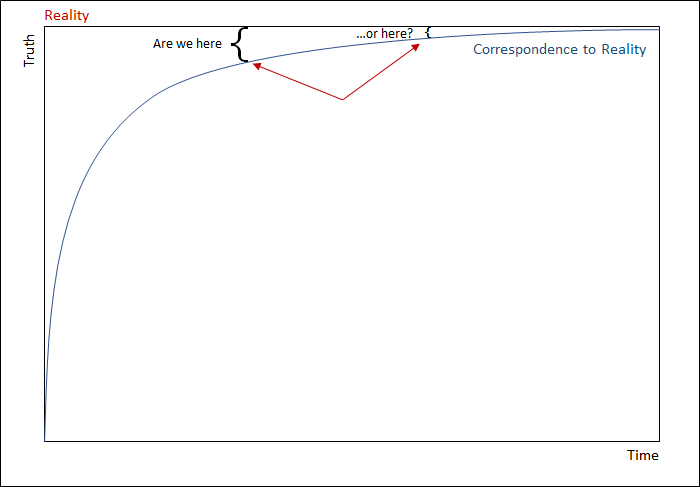
The standard story is comforting: over time, science marches closer and closer to the truth. Each new experiment, each new refinement, nudges us toward Reality, like a curve bending ever nearer to its asymptote.
Chart 1: The bedtime story of science: always closer, never arriving.
This picture flatters us, but it’s built on sand.
Problem One: We have no idea how close or far we are from “Reality” on the Y-axis. Are we brushing against it, or still a light-year away? There’s no ruler that lets us measure our distance.
Problem Two: We can’t even guarantee that our revisions move us toward rather than away from it. Think of Newton and Einstein. For centuries, Newton’s physics was treated as a triumph of correspondence—until relativity reframed it as local, limited, provisional. What once looked like a step forward can later be revealed as a cul-de-sac. Our curve may bend back on itself.
Use Case: Newton, Einstein, and Gravity Take gravity. For centuries, Newton’s laws were treated as if they had brought us into near-contact with Reality™—so precise, so predictive, they had to be true. Then Einstein arrives, reframes gravity not as a force but as the curvature of space-time, and suddenly Newton’s truths are parochial, a local approximation. We applauded this as progress, as if our asymptote had drawn tighter to Reality. But even Einstein leaves us with a black box: we don’t actually know what gravity is, only how to calculate its effects. Tomorrow another paradigm may displace relativity, and once again we’ll dutifully rebrand it as “closer to truth.” Progress or rhetorical re-baptism? The graph doesn’t tell us.
Chart 2: The comforting myth of correspondence: scientific inquiry creeping ever closer to Reality™, though we can’t measure the distance—or even be sure the curve bends in the right direction.
Thomas Kuhn was blunt about this: what we call “progress” is less about convergence and more about paradigm shifts, a wholesale change in the rules of the game. The Earth does not move smoothly closer to Truth; it lurches from one orthodoxy to another, each claiming victory. Progress, in practice, is rhetorical re-baptism.
Most defenders of the asymptotic story assume that even if progress is slow, it’s always incremental, always edging us closer. But history suggests otherwise. Paradigm shifts don’t just move the line higher; they redraw the entire curve. What once looked like the final step toward truth may later be recast as an error, a cul-de-sac, or even a regression. Newton gave way to Einstein; Einstein may yet give way to something that renders relativity quaint. From inside the present, every orthodoxy feels like progress. From outside, it looks more like a lurch, a stumble, and a reset.
Chart 3: The paradigm-gap view: what feels like progress may later look like regression. History suggests lurches, not lines, what we call progress today is tomorrow’s detour..
If paradigm shifts can redraw the entire map of what counts as truth, then it makes sense to ask what exactly we mean when we invoke the word at all. Is truth a mirror of reality? A matter of internal coherence? Whatever works? Or just a linguistic convenience? Philosophy has produced a whole menu of truth theories, each with its own promises and pitfalls—and each vulnerable to the same problems of rhetoric, context, and shifting meanings.
The Many Flavours of Truth
Philosophers never tire of bottling “truth” in new vintages. The catalogue runs long: correspondence, coherence, pragmatic, deflationary, redundancy. Each is presented as the final refinement, the one true formulation of Truth, though each amounts to little more than a rhetorical strategy.
Correspondence theory: Truth is what matches reality. Problem: we can never measure distance from “Reality™” itself, only from our models.
Coherence theory: Truth is what fits consistently within a web of beliefs. Problem: many mutually incompatible webs can be internally consistent.
Pragmatic theory: Truth is what works. Problem: “works” for whom, under what ends? Functionality is always perspectival.
Deflationary / Minimalist: Saying “it’s true that…” adds nothing beyond the statement itself. Problem: Useful for logic, empty for lived disputes.
Redundancy / Performative: “It is true that…” adds rhetorical force, not new content. Problem: truth reduced to linguistic habit.
And the common fallback: facts vs. truths. We imagine facts as hard little pebbles anyone can pick up. Hastings was in 1066; water boils at 100°C at sea level. But these “facts” are just truths that have been successfully frozen and institutionalised. No less rhetorical, only more stable.
So truth isn’t one thing – it’s a menu. And notice: all these flavours share the same problem. They only work within language-games, frameworks, or communities of agreement. None of them delivers unmediated access to Reality™.
Truth turns out not to be a flavour but an ice cream parlour – lots of cones, no exit.
Multiplicity of Models
Even if correspondence weren’t troubled, it collapses under the weight of underdetermination. Quine and Duhem pointed out that any body of evidence can support multiple competing theories.
Chart 4: orthodox vs. heterodox curves, each hugging “reality” differently
Hilary Putnam pushed it further with his model-theoretic argument: infinitely many models could map onto the same set of truths. Which one is “real”? There is no privileged mapping.
Conclusion: correspondence is undercut before it begins. Truth isn’t a straight line toward Reality; it’s a sprawl of models, each rhetorically entrenched.
Truth as Rhetoric and Power
This is where Orwell was right: “War is Peace, Freedom is Slavery, Ignorance is Strength.”
Image: INGSOC logo
Truth, in practice, is what rhetoric persuades.
Michel Foucault stripped off the mask: truth is not about correspondence but about power/knowledge. What counts as truth is whatever the prevailing regime of discourse allows.
We’ve lived it:
“The economy is strong”, while people can’t afford rent.
“AI will save us”, while it mainly writes clickbait.
“The science is settled” until the next paper unsettles it.
These aren’t neutral observations; they’re rhetorical victories.
Truth as Community Practice
Chart 5: Margin of error bands
Even when rhetoric convinces, it convinces in-groups. One group converges on a shared perception, another on its opposite. Flat Earth and Round Earth are both communities of “truth.” Each has error margins, each has believers, each perceives itself as edging toward reality.
Wittgenstein reminds us: truth is a language game. Rorty sharpens it: truth is what our peers let us get away with saying.
So truth is plural, situated, and always contested.
Evolutionary and Cognitive Scaffolding
Step back, and truth looks even less eternal and more provisional.
We spread claims because they move us (emotivism) and because we urge others to join (prescriptivism). Nietzsche was savage about it: truth is just a herd virtue, a survival trick.
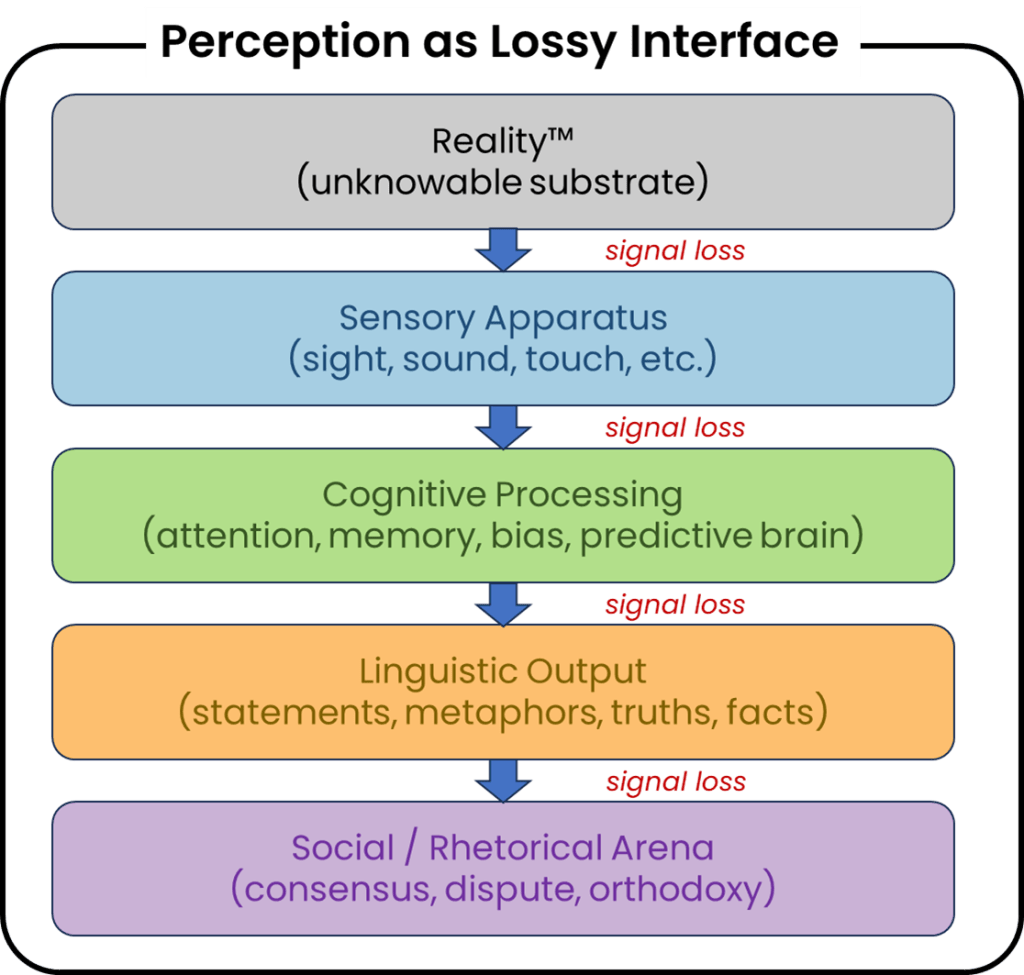
Cognitive science agrees, if in a different language: perception is predictive guesswork, riddled with biases, illusions, and shortcuts. Our minds don’t mirror reality; they generate useful fictions.
Diagram: Perception as a lossy interface: Reality™ filtered through senses, cognition, language, and finally rhetoric – signal loss at every stage.
Archetypal Truth (Positive Proposal)
So where does that leave us? Not with despair, but with clarity.
Truth is best understood as archetypal – a construct humans rally around. It isn’t discovered; it is invoked. Its force comes not from correspondence but from resonance.
Here, my own Language Insufficiency Hypothesis bites hardest: all our truth-talk is approximation. Every statement is lossy compression, every claim filtered through insufficient words. We can get close enough for consensus, but never close enough for Reality.
Truth is rhetorical, communal, functional. Not absolute.
The Four Pillars (Manifesto Form)
Archetypal – truth is a symbolic placeholder, not objective reality.
Asymptotic – we gesture toward reality but never arrive.
Rhetorical – what counts as truth is what persuades.
Linguistically Insufficient – language guarantees slippage and error.
Closing
Nietzsche warned, Rorty echoed: stop fetishising Truth. Start interrogating the stories we tell in its name.
Every “truth” we now applaud may be tomorrow’s embarrassment. The only honest stance is vigilance – not over whether we’ve captured Reality™, but over who gets to decide what is called true, and why.
Truth has never been a mirror. It’s a mask. The only question worth asking is: who’s wearing it?
To a comment on Death of the Metanarrative, I responded about the notion of truth relative to the map and the terrain. Although my rambling response was lengthy, I thought I’d share Richard Rorty’s view on this from his Contingency, Irony and Solidarity. According to Rorty, rationalists and empiricists turn claims about the world into the world—convincing others that a map of the world is the world.
We need to make a distinction between the claim that the world is out there and the claim that truth is out there.
—Richard Rorty
“We need to make a distinction between the claim that the world is out there and the claim that truth is out there. To say that the world is out there, that is not our creation, is to say, with common sense, that most things in space and time are the effects of causes which do not include human mental states. To say that truth is not out there is simply to say that where there are no sentences there is no truth, that sentences are elements of human languages, and that human languages are human creations.
Truth cannot be out there—cannot exist independently of the human mind—because sentences cannot so exist, or be out there.
Richard Rorty
“Truth cannot be out there—cannot exist independently of the human mind—because sentences cannot so exist, or be out there. The world is out there, but descriptions of the world are not. Only descriptions of the world can be true or false. The world in its own—unaided by the describing activities of human beings—cannot…
“The world does not speak. Only we do. The world can, once we have programmed ourselves with a language, cause us to hold beliefs. But it cannot propose a language for us to speak…
“It was Nietzsche who first explicitly suggested that we drop the whole idea of ‘knowing the truth’. But in abandoning the traditional notion of truth, Nietzsche did not abandon the idea of discovering the causes of our being what we are … In his view, in achieving this sort of self-knowledge we are not coming to know a truth which was out there (or in here) all the time. Rather, he saw self-knowledge as self-creation. The process of coming to know oneself, confronting one’s contingency, tracking one’s causes home, is identical with the process of inventing a new language … So the only way to trace home the causes of one’s being as one is would be to tell a story about one’s causes in a new language…
“[O]ne can—fruitlessly, in my view—come at [the question of knowledge] by way of anthropology and the question of whether there are ‘cultural universals’, or by way of psychology and the question of whether there are psychological universals. [There is an] indefinite plurality of standpoints, [a] vast number of ways of coming at the issue sideways … It is central to the idea of a liberal society that, in respect to words as opposed to deeds, persuasion as opposed to force, anything goes. This openmindedness should not be fostered because, as Scripture teaches, Truth is great and will prevail, nor because, as Milton suggests, Truth will always win in a free and open counter. It should be fostered for its own sake. A liberal society is one which is content to call ‘true’ whatever the upshot of such encounters turns out to be.”
Husky Meme – According to this book, I can’t read.
OK, so this isn’t at all about Foucault’s rhetoric. My main riff this year is the assertion that there is no Truth, only rhetoric—or should I rather say Rhetoric. I created a Reddit post asking for references to other philosophers (or whomever) who had made a similar claim, to which I was offered Vico and Rorty. Unfortunately, there were only two responders, and their assistance was superficial.
What I did encounter by one of the responders was a criticism similar to that levelled at Foucault, hence the inspired title of this post. This critique at its essence is that having proposed no positive solutions to the issues I point to, I cannot defend my position. In fact, as with Habermas‘ fault with Foucault, evidently, I have disarmed myself.
I find this line of argumentation weak tea at best. To argue that one has no claim to declare something incorrect if they don’t have a correct replacement for it is absurd. For example, I don’t know what 13,297 ÷ 1,492 equals arithmetically; but I can assert with confidence that it does not equal 2. Moreover, to criticise, one doesn’t need the ‘ability to generate positive alternatives’.
“There is no truth but rhetoric.”
So when I say there is no Truth but rhetoric (for non-ontic concepts), I am making a Truth statement. As such, this assertion—by my own admission—is only as strong as the rhetoric I can muster to its defence. Alas, my defences are weak, and so the argument fails. Were I to make a stronger argument—a more convincing argument—, it might be accepted as Truth.
Evidently, my first mistake was to separate ontic and non-ontic, which is to say things existing apart from their given names and those whose existence is entirely fabricated. An ontic thing might be a stone, a tree, a planet, a star, or the sensation of pain. These things exist even without language, a label, or an observer. As Saussure and other structuralists have noted, in semiotics, there is the signified (or referent) and the signifier—the object and the identifier. In the context of language, these are tautological.
There is no spoon.Non-ontic things are conceptual, freedom, truth, justice, rights, gods, and so on. I may opt to replace non-ontic with language-contextual or some such to sidestep the taxonomical quagmire. Or perhaps I’ll adopt the dichotomy of concrete versus abstract. These concepts do not exist outside of language. They are wholly constructed in a complex system created by humans—and humans whilst humans have done OK with complicated systems, they have an abysmal track record when it comes to complex systems. By analogue to the physics of solids, there is more space than atoms, and the atoms and their constituent particles are in constant motion—zero-degrees Kelvin, be damned. Our senses perceive something to be there, but as in that scene in The Matrix, ‘there is no spoon‘.
In my mind, leveraging Saussure’s ideas are useful to depict the differences in the concrete versus the abstract.
The famous painting depicted above illustrates explains the difference between a signifier and a referent. In this image, there is only the signifier. Magritte makes clear the distinction with the text, Ceci, n’est pas une pipe: This is not a pipe. It is merely a depiction of one. To be even more arcane, the image is a signifier to another signifier that in turn refers to the referent.
A sign is the device that encapsulates the concept. It may be visual—an icon (an illustration of photograph) or a written word or even Braille—or it can be spoken or signed, as with American Sign Language. These are all signs.
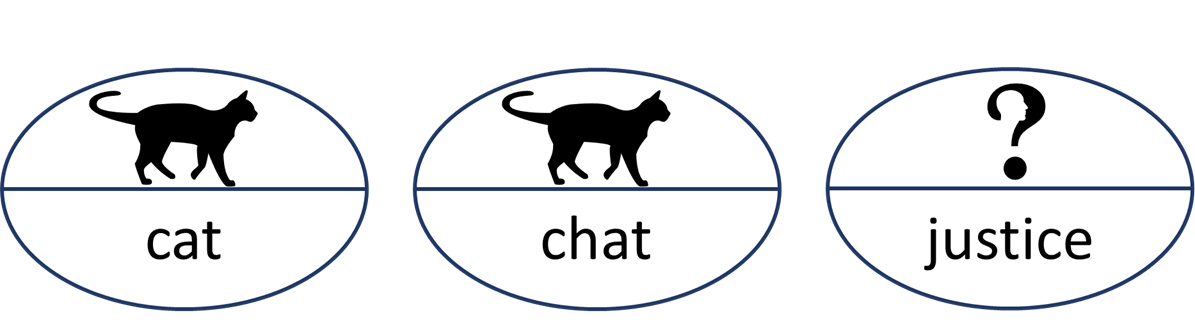
Notice when one considers a sign that a concrete cat (or in French, chat), it is pretty clear to what one is referring. Above the line, we see the signified, the idea conveyed by the sign. This doesn’t mean that everyone sees the silhouette depicted above, but it is a catlike thing, a feline animal, a mammal, normally with four legs and a tail. Perhaps you are thinking of a particular cat. But to someone with a grasp of the language in which you are communicating, when you say cat, there is little room for ambiguity. In fact, if you are trying to teach someone a different language, say, French, you could show them the cat with the chat signifier, and they would grasp your meaning almost instantaneously.
All language is arbitrary and socially constructed, so there is no connection between the words—say, the spelling or shape of a word—and its referent. The words cat and chat do not look like cats.
There are concrete things that cannot be so readily translated into an icon; for example, the wind. However, one could fairly quickly be able to articulate or gesticulate, as the case might be, the notion of wind. The same cannot be said for the abstract concept of justice.
As I’ve mentioned before, justice, especially one of the restorative or retributive varieties, is a euphemism for vengeance. The distinction is supposed to be found in the intent, but intent cannot be known; it can only be inferred. And, speaking of Foucault, justice can only be delivered from a power position.
But the notion of justice relies heavily on social construct; it has geo-spacial dependencies. What is considered to be just in ancient times may not be considered just now. What is considered just in one country might not be considered to be just in another. And this is more than a difference in instantiation. It is due to the arbitrary if not capricious articulation of a nebulous concept.
Returning to Foucault, (Christian apologist) Nancy Pearcey declares his stance paradoxical: “[when someone] states that it is impossible to attain objectivity, is that an objective statement? The theory undercuts its own claims.”
First, Pearcey merely asks a question about objectivity, but it doesn’t matter. The answer is: this may as well be an objective statement, but it’s just another language game. Wittgenstein (and Russell and Heidegger and Rorty…) was on the right path when he pointed out that the ambiguity inherent in language provide cover for all sorts of mischief. I’m only pretty sure that Derrida might yield paydirt as well. Besides, let’s pretend for a moment that there exists some objective truth, there is no reason (language game; except in accepting the broadest definition, reason is a capability elusive to many if not most humans) to expect that this truth is either accessible or verifiable anyway. The best one can do is to pose a more convincing rhetorical argument.
Reason /ˈrēzən/ (noun) the power of the mind to think, understand, and form judgments by a process of logic
A similar critique has been advanced by (another Christian apologist) Diana Taylor, and by Nancy Fraser who argues that “Foucault’s critique encompasses traditional moral systems, he denies himself recourse to concepts such as ‘freedom’ and ‘justice’, and therefore lacks the ability to generate positive alternatives.”
So whilst I’ve just managed to stream-of-consciousness my contention, I am not in a position to resolve anything. For now, I’ll settle for documenting my position as I continue to search for other supporters and formulate a more cogent response, a more robust rhetorical presentment.
If anyone can direct me to resources relevant to my position, let me know in the comments. I’ll appreciate it. If you don’t agree—which would be expected, as this is the accepted orthodoxy—feel free to comment as well.







![There_is_no_Spoon[1]](https://philosophics.blog/wp-content/uploads/2018/07/there_is_no_spoon1.jpg)
![1bb[1]](https://philosophics.blog/wp-content/uploads/2018/07/1bb1.jpg)
 Philosophics