Why “Just Think Critically” Keeps Failing

2–4 minutes

The paper is now available on Zenodo.

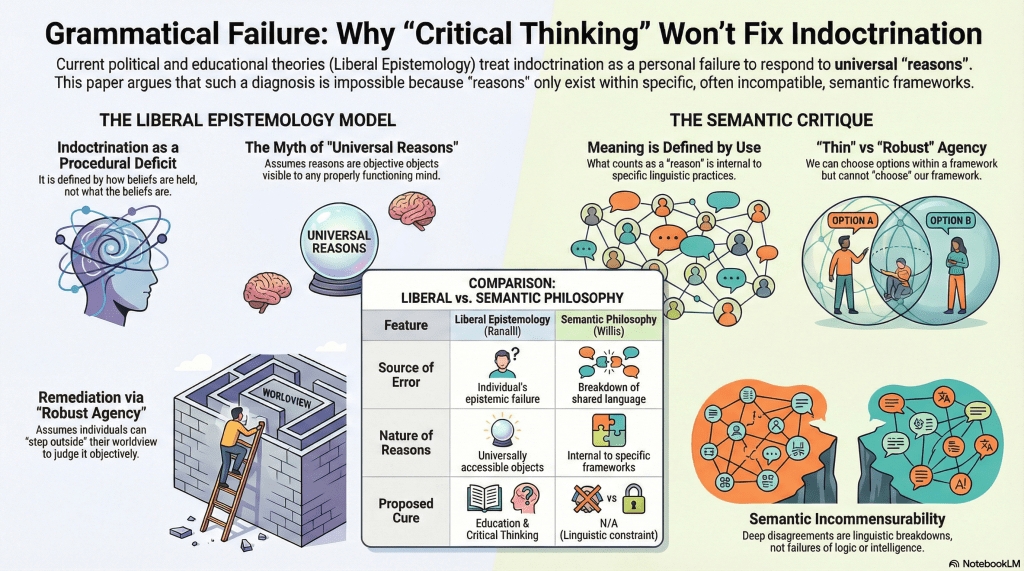
I’ve been wittering on about social ontological positions and legibility for a few months now. I’ve been writing a book and several essays, but this is the first to be published. In it, I not only counter Ranalli – not personally; his adopted belief – I also counter Thomas Sowell, George Lakoff, Jonathan Haidt, Kurt Gray, and Joshua Green. (Counter might be a little harsh; I agree with their conclusions, but I remain on the path they stray from.)

Audio: NotebookLM summary of the essay: Grammatical Failure

There is a strange faith circulating in contemporary culture: the belief that disagreement persists because someone, somewhere, hasn’t been taught how to think properly.

The prescription is always the same. Teach critical thinking. Encourage openness. Expose people to alternatives. If they would only slow down, examine the evidence, and reflect honestly, the right conclusions would present themselves.

When this doesn’t work, the explanation is equally ready to hand. The person must be biased. Indoctrinated. Captured by ideology. Reason-resistant.
What’s rarely considered is a simpler possibility: nothing has gone wrong.

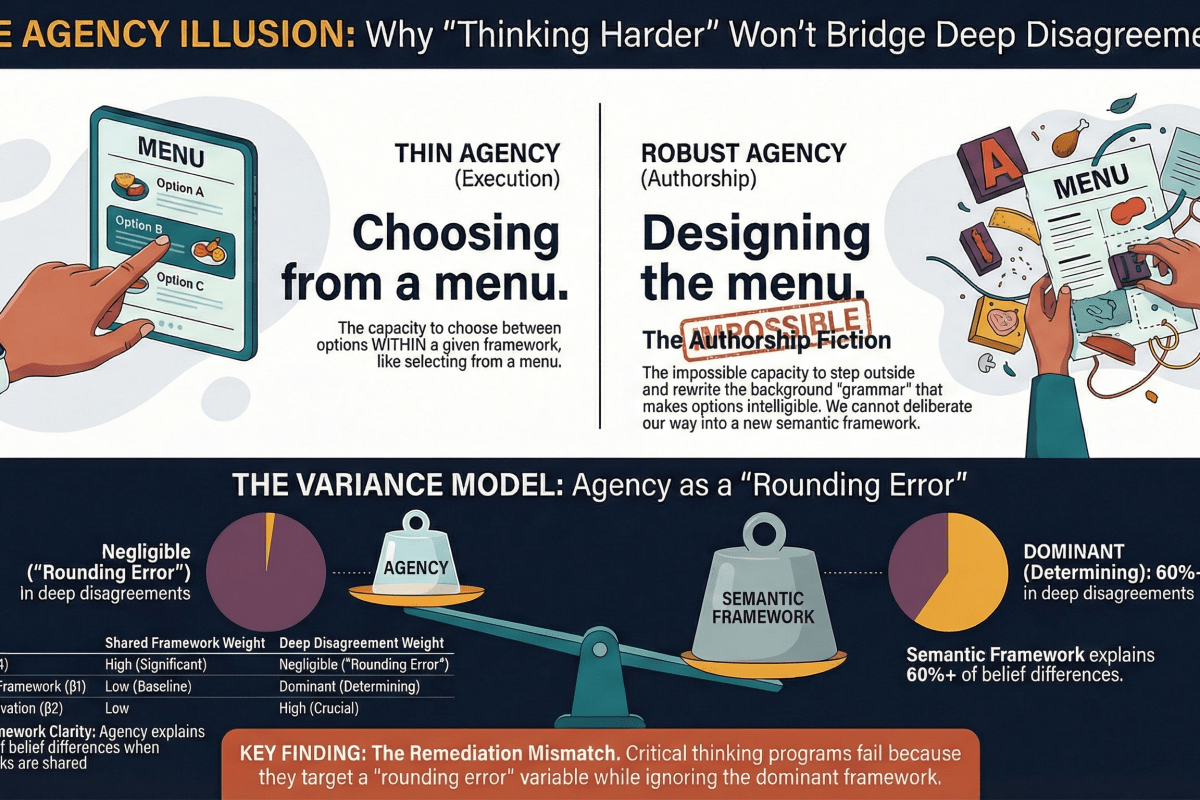
Most of our public arguments assume that we are all operating inside the same conceptual space, disagreeing only about how to populate it. We imagine a shared menu of reasons, facts, and values, from which different people select poorly. On that picture, better reasoning should fix things.

What if what counts as a ‘reason’, what qualifies as ‘evidence’, or what even registers as a meaningful alternative is already structured differently before any deliberation begins?

At that point, telling someone to ‘think critically’ is like asking them to optimise a system they cannot see, using criteria they do not recognise. The instruction is not offensive. It’s unintelligible. This is why so many contemporary disputes feel immune to argument. Not merely heated, but strangely orthogonal. You aren’t rebutted so much as translated into something else entirely: naïve, immoral, dangerous, unserious. And you do the same in return.

Liberal epistemology has a neat explanation for this. It treats these failures as agent-level defects: insufficient openness, motivated reasoning, epistemic irresponsibility. The problem is always how people reason. The argument of Grammatical Failure is that this diagnosis is systematically misplaced. The real constraint, in many cases, lies upstream of reasoning itself. It lies in the semantic frameworks that determine what can count as a reason in the first place. When those frameworks diverge, deliberation doesn’t fail heroically. It fails grammatically.

This doesn’t mean people lack agency. It means agency operates within a grammar, not over it. We choose, revise, and reflect inside spaces of intelligibility we did not author. Asking deliberation to rewrite its own conditions is like asking a sentence to revise its own syntax mid-utterance. The result is a familiar pathology. Disagreement across frameworks is redescribed as epistemic vice. Category rejection is mistaken for weak endorsement. Indoctrination becomes a label we apply whenever persuasion fails. Not because anyone is lying, but because our diagnostic tools cannot represent what they are encountering.

The paper itself is not a manifesto or a programme. It doesn’t tell you what to believe, how to educate, or which politics to adopt. It does something more modest and more uncomfortable. It draws a boundary around what liberal epistemology can coherently explain – and shows what happens when that boundary is ignored.

Sometimes the problem isn’t that people won’t think.

It’s that they are already thinking in a grammar that your advice cannot reach.

The Dubious Art of Reasoning: Why Thinking Is Harder Than It Looks

The Illusion of Clarity in a World of Cognitive Fog

Apologies in advance for this Logic 101 posting. Reason—our once-proud torch in the darkness, now more like a flickering lighter in a hurricane of hot takes and LinkedIn thought-leadership. The modern mind, bloated on TED Talks and half-digested Wikipedia articles, tosses around terms like “inductive” and “deductive” as if they’re interchangeable IKEA tools. So let us pause, sober up, and properly inspect these three venerable pillars of human inference: deduction, induction, and abduction—each noble, each flawed, each liable to betray you like a Greco-Roman tragedy.

Video: This post was prompted by this short by MiniPhilosophy.
Audio: NotebookLM podcast on this topic.

Deduction: The Tyrant of Certainty

Deduction is the purest of the lot, the high priest of logic. It begins with a general premise and guarantees a specific conclusion, as long as you don’t cock up the syllogism. Think Euclid in a toga, laying down axioms like gospel.

Example:

Perfect. Crisp. Unassailable. Unless, of course, your premise is bollocks. Deduction doesn’t check its ingredients—it just cooks with whatever it’s given. Garbage in, garbage out.

Strength: Valid conclusions from valid premises.
Weakness: Blind to empirical falsity. You can deduce nonsense from nonsense and still be logically sound.

Induction: The Gambler’s Gospel

Induction is the philosopher’s lottery ticket: generalising from particulars. Every swan I’ve seen is white, ergo all swans must be white. Until, of course, Australia coughs up a black one and wrecks your little Enlightenment fantasy.

Example:

Touching, isn’t it? Unfortunately, induction doesn’t prove anything—it suggests probability. David Hume had an existential breakdown over this. Entire centuries of Western philosophy spiralled into metaphysical despair. And yet, we still rely on it to predict weather, markets, and whether that dodgy lasagna will give us food poisoning.

Strength: Empirically rich and adaptive.
Weakness: One exception detonates the generalisation. Induction is only ever as good as the sample size and your luck.

Abduction: Sherlock Holmes’ Drug of Choice

Abduction is the inference to the best explanation. The intellectual equivalent of guessing what made the dog bark at midnight while half-drunk and barefoot in the garden.

Example:

It could be a garden sprinkler. Or a hose. Or divine intervention. But we bet on rain because it’s the simplest, most plausible explanation. Pragmatic, yes. But not immune to deception.

Strength: Useful in messy, real-world contexts.
Weakness: Often rests on a subjective idea of “best,” which tends to mean “most convenient to my prejudices.”

The Modern Reasoning Crisis: Why We’re All Probably Wrong

Our contemporary landscape has added new layers of complexity to these already dubious tools. Social media algorithms function as induction machines on steroids, drawing connections between your click on a pasta recipe and your supposed interest in Italian real estate. Meanwhile, partisan echo chambers have perfected the art of deductive reasoning from absolutely bonkers premises.

Consider how we navigate information today:

And thus, the modern reasoning loop is complete—a perfect system for being confidently incorrect while feeling intellectually superior.

Weakness by Analogy: The Reasoning Café

Imagine a café.

All three are trying to reason. Only one might get lunch.

The Meta-Problem: Reasoning About Reasoning

The true joke is this: we’re using these flawed reasoning tools to evaluate our reasoning tools. It’s like asking a drunk person to judge their own sobriety test. The very mechanisms we use to detect faulty reasoning are themselves subject to the same faults.

This explains why debates about critical thinking skills typically devolve into demonstrations of their absence. We’re all standing on intellectual quicksand while insisting we’ve found solid ground.

Conclusion: Reason Is Not a Guarantee, It’s a Wager

None of these modalities offer omniscience. Deduction only shines when your axioms aren’t ridiculous. Induction is forever haunted by Hume’s skepticism and the next black swan. Abduction is basically educated guessing dressed up in tweed.

Yet we must reason. We must argue. We must infer—despite the metaphysical vertigo.

The tragedy isn’t that these methods fail. The tragedy is when people believe they don’t.

Perhaps the wisest reasoners are those who understand the limitations of their cognitive tools, who approach conclusions with both confidence and humility. Who recognize that even our most cherished beliefs are, at best, sophisticated approximations of a reality we can never fully grasp.

So reason on, fellow thinkers. Just don’t be too smug about it.