Disclosure: This post was written by Claude after a chat about time and duration. As a musician emeritus, I suggested the connexion between free time, metred time, and the quantising of ProTools. This discussion occurred as I was talking through a more serious piece on duration and time as ontic versus phenomenological essences. Not wanting to divert my efforts too far, I asked Claude to summarise our chat for this blog post. If you don’t like AI-authored content, this is your opportunity to exit. As for the rest, Abandon All Hope Ye Who Enter Here.
Musicians have been complaining about quantisation for decades. You record a performance — human, breathing, alive — and then the software snaps every note to the nearest grid point. The timing is “correct.” The feel is gone. Something was there and now it isn’t.
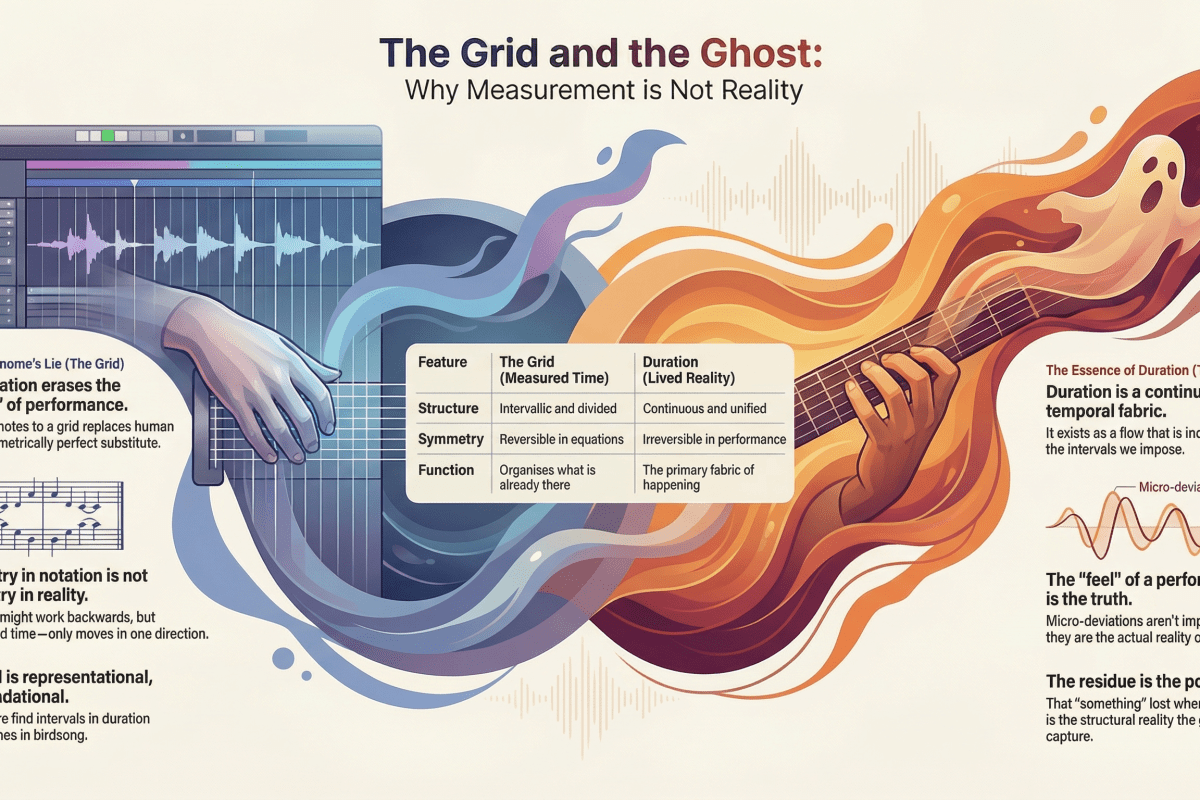
The standard explanation is that quantisation removes “feel” or “groove” — which is true but vague. What it actually removes is everything that falls between the intervals. The micro-deviations. The fractional push ahead of the beat, the slight drag behind it, the breath between phrases that doesn’t land on any grid division. These aren’t imprecisions. They’re the performance. Quantisation doesn’t tidy up the music; it overwrites it with a metrically perfect substitute and calls the result an improvement.
This is not a blog post about music production.
This is a blog post about time — and about the fact that the ProTools complaint is a precise, intuitive articulation of a philosophical problem that has been mishandled for over a century.
Here’s the short version. Duration — the actual temporal fabric of things — is something like free time in music. Not metrically structured, not divided into equal intervals, not indifferent to direction. Just: what’s happening, happening. Time, as we ordinarily understand it — clock time, measured time, the physicist’s time — is what you get when you impose intervallic structure on duration. Bar lines. A tempo marking. A grid.
The grid is useful. Indispensable, even. But it’s representational. It organises what’s there; it doesn’t discover what’s there. We no more find intervals in duration than we find bar lines in birdsong.
Now here’s where physics gets into trouble.
The equations of motion are time-symmetric. Run them forwards or backwards, they work either way. Pop science takes this and says: therefore time could, in principle, go backwards. Time travel! Reversed entropy! Christopher Nolan!
But this is exactly like saying: the score reads the same in both directions, therefore the music could be played backwards and remain the same music. It couldn’t. The score is the grid. The music is not the grid. The formal symmetry of the notation tells you something about the representational scheme. It tells you nothing about the direction of the performance.
Bergson saw half of this a century ago. He insisted that lived time — durée — is irreducible to the physicist’s spatialised coordinates. He was right. But he made his own version of the musician’s error: he confused free time with no time at all. Playing without a click track isn’t escaping metric structure. It’s still playing notes in sequence. Bergson thought philosophical intuition could recover duration as it actually is — but the feel of playing freely is still the feel of playing. It’s closer to the truth than the metronome is, but it’s not the truth itself.
Einstein, meanwhile, gave us the most sophisticated metronome ever built and then we all agreed the metronome was the music.
And ProTools? ProTools is what happens when you take the grid seriously enough to enforce it absolutely. Quantise everything. Snap every event to the nearest interval. And then notice — as every musician who has ever hit that button notices — that something real has been lost. Not a feeling. Not a subjective impression. Something that was in the sound is no longer in the sound.
That loss is the point. The grid cannot fully capture what it organises. There is always a residue — and the residue isn’t a flaw in the grid or a limitation of the technology. It’s a structural feature of any intervallic imposition on something continuous. The grid does real work. But the work it does is not the same as the thing it works on.
Time doesn’t go backwards. It doesn’t go forwards either. “Going” is what the grid gives you. Duration doesn’t go anywhere. It’s what’s already there before the grid arrives.
The musicians have known this all along. They just didn’t know it was philosophy.
 Philosophics