It’s nice to see responses still coming in from the Modernism Worldview Survey, so I thought I’d share some interim insights. Several people have shared their results with me privately. I’d be interested to know if any takers felt this was a fair and accurate assessment, given that this might be as relevant as the zodiac reading on a restaurant placemat. I’m an ox, if you’re wondering.
All aggregated responses resolve within the violet parallelogram that encompasses the population average (the blue dot). So, survey-takers have a slight propensity toward Modernist ideals with a tinge of Postmodernism. The force is weak, given how far the dot resides from the vertex. There were responses close to the green shading on the Modern side, but none indicated a strong Modernist worldview.
Firstly, no respondents are choosing “Pure Premodernity” (lower right). This doesn’t mean that no one abides by Premodern perspectives. It’s that they feel these ideas are filtered through Modern (mostly) and Postmodern (less so) lenses.
Secondly, respondents generally moderated their approach, avoiding any extremes. Although some responses were close to the Modern triangle (the green shading), none occupied the space, and points were even further removed from the other two corners. There were several scores in the white triangle. This space would be ripe for a Metamodernist to be positioned, but the survey would need to be restructured to determine whether this was mere happenstance.
Before the survey was published, I thought that the blue dot would be higher (toward Modernity) and further right (more Premodern), but this is likely due to the bias of people who visit this site and follow my content more generally. I need to share links in places without this bias. Of course, someone having even the slightest interest in the subject matter already represents a bias.
The genesis of the Modernity Worldview Survey was Metamodernism. Is this still a thing? In recent years, metamodernism has emerged as a supposed successor to postmodernism, claiming to transcend the seemingly irreconcilable tensions between modernist sincerity and postmodern irony. Yet, upon closer examination, this framework reveals itself not as a genuine paradigm shift but rather as a modernist invention that fails to escape the very critiques it attempts to address.
Despite its claims of oscillation between poles, metamodernism betrays its modernist underpinnings through its implicit teleology and notion of progress. The very framing of “meta” as beyond or transcending suggests a linear progression that is fundamentally at odds with the postmodern rejection of grand narratives. Metamodernism positions itself as forward-moving whilst attempting to recapture elements of premodernity, revealing an anxiety about being perceived as regressive or naive.
Podcast: Audio version of this content
This desire to have it both ways—to acknowledge the constructed nature of meaning whilst still pursuing transcendent meaning—doesn’t represent a resolution so much as a psychological coping mechanism. The cognitive dissonance created by attempting to simultaneously hold contradictory positions is assuaged through a clever rhetorical move: claiming that oscillation itself is the point.
A Rebranding Exercise
What metamodernism presents as novel is ultimately a recombination of elements from premodern, modern, and postmodern frameworks without resolving their fundamental contradictions. Rather than being mutually exclusive from these earlier paradigms, it cherry-picks aspects of each whilst maintaining the basic ontological framework of modernism.
The notion that one can meaningfully “oscillate” between accepting objective and subjective realities is particularly problematic. Either reality has objective features, or it doesn’t—pretending otherwise doesn’t create a new philosophical paradigm but rather a convenient means of avoiding the implications of either position.
Postmodern Irony in Motion
Perhaps the most intriguing interpretation of metamodernism is not as a sincere attempt to move beyond postmodernism but as postmodernism performing its own critique. Viewed through this lens, metamodernism becomes postmodern irony in motion—a knowing wink at the impossibility of escaping construction whilst performatively engaging with the desire to do so.
The irony deepens when we consider that “postmodernism” itself is essentially an externally imposed label rather than a self-identification. Most thinkers characterised as postmodernists reject the label, which functions primarily as a modernist attempt to categorise and contain ideas that fundamentally challenge its frameworks.
Art vs. Philosophy
Where metamodernism succeeds is as a descriptive label for certain artistic and cultural productions that deliberately play in the space between irony and sincerity. Works like David Foster Wallace’s “Infinite Jest,” the television series “BoJack Horseman,” and Wes Anderson’s films effectively combine postmodern techniques with sincere emotional engagement.
However, what works as an artistic sensibility fails as a comprehensive philosophical framework or moral compass. The oscillation that enriches art becomes paralysing when applied to ethics or ontology. A moral framework requires some stable reference points; constantly shifting between believing in objective moral truths and viewing morality as entirely constructed provides no reliable guide for actual decision-making.
Insider vs. Outsider Perspectives
Like religious frameworks that balance literal and metaphorical interpretations, metamodernism may function as a lived experience for those who embrace it, even if it doesn’t hold up to external philosophical scrutiny. The cognitive manoeuvres that appear as tricks or inconsistencies to outsiders often feel like natural, intuitive ways of navigating complexity to those within the system.
This insider/outsider divide recalls Thomas Nagel’s famous “What Is It Like to Be a Bat?” (PDF) thought experiment—there may be experiential aspects of inhabiting a metamodern worldview that aren’t fully comprehensible from the outside. Yet this doesn’t invalidate external critique; inconsistencies and contradictions still matter philosophically.
Conclusion: Beyond Labels
Perhaps the most postmodern insight is recognising that we cannot escape having an ideology—even a position of having no ideology is itself an ideology. What distinguishes various approaches isn’t whether they have ideologies but how explicitly they acknowledge them, how consistently they apply them, and how willing they are to subject them to revision.
Metamodernism, for all its aspirations to transcend earlier frameworks, ultimately reveals more about our contemporary psychological condition than it offers as a coherent philosophical position. It captures our desire to maintain meaning in a world where we’ve recognised its contingency—a desire that may be fundamentally human, even if philosophically untenable.
Rather than seeking yet another “-ism” to resolve our existential and philosophical tensions, perhaps we might more honestly confront the limitations and partialities of all our frameworks, recognising that the search for a perfect synthesis may itself be a modernist fantasy.
I’ve finally had time to create some video content for the Modernity Worldview Survey. This content is a cursory overview and serves as an introduction to deeper content planned for the future.
This video is short of seven minutes, so briefly, it outlines the worldviews and the questions. I opted not to produce a single comprehensive video so the material could arrive sooner. The content is bookmarked, though this is likely overkill for such a short video.
A permanent page about the survey is always available on this blog.
I’m still accumulating responses, but the survey is available here if you haven’t taken it. Apologies in advance for the fact that it renders best on a larger monitor or tablet rather than a mobile phone. It doesn’t render at all on a landline, so there’s that.
This post explains how to interpret the ternary plot chart’s visualisation. The ternary chart on the survey results page will render something like this. This is an admin page with additional functionality, but it’s similar enough. The blue dot represents the average of all responses. The star represents where I guessed the average would land–mostly modern with some residual premodernity and a touch of postmodernity.
Under the title in the header is a textual assessment of the visualisation. In this case, the response illustrates someone moderately modern with postmodern influences. Although this person also has some premodern tendencies, they are relatively insignificant to the context.
The three possible worldviews are at the vertices (the corners) of the triangle. Each side is a scale progressing from 0% to 100%—100% coincident with the label. For example, the bottom side runs from 0 on the left to 100 on the right, which would indicate a score of 100 per cent Premodern, which the output deems Pure Premodern.
Notice that each vertex has green and yellow shading that serves as visual aids representing the strength of the relationship to the corner. Green is strong, and yellow is moderate. The white section outlined by an interior triangle with a red border is decidedly mixed, showing no strong inclination to any of the extremes.
In the example above, the red plot point illustrates a response (as shown below the chart) that is 20.7% Premodern, 52.1% Modern, and 27.2% Postmodern. These numbers should always sum to 100, though there will be some drift due to rounding. The star represents where I thought the average response would be. Follow the tickmarks on each side, and you’ll notice they correspond with the plot point as a 3-tuple (20, 70, 10).
In the future, I expect to render a view that plots the average survey response as a reference.
Below this chart is an expository account of the response choices. You can render this content as a PDF for your personal archive.
Final Word
If you have any questions or suggestions related to this topic, please feel free to leave them in the comments below.
I happened upon an article that notes that the postmodern label is now 50-odd-years old, so what’s next? Just a short response, the label never made sense for several reasons.
First, the prefix post suggests a new era or paradigm. In and of itself, this is not a problem. The challenge is the root: modern.
Effectively, modern means now, the current era, in the same manner as today sits between yesterday and tomorrow. The problem is that we are employing the term postmodern as if it’s tomorrow but today. Of course, except in jest, tomorrow is never simultaneously today. The notion reminds me of the sentiment captured in the quip when asked ‘When will you do this task?’ ‘I’ll do it tomorrow’. When queried the next day, ‘Why have you not yet done this task?’ and the response is ‘I’ll do it tomorrow’, ad infinitum.
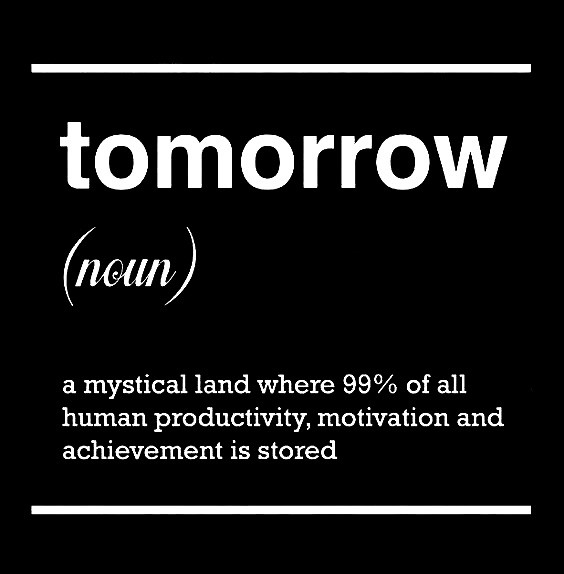
I’ll caption this tomorrow
Modern derives from the Latin meaning ‘just now‘. People have been labelling themselves as modern since at least 1585 when it meant ‘of or pertaining to present or recent times‘. As early as 1500, it meant ‘now existing‘, so more toward ‘extant‘.
My point is that one might be able to retroactively reference post-X in relationship to X, but to name something duratively as post-X simply makes no sense. Add to this the complication that Latour mentions that we’ve never been modern or the further connotation that privileges the term adopter over others. Namely, whilst the West are modern at time-zero, being the height of modernity, some other contemporaneous other does not qualify. The United States are modern—just not Appalacia and certainly not Bangladesh. In a temporal sense, premodern takes on a similar meaning, e.g. Aztec or Mayan civilisations.
Besides the unfortunate naming, ‘postmodern‘ attempts to envelop many thoughts. As I’ve mentioned before, it is most typically pejoratively.
Whist I attempt to align myself with certain so-called postmodern figures, and I use the term myself because it still has some referential value, I do so with reservations and the understanding that it’s a nonsensical notion from the start. Perhaps, I’ll suggest a new solution tomorrow.
I’ve been pondering how to effectively dimensionalise the spectrum that illustrates the relationship among premodern, modern, and postmodern—and potentially, metamodern. I was researching and happened upon a YouTube video from a few years back by Rick Durst, a Conservative Evangelical professor. He was diagramming the chronological path from pre to post.
I think at this point it’s important to distinguish between Modern and Modernity and PostModern and PostModernity1. I feel that the noun form, Modernity, can be used to describe the chronology whilst the adjective form, Modern, describes the philosophy. I’m not sure that this is a standard distinction. If I adhere to this difference, then Rick is discussing Modernity rather than Modern. Perhaps I’m being pedantic.
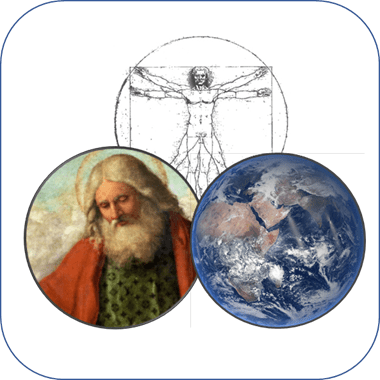
I’ve taken liberties to rerender Rick’s model.
In his view, the stages are from God to Man to Earth. I don’t fully agree with the transition from Man to Earth, but the God to Man or Humanism doesn’t feel very controversial. Although Rick is describing modernity against a temporal backdrop, this doesn’t invalidate the God-Man-Earth aspect—leaving open the possibility that it may be invalid for other reasons.
Following the chronology, Rick points out that the overlapping periods between PreModern and Modern and Modern and PostModern are not clean breaks. As I’ve suggested before, in illustration B, some people today retain PreModern beliefs and others hold PostModern beliefs. On balance, I feel that the Western world today remains substantially Modern, philosophically speaking. I am not sure that I am qualified to assess this relative to contemporary Eastern cultures.
Again, without otherwise critically evaluating Rick’s model, belief and God and in particular, Catholocism was the hallmark of the PreModern, PreEnlightenment world—the supernatural and superstition ruled the day.
Many consider Modernity to have commenced with the Renaissance, roughly from the 14th to the 17th century—describing it as early modern. Given the prevalence of superstitious beliefs, I’d be more comfortable with something more along the lines of proto-modern rather than modern. Scientific discoveries were evident, but this was reserved for the elite.
Given the Protestant Reformation that occupied the 15th century, it’s clear that a declaration of Modern should be considered to be premature. One might even argue that even with the advent of the Age of Enlightenment, which spanned the 17th and 18th centuries, Secular Humanism become the theme for the empowered elites, but the masses never relinquished their PreModern belief systems. If we are to start the Modern clock at all, this seems to be as good a place as any.
Although Modernism is marked by Humanism, in the United States, federal and state government is still predicated on PreModern principles, so it is not unfair, twisting Lyotard’s phrase, to question, Have We Ever Been Modern? It is somewhat interesting how—at least anecdotally—how many people do not find it inconsistent to have faith in humanity to solve the ills of the world through technology whilst simultaneously believing in gods, angels, tarot, and homoeopathic and other anachronistic healing modalities.
Chronologically, Rick demarcates Modern and PostModern with the ecological crises of the 1970s, which turned the focus from Man to the Earth. Seeds of postmodernism were sewn post-WWII and even post-WWI with the devastation and realisation of the limits of human capacity.
For the purpose of the ternary plot, it seems easy enough to assess where a person might feel relative to gods versus humans. And whilst I could argue that the belief in gods and the supernatural is a discrete binary state rather than on a continuous scale, I could argue as well that someone could feel that their gods are in control but they retain some degree of what’s known as free will. As a matter of degree, one could be a Deist—believing in some Prime Mover—but feel that now humans are on their own. God is like a crocodile slithering into the darkness having enabled the next generations. On a 1 to 10 spectrum, they might get 90% Modern and 10% PreModern. A believer in astrology, tarot, and the like, might also have faith in Man, yet they may reside more on the 60%-40% in favour of Modernity—or vice versa.
The question is how to get past Man to Earth. I am not sure how to frame this. Perhaps this wasn’t the right avenue to pursue.
For the record, I chose to render the terms PreModern and PostModern in camel case for no particular reason, save to think that it seems to make the prefix more readily distinguishable.
I don’t have a strong grasp of Metamodernism, but at first glance, it doesn’t seem to be a place I wish to reside, and I don’t have the motivation to look deeper. Instead, I’ll rely on proponants and advocates to fill that void. They are already ahead of me on that curve and far more qualified to lead that charge. Moreover, I believe there are at least two paths to follow.
Metamodernism attempts to synthesise Modernism and Postmodernism, but from my perspective, it’s a Modern belief that simply preferences Premodern mysticism over Postmodernism. From what I understand about Metamodernism, all of it’s dimensions can be measured on the planar ternary plot I am architecting. From what I read by Metamodernists is that it is either operates to sublate or is a paradigm shift that transcends these worldviews.
If my characterisation is correct, Metamodernism is captured by the model and simply shifts the dot to the left. If one of the other persectives is correct, it either changes the shape of the plane itself, alters the pathing of the movement of the dot, or creates a need for a Z-axis to capture this Z-dimentional movement. To assess this, I’ll need more information. For now, I will adopt my perspective and see where I end up.
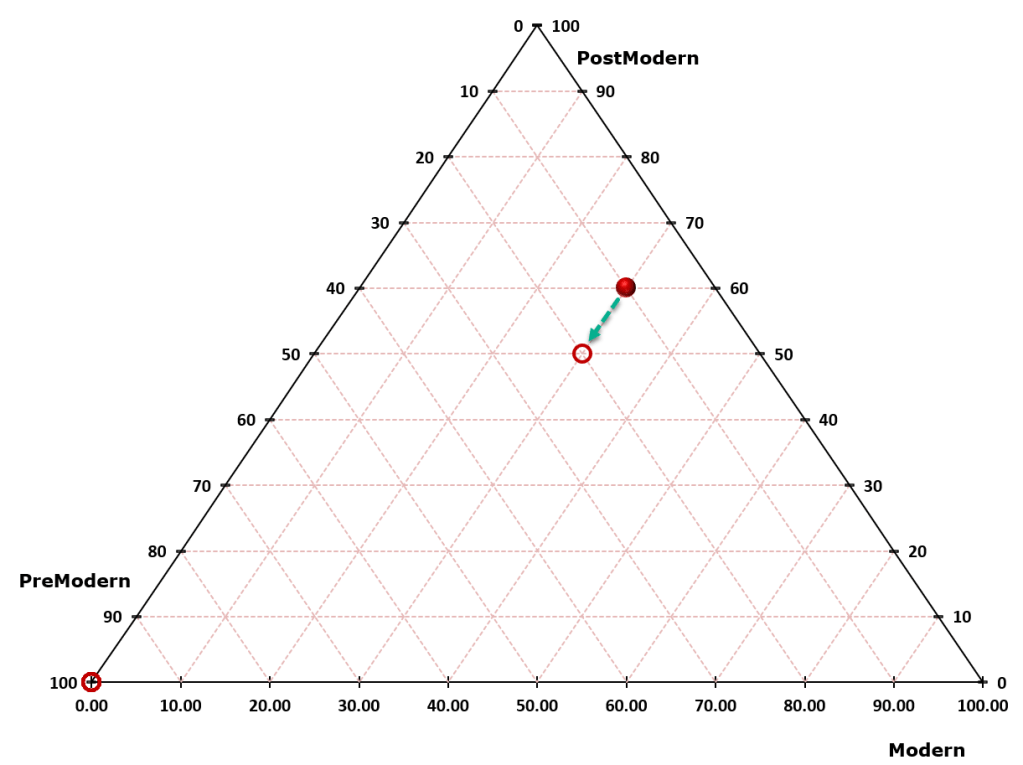
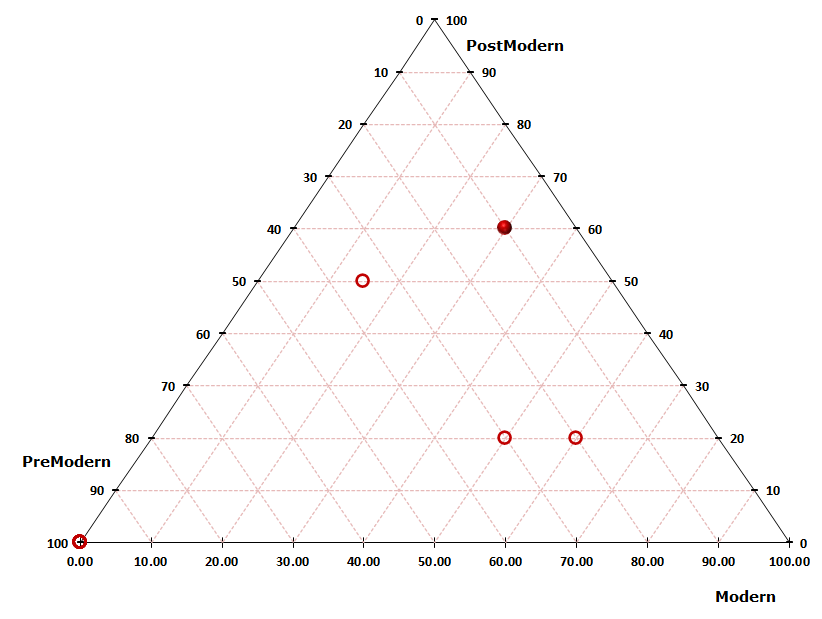
Usign this ternary chart as a reference, if I am the solid red dot at time-1, and adopt some Metamodern world views, my place at time-2 moves in the direction of PreModern, which is to say down and to the left.
To be clear, the direction of this shift is not inevitable. It depends on the initial orientation and the dimension under consideration. If I were lower on the chart (more Modern than PostModern), then the movement would more likely be from right to left horizontally and not angular as depicted. Moreover, even from the starting position shown, the movement might simply go left. What it won’t do is go up or to the right, the area shaded in red on the chart below.
My next step is still to dimentionalise this. Altought I have some canditates already in mind, I suspect this will be an emergant process. Feel free to come along for the ride.
I am working toward fleshing out my Modernity Triangle. Since I want to illustrate placement graphically, I’ve settled on using a ternary plot—at least for now. I’ve borrowed an existing Excel template, which already contained the simple maths and charting. This is really just the tip of the iceberg as creating appropriate dimensions, measures, and weights is the heavy lifting.
I may work on the aesthetics, but this is the underlying framework. I’ve already commenced a scoping conversation in a previous post. In a nutshell, there are three primative movements—the spectra are Premodern to Modern, Modern to Postmodern, and Postmodern to Premodern.
This chart is meant to be discriptive. As the adage goes, there is no correct placement. If you identify as a Modern, you may wish the dots to bias in that direction, but the same is true if you occupy one of the other corners. For those who prefer moderation as a stance—the Middle Path—, you may be tempted to find comfort in a dot occupying the centre. That’s fine. I’m not judging your worldview.
Taking a moment to mention prescription, the best I can offer at this point is that if you feel you should or want to occupy a particular place. Feel free to create a vector from where you are to where you aspire to be. My only caveat at this point is that sometimes it is hard to reverse tack once the genie’s been let out of the bottle. An example might be agriculture. Humans progressed from Hunter-Gatherers to Aggrarians. Some have ‘progressed’ to Industrial and Postindustrial worldviews. However, not all humans have taken these paths. But due to encroachment of Premodern humans by Moderns, the habitat of Premoderns has made hunting and gethering an untenable lifestyle, so in the contemporary world, only Hunter-Horticulturalist remain.
In the accompanying ternary chart, I clumsily place myself where I self-identify, though I could be way off base. As a matter of example, this dot could represent a single dimension as well as some aggregation of dimensions. At the most abstract level, the view should interpret as a person espousing a tendency toward Postmodernism over Modernism fairly far removed from Premodernism. The lower leftmost dot on the Premodern corner could represent a typical pre-Enlightenment peasant as well as a member of some contemporary indigenous tribe such as the Sentinelese.
In the contemporary Western world, I’d image that they might be represented by the 2 dots on the second horizontal, fairly Modern, a smidgeon of PostModern, and more PreModern than they’d likely be comfortable to admit.
Political Compass
I was inspired by the Political Compass conceived by Libertarians attempting to differentiate themselves from a strict Left-Right political frame. My intent is to create something similar. I don’t feel that I have four points to work with, so I settled for three. I discuss how Metamodernism fits into this model elsewhere. Here is how the Political Compass situated the UK parties in the 2019 general election.
I’ve been thinking, but I haven’t had a lot of free time, so I may be fleshing this post out over time.
I participate in several online groups centred around Postmodernism. There are some fellow Postmoderns, and there are some Moderns, some who want to find out what all the hubbub is about, and some detractors. Invariably, the conversation turns to one of definition. This post will not attempt to answer that question. I’ve made that attempt elsewhere and elsewhen.
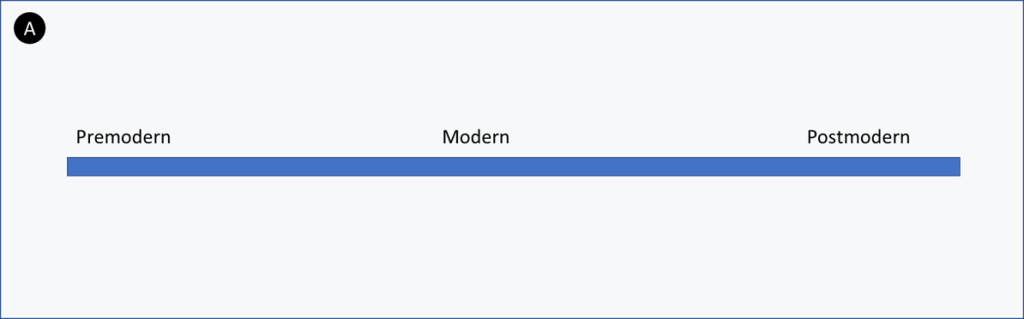
This post is meant to orient the relationship between premodern, modern, and postmodern. Image A depicts a strict linear chronology. I don’t suspect anyone views this progression where at some point Modern philosophy superseded Premodern and was itself superseded by Postmodern thought. In my own experience, this does not ring as valid, and it doesn’t feel like this will unfold in any future.
Image B is a more plausible chronology, though some might prefer a permutation where Premodern eventually fades away and where Modern fades away at another point. Again, experience doesn’t bear out this scenario.
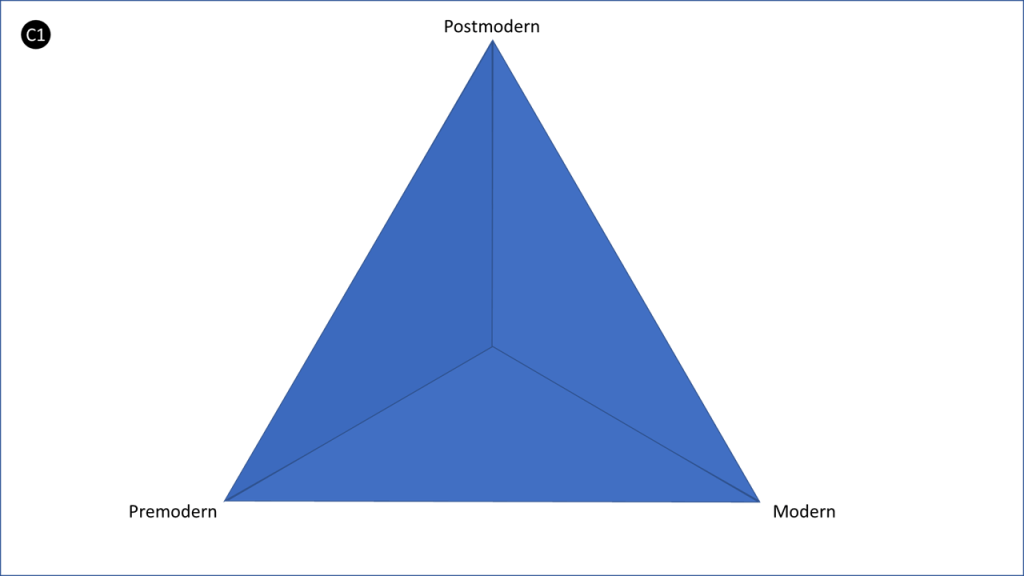
In fact, this is how I came to conceptualise the relationship as a triangle—rather a radial chart limted to three points. This is represented by image C1, where there is a triangular relationship, with each of the schools of thought represented at the angles. The placement of the labels is arbitrary. That Postmodern is rendered at the top should not suggest that it is elevated or better than the others. Neither is Modern better because it resides on the right side. The triangle doesn’t indicate and time dimension.
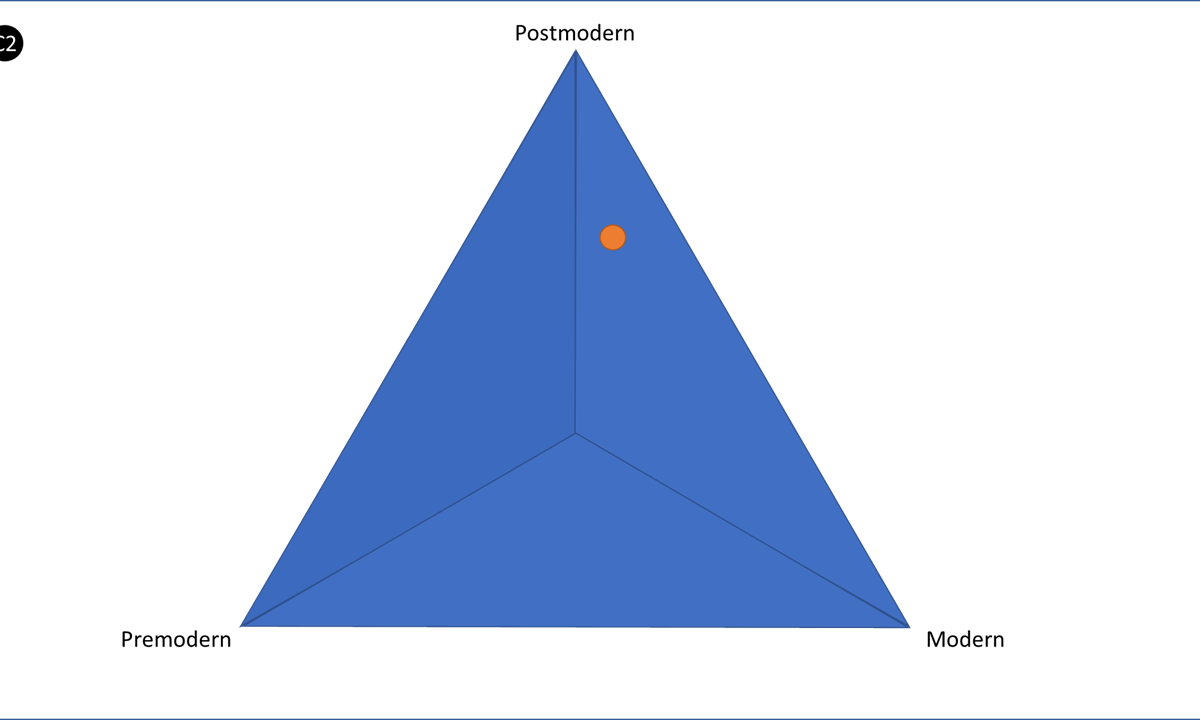
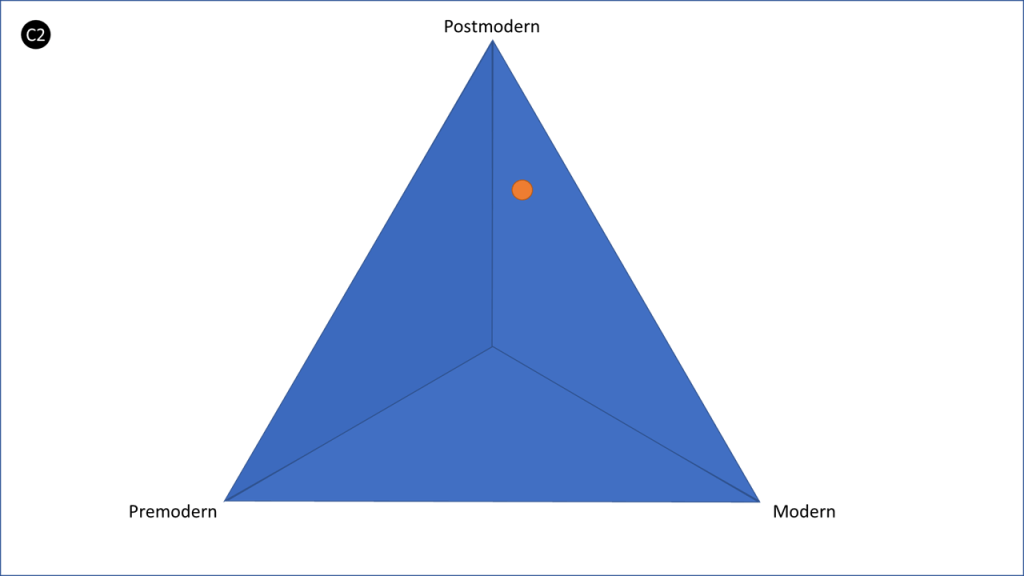
Image C2 is merely a representation of C1 with a dot to indicate placement on the plane.
Ostensibly, each angle contains dimensions and measures. I haven’t sussed out fully what these dimensions might be, but a triangle might represent individuals or aggregations of individuals. An individual or a group might place differently at different times.
Regarding the triangular plane, the concept is that an entity may hold belief sets of any or all of these worldviews simultaneously. A bit of self-reflection might place be on the orange dot in C2, though the chart is arbitrary and not to scale. No animals were harmed, and so on.
Moreover, it’s important to distinguish between the system of belief and the pragmatic life of an entity. In my case, I feel that I am intellectually a Postmodern. I have an incredulity toward metanarratives, don’t believe in objective truths, and feel that every system requires context to evaluate. This said, I am quite strategic and analytical. Also, although I’ve been called many times a Stoic and Spock from Star Trek, my emotions and cognitive biases and sense perception deficits still allow me to favour the underdog as a Social Justice Warrior.
socialism never took root in America because the poor see themselves not as an exploited proletariat but as temporarily embarrassed millionaires
— No one in particular
It’s been pointed out that many Postmoderns are simultaneously Marxists or otherwise Leftists. Personally, I feel these are simple covariances, that a Conservative has to give more weight to history and teleological arguments, thereby qualifying as a Modern, whereas a Postmodern is more likely to dismiss these are metanarrative-laden. I consider myself a Leftist, but again, this is an emotional rather than intellectual decision. As a Postmodern, intellectually speaking, I believe there is no way to determine whether Anarchosyndicalism is better or worse than Republicanism or Oligarchy, but I know how I feel about these. And without going down some political rabbit hole, it’s plain to see that many people are predictably irrational and vote against their own interests time and again as they believe some narrative where they see themselves in another position where this self-deprecation will pay off in the end. This is embodied in the meme that “socialism never took root in America because the poor see themselves not as an exploited proletariat but as temporarily embarrassed millionaires.” This is usually misattributed to John Steinbeck, but the sentiment remains—don’t tax the rich—because I am just a stone-throw away from that—if only I paid less in taxes.
Finally, there are the Premoderns. These people are not only nostalgics, but they retain superstitious beliefs, favour natural remedies, and Ayurvedic treatments. They retain religious beliefs—some even preferring pre-Judeo-Christian paradigms. And yet they may also be scientists and otherwise structured thinkers. It’s harder for me to conjure scenarios where an entity might simultaneously hold Premodern and Postmodern beliefs. Off the cuff, it seems that one might believe in some sort of cultural relativity and at the same time believe in some shamanic healing or Ayahuasca retreat for cleansing or getting in touch with the universe. I wouldn’t presume it’s that unusual for people to hold antithetical and mutually exclusive beliefs. I am not superstitious, but I carry a lucky penny or some such.
My next step in this journey is to dimensionalise the model. I already have got some ideas, many of which have already been captured here, but my familiarity with Premoderns is limited and probably contains a lot of stereotypes and caricatures.











 Philosophics