I’ve been thinking, but I haven’t had a lot of free time, so I may be fleshing this post out over time.
I participate in several online groups centred around Postmodernism. There are some fellow Postmoderns, and there are some Moderns, some who want to find out what all the hubbub is about, and some detractors. Invariably, the conversation turns to one of definition. This post will not attempt to answer that question. I’ve made that attempt elsewhere and elsewhen.
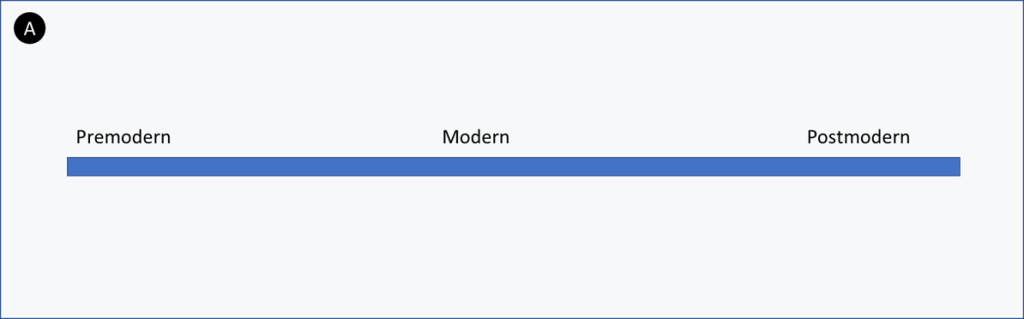
This post is meant to orient the relationship between premodern, modern, and postmodern. Image A depicts a strict linear chronology. I don’t suspect anyone views this progression where at some point Modern philosophy superseded Premodern and was itself superseded by Postmodern thought. In my own experience, this does not ring as valid, and it doesn’t feel like this will unfold in any future.
Image B is a more plausible chronology, though some might prefer a permutation where Premodern eventually fades away and where Modern fades away at another point. Again, experience doesn’t bear out this scenario.
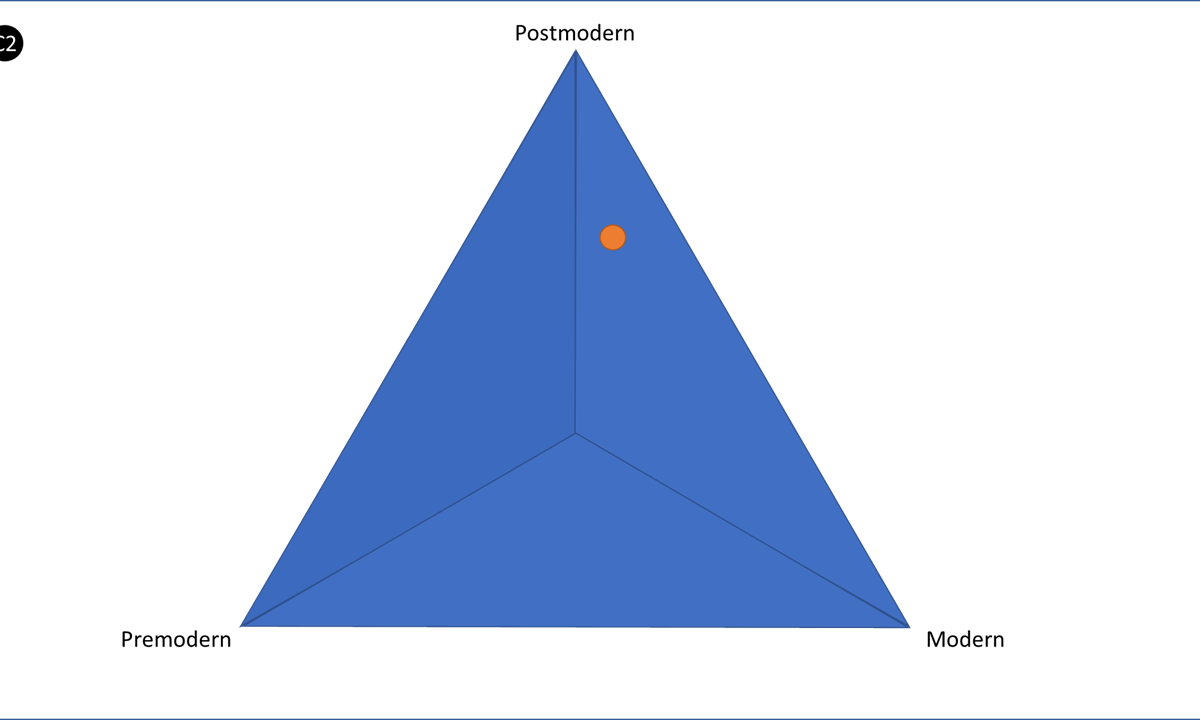
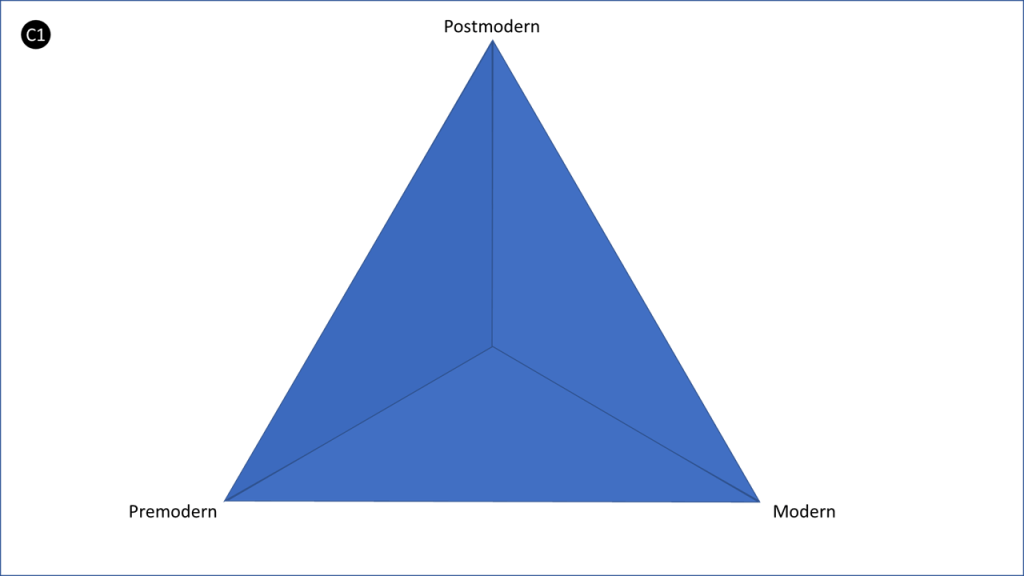
In fact, this is how I came to conceptualise the relationship as a triangle—rather a radial chart limted to three points. This is represented by image C1, where there is a triangular relationship, with each of the schools of thought represented at the angles. The placement of the labels is arbitrary. That Postmodern is rendered at the top should not suggest that it is elevated or better than the others. Neither is Modern better because it resides on the right side. The triangle doesn’t indicate and time dimension.
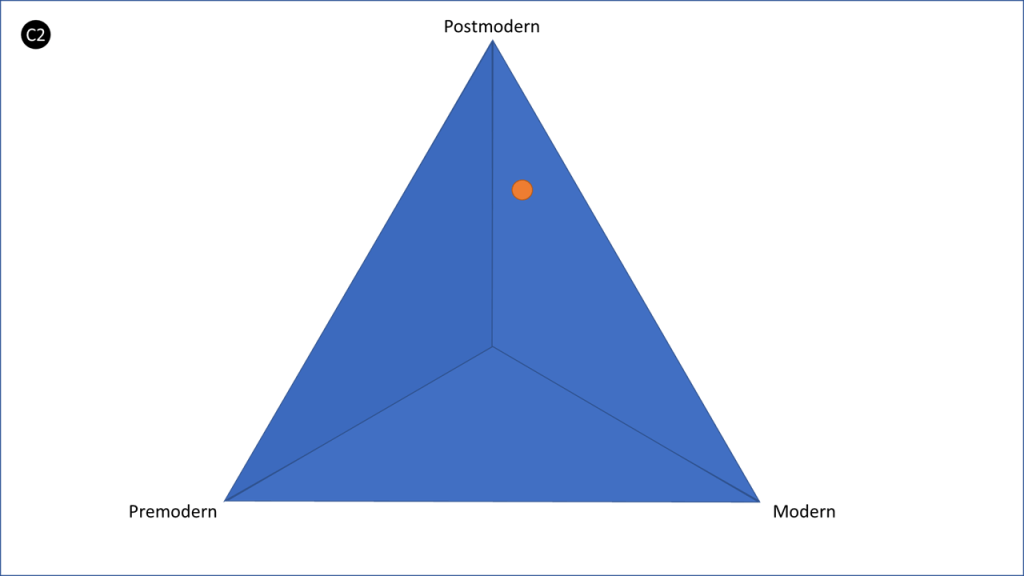
Image C2 is merely a representation of C1 with a dot to indicate placement on the plane.
Ostensibly, each angle contains dimensions and measures. I haven’t sussed out fully what these dimensions might be, but a triangle might represent individuals or aggregations of individuals. An individual or a group might place differently at different times.
Regarding the triangular plane, the concept is that an entity may hold belief sets of any or all of these worldviews simultaneously. A bit of self-reflection might place be on the orange dot in C2, though the chart is arbitrary and not to scale. No animals were harmed, and so on.
Moreover, it’s important to distinguish between the system of belief and the pragmatic life of an entity. In my case, I feel that I am intellectually a Postmodern. I have an incredulity toward metanarratives, don’t believe in objective truths, and feel that every system requires context to evaluate. This said, I am quite strategic and analytical. Also, although I’ve been called many times a Stoic and Spock from Star Trek, my emotions and cognitive biases and sense perception deficits still allow me to favour the underdog as a Social Justice Warrior.
socialism never took root in America because the poor see themselves not as an exploited proletariat but as temporarily embarrassed millionaires
— No one in particular
It’s been pointed out that many Postmoderns are simultaneously Marxists or otherwise Leftists. Personally, I feel these are simple covariances, that a Conservative has to give more weight to history and teleological arguments, thereby qualifying as a Modern, whereas a Postmodern is more likely to dismiss these are metanarrative-laden. I consider myself a Leftist, but again, this is an emotional rather than intellectual decision. As a Postmodern, intellectually speaking, I believe there is no way to determine whether Anarchosyndicalism is better or worse than Republicanism or Oligarchy, but I know how I feel about these. And without going down some political rabbit hole, it’s plain to see that many people are predictably irrational and vote against their own interests time and again as they believe some narrative where they see themselves in another position where this self-deprecation will pay off in the end. This is embodied in the meme that “socialism never took root in America because the poor see themselves not as an exploited proletariat but as temporarily embarrassed millionaires.” This is usually misattributed to John Steinbeck, but the sentiment remains—don’t tax the rich—because I am just a stone-throw away from that—if only I paid less in taxes.
Finally, there are the Premoderns. These people are not only nostalgics, but they retain superstitious beliefs, favour natural remedies, and Ayurvedic treatments. They retain religious beliefs—some even preferring pre-Judeo-Christian paradigms. And yet they may also be scientists and otherwise structured thinkers. It’s harder for me to conjure scenarios where an entity might simultaneously hold Premodern and Postmodern beliefs. Off the cuff, it seems that one might believe in some sort of cultural relativity and at the same time believe in some shamanic healing or Ayahuasca retreat for cleansing or getting in touch with the universe. I wouldn’t presume it’s that unusual for people to hold antithetical and mutually exclusive beliefs. I am not superstitious, but I carry a lucky penny or some such.
My next step in this journey is to dimensionalise the model. I already have got some ideas, many of which have already been captured here, but my familiarity with Premoderns is limited and probably contains a lot of stereotypes and caricatures.
I watched the video, What Makes us Postmodern, and its predecesor, What Makes Us Modern, and I immediately discounted any attempts to synthesise Modernism and Postmodernism in some Hegelian manner, Hegel’s approach being somewhat Modern at the start. One can pair the essential dimensions and perhaps arrive at some moderate position, but, firstly, this is a Modern perspective; secondly, Moderns are not likey to abandon their position.
There may be a resolution, but it seems that it will require a paradigm shift—a different perspective still.
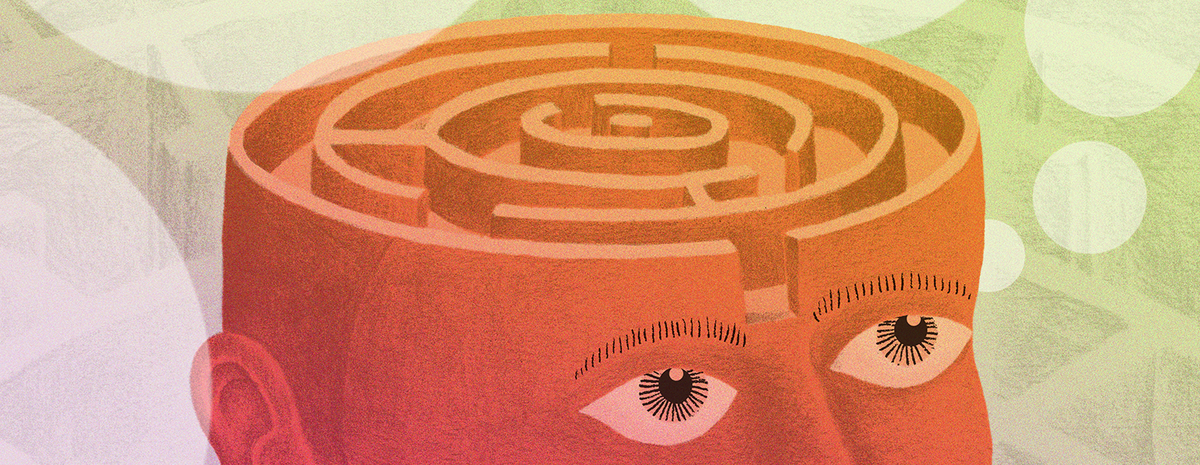
Ancient Greek mythology gives us the story of the Labyrinth. As I am not interested in analysing this from a Jungian perspective, we can safely ignore the Minotaur. The story of the labryrinth is a story for Moderns. It’s a teleological story based on the metanarrative that suggests that one can find order in disorder, if only they have the key.
As the story goes, the labyrinth is an unsolvable puzzle. However, at least one person knows how to solve it, or at least knows how to beat the system. Depending on the source version, Ariadne either assisted Theseus with a thread or jewels.
In a tl;dr version of the story, Theseus is tasked with killing the Minotaur. I’ve recently discussed his ship. Exposition informs us that the Minotaur is mortal, thus killable, but there is no escaping the maze—for reasons. However, Daedalus, the architect of the labyrinth, told Ariadne that there was one way out. If someone were to record their ingress, with say, a thread or jewels, they could then follow these to egress. Definitely not a plot device. Hansel and Gretel took this to heart and marked their ingress with breadcrumbs—or stones, depending upon which version you’re reading.
What Makes this Modern
Though the story of the labyrinth and the Minotaur comes from a pre-modern era, it remains an apt metaphor for modernity.
There is a deliberate underlying structure. In fact, it has been architected by Daedalus. This mirrors the Intelligent Design narrative favoured by Christians.
There is a definitive solution to the puzzle. The story is teleological. If one follows the plan, stays on the path, they will prevail. Go off-script, and perish.
This is a story about structure, about order, about adopting and conforming to the rules. Even though it’s also about gaming the system with cheat codes in more modern parlance. Nowadays, I’d turn off clipping and collision detection, but Ariadne didn’t know these codes. I digress.
Postmodern Reaction
This is not a story for Postmoderns because it starts with a design. For moderns, there is a design. It’s either a vestigial god or science. The belief is that everything has structure. Even if that structure is yet unknown to us. If only we had enough time, we could suss it out. Perhaps it’s past time to re-task Shakespeare’s infinite monkeys.
Reconciliation of this teleological belief is intractable. Rather, it can likely only be solved with rhetoric. Moderns love rhetoric, which explains why they have so much faith in Aristotle and classical philosophers, who still provide a foundation to much philosophy of the Moderns. It’s intractable in the same way that converting someone with some religious conviction to no longer have that conviction.
Modernism is about faith. It may have shifted from faith in gods to faith in logic and reason, science and technology, or organisation and progress. Postmodernism points out that whilst these are possible solutions, they are not the only solutions. Moreover, these have unintended consequences and create collateral damage. They also rely on a privileged perspective. Perhaps I’ll create a segment to illustrate this point using the disruption of COVID-19 as a backdrop.
In the end, Modernism relies on teleologies. The end may not be known, but we can divine a vision and lead people in that direction anyway by employing rhetorical devices. Postmodernism knows that any such narrative is fiction. A postmodern may emotionally buy into the narrative, but they never forget that it’s still fiction.
Modernism relies on order and control to maintain that order. This doesn’t mean that all Moderns are top-down authoritarians. But it does mean that they need crowd control and compliance. The United States are probably mostly Moderns. They like to claim they are individualists, but they are more typically either keeping up with the Joneses or competing with them. Most individuality is trivial at best. “I’m an individual because my BMW is purple.” Quite. And Moderns don’t like much non-compliance. They may want change, but if someone expresses this need for change through civil disobedience, the Modern may viscerally agree, but they will also rationalise that the civil disobedients should have used the admittedly broken system. Moderns like what they call progress, but they can only accept change in small doses at a slow pace, so there’s a friction.
Finally, there’s power. I am not going to rehash Nietzsche or Foucault, but this is a schism. Moderns want order and control. Power structures assist this, but then they don’t like the current actors. If only there were better actors. Nietzsche noted that the masters and the herd had different interests and moralities. Moderns know this on one level but think they can remediate this dichotomy. Because of course, they think they can bring order to everything—Second Law of Thermodynamics notwithstanding.
In the end, these schools will likely attempt to coexist. As for me, I’m a nihilist and somewhat of an existentialist. Yet, I am also a pragmatist as I still have to operate within the world I’ve been thrown into, as noted by Heidegger.
Audio: Philosopher Bry Willis discusses this topic.
Postmodernism was summarised by Lyotard as having an incredulity toward metanarratives.
What does this mean? What are metanarratives, and why harbour incredulity toward them?
Audio: NotebookLM podcast on this topic.
Metanarratives are narratives. Stories presented through a lens with a certain perspective. These stories provide a historical account of how a culture arrived to where it has. They can be viewed as origin stories. Metanarratives are also teleological, as they provide the foundation to progress, to advance the culture to a better future. Embedded in these metanarratives are the rules and conditions necessary to navigate, both from the past and into the future.
We’ve got stories. In his book Sapiens: A Brief History of Humankind, historian, Yuval Noah Harari tells us how important stories are for having made human progress. Hooray for us!
This sounds good so far. Right? We’ve got Caesar, Cornwall, and Kahn. We’ve got triumph of us over others. Good prevailing over evil. Right over wrong. So why the incredulity?
Let’s keep in mind that Lyotard is suggesting incredulity and not rejection. The narrative could be fine and accurate enough. One might argue that the benefit of the narrative for the purpose of cohesion outweighs the detriments posed.
There are several notable problems with metanarratives.
Firstly, the past suffers from a cherry-picked survivorship bias. The story threads that don’t support the narrative are abandoned, and some threads are marginalised. So, there’s a dimensional problem. As with any historical account, one needs to adopt a perspective and create a story. Let’s not forget that the word history comes from the word story. In fact, French only has one term: l’histoire. History is story.
Secondly—and this is somewhat related to the survivorship bias problem—, is that we privilege the perspective we take to view this history. In his book, We Have Never Been Modern, Latour uses this line of argumentation to arrive at the conclusion that we have never been modern. It is only because we are here now and surveying history through a rearview mirror that we can even look into the past. And we feel that we have somehow overcome this past. The past was primitive, but we are modern. Some time in the future we’ll deservedly be viewed in the same light because that’s how progress works. But there is no reason to accept this privileged assignment. It’s a function of ego—and to be even more direct: hubris.
Lastly, there’s the issue of teleology. Through this privileged vantage, we orient toward some alleged destination. Like fate, it’s just there for the taking. The only barriers are time, not keeping your eyes on the prize, and not following the rules to get there. There’s an embedded deontology. Those other societies don’t understand what it takes. You need to follow this path, this religion, this sports team. Because this is the best there is.
But there are no crystal balls. We cannot divinate the future. There is no particular reason to believe that our imagined path is the best path. If you don’t believe this, just ask the culture next door.
I’d like to think that somehow Progressives would be more aware of this tendency—and perhaps in some sense they are, but it’s not very apparent pragmatically. I don’t want to get distracted by the notion of institutionalism, but that is evidence of taking a privileged position regarding the status quo—even if your vision of the future would take a different path than your more conservative brethren and sistren.
In closing, this has been a summary of the problem postmoderns have with metanarratives. It could be that the metanarrative you believe to be valid is valid. It could be that your religion is the true religion. It could be that your sports team is the best sports team. That your system of government is the best of all other alternatives. It’s more likely that you’ve convinced yourself that these things are true than them being true.
We can either adopt the perspective of Voltaire’s Dr Pangloss and consider our world to be the best of all possible worlds, or we can step back and consider that we haven’t exhausted all of the possibilities.
Riffing on my recent post, I wanted to provide a tab more perspective on my claim that postmodernism serves a purely disintegrative function. Anyone can disintegrate a narrative into constituent parts, but postmodernism provides no grounds for privileged reintegration, as this too can be disintegrated. So, whilst one is free to disintegrate and even to reassemble the parts, one is never in a position to claim that this is how it should be put together because this privileges the subject and another subject can always come along and privilege another perspective. Also, there is no PoMo toolkit available to reassemble the parts that I am aware of.
When I was a child, a neighbour owned and operating a demolition company. He disintegrated buildings. He kept some of the materials and sold some other for scrap. Whilst these materials could be repurposed and used in the construction of another building—or a picnic table—, this was not the function of the demolition company. It’s safe to say that no one was ringing him up under the premise that he had tools, so why won’t he build them a house. He knows houses, right?
This is the same problem we face when deconstructing a narrative with postmodern tools. If we want to construct something, we can, but we should expect that no matter what we do, the next wave can readily knock it down. And though we can rebuild more castles made of sand, they are all subject to the same forces.
* I admit that this title was lent from The Cure’s Fascination Street, which does happen to be on their album Disintegration.
Postmodernism seems to have as many definitions as the number of people who encounter it, and that’s just not very useful. It’s less useful still when people with ulterior motives control the narrative. I’d like to take back the narrative and offer a succinct definition or description and offer reasons why some of the competing definitions are fundamentally incorrect. My journey commenced on my Descriptive Postmodernism post.
Each year, I start with a new notion to explore. For 2021, it’s postmodernism. I identify as practicing postmodernist, but it seems to have a nebulous definition, and many people assume it means different things. Some definitions seem to comport and others are curious takes. I am well-aware that some people in this space have opinions at least as strong as mine, and many have deeper and/or broader exposure than I do. Nonetheless, I feel confident that my logic will resonate.
Audio: NotebookLM podcast conversation about this content
As I pursue this definition, I will explore a line of inquiry that I hope will help to frame the issue.
These are my initial questions:
What is the core definition of postmodernism?
Why hate postmoderns?
Why can’t postmodernism be constructive?
Why do postmoderns deny Truth?
When did postmodernism, a critical, dis-integrative concept become identified as being integrative?
How does one parse the theory of postmodernism from the personality who espouses a perspective on it?
Postmodernism can be viewed as a reaction to so-called modernism, but it’s not so cut and dry. Postmodernism as an intellectual pursuit was in full force in the 1970s and 80s. But Modernism was still the main thrust, as is remains today. Post- is likely an overstatement, as it did not supersede. In comparison, post-Enlightenment thought—reason and logic—still competes with pre-Enlightenment thinking—metaphysical and superstition—, but even persons holding post-Enlightenment views still cling to traditional beliefs. Contrarily, people holding modern beliefs are not likely to simultaneously hold postmodern beliefs and vice versa. For moderns, postmodernism is a hot button, trigger item. For this cohort, any association will set them off.
What is the core definition of postmodernism?
From early on, postmodernism has been used as a pejorative term by its detractors. Many academics associated to postmodernism do not identify as postmoderns. They have been categorised as such, as something they have said or written is heretical to the Modern orthodoxy.
These days—if not from the start—postmodernism is nebulous. It has long since lost its brand to detractors, and its definition is undergoing some revisionist history by this cohort. What started as a perspective or lens to disintegrate content and context is now seen by many as possessing a point of view for constructing, for building.
The Condition of Postmodernity Before defining philosophical postmodernism, let’s first exclude a possible source of confusion: postmodernity. Postmodernity is a periodical distinction, a cultural state where it occurs chronologically subsequent to the period referenced as Modernity.
Postmodernity is a condition or a state of being associated with changes to institutions and conditions and with social and political results and innovations, globally but especially in the West since the 1960s, whereas postmodernism is an aesthetic, literary, political or social philosophy, the cultural and intellectual phenomenon, especially since the 1920’s new movements in the arts and literature.
To be fair, the philosophy of postmodernism is a reaction to the philosophy of Modernism, but there was a diversion of the periodic reference from the philosophical. If we adopt this definition, the only requirement for inclusion is to have been active in this period. Since Feminism and Marxism were coincidentally prevalent phenomena, it would be easy to include these by virtue of chronology, but it doesn’t follow that these fall into the philosophical notion of postmodernism. It may be a simple matter of the ambiguity of language.
Some social theorists and sociologists—Scott Lash, Ulrich Beck, Zygmunt Bauman, and Anthony Giddens—deny that there is a postmodern condition. Instead, they suggest that modernity has simply extended into a state of late or liquid modernity.
Simplifying to the extreme, I define postmodern as incredulity toward meta-narratives.
Jean-Francois Lyotard
To establish a grounding and because he got there first, let’s see how Lyotard defines it in the introduction to his Postmodern Condition:
Simplifying to the extreme, I define postmodern as incredulity toward meta-narratives. This incredulity is undoubtedly a product of progress in the sciences: but that progress in turn presupposes it. To the obsolescence of the metanarrative apparatus of legitimation corresponds, most notably, the crisis of metaphysical philosophy and of the university institution which in the past relied on it. The narrative function is losing its functors, its great hero, its great dangers, its great voyages, its great goal. It is being dispersed in clouds of narrative language elements – narrative, but also denotative, prescriptive, descriptive, and so on. Conveyed within each cloud are pragmatic valencies specific to its kind. Each of us lives at the intersection of many of these. However, we do not necessarily establish stable language combinations, and the properties of the ones we do establish are not necessarily communicable.
The simple definition is captured by the first sentence. The rest is exposition. But let’s rewind for a bit and establish a frame. Admittedly, even at the start this is ‘simplifying to the extreme‘. Moreover, the context is relative to hard sciences. Lyotard admits he was over his head. In fact, he later referred to the book as his worst. But books have lives of their own, a sentiment with which Barthes might agree.
The central point here is to question metanarratives. Period. Full stop. The next task is to ask how a postmodern might accomplish this task and what might be their perspectives and tools?
In Reclaiming a Scientific Anthropology, Lawrence Kuznar claimed that « the primary tenets of the postmodern movement include: (1) an elevation of text and language as the fundamental phenomena of existence, (2) the application of literary analysis to all phenomena, (3) a questioning of reality and representation, (4) a critique of metanarratives, (5) an argument against method and evaluation, (6) a focus upon power relations and hegemony, and (7) a general critique of Western institutions and knowledge. » [See end note 1]
Postmodernism is a disintegrative system. It disassembles, deconstructs, atomises, and lays bare. It is suspicious of underlying metanarratives—and I’d be willing to argue that it is equally suspicious of stated narratives as well. It questions who is served by a given narrative, who gains and loses power by one interpretation over another.
[tools and systems]
In the end, a reader may disagree with what I am proposing here, and the reader may even be correct in claiming that my definition is too reductive. Perhaps, I should abandon the postmodern label and simply recast my definition as Disintegrationism or some such. Deconstruction is already taken, so why not?
Why hate postmoderns?
One problem I notice is that postmodernism, long being applied as a pejorative term in a similar vein to the use of SJW, is a way to discredit personalities and ideologies they disagree with. We see entire ideologies being besmirched as postmodern theories. We might see Stephen Hicks misrepresent postmodernism and conflate feminism with it. Moderns are by nature traditionalists or conventionalists, so whether postmodernism, feminism, Marxism, and the like, these are unconventional. It may be a simple heuristic trick to paint all of these with a broad brush. Nuance and difference be damned. [See end note 2] Jordan Peterson‘s bete noir is cultural Marxism, that he insists is part of the blight of postmodernist thought.
Many have attempted to conflate social theories with postmodernism, whether Marxism, feminism, identity politics, and so on. But this is inherently wrong. Lyotard provided postmodernism with its original definition in his book, but detractors have been annexing other unpopular concepts to it in order to create a sort of critical mass for the uncritical opposition.
Why can’t postmodernism be constructive?
Postmodernism necessarily can’t be constructive, because after one disintegrates a perspective into its primitive elements, any reconstruction needs another narrative to serve as a foundation. It is true that one may reconstitute a disintegrated narrative through a different lens, as cited above Marxist, and so on, but all this does is to shift perspective, point of view, and creates a new power play.
There is nothing wrong with this approach, but neither is there a reason to privilege this interpretation over the original or some other. A Marxist perspective may resonate better with Marxists, and Feminist perspective with Feminists, but this doesn’t make the interpretation better or more generally applicable. It just brings it into clearer focus for that cohort. As near-sighted lenses help the hyperopic and far-sighted lens aid the myopic, neither is inherently better outside of the defined context. And each solution would create a distortion for a person neither near- or far-sighted. There is no lens that is all things to all people.
On balance, I think it’s fair to say that postmodernism is descriptive and not prescriptive, so whilst one can play at disintegrating and reintegrating, but this is simply to gain a new perspective and new insights. In literature, we might consider, say, Philip K Dick’s, The Man in the High Castle. In this, Dick explores what might have been if the Axis led by Nazi Germany had prevailed. This alternate historical rendering can be evaluated as a postmodern exercise. Dick is not promoting this outcome, he is merely playing what-if—reordering the actors to create speculative new narratives. Although the Amazon.com version takes liberties and injects additional narrative perspective, the reintegration is still evident.
As well, postmodernism cannot be constructive because it would be infinitely recursive. For each construction, there would exist a deconstruction. All that’s occurred is a rearrangement. From the same Lego pieces, we apply a new map—a new narrative. From the position of purpose, one construction may be deemed better or preferred, but this is not likely to persist from another.
Disintegration – Reintegration Cycle
Whilst I am more interested in the philosophical, postmodernism has much application to literature. This might be better defined as poststructuralism.
Why do postmoderns deny Truth?
Some people have argued that postmodern thinkers don’t believe in the notion of Truth.
There are a few things to clarify first: the definition of truth and the context of a truth claim.
There are different and competing theories on what truth is—whether correspondence, coherence, or some other version—but that’s beyond the scope of this content. Some people use ‘truth’ as a synonym for ‘fact’, but in the name of clarity, we should separate the two concepts even if idiomatically the terms can be used interchangeably. [See end note 3] In creating this bond, it’s easy to see how these people might be confused. Virtually no one is proposing that ‘facts’ are not ‘facts’. It may be that postmodernism should have a weak and a strong version.
If the colour red is defined as the reflection by an object having a wavelength between 625 and 700 nanometres and a corresponding frequency between 400 and 480 THz, and a ball as a 3-dimensional object where every point on the surface is the same distance from the centre, and all of the incumbent terms are similarly defined and accepted with concordant definitions, then a sighted person with no colour vision perception deficiencies in an environment with natural full-spectrum lighting, will agree with the fact that the sphere is red. If one prefers to label the correspondence of a red sphere and the perception of the red ball as true, then this trivial relationship is valid.
2-dimensional render of a 3-dimensional red sphere
It may be a correct assessment that some thinkers deny all truth, but it’s more likely that these thinkers are suspicious of the person claiming to know the truth because of the relationship between truth claims and power. Although Lyotard’s commentary was directed at hard science and underlying metanarratives such as progress, most postmoderns are more concerned with claims of moral truths.
This is related to the context of a claim. Per Foucault, if one context gives me power, I am more apt to adopt that perspective in order to manifest that power. I am not going to delve into some political discourse at the moment. Apart from this, Truth—where synonymous with fact—is contextual.
Using a typical example, one can evaluate the moral claim that killing another human is immoral. In fact, many—not all—people may agree with this as a general principle. But when we apply context—say, self-defence, military action, or capital punishment—, we discover that some of the same people now evaluate that killing another human is moral. So, we arrive that this moral assessment is subject to be either true or false depending on the context it’s evaluated in. Myself, being a non-cognitivist, I find moral claims to be lacking truth aptness, but that’s another story.
When did Postmodernism become a constructive rather than decompositional philosophy?
I’ll reserve the option to finish this section later. A quick internet search finds that David Ray Griffin coined the term constructive postmodernism. Griffin appears to have an agenda to return to modernism, particularly, it seems at first glance, Pragmatism.
My initial thought is that it was not thinkers fully invested in postmodernism; rather it was people with ulterior motives. Infusing Christian elements appear to be the most common thread. This line of thought is entirely speculative, so please stand by for an update or retraction. Metamodernism appears to have similar attributes, though perhaps simply metaphysical rather than Christian in nature.
How does one parse the theory of postmodernism from the personality who espouses a perspective on it?
Many people identified as postmoderns don’t self-identify as such. Kuznar labels postmodern anyone whose thinking includes most or all of these elements, but there is a compositional challenge inherent in this claim.
There are several compositional problems. First, one can apply postmodernism to a narrow domain and operate fully as a modern in the rest—perhaps even the majority of situations. Second, one can apply a postmodern lens theoretically, but be more pragmatic in more mundane matters. Third, one might apply a postmodern lens among many lenses, defending each in turn. Fourth, one may have had strong postmodern tendencies at one point in life but not held this perspective at other points.
Taking Foucault as an example—as well as one who eschewed the postmodern label—, he did disintegrate history and did question the underlying narratives, hitting all of Kuznar’s touchpoints. For one, I would categorise him as a postmodern thinker. Moreover, his disintegration led to the discovery of a common power thread throughout. Much of his writing was focused on this power relationship and illustrated how it was manifest.
Foucault was also a vocal Marxist. This is a constructive (integrative) worldview. This perspective gives privilege to Marxism, which is antithetical to postmodernism. As a rational interpreter, Foucault determined that this was a better form of government—but clearly, that’s because he accepted the underlying narrative and historicity proposed by Marx. Does this invalidate his postmodern credentials? Do we revoke his PoMo card?
Disclaimer
Excuse me for occasionally using this space as a scratchpad, but it serves the purpose well. I’ve never delved deeply in to critical theory, though I suppose I suppose that at least some of it resonates with me.
Note that I approach this as a stream of consciousness. It’s not meant to be a robust academic treatment. Although, I do cite source documents in some cases, many of my points are anecdotal or pulled from memory, understanding fallibility and so on. I expect to return to flesh out some details, but I figure I’ll publish my thoughts now and make updates in future. I may even correct spelling, grammar, and redundancies.
My goal at the start was two-fold (at least). First, is to describe the domains of postmodernism from the perspective of a proponent (as opposed to accepting a definition imposed by detractors). Second, is to assess where critical disintegration diverged to an integration theory. It’s obvious that you hold that deconstruction and discourse analysis fall within the domain. They are certainly orthodox post-structural concepts, so I suppose a third goal might be to define the boundaries of poststructuralism relative to postmodernism.
[2] This modern cohort has a similar tendency to paint any form of Socialism as Communism, and they see the Soviet Union’s failed experiment of whatever they attempted to do as Communism. Therefore all forms of Socialism are destined to fail. The failure to appreciate nuance and detail is the common thread. I might posit that it’s similar to the phenomenon where, on average, women tend to perceive more colours (or colour names) than men.
[3] Aping logical empiricism, idiomatic language allows for broader definitions of truth and allows it to be synonymous with fact. This is similar to the idiomatic similarity of sex and gender, though this distinction is necessary for technical and academic discussion.
I can’t count the number of times I’ve defended Postmodernism (PoMo) from attack, so I am publishing this, so I can link to it. Perhaps I am not defending PoMo, but my flavour of it, but I’ve read a lot of work published by the usual suspects—some who eschew being lumped into a poorly defined category—or at least a nebulous category.
Before I get too far, I also want to remind the reader to take care to separate the philosophy from the person. One popular attack is the conflating of identity politics and social justice advocacy as PoMo phenomena. In fact, I consider myself to be PoMO—to be defined here in a moment—and a social justice warrior (SJW), this despite contesting the very notion of identity to begin with.
By definition, a summary is a reduction of some thing, but one needs to be careful not not arrive at reductio ad absurdum. Where appropriate, one may also wish to differentiate postmodernism with postructuralism. So as not to create a definition partir de rien, I’ll reference other accessible versions. A critic may disagree with these definitions, but they will serve as the foundation of my position and vantage.
Wikipedia gives us this definition (their reference links retained):
That postmodernism is indefinable is a truism. However, it can be described as a set of critical, strategic and rhetorical practices employing concepts such as difference, repetition, the trace, the simulacrum, and hyperreality to destabilize other concepts such as presence, identity, historical progress, epistemic certainty, and the univocity of meaning.
Notice the commonalities. PoMo is a descriptive, critical activity. It’s descriptive. As language and grammar can be approached descriptively of prescriptively, so can philosophy. Some ‘schools’ do both. PoMo is exclusively descriptive. PoMo was born as a reaction to Modernism, especially the unstated foundations labelled by Lyotard as metanarratives—the grand narratives and underlying ideologies of prevailing beliefs that were uncritically taken for granted, many of which that were formed or catalysed in the Age of Enlightenment.
Jean-François Lyotard defined philosophical postmodernism in The Postmodern Condition, writing “Simplifying to the extreme, I define postmodern as incredulity towards meta narratives….”[4] where what he means by metanarrative is something like a unified, complete, universal, and epistemically certain story about everything that is. Postmodernists reject metanarratives because they reject the concept of truth that metanarratives presuppose. Postmodernist philosophers in general argue that truth is always contingent on historical and social context rather than being absolute and universal and that truth is always partial and “at issue” rather than being complete and certain.[3]
My defence is that PoMo cannot be for social justice or engage in identity, as it has no positive position on these. It functions to critically deconstruct. People unfamiliar with PoMo concepts often misunderstand this notion of deconstruction. All to often, I see people criticise Derrida for his brand of Deconstruction, but that only illustrates the fact that they never read or simply misunderstand what Derrida means by Deconstruction. Perhaps, I’ll elaborate on that in future.
My point is that PoMo is corrosive—like lye. It eats away at ideologies, dissolves them. It is not meant to construct anything. So where does this constructive expectation come from? It derives primarily from two places.
Modernism
Most people casting dispersion are modernists. They need to construct things. To be fair, this perspective has been an evolutionary advantage, but some people can’t allow a bunch of Lego pieces to remain unconstructed. This is fine, but you need another tool to perform this task. It’s not PoMo.
Ad Hominem
The other challenge is the inability to distinguish between the person and the idea. Michel Foucault was very vocal in the political realm and actively promoted Marxism, but, firstly, Foucault was not a self-professed PoMo—and for several reasons, one could come to accord with his assessment; secondly, in his deconstruction of history, he discovered a foundational component—this activity being squarely PoMo—, but he reconstructed historical narratives employing the lens of power. This rebuilding is not PoMo activity.
Parting Shot
Besides—or in addition to—ignorance, some people have an agenda, and they play ad hominem games, so if they can vilify a person and associate that person to an ideology, it can have the tendency of poisoning the well. Uncritical people won’t even notice the sleight of hand and redirect.
never attribute to malice that which is adequately explained by ignorance*
Hanlon’s Razor
A textbook example is Stephen Hick’s attempt in Explaining Postmodernism: Skepticism and Socialism from Rousseau to Foucault to conflate feminism (a positive mechanism) with postmodernism (to reiterate, a negative mechanism). In it he claims that feminists Andrea Dworkin and Catherine Mckinnon are proponents of PoMo thought, but he is apparently unaware that McKinnon has explicitly attacked PoMo as destructive to feminism. A fuller critique of Hicks‘ work can be heard on YouTube. I recommend it highly if you have the better part of an hour to spare. Jordan B Peterson is a celebrity personality whose primary exposure to PoMo is Hicks, so when you understand how off-base Hicks is, you’ll realise why Peterson is so off-base, too.
* Hanlon’s razor is originally cast as “never attribute to malice that which is adequately explained by stupidity“, but I prefer the term ignorance, as it it less value-laden and more broadly applicable. Besides, to be ignorant does not mean to be stupid. Many ignorant people are not stupid. I am ignorant of the Russian language, but I am not stupid.
I’ve been hearing that metamodernism is the next stage in the march of history toward progress. Metamodernism will synthesise modernism and postmodernism into something better that before. It’s what’s for breakfast.
Audio: Podcast conversation around this topic.
I’ve heard about metamodernism in the past, and every time I review some material, I discount it and move on. This time, I’ll react to it. My colleagues in some other online fora have suggested metamodernism (Freinacht) or post-liberalism (Pabst), who see their solution located in the middle between conventional polarities. The attempt here is to adopt Hegel’s dialectic approach, so we’ve got a starting point, an objective, a lens, and a framework. Sounds good. Let’s go. But what are we trying to reconcile?
Ideas attributed to Modernism are
Faith in science
Development and progress
Democracy
The individual
A meritocratic social order
Humanity can recreate nature by virtue of its reason
Ideas attributed to Postmodernism are
Critical questioning of all knowledge and science
Suspicion towards all grand narratives about “progress”
Emphasis on symbols and contexts
Ironic distance
Cultures have been oppressed and ruined by modern society
Reveals injustice in “democratic” societies
Relations create the individual
A multicultural order where the weak are included
Humanity has destroyed the biosphere
Metamodern Ideas
How can we reap the best parts of the other two?
Can we create better processes for personal development?
Can we recreate the processes by which society is governed, locally and globally?
Can the inner dimensions of life gain a more central role in society?
How can modern, postmodern and premodern people live together productively?
How can politics be adjusted to an increasingly complex world?
What is the unique role of humanity in the ecosystems of nature?
Reviewing the Modern List
I want to be careful not to construct a strawman or create a false dichotomy, so perhaps I do have to backtrack to touch on the Modern list.
Faith in science is exactly that—faith—and is not warranted without recognised and articulated assumptions.
The notions of development and progress rely on underlying teleological goals and values that are not universally agreed upon and don’t benefit participants in the same manner and to the same degrees. There are winners and losers.
Democracy is a specious notion that I’ve railed against time and again. This is simply one form of political organisation among many. There is no reason to elevate this form over many others.
Moderns do have an rather fixed notion of what defines the individual. A Postmodern is not very likely to accept this notion except as a snapshot that can only be interpreted within a narrowly defined context.
A meritocratic social order is a Modern concept ripe with metanarrative support.
That humanity can recreate nature by virtue of her reason—notwithstanding the odd use of ‘her, evidently a nod to Mother Nature—, there is a elevated notion that reason is a superior mechanism. I’d extend this to include the notion that many people—not just the elite—are capable of ‘reason’. Yet again, all of this is questionable.
Critiquing the Postmodern List
At the start, I’ll suggest that Metamodernism is an attempt by Moderns to re-established ground lost to Postmoderns under the auspices of reconciliation. This does not appear to come from a disinterested mediator. The constituents of the Modern list look orthodox enough for my purposes, and I wish to spend some time parsing the Postmodern list. These lists don’t appear to be equivalent, as there is more editorialising in the PoMo list. I’ll skip the the first 4, taking them as given.
That cultures have been oppressed and ruined by modern society is quite value-laden. I’d be more inclined toward cultural constructs rely on unspoken metanarratives that leads to unbalance and disrupt the playing field. Employing the term ruin is a hint that the author is a Modern out of their element. To ruin would presume a notion of something to ruin with some teleological metanarrative in play.
That PoMo reveals injustice in “democratic” societies is interesting. First, the quotes around democratic suggests that the author finds claims of democracy to be specious or finds the term is at least at times misapplied. I can’t be certain. In the end, it’s not important because it seems to be acting as an unnecessary filler anyway. I better rendering might be the phrase ‘reveals injustice in societies‘. Full stop.
Relations create the individual feel legitimate. Identity is unnecessary in a vacuum. Although Identity is a dynamic and ambiguous concept. I don’t think this will affect my assessment.
A multicultural order where the weak are included is prescriptive. This, again, is a misinterpretation by a modern. That a Postmodern makes a claim that a culture has inequalities and inequities, it does not follow that s/he is promoting some particular solution—include the weak. Emotionally, this may indeed be the reaction by a Postmodern—perhaps myself included—, but this is not part of the philosophy that points out the discrepancy. It’s an annex.
Attributing the claim that humanity has destroyed the biosphere to Postmoderns is a huge stretch. I don’t believe this is an idea initiated by Postmoderns, and I don’t think this perspective is disproportionality held by Postmoderns over some other cohort.
Perusing the Metamodern List
Now to react to the metamodern list. Having already inspected the list, I’ll point out that every one of these questions has a Modern perspective—the need to construct and resolve over a need to deconstruct and explore.
How can we reap the best parts of the other two?
Ok. The concept of best here is a bit disconcerting since best is value-laden and relies on context, which further relies on some set of narratives.
Can we create better processes for personal development?
Again, what is this person we are developing? What is the telos? Why this telos and not another?
Can we recreate the processes by which society is governed, locally and globally?
This is a binary question, so I’ll assume the author meant more. We already know this answer. It’s yes.
The question this implies is ‘what might it be?’ We already know this answer, too. There are any number of organisations and processes of government, none particularly better than the next.
Can the inner dimensions of life gain a more central role in society?
Where is the inner dimensions idea even come from? Why would anyone even accept the notion, and why give it any preference let alone credence? Not to be a dick, but why give anyone a role? The apparent metanarrative here appears to be democracy or at least participation, but there is not reason to accept this as better or worse than alternatives.
How can modern, postmodern and premodern people live together productively?
Why ‘productively’? This is another Modern notion foisted on the solution. Aside from the productivity red herring, this is a somewhat valid question, though it does elevate the notion of an inclusive society, and there is not reason to accept this as a preference, again, without some underlying metanarrative treatment.
How can politics be adjusted to an increasingly complex world?
This feels a bit emptier that the other list entries. Again, the answer depends on the goals and expectations, so it requires this context.
What is the unique role of humanity in the ecosystems of nature?
Really? Humans need to have a unique role? This is obviously a Modernist-Humanist notion that elevate humans. I could see an argument where humans can be unique but not elevated. Again, what world would that be in? With notions of progress and productivity, it should be obvious that we’re again operating with some underlying metanarratives in place.
So What?
Reviewing metamodernism again, I can see why I forget about it shortly after I encounter it. Perhaps this will serve as a reminder that I’ve trodden this ground before. In summary, it’s painfully apparent to me that so-called Metamodernism is simply an attempt by Moderns to repackage and re-gift Modernism through the same old lens, but I’m not buying it.
Along my quick review of information on Metamodernism, there is a large metaphysical/spiritual element that is quite unlikely to resolve to either rationality or Postmodernism.
I may investigate other flavours of this concept, whether post-post modernism, post-liberalism, but from what I can tell, these are backwards looking toward Classical Virtue metaethical models. Besides having nostalgic value, I’m not a fan.







 Philosophics