Hooray for Me – The 1,000-Download Threshold

2–3 minutes

Some milestones arrive quietly; others tap you on the shoulder and whisper, “Well? Are you going to gloat, or shall I?”

So here we are. The Anti-Enlightenment corpus – yes, that unruly battalion of essays insisting that the Enlightenment was less a dawn and more a flash-bang grenade into the human psyche – is about to pass 1,000 downloads across Zenodo and PhilArchive. By the time you read this, the counter will likely have ticked over, as if to confirm that a non-institutionally affiliated heretic can, in fact, find readers willing to squint at philosophy written in the half-light.

I should say something gracious. Something humble. Something befitting a scholar who’s spent far too much time dismantling the sacred furniture of modernity.

Instead, I’ll say this:

Hooray for me!

Video: Midjourney woman sketch for no apparent reason (no sound)

And hooray for you, the masochists who keep downloading this stuff.

Whether it’s Objectivity Is Illusion, which politely reminds you that truth is just a social ritual in a lab coat, or Against Agency, where we pretend the autonomous self was ever more than Enlightenment-era fan fiction, or The Will to Be Ruled, in which we accept that most people would rather outsource their freedom to the nearest charismatic authoritarian – each piece contributes to the great unmasking of reason’s beloved myths.

If you’ve made your way through The Illusion of Light (cloth or paperback – the cloth is for people who enjoy prestige bindings with their epistemic despair – or on Kindle for the ones who have already surrendered), you’ve already walked the whole architecture: rooms filled with rational ghosts, temporal anxieties, moral fictions, and the faint smell of Enlightenment wiring beginning to smoulder.

And still you download. Saints, the lot of you.

A thousand reads does not confer legitimacy – nothing so vulgar – but it does confirm that the cracks in the Enlightenment’s porcelain façade are visible from more than one angle. It suggests that others, too, are learning to see in the dark, to navigate by afterglow rather than glare.

So: thank you.

For the curiosity.

For the tolerance of structural pessimism.

For indulging a scholar who insists on disassembling Western metaphysics one lovingly overlong sentence at a time.

Here’s to the next thousand. And the thousand after that. And to the collective, slow, post-Enlightenment work of maintenance in the half-light.

The Anti-Enlightenment lives on your hard drives now.

There’s no taking it back.

On the Strange Politics of Solidarity

2–3 minutes

A LinkedIn colleague posts this. I didn’t want to rain on his parade there – we’ve got an interesting binary intellectual relationship – we either adamantly agree or vehemently disagree. This reflects the latter. The title is revelatory – the all-caps, his:

SOLIDARITY IS THE NECESSARY LINK BETWEEN VIRTUE & COMMON GOOD

It opens like this:

A good society requires more than virtuous individuals and fair institutions: it requires a mediating moral principle capable of binding persons, communities, and structures into a shared project of human flourishing.

Unfortunately, LinkedIn is a closed platform, so you’ll need an account to access the post. Anyway…

Audio: NotebookLM summary podcast of this topic.

I can remember when I emerged from this mindset – or at least consciously reflected on it and declined the invitation.

Video clip: Because I felt like it. (No Sound)

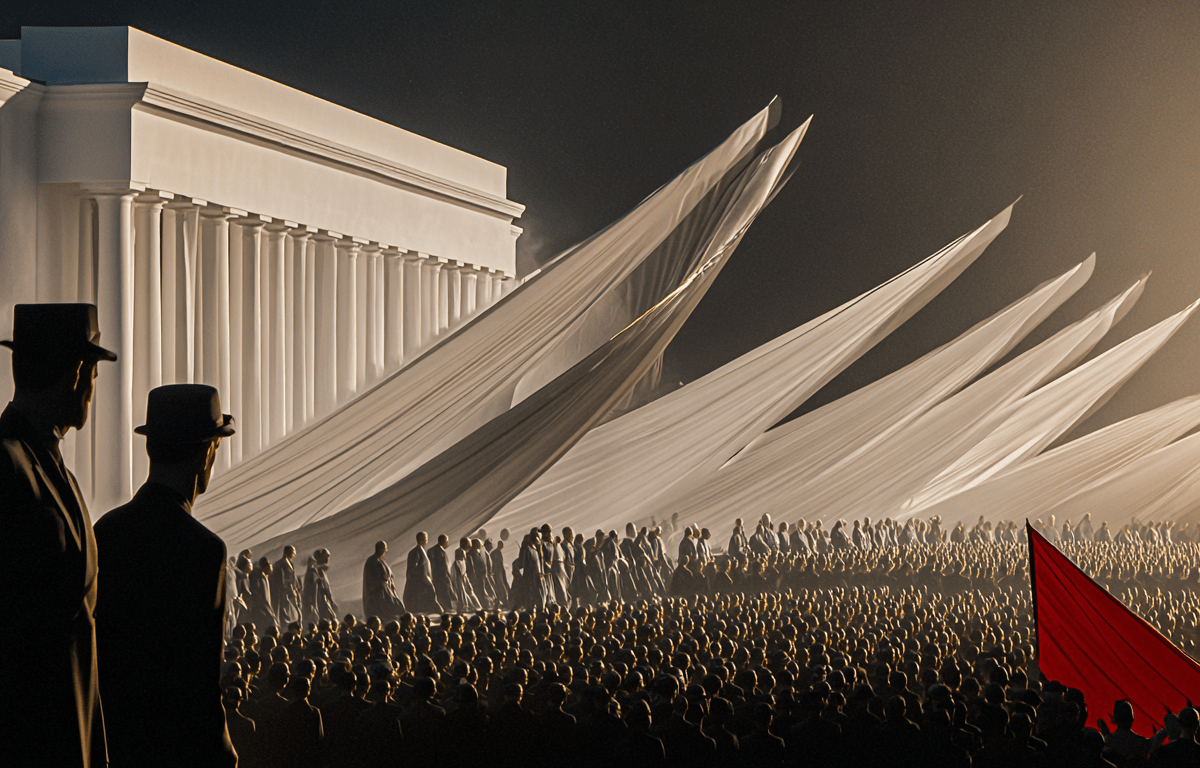
When I was 10 years old, I remember thinking about historical ‘National Socialism’ – wouldn’t it be nice if we were all on the same page in solidarity? Then I realised that I’d have to be on their page; they wouldn’t be on mine.

Then, I realised that ‘solidarity’ isn’t a warm circle of clasped hands under a rainbow; rather, it’s a demand to harmonise one’s interior life with someone else’s tuning fork. So-called unity is almost always a euphemism for ideological choreography, and one doesn’t get to pick the routine.

Children are sold the Sesame Street version of solidarity, where everyone shares crayons and sings about common purpose. Cue the Beach Boys: Wouldn’t It Be Nice?

Meanwhile, the historical version is rather more Wagnerian: impressive in scale, suspiciously uniform, and with all dissenters quietly removed from the choir.

My childhood self intuited precisely what my adult writing has since anatomised:

‘We’re all on the same page’ always becomes ‘Get on the page we’ve selected for you’ – or elected against your vote. The fantasy of we dissolves into the machinery of they.

This isn’t a bug in the system; that is the system. Solidarity requires a centre, and once there’s a centre, someone else gets to define its radius. Even the gentle, ethical, cotton-wool versions still rely on boundary enforcement: who belongs in the shared project, who must adjust their cadence, who is politely removed for ‘disrupting the collective good’. I’m more often apt to be that person than not. History merely illustrates the principle at scale; the mechanism is universal.

Anyway, this is how my brain works, and how I think how I do, and write what I write. As much as I witter on about episodic selves, this remains a prevalent continuity.