Here to Help

“The nine most terrifying words in the English language are: I’m from the Government, and I’m here to help.”

Ronald Reagan

This sentence just crossed my mind. People of a certain age may remember film actor Ronald Reagan’s quip: I’m from the Government, and I’m here to help. Libertarians seem to be enamoured by this. Perhaps smug captures it better. For them, this is about the ineptness of government, that bloated bureaucracy that couldn’t get it right if it tried, and certainly not efficiently. If the government comes a knocking, view it as you do with stranger danger: Don’t get in the van with the guy with the puppy and candy. I get it. But let’s shift perspective to see how it renders from a different perspective.

Let’s start from the start with a small disclaimer. I am not an apologist for government. In fact, I am not a fan of bureaucracy. One of the more successful propaganda-slash-marketing campaign in the sphere of public opinion is that private enterprise is somehow superior in all manners to the public version. Let’s be clear here. If one is making sweeping generalisations, then start here. All bureaucracies are created equal.

Echoing Tolstoy, “Bureaucracies are all alike; every bureaucracy is unhappy in its own way.” I may have misremembered how this opening line goes. Poor Anna. Let’s keep going. Government bureaucracy is no better or worse than corporate bureaucracy. There is no correlation. For every efficient corporation—not a thing, but bear with me—there is an efficient government agency—also not a thing, so, I think you’re realising my point. Bureaucracies are practically by definition recipes for mediocrity. They are meant to produce repeatable processes at scale. They aren’t designed to be innovative or nimble, although you can buy many books and training materials on how to achieve this if you’ve got nothing better to do with your money. Let’s return to the main concept: I’m from the Government, and I’m here to help.

I’m from the Government, and I’m here to help.

What’s the problem with this? We need to ask, why has the government shown up at our doorstep, to begin with. The answer, private markets have failed. There is a hole in the social fabric. Perhaps the private sector does provide the needed good or service, but it is clearly not affordable. Hence the hole. Clearly, the private sector has dropped the ball. So when the government attempts to intervene, the response is to cry foul. “Those people can’t afford to pay for a solution, so they shouldn’t get one. Perhaps those people should work harder or get more job training so they can afford to pay us.”

“What? Urgent medical care, you say? They should have thought ahead.”

“What’s that? She’s an infant? I suppose she should have picked different parents who thought ahead. Why do people reproduce when they can’t afford to raise a child in the first place. There ought to be a law.”

And so it goes.

Not only doesn’t the private sector not want to serve a population if it can’t profit. It’s decided that if it can’t profit from a person in a circumstance, then that person doesn’t deserve assistance. Even shoddy assistance as is suggested by the quote.

I recall another adage: something is better than nothing.

But there is more to this than meets the eye. The unstated objection is that government will provide the good or service, and it will be as good if not better than the private sector offering and it will cost less to provide. This would reveal the private sector apologists to be the charlatans they are. I am not claiming that this is some foregone conclusion. But it’s an eventuality the private sectorists don’t want exposed.

A prime example of this is the provision of healthcare and insurance. The world over provides these services cheaper and with superior health outcomes, and yet a common refrain by profit mongers is that you don’t want those other services with better health outcomes, not only provided for a lower cost, but also provided for a lower cost to you.

There is nothing inherent in this quote about the government being here to help that it is attempting to supplant some successful private sector business model.

“Why don’t we get into the yacht-building business?”

When government intervenes, it is usually due to market failure. So then why do we so often see the government trying to intervene? Availability bias aside, it’s because the market fails often, so the government has to play MacGyver time and time again. Markets are fragile. Capitalism is fragile.

The Second Law of Thermodynamics relates to entropy. Capitalism and market systems are not self-sustaining. Entropy consistently dissipates energy in these systems, hence economic busts. This isn’t even addressing the issue of misappropriation of resources from this system, which only serves to exacerbate and accelerate this natural decline. If external capital weren’t injected into this system, it would have collapsed under its own weight ages ago.

As a parting shot, it’s interesting to me that for a cohort loathing government assistance, these same blokes seem to have their hands out begging, or at least accepting, this same government assistance. The help the eschew on behalf of others is often welcomed with open arms. Where I come from, we call this hypocrisy. Hypocrisy Now. I’ve got an idea for a film.

Organised Government

Is organised government already on the same downward spiral as organised religion?

Faith in government is low. Without exception, the system has weakened and is clearly broken. The same power corruption that is bringing down organised religion is weighing heavy on governments.

In the US, Canada, and the UK, governments have become polarising entities, and most participants don’t even try to practise statesmanship. Perhaps not the governments, per se, but the forces trying to wrest control. It’s usually us versus them. This has been going on for about half a century and accelerating. Regarding religion, we hear many say they are spiritual or have faith, but they eschew the structure of religion. What is the parallel for government?

Its easy to support the concept of government—or at least of governance—and still complain about the particular instantiation: Trump’s Republicanism is good, but Biden’s Democracy is bad, and vice versa. But I’ll argue that organised government as an institution is as fatally flawed as organised religion.

organised government as an institution is as fatally flawed as organised religion

Government participation like that of religion attracts sociopaths and power-mongers. Are there acceptions. Yes. Are these people corruptable? Yes. Do the become corrupted? Some. Many simply become complacent.

In religion, some defend that they are spiritual but not religious. In politics, we have quasi- and pseudo- anarchists and Libertarians who just haven’t yet realised the source of their malaise, so they tilt Quixotically.

People haven’t quite sussed it out and can’t really seem to put their collective fingers on it, but it’s not governance most of us don’t like, it’s the misuse and abuse of power—as rendered by the NASCAR-themed political meme.

In the current environment, it’s ‘the other party’ that’s the problem. I hope that as with religion, we’ll see a turning point where people realise that it’s the system, the organisation, that’s the problem, not some aspect of it. It’s not a few bad apples. Like in a Stephen King novel, it’s the barrel that’s possessed. That barrel is the system.

Equality. Equity. Egality.

I can’t count how many times I’ve seen takes on this equality versus equity meme. One appeared on by LinkedIn feed this morning and I wanted to comment. I thought I’d have posted on this before and wanted to link to it. If I did, I couldn’t find it, so here’s a fresh accounting. I searched Google for the original image and cobbled together my own versions, if only for visual continuity.

 L’homme est né libre, et partout il est dans les fers.

Jean-Jacques Rousseau
Social Equality vs. Equity Meme

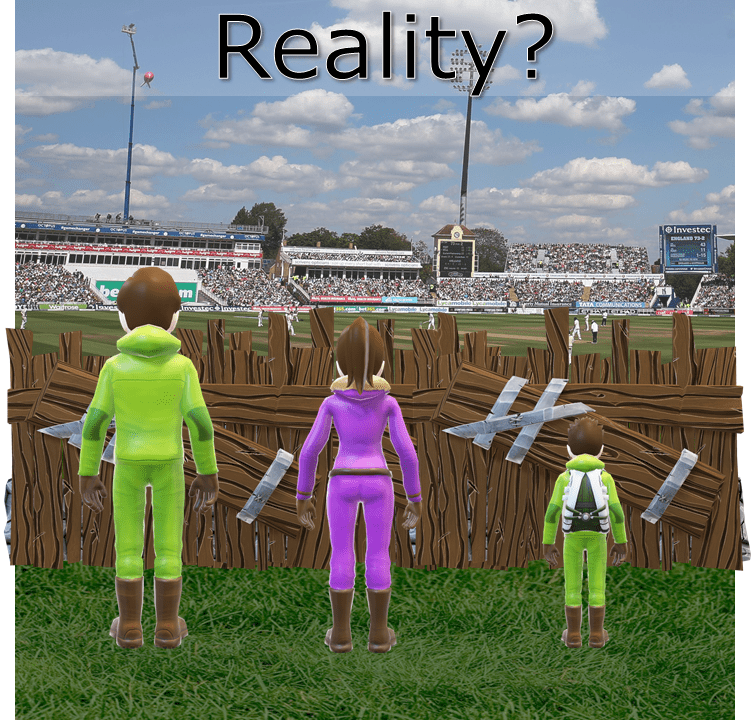
The meme renders something like this:

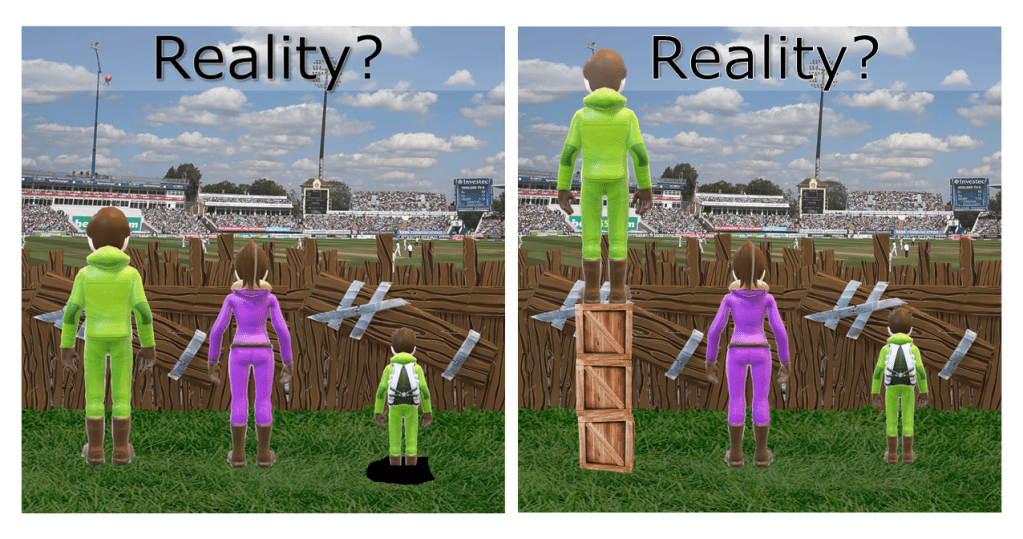
There are two frames being compared—equality and equity. In both, we see three people trying to view an event, but a barrier obstructs their view. The people are of different heights—tall, medium, and short—, metaphorically representing some intitial social status.

In one we see a representation of equality. In the spirit of equality, each person has one crate upon which to stand. This represents equality of condition. Each person is ensured to start the game on equal social footing. At a glance, it’s easy to discern that this intervention allows two of the people to see the event but leaves one of the three at a disadvantage and unable to view.

In the other, we see a representation of equity. In this frame, we see the same three people and a redistribution of the three crates. Equity is more in tune with equality of opportunity if not of outcomes. The taller person who had been standing on a crate had no need for it as he was tall enough to see over the barrier without it. The mid-size person, who could see the event with the crate but not without it, retained the crate. The shortest person was given the crate from the tallest person, now standing on a stack of two. The result is that each of the three people can now view the event unimpeded.

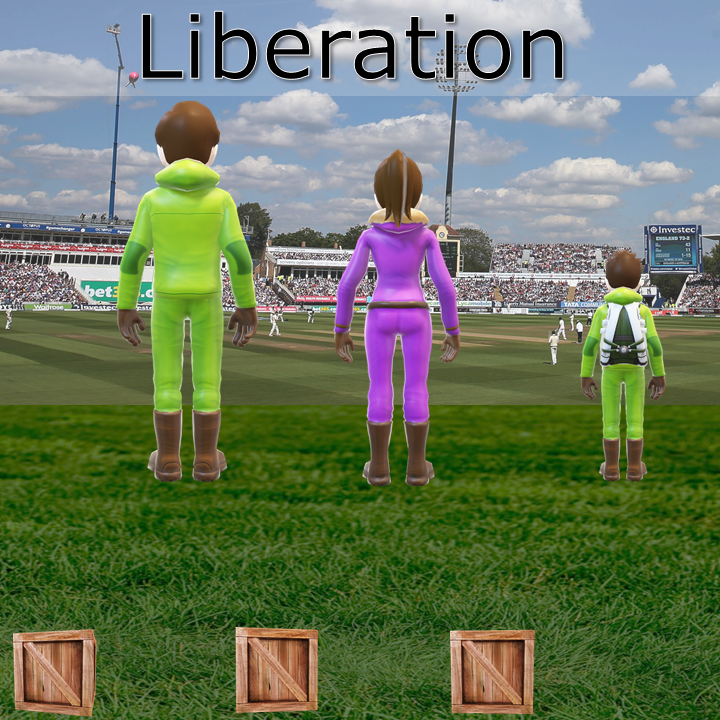
This comparison is such a nice conversation starter. It’s a hot button topic for some—and I’ll get to that presently. For me, it illustrates the concept of framing. There are several things left out of frame—at least one literally. In this meme, we are given a binary frame, but we can pull the shot back and there’s a third option: egality. This term has fallen out of favour in English, but the French retain it—égalité. In this frame, there is no need for crates, and the plank barrier is replaced by a chain-link fence.

Social Equality

Yet there’s the matter of metanarrative device. Why should there be any barrier? Why focus on these three in the foreground? Do the seated people represent the haves and those standing represent the have-nots? Might we interpret this as bourgeois versus proletariat with the focus on the struggle between the prols distracting from the broader issue? —being further distracted by the circus event? Have we lost the forest for the trees?

As it happens, people along the way have inserted their own social commentary through like-memes. I’ve similarly reconstructed these.

Societal Common Ground

In the beginning there are no crates. They are simply a device. At the start, only the tallest person can see over the barrier. At some point three crates appear ex nihilo and each person obtains one as depicted in the equality of condition frame, which leaves one of our participants better off and the other in no different of a social status, though a bit off the ground in the event of flash flooding. Small wins.

Past Burdens and Generational Wealth Transfer

Some shared the opinion that at least we all start on common ground, and yet others—likely Left- or Liberal-leaning—propose that some people start in a hole. Others might have noted that whilst some start out in a hole others start out with inherited boxes—or houses or networks—showcasing the transfer of generational wealth . Another might be able to view if there was a crate available. Given the negative starting place, the third would likely require three boxes to be on par to view, so even a redistribution of the three boxes would be insufficient.

For my first diversion, I’d like to spend a few moments defending a common response for the Right and Libertarians. Firstly, no one who supports this level-setting is suggesting that the advantaged be put into a hole like the disadvantaged. Nor is anyone asking for The Prince and the Pauper treatment where they trade places. This is a silly attempt at a strawman attack. Secondly, in a similar vein, no one is asking for the best off to relinquish everything and now be unable to see whilst the meek inherit the earth. As if that could ever happen.

Some people were overly optimistic—presumably representing the ‘if some is good, more must be better’ contingent. Why don’t we give everyone two boxes? Aside from the fact that only three are necessary for everyone to view the event, there was no mention where the original three crates came from let alone these additional three. I suppose they might have fashioned them from the fence. Who knows? But this leads us into contributions from the advocates of Capitalism.

Capitalism: Libertarian Vantage

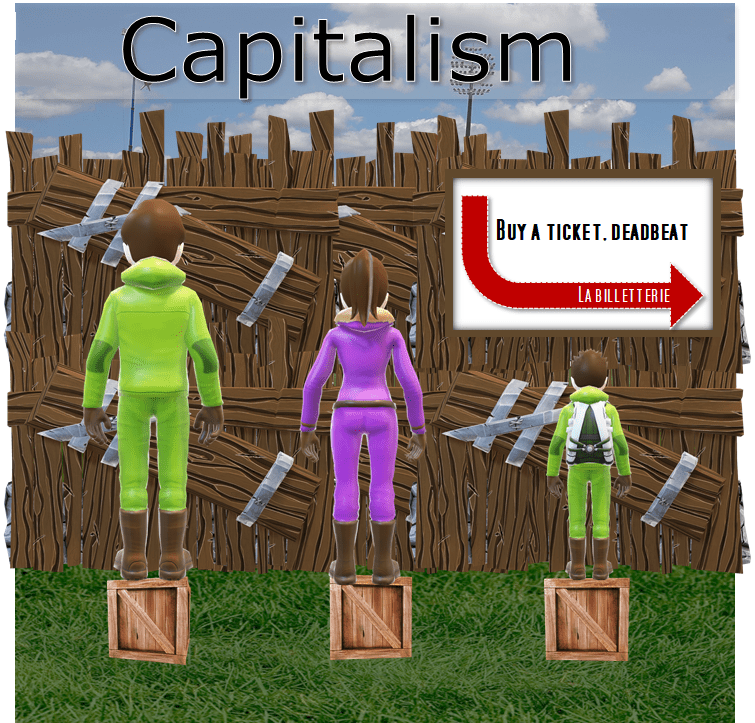
Let’s chalk this up to the Right can’t meme syndrome. To this cohort, Capitalism is the solution. In fact, there will be more crates than one could possibly use. A rising tide rises all boats—and crates. None are left behind. In fact, this is what Capitalism is known for. Of course, this suffers from several cognitive biases: survivorship, selection and availability. But who’s really counting?

For this less fond of Capitalism, this illustrates excess and waste. We needed three crates, yet we produce over thirty. Moreover, these less-fond likely also notice a capital distribution challenge with Capitalism.

Capitalism: Democratic Vantage

The prevailing view by one cohort is that some of the excess crates ‘owned’ by the tallest person should be redistributed whilst the polar perspective holds that this person ‘earned’ those crates and is entitles to keep them. And why can’t that woman just hold her child so he can see? Don’t get me started.

Capitalism for Sale

You really do have to love Capitalists. The solution is always ‘you just have to pay for it. Duh’. Without going too far off track, many of these people—likely vastly most of them—can’t afford what they want, yet they stand by this mechanism.

Socialism Kills

Some people who despise Socialism have a rather macabre perspective on how socialism operates. To them, equality can only be acheived via some Harrison Bergeron mechanism—primarily because they choose not to distinguish between social and physical equality. And maybe they are simply sadistic and enjoy watching people suffer.

My personal favourite is the one for liberation.

Liberation is Liberating

We don’t need no fences. No barriers. No boundaries. Sit on the boxes. Fill them with food for the hungry.

But in the end, if all you are fighting for is free access to cricket matches and other circus events, you aren’t really liberated anyway. You are the slave that Rousseau wrote about, ‘Man is born free but everywhere is in chains’.


Disclaimer: For the record, I have been using the term, Capitalism idiomatically equivalent to a market economy because Americans just don’t want to separate them. I think they feel that if they can pretend they are the same, that criticising Capitalism would be tantamount to criticising market economics. This is wrong on so many levels, but, at least in North America, the terms are inextricable. The fact that Capitalism is a means of production, and the other is a distribution mechanism, people—from syndicalists and worker coöperatives to Mercantilists, tradesmen, and craft-workers—could choose to distribute goods and services through a market system without consequence. It’s not even worth expending a breath. Even English dictionaries have given up and conflated the concepts. Economic textbooks are the last bastion of academic sanity.

Democracy Casino

« Democracy is the worst form of government – except for all the others that have been tried. »

— Winston Churchill

Those of us in the West defending Capital-D Democracy with passion know this quote by Winston Churchill. We accept the inherent frailties in the system of Democracy because at least we get to participate. The sentiment generally follows a path of (1) it’s not perfect, but it’s the best we have, and (2) if we could have a benevolent dictator, things would be so much easier to tidy up around the edges—only we can’t trust the succession of the benevolent dictator; (3) a Republic is Democracy levelled up. This solves many of the weaknesses of Democracy. Plato said that Socrates said so. So it must be true. Always trust men in togas.

Let’s unwind this ball of twine. Taking the quote in context, Churchill had just been voted out as Prime Minister so he was feeling a bit of a sting of democracy in action. He was being conciliatory whilst attempting to euphemise his sour grapes sentiment.

At a casino, the odds are stacked against you. As with casinos, you can raise your fist and rail at the casino for not making you better off exiting the system than when you entered it, but everyone will tell you that you should have known better. Some will encourage you with ‘Better luck next time’. Casinos and Democracy alike, if you are relying on luck for positive outcomes, you may need to consider taking another look.

At the start, Democracy is untenable even in a classroom textbook context with no frictions. At any scale, it can’t yield optimal results. What this means is that even if Democracy was operated with the precision of dispassionate AI logic, it would still be suboptimal. By extension, this means that outcomes move from suboptimal to less than mediocre when we add humans and emotions to the equation. On top of all this, what it is that we are optimising compounds these challenges. Coming to accord here is paramount. In American baseball lets consider this to be strike three.

So what about this proverbial benevolent dictator. This actually adds nothing to the equation. If the ideas of the dictator happen to align with everything our hearts desire as individuals, it does nothing to the dissenters. They are left in the same position, which is to say disenfranchised—effectively outvoted. If we are the dissenters, thus we are disenfranchised. Not that we will have been enfranchised in any case, but our desires will remain as unmanifest as if we had lost the vote.

A Republican construction, not the trademark, circle-R, Republicans, who are the Tories of the United States of America. Let Freedom ring, and don’t tread on me Republicans. These follow the Platonic franchise. This Republican construction merely kicks the tin up the alley. We’ve got fewer voters with the same suboptimal outcomes, but now we’ve exacerbated it with principle-agency problems. Not only might one’s vote not be heard, but this agent may have secured office on the promise of delivering our wants only to take the ball and run with it in another direction. Off the playground. No universal healthcare for you lot. Yoink!

In the end, Democracy offers nothing but hope. Pandora’s box hope and empty promises. It’s a specious proposition of smoke and mirrors. And to be honest it’s more smoke than mirrors. Echoing the words of a wise poet, and the feeling that it’s all a lot of oysters, but no pearls.

So, wait. What do I mean by mathematically untenable? Kenneth Arrow demonstrated that no voting systems, whether in theory or in practice, will yield optimal results. Again, this is before humans are introduced into the equation. No form, whether all or nothing, instant run-off, proportional, ranked, and so on. There’s simply no way. With as few as 3 voters and 3 initiatives, voting fails. Add voters and initiatives and it fails harder. Add human voters and it fails miserably. Many of us rail at the candidates and aspects of the system such as disenfranchisement and gerrymandering, but it had already failed prior to this. We’ve been sold a bill of goods, and the contents are rotten.

In closing, my point is that Democracy is over-sold. It’s hype appealing to emotion. We’ve got illusions of self and personal agency intertwined with illusions of control. And it is used to lull people into believing they have an impact. Instead, they complain when things don’t quite work out. A near-perfect analogy is railing at the casino when you don’t get the payout you had expected. Or that lottery ticket. It’s not that Democracy is a bad system. It’s just not all it’s cracked up to be.

And it’s not like you are being over-billed and getting ninety-nine per cent of what you bargained for. You are more likely getting less than half, and the rest is filler. You are paying for filet mignon, and you are getting bologna. You’d not accept that outcome at a restaurant, yet with Democracy, the best one can defend is that it’s imperfect.

And do politicians exploit these at every opportunity? No, as hard as they try, they miss some opportunities to exploit, but they are yet another nail in the coffin of the dream of democracy.

Should the Criminal Justice System Be Abolished?

Much of jurisprudence is based on logic founded on faulty premises of regurgitated theological concepts shrouded in naturalistic theory and pseudoscience. This is not about the defund the police social trend of 2020. This is to say that the justice system is smoke and mirrors writ large. It’s ostensibly built on anachronistic concepts such as volition, evil, soul, blame, and forgiveness that should be tossed into the dustbin of history along with phrenology, humours, and will.

The titleof this post is taken from Robert Spapolsky’s proposed chapter concept for Behave, published in 2017, where until now, it’s languished on my Want to Read list, having entered via the vector of my interest in behavioural economics. Chapter 16 was eventually published with the title of Biology, the Criminal Justice System, and (Oh, Why Not?) Free Will.

I’ve been writing for years about the nonesensical attachment to these notions, so it gives me comfort in solidarity to discover others who share, at least to some degree my perspective, knowing, of course, that this doesn’t make this perspective any more correct.

To be fair, I’ve held a low opinion of so-called justice (and government) systems pretty much since I was taught about them almost 50 years ago. In the US, much teaching is really propagandising about how fair these systems are and how peers and reasonable persons concepts make is superior. In my mind, those were the being failings. Later, when I hopped onto my language insufficiency bandwagon, it only fell apart more. Kafka’s The Trial represents the internal workings of most justice systems than the logic and reason of propogated but proponants.

Stopping here. Much to do. I recommend reading Behave. If you’ve read it, I’d love to see what you thought about it.

Western Feminisms and the ‘War on Terror’

This is why I dedicate time to watching YouTube. Although this essay was published in 2007, I had not been aware of it or its author. This work and David Guignion’s presentation is an excellent reminder of the relevance and intersection between feminism and post-modern perspectives. In the West, at least in North America, we often hear the term ‘privileged’, and many of us defend that we don’t feel very privileged. Sunera Thobani shows us how we are complicit in exacerbating world problems, particularly reminding us that not all women are ‘Western women’, and not all women need to be rescued by the West. Moreover, even women who identify with the West as a privileged or modern lens do a disservice to women who don’t hold this worldview.


Don’t let David, a male who is delivering the message, be a distraction. It feels like he is authentically trying to represent Thobani’s perspective. I provide a link to Thobani’s original article if you’d rather just read the unfiltered source.

Cover Art: sacrée frangine

Compatible with Compatibilism?

Full Disclosure: I consider myself to be a determinist. I looked for something like Dawkins’ spectrum of theistic probability to evaluate where one might be oriented on a scale of free will to determinism to fatalism whilst also considering compatibilism.

Dawkins’ spectrum of theistic probability

Let’s lay some groundwork by establishing some definitions from most constrained to least:

  • Fatalism : a doctrine that events are fixed in advance so that human beings are powerless to change them
  • Compatibilism : a doctrine that maintains that determinism is compatible with free will
  • Determinism : a theory or doctrine that acts of the will, occurrences in nature, or social or psychological phenomena are causally determined by preceding events or natural laws
  • Freewill : freedom of humans to make choices that are not determined by prior causes or by divine intervention

It seems that freewill and fatalism are bookends with compatibilism attempting to moderate or synthesise freewill and deteminism. But it also seems that one’s selection may be contexual. Ultimately, this argument is fraught with semantic challenges insomuch as some underlying concepts are yet unresolved.

Crash Course Philosophy does provides a nice summary of the challenges in defending even compatibilist positions away from detemininism and even fatalism.

As this video notes, our choices may appear to be free, but it doesn’t take much effort to perform a 5-whys investigation to remove anything but homoeopathic amounts of agency.

Taking a short example, let’s look at the cases of the trial judges mentioned by Sapolsky (Behave) and Kahneman (Noise). Given all of the factors entering into sentences, prior offences, sex or gender of either the defendant or the judge, education, income, and so on, but far the largest factor in determining the length or severity of a sentence was the time between the sentencing and the judge’s last meal—effectively their blood glucose levels.

Some may argue that this is a short interval, but behaviourists would argue that a person now is a culmination of all of their experiences to date. That the decision of the so-called criminal to rob the liquor store (going for the stereotype here) was not the result of low blood sugar. This may be true, but there is still an unbroken chain of confluent events that brought them to that place.

From a culpabilty perspective, even absent true agency, the offender should still be incarcerated or whatever to prevent this behaviour from repeating. Of course, if you believe in rehabilitation, you are necessarily a behaviourist in soem shape or form: the idea is to effectively repattern experience impressions. The other problem is one of probability. That you did X once, are you lilkey to do it again? If not, then there is no further risk to society, as it were. Given the probability of recitivism—and some argue that mass incarceration increases the probability or attempting criminal actions post-release—, is this even an effective deterence? It’s time to get out of the rabbit hole.

From my position, it is impossible to reconcile experience and freewill. The best you can argue is that one is free in the moment—like some strange improv exercise, where you are shown a film that stops abrutly, and you are instructed to act out the remainder of the scene. Is this free, or is this extrapolating on your experience.

Skipping to fatalism, how probable is it that absolutely everything is determined. Reality is just a film we are both in and observing or experiencing, but all of it is already laid down. We are just unawares. Every strange plot twist and early exit was not only already scripted, but it’s already been captured. There is no room for improvisation or flubbed lines. There is no opportunity to go off-script. Even these words are predestined. Even unpublished thoughts were not meant to be published.

There is no way to test this sort of system from inside the system, and there is no way to get a vantage above it, so here we are.

The notion of determinism affords humans some modicum of agency, perhaps akin to one part in a trillion trillions. Practically, we are taking credit for a butterfly effect—and punishing for this degree of freedom. As Sapolsky has noted, most instances of perceived agency are trivial. We can ‘instruct’ finger movement with our brain. Ostensibly, we think: move finger; bend; point; stop. And even so, what was the cause of the thought to move the finger? Was there truly a non-causal event?

Cognotive dissonance ensures that we can’t allow ourselves to be NPCs or automotons. We have to omuch hubris for that. We must have some free will. Some religions say we not only have agency here in this life but that we chose the life to begin with. Even so, we’ve not seen the script in advance; we’ve merely chosen which lessons we want learnt.

So what about compatibilism? Sort of, who cares? Whilst I can define some interstitial state between free will and determinism, it seems that it would not be even tempered or would otherwise skew heavily toward determinism.

What keeps me from being a hard determinist is that I hold out hope for statistics, chaos, and stochasticism. One might argue in return, that these, too, are determined; we just don’t see the underlying connection. And that’s my cognitive cross to bear.

To be fair, it seems that the notion of free will or even compatibilism are secondary, let’s say, reactions to the need for culpability, for moral responsibility. Societies are built upon these notions, as are legal systems. Necessary ingredients to invent are:

  • ‘Individual’
  • Agency and Volition
  • Choice, Motivation, and Intent
  • Responsibilty and Blame

None of these actually exist, so they need to be invented and constructed in order to associate self-control to actions. In fact, we have insanity escape clauses to recognise that there are cases where control is lost, whether temporarily or permanently, or never had in the first place for any number of ‘reasons’. At core, these attributes are necessary to exert power in a society. The next goal is to convince the actors or subjects that these things are ‘real enough’— as the saying goes, ‘good enough for the government’.

Even if we accept these things at face value, the interpretation and processing of these are different animals still. The notion of Will itself is likely speceous or another fabricated notion. Perhaps, I’ll address Will on another day. Probably not, as all of this is distracting me from my language insufficiency work.

When I think about free will, it is foisted on humanity in the same manner as gods and religion. With gods, we have been defending against theism for millennia. The gods fetish and free will are inextricably linked. As with the chicken and egg connundrum, the question is whach came first. Is God a reaction to fee will, or is it the other way around. Did we create free will to allow for responsibility and then fabricate Supreme busy bodies to act as ultimate judges? Or did we create the gods and build out the myth of free will to accommodate punishment of deviant behaviour. Or are these just parallel constructions? Enquiring minds want to know.

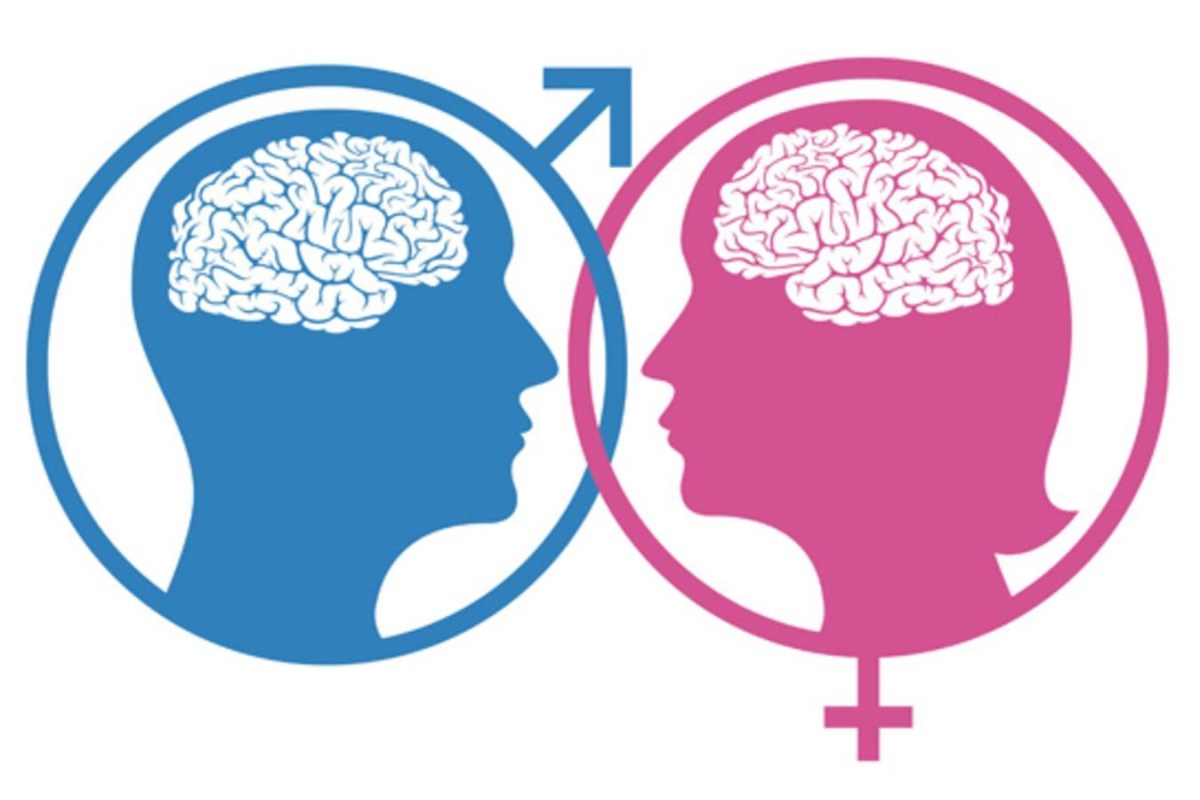
Gender Constructs

I’ve been following Philosophy Tube since Abigail was Ollie. Always top-notch material. Their content has gotten longer over time, so I’ve found myself skipping over in favour of shorter presentations. I am so glad to have decided to watch this one.

As anyone who follows me knows, I am a big advocate of social construct theory, yet I learned so much in this vid, which is proper well-cited AF. Lot’s of new content to add to my backlog, so I’ve got more than enough reading material for my next few incarnations at least.

The biggest takeaway for me is the notion that not only is gender a social construct, but so is sex itself. Previously, I have defended the sex-gender distinction, but in fact, scientific taxonomies are still social constructs—only in the scientific community rather than the greater community at large.

Abigail’s platypus drives home the point. Not that it’s some big reveal. Another less poignient analogy is fruit and vegetable classification. Tomatoes are fruits. Mellons—watermellons, pumpkins, and so on—are fruits. Say it ain’t so.

Give it a viewing and like or comment here and/or there.

Counting on Grammatical Gender

This wall of words was posted in a Facebook that the AI thought I would be interested in. I’m not, save for the rhetorical and grammatical structure. I am not interested in the veracity of the claim or the sentiment it is meant to provoke.

May be an image of text

The author purportedly had a conversation with a former student, who identified as being a member of another race—black, I suppose; African-American in the current vogue; negro and coloured in bygone days.

Notice the head-fake. A conversation with an individual person quickly morphs into a generalisation. This individual, in the mind of the author—or at least the conveyance—was now the representative mouthpiece for this so-called race. But that’s not what I question.

They and them are now considered to be acceptible singular forms if a person identifies as such. I’m not sure I am equiped to comment on identification to a grammatical element, so I’ll side-step that and focus on the outcome.

Perusing this or something similar, there is a sense of undeserved weight—an inclusion from the perspective of a single person. Some people actively promote themselves as spokespeople for a group, whether race or something else. But this person did not necessarily claim to speak for anyone beyond him or herself—perhaps some small, immediate group of collegues who shared this perspective.

I am wondering how this will play out as a device to intentionally deceive the reader.

Another thing…

I was in Philadelphia yesterday, and a black associate of mine was commenting on what he deemed to be 150 neo-Nazi skinheads parading in the rain, a point eliciting more pleasure than perhaps it deserved. His assessment is that race was not a problem, that he held no illwill toward any race. His contention was with ‘motherfucking racists’. Unfortunately, there is no scientific racist litmus. There are only actions and perceptions. This is where Popper’s paradox of tolerance pops into mind. And so it goes

Corporate Religion

In bygone days, national governments asserted power and prevailed over relgion, in essence forming a ceasefire partnership that has, save in pockets, pretty much held fast in most of the Western world. Religion is still somewhat of a factor in many corners — in some circles dominant —, but the latest challenger are the acquisitive corporate defenders: multinational (wannabe supernational) entities, whose aspirations of dominance is stifled by the prevailing power structure.

As many in government are Capitialist converts, they each and collectively have an Achilles heel, as captured by the adage probably misattributed to Lenin, ‘The capitalists will sell us the rope with which to hang them’.

The capitalists will sell us the rope with which to hang them.

not Vladimir Ilich Lenin

Contemporary politics see the orgy of strange bedfellows and the slow poisoning of Democracy by lobbyists and their palliative care of the deligates of the People. Some of the polis see this and react in horror to decisions such as Citizens United in the United States, as more and more foxes are voted into the hen house — and wolves into Congress. This is not limited to the United States.

Along the way, some government officials attempt to cozy up to the predators to enriched themselves personally at the expense of their citizenry and on the way to the killing floor. They’ll have been fattened by scraps, only to be consumed in the abbatoir. In some cases — perhaps many — the leaders are themselves part of this acquisitive class, so they are not in particular need of a country.

Even if the acquisatives are aware that they’re destroying the host and the structure that invented them, these petulent progeny run roughshod anyway. But the permissive parents don’t wish to bite the hands that feed them.

So far, the acquisitive corporatists have been able to snuggle up with the ruling class, and this class perceives themselves as being part of this class. Most aren’t. They are entourage at best — pathetic sycophantic hanger-ons. Once they realise that they are not members of the club and try to wrest control, the real fight will commence, but it will likely be too little and too late. The real losers will be the people, no longer having evern the semplence of protection. Libertarians will finally see that their dream was a nightmare from the start.

And then we await the next paradigm shift.

Backstory

What prompted this post?

A colleague on Facebook posted a Scientific American article about oversimplification of sex determination in response to a transphobe, and Facebook took it down. Having had a couple similar responses myself, I have come to the conclusion that Facebook and the other social media giants need external governance. I don’t want to endure what ass hats like Donald Trump have to say any more than the next person, but this censorship needs to happen in a different way. Given my perspective on Truth, we need to assess how best to keep devisive speech in control. In some cases, these people are simply lying. They claim that I didn’t say that, wasn’t with that person, wasn’t in that place, and so on when these are all demonstrably false. This is not generally illegal behaviour.

When Trumps says, I’ll be president again in August, or I’ll be Speaker of the House, this is a prediction. It’s like saying, ‘This is the winning lottery ticket’. Language allows for this speculative hyperbole. Again, bad form and taste are not illegal. Even if some assclown riles up some portion of the populace, who’s to say whatever they’re hawking isn’t for some future greater good at the expense of some near-term disruption.

I’m rambling. The point is that the overreach of Facebook is just another instance of corporations taking power into their own hands and uncontested. It will come to a head. Perhaps not in my lifetime, but mark my words.