The road to Hell is paved with good intentions. I wanted to post a fairly robust piece arguing against democracy, but it is proving to be a bit daunting of a task. There is a lot of data and information to support this position. Too much, in fact. I’ve decided to step back and approach supporting this position more academically (which is to say, less blog-like… citations, footnotes, counterpoints, and the rest).
“Democracy don’t rule the world, You’d better get that in your head; This world is ruled by violence, But I guess that’s better left unsaid.”
—Bob Dylan
As it happens, I’ve been spending a lot of prep time reading, reviewing, watching online content, and so on. To be honest—I know, right?—, I’ve been engaging in deliberate selection bias, seeking arguments and evidence to make my case. In fact, it’s not too difficult to locate. The reality is that most people, such as David Moscrop, who asks Are We Too Dumb for Democracy? are creating provocative titles to grab attention, but their punchline is always ‘of course not’ and let me tell you why not by peddling hope and optimism. There is a reason self-help books sell.
Where I am now as 2021 has bled into 2022 is to try to create a structure around my thoughts. So far, it looks like this—not necessarily in this order:
Position and setup
Prima facie arguments
essential strawman counter arguments
historical backdrop – pre-enlightenment until now (pro-dem args)
Think about it: The average person has an IQ of 100. Essentially, half of the people have lower and half have higher. Not a good hand to be dealt. I don’t particularly buy into the whole IQ thing, but it serves this line of logic. Adopting this framework and reflecting on normal or so-called Gaussian distributions, this means (pun initially unintended) that within one standard deviation of the mean, 68 per cent of the population falls, which is to say having an IQ between 85-115.*
Zut Alors!
An IQ score of 100 wouldn’t be that bad if it was calibrated to Einstein or Hawking, but it’s not. The average police officer in the US has an IQ of around 103. Think about it. This is who democracy is asking to be in charge; this is who we expect to make good voting decisions. Amor fati. Memento mori.
Continuing on my It’s People riff, I am further struggling with options. As a Disintigrationist, I don’t feel compelled to provide answers, but as a personal matter, it seems that I am stuck in the middle. Idiocracy was supposed to be satire, but it’s serious.
So, accuse me of being an elitist. Call me a misanthrope. But it’s more patho-anthropy. It’s pity. Dunning-Kruger, be damned. On the one hand, a hierarchical structure leaves us with self-interested opportunists, megalomaniacs and narcissists; on the other, we get to know the political opinions of the Paul Blart‘s and Homer Simpson‘s of the world. And there’s nothing in between.
The Devil You Know
Following Plato’s Republic, the current system presumes a sort of meritocracy that elevates those who excel at politics to rise to the top. Optimistically, this is precisely what happens; pessimistically, this is precisely what happens. This is as good as it gets—self-serving politicos doing all they can to maintain their positions.
But what about the other people? Surely some honourable people are attracted to the political calling, right? Some who make it into the system are spat out by it; some are marginalised; the remainder are corrupted by it.
Then there’s the other side of the coin. There’s something to consider with local democracy. At least you know the idiots you are dealing with, but that’s not really a consolation. Here, Plato noted the benefits of rhetoric.
Police break up an illegal poker match—doggy style
Given the limited prospects for even a third-tier suboptimal solution, we might be better off by adopting RNG as a ruling system. No boundaries. No parameters. Remove any interference by humans. They’ll only muck it up.
Where to Go from Here
Hyperbole aside, what is the solution? Nazi Germans took a stab at it, but of course, they were idiots, too. Plain and star-bellied Sneetches. Pots calling the kettles black. People have tried literacy testing, income and wealth testing, lots, and any other number of approaches. The challenge is to have a system with no human intervention. Sadly, even this system would necessarily be constructed by humans, so we’re pretty much doomed.
Sneetches
Finally, to silence those who might label me an elitist, no, I don’t think that a society comprised and governed by people only with IQs at and above, say, 160 would fare much better because the problem is broader than facile intelligence.
* If your reaction is ‘but my IQ is in this range’, you may now get my trepidation.
Surfing the Web, I happened upon a blog wherein Wintery Knight riffed on a conversation about morality with an atheist millennial man. My interest was piqued, so I scanned it and then read it. I scanned the About page, and it’s apparent that we hold diametrically opposed worldviews, and that’s OK.
As a result of the encounter with this millennial man, the post intends to answer the question: How could I show him that happy feelings are not a good basis for morality? But let’s step back a bit.
In the words of the author, ‘I asked him to define morality, and he said that morality was feeling good, and helping other people to feel good.’ Here’s the first problem: Although a conversation about morality may have occurred between the author and an atheist millennial man, the post is not in fact a reaction to Millennial morality. Rather, it’s of the respondent’s dim characterisation of what morality is (whether for a theist or an atheist). His reply that morality is ‘feeling good, and helping other people to feel good’ sounds more like hedonism and compassion. The author does pick up on the Utilitarian bent of the response but fails to disconnect this response from the question. The result is a strawman response to one person’s hamfisted rendition of morality. The author provides no additional context for the conversation nor whether an attempt to correct the foundational definition.
A quick Google search yields what should by now be a familiar definition of morality: principles concerning the distinction between right and wrong or good and bad behaviour.
morality (noun) : principles concerning the distinction between right and wrong or good and bad behaviour
Oxford Languages
Clearly, conflating utility with rightness and wrongness, with goodness and badness, is an obvious dead-end at the start. This said, I could just stop typing. Yet, I’ll continue—at least for a while longer.
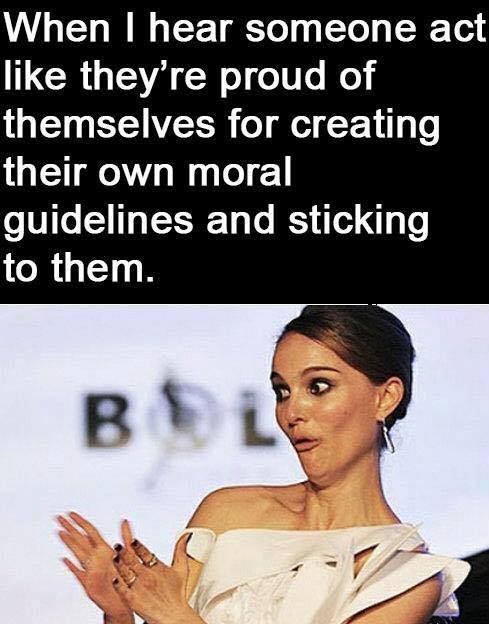
At the top of the article is a meme image that reads ‘When I hear someone act like they’re proud of themselves for creating their own moral guidelines and sticking to them’.
Natalie Portman sports an awkward facial expression and a sarcastic clap. Under the image is a line of copy: If you define morality as “whatever I want to do” then you’ll always be “moral”, which is tautological, but a bit of a non-sequitur to the rest, so I’ll leave it alone.
Let’s stop to regard this copy for a few moments but without going too deep. Let’s ignore the loose grammar and the concept of pride. I presume the focus of the author to be on the individually fabricated morals (read: ethical guidelines or rules) and that the fabricator follows through with them.
That this person follows through on their own rules is more impressive than the broken New Year’s resolutions of so many and is a certainly better track record than most people with supposed religious convictions.
New Years’ Resolutions
First, all morals are fabricated—his morals or your morals. And you can believe that these goods came from God or gods or nature or were just always present awaiting humans to embody them, but that doesn’t change the point.
Let’s presume that at least some of his morals don’t comport with the authors because they are borne out of compassion. Since we’ve already established precedence for cherry-picking, allow me to side-step the hedonistic aspects and instead focus on the compassionate aspects. Would this be offensive to the author? Isn’t, in fact, in Matthew 7:12 and Luke 6:31, the do unto others Golden Rule edict, is a call for compassion—at least sympathy if not empathy?
After a quick jab at abortion (tl; dr: abortion is bad) taking the scenic route to articulate the point that atheists typically don’t think of unborn children as people, apparently without fully grasping the concept of zygotes and gametes. The author then confuses the neutral notion of a probabilistic outcome with accidents, having negative connotations—as if I flip a coin, the result is an accident. Let’s ignore this passive-aggressive hostility and move on. Let’s also forgive the flippant—or at least facile—articulation of biological evolutionary processes as ‘the strong survive while the weak die’. We can let it slide since what is meant by strong in this context is wide open.
child (noun) : a young human being below the age of puberty or below the legal age of majority
Oxford Languages
The author continues with a claim that ‘you aren’t going to be able to generate a moral standard that includes compassion for weak unborn children on that scenario’. This feels like an unsubstantiated claim. Is this true? Who knows. Some people have compassion for all sorts of things from puppies to pandas without having some belief in rights. Some people like Peter Singer argues that rights should be extended to all species, and all humans should be vegans. I wonder if the author can live up to this moral high watermark. Maybe so. Probably doesn’t mix linen and wool because it’s the right thing to do.
“If the rule is “let’s do what makes us happy”, and the unborn child can’t voice her opinion, then the selfish grown-ups win.” This is our next stop. This is a true statement, so let’s tease it a bit. Animals are slaughtered and eaten, having no voice. Pet’s are kept captive, having no voice. Trees are felled, having no voice. Land is absconded from vegetation and Animalia—even other humans. Stolen from unborn humans for generations to come. Lots of people have no voice.
People are into countries and time and space. What about the converse situation? Where is the responsibility for having the child who gains a voice and doesn’t want this life? Does it matter that two consenting adults choose to have a child, so it’s OK? Doesn’t the world have enough people? What if two consenting adults choose to rob a bank? I know I don’t have to explicitly make the point that once the child is thrown into this world, the voice is told to shut up if it asks to exit or even tries to exit without permission. Unless circumstances arise to snuff out the little bugger as an adult.
Finally, the author is warmed up and decides to focus first on fatherhood. The question posed was whether the interlocutor thought that fatherlessness harmed children, to which the response was no.
Spoiler alert: The author is toting a lot of baggage on this fatherhood trip. Before we even get to the father, the child, or the family, there is a presumption of a Capitalist, income-based, market economy. Father means the adult male at the head of a nuclear family with a mum (or perhaps a mother; mum may be too informal), likely with 2 kids and half a pet. The child is expected to also participate in this constructed economy—the imagined ‘right’ social arrangement. It goes without saying that I feel this is a bum deal and shit arrangement, but I’ll defer to pieces already and yet to be written here. But if fathers are the cause of this ‘Modern’ society, fuck ’em and the horses they rode in on.
She asks him, if a system of sexual rules based on “me feeling good, and other people around me feeling good”, was likely to protect children. Evidently, he was silent, but here you can already determine that she unnecessarily links sex to procreation. And reflecting on a few paragraphs back, how is forcing a child (without asking) to be born and then told to become a wage slave or perish not violent and cruel?
(Self-guidance: Calm down, man. You can get through this.)
So the question is surreptitiously about procreative sex. By extension, if the couple can’t procreate for whatever myriad reasons, it’s OK? Sounds like it? Premenstrual, menopausal, oral, anal, same-sex coupling is all OK in this book. Perhaps, the author is more open-minded than I am given credit for. Not all humans are fertile, sex with plants and animals won’t result in procreation. A lot of folks would call this author kinky or freaky. Not my cup of tea, but I’m not judging. Besides, I’ve read that book—though shalt not judge. I’m gonna play it safe. And they couldn’t print it if it wasn’t true.
Spoiler Alert: Jesus dies at the end.
Seeking credibility, the author cites Bloomberg, as Centre to Centre-Left organisation as Far-Left. Clearly another red flag. Excuse me, your bias is showing. This piece is likely written for choir preaching, so we’ll take the penalty and move along.
A quick jab at the bête noire of ‘Big Government’ facilitating idle hands and, presumably genitals, to play. The idle rich as Croesus folks are idols to behold. At least I can presume she opposes military spending and armed aggression on the grounds of harm, so we’ve got common ground there. They’re probably an advocate of defunding the police, though by another name. so there’s another common platform. It just goes to show: all you need to do is talk to ameliorate differences. We’re making good headway. Let’s keep up the momentum.
Wait, what? We need to preserve a Western Way? I was shooting for something more Zen. Jesus was a Westerner—being from Bethlehem and all. (That’s in Israel—probably on the Westside.)
White Jesus from the Middle East
No worries. Just a minor setback—a speedbump. It’s just a flesh wound. But we’ve pretty much reached the end. A little banter about some other studies. There’s an impartial citation from the Institute for Family Studies on cohabitation they beg the question and employs circular logic. And another from the non-partisan Heritage Foundation finds that dads who live with their children spend more time with them. How profound. I’d fund that study.
And it’s over. What happened? In the end, all I got out of it is ‘I don’t like it when you make up morals’. You need to adopt the same moral code I’ve adopted.
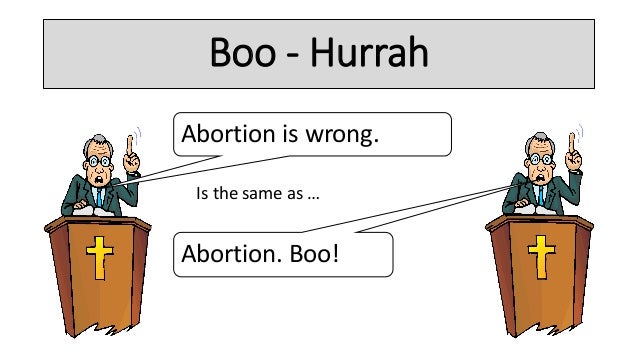
AJ Ayer – Emotivism
Where was I? Oh yeah. Fathers. So these people don’t mean generic fathers. They mean fathers who subscribe to their worldview. In their magical realm, these fathers are not abusive to their mothers or children; these fathers are not rip-roaring alcoholics; these fathers are the dads you see on the telly.
Suspiciously absent is the plotline where the fathers are ripped from their families through systematic racism and incarcerated as if they didn’t want to be there for their children. And this isn’t discussing whether it’s an issue of fathers or an issue of money. It isn’t discussing whether someone else might serve as a proxy for this role. Indeed, there is nothing magical about fathers unless you live in a fantasy world.
25. I believe the strength of a sports team comes from the loyalty of its members to each other
Who TF cares about a sports team or where their loyalty comes from, whatever that even means. And the strength of what exactly? Players move from team to team with ease, and they are obliged to win in order to advance their own interests and personal glory. Weaker players can coattail by association to their team or their league.
26. I think children should be taught to be loyal to their country
Smh. No. I think that countries should be abolished. Children should be taught how arbitrary countries are and how they divide more than they unite.
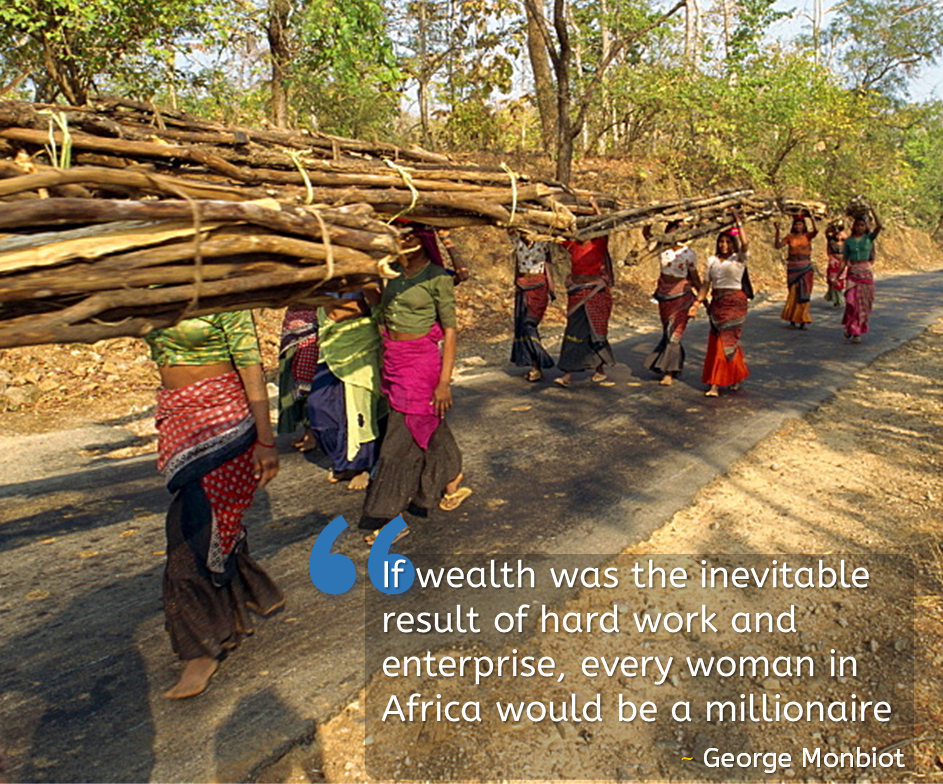
27. In a fair society, those who work hard should live with higher standards of living
Weasel words—fair, hard, work, higher, and living standards. Perhaps the answer can be found in the definitions, like divining with tea leaves.
Hard Work & Enterprise
28. I believe that everyone should be given the same quantity of resources in life
What resources? A family with no children doesn’t need children’s shoes and clothing. A vegan doesn’t need a side of beef. What is this asking?
29. The world would be a better place if everyone made the same amount of money
I agree. And the amount should be zero. Didn’t I already answer this one?
30. I believe it would be ideal if everyone in society wound up with roughly the same amount of money
What is this obsession with money? I guess this is a reflection on Harvard. Get over it.
31. People should try to use natural medicines rather than chemically identical human-made ones
What? Sure. Maybe. I suppose if they are identical. Are they cheaper or free? Are they dosage- and quality-controlled? What is the function of the infinitive try to?
32. I believe chastity is an important virtue
Not more virtue. Make it stop. Chastity is defined as the state or practice of refraining from extramarital, or especially from all, sexual intercourse. This would be important why? And how would it be a virtue by any measure?
33. I think obedience to parents is an important virtue
Just why?
34. I admire people who keep their virginity until marriage
How would I know? Why would I admire them? I understand the traditional and statutory function of marriage, but this anachronistic chattel arrangement doesn’t need to exist.
35. Everyone should defend their country, if called upon
Perhaps we should abolish countries and property. What are the defending—their unique way of life? Their awesome achievements or prospects thereof? The dirt and natural resources? The buildings? Some mythos? Just no. If politicos want to fight for imaginary boundaries, let them fight it out in an old school cage match.
36. If I found out that an acquaintance had an unusual but harmless sexual fetish I would feel uneasy about them
Define harmless. Does this fetish involve me? If not, I don’t care. Might I roll my eyes? Perhaps. Might I laugh? Sure.
Summary
Having commented in some form or fashion on each of these questions, I can remain unmoral. Morality is an exercise in mental masturbation and power. As should be obvious by now, morality presumes that one subscribes to some underlying and supposed metanarratives.
In the end, reflecting upon other sources, a certain sense of what might be considered to be a moral compass may be present in infants and children, but these can be (and are) manipulated through education, books, entertainment from TV and movies to sports to civic instruction and all sorts of propaganda. So, the point that wee folk have propensities for certain behaviours is all well and good, but this feels an awful like confirmation bias in full view. Of course, it might be considered to be immoral to raise classless, less judgmental children especially if they make choices different to the leaders.
I was commenting elsewhere on morals and was directed to Jonathan Haidt and his work. Notably, the questionnaire at YourMorals.org, where you can get your own assessment and contribute data points to the body of work.
Full disclosure: I am not a fan of this type of survey, as I’ve mentioned previously. Still, I made an attempt. Better still, I’ve copied the questions to critique. There are 36 all tolled. Perhaps, I’ll respond to a dozen at a time. The next dozen responses are here. Generally speaking, they present each question and provide a Likert scale as follows:
Does not describe me at all
Slightly describes me
Moderately describes me
Describes me fairly well
Describes me extremely well
Standard fare. It starts off bad:
1. Caring for people who have suffered is an important virtue.
Why include an abstract concept like virtue? I don’t ascribe to the notion of virtue, so it’s an empty set. Given that, my response would be a 1. If I ignore the offensive nomenclature and assume it translates idiomatically into ‘beneficial for some target society’, then I still have to question what is meant by suffering, and how far does caring extend. Is it enough to feel bad about the homeless person, or does one have to care enough to provide sustenance and shelter? Talk is cheap.
2. The effort a worker puts into a job ought to be reflected in the size of a raise they receive.
This is fraught with all sorts of problems. In fact, it’s a reason why I consider myself to be a Postmodern. The inherent metanarrative is that societies are effectively money-based. I don’t happen to believe that, so I am again faced with responding to an empty set. Even if I attempt to abstract the ‘raise’ aspect to mean that effort represents input and output is a direct and (perhaps) proportional function, I am still left to wrestle with how this effort is measured and what could have been achieved had the others not been present.
Using a sports analogy—always a dangerous domain for me to play in—, what if LeBron James was to play an opposing team by himself? He needs the other team members. Of course, his teammates are compensated, too. But in his case, his salary is not only based on his athletic talent but on his celebrity power—rent in economic parlance. Perhaps LeBron makes a lot of baskets, but without the assists, he’d have fewer. And because he is the go-to guy, some other teammates might be sacrificing baskets as part of their winning strategy.
Finally, how do you measure the effort of an accountant, a janitor, and an executive? The question is fundamentally bollox.
3. I think people who are more hard-working should end up with more money.
On a related note, I can abbreviate my commentary here. Again, what is harder? Are we asking if construction workers should earn more than CEOs? More bollox.
4. Everyone should feel proud when a person in their community wins in an international competition.
Yet, again, an empty set and a sort of mixed metaphor. I don’t agree with the notion of identity and even less at scale—states, countries, and nationalities. Putting that aside, why should I derive pride (that cometh before the fall) because someone succeeds at some event anywhere? It’s facile. If the question was focused on whether I would be happy for that person, the answer might shift up the scale, but where would I have derived pride for that person’s achievements?
5. I think it is important for societies to cherish their traditional values.
First off, why? What values? Not to beat a dead horse, but what if my tradition is slavery? Should I cherish that? This is really asking should I cherish the traditions of my society. Clearly, it’s not asking if other societies should enjoy the privilege of cherishing theirs? From the standard Western vantage, many want to cherish their own, but not Eastern values of eating dogs or Middle Eastern values of burqaed women and turbans. Is this asking should the world subscribe to my society’s values? I’m not sure.
6. I feel that most traditions serve a valuable function in keeping society orderly
Speaking of tradition… We are not only dealing with the vague notion of tradition, we are discussing another vague concept, order, and elevating order over (presumably) disorder. Order connotes a status quo. And why is the superlative most present? Has someone inventoried traditions? I believe I am supposed to translate this as ‘I feel that the traditions I am familiar with and agree with help to create a society that I am content with’. Again, this betrays the privileged perspective of the observers. Perhaps those disenfranchised would prefer traditions like Capitalism and private property to be relics of the past–or traditions of two-party rule, partisan high court judges, or money-influenced politics, or politicians serving themselves and their donors over the people or Christmas.
7. We all need to learn from our elders
Learn what exactly from our elders? Which elders? The bloke down the block? That elderly Christian woman at the grocery mart? The cat who fought in some illegal and immoral war? The dude who hordes houses, cars, and cash at the expense of the rest of society? Or the guy who tried to blow up Parliament. I believe this is asking should we learn how to remain in place as taught by the privileged wishing to maintain their places.
8. Everyone should try to comfort people who are going through something hard
Define hard, and define comfort? This harkens back to the first question. Enough said. As far as lying is concerned, we should by now all be familiar with the adage trying is lying. Or as Yoda would restate it, do or do not, there is no try.
9. I think the human body should be treated like a temple, housing something sacred within
Obviously, this one is total rubbish. Here, I don’t have a structure that makes it difficult to answer. I may have sprained my eye rolling it, though. This said, what is a temple treated like?
10. I get upset when some people have a lot more money than others in my country
This one is interesting. Whilst I don’t believe that countries or money should exist. In practice, they do. So on its face, I can say that I get upset when we are thrown into a bordered region and told we need to exchange paper, metal, plastic, and bits for goods and services–that some people have more and others have less primarily through chance.
11. I feel good when I see cheaters get caught and punished
Which cheaters? Cheating requires perspective and a cultural code. It can privilege the individualist over the communalist. This reminds me of the cultures that are more interested in ensuring that all of their members finish a contest than having any one win.
Academically, it is considered to be cheating to work together on an exam because the individual is being tested. Of course, the exam is on certain content rather than on the contribution of the human being.
Again, the question feels targeted at cheaters getting caught circumventing something we value. If someone cheats becoming assimilated into some military-industrial society, I will encourage and support them. If they get caught and punished, my ire would more likely be directed toward the power structure that created the need to cheat.
12. When people work together toward a common goal, they should share the rewards equally, even if some worked harder on it
I’ll end this segment here on another question of meritocracy. I think it’s fair to judge the authors as defenders of meritocracy, though I could be wrong. This feels very similar to some other questions already addressed. The extension here is about sharing the rewards, whatever that means. Are we baking a cake? Did we build a house for a new couple? Did we plant trees in a public park? Did we clean up litter on a parkway? Did we volunteer to feed the homeless? And what was the work? Again, how are we measuring disparate work? Did the chicken farmer work harder than the cow farmer? Did the carpenter work harder than the organiser?
If the remainder of these questions is different enough, I’ll comment on them as well. Meantime, at least know you know more why I have little faith in the field of morals. This does nothing to change my opinion that morals are nothing more than emotional reactions and subsequent prescriptions. I don’t mean to diminish emotions, and perhaps that might be a good central pillar to a vibrant society. I’ll need more convincing.
I’ve always taken the Libertarian Political Compass to be a bit interesting, like fortune cookies and tarot readings. Along with other tests like MBTI and IQ tests, it feels like it might be useful. In fact, it is. It facilitates signals tribal affiliation. Whenever I take the test, I always trend to the lower-left corner, so I can smugly reaffirm my Leftist leanings—if you interpret leanings as up against the wall and on the floor.
When I commented on a forum that I felt that (presuming the X-Y axes of this scale without even mentioning it) Liberals and Conservatives in the United States are each Right of Centre and Conservative—they just want to Conserve different things, someone replied with a link to this video by Halim Alrah. Whilst I won’t comment on his class materialism claim—at least not now—, I do feel it makes me not only double down on my claim but to toss more into the Conservative bucket list.
Besides noting that each aspect is defined in the abstract, he tacitly makes a point with which I agree: all professional and most amateur politics are Conservative: Conservatives want to conserve the 1950s; Liberals want to conserve the 1960s and some of the 1930s and ’40s; Leftist Marxists want to conserve the missed opportunities of the 19-teens, and I suppose the Progressives want to conserve the 19-teens as well. Bully!
all professional and most amateur politics are Conservative
Politics are inherently backwards-looking and fraught with appeals to tradition, each cherry-picking which traditional narrative fits their bill whilst suffering from selective blindness in areas that didn’t quite work out or fit the narrative. Or they want to cash in a mulligan and try again. Or they feel with 20/20 hindsight, they can Groundhog Day the hell out of it. In some hundreds of generations, we’ll be bound to get it right. Even Libertarians and Anarchists cling to ideas of the past. As I’ve mentioned before, I am an anarchosyndicalist, and though that has never been instantiated to scale, it is nonetheless an idea almost two hundred years old. Hardly novel.
I am not a traditionalist, but neither I am not claiming that every tradition is rubbish. But what worked in the past may not actually work in the present or in the future. As the title of a book that I am fond of reminds us, What Got You Here Won’t Get You There, so these political armchair quarterbacks are operating on bad assumptions. All are operating on nostalgia and historical reconstructions of what might have been. Perhaps they excel at Risk or Sid Meyer’s Civilisation. Whatever the mindset, it’s taking a rearview mirrored approach.
So, what’s in a name anyway? If Conservatism doesn’t denote anything and only connotes a bunch of old white guys as a synonym for Tories in the UK and Republicans in the US; and where the Republicans and Democrats could both merge into a single Oligarchy Party (or Kleptocratic Party depending on one’s mood)?
In the end, we need a new way to describe the political sphere if we wish to promote discussion and build alliances, but perhaps that’s never been the goal.
That was the response to my question regarding the police presence yesterday.
EDIT: Some in the community have arranged a memorial for Gary.
In Memorium
I live in an economically depressed community. Swathes of addicted streetwalkers to the south and crack and smack street dealers to the north. Between these bookends are some dozen or more churches and me. Adjacent to me is an abandoned church, a haven for the doubly disenfranchised homeless in the community.
Gary didn’t make it to Christmas. Perhaps I saw him around the neighbourhood, but I didn’t know Gary by name.
“It doesn’t sound like it ended well,” said I. “I think it was frostbite,” he continued.
I find it difficult to believe it was frostbite, but I’m no expert. It barely gets below freezing in this part of the country, but it did last night. Does anyone remember the Valley Forge of American history?
“He had no place to go. They wouldn’t let him in the shelter because he drinks.”
This is Tough Love™ in action. Hate the sin. Fuck the sinner. Another victim of the system and of morality vis-à-vis Virtue Signalling.
In the words from the first Home Alone instalment: Merry Christmas, you filthy animal.
Foucault should be a reminder that the culture wars are not new and post-truth can’t exist because there was never a truth at the start. This is similar to Latour’s question asking if we’ve ever been modern. And the answer remains ‘no’. There is no post-truth as there is no post-modern as each of these is predicated on a fantastical claim. Many humans defend the notion of truth, but they are fighting windmills.
“We are therefore at war with one another; a battlefront runs through the whole of society, continuously and permanently, and it is this battlefront that puts us all on one side or the other. There is no such thing as a neutral subject. We are all inevitably someone’s adversary.”
In these culture wars, each side is fighting for its version of the truth. The truth of rights and freedoms and the correct construct of societies. But there is not one culture war. There are myriad culture wars, and there are few opportunities to be allied across all of these dimensions with another person. For the congruent dimensions, one needs to operate in the mode of the enemy of my enemy is my friend whilst deciding how to ally on other disagreed dimensions later.
But never forget that the wars are intentional. They are a feature of the system of normalisation, not a bug. More importantly, don’t think for a moment that your truth is the truth. The same goes for your adversary.
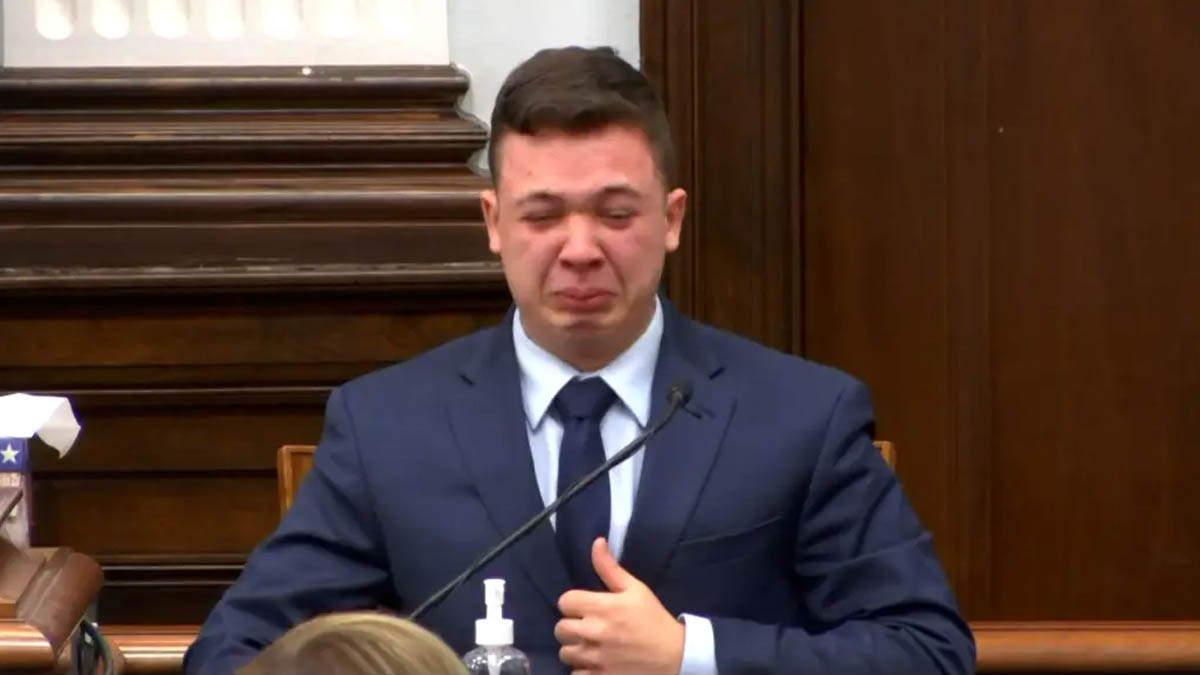
If anything showcases how nonsensical the concept of justice is, just look at the Rittenhouse trial in the United States. Ultimately, justice is about perception. In a textbook, a bad person does something bad, and a process ritual is performed by judges and juries to divine the otherwise obvious badness, and the bad person is brought to justice. In the extended version, they learn the error of their ways and reintegrate into society and live happily ever after.
In reality, this is all bollox. Good and bad are subjective and contextual. But this post isn’t about that. It’s about the charade of justice. In the case of the Rittenhouse trial-slash-debacle, Kyle Rittenhouse shot some people and killed them. Whilst he is being charged with murder, some people view him as a hero—the good man with a gun rather than a vigilante.
Given these perspectives, whether justice is served is a matter of your starting perspective. People in the United States are generally divided on some fundamental political stands, and this predictably colours individual perspectives.
In the Bible, Christians are taught the story of King Solomon, wherein two women each claim a child as their own. Solomon suggests that they cut the child in half and by doing so, he reveals the true mother by judging their responses.
Spoiler Alert: I am only pretty sure that Solomon wouldn’t have followed through on his twisted joke.
This Bible story is part of the Western legal canon and teaches the impartiality of judges and some practical wisdom, but then we remember that it’s just a story.
Returning to Rittenhouse, irrespective of whether justice ends up being served is basically a coin toss. If you have been following the proceedings, you’ll notice that the pack is being stacked in his favour and the dice are weighted and the coin is biased.
Personally, I think the guy is an ass-hat. I feel that anyone who carries a weapon has anger and compensation issues. And if he wasn’t there in the first place, none of this would have unfolded as it did. I am a conscientious objector and believe this is precisely why the Second Amendment of the US Constitution relates to a well-regulated militia and not some pizza-faced wanker.
If he is judged not guilty, people like me will viscerally feel that justice is a sham. Obviously, I already maintain that opinion, but other people still believe in justice and Santa Claus. If he is judged guilty and gets a suitable sentence—another subjective constituent of justice—, then the other cohort feels that justice was not served.
One could argue, as Christians do, that God is the final arbiter of justice. Someone has to be, right? It also reminds us not to judge—probably because we’re not very good at it—, so there’s that, too.
I hold my original stance: justice is just another vapid weasel word.
I was engaged in an online conversation where the participants were anti-Postmodern—one person in particular.
The conversation hinged on democracy. My postition remained that it is not a particularly functional form of government and tends toward mediocracy and oligarchy, neither of which is very appealing. At least oligarchy accrues benefits to the oligarchs. If you happen to be one, good on you. Mediocracy benefits no one in particular.
Cutting to the chase, I was basically accused of revealing the soft underbelly of democracy—hence the relationship to the Emperor’s New Clothes. Some Moderns such as this chap osensibly understand that Democracy is a specious proposition. His defence is basically ‘don’t point it out because that would ruin everything’. I was the kid who told your kid there is no Santa Claus. Oh, the horrors. Ignorance is indeed bliss.
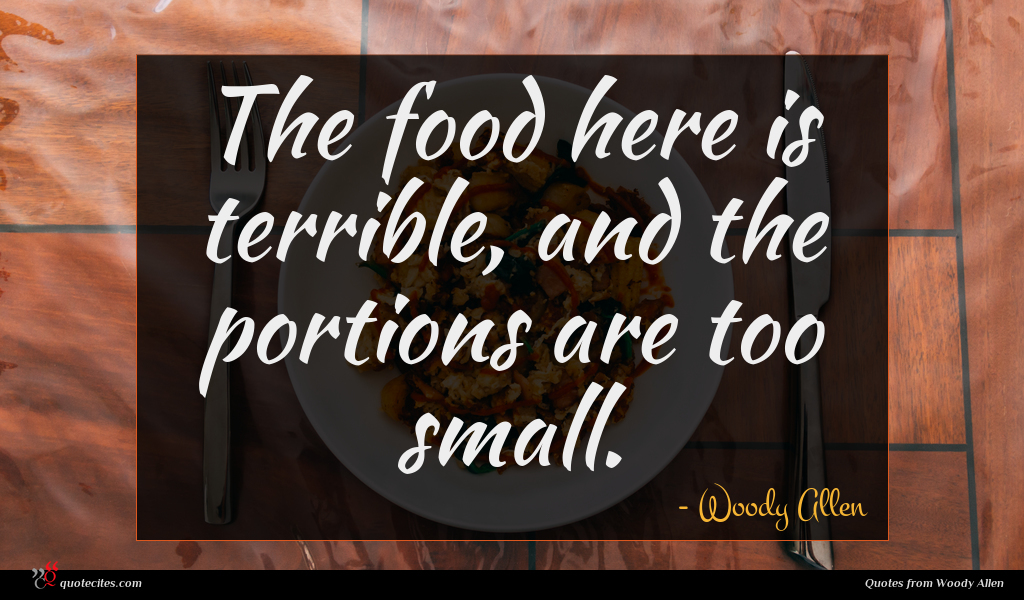
Besides the connection to the Emporer’s New Clothes, is reminds me of a Woody Allen joke: The food here is terrible, and the portions are too small.
The essence of the experience is bad, and yet some complain that there’s not enough. Yes, the emporer is naked, but the emporer is us, and we don’t want to know. Or, don’t embarrass the emporer. If he’s OK, just let him be. No use in pointing out his shortcomings.
In any case, the critique turned from my perspective is wrong to “Shht. Don’t tell anyone.”












 Philosophics