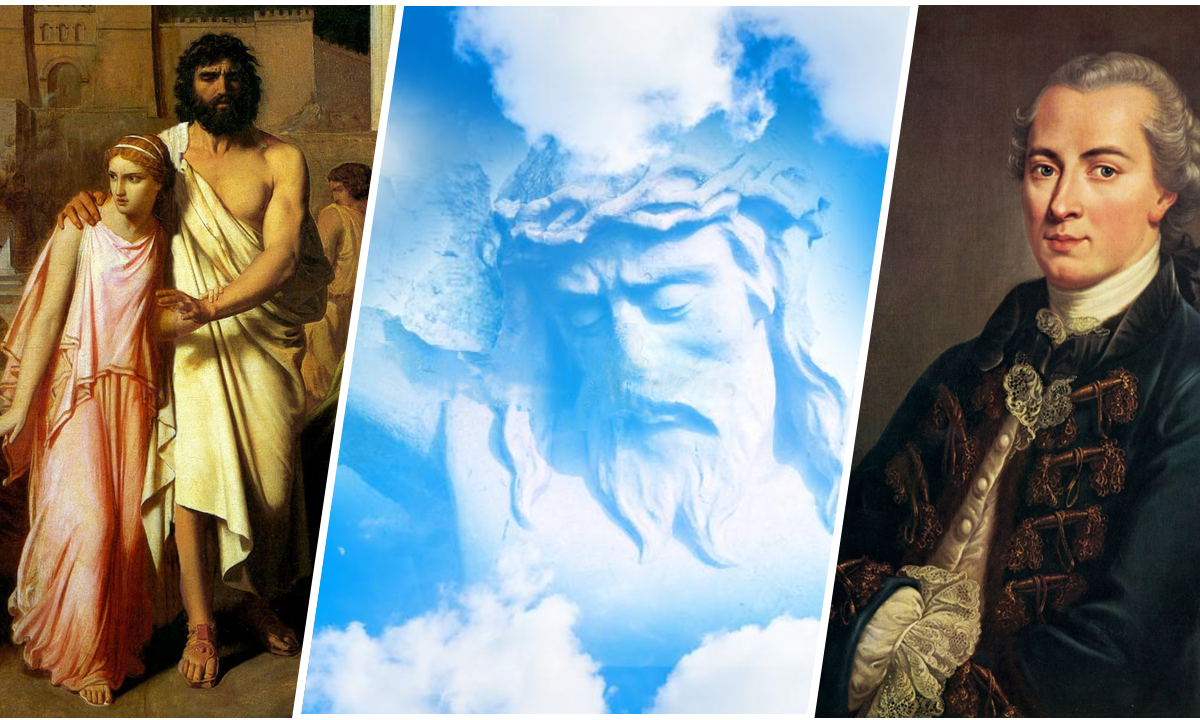
The more I read about free will the more I feel that it is a modern invention. I don’t mean to claim that this is cut and dry, but as the image accompanying this post suggests, Sophocles’ story of Œdipus Rex is precisely about a man attempting to escape his fate. Without getting mired in a discussion about the distinction between fate and determinism, we understand that the plight of Œdipus is set in stone.
As I said, I am simplifying as I know there are authors debating free will before this, but it is also known that many people simply believed that their lives were governed. I suspect that in certain slave societies this might be a source of comfort. If Buddhist thought that life is suffering holds true, what better consolation than it was just meant to be, I might as well just make the best of it.
Enter Christianity and Aquinus. Their god may have set things up, but there can be no notion of growth or responsibility without free will, so we’d better create a narrative around this. How an omniscient creator can not know every possible plotline and twist remains a question, though rationale akin to retrograde motion has been suggested to accommodate it. Now, it seems that we’ve got a little less determined and a little freer if I think of it as a zero-sum game.
Si Dieu n’existait pas, il faudrait l’inventer
Voltaire, Épître à l’Auteur du Livre des Trois Imposteurs (1769)
By the time Kant enters the picture, he rather spills the beans on the whole narrative. Perhaps riffing on Voltaire’s quip, ‘If God did not exist, it would be necessary to invent Him‘. Kant tells us that if we need to blame people and presume responsibility, then we need to assume free will. And so we did.
In this day and age, most people have been marinated in this worldview, so it’s difficult to see outside of this frame. The rhetoric of free will has been particularly effective. Though we have evidence of free will not being dominant in some cultural conversations, we have little idea in preliterate societies. I’d be interested to gain additional perspective from historians or anthropologists. Some may have already been published. I’ve already been so overwhelmed with the deluge of information and opinions to date. I’ve learned much and have been introduced to many new scholars. As I wrote the other day, this is somewhat daunting. I wish I were a grad student and could justify spending so much time trying to justify my position.
The Appointment in Samarra*
There was a merchant in Bagdad who sent his servant to market to buy provisions and in a little while the servant came back, white and trembling, and said, Master, just now when I was in the marketplace I was jostled by a woman in the crowd and when I turned I saw it was Death that jostled me. She looked at me and made a threatening gesture, now, lend me your horse, and I will ride away from this city and avoid my fate. I will go to Samarra and there Death will not find me. The merchant lent him his horse, and the servant mounted it, and he dug his spurs in its flanks and as fast as the horse could gallop he went. Then the merchant went down to the marketplace and he saw me standing in the crowd and he came to me and said, why did you make a threatening gesture to my servant when you saw him this morning? That was not a threatening gesture, I said, it was only a start of surprise. I was astonished to see him in Bagdad, for I had an appointment with him tonight in Samarra.
I was astonished to see him in Bagdad, for I had an appointment with him tonight in Samarra.
Death
I love this story of fatalism. Originally from the Babylonian Talmud, Sukkah 53a, it’s a story about one attempting to alter their determined fate. An interesting side-comment on the original version. The last line attributes fate to the servant’s feet.
A man’s feet are responsible for him; they lead him to the place where he is wanted
Babylonian Talmud, Sukkah 53a
This interpretation would allow for the feet to be determined but in conflict with the intellect and reason of the head, much as is said about the conflict between the head and the heart. It could be argued that the only fate this accounts for is that of death, but that’s well beyond my scope of inquiry.
Final Note
Some people seem to not quite grasp the distinction between constructed and unreal. Many things are human social constructs, from money to states and countries, to nations, to governments, to ethnicities, and to gender. Even sex. All of my favourite weasel words are constructs.
But there’s a difference between money and unicorns. No amount of money can buy you a unicorn. This is the difference between fiction and figment. We can say that money is ‘real’ insomuch as it affects our everyday lives. We transact. We buy things. We sell things. It’s an agreed-upon medium of exchange. Without going into details, long before cryptocurrency, most money is in the form of computer bits and bytes—rather it has no form. The currency and coins we can touch are a small fraction of the money that exists. The money behind your credit card or debit card is not banknotes—and it’s not gold. When a central bank wants to create money, it simply has to type a number in a computer register and press enter, and it exists.
So whilst each of these is pretend, some things are manifest in our ‘real’ world and have real-world implications. Not so much for unicorns and fairies.
* The Appointment in Samarra as retold by W Somerset Maugham (1933)
Robert Kane’s chapter in Four Views on Free Will is titled Libertarianism, and I’ve just finished it. I’ve been writing in the margins, and I’ll summarise my thoughts here.
TL;DR
As I wrote in my last post, I don’t find the Libertarian position on free will and agency compelling. Kane made some interesting points, but none persuaded me to buy what he was selling. The biggest challenge I had was to maintain focus because I think he was chasing red herrings—at least given my focus on agency. He spent a lot of time tearing down determinism and indeterminism instead of building up his own position. I feel the debate centres around agency. I waited for him to explain how this agency operated, but he just assumes agency—or at least a self to possess agency—from the start. I am not convinced. If you are interested, my more detailed commentary follows.
The Rest of the Story
My intent at the start is to approach this chronologically as I retrace my marginalia, hoping to recall whatever prompted my notes in the first place. I’ll be quoting or paraphrasing Kane’s positions to serve as a reference in the event you don’t have access to the book.
1, Determinism and the Garden of Forking Paths
Kane starts off by mentioning that determinism implies that ‘given the past and the laws of nature at any given time, there is only one possible future‘. Within this unvarying environment, he writes, ‘We believe we have free will when we view ourselves as agents‘. I don’t disagree with either of these points, and, as agents, we are ‘capable of influencing the world in various ways‘.
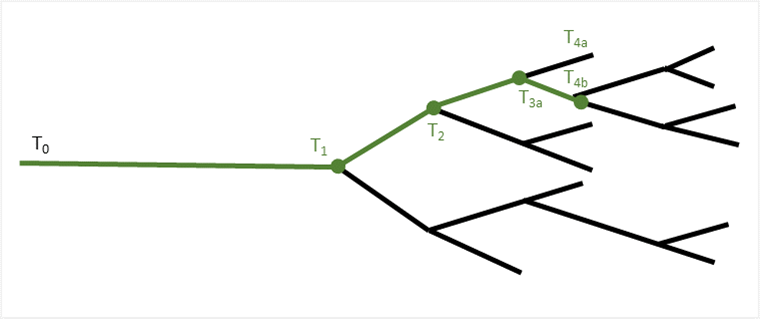
Kane introduces a garden of forking paths illustration, which I’ve recreated here.
Garden of Forking Paths
He uses this as a visual decision tree, where an actor traverses the branches and makes decisions at the various vertices. To breathe life into this tree, he gives us one of several forthcoming examples. He introduces us to Jane.
In his scenario, Jane is faced with a decision with one of two possible outcomes, and ‘she believes there is more than one possible path into the future available to her and it is “up to her” which of these paths will be taken‘. He continues, ‘This picture of different possible paths into the future is also essential, I believe, to what it means to be a person and to live a human life‘.
And herein lies the rub. Jane is not making these decisions in a vacuum. She is a puppet to forces beyond her control. I shouldn’t be so hard on psychology and Freud, but as Luke 23:34 of the Christian Bible relates, ‘Forgive them, for they know not what they do’.
Then Kane reinforces that if determinism were true that Jane would not have free will before bringing up the idea of responsibility, that ‘free will is … intimately related to notions of accountability, blameworthiness, and praiseworthiness for actions‘. I agree with Kane here.
Next, he invokes an emotional appeal-to-nature argument, asking us to imagine a ‘young man [who] is on trial for an assault and robbery in which his victim was beaten to death.’ He suggests that our tendency to blame this man is natural, but that we might search for mitigating circumstances that might account for his actions. He leaves us with a question, Did these influences entirely determine his actions, or did they “leave anything over” for him to be responsible for?
I have this question, too, but as I said, this is an appeal to emotion in the way Westerners have been conditioned to believe. There is little reason to accept this as some sort of universal law or principle.
2. Modern Challenges to Libertarian Free Will
He starts this section as follows, ‘I will be defending the libertarian view of free will in this volume. We libertarians typically believe that a free will that is incompatible with determinism is required for us to be truly morally responsible for our actions, so that genuine moral responsibility, as well as free will, is incompatible with determinism.’
He continues his setup, ‘A goal of this essay is therefore to consider this modern attack on the traditional libertarian view of free will and to ask how, and whether, it can be answered. Much is at stake, it seems to me, in knowing whether we do or do not have a freedom of the will of the ultimate kind that libertarians defend. The modern attack on it has two parts‘.
‘Part 1: The first prong of the modern attack on libertarian free will comes from compatibilists, who argue that, despite appearances to the contrary, determinism does not really conflict with free will at all.‘
‘[A]ccording to compatibilists, esoteric questions about whether determinism is true or not – in the physical or psychological sciences – are irrelevant to the freedoms we really care about in everyday life. All the varieties of free will “worth wanting” (as a modern compatibilist, Daniel Dennett, has put it) do not require the falsity of determinism for us to possess them, as the traditional libertarian view of free will suggests.‘
He informs the reader, ‘Influential philosophers of the modern era, such as Thomas Hobbes, John Locke, David Hume and John Stuart Mill, were all compatibilists‘.
Kane ends part 1 with, ‘If compatibilists are right, we can have both free will and determinism; and we need not worry that increasing scientific knowledge about nature and human beings will somehow undermine our ordinary convictions that we are free and responsible agents.’
I agree with this statement. It’s also why I consider agency to be the pivotal target, not determinism.
In part 2, he writes ‘The second prong goes further, arguing that libertarian free will itself is impossible or unintelligible and has no place in the modern scientific picture of the world.‘
He conveys that ‘modern defenders of libertarianism, such as Immanuel Kant, have argued that we need to believe in libertarian free will to make sense of morality and genuine responsibility, but we can never completely understand such a free will in theoretical and scientific terms.’
This is a good point, and Kant is correct. As a moral non-cognitivist, I feel that morality is a non-sensical human social construct. Inventing free will to make sense of another invention doesn’t get much sympathy from me. Kant finishes with an appeal to noumenism, yet another concept I’ve got no time for.
Next, Kane introduces us to another foe of free will, indeterminism. ‘Events that are undetermined, such as quantum jumps in atoms, happen merely by chance. So if free actions were undetermined, as libertarians claim, it seems that they too would happen by chance.’
He ends this section with two issues a libertarian must address:
The Compatibility Problem: free will really is incompatible with determinism
The Intelligibility Problem: indeterminism can be made intelligible and how, if at all, such a free will can be reconciled with modern scientific views
3. Is Free Will Incompatible with Determinism?: The Consequence Argument
Kane opens with a plea, ‘[L]ibertarians who believe free will is incompatible with determinism can no longer merely rely on intuitions about “forking paths” into the future to support their view that determinism conflicts with free will. These intuitions must be backed up with arguments that show why free will must be incompatible with determinism.‘
If determinism is true, then our acts are the consequences of the laws of nature and events in the remote past. But it is not up to us what went on before we were born; and neither is it up to us what the laws of nature are. Therefore the consequences of these things (including our own acts) are not up to us.
Peter van Inwagen, An Essay on Free Will, Oxford: Clarendon Press, 1983, p. 16
Then he sets up The Consequence Argument:
There is nothing we can now do to change the past.
There is nothing we can now do to change the laws of nature.
There is nothing we can now do to change the past and the laws of nature.
If determinism is true, our present actions are necessary consequences of the past and the laws of nature.
Therefore, there is nothing we can now do to change the fact that our present actions occur.
In other words, we cannot now do otherwise than we actually do.
Indeed, I agree in principle with the logic, but I’ll reiterate that I feel that the entire determinism angle is a red herring. Next, Kane goes into a discussion about the Transfer of Powerlessness Principle.
In essence, TP ‘says in effect that if you are powerless to change something X, and something else Y is necessarily going to occur if X does, then you are also powerless to change Y.‘
As I don’t think it’s’ important to my ends and I agree with Kane’s critique of this tailing logic, if you are powerless to change something X, and something else Y is necessarily going to occur if X does, then you are also powerless to change Y.
Finally, he argues that there is a likely insurmountable semantic challenge that accepting one meaning of ‘can’ and ‘power’ (and some other terms) will determine [pun intended] if one is a compatibilist or not.
4. Ultimate Responsibility
Carrying over from the previous section, Kane reminds us that ‘as a result of this impasse, philosophical debates have multiplied about just what “can” and “power” (and related expressions, such as “could have done otherwise”) really mean‘. But he also concedes that ‘The problem is that focusing on “alternative possibilities” (or “forking paths” into the future) or the “power to do otherwise” alone, as the Consequence Argument does, is too thin a basis on which to rest the case for the incompatibility of free will and determinism.’
He sets up his position.
Free will seems to require that open alternatives or alternative possibilities [AP] lie before us – a garden of forking paths – and it is “up to us” which of these alternatives we choose.
Free will also seems to require that the sources or origins of our actions lie “in us” rather than in something else.
This second point he terms ultimate responsibility [UR].
‘The basic idea of UR is this: To be ultimately responsible for an action, an agent must be responsible for anything that is a sufficient cause or motive for the action’s occurring.‘
‘To be ultimately responsible for the choice, the agent must be at least in part responsible by virtue of choices or actions voluntarily performed in the past for having the character and motives he or she now has.‘
This is what I am waiting for him to resolve. A red flag that has me on alert is the term character. This is on my list of weasel words. He also cites Aristotle as a reference—also relative to character—, so that’s a double red flag in my book.
He returns to his post that free will ‘does require that we could have done otherwise with respect to some acts in our past life histories by which we formed our present characters. I call these earlier acts by which we formed our present characters “self-forming actions,” or SFAs‘.
My causa sui post already illustrates that Kane doesn’t actually answer the question of how the self forms the so-called self-forming actions. He just invents the term, appeals to idiomatic notions of self and declares victory. I recent post discussed the challenges with self.
In the sense that the enemy of my enemy is my friend, he name-drops Daniel Dennett and a story Dennett had cited involving Martin Luther initiation of the Protestant Reformation. Luther said, “Here I stand, I can do no other.”
Kane then argues that Dennett’s deterministic interpretation is incorrect, but given that Dennett is a compatibilist, he doesn’t care if Luther was free or determined in a deterministic universe.
So the ability to do otherwise (“could have done otherwise”) or AP, says Dennett, is not required for moral responsibility or free will.
In the end, we are back into a language game—a semantic pissing match.
Continuing with Luther, Kane concedes, ‘We can grant that Luther could have been responsible for this act, even though he could not have done otherwise then and there and even if his act was determined. But this would be so, if UR is required, only to the extent that Luther was responsible for his present motives and character by virtue of some earlier struggles and self-forming actions.‘
I’m still left wondering how and when Kane is going to prove this argument.
Kane provides more context by telling us that an agent requires sufficient cause of motive, but he never does define sufficient. He is also aware that a causal chain can lead us back to the dawn of time, so he’s devised an angle:
‘The only way to stop this regress is to suppose that some acts in our life histories must lack sufficient causes altogether.’
Perfect. Let’s see how this works.
Now he’s bringing in his SFAs and character. No thank you, please.
‘UR makes explicit something that is often hidden in free will debates, namely that free will – as opposed to mere freedom of action – is about the forming and shaping of character and motives which are the sources or origins of praiseworthy or blameworthy, virtuous or vicious, actions.’
This is where the psychobabble word salad comes in full force. It feels that Kane is employing circular reasoning and claiming that free will is necessary to shape the character necessary to have free will. Perhaps I am missing something.
‘If persons are responsible for the wicked (or noble, shameful, heroic, generous, treacherous, kind or cruel) acts that flow from their wills (characters and motives), they must at some point be responsible for forming the wills from which these acts flow
This ‘forming’ argument feels like a non-sequitur. Let’s keep going.
5. Ultimate Responsibility and Alternative Possibilities
‘When one argues about the incompatibility of free will and determinism from alternative possibilities or AP (as in the Consequence Argument), the focus is on notions of “necessity,” “possibility,” “power,” “ability,” “can,” and “could have done otherwise.” By contrast, the argument from UR focuses on a different set of concerns about the “sources,” “grounds,” “reasons,” and “explanations” of our wills, characters, and purposes. Where did our motives and purposes come from, who produced them, who is responsible for them?’
These are my questions as well. He provides his answers to his own question:
‘To understand the connection between AP and UR, alternative possibilities and ultimate responsibility, we must first note that having alternative possibilities for one’s action – though it may be necessary for free will – is not sufficient for free will, even if the alternative possibilities should also be un-determined. This can be shown by noting that there are examples in which agents may have alternative possibilities and their actions are undetermined, and yet the agents lack free will.’
I can’t wait.
Next, he witters on about God and determinism and leaves us with the conclusion that ‘persons in such a world lack free will‘. Whew! Good thing.
I haven’t really addressed the issue here, but the very concept of will doesn’t sit right with me. It feels a bit magical, but let’s just leave that here.
This assertion relies on volition, cause, and motive—volition and motive feeling pretty weaselly.
Around here, he conveys a story about an assassin that I feel totally misses the mark. Pun intended because in this story, the assassin intent on shooting the Prime Minister gets an involuntary twitch and kills the aide instead.
‘UR captures this additional requirement of being the ultimate source of one’s will that is lacking in this imagined world. For UR says that we must be responsible by virtue of our voluntary actions for anything that is a sufficient cause or a sufficient motive (or reason) for our acting as we do.’
Kane says that the will of the assassin is sufficient motive and reason. I disagree. I’ll circle back to this in a moment with a robot assassin analogy. Kane goes on to say ‘Anything else he might do (miss the prime minister, kill the aide) would be done only by accident or mistake, unintentionally or unwillingly‘.
This second part is particularly interesting to me. If his intent was to kill the Prime Minister and failed but killed the aide without intention, does this mean he’s not culpable?
Kane tells us that ‘we are interested in whether they could have acted in more than one way voluntarily, intentionally, and rationally, rather than only in one way voluntarily, intentionally, and rationally and in other ways merely by accident or mistake, unintentionally or irrationally.‘
Kane revisits UR: If (i) free will requires (ii) ultimate responsibility for our wills as well as for our actions, then it requires (iii) will-setting actions at some points in our lives; and will-setting actions require (iv) the plurality conditions, the ability to act in more than one way voluntarily, intentionally and rationally.
I’m feeling strongly that a person agreeing with this line of argumentation has to already agree with the underlying conditions. In fact, one cannot will oneself to believe in free will if one doesn’t and vice versa. I’m not inclined to agree.
Kane injects pangs of conscience into the equation. I’ll ignore it, as conscience in this context is wholly constructed. I understand that Kane wants to say that conscience is an impetus for free. I’ll disagree and level it at that.
‘If we are to be ultimately responsible for our own wills, some of our actions must be such that we could have done otherwise, because some of them must have been such that we could have done otherwise voluntarily, intentionally, and rationally.‘
We are still in agreement. Now what?
He closes with a dual regress of free will. We need to be ultimate sources of our actions and ultimate sources of our actions wills.
6. The Intelligibility Problem: Is Libertarian Free Will Possible?
‘Can we make sense of a free will that requires Ultimate Responsibility of the kind described in the previous section? Can we really be the ultimate designers of our own ends and purposes? There are many skeptics about free will who think not. They argue that being the ultimate source of one’s will and actions is an incoherent and impossible ideal…‘
Please. Are we there yet?
The “Intelligibility Problem” says that incompatibilist free will requires that ultimate responsibility is intelligible or possible and can be reconciled with modern scientific views of human beings.
Kane articulates how indeterminism and probability might affect free will and how, given the ‘exactly same past’, can possibly arrive at different outcomes on our forking paths. He provides an example. I’ll relate it, but mostly to critique his narrative.
Recalling the forking paths we have two scenarios. The premise is that, in the first scenario, John has to decide whether to travel to Hawaii or Colorado. Based on the state of his person, he chose Hawaii.
This can be illustrated about be following the green line from point T0 to T4b. At decision point T3a, John had to choose between Hawaii and Colorado. T4a represents his Hawaii preference.
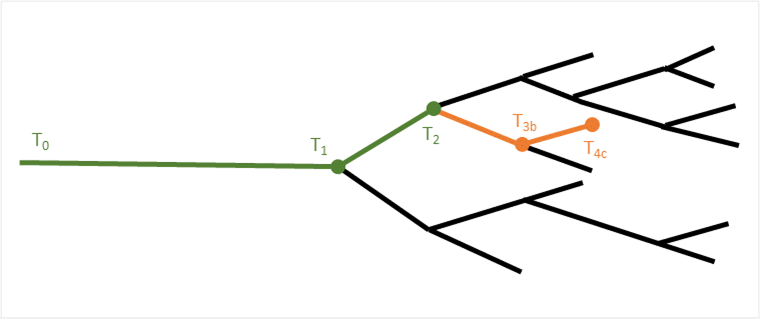
Still looking at the same chart (above), under the second scenario, something ever so slightly changed and John could have chosen the top branch rather than the lower branch, thus choosing Colorado instead.
‘“If the past had been just a tiny bit different, then John might have sensibly and rationally chosen differently (chosen Colorado instead).” Determinists and compatibilists can say this.’
The problem (referring to the chart below) is that a different choice at T2, no matter how small or seemingly insignificant, would have put him on a different path, choosing T3b on the lower branch over T3a on the upper branch. Therefore, the T4b option stemming from the upper T3a branch is not the same T4c option on the lower branch. Instead of a choice of travelling to Hawaii or Colorado, the choice may have between chicken or steak for dinner.
Whilst it is conceivable that the Colorado versus Hawaii decision might still occur, the person at T3 is not the same person.
Kane reintroduces Kant’s noumenal self by name, but he quickly discounts it on the grounds of obscurantism or mystery or “panicky metaphysics”. He’s right in doing so.
As Kane also admits creating the external actors tend to render supporters of these notions as nutters. Besides, if the external actor is the agent, it’s no different than a god doing it.
Before we move to the next section, I want to return to the assassin. My argument is that anyone, including the assassin, is a product of their environment. Full stop. Therefore, one cannot be responsible for anything. To illustrate this, let’s replace the human assassin with a robot assassin. We want to be sure the robot doesn’t twitch and miss.
The robot gets into place and does the assassination task as designed without a hitch (or a twitch). Is the robot in any way responsible for its actions? Not many would argue that it was. It was a victim of its own circumstances. Here, one might argue that the robot has no conscience, and so has no ability to do otherwise. The robot has been programmed. Even if this robot could acquire new information, it could only interpret it relative to the information and processes it already had. The human is no different. The human cannot transcend itself to invoke a different outcome. And any new input would. by definition, be an external influence.
7. Indeterminism and Responsibility
Kane wants to set the stage, so he conveys that ‘The first step in this rethinking about the Intelligibility Problem is to note that indeterminism does not have to be involved in all acts done “of our own free wills” for which we are ultimately responsible … only those acts by which we made ourselves into the kinds of persons we are, namely the “will-setting” or “self-forming actions” (SFAs) that are required for ultimate responsibility.’
Kane believes that ‘believe these undetermined self-forming actions or SFAs occur at those difficult times of life when we are torn between competing visions of what we should do or become.’ Thus, he reintroduces character.
Next, he makes an assertion that I disagree with: ‘The uncertainty and inner tension we feel at such soul-searching moments of self-formation is thus reflected in the indeterminacy of our neural processes themselves.’ It should be obvious that I object to the notion of soul-searching from the start.
Kane advances another assertion: ‘Just as indeterminism need not undermine rationality and voluntariness of choices, so indeterminism in and of itself need not undermine control and responsibility.’ I suppose it may ‘need not’, but let’s see if it does.
Then he introduces an example from communications theory, suggesting that a person can willfully concentrate on the signal to overcome noise: ‘Whether you are going to succeed in solving the problem is uncertain and undetermined because of the distracting neural noise. Yet, if you concentrate and solve the problem nonetheless, we have reason to say you did it and are responsible for it, even though it was undetermined whether you would succeed. The indeterministic noise would have been an obstacle that you overcame by your effort’. My margin note reads ‘silly’. I’ll just leave it at that.
8. Parallel Processing
I’ll admit at the start, that this section was just an annoyance, adding little to Kane’s position. My commentary will be brief.
Kane brings in his SFAs and suggests that if we are at a decision point with two (or multiple) options, each option is processed on its own thread. Reflecting on a woman faced with a decision, he tells us that ‘the choice the woman might make either way will not be “inadvertent,” “accidental,” “capricious,” or “merely random” (as critics of indeterminism say) because the choice will be willed by the woman either way when it is made, and it will be done for reasons either way – reasons that she then and there endorses.‘
NB: Underlined words in the paragraph above represent Kane’s italicised words in the chapter text.
Here, Kane continues down a rabbit hole wintering on about SFAs. I’m not convinced. It’s getting late. I’m getting cranky. I’ll will myself to continue. [Yes, that’s a joke.]
9. Responsibility, Luck, and Chance
Kane now wants to remind us that although one might ‘still find it hard to shake the intuition that if choices are undetermined, they must happen merely by chance – and so must be “random,” “capricious,” “uncontrolled,” “irrational,” and all the other things usually charged‘, and that ‘such intuitions are deeply ingrained‘.
Fair enough. Also interesting is how ingrained the sense of self and soul is, but never mind that for now.
Kane continues to unwind the bias he notes. His punchline is this:
‘(Imagine the assassin’s lawyer arguing in the courtroom that his client is not guilty because his killing the prime minister was undetermined and might therefore have failed by chance. Would such a defense succeed?)’
The ‘law’ is not seeking this truth. it is seeking blame and will go to great lengths to do so. Law is about closure. This feels like a strawman on a non-sequitur. Nothing to see here. Let’s keep on.
Kane’s final blow is that if ‘they endorsed the outcomes as something they were trying and wanting to do all along, knowingly and purposefully, not by mistake or accident‘, then they are responsible.
This reminds me of something that may or may not have been uttered by the Dalai Lama explaining the mechanics or scoring system that karma operates by. There are effectively three dimensions of karma:
Intent
Action
Reaction
Intent is the desire to do something, whether to give a gift or assassinate a Prime Minister.
Action is the activity itself: giving a gift or killing a Prime Minister.
Reaction is your emotional response: giving a gift or killing a Prime Minister.
Exploring this, say a person gains or loses a karmic point for each good or bad thing and receives no point where an event did not happen.
Let’s start with the assassin.
If your intent is to kill someone, you lose a karma point. Sort of a thought crime, I guess. [-1]
If you do kill the Prime Minister, you’ve lost another point. [-1]
Now, if you feel good about your success in this case, you lose yet another point [-1], netting you with minus 3 [-3] all tolled. However, if you feel remorse, you gain a point [+1], netting you with a minus 2 [-2].
Let’s say you have no intent to kill the Prime Minister, yet you lose control of your vehicle and smash into them. S/he dies instantly.
You get no intent point—positive or negative. [0]
You lose a point for the action. Sorry, Charlie. [-1]
Now, if you feel remorse about this event, you gain another point [+1], netting you with zero [0] all tolled. However, if you didn’t really like the Prime Minister and start singing—even in your head—Ding, Dong, the witch is dead, you lose another point [-1], netting you with a minus 2 [-2].
Let’s try gift-giving.
If you want to give a gift, you gain a karma point. [+1]
If you don’t follow through, you lose a karma point [-1], leaving you with zero [0]. There is no cause for reaction, so you remain at zero.
Let’s up the game a bit and instead of just wanting to buy a gift, you promise to buy one.
If you promise to give a gift, you gain a karma point. [+1]
If you don’t follow through, you lose a point [-1], leaving you with zero [0].
If you feel good about the ensuing disappointment, you lose another point. [-1]
If you feel bad about it, you regain a karma point [+1], so you are ahead of the game. And this, boys and girls, is how you game karma. But karma is ahead of your sorry ass, and it takes back the point. And then it takes away a penalty point if you don’t feel sorry about being a jerk.
But I digress. What were we talking about? Oh yeah, I do not endorse Kane’s endorsement idea.
10. Choice, Agency, Efforts, and Causes: Further Objections Considered
‘If indeterminism is involved in a process (such as the woman’s deliberation) so that its outcome is undetermined, one might argue that the outcome must merely happen and therefore cannot be somebody’s choice. But there is no reason to assume such a claim is true‘, Kane relates. More subterfuge.
‘Self-forming choices are undetermined, but not uncaused‘, Kane says. Tell me more.
‘They are caused by the agent’s efforts.’ Them’s fighting words.
He continues, ‘Perhaps indeterminism does not undermine the idea that something is a choice simply, but rather that it is the agent’s choice. This objection raises important questions about agency. What makes the woman’s choice her own on the above account is that it results from her efforts and deliberation, which in turn are causally influenced by her reasons and her intentions (for example, her intention to resolve indecision in one way or another). And what makes these efforts, deliberation, reasons, and intentions hers is that they are embedded in a larger motivational system realized in her brain…
‘A choice is the agent’s when it is produced intentionally by efforts, by deliberation and by reasons that are part of this self-defining motivational system and when, in addition, the agent endorses the new intention or purpose created by the choice into that motivational system as a further purpose to guide future practical reasoning and action.’
My reaction is that this so-called agent is just an invention.
‘Since those causally relevant features of the agent, which can be counted among the causes of the woman’s choice, are her reasons or motives, her conscious awareness and her deliberative efforts, we can also say that she is the cause of the choice by virtue of making the efforts for the reasons and succeeding.’
Just no.
Next, Kane conveys a situation where a guy smashes a glass table and blames it on chance events, ending with this argument.
‘We tend to reason that if an outcome (breaking a table or making a choice) depends on whether certain neurons fire or not (in the arm or in the brain), then the agent must be able to make those neurons fire or not, if the agent is to be responsible for the outcome.’
Let’s see if he comes up from this rabbit hole in the next section.
11. Responsibility and Control: Three Assassins
Watch out. Kane is doubling down—nay, tripling down—on the assassins. His primary argument appeals to emotion and indoctrination—the social programming of the reader.
‘Is the assassin less guilty of killing the prime minister, if he did not have complete control over whether he would succeed because of the indeterminism in his neural processes?’
Robert Kane, Four views on Free Will
Kane recalls the dilemma that I discussed in my Citizen Kane post of a woman to continue to the office or to help someone being mugged, and asserts (without evidence) that this is volitional and ‘is coming from her own will‘.
‘There must be hindrances and obstacles to our choices and resistance in our own wills to be overcome, if we are to be capable of genuine self-formation and free will. Compare Evodius’s question to St Augustine (in Augustine’s classic work On the Free Choice of the Will).‘
This seems like plausible logic, I suppose. But it doesn’t follow from this definition that self-formation—genuine or otherwise—or free will exists.
I tuned out at the God talk.
12 Conclusion: Complexity and “Being an Author of One’s Own Story”
Finally. The last section of this chapter before I turn to John Martin Fischer’s chapter on Compatibilism.
Kane introduces the complexity of chaotic systems next.
‘Agents, according to this modern conception with ancient roots, are to be conceived as information-responsive complex dynamical systems. Complex dynamical systems are the subject of “dynamical systems theory” and also of what is sometimes popularly called “complexity theory.” They are systems (which are now known to be ubiquitous in nature) in which new emergent capacities arise as a result of greater complexity or as the result of movement away from thermodynamic equilibrium toward the edge of chaos.’
‘Only when creatures attain the kind of inner complexity capable of giving rise to conflicts in their wills, or motivational systems, between incommensurable values does the capacity for self-formation characteristic of free will arise.’
Supposing a reaction by critics, he asks himself, ‘Even if one granted that persons, such as the businesswoman, could make genuine self-forming choices that were undetermined, isn’t there something to the charge that such choices would be arbitrary?‘
His response is that we can’t really answer this question and tries to redirect the reader’s attention to the semantics of the word arbitrary. In the end, his final position is that this is the right approach because he can feel it in his bones.
I like David Guignion’s channel, and I’ve been taking in several perspectives on Kant’s article, ‘What is Enlightenment?‘
Feel free to watch from the start, but I’ve cued it to the place where David shares my thoughts around Agency. He brings up the point that absent official authority such as a political or religious structure, we are still influenced—subconsciously—to some degree by mass media and culture. These are the embodied norms and customs that most people just take for granted without question.
As David suggests, we can’t just slough off this inherited skin. First, because we do not even question it, and, two, it’s ingrained, one would likely deny the influence or be subject to escalating commitment under so-called critical inspection.
This is akin to asking a person of a certain religious persuasion if they would have the same religious beliefs if they had not been indoctrinated with them. I feel that a vast majority would defend their religion and the underlying or resultant morality as being obvious, so at the very least they are kept in the lane with guide rails. The extent of this influence and the degree it subtracts from autonomy is my question. I believe if pressed, the individual would defend the prescribed morality to be self-evident and they would have acted the same way even without religious instruction.
The maxims are, first, that the individual is not accountable to society for his actions, in so far as these concern the interests of no person but himself.
…
Secondly, that for such actions as are prejudicial to the interests of others, the individual is accountable, and may be subjected either to social or to legal punishment, if society is of opinion that the one or the other is requisite for its protection.
John Stuart Mill, On Liberty, Utilitarianism, and Other Essays (Oxford University Press, 2015, p. 91)
John Stuart Mill, On Liberty, Utilitarianism, and Other Essays (Oxford University Press, 2015)
I’ve been cycling through The Righteous Mind and Moral Tribes, respectively by Jonathan Haidt and Joshua Greene. These blokes are social psychologists and moral philosophers. I started each of these books with the conception that I would neither like nor agree with the content. As for like, I suppose that’s a silly preconception better captured by whether or not I agree; that with which I don’t agree, I don’t like.
This said, I like the style of both of the authors, and I am finding the material to be less contentious than I first thought. I can already envisage myself agreeing with much of the substance but waiting to disagree with the conclusions.
Although I committed myself to document The Righteous Mind in situ, I am finding that I am listening to the audiobook whilst driving and so getting ahead of myself, so I’ll have to rewind and retread in order to do this. In fact, the reason I switched back to Greene’s Moral Tribes is so I wouldn’t progress even further in Haidt’s work.
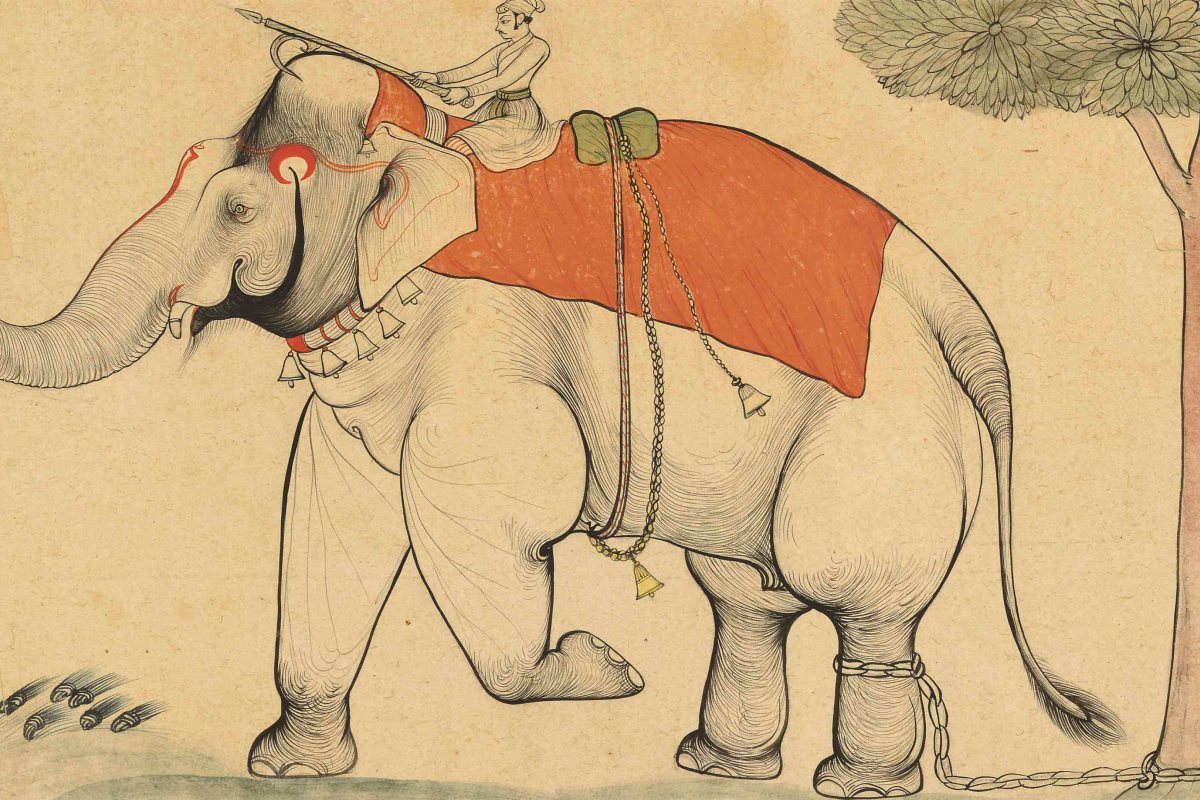
I am writing this post to acknowledge this. I’d also like to document that I don’t believe that humans are good reasoners, a situation both Haidt and Greene cite to be generally true. Humans are post hoc rationalisers, which is to say that they make up their minds and then create a narrative to justify that position. Haidt uses an analogy of an elephant and a rider, and he asserts that humans might more accurately be described as groupish than selfish. Certainly not shellfish. Greene notes that people have been shown to concede self-interest to political party interest, which helps to explain how people continually and predictably vote against their own self-interests. This also supports my position that democracy is a horrible form of government. Of course, Haidt would argue that this proves his point that people tend to adopt facts that support their perspective and diminish or disregard those that don’t.
it doesn’t follow that intuition is (1) better, (2) significantly better, or (3) good enough for (a) long term viability or (b) grasping complexity.
Haidt suggests that reason is overvalued, but then he proposes intuition as a better alternative. I agree with him that reason is overvalued and for the same reasons (no pun intended) that he does. But it doesn’t follow that intuition is (1) better, (2) significantly better, or (3) good enough for (a) long term viability or (b) grasping complexity.
Whilst I am not immune to this any more than someone else. I recall Kahneman writing in Thinking Fast and Slow that even though he is well aware of cognitive biases and fallacies, he himself can’t escape them either. When I used to teach undergraduate economics, I’d give some sort of policy assignment. As a preamble, I’d instruct the students that without exception, all policy decisions have pros and cons. In their submissions, they’d need to gather both supporting and detracting arguments and then articulate why one should be adopted over another. Minimally, I’d expect at least three pros and cons.
The students would almost invariably complain about how difficult it was to imagine a counter-position. Even when they’d include some, they were usually weak tea fodder. Oftentimes, the students already shared the same perspective, so they couldn’t usually even get the opposing side until we debriefed after the assignments had been graded. Although I do recall instances where students would admit that they hadn’t considered this or that opposing view, I can’t recall a case where a position was flipped after hearing new evidence—not that this was my intention. People do engage in escalating commitment, doubling down on existing beliefs and generating defensive—sometimes tortuous—arguments to support their positions.
In chapter 71, Ultimate Responsibility, in Intuition Pumps and Other Tools for Thinking, author and philosopher, Daniel Dennett presents a counterargument to the notion that an agent, a person, is not absolutely responsible for their actions. He questions some premises in the ‘the way you are’ line of argumentation, but I question some of his questions.
Here is a nice clear version of what some thinkers take to be the decisive argument. It is due in this form to the philosopher Galen Strawson (2010): 1. You do what you do, in any given situation, because of the way you are. 2. So in order to be ultimately responsible for what you do, you have to be ultimately responsible for the way you are—at least in certain crucial mental respects. 3. But you cannot be ultimately responsible for the way you are in any respect at all. 4. So you cannot be ultimately responsible for what you do.
Dennett, Daniel C.. Intuition Pumps And Other Tools for Thinking (p. 395). W. W. Norton & Company. Kindle Edition.
Dennett continues.
The first premise is undeniable: “the way you are” is meant to include your total state at the time, however you got into it. Whatever state it is, your action flows from it non-miraculously.
Dennett and I are in agreement with Strawson. There is not much to see here. It’s akin to saying the now is the result of all past events until now. This is “the way you are”.
The second premise observes that you couldn’t be “ultimately” responsible for what you do unless you were “ultimately” responsible for getting yourself into that state—at least in some regards.
This second premise asserts that one cannot be responsible for any action that one had no part in performing. Two scenarios come immediately to mind.
First, you are not responsible for being born. As Heidegger notes, we are all thrown into this world. We have no say in when or where—what country or family—or what circumstances.
Second, if one is hypnotised or otherwise incapacitated, and then involved in a crime, one is merely a cog and not an agent, so not responsible in any material sense.
But according to step (3) this is impossible.
Whilst Dennett fixates on the absolute aspect of the assertion, I’d like to be more charitable and suggest that we still end up with a sorites paradox. Dennett will return to this one, and so shall I.
So step (4), the conclusion, does seem to follow logically. Several thinkers have found this argument decisive and important. But is it really?
As Dennett invalidates step (3), he insists that the conclusion is also invalid. He asserts that the notion of absolute responsibility is a red herring, and I argue that Dennett doesn’t get us much further, perhaps redirecting us with a pink herring.
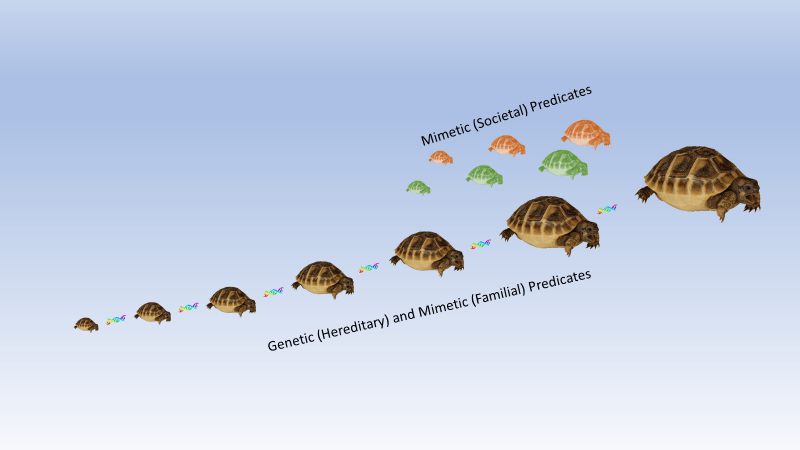
I’ve created an image with tortoises to make my point. There are actually two points I wish to make. The first point is to determine where the responsibility is inherited. This point is meant to articulate that the world can not be strictly deterministic and yet one can still not have significant agency. The second point is that culpability is asserted as a need, and acceptance of this assertion is the problem.
Testuditude
The image depicts an evolution of an agent, with time progressing from left to right. The tortoise on the right is a product of each of the recursive tortoises to its left. The image means to convey that each subsequent tortoise is a genetic and social and social product of each tortoise prior. Of course, this is obviously simplified, because tortoises require pairs, so feel free to imagine each precedent tortoise to represent a pair or feel free to add that level of diagrammatic complexity.
This is not meant to distinguish between nature and nurture. Instead, the claim is that one is a product of both of these. Moreover, as genetic, epigenetic, and mimetic influences are transmitted in family units, they also occur through social interaction and the environment, as represented by the orange and green tortoises.
…if one is a product of genetic and mimetic forces, how much agency remains for culpability?
The point here is that if one is a product of genetic and mimetic forces, how much agency remains for culpability? Each person is an emergent unit—autonomous, yes, and yet highly programmed.
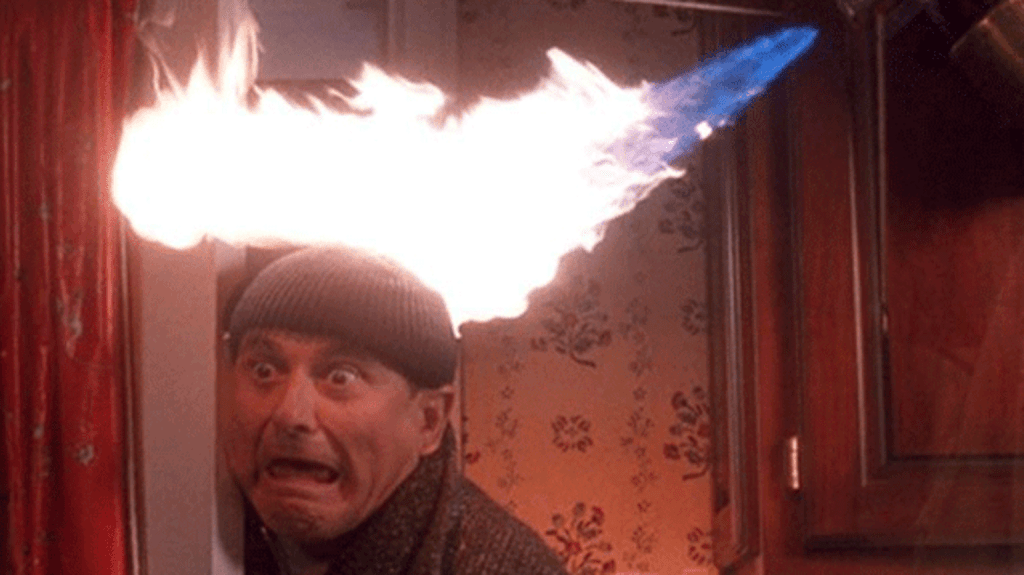
If I programme a boobytrap to kill or maim any intruder, the boobytrap has no agency. I assert further, that the maker of that boobytrap has no more responsibility than the killing device.
The old hand grenade wired to a doorknob boobytrap trick
But who do we blame? you ask, and that’s precisely the problem. Asking questions doesn’t presume answers. This is a logical fallacy and cognitive bias. This heuristic leaves us with faulty jurisprudence systems. Humans seem hardwired, as it were, to blame. Humans need to believe in the notion of free will because they need to blame because they need to punish because vengeance is part of human nature to the extent there is human nature. There seems to be a propensity to frame everything as a causal relationship. Dennett calls this the Intentional stance. To borrow a from Dennett…
This instinctual response is the source in evolution of the invention of all the invisible elves, goblins, leprechauns, fairies, ogres, and gods that eventually evolve into God, the ultimate invisible intentional system.
Dennett, Daniel C.. Intuition Pumps And Other Tools for Thinking (p. 374). W. W. Norton & Company. Kindle Edition.
Fire Trap in Home Alone
Sins of the Fathers (and Mothers)
Let’s wrap this up with a sorites paradox. As I’ve already said, I agree with Dennett that the absolute aspect is unnecessary and undesired. The question remains how much agency™ does a person have once we account for the other factors? Is it closer to 90 per cent or 10 per cent? Apart from this, what is the threshold for culpability? Legal systems already have arbitrary (if not capricious) thresholds for this, whether mental capacity or age, which basically distils back to the realm of capacity.
I have no basis to even venture a guess, but that’s never stopped me before. I’d argue that the agency is closer to zero than to one hundred per cent of the total, and I’d propose that 70 per cent feels like a reasonable threshold.
I could have sworn I’d posted a position on this after I read Robert Sapolsky’s Behave. Perhaps it’s never made it out of drafts.
In closing, I don’t think we need to settle the question of determinism versus free will to recognise that even without strict determinism, personal agency is still severely limited, and yet as our political systems presume a level of rationality that is not apparent, so do legal systems presume a level of agency not present.
All too often, I’ll read or listen to a book and place bookmarks with the best of intents to revisit and comment. yet either never to return or to return and not recall the context and not wanting to reread to regain it. I am going to attempt to document my reaction to Jonathan Haidt’s book, The Righteous Mind: Why Good People are Divided by Politics and Religion. If you’ve read some posts here, you’ll understand that I am not a moralist, so I don’t expect to like the book or agree with it. I’ve already ready the forward materials, so I’ll return to comment on that before I get too far ahead. I have done this before at university, and it is decidedly slow progress and can chase one down rabbit holes—this one, anyway.
I have a habit of abandoning books in favour of others including dropping them outright. This is one of 16 I have in progress at the moment, some commenced as many as 5 years ago. To be fair to myself, many of those books are substantially completed. I feel I got the intended message—or at least got what I wanted out of them—, and I just haven’t read the final few chapters. In some cases, the book is an anthology, and I have been slogging my way through it. A few books I’ve read before and am reabsorbing the material, so I may decide not to re-read cover to cover. I just pulled a second reading book off the list to get to 16 from 17.
I have striven not to laugh at human actions, not to weep at them, not to hate them, but to understand them.
— Baruch Spinoza, Tractatus Politicus, 1676
Introduction
“Can we all get along?” — Rodney King
“Please, we can get along here. We all can get along. I mean, we’re all stuck here for a while. Let’s try to work it out.”
Born to be Righteous
I could have titled this book The Moral Mind to convey the sense that the human mind is designed to “do” morality, just as it’s designed to do language, sexuality, music, and many other things described in popular books reporting the latest scientific findings.
Empasis mine
Straight away, I have a contention. The human mind is not designed to do anything. It has evolved and performs functions. Perhaps, this is just a matter of semantics, but it puts me on guard. Moreover, that it does morality doesn’t evaluate the relative benefit or if it should even be done. Without going down the aforementioned rabbit hole, language is a perfect example. We use language to communicate, but language as a social mechanism may be a secondary or tertiary function. As I’ve argued—even quite recently—, this is a reason I feel that language is insufficient for the purpose of conveying abstract concepts, like for example, morals and morality.
But I chose the title The Righteous Mind to convey the sense that human nature is not just intrinsically moral, it’s also intrinsically moralistic, critical, and judgmental.
A primary function of the brain is as a difference engine. This is what allows us to discern friend from foe, edible versus poison, and so on. Reflecting on Kahneman and Tversky, most (if not ostensibly all) of this is a heuristic system I process, which is good enough but only at a distance. Morals allow us to create in-group and out-group distinctions.
I want to show you that an obsession with righteousness (leading inevitably to self-righteousness) is the normal human condition. It is a feature of our evolutionary design, not a bug or error that crept into minds that would otherwise be objective and rational.
To my first point—not only his insistence on a design metaphor, but doubling down and declaring it as not a bug or an error—, this is disconcerting. And it may be a normal human condition, but so is cancer. The appeal to nature isn’t winning me over.
Our righteous minds made it possible for human beings—but no other animals—to produce large cooperative groups, tribes, and nations without the glue of kinship.
Agreed.
What Lies Ahead
Part I is about the first principle: Intuitions come first, strategic reasoning second.
If you think that moral reasoning is something we do to figure out the truth, you’ll be constantly frustrated by how foolish, biased, and illogical people become when they disagree with you. But if you think about moral reasoning as a skill we humans evolved to further our social agendas—to justify our own actions and to defend the teams we belong to—then things will make a lot more sense.
Haidt and I are much aligned on these points.
Keep your eye on the intuitions, and don’t take people’s moral arguments at face value. They’re mostly post hoc constructions made up on the fly, crafted to advance one or more strategic objectives.
Not buying the ‘go with your intuitions‘ advice. Moving on.
…the mind is divided, like a rider on an elephant, and the rider’s job is to serve the elephant … I developed this metaphor in my last book, The Happiness Hypothesis.
I’m not sure I am going to like this dualism, and I haven’t read The Happiness Hypothesis, so I’ll just have to see where he takes it. It seems like Haidt is a hardcore Traditionalist.
Part II is about the second principle of moral psychology, which is that there’s more to morality than harm and fairness.
This feels about right.
The central metaphor of these four chapters is that the righteous mind is like a tongue with six taste receptors.
OK. Let’s see where this goes.
Part III is about the third principle: Morality binds and blinds.
I like this pair.
…human beings are 90 percent chimp and 10 percent bee.
Did he say bee? I agree with the chimp reference. Maybe this won’t be as bad as I thought.
A note on terminology: In the United States, the word liberal refers to progressive or left-wing politics, and I will use the word in this sense. But in Europe and elsewhere, the word liberal is truer to its original meaning—valuing liberty above all else, including in economic activities. When Europeans use the word liberal, they often mean something more like the American term libertarian, which cannot be placed easily on the left-right spectrum.10 Readers from outside the United States may want to swap in the words progressive or left-wing whenever I say liberal.)
Decent advice.
Why do you see the speck in your neighbor’s eye, but do not notice the log in your own eye? … You hypocrite, first take the log out of your own eye, and then you will see clearly to take the speck out of your neighbor’s eye.
— MATTHEW 7:3–5
I do find myself, probably too often, parroting this paragraph.
PART I
Intuitions Come First, Strategic Reasoning Second
Central Metaphor: The mind is divided, like a rider on an elephant, and the rider’s job is to serve the elephant.
Where Does Morality Come From?
A family’s dog was killed by a car in front of their house. They had heard that dog meat was delicious, so they cut up the dog’s body and cooked it and ate it for dinner. Nobody saw them do this.
A man goes to the supermarket once a week and buys a chicken. But before cooking the chicken, he has sexual intercourse with it. Then he cooks it and eats it.
TBD
The Origin of Morality
Quick reaction for now. Details to follow…
I’m not quite buying into Haidt’s attempt to parse the nature versus nature argument into three segments: nativism and empiricism whilst adding rationalism insomuch as rationalism is seen by many as ambiguous and not a mutually exclusive option. It feels as though he’s throwing up a rationalist strawman to take down. We’ll see where it leads
Nativism the theory that concepts, mental capacities, and mental structures are innate rather than acquired by learning.
Empiricism the theory that all knowledge is derived from sense-experience.
Rationalism the theory that reason rather than experience is the foundation of certainty in knowledge.
Let’s pick up on this later. I knew this would take a lot longer.
A social connection posted a piece on Humberto Maturana’s idea of “aesthetic seduction”. I found it interesting, so I wanted to understand more. Performing a Google search, I landed on The Edge, where I found an interesting comment by Dan Dennett. I share it in its entirety.
Philosopher; Austin B. Fletcher Professor of Philosophy, Co-Director, Center for Cognitive Studies, Tufts University; Author, From Bacteria to Bach and Back
Post hoc ergo propter hoc! “After this, therefore because of this.” Francisco Varela is a very smart man who, out of a certain generosity of spirit, thinks he gets his ideas from Buddhism. I’d like him to delete the references to Buddhist epistemology in his writings. His scientific work is very important, and so are the conclusions we can draw from the work. Buddhist thinking has nothing to do with it, and bringing it in only clouds the real issues.
There are striking parallels between Francisco’s “Emergent Mind” and my “Joycean Machines.” Francisco and I have a lot in common. In fact, I spent three months at CREA, in Paris, with him in 1990, and during that time I wrote much of Consciousness Explained. Yet though Francisco and I are friends and colleagues, I’m in one sense his worst enemy, because he’s a revolutionary and I’m a reformer. He has the standard problem of any revolutionary: the establishment is — must be — nonreformable. All its thinking has to be discarded, and everything has to start from scratch.
We’re talking about the same issues, but I want to hold on to a great deal of what’s gone before and Francisco wants to discard it. He strains at making the traditional ways of looking at things too wrong.
Dennett’s response is a critique of Francisco Varela, which is not the part that interests me. What caught my eye is his distinction between revolutionary and reformer. And it dawned on me—perhaps re-dawned might be a better verb, or to illuminate or intensify, to shine a light.
I consider myself to be introspective, and times like these allow me to be self-critical. I view myself as a revolutionary as far as expectations go. This makes me impatient with little tolerance for the marginal changes that attendant with reformism.
Being a revolutionary doesn’t make one a Utopian—a common critique—, that one is seeking perfection. From my perspective, when things are so far off course or misaligned, incremental changes don’t seem to be enough.
Moreover, reform is a political misdirection tactic I am leery of. So, irrespective of core beliefs, I feel even a reformist should be wary of the tactic. In politics, sometimes new ideas arise that are not in concert with the prevailing orthodoxy but are building mass. The idea is to retain the status quo as much as possible. The tactic is to find the smallest least disruptive sliver and find a way to integrate it in a manner for the mass to diminish and to be able to claim concordance.
The first example that pops into my mind is the Affordable Care Act (AKA Obamacare) in the United States, which is not exactly affordable not all that caring, though it is a reformist act. Even the main alternative of Universal Single-Payer insurance wasn’t that revolutionary, making the delusion of the solution and the adopted approach all that much more disappointing.
Industrial and post-industrial countries have solved this problem, so it’s not revolutionary unless one considers being over a hundred years late to the party to be particularly impressive. Moreover, there are programmes in the United States, i.e. Medicare, that are ostensibly single-payer programmes. In fact, one approach suggested was to expand Medicare to include everyone. This was dubbed Medicare Part E.
What this exposes is that the Reform-Revolution debate is a sorites challenge. The reformers consider the Medicare Part E proposal to be radical or revolutionary whilst I viewed it as a couple more millimetres away from the original Obamacare promises. Since the status quo started from such a limited position, when they ended up with is a milquetoast implementation.
To me, the debate is about paradigm shift versus glacial change. As for me, when I regard the battle between the Democrats and Republicans in the United States, I am not satisfied with any solution that sees these parties still standing post-solution. As a revolutionary thinker, I don’t need to toss out the proverbial baby with the bathwater, but let’s lose the bathwater and at least the sieve of a tab. Of course, I argue that the direction the so-called Enlightenment has taken the Western world, which is different to the argument made by prior traditionalists, so I can see a lot of room for change—revolutionary change. In the case of implementing Enlightenment beliefs, they took the idea of revolution a bit more literally than was perhaps necessary, but since it was more about a power grab than some broader promise of freedom, I suppose it was necessary. Meet the new bosses, same as the old boss.
“Equality of rights under the law shall not be denied or abridged by the United States or by any state on account of sex.”
The United States doesn’t constitutionally protect women. This is where reformism gets you. Per Wikipedia,
The Equal Rights Amendment (ERA) is a proposed amendment to the United States Constitution designed to guarantee equal legal rights for all American citizens regardless of sex. Proponents assert it would end legal distinctions between men and women in matters of divorce, property, employment, and other matters. The first version of an ERA was written by Alice Paul and Crystal Eastman and introduced in Congress in December 1923.
Wikipedia — Equal Rights Amendment
If you read 1923 and wonder if that’s a typo, it’s not. It’s been almost 100 years and women still have no guarantee of equal rights. Women had only been granted voting rights with the ratification of the 19th Amendment to the Constitution on August 18, 1920.
For a country founded on the principle that all people are created equal, this feels like it should be considered to be a redundant act…
My bad, the US Declaration of Independence reads “We hold these truths to be self-evident, that all men are created equal, that they are endowed by their Creator with certain unalienable Rights, that among these are Life, Liberty and the pursuit of Happiness”. This is just men. And when this was written BIPOC did not fully qualify as men. Reformists have almost got that sorted out by now right? 1776 seems like almost yesterday. Change comes slowly.
By now, I’m rambling semi-coherently, so I’ll close this down. Keep in mind the foundation of your interlocutor. Is s/he a reformist or a revolutionary? Determine where on the scale s/he falls. You might save yourself a lot of time. Time Is on My Side is only a song not a recipe for living.
Capitalism and apathy in the United States are leading factors in driving homelessness. Employing Capitalism and apathy is somewhat redundant as a major component of Capitalism is apathy and creating otherness—us and them; haves and have nots. People reaching retirement age—Boomers in the parlance—are finding themselves homeless—or as the sage, George Carlin reminds us, houseless.
The feeling behind this sentiment is that this cohort did this to themselves. They shot themselves in the foot—or the face, as the case might be. They bought into the Darwinist mythos and envisaged themselves as coming out on top—except they didn’t and the music stopped and someone else had all the chairs. In fact, a few people had many more chairs than a person could ever need, leaving more people out of the game than strictly necessary. Illusory superiority is a cognitive fallacy that keeps things like Capitalism alive. And cognitive dissonance masquing mechanisms assuage the delta between perception and reality. And like lottery players, they convince themselves that one day their ship will come in. Yet at some point during the backside of midlife—however one defines that—, comes the foreboding that this is probably not in the cards. You’d gone all in and there was no payoff.
Whilst viscerally, I agree with the sentiment—as I sometimes feel schadenfreude for the people who vote for any major party candidates in election after election and are surprised that their candidate doesn’t move the needle because of [insert excuses here]. When the other party wins, nothing material happens because they don’t understand or don’t have it right. When their party wins and nothing material happens it’s because of entrenched opposition—perhaps, rather, controlled opposition.
Controlled Opposition
But what’s entrenched is not the other party. As I’ve noted before, there is no other party. There are no material choices. I don’t believe the image below is to scale because it makes it appear that they are less alike than they actually are. The image illustrates how the Democratic and Republican parties share the same foundation. I am fairly certain one could swap our Democrats and Republicans for Labour and Conservative, but I won’t speak out of school.
Twin Peaks
Almost nothing anyone can do in the near term can have any effect. In the long run, any real threat will be eliminated, neutralised, or assimilated. They may even allow an independent voice remain, but that is only for the sake of performance. It’s more like improv than scripted, but the impact will be negligible, in the manner of throwing a pillow at an aircraft carrier—even a firm foam pillow.
The most obvious connexion is that both parties—in practice all participating factions—are constitutionalists. Interestingly enough, my spellchecker autocorrected ‘institutionalist’ as ‘constitutionalist’, and that’s another commonality. As for foreign policy, the two are virtually indistinguishable. On domestic affairs, aside from vapid rhetorical and stylistic differences that might amount to some inconsequential veneer of a different tint, but their biggest differences above the water are hot-button items that spawn more words than action—especially from the Democrats.
In the US, there’s a notion of two Santa Clauses. Ostensibly, Republicans run roughshod and spend like drunken sailors when they are in power, but when Democrats are in power, Republican messaging accuses timid Democrats—and let’s be honest here; that’s most of them—of being free-spending liberals. Both parties are unrepentant spendaholics. The only difference is which people get the leftovers. I say ‘leftovers’, because their sponsors are first on queue to get paid.
The meter’s about to run out, so I’ll end my rant here. This is just one of two topics I wanted to get off of my chest. The other relates to racism—and otherness more generally, but that will have to wait for another day.
Some geezer, John Gray, wrote a book having this title. It was, let us say, ‘suggested’ that I watch it in video format—over an hour-long at that. I decided to search for a summary instead.
It’s not particularly up my street. The bloke who suggested the vid posted a statement:
Atheism is a narcissistic apostasy; the adoration of the things humans do & make; the worship of the golden calves of science & technology.
When I responded thusly « This quip reduced and conflates, almost creating a strawman. I suppose some atheists might be narcissists, though I don’t see that they would significantly differ from a sample of the general population. I’m guessing the second clause is intended to connect from the first, which is to claim that an atheist is a human who chooses STEM over gods as if there are no other alternatives, which creates a false dichotomy. But to treat atheism as some monolith is to treat all religions as ostensibly identical », his response was
What is atheism?.
To which I replied, « Atheism is the absence of belief in gods (or supernatural beings, if that’s a more generalisable concept). »
well, that is not enlightening at all. Explain atheism clearly.
That is all there is to it. There are different reasons why people are atheists, but that’s the definition. Etymologically, ‘theism’ is ‘belief in a deity or deities’. Atheism, applying the Greek prefix ‘a-‘, is the negative state of ‘theism, so the absence of ‘belief in a deity or deities’.
Atheism is not science. A large number of scientists believe in God. They see no contradiction between God and science, in fact they find the order behind everything reinforces their belief.
And so here the conversation, as it was, went off the rails. At no point did I invoke science. And then he promotes the John Gray video.
Interview with John Gray on Does God Exist
And we’ve been there before.
New Atheism: the debate between science and religion was a result of confusing myths with theories. Religion is no more a primitive type of science than is art or poetry; scientific inquiry answers a demand for an explanation; the practice of religion expresses a need for meaning.
Secular Humanism: a hollowed-out version of the Christian belief in salvation in history; the widespread belief that humans are gradually improving is the central article of faith of modern humanism
Science-Religion: Gray reflects on the twentieth century’s strange faith in science – a faith that produced the false equation of evolution with progress and the racist ideologies that infect our social arrangements and political institutions
Political Religion: Modern political ideologies are de facto religions; the belief that we live in a secular age is an illusion
God-hatred: absorbed by the problem of evil; suffering, if inevitable, is at least infused with moral significance
The Unsentimental Atheisms of George Santayana and Joseph Conrad: Santayana dismisses any idea that civilization is improving; everything in this world is a progress towards death. Conrad wrote that man is a wicked animal; his wickedness has to be organized; society is essentially criminal – otherwise, it would not exist
Mystical Atheism: Schopenhauer was deeply and articulately antagonistic to religion in general; he rejects the notion that history has any metaphysical meaning, or that human beings are somehow advancing
Disclaimer 1: This summary list is copy-pasted from the linked source and edited ever so slightly to fit here.
Disclaimer 2: Neither did I watch the video nor read his book, so the summary might be off-kilter.
Still, I offer my reaction/reflection.
Firstly, this comes off not as an attack on atheism; rather, it’s an attack more particularly on Enlightenment and post-Enlightenment thinkers, predominantly Scientists—as in those who practice Scientism religiously.
Secondly, this limited attack garners the same critique as I give Dawkins’ God Delusion. I liked this book, but whereas Gray limits his attack on a thin slice of atheists—despite offering up 7 flavours—, Dawkins limits his attack to Christians; perhaps, some Abrahamic denominations. This is a particular God and particular disciples.
I address these in turn.
New Atheism: I agree that Scientism simply switched faith from God to Science or it deified Science, whichever vantage you prefer. This ilk simply swapped God for Naturalism. These are the same lot who offer up ‘Self-evident truths’ and Natural Law. Please. I agree with neither.
Secular Humanism: Whilst admittedly secular, I am not quite a Humanist and decidedly not a Secular Humanist™. Here, I disagree with the underlying teleological notion of both.
Science-Religion: The only nod I am willing to give to science is the evidence-based, falsifiability over faith, but much of science is still faith-based. It just operates from a different metanarrative. Again, Scientism is no one’s friend.
Political Religion: I agree that this is as much a scourge as organised religion. By now, one might notice a trend—a healthy does of whataboutism: We can’t suck because we’re no different to this other thing that you might be attached to. Except they are all bollox through and through. Political ideology is religion without the blatant metaphysical nod—though it is still there beneath the surface.
God-hatred: Even having not read the book, this makes no sense whatsoever. How can one hate what one doesn’t believe exists? I suppose I could hate unicorns, faeries, and Harry Potter, but I don’t think that’s the same thing. The summary suggests that it’s more about an obsession with evil, but I don’t have enough context to respond meaningfully. Do atheists actually believe in evil? I don’t. And, except idiomatically, I don’t personally know of others who do. Feels like a red herring.
Unsentimental Atheisms: Satayana refutes the Secular Humanists. I’m buying what he’s selling. Conrad is taking a spin on evil but opting to label it wicked—a bit of a drama llama. I’m not buying it.
Mystical Atheism: I like Schopenhauer—probably because he’s such an underdog. He did glean a bit from Buddhist philosophy. So have I. But Buddhism ranges from the secular to the sacred. I don’t tend to stray too far from the secular. I fully agree that history has no metaphysical meaning and human beings are not objectively advancing.
If anything, this is one of the longer posts I’ve made in a while. Thanks to the Copy-Paste Gods. Allahu Akbar, Oh Mighty. In the end, Santayana and Schopenhauer notwithstanding, I am still left with a why not neither.









 Philosophics