He doesn‘t, but he accidentally demonstrates the problem.
There is a certain kind of person who loathes Nietzsche for the same reason they loathe earthquakes. Not because he causes damage, but because he refuses to pretend the ground was ever stable.
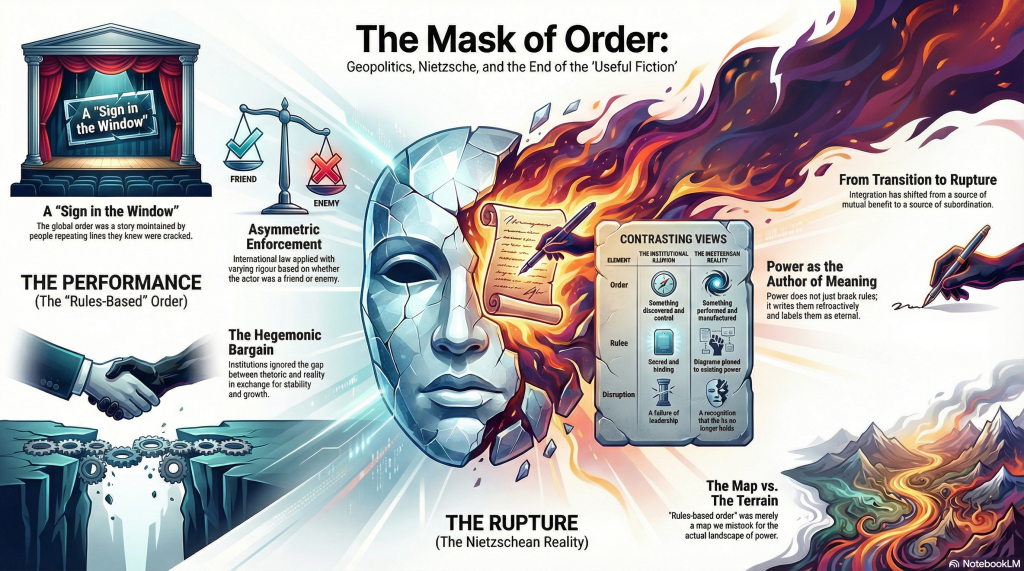
In a recent address, Mark Carney says something that would have been unutterable in polite company a decade ago. He admits that the ‘rules-based international order’ was always a partial fiction. Not false enough to abandon, not true enough to believe in without effort. A story everyone knew was cracked, but which continued to function so long as enough people kept repeating the lines.
“We knew that the story about the rules-based order was partially false… We knew that international law applied with varying rigour depending on the identity of the accused and the victim. This fiction was useful [because of the goods provided by American hegemony]… So we placed the sign in the window. We participated in the rituals. And we largely avoided calling out the gaps between rhetoric and reality. This bargain no longer works. Let me be direct. We are in the midst of a rupture, not a transition… You cannot live within the lie of mutual benefit through integration when integration becomes the source of your subordination.“
Audio: NotebookLM podcast of this topic.
International law, he concedes, applied unevenly. Power decided enforcement. Friends received nuance. Enemies received principle. This was not ignorance. It was a bargain. The illusion delivered goods, stability, growth, a sense of moral hygiene. So the sign stayed in the window. The rituals continued. The gaps between rhetoric and reality were politely ignored. That bargain, Carney says, no longer works.
This is framed as geopolitical realism, but it is really an ontological admission. The mask slipped, and everyone is suddenly offended by the face underneath.
Image: NotebookLM infographic of this content.
This is why people hate Friedrich Nietzsche. Not because he celebrates cruelty or chaos, but because he insists that order is something we perform, not something we discover. He refuses the comfort of believing that the rules were ever neutral, universal, or self-enforcing. He points at the scaffolding and says: this is what is holding things up, not the sky.
When enough people play along, the game feels like reality. When someone refuses to play, panic sets in.
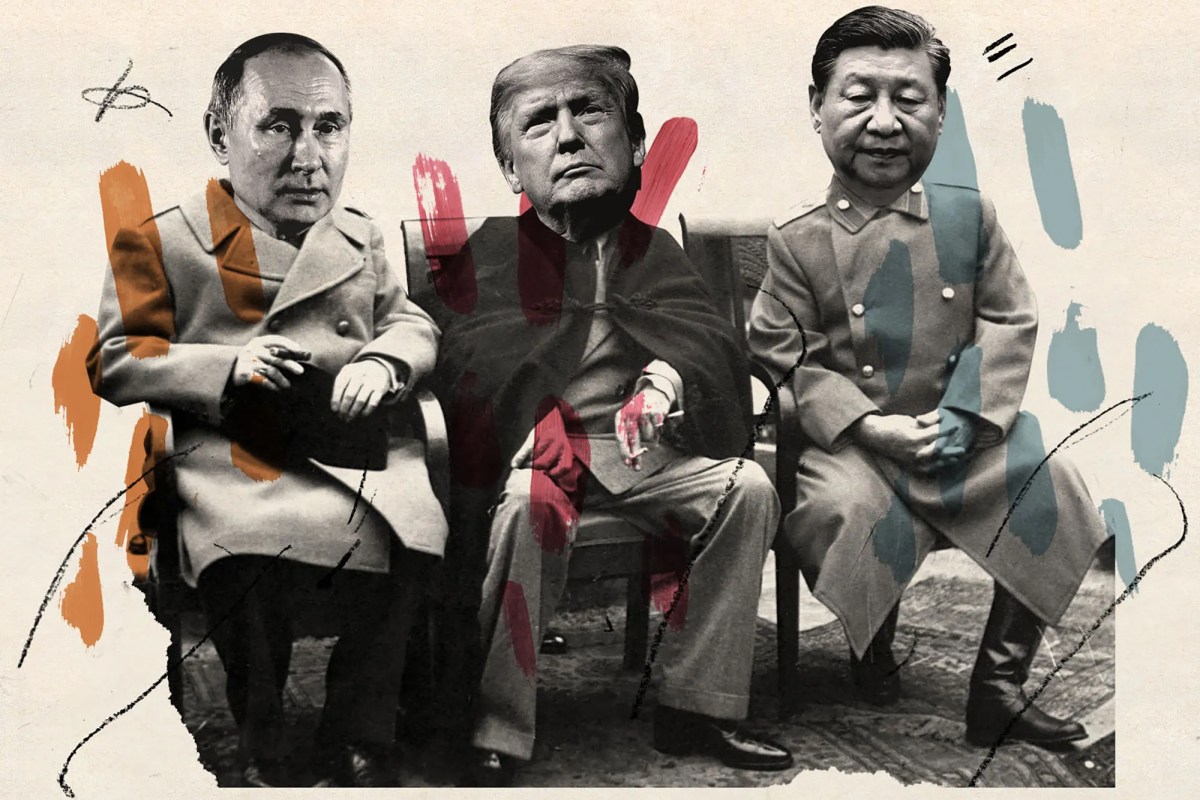
Enter Donald Trump. Trump did not invent the asymmetries of power. He refused to speak them politely. This created a moral crisis for institutions built on the assumption that everyone would continue to pretend. When a designated enemy like Vladimir Putin does this, it is filed under Evil. When an ally does it, the response bifurcates: either frantic appeasement, or embarrassed silence disguised as strategy.
Image: Foreignsentiment
Carney tries to walk a middle path. He neither genuflects nor detonates the stage. He acknowledges the fiction without fully abandoning it. This makes him interesting, but also symptomatic. He wants the audience to notice the set wobbling without asking them to leave the theatre.
When he says the old rules-based order is not coming back, what he really means is that the illusion has been interrupted. Whether permanently or only until someone builds a more convincing façade is left diplomatically unresolved. This is where Nietzsche becomes unavoidable.
People often lump Nietzsche together with vague talk of “power,” as though this were a crude obsession shared with Michel Foucault. But Nietzsche’s contribution is sharper and more unsettling. He is not merely describing power as something exercised. He is describing power as something that manufactures meaning, legitimacy, and moral vocabulary after the fact. Power does not break the rules. It writes them retroactively and calls them eternal.
This is the kind of power later adopted by Adolf Hitler, by Putin, and now by Trump. Not brute force alone, but the refusal to treat inherited norms as sacred simply because they are inherited. This is precisely what terrifies people who mistake procedural continuity for moral truth.
The United States borrowed Montesquieu’s separation of powers as though it were a lock rather than a suggestion. Anyone paying attention could see how easily it could be gamed. That this came as a shock says less about constitutional brilliance than about selective vision. The system functioned not because it was impregnable, but because its participants agreed, tacitly, to behave as though it were.
Nietzsche would call this decadence. Not decline as catastrophe, but decline as denial. The refusal to look directly at the conditions that make order possible, preferring instead to moralise their breakdown.
Carney’s speech is not radical. It is late. It says aloud what everyone already knew but preferred not to articulate: that the world was never neat, the order never neutral, and the rules never binding on those strong enough to ignore them.
What comes next is the uncomfortable part. Once the illusion is acknowledged, it cannot simply be re-believed. You can rebuild institutions. You can repaint the signage. But you cannot unknow that the coffee was always bitter.
Nietzsche does not tell us what replaces the façade. He only insists that pretending it was ever a window onto truth is the most dangerous fiction of all.
What Carney inadvertently demonstrates is not a failure of leadership but a failure of language. ‘Rules-based order’ was never a description of the world; it was a map we mistook for the terrain because it worked often enough to feel true. Nietzsche’s crime was pointing at the legend and saying it was doing the real work. Once that admission is made, you do not get to return to innocence. You can draw a new map, call it reform, integration, or renewal, but you will know it is a diagram pinned to power, not a window onto justice. The unease people feel now is not about chaos. It is about recognition. The lie no longer holds because too many have noticed the pins.
We like to believe the world is governed by rules. By fairness. By international law, norms, institutions, treaties, and laminated charters written in earnest fonts. This belief survives not because it is true, but because it is psychologically necessary. Without it, we would have to admit something deeply unfashionable: power still runs the table.
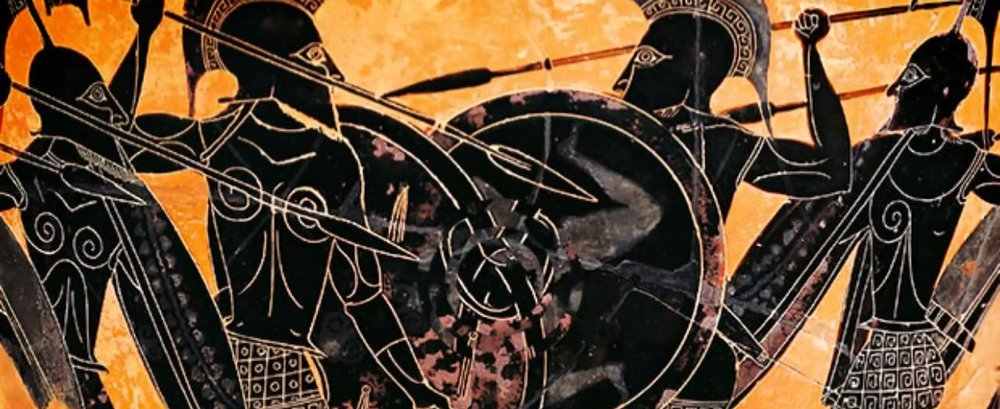
Two and a half millennia ago, Thucydides recorded what remains the most honest conversation in political theory: the Melian Dialogue. No soaring ideals, no speeches about freedom. Just an empire explaining itself without makeup.
Audio: NotebookLM summary podcast of this topic.
Athens, the regional superpower of the ancient world, demanded that the small island of Melos surrender and pay tribute. Melos appealed to justice, neutrality, and divine favour. Athens replied with a line so indecently clear that political philosophy has been trying to forget it ever since: ‘The strong do what they can and the weak suffer what they must’.
That sentence is not an ethical claim. It is a descriptive one. It does not say what ought to happen. It says what does. The Athenians even went further, dismantling the very idea that justice could apply asymmetrically: ‘Justice, as the world goes, is only in question between equals in power’.
This is the part liberal internationalism prefers to skip, usually by changing the subject to institutions, norms, or aspirations. But the Athenians were being brutally honest. Appeals to fairness only work when neither side can impose its will outright. When there is a power imbalance, morality becomes theatre.
The Melians refused to submit. They chose honour, principle, and the hope that the gods would intervene. Athens killed every Melian man of fighting age and enslaved the women and children. End of dialogue. End of illusions. Fast-forward to now.
In early 2026, under Donald Trump, the United States launched a military operation against Venezuela, striking targets in Caracas and forcibly detaining Nicolás Maduro, who was transported to the United States to face federal charges. The justification was framed in familiar moral language: narco-terrorism, stability, regional security, democratic transition. The accompanying signals were less coy: temporary U.S. administration, resource access, and ‘order’. Cue outrage. Cue talk of illegality. Cue appeals to sovereignty, international law, and norms violated. All of which would have been very moving… to the Athenians.
Strip away the rhetoric and the structure is ancient. A dominant power identifies a weaker one. Moral language is deployed, not as constraint, but as narrative cover. When resistance appears, force answers. This is not a deviation from realism. It is realism functioning exactly as advertised.
Modern audiences often confuse realism with cynicism, as if acknowledging power dynamics somehow endorses them. It does not. It merely refuses to lie. The Melian Dialogue is not an argument for empire. It is an autopsy of how empire speaks when it stops pretending. And this is where the discomfort really lies.
We continue to educate citizens as if the world operates primarily on ‘shoulds’ and ‘oughts’, whilst structuring global power as if only ‘can’ and ‘must’ matter. We teach international law as though it binds the strong, then act shocked when it doesn’t. We pretend norms restrain power, when in reality power tolerates norms until they become inconvenient.
The Athenians did not deny justice. They reclassified it as a luxury good. Trump’s Venezuela operation does not abolish international law. It demonstrates its conditional application. That is the real continuity across 2,500 years. Not cruelty, not ambition, but the quiet consensus among the powerful that morality is optional when enforcement is absent.
The lesson of the Melian Dialogue is not despair. It is clarity. If we want a world governed by rules rather than force, we must stop pretending we already live in one. Appeals to fairness are not strategies. They are prayers. And history, as ever, is not listening.


 Philosophics