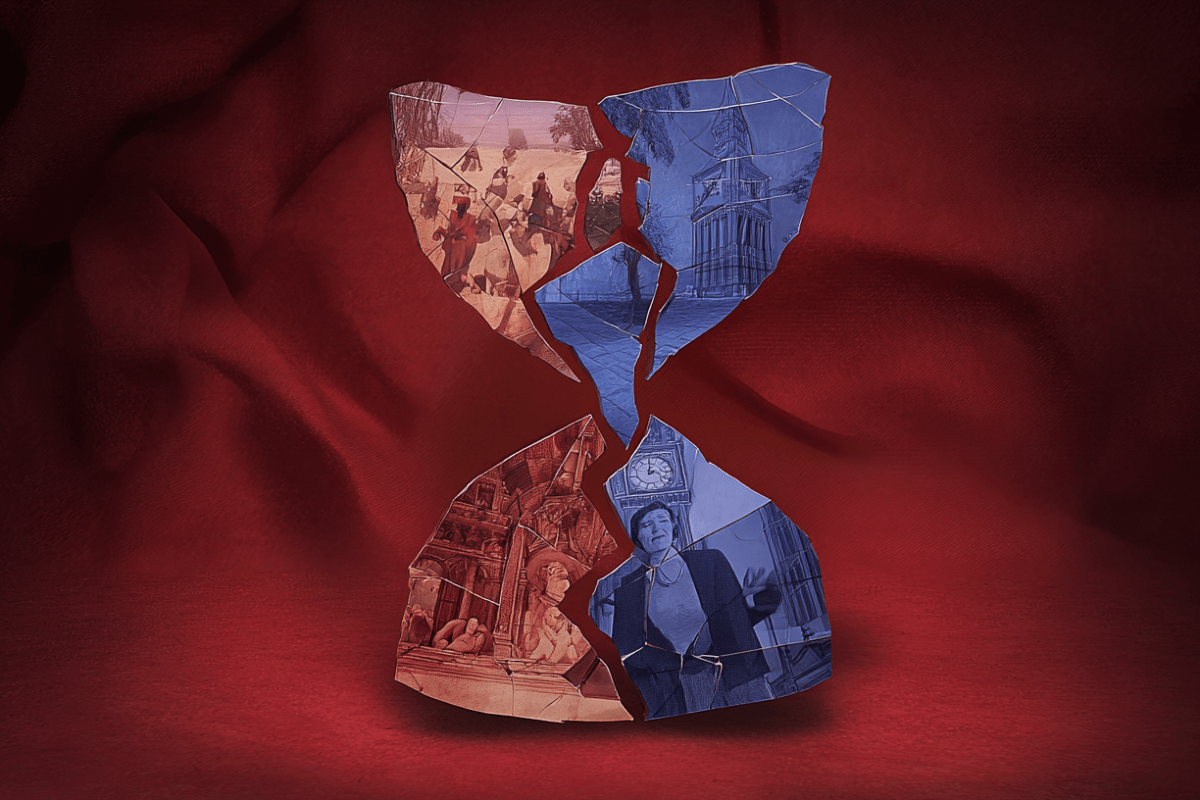
How the Trump Era Rewrote Time, Truth, and the Very Idea of a Common World
Politics in the Trump era wasn’t merely a spectacle of bad manners and worse epistemology; it was the moment the United States stopped pretending it shared a common world – when politics ceased to be a quarrel over facts and became a quarrel over the very conditions that make facts possible. This essay is part of an ongoing project tracing how post-Enlightenment societies lose their shared grammar of verification and retreat into parallel narrative architectures that demand allegiance rather than assessment.
And before anyone hyperventilates about implied asymmetry: the recursive logic described here is not exclusive to the right. The progressive cosmology, though stylistically different, exhibits the same structural features – prophetic claims about impending catastrophe or salvation, retrospective reinterpretations to maintain coherence, and an insistence on possessing privileged interpretive tools. The Trump era didn’t invent this recursive mode; it simply accelerated it, stripped it naked, and pumped it through a 24-hour media bloodstream until everyone could see the circuitry sparking.
Welcome to the new cosmology.
1. The Death of a Common Grammar
Once the shared grammar of verification dissolves, political discourse stops unfolding in empirical time. It migrates into suspended futurity – a realm of conditional wagers:
If this, then that. Just wait. You’ll see. The future will vindicate us.
But the horizon keeps receding. When reality refuses to comply, factions rewrite the past to preserve the equilibrium between prophecy and outcome. Truth becomes less a matter of correspondence and more an act of narrative self-maintenance. Where the world diverges from the story, the world is adjusted.
Political time becomes pliable; the narrative must be kept intact, whatever the cost.
2. Mimetic Prophecy and the Absence of Catharsis
A Girardian lens clarifies what’s happening beneath the surface. The factions are not simply disagreeing; they are locked in mimetic rivalry, each imitating the other’s claim to prophetic vision. Insight becomes the mimetic object: each camp insists it alone can decode the approaching shape of events.
As the rivalry escalates, differentiation collapses. Both sides perform identical moves – warnings of authoritarianism, narratives of national peril, promises of historical vindication – whilst insisting the other’s prophecies are delusional.
In classic Girardian fashion, this symmetry produces a crisis: a collapse of distinction between rivals, accompanied by a desperate hunt for a stabilising sacrifice. In the Trump era, the scapegoat was not a person but a category: truth itself. Doubt, verification, shared reality – these were sacrificed at the altar of maintaining internal cohesion.
Yet unlike the societies Girard studied, the American polity achieves no catharsis. The sacrificial mechanism fails. No cleansing moment restores order. The cycle loops endlessly, forcing the community to reenact the ritual without the relief of resolution.
Prophecy, rivalry, crisis – repeat.
3. From Chronology to Mythic Temporality
Once prediction and remembrance collapse into one another, political time becomes mythic rather than chronological. The present becomes a hinge between two versions of the world: the one the faction already believes in and the one it insists the future will confirm.
The future becomes partisan property. The past becomes commentary. The present becomes maintenance.
Each faction edits its cosmology to preserve coherence, producing a recursive temporality in which prophecy and memory reinforce one another. Narrative supplants chronology; plausibility is subordinated to coherence. The factions are not lying; they are mythologising.
This is what a society does when it cannot stabilise truth but cannot abandon truth-claims either.
4. Madison’s Diagnosis, Reversed
James Madison, in his republican optimism, believed factions were inevitable but containable. Pluralism, he argued, would safeguard the republic by ensuring no faction could elevate its partial vision into a universal claim. The sheer scale and diversity of the republic would generate cross-pressure strong enough to check epistemic domination.
He assumed a shared evidentiary world.
He did not imagine a polity in which factions construct discrete epistemic universes – self-sealing interpretive systems with their own temporal orders, myths of origin, and theories of legitimacy. Under such conditions, pluralism no longer disciplines factional excess; it shelters it. It becomes a buffer that prevents contact, not a mechanism that fosters correction.
Madison feared that factions might mistake their partial view for the whole.
Our moment dissolves the very idea of the whole.
Pluralism, once a remedy, becomes the architecture of epistemic secession.
5. The Theatre of Recursive Narration
What remains is not deliberation but theatre—political communities sustained by the perpetual reenactment of their own certainties. Each faction maintains itself through narrative recursion, chanting the same incantation of retrospective rightness, performing the same rites of interpretive renewal.
The republic no longer hosts disagreement; it hosts parallel cosmologies.
In the republic of recursive prophecy, truth is no longer what grounds politics – it’s what politics performs.
Afterword
This article followed a chat with ChatGPT. For what it’s worth, I now style myself a post-postmodern, post-critical theorist – though these labels are as pointless as the ones they replace.
The conversation began with Paul Feyerabend’s Against Method, which was already on my mind. In Appendix 1 he writes:
“After all, in a democracy ‘reason’ has just as much right to be heard and to be expressed as ‘unreason’, especially in view of the fact that one man’s ‘reason’ is the other man’s insanity.”
That set me wondering, again, how one discerns signal from noise. As a statistician, separating wheat from chaff is my daily bread, but how does one do it politically without pretending to possess privileged access to truth? In this environment, each faction insists it has such access. The other side, naturally, is deluded. Ignore the fact that there are more than two sides; binary thinking is the fashion of the day.
I leaned on ChatGPT and asked for sources on this lemma – what to read, where to dig. It replied with books I’d already read, save for one:
- Paul Feyerabend: Against Method and Science in a Free Society
- Jean-François Lyotard: The Postmodern Condition
- Richard Rorty: Contingency, Irony, and Solidarity
- Michel Foucault: Power/Knowledge and The Archaeology of Knowledge
- Jacques Derrida: Of Grammatology and Positions
- Bruno Latour: We Have Never Been Modern
- Chantal Mouffe and Ernesto Laclau: Hegemony and Socialist Strategy
I hadn’t read Laclau & Mouffe. ChatGPT summarised them neatly:
“Politics is the contest over the very conditions for meaning. The signal/noise split is hegemonic construction, not metaphysical reality.”
Right up my street. (I still need to read it.)
That, in turn, brought Madison’s Federalist No. 10 to mind – his warning that factional division, particularly the two-party structure the United States later perfected, would one day become corrosive.
Then Girard entered the chat. And so on. We followed the thread a little longer until this essay took shape. I didn’t feel compelled to polish it into a formal academic piece. A blog seems a far better home for now, and the essay version can remain an open question.




 Philosophics