Destiny or free will is a question only as old as religion, and it’s a silly question. In my opinion, this is one of the ways that religion and religious thought sullies the world. Some dead bloke way back when had some seeming epiphany, and it was entered into the doctrinal record.
The concept of destiny is the silliest part. This is a throwback to the teleological notion of progress. I wonder if the whole concept of progress isn’t an offshoot of religion.
I’ve written elsewhere about the folly of progress. Destiny fails on the same level. Moreover, destiny in this context is first about individual destiny—what is my personal fate—and then we devolve further into some group notion, whether by race or nationality or some other social construct. It’s the same logic that led to Manifest Destiny and the slaughter of millions upon millions of people worldwide over the course of history1.
Progress Sign
Neither is free will sensible. Humans—living beings, categorically—have some autonomy over themselves. This, of course, presumes self and identity to actually mean anything. But, they are subject to the influences of genetics and environmental factors—including social indoctrination—, so how would one extricate these from some notion of sovereign free will?
One does not even need to be a strict materialist to see that one does not have free will. Not even Sartre’s no excusesExistentialism fully accounts for this. An Existentialist might argue the despite whatever historical baggage yo carry with you to any given point, you can always decide on what your next point might be. But this misses the point that any decision one makes can only be made in context to the experiences you’ve already had.
One can’t one day decide to speak Russian if one had never before learnt the Russian language.
So, as I said at the start, the question of destiny and free will are for juveniles. There is no reason to adopt the religious frame that makes them appear to be more than the specious notions they happen to be.
In the end, you just are. Enjoy the moment or at least just live it. It may be your last.
1. Please note the I am using the course of history in the idiomatic sense as one might employ corners of the earth. There is no course; there are no corners.
One primary function of language is to convey stories. As Yuval Noah Harari notes in his Sapiens, one reason humans have evolved to be seemingly above other species is the ability to construct narratives—particularly narratives about some vision of the future as well as metanarratives about the past and how we got here. His other two factors were money and religion; rather, these are merely special instances of story-telling, and so it’s all about stories.
The human brain responds to narratives, but it does not seem
so concerned with the truth element. We are often deceived. In fact, there are
notions like cognitive dissonance and escalating commitment where we fabricate
rationale around some implausible story or we entrench our thinking when
counter-knowledge might otherwise alter our perspective.
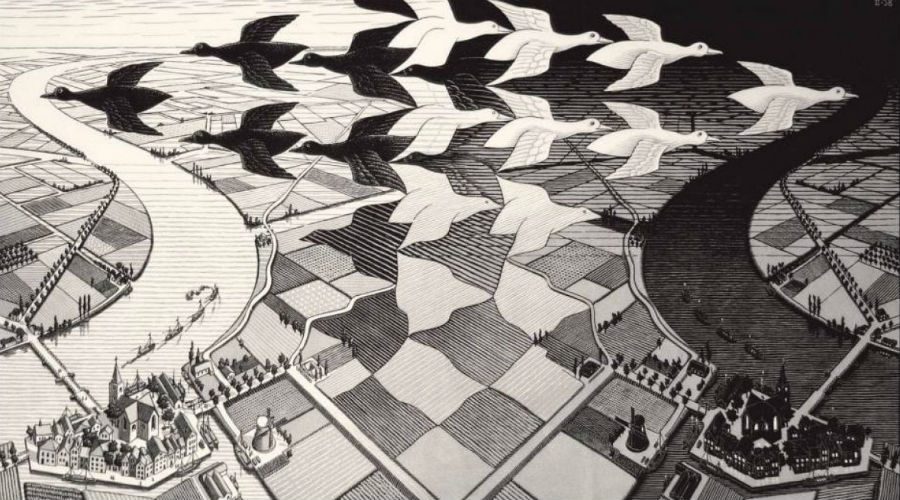
MC Escher
In fact, truth is merely another narrative we’ve been fed—rhetorical legerdemain. But it’s just a story: cognitive dissonance envelopes the notion and we build some heuristic defences around it; escalating commitment kicks in when someone attacks the notion.
The concept of Truth underlies entire societies, governments,
and legal systems. Idiomatically, we employ small-t truth to represent a sort
of relative proximity to match our senses to some observation. If I am asked if
a book is on a table when a book is on a table—ignoring semantics of what
constitutes a book, a table, or the concept of on—, and I say that it is, this is
considered to be a true statement. Of course, this statement is concerned with
the correspondence of observation and some shared reality. But this is
tautological or analytical. In the end, it’s petty.
Capital-T Truth is more universal (or multiversal), is so
much as it would be inviolable. Besides, the Truth of Truth, there are the
notions of Trust of Justice or Truth of Duty or Truth of Integrity. Truth of
any archetypes, really. Yet these are unobtainable—because there are imaginary
concepts.
Classically, archetypes are forms from which physical
objects sort of spawn. A table to an instantiation of some archetypal table.
Archetypes follow from Ancient Greek pathological notions of perfections—perfect
forms, shapes, harmonies, relationships, virtues, gods, and on and on. The
notion of perfect itself is an archetype in this sense.
But the causal relationship has been inverted. Empirical observations taken to imaginary extremes generate a notion of the archetype. Mother is an archetype—the perfect mother—, but it’s not that mothers are formed by some archetypical mould; it’s that the aggregation of mothers and how a perfect mother might be is the definitive. In Jungian psychology, all mothers are compared by their children against this archetypal form. In the Greek tradition, the virtuous mother would attempt to live up to this expectation.
Christian religion plays this up, too. Jesus and God are archetypes. Humans are fallible, but the virtuous strive to be like them; WWJD. Buddhists have their own archetypes of Buddha and Enlightenment, the realization of perfection in nirvana. Again, this is just a story.
Language itself is a human construct, and so anything within it is also constructed. It doesn’t matter whether language acquisition comes a priori or a posteriori. The language itself remains a fabrication.
Post Truth has been a popular topic recently. But what is post is the belief by many in the concept of truth. Although couched this way by detractors, no one is claiming that all truths are equally valid. The claim is rather that many truths are. To claim that women are equal to men and women are inferior to men cannot be evaluated because it would require a complete set of dimensions. Besides, even with this complete set of dimensions, a couple of dimensions are place and time, both of which are subject to change. Beauvoir pointed this out in Second Sex, where she noted that in hunter-gatherer societies physical size and strength may have made males ‘superior’ in matters of protection (a specific context), but that industrialization and automation have rendered this factor insignificant.
So why is any of this important? Well, it’s not. As I’ve
said, evidently truth was not necessary to become evolved to this point. And
since it’s a figment, there is little reason to believe that it will ever
become necessary. My point is merely to
point out that the emperor of truth is wearing no clothes.
Foucault (or Dworkin or Butler) may have had something to say about penetration politics—not the measure of electability in the professional political arena, rather the type that occurs in interpersonal sexual (or protosexual) relationships.
Although different cultures treat this differently, at least in the West, there is a certain polarity between the penetrator and the penetrated, with the penetrator presumed to be dominant and the penetrated to be passive or submissive. I’ve not done any deep research—especially cross-culturally—but I’ll guess that this is more prevalent in patriarchal settings. Religion adds the element of shame and fetishises sex in the first place.
Before Greece
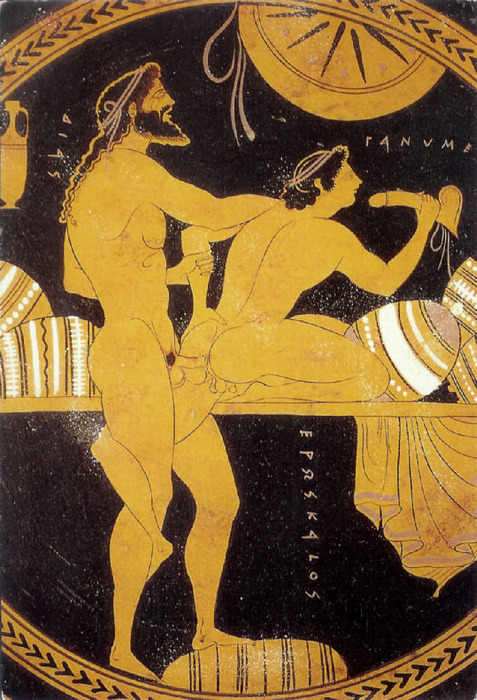
Even in Ancient Greece and some African cultures, same-sex penetration is allowed, but only when the penetrated is of a lower station, whether by age or class standing.
Greek Art
Anecdotally, female same-sex interaction is less of an issue than the male counterpart. I suggest that this is because of the penetration involved. It is also statistically speaking, the least risky. In BDSM parlance, there is a top and a bottom. The choice of these terms is not merely coincidental. And whilst they could represent the actors in physical space, they also relate to the power hierarchy.
Greek Pottery
We can also visit idiomatic speech—at least in English. Penetrative notions are most typically negative. I can’t think of any that are positive, so correct me if I am wrong.
‘I got fucked’ and ‘He fucked me’ are both terms of being taken advantage of. ‘I got screwed’ is the lighter version. ‘I got fucked in the ass’ ratchets it up a notch, perhaps. ‘Fuck you’ is not a term of endearment. I suppose I’ve heard people exclaim ‘fuck me’, but I don’t think one is supposed to reconcile that literally.
Boys will be boys
People we don’t like are cocksuckers. This one has always been a bit curious to me. It represents cocksuckers as some negative actor, but—as a fairly typical male—who doesn’t like a cock-sucker? How could this possibly be a negative? It’s because of the penetration. It’s yet another double standard. Most guys I know want to get their cock sucked and even enjoy it, but the sucker—that person is of a lower order; clearly a loathed order. Myself, I can’t use the term—at least not as a pejorative.
Sex seems to be a power play. Some people use sex as a weapon, either through teasing or withholding, which as I think about it are one and the same. If the receptor (allow me to stay with a heterosexual model for a while) gives in, the penetrator; if she doesn’t, she’s got the upper hand.
Greek Pederasty
Don’t get me wrong. In a functioning relationship, this is an activity of equals, but many relationships are dysfunctional on one level or another, and so it becomes a power struggle. He or she wants it less. One or the other party ‘gives in’ in order to remain in the relationship for some other reason, and so we are back to politics.
In the spirit of TMI (but hopefully not too too much ‘I’), my first wife hated doing dishes. Though I would have preferred not to wash them, I didn’t really care either way, so we alternated turns every other day. On her days, she’d offer a blowjob in exchange for my taking her turn. To me, it was a win-win proposition. Although I might have, I never viewed it as a power thing, though I did view it as transactional. Firstly, it was her idea; secondly, it seemed so consensual.
Unlearn Sexism
But where is the shame in sex? There is even shame in being seen nude in most circles. How did this happen? And why does there appear to be more shame in being penetrated? I’ll blame religion. It seems to be like a cancer that ruins everything it touches—like a reverse Midas touch.
Slut-shaming
I understand that in the past, sex could lead to death in childbirth or sexually transmitted diseases or infections, but with the widespread availability of barrier protection, this risk is substantially reduced. Think about this. What is the difference between a wife having (protected) sex with her husband each day for a year and a woman who has (consensual, protected) sex with different men each day of the same year? Ostensibly, nothing.
It’s not so much that the wife would advertise to the world that she had had sex each night—because sex is somehow shameful—, but if she let it slip that she and her husband had shagged the night before—or the past trend of nightly sex for a week—, there would be likely little more than a blush. For the unattached woman, there would likely be judgment and scorn. But this would be for no other reason than the taint of religious dogma.
I haven’t done any film reviews, and I’m not about to start now. I’ve just watched What Still Remains on Netflix.
People become their own kind of monster.
What Still Remains Film Trailer
This is decent post-apocalyptic fare, some catalyst, societies, competing factions, good versus evil, at least in the eyes of the devout. But that’s not what I am going to be writing about.
What still remains contains good writing and strong character development. It does over-employ tropes, but this seems to be the norm these days: modular writing; rearranging the Lego pieces to make something that appears fresh. So what do I have to say?
Spoiler Alert: Proceed with caution…
This is a perfect depiction of the problems with property rights and social contract theory. There are apparently 3 factions—4 if you count independents.
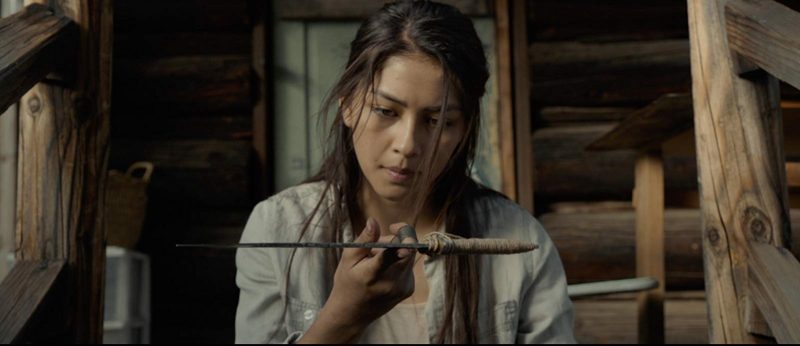
Anna
Initially, there were the Changed, never seen on screen and perhaps not even contemporaneous to the current period, though they may reside in the unseen cities. Anna, the protagonist, and her family are among the independent. Peter, a preacher from the ordained, holier than thou faction. In the realm of ‘if you’re not with me (and our God), you’re against me, thence evil’, they are the arbiters of all that is good. And then there are the Berserkers, as named by the Ordained. To the Ordained, Berserkers aspire to be Changed, but the Berserkers view themselves more along the line of Spartans: Pain is good.
Peter
All scenes are shot in the wilderness, but the various factions have staked property claims with wide perimeters. The penalty for trespass appears to usually involve death of the offending party—or at least a hefty fee. This is Hobbes’ ‘solitary, poor, nasty, brutish, and short’ life outside of society quip, though he didn’t exactly account for a class of societies despite this being common in his day.
Berserker
So, these factions don’t actually have property rights; what they have is a notion of property, and they defend it with violence, as is a necessary condition for all property. In so-called modern societies, the violence is obfuscated much in the same manner that supermarkets obscure the carnage behind the meat. It’s still there; it’s just at arm’s length. Violate one of these ‘rights’, and you’ll see the violence inherent in the system.
And then there’s social contract theory—or the gaping flaw in the logic. Anna is an independent, but one can only be as independent as the ability to defend their independence. It’s sort of like contract law. If you can afford to defend a contract, you are entitled to having it enforced.
Redact intellectual property rant.
Anna doesn’t particularly want to belong to either faction, who have divided their world into two pieces in the same manner that, say, Britain and Scotland might have. If you happen to be born there through some loin lottery, you pretty much have to choose a side. Given Sartre’s no excuses policy, you can choose neither; it just won’t bode well for you. You’ve got no real choice.
Social Choice Theory
In Anna’s eyes, upon the death of her mother and brother, she is persuaded with reluctance to return with Peter to his community, a God-fearing bunch. Her mum had indoctrinated her into this cult of God through bible readings, so she was primed for the eventuality. Some independent interlopers attempted to block their return journey by claiming trespass, so Peter summarily offed them rather than paying their ransom—a fee Anna has been willing to tender.
When the two finally reached the sanctuary, Anna quickly realised that she had no say in the matter: she was either a (good) member or (an evil) dead. To reiterate, this is an underlying problem with social contract theory. There is no exit clause.
Side Bar: Some have argued that the cost of coerced—though they’d never use this term—participation and compliance is owed to the greater good. There is no reason given why this is preferred or across which dimensions better is being assessed—or good for that matter—, so don’t ask. Long live Jeremy Bentham and John Stuart Mill with a hat tip to David Hume.
“The first man who, having fenced in a piece of land, said “This is mine,” and found people naïve enough to believe him, that man was the true founder of civil society.
From how many crimes, wars, and murders, from how many horrors and misfortunes might not any one have saved mankind, by pulling up the stakes, or filling up the ditch, and crying to his fellows: Beware of listening to this impostor; you are undone if you once forget that the fruits of the earth belong to us all, and the earth itself to nobody.”
Hobbes, Locke, and Rousseau each approached social contracts from their own perspectives, but it may be interesting to note that each was a privileged white male of his day. Sure, Hobbes was a monarchist, and Rousseau was the Thoreau of his day, a nostalgist, but he like the others were beneficiaries of the status quo, save perhaps at the margins.
Anna thought she had sovereignty over her choices. In the end, the plot line prevailed, but then again, this was just a movie, so even her choices were scripted.
This is a continuation of my previous post—with a touch of TMI…
I was divorced some time ago, and I was ‘accused’ of giving gifts to another woman—a woman a met after I was served papers for the divorce. After her attorney asked if I had ever given any gifts to anyone, the judge scoffed when I asked for a definition of gift so that I could respond honestly. The judge actually rolled her eyes and made a comment that my approach was not going to work. So without an established definition, I replied, ‘No. I never gave any gifts to anyone.’ She was fine with the response. In fact, she already had made up here mind in the same manner when a person pleading the Fifth in the US is automatically seen as having something to hide and therefore guilty of something. It’s a fanciful notion that taking the Fifth somehow eliminates the concern in question, but the entire jurisprudence system is arbitrary and virtually capricious—despite supposedly being a deontological endeavour. In practice, the goal of organised Law is to elevate process over justice so as to at least give the appearance that it is fair and otherwise meaningful.
Lady Justice
So, is it possible to give a gift? Is it possible to know this? Is it possible to know the intent of anything?
Gift (n): a thing given willingly to someone without payment
If gift is defined as a something given willingly and without payment, what is the scope of without payment, and what constitutes payment? Is altruism even possible? Is this possible to know? Again, can anyone know the intent of another? Can anyone truly know the intent of their own actions? Does the unconscious or past experience obviate intent?
In my case, I gave a woman some—what might colloquially be called—gifts. There were no strings explicitly attached? Does this mean there were no strings attached? I had a romantic interest in this woman. Clearly, this courting game involved gift-given in return for some expected payoff at some time in the future.
What if I had given one of these gifts to a stranger on the street—perhaps a homeless person? Would that now be a gift? What if I was in a foreign place with a nil probability of encountering this person ever again and nobody witnessed the transaction and I would never tell another soul about it? Would this be a gift?
I suppose if I had no notion of karma, whether the Eastern variety or the Western Heaven-oriented variety, and it gave me no hormonal benefits relative to dopamine, serotonin, and oxytocin, I’d buy it.
So, accuse me of being pedantic, and you’ve made my point. We only want to employ language until the point it complies with our notion of our sense of truth. But it’s nothing more than this.
The language of sex is a horse of a different colour. Language is ambiguous, and sex terms take this a step further.
My main thrust is neither the power-structure angle of Foucault or Beauvoir nor the penetration politics of, perhaps, Butler, Dworkin, or Paglia. Instead, I’ll start with ex-US-President Bill Clinton.
“I did not have sexual relations with that woman.”
Of course, Clinton was a lawyer, and he understood the ambiguity inherent in language. The problem is that despite this recognition by the legal profession, they arrive at a point where language specificity is good enough. It’s not, but Upton Sinclar got it right when he pointed out, “It is difficult to get a man to understand something when his salary depends upon his not understanding it!” But that’s a topic for another day.
“It is difficult to get a man to understand something when his salary depends upon his not understanding it!”
Upton Sinclair
Clinton was attempting to employ the word sex, simultaneously distancing himself from the act. By his logic, he was defining sex as vaginal intercourse. It seems that many people share this definition—it’s convenient in the Christian sense—, so his comment was not unfounded.
To Christians, there is only one legitimate sex act: intercourse between a penis and a vagina—and only in missionary position. Anything else is basically sodomy. So, by this definition, Clinton did not have sex with Lewinski because all he got was a blowjob—and so he’s a sodomite.
To the uninitiated, a blowjob is oral sex. Note the modifier: this was not sex but oral sex. Of course, if you see sex as a class of activities, vaginal, oral, anal, or whatever, then you can conclude that his actions fell within this classification; but if you see sex as the more limited definition, then no sex occurred (in this particular blue-dress moment).
Sex workers have their own nomenclature for sex—and their own acronyms and abbreviations. They make a similar distinction. To them, sexual intercourse is full service, FS, for short. Anything less doesn’t qualify. In practice, lesser activities are discounted, and other activities come at a premium, as they are considered to be fetishes. Again, that’s a topic for a different day and, most likely, a different blog.
A larger question that I will avoid is what should qualify as sex? This question is not simply rhetorical because, say, in the case of rape, where is the delineation? Rape, it seems, is more about penetration than of sex, though, it further seems, that not all penetration is created equal. What qualifies as rape changes over time and place—again, an issue with language and objective truth.
It is not that language and words are meaningless, but it does mean that it is contextual. Heuristically, this is adequate for incidental communication, but technically, things don’t hold together. There is no there there.
I’ve been reading and listening to Conservative Stephen Hicks’ Explaining Postmodernism. He’s made it free on YouTube and as PDF. It’s important to note that the book is a decent read, but Hicks makes little attempt to remain in a neutral voice. It’s clear that he is critical of it, so his explaining is not to articulate to the generally interested; rather, it’s to impose his worldview on the topic matter. Read or listen, but keep this in mind. If you lean Conservative, you’ll eye-roll in unison with him; if you lean to the Left, the eye-rolls will have a different significance, as he mows down one strawman after another.
In this clip (bookmarked from the full audiobook), he attempts to make the case that postmodernists—which is as motley a crew as a group of atheists—eschew the notion of rationality for the comfort of feelings. Sure, I suppose some postmodernists do make this argument, but it is hardly a universal position. Taking myself as an example, I have no illusion that most people can register let alone understand their feelings.
I recall being in a corporate-sponsored (human resource-sponsored) interpersonal communications class where the instructor made the claim that one should defend your position by invoking feelings:
Your loud voice frightened me.
I feel sad when you shout at me.
I feel anxious when…
My reaction then is about the same as it is as I write: Whilst I may not understand what the other person may be feeling, there is little reason for me to believe that this person has identified and named this feeling. There is also little reason to presume this person is conveying to me a correctly-interpreted feeling in lieu of a more hyperbolic version for maximum effect. Moreover, some people seem to be offended by pretty much anything. And there’s one thing I’ve learnt along the way:
A person looking to be offended is pretty much guaranteed to be offended.
So, absent context, I have no reason to take this person at their word. Call me a curmudgeon, if you please.
Like Jordan Peterson, a personality who promotes Hicks, standing up and knocking down strawmen seems to be their raisons d’être, but this is sloppy philosophy and lacks the integrity these people claim to admire. In any case, forewarned is forearmed. Caveat emptor.
EDIT: The more I read of Hicks, the less I like it. He misunderstands or at least misrepresents postmodernism in a big way. I am not sure whether it is intentional or through ignorance, but a certain expected academic neutrality is absent to the brink of malpractice.
Here is a fuller critique of Hicks’ misrepresentation of Postmodernism.
Whether in English or in French, I don’t believe Foucault ever uttered the words, ‘It is meaningless to speak in the name of – or against – Reason, Truth, or Knowledge‘*, but I don’t think he’d disagree with the sentiment.
“All my analyses are against the idea of universal necessities in human existence.”
Michel Foucault
Foucault was a postmodernist, and on balance, political Conservatives (Rightists?) dislike the notion of postmodernism. Evidently, a lot of Postmodernists are also Leftists (Progressives or Liberals in the US), so somehow critics such as Jordan Peterson conflate the two clearly distinct concepts.
A basis for Conservatism is the notion of an objective truth, and despite recent sociopolitical trends, they at least say they are guardians or truth and purveyors of knowledge. Conservatives (OK, so I am broad-brushing here) are staunch individualists who believe strongly in possession and property, of material, of an objective reality. Fundamentally, the are aligned to a monotheistic god or at least some discernible (and objective) moral compass.
On the Left, especially post-Enlightenment, they’ve substituted God with some anthropomorphic Nature. In fact, they find comfort in natural laws and human nature. Science is often their respite because science is objective. Isn’t it? Leftists are friends or Reason, and one can’t acquire enough knowledge. Moderation need not apply here; the more the merrier.
This being said, evidently, many on the Left seem to have abandoned this comfort zone. Of course, this may be because the Left-Right dichotomy doesn’t capture the inherent nuance, and so they were miscategorised—perhaps, much in the same manner as persons are miscategorised in a binary gender system. No. It must be something else.
In any case, both side claim to the parties of knowledge, reason, and truth because the opposing parties are clearly abject morons. There is no hint of irony in the situation where each side claims some objective notion of truth—whether divinely granted or self-evidently reasoned—, yet they can’t resolve what the true truth is. If only the other side were more rational.
By now, we are well aware of the demise of homo economicus, the hyper-rational actor foundational to modern economic theory. In reality, humans are only rational given the loosest definitions, say, to (in most cases) know enough to get in the shade on a 37.2°C day. However, as behavioural economist Dan Ariely noted by the title of his book, people are Predictably Irrational. Ariely is just standing on the shoulders of Kahneman and Tversky and Richard Thaler. My point is that humans are only marginally rational.
As I’ve written elsewhere, truth is nothing more than a rhetorical endpoint. It is hardly objective. It’s a matter of opinion. Unfortunately, systems of government and jurisprudence require this objective truth. In truth—see what I did there?—, social fabric requires a shared notion of truth.
A shared notion doesn’t imply that this notion is objective, but if it’s not objective, how does one resolve differences of opinion as to which is the better truth. Without establishing a frame and a lens, this is impossible. The problem is that frames and lenses are also relative. Whether the members accept a given frame or lens is also a matter of rhetoric. It’s turtles all the way down.
Turtles all the way down
Even if all members agree on all parameters of truth at day 0, there is nothing to prevent opinion changes or from new members not to share these parameters. Such is always the problem with social contract theory. [How does one commit to a contract s/he is born into with little recourse to rescind the contract, renegotiate terms, or choose a different contract option. The world is already carved up, and the best one can do is to jump from the frying pan into the fire.]
In the end, the notion of truth is necessary, but it doesn’t exist. Playing Devil’s advocate, let’s say that there is a single purveyor of Truth; let’s just say that it’s the monotheistic Abrahamic God of Judeo-Christian beliefs. There is no (known) way to ascertain that a human would have the privilege to know such a truth nor, if s/he were to encounter, say, a burning bush of some sort, that this entity would be conveying truth; so, we aren’t really in a better place. Of course, we could exercise faith and just believe, but this is a subjective action. We could also take Descarte’s line of logic and declare that a good God would not deceive us—sidestepping that this ethereal being was good, as advertised. I’m afraid it’s all dead ends here, too.
And so, we are back to where we started: no objective truth, limited ability to reason, and some fleeting notion of knowledge. We are still left with nothing.
Enter the likes of Jordan Peterson, he with his fanciful notion of metaphysics and morality—a channeller of Carl Jung. His tactic is to loud dog the listener and outshout them indignantly. His followers, already primed with a shared worldview, are adept (or inept) cheerleaders ready to uncritically echo his refrain. To them, his virtue-ethical base, steeped in consequentialism awash in deontology, Peterson speaks the truth.
He also potentiates the selfish anti-collective germ and rage of the declining white man. He’s sort of a less entertaining Howard Stern for the cleverer by half crowd. He gives a voice to the voiceless—or perhaps the thoughtless. He uses ‘reason’ to back his emotional pleas. He finds a voice in the wilderness where white Western males are the oppressed. If only they hadn’t been born centuries earlier—albeit with iPhones and microwaves.
Those would be the days.
* I believe this phrase attributed to Foucault was a paraphrase by philosopher Todd May.
I’ve shared a new video on YouTube discussing the rhetorical nature of truth.
Before the Classical Hellenes, Mesopotamians recognised the power of rhetoric as the art of using language to convince or persuade. The term itself derives from the Greek ῥητορικός, rhētorikós.
As with any human construct such as language, truth and rhetoric are confined by limitations of the system and its logical structure.
In “Gorgias”, one of his Socratic Dialogues, Plato defines rhetoric as the persuasion of ignorant masses within the courts and assemblies.
Rhetoric, in Plato’s opinion, is merely a form of flattery and functions similarly to cookery, which masks the undesirability of unhealthy food by making it taste good.
Rhetoric typically provides heuristics for understanding, discovering, and developing arguments for particular situations, such as Aristotle’s three persuasive audience appeals: logos, pathos, and ethos.
But it’s more insidious than all of this. The notion of truth—or whatever we believe to be true—is nothing more than rhetoric.
If one is aptly convinced that something is true, it is. The physical world—the world of objects—contains facts—attributes of these objects, but these facts are tautological descriptors: a red car, une voiture rouge, ou quelque chose. In the conceptual domain of abstractions such as truth, justice, gods, and love, all bets are off.
As Geuss aptly suggests, most of society and civilisation don’t care about philosophical thought at this level. This is privileged activity. It’s not about level of intellect, per se; rather, it’s the privilege of free time to devote to abstract thinking.
Most people are more concerned with getting to the next day to earn a paycheque, and they accept sloganeering for any deeper meaning.
Humans are said to be rational beings. In fact, this predicates entire disciplines such as economics…
…and jurisprudence. Legal systems are founded on the concept that humans are at least rational enough to make fundamental decisions about right and wrong—and this, of course, presumes that the notions of right and wrong in and of themselves are meaningful.
For the sake of argument, let’s presume that humans are at least rational enough for our purposes, and whilst right and wrong may not be objectively validated, that within the context of a society—presuming that not to be mired in its own identity problem—, it can be defined in the manner of a social compact envisaged by the likes of Hobbes, Locke, Rousseau, et alii. As the saying goes, ‘if it’s good enough for the government… well.
Language is a human construct, yet it’s an apparition. Like a physical object, it appears solid, but there’s more space than not. What’s there is exiguous. Echoing Heisenberg’s observations at the atomic level, one cannot be fully certain of a particular meaning. This is what Derrida (via Barthes) meant by ‘the death of the author’, though there is nothing to guarantee that the author could fully articulate the meaning or intent even if they were present to defend it.
About the same time, Saussure was finding promise in the structure of language, Russell was creating a new language of logic to obviate its deficiencies. Structuralists and logical positivists were a natural extension of the scientism of the 20th Century, the prevailing wave since the Enlightenment, but as with the demise of gods, religious belief, and other things metaphysical, this faith in structure was also specious.
Historically speaking, there is progress (another illusion), and there are paradigm shifts. When a paradigm shifts, an old truth is replaced by a new one. This is typically credited to a progression of knowledge, but it’s actually just that, on balance, people have accepted a new frame, chalking it up to scientific method rather than some rhetorical sleight of hand.
Even so, scientific discovery is different to archetypal notions such as truth or justice. At least we can empirically test and verify a scientific notion, even if what we are observing is later revised because of some previously unknown factor or removed constraint. For example, until Einstein’s day, Newton would not have known that his theory of gravity would break down as it approached the speed of light. But truth is just an opinion—even if widely held. Enter the ‘appeal to tradition’ flavour of logical fallacy—I’ll not dwell on the fact that systems of government are based on this quaint notion of precedents. #JustSaying
“Truth is simply a culmination of the rhetorical power to persuade the ignorant masses.”
Plato
I’ve arrived at my philosophical position as an autodidact. I am not a conventional scholar, and my exposure to philosophy derives from books, videos, and online sources including Wikipedia, blogs, Reddit, and the such.
I consider myself to be a non-cognitivist in the realm of Ayers’ Emotivism, and I fully realise that society as we know it relies on some notion of ascertainable truth. Of course, Nietzsche was vilified for observing that ‘God is dead’ and unceremoniously subjected to the ad hominem attacks afforded to the likes of Marx.
I’ve got a certain amount of respect for Existentialists (and Absurdists), but I find the teleological component a bit at odds with the central tenet. To that extent, I am more of a Nihilist.
I am more comfortable with what’s been called ‘Post-Modernism’, despite admiring the effort of some Structuralists and Logical Positivists. Where this love affair ends is where the permeation of science fetishists begin. Scientific Method and Logic are the gods of the New Age.
As a post-Enlightenment child, I’ve been steeped in all of its unfound glory, and it’s harder still for me to escape the pull of my Western indoctrination. So, to argue, one is forced to comply with the rules of logic within the limitations of human language—even the limitations of Russell’s language of Logic. And like arguing with a proponent of religion who points out that you can’t disprove his Ethereal Unicorn, one is forced into positions of arguing against Quixotic figments introduced as metaphysical elements.
This Christmas/holiday season, a social media row rages in the shadows of the #MeToo movement, and a holiday classic penned in 1944 is reinterpreted for #today. The central claim is that the content stems directly from a rape culture in the United States. I am not going to argue whether the US have a rape culture or are forged from and tempered by violence—they do; they are.
My contention is about the reinterpretation of language, vilifying an author who is quite literally dead, deceased, demised, expired, no more—unable to defend himself.
The song is about a man and a woman playing a courting game. In my interpretation, she is being coy so as not to be slut-shamed, seeking plausible deniability as she worries about what her mother and father, the neighbours, her brother and sister, and even her aunt, might think.
The kicker for the revisionists is ‘Say, what’s in this drink’ as if it’s been spiked; she’s been roofied; he’s plying her with some date rate drug. This interpretation is preferred to the more period-probable scenario that she’s conveying a signal that she’s feeling a bit tipsy and giving him the go-ahead with a wink and a nod. The decorum of the day suggests that she ‘ought to say no, no, no’, but she wants to say yes and stretches the encounter with another cigarette.





















 Philosophics