Industrial Society and Its Future

I was writing a post about cop and crime shows and fittingly commenting on cops and crime, when my girlfriend turned on Manhunt: Unabomber, a series about serial bomber Ted Kaczynski. I remember when the FBI finally caught Ted and publicised this story, but I don’t know how much of the series was dramatised versus the facts, so my comments will be on the series and not the underlying events.

I title this post after his published ‘manifesto’, Industrial Society and Its Future, but it otherwise has nothing to do with this topic or his manifesto. To me, Ted Kaczynski seems to be a contemporary Thoreau or Rousseau, a primitivist born into the wrong century.

From a philosophical position, the series depicted the perils of taking a deontological approach. Process prevailed over consequences, which resulted taking 18 years to identify and capture Kaczynski. Time and again, process and pushing paper were promoted over new methods.

criminal profiling is the astrology of forensics

As people familiar with me know, I find the discipline of psychology to be pseudoscience (or perhaps simply a parascience), and so-called criminal profiling is the astrology of forensics, which are already a bit sketchy from the start.

Television promotes the logical rationalism underlying forensic science, connecting the dots to a forgone conclusion, if only the right dots are found. As with most law enforcement and court dramas, the focus is on the good guys overcoming the bad guys. Sometimes, it’s the good cop rooting out the bad cops or the perils of a cop who crosses the line to the dark side. These shows want to show how procedural criminology is in order to dissuade people from taking this path.

Knowingly or otherwise, this is propaganda. The fact is that most crime goes unsolved. Most criminals don’t get caught. Many who get caught are not convicted. Some convicted didn’t commit the crime they have been charged with. From an economic perspective, the vast monetary value is taken by white collar professionals with MBAs not burglars and bank robbers.

Systems need people to have confidence in systems. It’s self-serving. The propaganda is important to shore up confidence in the system of law & order, but it’s analogous to slot machines in Vegas or Atlantic City or wherever. When a person wins, there are bells and lights to increase the excitement in the room. But this misses the losers. If the sound was for losers and not winners, the cacophony might be deafening.

Henry Ford failed at 7 business before succeeding

This propaganda overplays winners and concentrates focus. This is classic cognitive survivorship bias. But don’t ask about the losers. This framing isn’t limited to law enforcement. It is also employed in the prevailing Capitalist narrative, but it under advertises the fact that most entrepreneurs fail. Counter arguments are presented in the likes of Henry Ford failed at 7 business before succeeding. If you fail, just try again. It has to work out for you eventually—unless, of course, you aren’t working hard enough—not working as hard as the winners, not paying your dues.

Whilst watching, I found myself scoffing time and again. I am not a Romantic and not a Primative, so I didn’t exactly side with Kaczynski, but I definitely didn’t side with the system, even if that’s not what he was railing against.

Of interest to me was the forensic linguistics. Humourous to me was his choice of spelling. Like me, he wrote in international English. The series represented his spelling as accepted variants, but this is a US-centric position. In fact, most the the world that speaks English employes the British flavour, which is closer to international English than so-called American English, which is only spoken in the US and Central and northern South America. The rest of the world doesn’t use American English. I chose to use international English after high school. Occasionally I get comments and criticisms, but my grammatical footing is stronger than the vast majority of these. The biggest factor is that I don’t identify as an American. Rather, I am a citizen of the world. Perhaps Esperanto?

Institutionalised

This LA Times Op-Ed piece, Why so many people want to believe the election was stolen, got my mind wondering

The United States have seen ‘stolen elections‘ before, but the last time this happened in a presidential election—hanging chads, and all—, Al Gore was on the losing end of a misguided Supreme Court decision that landed George W Bush into the Whitehouse. This time, we see Donald J Trump on the losing end and Joe Biden running the victory lap—except Trump was running a victory lap himself until the weight of reality stalled him.

Gore is an Institutionalist.

Many Gore supporters felt upset (and somewhat betrayed) as he conceded the election to Bush. Gore is an Institutionalist. For all of their hubris, some politicians still see the institution as a higher power greater than them. Al Gore is one of these. Despite all of their faults, most of the past presidents have been institutionalists—systemists. One of the benefits of the US system is a peaceful transfer of power. To preserve a system, proponents need to maintain the mythos of that institution.

Gore said that he fought the good fight, but by the rules of the system, he lost. Not different to a court case lost on technical grounds rather than merit, he sucked it up and demurred to the system. It may not be perfect, but it works.

Trump is not an institutionalist.

Enter Donald Trump. Trump is not an institutionalist. He is entirely self-serving—a narcissist in pop-psychology vogue. He makes no qualms about disparaging the system. He seeded the fraud argument just to be able to say, ‘I told you so’, in the event of a loss. And so he did.

— Fin —

Donald J Trump, like others before him—Homer J Simpson, Barney J Rubble, Forrest J Gump?—is a simple man—a simpleton. George W Bush was another. Many of their followers are simple, too, though not all are simpletons. They just want to believe. It’s human nature.

I am not an institutionalist, but I understand the comfort zone institutions provoke. And beyond nostalgia, there can be a certain benefit to institutions. For one, it’s easier to navigate charted territory. So, whilst I don’t have a horse in the institutional race, I can see how one’s disposition towards can be a factor in how it treats it.

— Bumper Trailer —

Problem of Evil

I’m not religious, so that might be why I don’t understand the so-called ‘problem of evil’. To me, it’s a sophomoric question: If God exists—and is all-good, all-loving, and created everything—, then explain how evil came to be and why it seems to be so prevalent. There’s no reason to accept Occam’s Razor, but this might be a good time to adopt it. A narrative of God is created, and then—as with retrograde planetary motion to justify a geocentric ‘solar’ system—one needs to create odd sub-narratives to fill holes in the main storyline.

The problem of evil is that it doesn’t exist. Evil doesn’t exist. Denotatively, it can be defined as very bad. Connotatively, a moral element is manifest in the term, but the word is unnecessary judgmental hyperbole.

Etymologically, the word evil derives from the

Old English yfel (Kentish evel) "bad, vicious, ill, wicked," from 
Proto- Germanic *ubilaz (source also of Old Saxon ubil, Old Frisian 
and Middle Dutch evel, Dutch euvel, Old High German ubil, 
German übel, Gothic ubils), from PIE *upelo-, from root *wap- "bad, evil"
 (source also of Hittite huwapp- "evil").

In Old English and other older Germanic languages other than
Scandinavian, "this word is the most comprehensive adjectival
expression of disapproval, dislike or disparagement" [OED]. 
Evil was the word the Anglo-Saxons used where we would use badcruelunskillfuldefective (adj.), or harm (n.), crimemisfortunedisease (n.). 
In Middle English, bad took the wider range of senses 
and evil began to focus on moral badness. 
Both words have good as their opposite. 
Evil-favored (1520s) meant "ugly." Evilchild is attested as an 
English surname from 13c.

The adverb is Old English yfele, originally of words or speech. 
Also as a noun in Old English, "what is bad; sin, wickedness; 
anything that causes injury, morally or physically." Especially of 
a malady or disease from c. 1200. The meaning "extreme moral
wickedness" was one of the senses of the Old English noun, but it did
not become established as the main sense of the modern word until
 18c. As a noun, Middle English also had evilty. 

Adolf Hitler is evil. Pol Pot is evil. Charles Manson is Evil. This employment of evil intends to communicate that these are bad (versus good) people. The intent is that these people are possessed by evil—as in an evil metaphysical spirit controlling these people. They were born with an evil soul. That’s how the term is typically employed, but this is a kin to a 4-year-old. Having yet to adopt the term, a child might, upon reflection, assert that these so-called evil people as very, very, very, very (…) bad.

One could argue that the term is shorthand for the 4-year-old’s version, but this missing the connotative subtext.

Nietzsche gave an interesting account of the origins of the term in Beyond Good and Evil. I recommend reading it along with the Genealogy of Morals. I don’t have more to add, but somehow got on this tangent after reading Nagel’s defence of religion.

What Reason?

Any system built on the presumption of widespread capacity for reason is bound to fail. The ability for most humans to ‘reason’ is clearly abridged and homoeopathic. And this is before one factors in cognitive deficits and biases. This is separate from sense perception limitations.

Nietzsche was right to separate the masters from the herd, but there are those in both classes with these limited capacities, though in different proportions.

People are predictably irrational

In economics, we have to define reason so narrowly just to create support the barebones argument that humans are rational actors—that given a choice, a person will take the option that leaves them relatively better off—, and even with this definition, we meet disappointment because people are predictably irrational, so they make choices that violates this Utilitarian principle. And it only gets worse when the choices require deeper knowledge or insights.

Democracy is destined to fail

This is why democracy is a destined to fail—it requires deeper knowledge or insights. The common denominator is people, most of whom are fed a steady diet of the superiority of humans over other species and lifeforms and who don’t question the self-serving hubris. They don’t even effectively evaluate their place in the system and their lack of contribution to it.

To the masters, who are aware of the limited abilities of the herd to reason, it seems like hunting fish in a barrel. If we convince the herd that they have some control over their destinies, that’s as far as it needs to go, but among the masters, there are subclasses, so people in these factions are also vying for position, so each employs rhetoric to persuade herd factions.

No one is sheltered from the limitations of reason

To the people out reading and writing blogs and such, confirmation bias notwithstanding, they may more likely to be ‘reasonable’ or able to reason, but try as they may, no one is sheltered from the limitations of reason.

More on this later…

Not Just a Number

That perception and memory work hand in hand is mostly taken for granted, but this case reminds us that this sometimes breaks down. This is not the case of the neurotypical limitations to fallible sense organs and standard cognitive boundaries and biases. This subject can’t discern the arabic numerals from 2 through 9.

To recap the study, the man can perceive 0 and 1 as per usual, but numerals 2 through 9 are not recognisable. Not even in combination, so A4 or 442 are discernible.

In a neurotypical model, a person sees an object, a 3 or a tree, and perhaps learns its common symbolic identifier—’3′, ‘three’, or ‘tree’. The next time this person encounters the object—or in this case the symbol—, say, 3, it will be recognised as such, and the person may recite the name-label of the identifier: three.

It might look like this, focusing on the numerals:

Encounter 1: 3 = X₀ (initial)
Encounter 2: 3 = X₁ ≡ X₀ (remembered)
Encounter 3: 3 = X₂ ≡ X₀ (remembered)

In the anomalous case, the subject see something more like this:

Encounter 1: 3 = X₀ (initial)
Encounter 2: 3 = Y₀ = { } (no recollection)
Encounter 3: 3 = Z₀ = { } (no recollection)

For each observation, the impression of 3 is different.

Phenomenologically, this is different to the question of whether two subjects share the same perception of, say, the colour red. Even if you perceive red as red, and another perceives red as red, as long as this relative reference persists to the subject, you can still communicate within this space. When you see a red apple, you can remark that the apple is red—the name marker—, and the same is true for the other, who can also communicate to you that the apple is indeed red because the word ‘red’ become a common index marker.

But in the anomalous case, the name marker would have little utility because ‘red’ would be generated by some conceivably unbounded stochastic function:

Colourₓ = ƒ(x), where x is some random value at each observation

It would be impossible to communicate given this constraint.

This, as I’ve referenced, is anomalous, so most of us have a stronger coupling between perception and memory recall. Interesting to me in this instance is not how memory can be (and quite often is) corrupted, but that fundamental perception itself can be corrupted as well—and not simply through hallucination or optical illusion.

Thinking Truth

Neil Gaiman, an articulate, imaginatory writer. He makes a claim:

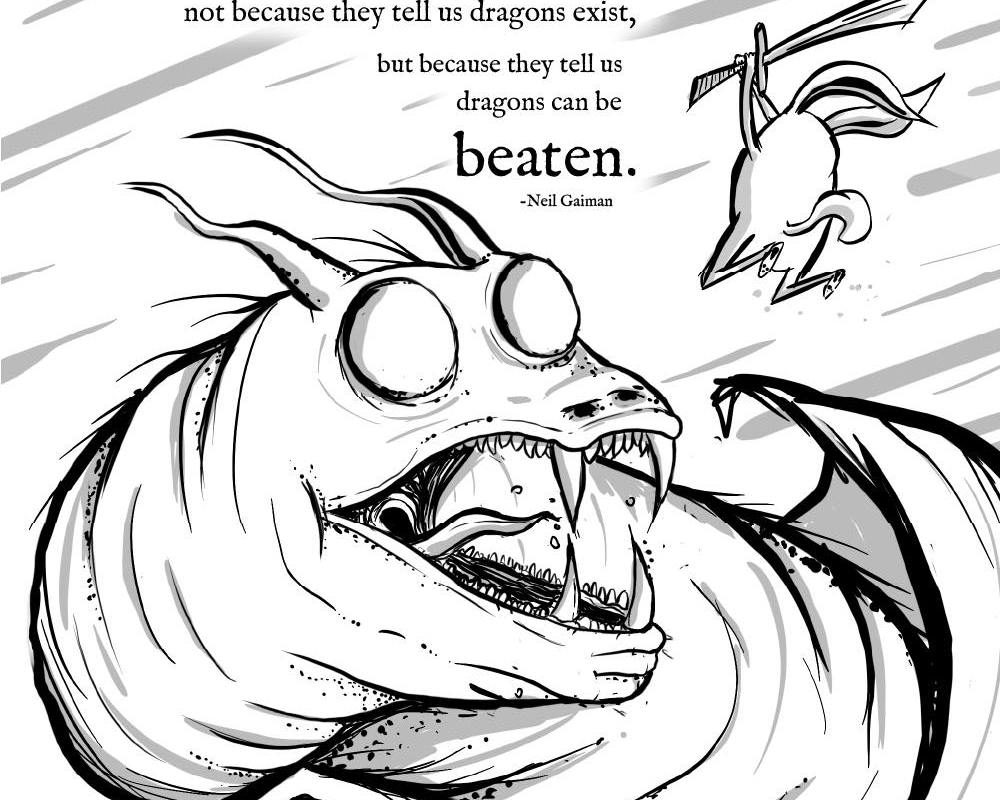
Fairy tales are more than true — not because they tell us dragons exist, but because they tell us that dragons can be beaten.

Neil Gaiman

To me, this is a problem with correlating imagination with truth. Moreover, many a war was lost on the story that it could be won.

Of course, we can still play the metaphor game. I’ve been a fan of metaphor since Joseph Campbell. Metaphor is strength. There was a time when I read Jung and had a stronger interest in Depth and Archetypal Psychology. And fairy tales per Marie-Louise von Franz or her more contemporary cantadora, Clarissa Pinkola Estes. Archetypes are metaphor, but this doesn’t render them real. Still, we can operate as if they are. The trick is to remember that they are not.

Mauvaise Foi

I find the notion of authenticity interesting. I believe that Heidegger was the first philosopher to promote the issue. As I have a contention with matters of identity in general, the notion of authenticity has no foundation in my eyes. As I don’t believe that the notion of identity is valid, it follows that I don’t ascribe to notions of authenticity either—the question is: authentic to what?

Essentially authenticity can be described as ‘being true to one’s own essence or true self’—whatever that might be. Heidegger presents authenticity as a response to our place in the world. An inauthentic person conforms to society and in the loses their own identity in the process to become assimilated into the society.

Carl Jung had a related concept, individuation. This is where a person strips off all of the ego and superego to get to the core of their being, to unpeel the onion, but to find a centre—and to become that true unadulterated self. This is not what Heidegger means by authentic.

To Heidegger, an authentic person remains true to themself within the constraints of society. As with Camus’ acceptance of the Absurd, Heidegger’ authenticity accepts the ‘real world’ as is it whilst retaining with awareness one’s self, even if this is more limiting than Jung’s individuation or Sartre’s freedom with no excuses.

Sartre’s vein of Existentialism contained within it the notion of authenticity. This is in common with other Continental philosophies. According to Sartre, when people hyper-constrain their identities to preclude their larger humanity, they are operating in bad faith, mauvaise foi (eidétique de la mauvaise foi). A while back, a story from an incident in 2013 was circulating on social media, where a Spanish runner, Ivan Fernandez Anaya, assisted another runner, Kenyan athlete, Abel Mutai, who errantly believed that he had already passed the finish line, so he stopped with another 10 metres to go.

The reaction was split—some praising Anaya for his humanity and other chastising him for not following the rules of the competition. These critics are guilty of mauvaise foi, of prioritising the minuscule for the larger picture. In fact, all sports do this. One might argue that all competition does this, but this is a matter of perspective. I think that Sartre’s scope was a bit narrower than this, but I believe it’s not off-point.

Evidently, I am just typing stream of consciousness, and the stream has come to an end.

And so it goes

Pragmatism and Samsara

I was engaged in a conversation in a Facebook Philosophy group for Pragmatists. I feel that these groups take me as adversarial because I question their system of belief. To the extent that I accept any categorical distinction, I consider myself to be a Postmodernist first and foremost and a Pragmatist second. In a similar fashion, I am at once an atheist first, but I operate as a Buddhist. I am a nihilist first, but I operate as an Existentialist. In any case, in explaining this, I hit upon an analogy that I hadn’t considered before.

everything just ‘is’

Pragmatism is Samsara. In Buddhism, there is the concept of Samsara, which contains the realms we reside in before we reach Enlightenment, the state of realising that everything just ‘is’, is , and is undifferentiated, at which case we either exit the system or remain as aware (woke anyone?) Bodhisattvas.

everything is a constructed illusion

The ‘just is’ is the postmodern condition. Nothing is as it seems and everything is a constructed illusion. There is no good, no bad, no right or wrong—not even black or white. This is all perception of difference, but there is no difference.

I am a Buddhist in the same way I am a Pragmatist. I know that this is all a cognitive construct—or constructs—, but I am still stuck in the middle of it, ‘thrown in’ (Geworfenheit) to echo Heidegger, and I attempt to make the best of it. None of it is real, but, as with people of the Matrix, I can’t perceive my way out of it.

The risk for Pragmatists is that they are empiricists. They trust that the past will ostensibly operate the same as the future. It’s been generally that way thus far, and we’ve misinterpreted how things operate in the past, but we’ve corrected this interpretation, and we’ll correct and refine these interpretations in future. That’s the employed logic. I’ve not got a better plan, so as shoddy or rickety as it might be, it’s my life raft replete with holes, but I’ll patch them as swiftly as I can and hope my history of having not encountered any sharks or tidal disruptions or undertows persists.

none of this exists

All the while, my core beliefs are that none of this exists—not in a solipsistic way, just not as we imagine it does. It’s the wall constructed of atoms and molecules that is more space than not, and yet we can’t pass through it. If only we could all be Neo and overcome this misperception.

Democracy à la Carte

I’ve been pondering the notion of democracy. This is not new for me. I’ve looked around and asked myself, ‘If democracy is so great, why is it not more widely adopted’. I don’t mean why don’t other countries try it? And I don’t mean to confound the issue by arguing that a republic is not a democracy, the last refuge of the desperate.

Democracy is a pathetic belief in the collective wisdom of individual ignorance. 

H. L. Mencken

Mencken offers more critique in his Notes on Democracy.

What I wonder is why, if it’s so good, why don’t companies structure democratically? Why not the military? I’ve always found this particularly humorous: An autocratic, socialised structure defending democracy. Some of the biggest democratic flag-wavers are military and ex-military.

I know that most military members in the US would be lucky to work flipping burgers at McDonald’s. Some speak of the mental illness and homelessness of military veterans, but this misses the direction of the arrow of causation. These people had a free ride, room, and board on Uncle Sam’s dime in the States—some other denomination elsewhere. It’s really no wonder that one wouldn’t want to give these people a voice in military affairs, and yet they do get a voice in civilian affairs. It’s a good thing almost half of Americans eligible to vote don’t.

The best argument against democracy is a five-minute conversation with the average voter.

Winston Churchill

I’ve already mentioned that democracy is a sham and its best feature is the illusion of control. I suppose if I come up with something better, I might write about it. Until then, it’s just one of many mediocre options.

Interestingly, some people’s options are asinine. Frank Karsten hawking his book and ideology on Beyond Democracy thinks that downsizing is the answer. Hans-Hermann Hoppe agrees, as he posits in several essays in Democracy: The God that Failed. I don’t disagree, but his basic point seems to be that 300MM people deciding is too much, so perhaps 10MM or 20MM might work better. What’s the limit? Why not 150? How is conflict among this smaller political units adjudicated? With this downsizing, how does the system control the urge for upsizing? In the end, this feels like more Libertarian, anarcho-capitalistic mental masturbation, which as I type this feels redundant. Unfortunately, the common denominator is people, and that’s Achilles’ heel.

Misunderstanding

As part of my indictment against language and its insufficiency to facilitate precise and accurate transmission of abstract concepts, I happened upon a quote by Karl Popper:

It is impossible to speak in such a way that you cannot be misunderstood.

—Karl Popper

“However, the problem still remains: what should we do in order to make our meaning clearer, if greater clarity is needed, or to make it more precise, if greater precision is needed? In the light of my exhortation the main answer to this question is: any move to increase clarity or precision must be ad hoc or ‘piecemeal’. If because of lack of clarity a misunderstanding arises, do not try to lay new and more solid foundations on which to build a more precise ‘conceptual framework’, but reformulate your formulations ad hoc, with a view to avoiding those misunderstandings which have arisen or which you can foresee. And always remember that it is impossible to speak in such a way that you cannot be misunderstood: there will always be some who misunderstand you. If greater precision is needed, it is needed because the problem to be solved demands it. Simply try your best to solve your problems and do not try in advance to make your concepts or formulations more precise in the fond hope that this will provide you with an arsenal for future use in tackling problems which have not yet arisen.

— Unended Quest: An Intellectual Autobiography, Karl Popper

Popper’s point here is more that some people won’t understand what you are saying, which differs from my concept that some ideas just can’t be conveyed. Some people will assume their interpretation is the true meaning, but this assumption may be incorrect. Even more problematic is when different people assume to know the true meaning, yet their definitions differ materially.

Charles makes another point commenting on this quote on his Thing Finder blog.

And there will be even more who deliberately choose to misunderstand you. The man in search of truth will always be at risk from the man of conviction.

Charles Bayless, Thing Finder blog

Some if not most of this deliberate misunderstanding is captured in Upton Sinclair’s quip:

It is difficult to get a man to understand something, when his salary depends upon his not understanding it!

—Upton Sinclair

But this still doesn’t capture the point the some concepts are actually nebulous; there is nothing there there.

I’ll leave this post with a quote from Le Petite Prince:

Language is the source of misunderstandings.

—Antoine de Saint-Exupéry

Indeed, language is simultaneously expanding and limiting, but like faith in technology, faith in language may lead to an untimely end.